
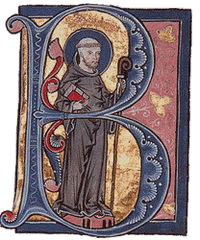
 ernard of Clairvaux, a leader in Christian Europe in the first half of the 11th century A.D., is honored in his native France and around the world. Born into a noble Burgundian (Fontaines, near Dijon) family in 1090, he was drawn toward the Church by his own nature and encouraged by his mother's desire. His family opposed His desire to enter a monastery and sent him to study at Châlons in order to qualify him for higher ecclesiastical office. However, Bernard left his affluent heritage, entering the monastery of Citeaux at age 22. He persuaded four of his brothers, an uncle, and 26 other men, mainly the sons of nobles, to join him.
After two years he and several others were sent to a new monastic house at Clairvaux, where Bernard soon became its abbot. His work there was blessed in many ways. The monastery at Clairvaux grew in mission and service, eventually establishing some 68 daughter houses.
During the disputed papal elections between Anacletus II and Innocent II, he took the side of Innocent. From 1130-38, Bernard worked to solidify the papal claim through ecclesiastical and secular politics. He battled against the "New Teaching" espoused by Pierre Abélard at the University of Paris, resisting a broad-based liberal arts education using the philosophy of Aristotle. Instead, Bernard insisted that such an education was only to be used in preparation for the priesthood.
At the command of Pope Eugenius III in 1146, Bernard preached in favor of a new effort to free the Holy Land from the Mohammedans. This gave life to the previously moribund Second Crusade. While the results of the campaign were certainly mixed, events during it served to enhance Bernard's perception among non-Christians: When a monk named Radulf (or Raoul) incited the populace of Mainz against the Jews, Bernard vigorously opposed him, calling the monk arrogant, without authority, a preacher of mad and heretical doctrines, a liar, and a murderer. Radulf slipped away, the riots ended, and Bernard became known as a "righteous gentile." His reputation among Rhine valley Jews remained so good that his name is still given to some of their descendants. The most famous of these would probably be American businessman and presidential advisor Bernard Baruch.
Certainly, we remember St. Bernard for his charity and political abilities. Even more, we honor his preaching ability and, especially, his poetry and hymn writing (cf. NetHymnal and Hymnuts at the Internet Archive): The texts of O Jesus, King Most Wonderful (MIDI audio) and O Sacred Head, Now Wounded (MIDI audio), as well as others, remain vital parts of our Christian heritage.

Where Bernard lapsed into exalting the office of the papacy or waxed eloquent on the merits of the saints — particularly Mary — Luther condemned these works as false and misleading. Yet the reformer appreciated and held close the monk's death-bed confession of personal unworthiness and total reliance on Christ's merits: "That is how St. Bernard was saved. He was an exemplary monk; he observed the rules of his order scrupulously, and he fasted so assiduously that his breath stank and no one could abide his presence. But on the threshold of death he exclaimed: 'Oh, I have lived damnably! But heavenly Father, Thou hast given me Thy Son, who has a twofold claim to heaven: first, from eternity, by reason of the fact that He is Thy Son; secondly, He earned heaven as the Son of man with His suffering, death, and resurrection. And thus He has also given and bestowed heaven on me. [Sermones in cantica, Sermon XX, Patrologia, Series Latina, CLXXXIII, 867]' Thereby St. Bernard dropped out of the monastic role, forsook cowl and tonsure and rules, and turned to Christ; for he knew that Christ conquered death, not for Himself but for us men that all who believe in the Son should not perish but have eternal life. And so St. Bernard was saved. (LW 22:360)"
In case you're wondering, the Saint Bernard dog is not named for Bernard of Clairvaux but indirectly for Bernard of Montjoux (or Menthon), an earlier monk who founded a travelers' hospice and monastery in the Pennine Alps and another hospice in the Graian Alps. Both of these passes were later named for him and and the large rescue dogs for these places where they were stationed.
NB: I followed the LCMS Calendar of Commemorations and listed Bernard on 19 August, even though his death date is normally remembered as 20 August and occasionally as the 21st. Roman Catholicism celebrates his feast on the 20th.
Suggested Lection
Psalm 139:1-12 or 19:7-11
Sirach 39:1-10
John 15:7-11
Collect
O God, by whose grace Your servant Bernard of Clairvaux, kindled with the flame of Your love, became a burning and a shining light in your Church, grant that we also may be aflame with the spirit of love and discipline, walking before You as children of light; through Jesus Christ our Lord, who lives and reigns with You and the Holy Spirit, one God, now and for ever.
Be Thou my Consolation, My Shield when I must die;Hymn texts and MIDI audio linked from the Lutheran Hymnal Project.
Remind me of Thy Passion When my last hour draws nigh.
Mine eyes shall then behold Thee, Upon Thy cross shall dwell,
My heart by faith enfold Thee. Who dieth thus dies well!
(P. Gerhardt; from Bernard's Salve caput cruentatum)
Martin Luther quotes from Volume 13: Luther's Works, Selected Psalms II, © 1956 by Concordia Publishing House and Volume 22: Luther's Works, Sermons on the Gospel of St. John: Chapters 1-4, © 1957 by Concordia Publishing House.
Labels: bernard, biography, christianity, church history, clairvaux, commemoration, crusades, hagiography, hymns, medieval history, monasticism
¶ 00:00 | 0 comments |

 Born 17 October 1582, Johann Gerhard, a Lutheran theologian in the tradition of Martin Luther (1483-1546) and Martin Chemnitz (1522-86), was the most influential 17th Century dogmatician. Many still consider his Loci Theologici in 23 large volumes to be the most definitive statement of Lutheran orthodoxy. Born in Quedlinburg, Germany, Gerhard was stricken with a life-threatening illness at age 15.
Following this experience, coupled with with guidance from his pastor, Johann Arndt, Gerhard experienced a turning point: He devoted the rest of his life to theology, serving many years as the Superintendent of Heldberg and, later, of the Duchy of Coburg. Eventually he become a professor at the University of Jena. With a sharp, critically trained mind, Gerhard also possessed deep evangelical piety and love for Jesus.
He wrote exegetical and theological works, devotional literature, history, and polemics. Many of his sermons remain in publication, still exercising wide influence upon confessional Lutheran thought. Since its writing and subsequent translation, his Sacred Meditations probably outsold every book in the Western world except the Bible and The Imitation of Christ by Thomas à Kempis.
His son Johann Ernst Gerhardt was also a Lutheran theologian and professor. An even more noted relative was his nephew, Johannes Andreas Quenstedt.
For more detailed information, see the Studium Excitare, Wikipedia, and the Christian Cyclopedia.
Partial List of Works
† Exegesis: Commentarius in harmoniam historiae evangelicae de passione Christi (A comentary harmonizing the Gospel accounts of Christ's Passion, 1617)
† Exegesis: Comment, super priorem D. Petri epistotam (1641)
† Exegesis: Commentaries on Genesis (1637) and Deuteronomy (1658)
† Theology: Confessio Catholice (Universal Confession, 1633-1637), a defense of the evangelical and catholic nature of the Augsburg Confession
† Theology: Loci communes theologici (1610-1622)
† Devotional: Meditationes sacrae (Sacred Meditations, 1606)
Suggested Lection
Psalm 46
Isaiah 55:6-11
Romans 10:5-17
John 15:1-11
Collect
O Lord God, heavenly Father, pour out Your Holy Spirit upon Your faithful people, keep them steadfast in Your grace and truth, protect and comfort them in all temptation, defend them against all enemies of Your Word, and bestow on Christ's Church Militant Your saving peace; through Jesus Christ, Your Son, our Lord, who lives and reigns with You and the Holy Spirit, one God, now and forever. Amen.
Lord, keep us steadfast in Your Word!
Labels: biography, christianity, church history, commemoration, german history, hagiography, johann gerhard, lutheranism, martin chemnitz, martin luther, theology
¶ 00:00 | 3 comments |
 A river, a gulf, and a seaway are named in his honor. A number of Christian congregations and almost anyone known as "Larry" likewise owe their names to this martyr of the ancient Christian Church.
Early in the third century A.D., Lawrence (Latin, Laurentius, also often known as "Lorenz," "Laurence," or "Lorenzo"), who was most likely born in Spain, made his way to Rome. There he was appointed chief of the seven deacons and was given the responsibility to manage church property and finances.
The emperor at the time, thinking that the church had valuable things worth confiscating, ordered Lorenz to produce the "treasures of the church." Saint Lorenz brought before the emperor the poor whose lives had been touched by Christian charity. He was then jailed and eventually executed in the year 258. Many accounts tell of his being roasted on a gridiron until dead. However, some scholars think that this tradition came about due to a faulty transcription and that the phrase assus est (he roasted) should have been rendered passus est (he suffered).
His martyrdom left a deep impression on the young church. Almost immediately, the date of His death, 10 August, became a permanent fixture on the commemorative calendar of the early Church.
Lection
Psalm 65:1-8 or 34:1-10
Deuteronomy 33:1-3 or Isaiah 26:1-4, 8-9, 12-13, 19-21
Revelation 7: 2-17 or 21:9-11, 22-27; 22:1-5
Matthew 5:1-12
Collect
Stir up, O merciful Father, Your people to true brotherly affection that we may gladly do good and serve our neighbor, as did Your servant Saint Lawrence, when he emptied the treasure of the Church to help the poor; through our Lord Jesus Christ, who lives and reigns with You and the Holy Spirit, one God, now and forever.
Labels: biography, christianity, church history, commemoration, feasts, hagiography, lawrence, lorenz, martyrdom, roman empire
¶ 00:00 | 0 comments |
 Lutheran pastor and theologian Hermann Otto Erich Sasse was born on 17 July 1895 at Sonnewalde, Lower Lusatia (Lausitz), Germany. He was the eldest of five children born to pharmacist Hermann Sasse and his wife Maria, née Berger. In 1913,he began reading theology and ancient philology at the University of Berlin. In later years, he claimed that his tutor in practical theology was war, as he was one of only six survivors from his battalion after engaging in trench warfare in Flanders.
After the war, he continued his studies and was ordained in 1920 in St Matthew's Church, Berlin. He served in several Brandenburg parishes took the licentiate in theology in Berlin in 1923. Sasse came to Hartford Seminary, Connecticut in 1926, where he earned a master's degree.
Hermann Sasse married Charlotte Margarete Naumann (d. 1964) on 11 September 1928 in St. Nicolai's Church, Oranienburg, Germany. Their union was blessed with three children.
During the tough economic times of the Great Depression, During the Depression, Sasse was made a Sozialpfarrer (pastor with social duties). As such, he reached out to those in need in the community, particularly to factory workers in Berlin.
Although remembered as one who resisted the watered-down theology of unionism, Sasse participated in the Ecumenical Movement and was a delegate and interpreter during the first world conference of the Faith and Order Movement in Lausanne, Switzerland (1927). He also attended the 1932 disarmament conference in Geneva.
Among German theologians, he ranks as one of the the earliest to speak out against Nazism. While criticizing some of its theology, he participated actively in the Confessing Church Movement that had emerged under Martin Niemöller and others. Sasse and Dietrich Bonhoeffer were among the small but growing church opposition to Hitler. In 1933, they were the primary authors of the Bethel Confession. This strongly trinitarian document also clearly condemned discrimination against the Jews. Rejecting an all-Aryan German Church, the Confession stated, "Instead of giving up, either willingly or unwillingly, in one area the ecclesial fraternity with the Jewish Christian that is created by word and sacrament, the Gentile Christians should rather expose themselves to persecution."
 Although he'd been working hand-in-hand with its members, Sasse left the synod that produced the Barmen Declaration. He objected to Karl Barth and others leading the Confessing Movement to wrongly arrogate church authority for itself. During this time, he continued as professor in church history at the University of Erlangen, Bavaria, a position he received in 1933. The German government withdrew his passport in 1935 but his popularity as a lecturer and protection from the dean of the faculty helped him to retain his university post through the Nazi era.
Uncomfortable with its theological compromises, Sasse protested at the 1948 formation of the Evangelical Church in Germany. His opposed its policy of restoration rather than renewal and expressed disquiet over state-supported university faculties of theology. This led him to join the Lutheran Free Church.
After receiving a call to teach at Immanuel Seminary (now Australian Lutheran College) in North Adelaide, South Australia, he migrated in 1949. There, he worked mightily to unite Australia's divided Lutheran churches, devoting much energy to this cause. Exercising his considerable teaching and writing skills, he helped to formulate and forge new doctrinal bases of agreement and was rewarded by seeing the 1966 church union.
Sasse stayed active in the German Lutheran communities of Adelaide and Melbourne. Through his many contacts, he assisted immigrants with pastoral advice and care.
Sasse also retained his global Lutheran connections — many in the United States knew him as "Mr. Lutheran." He maintained world-wide correspondence through regular doctrinal and pastoral "Letters to Lutheran Pastors." He continued to encourage ongoing theological research, particularly in the areas of Scripture as Word of God and the Eucharist. While maintaining his justly deserved reputation for strongly defending confessional and conservative positions, Sasse also kept active personal contacts across denominational boundaries.
 From its inception, Sasse involved himself in Australian Roman Catholic-Lutheran dialog. He finally retired from the seminary in 1969 but stayed active in the affairs of the Church. The Federal Republic of Germany honored him with the Order of Merit in 1972.
Sasse saw over 450 of his works published. Included among them are Here We Stand (Minneapolis, 1946) and This is My Body (1959). A fire in his North Adelaide home claimed his life on 9 August 1976. Survived by two sons, he was buried in Centennial Park, Pasadena, South Australia. One obituary declared Sasse "Australia's most distinguished acquisition from the Continental theological scene."
Hermann Sasse was one of many who stood steadfast in confession of the Evangelical, Orthodox, Catholic, and Apostolic Faith. For a sampling of some of the others in Lutheranism, please see The Meanies of Grace. For more on and by Sasse, I recommend What Sasse Said and Hermann Sasse and the Liturgical Movement as possible starters. You can also find plenty of Sasse to read through this CPH search.
Suggested Lection
Psalm 46
Isaiah 55:6-11
Romans 10:5-17
John 15:1-11
Collect
O Lord God, heavenly Father, we pray that, as You raised up Hermann Sasse to resist the evils of Nazi philosophy and through him led Lutherans in Germany, Australia, and around the world into renewed appreciation of their confessional heritage and trust in the saving Gospel of Jesus Christ, so You would continue to provide Your Church with faithful pastors and leaders, keeping them steadfast in Your grace and truth, defending them against all enemies of Your Word, and bestowing on Christ's Church Militant Your saving peace; through Jesus Christ, Your Son, our Lord, who lives and reigns with You and the Holy Spirit, one God, now and forever.
Labels: australia, biography, christianity, church history, commemoration, confessionalism, ecumenical movement, german history, germany, hagiography, lutheranism, sasse, theology
¶ 00:00 | 0 comments |
 Remembered as a disciple of Martin Luther, Robert Barnes is considered to be among the first Lutheran martyrs. Born in 1495, he became the prior of the Augustinian monastery at Cambridge, England. Converted to Lutheran teaching, he shared his insights with many English scholars through writings and personal contacts.
During a time of exile to Germany he became a friend of Luther and later wrote a Latin summary of the main doctrines of the Augsburg Confession titled Sententiae.
Upon his return to England, Barnes shared his Lutheran doctrines and views in person with King Henry VIII and initially had a positive reception. In 1529 Barnes was named royal chaplain.
The changing political and ecclesiastical climate in England later claimed him as a victim; he was burned at the stake in Smithfield in 1540.
His final confession of faith was published by Luther, who called his friend Barnes "our good, pious table companion and guest of our home, this holy martyr, Saint Robertus."
For a bit more on Barnes, please read the introduction to Lutheran Carnival 26 at A Beggar at the Table.
Labels: biography, christianity, church history, commemoration, english history, hagiography, lutheranism, martin luther, martyrdom, reformation, robert barnes
¶ 00:00 | 0 comments |
 Johann Sebastian Bach (1685-1750) is acknowledged as one of the most famous and gifted of all composers past and present in the entire western world. Orphaned at the age of ten, Bach studied with various family members but was mostly self-taught in music.
He began his professional career as conductor, performer, composer, teacher, and organ consultant at age 19 in the town of Arnstadt. He traveled wherever he received good commissions and steady employment, ending up in Leipzig, where the last 27 years of his life found him responsible for all the music in the city's four Lutheran churches.
 Acclaimed more in his own time as a superb keyboard artist, the majority of his compositions fell into disuse following his death, which musicologists use to date the end of the Baroque Period and the beginning of the Classical Era. However, his compositional ability was rediscovered, in large part due to the efforts of Felix Mendelssohn.
The genius and sheer magnitude of Bach's vocal and instrumental compositions remain overwhelming. Also, whether due to nature or nurture, he was but one of the giants in, perhaps, the most talented musical family of all time.
Christendom especially honors J. S. Bach, a staunch and devoted Lutheran, for his lifelong insistence that his music was written primarily for the liturgical life of the Church, glorifying God and edifying His people. For an overview of the Christological basis of his work and a strong argument that he was among the theological giants of Lutheranism, please read J. S. Bach: Orthodox Lutheran Theologian?.
Today we remember his "heavenly birthday," for it was on 28 July AD 1750 that the Lord translated Mr. Bach to glory.
Soli deo gloria — To God alone the glory! These words appear on most manuscripts of Bach's compositions as testimony to his faith and his idea of music's highest, noblest use.
Labels: bach, biography, christianity, church history, commemorations, german history, hagiography, liturgics, lutheranism, music
¶ 00:00 | 0 comments |
 Ólafr Haraldsson (also known as Olav, Olafe, Oláfr hinn helgi, and Olavus rex) was born in 995 to Harald Grenske and Åsta Gudbrandsdatter. While Snoore says that he was baptized in 998 in Norway, it's more likely that it was by the hand of Archbishop Robert in Rouen, France around 1010. As was common among young Norsemen, he spent much of his youth going a-viking (raiding), first in the Baltic, then Denmark, and finally in the British Isles. He was nicknamed "Digre" (physically large) and some believed him to be a reincarnation of a previous (pagan) Viking king Olav Digre. While involved in numerous armed conflicts, Olaf also developed a deep interest in Christianity.
Olaf declared himself King of Norway in 1015. Following battles with various petty kings, he ruled until 1029, although his strength was greatly reduced following his loss in the Battle of the Helgeå (1026). As monarch, he struggled to root out heathenism and make Christianity the religion of the realm. Like his ancestor Olaf Trygvesson, he frequently attacked the old faith and customs. Olaf destroyed pagan temples and built Christian churches in their place. He brought many bishops and priests from England, a practice later followed by King Saint Canute of Denmark. It appears that he based ecclesiastical organization on the Anglo-Saxon model.
The rebellion against Olaf stemmed but in part from his unflinching Christianity. Many of the nobles were also exasperated by his ongoing struggle with the old Norse method of governance and his never-ending desire for a truly united Norway. The governing clans enlisted King Canute of Denmark and England for help in ousting Olaf. Once he was banished, the clans elected Canute as King of Norway. Therefore, he became not only an icon of the Christian Faith but also one of Norwegian nationalism — an image he carries even among secular Norwegians to this day.
 After Canute's vassal Håkon Eiriksson died, Olaf returned from his two year exile and met the rebellious clans at Stiklestad on 29 July 1030. Although neither King Canute or the Danes took part, Olaf — who fought courageously — was mortally wounded at that battle and died in the battlefield. His final recorded words were the prayer, "God help me."
He was disinterred a year after his death and his remains moved to the Church of St. Clement in Nidaros (current Trondhjem). There, Bishop Grimkel and Earl Einar Tambeskjelver placed his corpse in a coffin and laid it on the church's high altar. At that time, the bishop also declared Olaf a saint. Although Olaf was embraced by most Norwegian Lutherans, his remains disappeared as part of the iconoclasm that occasionally accompanied the Reformation.
His cult spread widely in the Middle Ages, moving from Norway to Denmark, Sweden, and even parts of England. Although a rather harsh ruler and prone to rough treatment of his enemies, Olaf became Norway's patron saint. The cult of Olaf not only unified the country, it also fulfilled the conversion of the people, something for which the king had fought so hard. While divisive in life, Olaf in death held a unifying power that defied outside state and religious rulers attempts to undo his dream.
Although Olav was certainly not the first to introduce Christianity to Norway, he first codified the faith in 1024, laying the basis for the Church of Norway. So high did Olaf's legal arrangements for the Church of Norway come to stand in the eyes of the Norwegian people and clergy, that when Pope Gregory VII attempted to make clerical celibacy binding on the priests of Western Europe in 1074-75, the Norwegians largely ignored him, since celibacy wasn't mentioned in Olaf's legal code for their church. Although he continued to be known through most of his life as Olaf digre, in death he remains best known by as Olav den hellige (Olaf the Holy).
The coat of arms of Norway is a lion holding the battle axe of St. Olaf in his forepaws.
Suggested Lection
Wisdom 10:10-14
Psalm 31:1-7
James 1:2-4, 12
Matthew 16:24-28
Collect
Almighty, eternal God, you are the crown of kings and the triumph of martyrs. We thank You for the bold confession made by Your blessed martyr, Olav We praise your greatness in his death and we pray You give us the crown of life that You have promised those who believe in Your Son Jesus Christ, who lives and reigns with you and the Holy Spirit, one God, forever and ever.
See Wikipedia, the Catholic Encyclopedia, and the Christian Cyclopedia for more.
Labels: biography, christianity, church history, commemoration, hagiography, iconoclasm, lutheranism, martyrdom, norway, olaf, scandanavia
¶ 00:00 | 0 comments |

In 1934, Giertz was ordained in the Linkoping Cathedral. He became assistant to the bishop and was given responsibility for working with the youth. His own faith and his conviction concerning the relevance of Christianity were on display for the thousands of young people who came under his care. Even as orthodox Lutherans lauded him, he also drew attacks from modernists in the Swedish state church and secularists as his writings spread in newspapers and periodicals. The public knew him as a talented and faithful confessor of a Church doctrine that was based in Scripture, confessed in the Creeds, and expounded in the Lutheran Confessions.
Giertz became a priest in Torpa in 1938, serving that parish until 1949, when he was consecrated as Bishop of Gothenburg. While serving Torpa, he wrote With My Own Eyes, a retelling of the Gospels (1947), four theological works, Christ's Church (1939), Church Piety (1939), The Great Lie and the Great Truth (1945), and The Battle for Man (1946), the catechetical book The Foundation (1942), and two novels The Hammer of God (1941) and Faith Alone (1943). These latter, particularly Hammer of God, became popular throughout Scandinavia and then around the globe.
The attention to theology and care for souls that Giertz evidenced in Torpa continued when he became Bishop of Gothenburg in 1949. As the youngest man elected and consecrated to serve the Church of Sweden as a diocesan bishop, he combined a somewhat pietistic type of pastoral care with High Church Lutheran theology, traits that are noticeable in his novels. Following the decisions of the Swedish Parliament and the Church Assembly to ordain women in the Church of Sweden (1958), Giertz became a leader of the opposition. In that same year, he invited all confessional groups in the Church of Sweden to form The Church Movement for Bible and Confession in response to the Assembly's decision.

Giertz pioneered a return to every Sunday celebration of the Lord's Supper, something that had largely vanished in the Church of Sweden due to the erosion caused by Pietism and Rationalism. He strongly urged pastors to pray the Daily Offices, something he applied in his own devotional life. Although often rejected by the leaders of the Church of Sweden, Giertz remains popular with true Lutherans in his own country, throughout Scandinavia, and across the world. Of him, the Reverend Hans O. Andrae wrote, "In his vision of the One Holy Christian and Apostolic Church, Giertz integrated a vibrant Evangelical-Lutheran orthodoxy, the Church's traditional liturgy, and sincere church piety into a harmonious and powerful wholeness."
Suggested Lection
Psalm 46
Isaiah 55:6-11
Romans 10:5-17
John 15:1-11
Collect
O Lord God, heavenly Father, we pray that, as You raised up Bo Harald Giertz to lead Swedish Lutherans into a renewed appreciation of their confessional heritage and trust in the saving Gospel of Jesus Christ, and as You spoke to the entire Church through his writings, so You would continue to provide faithful pastors and leaders, keep us steadfast in Your grace and truth, defend us against all enemies of Your Word, and bestow on Christ's Church Militant Your saving peace; through Jesus Christ, Your Son, our Lord, who lives and reigns with You and the Holy Spirit, one God, now and forever.
Labels: biography, bo giertz, christianity, church history, commemorations, european history, hagiography, lutheranism, sweden
¶ 00:00 | 0 comments |
 Isaiah son of Amoz is considered to be the greatest of the writing prophets and is quoted in the New Testament more than any other Old Testament prophet. His name means "Yahweh [the Lord] saves." Isaiah prophesied to the people of Jerusalem and Judah from about 740 B.C. to 700 B.C. and was a contemporary of the prophets Amos, Hosea, and Micah.
Isaiah was a fierce preacher of God's Law, condemning the sin of idolatry. He was also a comforting proclaimer of the Gospel, repeatedly emphasizing the Lord's grace and forgiveness. For this he is sometimes called the "Evangelist of the Old Testament." No prophet more clearly prophesied about the coming Messiah and His saving kingdom. He foretold the Messiah's miraculous birth (Isaiah 7:14; 9:6), His endless reign (2:1–5; 11:1–16), and His public ministry (61:1–3), but most notably His "Suffering Servant" role and atoning death (52:13-53:12).
The apostle John's description of Isaiah, that Isaiah saw Jesus' glory and spoke of Him (John 12:41), is an apt summary of Isaiah's prophetic ministry. The seraphim's refrain of, "Holy, holy, holy is the Lord of hosts, (Isaiah 6:3)" during his call into the prophetic ministry (Isaiah 6) is the basis of many Christian hymns and liturgical pieces.
Hymn: Isaiah, Mighty Seer
Isaiah, mighty seer, in days of old
The Lord of all in Spirit did behold
High on a lofty throne, in splendor bright,
With flowing train that filled the Temple quite.
Above the throne were stately seraphim,
Six wings had they, these messengers of Him.
With twain they veiled their faces, as was meet,
With twain in reverent awe they hid their feet,
And with the other twain aloft they soared,
One to the other called and praised the Lord:
"Holy is God, the Lord of Sabaoth!
Holy is God, the Lord of Sabaoth!
Holy is God, the Lord of Sabaoth!
Behold, His glory filleth all the earth!"
The beams and lintels trembled at the cry,
And clouds of smoke enwrapped the throne on high. (from Isaiah 6:1-4)
Canticle: Isaiah 12
You will say in that day:
"I will give thanks to you, O Lord,
for though you were angry with me,
your anger turned away,
that you might comfort me.
Behold, God is my salvation;
I will trust, and will not be afraid;
for the Lord God is my strength and my song,
and he has become my salvation."
With joy you will draw water
from the wells of salvation.
And you will say in that day:
"Give thanks to the Lord,
call upon his name,
make known his deeds among the peoples,
proclaim that his name is exalted.
Sing praises to the Lord, for he has done gloriously;
let this be made known in all the earth.
Shout, and sing for joy, O inhabitant of Zion,
for great in your midst is the Holy One of Israel."
See Happenings for a hymn stanza written for the Commemoration of Isaiah.
Labels: biography, christianity, christology, church history, commemoration, hagiography, isaiah, jesus, lutheranism, old testament, prophet
¶ 00:00 | 3 comments |
 This major Christological feast commemorates the joyous visit Mary paid to her relative (probably her cousin) Elizabeth, following The Annunciation. Inspired by the amazing news that she was to become the mother of the Christ and in response to the joyous word that her old and previously barren kinswoman was also pregnant, she joined Elizabeth during her sixth month of pregnancy (see Luke 1:39-56).
After Mary declared the wondrously good news, Elizabeth replied to the Virgin, "Blessed are you among women, and blessed is the fruit of your womb! ... Behold, when the sound of your greeting came to my ears, the baby in my womb leaped for joy. (vv. 42, 44)" She concluded by giving full credit and glory to God while also commending her young cousin's hearty faith: "Blessed is she who believed that there would be a fulfillment of what was spoken to her from the Lord. (av. 45)"
Mary responded with the Magnificat, the beautiful song of praise beginning, "My soul magnifies the Lord. (vv. 46-55)" It's not clear whether Mary stayed there until after the birth of John or if she left immediately beforehand; Luke merely said that the Virgin "remained with her about three months and returned to her home. (v. 56)"
And so, as we encounter God sending the Forerunner and the Messiah into the world, we see a study in contrasts. Two women stand before each other. One seemingly too old to bear children now carries the final prophet of the Old Covenant. The other, youthful and as yet unwed — completely unprepared in the eyes of the world — carries the One who brings both the Advent and the Fulfillment of the New Testament. And again we see, in the fullness of time, one age passing away while another age begins — an age that has no end but which lasts unto eternity.
The reaction of Jesus' unborn cousin and the words of his mother also serve as reminders to many Christians about the sanctity of life. Christian pro-lifers point to John's celebration as clear evidence of the humanity and the consciousness of children who are still in utero.
In Roman Catholicism, Vatican II changed the date of the observation from 2 July to 31 May in order to more accurately reflect the Bible's chronology regarding the life of Christ. Several other Western churches followed suit. In The Lutheran Church —Missouri Synod, today is celebrated in the One Year Lectionary while the Three Year Lectionary moves the feast date to 31 May.
Note: This illustration by Albrecht Dürer is from the Web Gallery of Art.
Lection
Psalm 138
Isaiah 11:1-5
Romans 12:9-16
Luke 1:39-56
Collect
Almighty God, You chose the virgin Mary to be the mother of Your Son and made known through her Your regard for the poor and lowly and despised. Grant that we may receive Your Word in humility and faith, and so be made one with Jesus Christ, Your Son, our Lord, who lives and reigns with You and the Holy Spirit, one God, now and forever.
The Magnificat
My soul magnifies the Lord,
and my spirit rejoices in God my Savior,
for He has looked on the humble estate of his servant.
For behold, from now on all generations will call me blessed;
for He who is mighty has done great things for me,
and holy is His name.
And His mercy is for those who fear Him
from generation to generation.
He has shown strength with His arm;
He has scattered the proud in the thoughts of their hearts;
He has brought down the mighty from their thrones
and exalted those of humble estate;
He has filled the hungry with good things,
and the rich He has sent empty away.
He has helped His servant Israel,
in remembrance of His mercy,
as He spoke to our fathers,
to Abraham and to his offspring forever.
Labels: christianity, christology, church history, elizabeth, feasts, festivals, gospels, jesus, john the baptist, luke, magnificat, mary, new testament, visitation
¶ 00:00 | 0 comments |
 The first Protestants weren't Martin Luther and his fellow theologians. Instead, the word was originally applied to the German rulers who opposed the imperial laws adopted at the Second Diet of Speyer in 1529. Chief among these protesters was John, Elector of Saxony, who thereby gained a reputation as the first and foremost Protestant.
Although John is not well-known outside of Lutheran circles, he should be. He earned the title John the Steadfast (Johann der Beständige) for his steadfast confession and defense of the Evangelical (Lutheran) doctrine and its pastors and theologians. Without his unshaken conviction that Luther's teaching was true and his steadfast actions in defense of the Reformation probably there would be no Lutheran nor Protestant churches today. Without John's protection, Luther likely would have experienced the same fate as Jan Hus, who was burned at the stake at the Council of Constance. Without John's wisdom in political affairs, the Lutherans in Germany might have been murdered like the 70,000 French Calvinists on Saint Bartholomew's Day in 1572.
German Lutherans maintain special remembrance of the role that John the Steadfast played in defending their religion. The Wittenberg Castle Church has two prominent tombs today. These are not the graves of Luther and Philipp Melanchthon, who are buried in front of the pulpit, but the tombs of John and his elder brother, Elector Frederick III. The electors are buried in front of the altar under huge bronze memorial slabs. They are flanked by alabaster statues, depicting them kneeling in prayer, and by magnificent bronze sculptures of the two electors in ceremonial garb and sword.
 John the Steadfast was born on 30 June 1468 at Meissen, a city now known for its famous porcelain. He received a scholarly education, was trained in the arts of the knight, and gained prestige in battles against the Ottoman Turks.
John became an enthusiastic reader of Martin Luther's writings. When the papal bull was published against Luther in 1520, John was responsible for making sure it was not enacted in Electoral Saxony. At the Diet of Worms, his correspondence helped to convince and encourage his brother Frederick the Wise to be more bold in his defense of Luther, resulting in Luther's protection at the Wartburg.
In October 1522, John heard Luther preach sermons at the court of Weimar on the powers and limits of secular authority (German: Von weltlicher Obrigkeit). These sermons became John's personal political philosophy.
Upon the death of Frederick in May 1525, John became the Elector of Saxony. In those days, the Saxon Elector was second only to the emperor in power and influence in the Holy Roman Empire. Upon his accession, John announced to the clergy of Saxony that, in the future, the pure Word of God should be preached without human addition and that all useless ceremonies were to be abolished. In February 1526, John ratified a treaty with the Landgrave Philip of Hesse, which was soon joined by other Lutheran states. This was the beginning of political organization in defense of the Lutheran church.
 John the Steadfast also defended the Lutheran church from economic disaster. The Saxon aristocracy had been appropriating church lands, which had previously been used as capital assets to pay the salaries of clergy, teachers, janitors, maintenance, and capital improvements. John put a stop to this capital drain, ensuring that the church was properly endowed for the present and future. John also assisted Luther and Melanchthon in the reform of the University of Wittenberg, setting a pattern for Lutheran universities until the present day.
The imperial laws adopted at the Second Diet of Speyer in 1529, if enacted, would have resulted in the eradication of the Lutheran religion in the Holy Roman Empire. Along with his allies, John the Steadfast protested these laws. Emperor Charles the Fifth then challenged the Protestants to defend their new religion and its practices, which they did at the Diet of Augsburg in 1530. Their defense is known as the Augsburg Confession, with its first signature being that of Elector John the Steadfast.
From this history, we learn that the first defenders and confessors of the Lutheran church were laymen. Their spiritual heirs should remember that the Lutheran church cannot survive without laymen who continue to confess and defend this faith.
John the Steadfast met his Savior on 16 August 1532* and was succeeded by sons John Frederick I and John Ernest (Johann Friedrich and Johann Ernst). John Frederick became sole elector of Ernestine Saxony in 1542.
Thanks to Martin Noland for permission to use his article on Elector John posted at Brothers of John the Steadfast.
*Transferred to his birthday because the LCMS Calendar of Commemorations remembers the patriarch Isaac on 16 August.
Labels: biography, christianity, church history, commemoration, elector john, frederick the wise, german history, hagiography, john the steadfast, lutheranism, martin luther, reformation
¶ 00:00 | 0 comments |
 Irenaeus (ca. AD 130-200), believed to be a native of Smyrna (modern Izmir, Turkey), studied in Rome and later became pastor in Lyons, France. Around 177, while Irenaeus was away from Lyons, a fierce persecution of Christians led to the martyrdom of his bishop. Upon Irenaeus' return, he became Bishop of Lyons.
His most famous writing is Adversus Haereses (Against Heresies). This work condemned several errors but focused especially on Gnosticism, which denied the goodness of creation. In opposition, Irenaeus confessed that God has redeemed his creation through the incarnation of the Son. Irenaeus also affirmed the teachings of the Scriptures handed down to and through him as being normative for the Church.
Despite a few stray texts, very little suggests that he did not die a natural death. He was buried in Saint John's Church, Lyon — a congregation later renamed in his honor. Huegenot Calvinists destroyed his tomb and his remains during in 1522, during a period of iconoclasm.
Collect
Almighty God, You upheld your servant Irenaeus, giving him strength to confess the truth against every false doctrine; keep us, we pray, steadfast in Your Word and grant us the practice of true religion, that in constancy and peace we may walk in the way of eternal life; through Jesus Christ our Lord, who lives and reigns with You and the Holy Spirit, one God, now and forever.
Labels: biography, christianity, church history, commemoration, european history, french history, hagiography, irenaeus, lutheranism, lyons, patristics
¶ 00:00 | 0 comments |
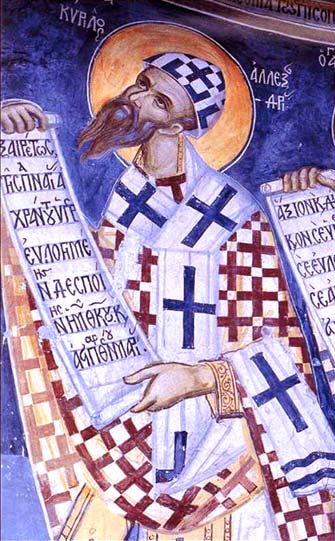 Saint Cyril (ca. AD 376-444) became Patriarch of Alexandria, Egypt in 412. Throughout his career he defended a number of orthodox doctrines, among them the teaching that Mary, the mother of Jesus, is "rightly called and truly is the Mother of God" — Theotokos, "the God-Bearer" (Formula of Concord, Epitome, VIII:12). In 431 the Council of Ephesus affirmed this teaching that the Son of Mary is also true God.
The Council was responding to the Nestorian heresy, which distinguished so completely between the divine and human natures of Christ that claims were made that the divine Christ did some things while the human Jesus did others.
Some of the differences are quite subtle; perhaps even Nestorius himself could not have foreseen the full ramifications of his position, including a "resurrection" of only the divine nature. Ephesus condemned the title of "Christ-Bearer" (Christotokos) for the Virgin, since the Nestorians would only claim that Mary bore the Christ, but not God Himself.
Cyril receives almost as many brickbats as he does bouquets, even from orthodox Christians, because he's also known for being what one person calls "an ill-tempered, quarrelsome, hasty, and violent man." This seems especially so during his early years as Bishop of Alexandria.
A particularly acute example of his extreme rigidity comes from his closing of Novatianist churches, although the Novationists weren't particularly unorthodox. Their "fault" was as much one of pride as of theology — they descended from those who'd stood firm in the persecutions of earlier years and refused to associate or worship with the heirs of those who recanted the Faith under persecution. Their main theological aberration were insisting upon rebaptism of converts from "lapsed" Christianity and an attitude that was, perhaps, less than Christ-like in dealing with erring brothers.
Cyril also ran the Jews out of town. The reason given was that they were seditious and violent, although we're left with little evidence. This action likely contributed to an ongoing feud with Orestes, the imperial prefect. These disagreements seemingly spilled over into a quarrel with the prefect's friend, the neo-platonist scholar Hypatia, who was later murdered by a mob.
Few have directly condemned Cyril for her death but the leaders of the mob certainly claimed the bishop as their leader. In modern times, Carl Sagan, in his book Cosmos, blamed Hypatia's death (and the destruction of the great Library of Alexandria) on dogmatic Christianity's desire to root out rational paganism. However, other scholars see the whole feud as an internal Church struggle and no one has yet established a definitive cause (or date) for the final destruction of Alexandria's library.
At any rate, and despite the considerable rancor that accompanied his early years as bishop, the mature Cyril worked diligently to reconcile the Nestorian and Orthodox parties. His efforts led many of the less virulent Nestorians back to full communion.
The writings of Cyril on the doctrines of the Trinity and the person of Christ reveal him to be one of the most able theologians of his time. Cyril's Christology influenced subsequent church councils and was a primary source for Lutheran confessional writings. He still speaks clearly to our age, especially as the old Christological heresies are trotted out under new guises.
Collect
Heavenly Father, You used Your servant Cyril to confess the mysteries of the Holy Trinity and of Your Son being one person with fully divine and human natures. Grant that we, also, might be constant in Your Word, bold in Your confession, and steadfast in Your worship, to the glory of Your holy Name; through Jesus Christ our Lord, who lives and reigns with You and the Holy Spirit, one God, now and forever.
Labels: alexandria, biography, christianity, church history, commemorations, cyril, hagiography, lutheranism, nestorianism, patristics, theotokos
¶ 00:00 | 0 comments |
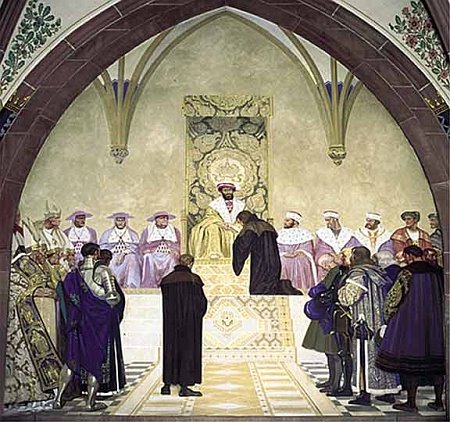 Note: Please see Ask the Pastor for more on the history and theology of the Augsburg Confession and its presentation.
The Augsburg Confession, the principal doctrinal statement of the theology of Martin Luther and the Lutheran reformers, was written largely by Philipp Melanchthon. At its heart it confesses the justification of sinners by grace alone, through faith alone, for the sake of Christ alone.
Signed by leaders of several German cities and regions, the confession was formally presented to the Holy Roman Emperor Charles V at Augsburg, Germany, on 25 June 1530. A few weeks later Roman Catholic authorities rejected the Confession, which Melanchthon defended in the Apology of the Augsburg Confession (1531). In 1580 the Unaltered Augsburg Confession was included in the Book of Concord.
An historical sidelight: Because of imperial protocol, Melanchthon wasn't allowed to make — or even attend — the presentation. Instead, two of the Saxon chancellors gave the oral reading and handed the written Latin and German copies to Charles V.
Lection
Psalm 46
Isaiah 55:6-11
Romans 10:5-17
John 15:1-11
Collects
O Lord God, heavenly Father, pour our Your Holy Spirit on Your faithful people, keep them steadfast in Your grace and truth, protect and comfort them in all temptation, defend them against all enemies of Your Word, and bestow on Christ's Church Militant Your saving peace; through Jesus Christ, Your Son, our Lord, who lives and reigns with You and the Holy Spirit, one God, now and forever.
Almighty God, we praise You for those You have sent to call the Church to its tasks and renew its life, including your servant Philipp Melanchthon. Raise up in our own day pastors, teachers, and theologians inspired by Your Spirit, whose voices will give strength to Your Church and proclaim Your kingdom; through Your Son, Jesus Christ our Lord.
Hymn
God's Word Is Our Great Heritage
God's Word is our great heritage
And shall be ours forever;
To spread its light from age to age
Shall be our chief endeavor.
Through life it guides our way,
In death it is our stay.
Lord, grant, while worlds endure,
We keep its teachings pure
Throughout all generations.
Notes on the Propers: The suggested readings come from the LCMS hymnal Lutheran Worship, as does the first collect. These propers may also used for the Commemoration of the Doctors of the Church, including Luther and C. F. W. Walther. The second collect is modified from James Kiefer's Hagiographies.
Labels: augsburg confession, book of concord, church history, commemoration, german history, lutheran confessions, lutheranism, martin luther, philipp melanchthon
¶ 00:00 | 0 comments |
 Pentecost, an Israelite festival connected to the spring harvest, was the time chosen by the Lord for the special outpouring of the Holy Spirit upon the disciples as they waited in Jerusalem.
With wind and fire, the Holy Spirit manifested Himself upon the apostles. Immediately, they rushed out to begin proclaiming the Gospel of Jesus Christ crucified for our sins and raised for our justification. The account is in Acts 2:1-41. Such was the power of the Holy Spirit working through Law and Gospel preaching that He converted over 3000 people faith in Christ at one time.
In Christianity, Pentecost is a "movable feast." Under the Old Covenant, including among modern Jews, Pentecost was (and is) the fiftieth day of Passover. The Christian Church, as more Gentiles swelled its ranks, kept the idea of the fiftieth day but based the celebration on the date for Easter rather than for Passover. See the second question under Notes on the Christian Calendar for a bit more on how we arrive at a date each year.
If you're preaching on the Genesis text, take a look at Upon the Plain of Shinar, a hymn by Pastor Walter Snyder.
Lection: Three Year Cycle, Series A
Psalm 25:1-15
Numbers 11:24-30
Acts 2:1-21
John 7:37-39
Lection: One Year Cycle
Psalm 143
Genesis 11:1-9
Acts 2:1-21
John 14:23-31
Collect
O God, on this day You once taught the hearts of Your faithful people by sending them the light of Your Holy Spirit. Grant us in our day by the same Spirit to have a right understanding in all things and evermore to rejoice in His holy consolation; through Jesus Christ, Your Son, our Lord, who lives and reigns with You and the Holy Spirit, one God, now and forever.
Labels: acts, apostle, christ, church history, conversion, disciple, easter, feasts, festivals, gospel, holy ghost, holy spirit, jesus, new testament, pentecost, pneumatology, translation
¶ 00:00 | 0 comments |
Born in Flavia Neapolis, Palestine around AD 100, near the close of the New Testament period, Justin was the son of pagan Greek parents. He was a philosophy student who studied in Alexandria, moving from Stoicism to Pythagoreanism and then Platonism as he sought to make sense of life. He converted to the Christian faith and became a teacher in Ephesus and Rome. Justin wrote that his conversion came as he observed the steadfast faith of Ephesian martyrs and through an elderly Christian whom he met along the shore of the sea.
 Justin probably wrote much more than we have preserved, but three extant works show his intellect, his never completely abandoned Platonic philosophical education, and his inclination toward apologetics — that is, an intellectual defense of the Faith.
In his First Apology, addressed to Emperor Antoninus Pius and his adopted sons, Justin defended Christianity as the only rational creed. He included accounts of contemporary baptismal and communion rites, quite possibly designed to rebut distorted accounts from anti-Christian sources. Some of these anti-Christian writings claimed that Christians were cannibals (probably because of a distorted second hand understanding of the Lord's Supper).
He addressed his Second Apology to the Roman Senate. It counters spurious charges of immorality and the like that were being made against Christians. He said that only those who misunderstood the Faith would accuse it of undermining Roman society and countered that Christians made good citizens.
His Dialogue with Trypho the Jewish rabbi shows him at his strength. He carefully defended Christian teaching while allowing that the Church would continue to welcome Jews and would let them remain faithful to the laws of the Torah. While he may have edited it to provide himself with a few good lines, the text reads as a faithful exposition of an actual conversation.
Justin was living in Rome when the cynic philosopher Crescens stirred up trouble for the Christians. After refusing to make pagan sacrifices, Justin was arrested, tried and executed, along with six other believers, including Charites, Paeon, and Liberianus. The official Roman court proceedings of his trial before Rusticius, a Roman prelate, document his confession of faith. The account of his martyrdom became a source of great encouragement to the early Christian community.
Much of what we know of early liturgical practice comes from Justin. For example, in the First Apology he gave this brief description of Holy Communion: "On finishing the prayers we greet each other with a kiss. Then bread and a cup of water mixed with wine are brought to the leader and he, taking them, sends up praise and glory to the Father of the Universe through the name of the Son and of the Holy Spirit, and offers thanksgiving at some length that we have been deemed worthy to receive these things. When the leader has finished the prayers and thanksgivings, the whole congregation assents, saying, 'Amen.' ('Amen' is Hebrew for 'So be it.') Then those whom we call deacons give to each of those present a portion of the consecrated bread and wine and water, and they take it to the absent."
Suggested Lection
Psalm 16:5-11 or 116:1-8
1 Corinthians 1:18-25
John 12:44-50
Collect
Almighty and everlasting God, who found Your martyr Justin wandering from teacher to teacher, seeking the true God, and revealed to him the sublime wisdom of Your eternal Word, grant that all who seek You, or a deeper knowledge of You, may find and be found by You; through Jesus Christ our Lord, who lives and reigns with you and the Holy Spirit, one God, now and forever.
Labels: apologetics, biography, church history, dialogue, hagiography, justin, liturgics, martyr, martyrdom, patristics, philosophy, platonism, trypho
¶ 00:00 | 0 comments |
 After Martin Luther's death, political changes altered the face of the Evangelical (Lutheran) Church. Emperor Charles V exercised control over all of southern Germany and most of the north. The Augsburg Interim, a capitulation disguised as a compromise, denied justification by grace through faith alone. It also officially recognized seven sacraments, confessed transubstantiation, and re-instituted the Mass as a sacrificial thank offering. Most of the defeated Lutheran princes went along with the Interim.
Although Philipp Melanchthon initially opposed the Augsburg Interim, some combination of fear and his conciliatory nature led him to accept its demands. The damage continued with the Leipzig Interim, which continued to compromise justification by faith while also restoring Catholic rites to Baptism, reintroducing Corpus Christi processions, and otherwise granting favor to Roman practice.
During the same period, a number of doctrinal controversies intruded among the Lutherans. Some grew out of Melanchthon's ongoing compromises with either Rome or the Reformed. Others sprang from the reactionary excesses of his opponents, including Matthias Flacius. Almost two dozen confessions ranging widely across the doctrinal spectrum were composed between 1546 and 1577, variously appealing to the Augsburg Confession for support of often contradictory positions.
 In the early 1570s, Jakob Andreae published Six Christian Sermons against the Philippist party and other Crypto-Calvinists. Meanwhile, Elector Augustus of Saxony, a staunch Lutheran who had been deceived by the Crypto-Calvinists and had actively opposed Lutheran theologians, came to his senses when confronted with Joachim Cureus's refutation of the Evangelical understanding of the Lord's Supper. He imprisoned many of those who'd misled him and began active support and encouragement of a uniting Lutheran confession.
Martin Chemnitz urged Andreae to revise and edit his Six Sermons into a formal statement of harmony. Andreae responded with the eleven articles of the Swabian Concord. Chemnitz and David Chytraeus added further revisions, producing the Swabian-Saxon Concord. Meanwhile Balthasar Bidembach and Lukas Osiander the elder had also composed a proposed uniting document, the Maulbronn Formula. Andreae, Chemnitz, David Chytraeus, Nikolaus Selnecker, and others met in Torgau from 28 May-7 June 1576 and drew the Swabian-Saxon Concord and the Maulbronn Formula together into the Torgau Book.
Elector Augustus received and passed along suggestions and criticisms of the Torgau Book to its authors, hoping that one more round of work would complete the task. Chemnitz, Andreae, Selnecker, Chytraeus, Andreas Musculus, and Christophorus Cornerus joined to complete the Bergen Book, which became known as the Solid Declaration or the Thorough Declaration. As this was being done, Andreae also worked on an Epitome or summation of the same doctrinal articles. The six men's work was completed by 28 May 1577.
These two works were included together as the Formula of Concord in the Book of Concord of 1580, along with the three Creeds and the Unaltered Augsburg Confession, the Apology to the Augsburg Confession, the Small and Large Catechisms, the Smalcald Articles, and the Treatise on the Power and Primacy of the Pope. The Epitome briefly summarizes each controversy, confesses true doctrine, and rejects and condemns false teaching. The Solid Declaration is less rigid in structure, instead delving into each topic in much greater length.
Labels: book of concord, church history, david chytraeus, formula of concord, jakob andreae, lutheran confessions, lutheranism, martin chemnitz
¶ 00:00 | 2 comments |


