Aardvark Alley

Confessional Lutheran theology, hagiography, philosophy, music, culture, sports, education,
and whatever else is on the fevered mind of Orycteropus Afer
25 June 2017
The Presentation of the Augsburg Confession
25 June AD 1530
 Note: Please see Ask the Pastor for more on the history and theology of the Augsburg Confession and its presentation.
The Augsburg Confession, the principal doctrinal statement of the theology of Martin Luther and the Lutheran reformers, was written largely by Philipp Melanchthon. At its heart it confesses the justification of sinners by grace alone, through faith alone, for the sake of Christ alone.
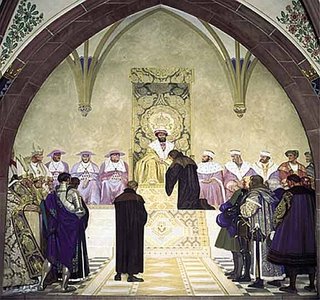
Signed by leaders of several German cities and regions, the confession was formally presented to the Holy Roman Emperor Charles V at Augsburg, Germany, on 25 June 1530. A few weeks later Roman Catholic authorities rejected the Confession, which Melanchthon defended in the Apology of the Augsburg Confession (1531). In 1580 the Unaltered Augsburg Confession was included in the Book of Concord.
An historical sidelight: Because of imperial protocol, Melanchthon wasn't allowed to make — or even attend — the presentation. Instead, two of the Saxon chancellors gave the oral reading and handed the written Latin and German copies to Charles V.
Lection
Psalm 46
Isaiah 55:6-11
Romans 10:5-17
John 15:1-11
Collects
O Lord God, heavenly Father, pour our Your Holy Spirit on Your faithful people, keep them steadfast in Your grace and truth, protect and comfort them in all temptation, defend them against all enemies of Your Word, and bestow on Christ's Church Militant Your saving peace; through Jesus Christ, Your Son, our Lord, who lives and reigns with You and the Holy Spirit, one God, now and forever.
Almighty God, we praise You for those You have sent to call the Church to its tasks and renew its life, including your servant Philipp Melanchthon. Raise up in our own day pastors, teachers, and theologians inspired by Your Spirit, whose voices will give strength to Your Church and proclaim Your kingdom; through Your Son, Jesus Christ our Lord.
Hymn
God's Word Is Our Great Heritage
God's Word is our great heritage
And shall be ours forever;
To spread its light from age to age
Shall be our chief endeavor.
Through life it guides our way,
In death it is our stay.
Lord, grant, while worlds endure,
We keep its teachings pure
Throughout all generations.
Notes on the Propers: The suggested readings come from the LCMS hymnal Lutheran Worship, as does the first collect. These propers may also used for the Commemoration of the Doctors of the Church, including Luther and C. F. W. Walther. The second collect is modified from James Kiefer's Hagiographies.


 Note: Please see Ask the Pastor for more on the history and theology of the Augsburg Confession and its presentation.
The Augsburg Confession, the principal doctrinal statement of the theology of Martin Luther and the Lutheran reformers, was written largely by Philipp Melanchthon. At its heart it confesses the justification of sinners by grace alone, through faith alone, for the sake of Christ alone.
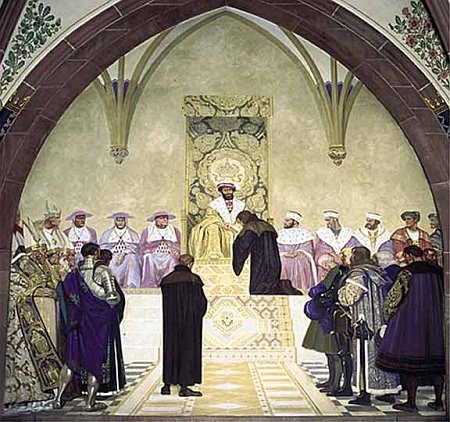
Signed by leaders of several German cities and regions, the confession was formally presented to the Holy Roman Emperor Charles V at Augsburg, Germany, on 25 June 1530. A few weeks later Roman Catholic authorities rejected the Confession, which Melanchthon defended in the Apology of the Augsburg Confession (1531). In 1580 the Unaltered Augsburg Confession was included in the Book of Concord.
An historical sidelight: Because of imperial protocol, Melanchthon wasn't allowed to make — or even attend — the presentation. Instead, two of the Saxon chancellors gave the oral reading and handed the written Latin and German copies to Charles V.
Lection
Psalm 46
Isaiah 55:6-11
Romans 10:5-17
John 15:1-11
Collects
O Lord God, heavenly Father, pour our Your Holy Spirit on Your faithful people, keep them steadfast in Your grace and truth, protect and comfort them in all temptation, defend them against all enemies of Your Word, and bestow on Christ's Church Militant Your saving peace; through Jesus Christ, Your Son, our Lord, who lives and reigns with You and the Holy Spirit, one God, now and forever.
Almighty God, we praise You for those You have sent to call the Church to its tasks and renew its life, including your servant Philipp Melanchthon. Raise up in our own day pastors, teachers, and theologians inspired by Your Spirit, whose voices will give strength to Your Church and proclaim Your kingdom; through Your Son, Jesus Christ our Lord.
Hymn
God's Word Is Our Great Heritage
God's Word is our great heritage
And shall be ours forever;
To spread its light from age to age
Shall be our chief endeavor.
Through life it guides our way,
In death it is our stay.
Lord, grant, while worlds endure,
We keep its teachings pure
Throughout all generations.
Notes on the Propers: The suggested readings come from the LCMS hymnal Lutheran Worship, as does the first collect. These propers may also used for the Commemoration of the Doctors of the Church, including Luther and C. F. W. Walther. The second collect is modified from James Kiefer's Hagiographies.
Labels: augsburg confession, book of concord, church history, commemoration, german history, lutheran confessions, lutheranism, martin luther, philipp melanchthon
¶ 00:00 | 0 comments |
16 February 2017
+ Philipp Melanchthon +
16 February AD 1497 – 19 April AD 1560
 Philipp Melanchthon, a brilliant student of the classics and a humanist scholar, was appointed to teach along with Martin Luther at the University of Wittenberg in 1518. At Luther's urging, Melanchthon began teaching theology and Scripture in addition to his courses in classical studies.
In April of 1530, Emperor Charles V called an official meeting between the representative of Lutheranism and Roman Catholicism, hoping to effect a meeting of minds between two opposing groups. Since Luther was at that time under papal excommunication and an imperial ban, Melanchthon was assigned the duty of being the chief Lutheran representative at this meeting. Thus, he made the primary verbal and written defenses of the Evangelical (Lutheran) position.
We especially remember and honor him as the author of the Augsburg Confession, which was officially presented by the German princes to the emperor on 25 June 1530, as the defining document of Lutheranism within Christendom. Following the Roman Catholic response, Melanchthon wrote the Apology (Defense) of the Augsburg Confession.
Unfortunately, Melanchthon's desires for peace within Christendom led him to later rewrite and weaken some of the Augsburg Confession's language. The resulting Variata were palatable to some who disagreed with certain Lutheran teachings and allowed for false teaching to infiltrate Lutheranism. Ask the Pastor details some of this in a post on the Unaltered Augsburg Confession.
Lection
Psalm 46
Isaiah 55:6-11
Romans 10:5-17
John 15:1-11
Collect
O Lord God, heavenly Father, pour our Your Holy Spirit on Your faithful people, keep them steadfast in Your grace and truth, protect and comfort them in all temptation, defend them against all enemies of Your Word, and bestow on Christ's Church Militant Your saving peace; through Jesus Christ, Your Son, our Lord, who lives and reigns with You and the Holy Spirit, one God, now and forever.
Note: We commemorate Philipp Melanchthon's birth date because his death date often conflicts with Holy Week or Easter observances.
Philipp Melanchthon, a brilliant student of the classics and a humanist scholar, was appointed to teach along with Martin Luther at the University of Wittenberg in 1518. At Luther's urging, Melanchthon began teaching theology and Scripture in addition to his courses in classical studies.In April of 1530, Emperor Charles V called an official meeting between the representative of Lutheranism and Roman Catholicism, hoping to effect a meeting of minds between two opposing groups. Since Luther was at that time under papal excommunication and an imperial ban, Melanchthon was assigned the duty of being the chief Lutheran representative at this meeting. Thus, he made the primary verbal and written defenses of the Evangelical (Lutheran) position.
We especially remember and honor him as the author of the Augsburg Confession, which was officially presented by the German princes to the emperor on 25 June 1530, as the defining document of Lutheranism within Christendom. Following the Roman Catholic response, Melanchthon wrote the Apology (Defense) of the Augsburg Confession.
Unfortunately, Melanchthon's desires for peace within Christendom led him to later rewrite and weaken some of the Augsburg Confession's language. The resulting Variata were palatable to some who disagreed with certain Lutheran teachings and allowed for false teaching to infiltrate Lutheranism. Ask the Pastor details some of this in a post on the Unaltered Augsburg Confession.
Lection
Psalm 46
Isaiah 55:6-11
Romans 10:5-17
John 15:1-11
Collect
O Lord God, heavenly Father, pour our Your Holy Spirit on Your faithful people, keep them steadfast in Your grace and truth, protect and comfort them in all temptation, defend them against all enemies of Your Word, and bestow on Christ's Church Militant Your saving peace; through Jesus Christ, Your Son, our Lord, who lives and reigns with You and the Holy Spirit, one God, now and forever.
Note: We commemorate Philipp Melanchthon's birth date because his death date often conflicts with Holy Week or Easter observances.
Labels: augsburg confession, biography, book of concord, commemoration, german history, hagiography, lutheran confessions, martin luther, philipp melanchthon, reformation, variata
¶ 00:00 | 0 comments |
25 June 2016
The Presentation of the Augsburg Confession
25 June AD 1530
Note: Please see Ask the Pastor for more on the history and theology of the Augsburg Confession and its presentation.
The Augsburg Confession, the principal doctrinal statement of the theology of Martin Luther and the Lutheran reformers, was written largely by Philipp Melanchthon. At its heart it confesses the justification of sinners by grace alone, through faith alone, for the sake of Christ alone.
Signed by leaders of several German cities and regions, the confession was formally presented to the Holy Roman Emperor Charles V at Augsburg, Germany, on 25 June 1530. A few weeks later Roman Catholic authorities rejected the Confession, which Melanchthon defended in the Apology of the Augsburg Confession (1531). In 1580 the Unaltered Augsburg Confession was included in the Book of Concord.
An historical sidelight: Because of imperial protocol, Melanchthon wasn't allowed to make — or even attend — the presentation. Instead, two of the Saxon chancellors gave the oral reading and handed the written Latin and German copies to Charles V.
Lection
Psalm 46
Isaiah 55:6-11
Romans 10:5-17
John 15:1-11
Collects
O Lord God, heavenly Father, pour our Your Holy Spirit on Your faithful people, keep them steadfast in Your grace and truth, protect and comfort them in all temptation, defend them against all enemies of Your Word, and bestow on Christ's Church Militant Your saving peace; through Jesus Christ, Your Son, our Lord, who lives and reigns with You and the Holy Spirit, one God, now and forever.
Almighty God, we praise You for those You have sent to call the Church to its tasks and renew its life, including your servant Philipp Melanchthon. Raise up in our own day pastors, teachers, and theologians inspired by Your Spirit, whose voices will give strength to Your Church and proclaim Your kingdom; through Your Son, Jesus Christ our Lord.
Hymn
God's Word Is Our Great Heritage
God's Word is our great heritage
And shall be ours forever;
To spread its light from age to age
Shall be our chief endeavor.
Through life it guides our way,
In death it is our stay.
Lord, grant, while worlds endure,
We keep its teachings pure
Throughout all generations.
Notes on the Propers: The suggested readings come from the LCMS hymnal Lutheran Worship, as does the first collect. These propers may also used for the Commemoration of the Doctors of the Church, including Luther and C. F. W. Walther. The second collect is modified from James Kiefer's Hagiographies.
Note: Please see Ask the Pastor for more on the history and theology of the Augsburg Confession and its presentation.The Augsburg Confession, the principal doctrinal statement of the theology of Martin Luther and the Lutheran reformers, was written largely by Philipp Melanchthon. At its heart it confesses the justification of sinners by grace alone, through faith alone, for the sake of Christ alone.
Signed by leaders of several German cities and regions, the confession was formally presented to the Holy Roman Emperor Charles V at Augsburg, Germany, on 25 June 1530. A few weeks later Roman Catholic authorities rejected the Confession, which Melanchthon defended in the Apology of the Augsburg Confession (1531). In 1580 the Unaltered Augsburg Confession was included in the Book of Concord.
An historical sidelight: Because of imperial protocol, Melanchthon wasn't allowed to make — or even attend — the presentation. Instead, two of the Saxon chancellors gave the oral reading and handed the written Latin and German copies to Charles V.
Lection
Psalm 46
Isaiah 55:6-11
Romans 10:5-17
John 15:1-11
Collects
O Lord God, heavenly Father, pour our Your Holy Spirit on Your faithful people, keep them steadfast in Your grace and truth, protect and comfort them in all temptation, defend them against all enemies of Your Word, and bestow on Christ's Church Militant Your saving peace; through Jesus Christ, Your Son, our Lord, who lives and reigns with You and the Holy Spirit, one God, now and forever.
Almighty God, we praise You for those You have sent to call the Church to its tasks and renew its life, including your servant Philipp Melanchthon. Raise up in our own day pastors, teachers, and theologians inspired by Your Spirit, whose voices will give strength to Your Church and proclaim Your kingdom; through Your Son, Jesus Christ our Lord.
Hymn
God's Word Is Our Great Heritage
God's Word is our great heritage
And shall be ours forever;
To spread its light from age to age
Shall be our chief endeavor.
Through life it guides our way,
In death it is our stay.
Lord, grant, while worlds endure,
We keep its teachings pure
Throughout all generations.
Notes on the Propers: The suggested readings come from the LCMS hymnal Lutheran Worship, as does the first collect. These propers may also used for the Commemoration of the Doctors of the Church, including Luther and C. F. W. Walther. The second collect is modified from James Kiefer's Hagiographies.
Labels: augsburg confession, book of concord, church history, commemoration, german history, lutheran confessions, lutheranism, martin luther, philipp melanchthon
¶ 00:00 | 0 comments |
16 February 2016
+ Philipp Melanchthon +
16 February AD 1497 – 19 April AD 1560
Philipp Melanchthon, a brilliant student of the classics and a humanist scholar, was appointed to teach along with Martin Luther at the University of Wittenberg in 1518. At Luther's urging, Melanchthon began teaching theology and Scripture in addition to his courses in classical studies.
In April of 1530, Emperor Charles V called an official meeting between the representative of Lutheranism and Roman Catholicism, hoping to effect a meeting of minds between two opposing groups. Since Luther was at that time under papal excommunication and an imperial ban, Melanchthon was assigned the duty of being the chief Lutheran representative at this meeting. Thus, he made the primary verbal and written defenses of the Evangelical (Lutheran) position.
We especially remember and honor him as the author of the Augsburg Confession, which was officially presented by the German princes to the emperor on 25 June 1530, as the defining document of Lutheranism within Christendom. Following the Roman Catholic response, Melanchthon wrote the Apology (Defense) of the Augsburg Confession.
Unfortunately, Melanchthon's desires for peace within Christendom led him to later rewrite and weaken some of the Augsburg Confession's language. The resulting Variata were palatable to some who disagreed with certain Lutheran teachings and allowed for false teaching to infiltrate Lutheranism. Ask the Pastor details some of this in a post on the Unaltered Augsburg Confession.
Lection
Psalm 46
Isaiah 55:6-11
Romans 10:5-17
John 15:1-11
Collect
O Lord God, heavenly Father, pour our Your Holy Spirit on Your faithful people, keep them steadfast in Your grace and truth, protect and comfort them in all temptation, defend them against all enemies of Your Word, and bestow on Christ's Church Militant Your saving peace; through Jesus Christ, Your Son, our Lord, who lives and reigns with You and the Holy Spirit, one God, now and forever.
Note: We commemorate Philipp Melanchthon's birth date because his death date often conflicts with Holy Week or Easter observances.
Philipp Melanchthon, a brilliant student of the classics and a humanist scholar, was appointed to teach along with Martin Luther at the University of Wittenberg in 1518. At Luther's urging, Melanchthon began teaching theology and Scripture in addition to his courses in classical studies.In April of 1530, Emperor Charles V called an official meeting between the representative of Lutheranism and Roman Catholicism, hoping to effect a meeting of minds between two opposing groups. Since Luther was at that time under papal excommunication and an imperial ban, Melanchthon was assigned the duty of being the chief Lutheran representative at this meeting. Thus, he made the primary verbal and written defenses of the Evangelical (Lutheran) position.
We especially remember and honor him as the author of the Augsburg Confession, which was officially presented by the German princes to the emperor on 25 June 1530, as the defining document of Lutheranism within Christendom. Following the Roman Catholic response, Melanchthon wrote the Apology (Defense) of the Augsburg Confession.
Unfortunately, Melanchthon's desires for peace within Christendom led him to later rewrite and weaken some of the Augsburg Confession's language. The resulting Variata were palatable to some who disagreed with certain Lutheran teachings and allowed for false teaching to infiltrate Lutheranism. Ask the Pastor details some of this in a post on the Unaltered Augsburg Confession.
Lection
Psalm 46
Isaiah 55:6-11
Romans 10:5-17
John 15:1-11
Collect
O Lord God, heavenly Father, pour our Your Holy Spirit on Your faithful people, keep them steadfast in Your grace and truth, protect and comfort them in all temptation, defend them against all enemies of Your Word, and bestow on Christ's Church Militant Your saving peace; through Jesus Christ, Your Son, our Lord, who lives and reigns with You and the Holy Spirit, one God, now and forever.
Note: We commemorate Philipp Melanchthon's birth date because his death date often conflicts with Holy Week or Easter observances.
Labels: augsburg confession, biography, book of concord, commemoration, german history, hagiography, lutheran confessions, martin luther, philipp melanchthon, reformation, variata
¶ 00:00 | 0 comments |


