
 Irenaeus (ca. AD 130-200), believed to be a native of Smyrna (modern Izmir, Turkey), studied in Rome and later became pastor in Lyons, France. Around 177, while Irenaeus was away from Lyons, a fierce persecution of Christians led to the martyrdom of his bishop. Upon Irenaeus' return, he became Bishop of Lyons.
His most famous writing is Adversus Haereses (Against Heresies). This work condemned several errors but focused especially on Gnosticism, which denied the goodness of creation. In opposition, Irenaeus confessed that God has redeemed his creation through the incarnation of the Son. Irenaeus also affirmed the teachings of the Scriptures handed down to and through him as being normative for the Church.
Despite a few stray texts, very little suggests that he did not die a natural death. He was buried in Saint John's Church, Lyon — a congregation later renamed in his honor. Huegenot Calvinists destroyed his tomb and his remains during in 1522, during a period of iconoclasm.
Collect
Almighty God, You upheld your servant Irenaeus, giving him strength to confess the truth against every false doctrine; keep us, we pray, steadfast in Your Word and grant us the practice of true religion, that in constancy and peace we may walk in the way of eternal life; through Jesus Christ our Lord, who lives and reigns with You and the Holy Spirit, one God, now and forever.
Labels: biography, christianity, church history, commemoration, european history, french history, hagiography, irenaeus, lutheranism, lyons, patristics
¶ 00:00 | 0 comments |

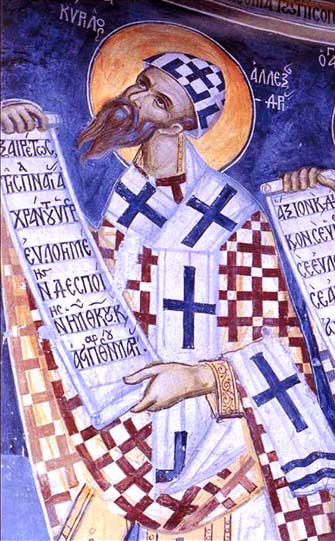 Saint Cyril (ca. AD 376-444) became Patriarch of Alexandria, Egypt in 412. Throughout his career he defended a number of orthodox doctrines, among them the teaching that Mary, the mother of Jesus, is "rightly called and truly is the Mother of God" — Theotokos, "the God-Bearer" (Formula of Concord, Epitome, VIII:12). In 431 the Council of Ephesus affirmed this teaching that the Son of Mary is also true God.
The Council was responding to the Nestorian heresy, which distinguished so completely between the divine and human natures of Christ that claims were made that the divine Christ did some things while the human Jesus did others.
Some of the differences are quite subtle; perhaps even Nestorius himself could not have foreseen the full ramifications of his position, including a "resurrection" of only the divine nature. Ephesus condemned the title of "Christ-Bearer" (Christotokos) for the Virgin, since the Nestorians would only claim that Mary bore the Christ, but not God Himself.
Cyril receives almost as many brickbats as he does bouquets, even from orthodox Christians, because he's also known for being what one person calls "an ill-tempered, quarrelsome, hasty, and violent man." This seems especially so during his early years as Bishop of Alexandria.
A particularly acute example of his extreme rigidity comes from his closing of Novatianist churches, although the Novationists weren't particularly unorthodox. Their "fault" was as much one of pride as of theology — they descended from those who'd stood firm in the persecutions of earlier years and refused to associate or worship with the heirs of those who recanted the Faith under persecution. Their main theological aberration were insisting upon rebaptism of converts from "lapsed" Christianity and an attitude that was, perhaps, less than Christ-like in dealing with erring brothers.
Cyril also ran the Jews out of town. The reason given was that they were seditious and violent, although we're left with little evidence. This action likely contributed to an ongoing feud with Orestes, the imperial prefect. These disagreements seemingly spilled over into a quarrel with the prefect's friend, the neo-platonist scholar Hypatia, who was later murdered by a mob.
Few have directly condemned Cyril for her death but the leaders of the mob certainly claimed the bishop as their leader. In modern times, Carl Sagan, in his book Cosmos, blamed Hypatia's death (and the destruction of the great Library of Alexandria) on dogmatic Christianity's desire to root out rational paganism. However, other scholars see the whole feud as an internal Church struggle and no one has yet established a definitive cause (or date) for the final destruction of Alexandria's library.
At any rate, and despite the considerable rancor that accompanied his early years as bishop, the mature Cyril worked diligently to reconcile the Nestorian and Orthodox parties. His efforts led many of the less virulent Nestorians back to full communion.
The writings of Cyril on the doctrines of the Trinity and the person of Christ reveal him to be one of the most able theologians of his time. Cyril's Christology influenced subsequent church councils and was a primary source for Lutheran confessional writings. He still speaks clearly to our age, especially as the old Christological heresies are trotted out under new guises.
Collect
Heavenly Father, You used Your servant Cyril to confess the mysteries of the Holy Trinity and of Your Son being one person with fully divine and human natures. Grant that we, also, might be constant in Your Word, bold in Your confession, and steadfast in Your worship, to the glory of Your holy Name; through Jesus Christ our Lord, who lives and reigns with You and the Holy Spirit, one God, now and forever.
Labels: alexandria, biography, christianity, church history, commemorations, cyril, hagiography, lutheranism, nestorianism, patristics, theotokos
¶ 00:00 | 0 comments |
Born in Flavia Neapolis, Palestine around AD 100, near the close of the New Testament period, Justin was the son of pagan Greek parents. He was a philosophy student who studied in Alexandria, moving from Stoicism to Pythagoreanism and then Platonism as he sought to make sense of life. He converted to the Christian faith and became a teacher in Ephesus and Rome. Justin wrote that his conversion came as he observed the steadfast faith of Ephesian martyrs and through an elderly Christian whom he met along the shore of the sea.
 Justin probably wrote much more than we have preserved, but three extant works show his intellect, his never completely abandoned Platonic philosophical education, and his inclination toward apologetics — that is, an intellectual defense of the Faith.
In his First Apology, addressed to Emperor Antoninus Pius and his adopted sons, Justin defended Christianity as the only rational creed. He included accounts of contemporary baptismal and communion rites, quite possibly designed to rebut distorted accounts from anti-Christian sources. Some of these anti-Christian writings claimed that Christians were cannibals (probably because of a distorted second hand understanding of the Lord's Supper).
He addressed his Second Apology to the Roman Senate. It counters spurious charges of immorality and the like that were being made against Christians. He said that only those who misunderstood the Faith would accuse it of undermining Roman society and countered that Christians made good citizens.
His Dialogue with Trypho the Jewish rabbi shows him at his strength. He carefully defended Christian teaching while allowing that the Church would continue to welcome Jews and would let them remain faithful to the laws of the Torah. While he may have edited it to provide himself with a few good lines, the text reads as a faithful exposition of an actual conversation.
Justin was living in Rome when the cynic philosopher Crescens stirred up trouble for the Christians. After refusing to make pagan sacrifices, Justin was arrested, tried and executed, along with six other believers, including Charites, Paeon, and Liberianus. The official Roman court proceedings of his trial before Rusticius, a Roman prelate, document his confession of faith. The account of his martyrdom became a source of great encouragement to the early Christian community.
Much of what we know of early liturgical practice comes from Justin. For example, in the First Apology he gave this brief description of Holy Communion: "On finishing the prayers we greet each other with a kiss. Then bread and a cup of water mixed with wine are brought to the leader and he, taking them, sends up praise and glory to the Father of the Universe through the name of the Son and of the Holy Spirit, and offers thanksgiving at some length that we have been deemed worthy to receive these things. When the leader has finished the prayers and thanksgivings, the whole congregation assents, saying, 'Amen.' ('Amen' is Hebrew for 'So be it.') Then those whom we call deacons give to each of those present a portion of the consecrated bread and wine and water, and they take it to the absent."
Suggested Lection
Psalm 16:5-11 or 116:1-8
1 Corinthians 1:18-25
John 12:44-50
Collect
Almighty and everlasting God, who found Your martyr Justin wandering from teacher to teacher, seeking the true God, and revealed to him the sublime wisdom of Your eternal Word, grant that all who seek You, or a deeper knowledge of You, may find and be found by You; through Jesus Christ our Lord, who lives and reigns with you and the Holy Spirit, one God, now and forever.
Labels: apologetics, biography, church history, dialogue, hagiography, justin, liturgics, martyr, martyrdom, patristics, philosophy, platonism, trypho
¶ 00:00 | 0 comments |
 Today marks the heavenly birthday of Bede (pronounced BĒD). Since his commemoration often falls near the end of Eastertide, it's quite likely that many Christians have close familiarity with one of Bede's best known (and one of this Aardvark's favorite) hymns, the Ascension anthem "A Hymn of Glory Let Us Sing."
Bede (673-735) was the last of the early church fathers and the first person to compile a history of the English church. Born in Northumbria, Bede was given by his parents to a monastery in Northern England at the age of seven. He was ordained when he was thirty.
Probably the most learned man of his time, he was a prolific writer of history and his careful use of sources provided a model for historians in the Middle Ages. His skill in both history and theology gave him the ability to complete a synthesis between the older Celtic monasticism and the later Rule of Saint Benedict.
Known best for his book Historia ecclesiastica gentis Anglorum (The Ecclesiastical History of the English People), he was also a profound interpreter of Scripture; his edition of the Vulgate was the standard in Catholicism until 1979 and his commentaries still provide fresh insights for today's readers.
Bede also popularized the use of Anno Domini Nostri Iesu Christi ("in the Year of Our Lord Jesus Christ") in speaking of the time since our Savior's birth. This is usually shortened to Anno Domini or AD.
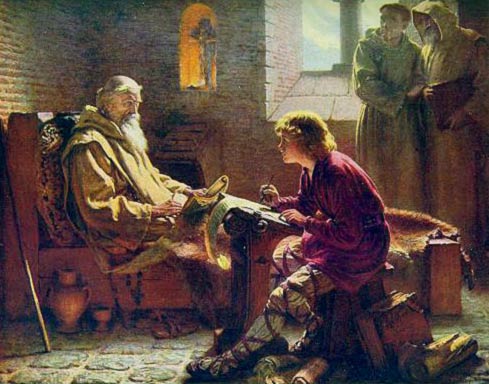 His most famous disciple, Cuthbert, reported that Bede was working on a translation of John's Gospel into English when death came. He also said that Bede died with the words of the Gloria Patri on his lips.
Attested hymns include Hymnum canentes martyrum ("The Hymn for Conquering Martyrs Raise"), Hymnum canamus Domino (translated variously as "A Hymn of Glory Let Us Sing," "The Hymn of Glory Sing We," and "Sing We Triumphant Hymns of Praise"), and Praecursor altus luminis ("The Great Forerunner of the Morn"). He also wrote vernacular poetry.
Bede received the title "Venerable" within two generations of his death and is buried in Durham Cathedral as one of England's greatest saints.
Lection — ESV Except as Noted
Psalm 78:1-4 or 19:7-14
Wisdom 7:15-22 (NRSV)
Matthew 13:47-52
Collect
Heavenly Father, who called your servant Bede, while still a child, to devote his life to Your service in the disciplines of religion and scholarship, grant that as he labored in the Spirit to bring the riches of Your truth to his generation, so we, in our various vocations, may strive to make You known in all the world; through Jesus Christ our Lord, who lives and reigns with you and the Holy Spirit, one God, now and forever.
A Hymn of Glory Let Us Sing
A hymn of glory let us sing New songs throughout the world shall ring
Alleluia, Alleluia.
Christ, by a road before untrod Ascendeth to the throne of God.
Alleluia, Alleluia, Alleluia, Alleluia, Alleluia.
The holy apostolic band Upon the Mount of Olives stand
Alleluia, Alleluia.
And with His followers they see Jesus' resplendent majesty
Alleluia, Alleluia, Alleluia, Alleluia, Alleluia.
To Whom the angels drawing nigh, "Why stand and gaze upon the sky?"
Alleluia, Alleluia.
"This is the Savior," thus they say. "This is His noble triumph day."
Alleluia, Alleluia, Alleluia, Alleluia, Alleluia.
"Again ye shall behold Him so, As ye have today seen Him go."
Alleluia, Alleluia.
"In glorious pomp ascending high Up to the portals of the sky."
Alleluia, Alleluia, Alleluia, Alleluia, Alleluia.
O grant us thitherward to tend And with unwearied hearts ascend,
Alleluia, Alleluia.
Unto Thy kingdom's throne, where Thou As is our faith, art seated now,
Alleluia, Alleluia, Alleluia, Alleluia, Alleluia.
Be Thou our Joy and strong Defense, Who art our future Recompense,
Alleluia, Alleluia.
So shall the light that springs from Thee Be ours through all eternity,
Alleluia, Alleluia, Alleluia, Alleluia, Alleluia.
O risen Christ, ascended Lord, All praise to Thee let earth accord,
Alleluia, Alleluia.
Who art, while endless ages run, With Father and with Spirit One,
Alleluia, Alleluia, Alleluia, Alleluia, Alleluia.
More on Bede's hymns and related information from NetHymnal.
Labels: bede, biography, church history, commemoration, english history, hagiography, historiography, hymnody, medieval history, patristics, the venerable bede, translation
¶ 00:00 | 0 comments |
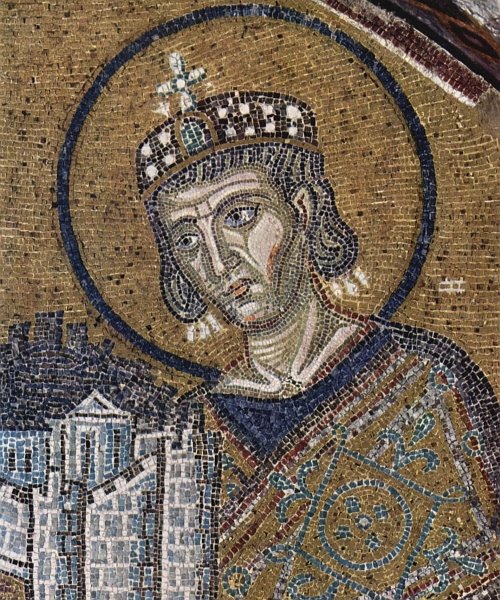
 Flavius Valerius Aurelius Constantinus served as Roman Emperor from AD 306 to 337. During his reign the persecution of Christians was forbidden by the Edict of Milan in 313. Ultimately, the faith gained full imperial support.
Constantine took an active interest in the life and teachings of the church. He called the First Council of Nicaea in 325 at which Saint Athanasius and others defended and defined orthodox Christianity. Among the fruits of this council was one of Christendom's major confessions of faith, the Nicene Creed.
Some argue that Constantine may not have been true believer since he wasn't baptized until his death bed. However, he actively supported Christianity in his later life and even preached upon occasion. Other scholars speculate that he delayed baptism for the same reason as did many others during portions of the Church's history, that of a general misunderstanding of Holy Baptism.
 Many theologians spoke of the need for "satisfaction" — making amends for sins committed during one's life — and warned about time that would be spent in Purgatory by those who didn't make full satisfaction while still living. Indeed, some even taught that unless proper penance was done, one might find himself forever barred from Heaven!
Since Baptism truly washes away all sin — both that of our birth nature and any transgressions committed later — some thought the best way to avoid Purgatory (or Hell) was to be baptized when one was at death's door. In so doing, people believed that there would be no unrepented, unsatisfied sins remaining that would leave one waiting for eternal bliss or forever denied its blessings.
I'll not argue here the reasons why Lutherans reject the notion of satisfaction or the idea of Purgatory. I'll merely say that if Constantine had such worries, he wasn't alone during his day, and his decision to delay would be understandable in light of such teaching.
Saint Helena, ca. AD 255-329
Constantine's mother Helena strongly influenced her son throughout his life. Her great interest in locating the holy sites of the Christian faith led her to become one of the first Christian pilgrims to the Holy Land. Her research led to the identification of Biblical locations in Jerusalem, Bethlehem, and beyond, which are still maintained as places of worship today. One of Christianity's annual festivals, Holy Cross Day, has its origin in her explorations of Palestine.
Collects
O Lord, our God, King of the universe, who raises up earthly rulers to work Your will in this life, You called Constantine to the imperial throne and ended wide-spread persecution of Your Son's Church; grant that as he served You by fulfilling his vocation, so we would continue to receive from You rulers who allow the Church to proclaim the saving Gospel of Your Son, Jesus Christ, our Lord, who lives and reigns with You and the Holy Spirit, one God, now and forever.
Almighty God, who called your servant Helena to an earthly position of authority so that she might advance your heavenly kingdom, filling her with zeal for your Church and love for Your people, grant that we may be fruitful in good works and steadfast in our faith in Your Son, and finally by your mercy attain everlasting life; through Jesus Christ our Lord, who lives and reigns with you and the Holy Spirit, one God, now and forever.
Labels: athanasius, biography, church history, commemoration, constantine, edict of milan, european history, hagiography, helena, holy cross, nicaea, nicene creed, patristics, roman empire
¶ 00:00 | 0 comments |
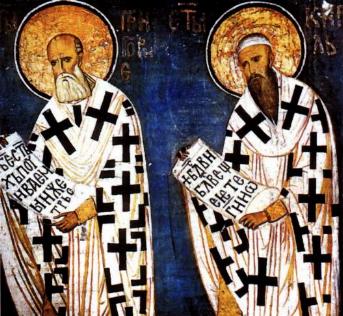 Saint Cyril and Saint Methodius were missionaries to the Slavs. The brothers Constantine and Methodius came from a Greek family in Thessalonica. Younger brother Constantine took the name Cyril when he became a monk in 868. After ordination, Cyril became librarian at the Church of Holy Wisdom (Hagia Sophia) in Constantinople.
In 862, Emperor Michael III and the Patriarch Photios sent the brothers as to what is now the Czech republic, where they taught in the native Slavic tongue. While the fact of their sending may have included the emperor's political designs, the brothers seem to have focused only upon the spiritual aspect of their task.
Cyril is said to have invented the alphabet known today as Cyrillic, which provided a written language for the liturgy and Scriptures for the Slavic peoples. Slavic alphabets include characters from Greek with extra symbols devised for sounds not expressed in Greek.
Their use of the vernacular established an important principle for evangelical missions. People could be taught directly without needing to first instruct them in the language of the Bible before teaching them what it said about their salvation.
Note: Cyril is traditionally celebrated in many places on 14 February, his date of death, and Methodius is often combined with him. I'm following the lectionary from the Lutheran Service Book, which moved the brothers' commemoration to 11 May, evidently because so much of the Western Church associates 14 February with Saint Valentine.
Collect
Almighty and everlasting God, who by the power of the Holy Spirit moved your servant Cyril and his brother Methodius to bring the light of the Gospel to a hostile and divided people, overcome all bitterness and strife among us by the love of Christ, and make us one united family under the banner of the Prince of Peace; who lives and reigns with You and the Holy Spirit, one God, now and forever.
Labels: biography, church history, commemoration, constantine, cyril, hagiography, methodius, missionary, patristics, slavic history, translation
¶ 00:00 | 0 comments |
 Athanasius was born in Alexandria in Egypt in AD.295. He served as a church leader in a time of great controversy and ecclesiastical disagreements. While he was still a deacon, around the year 319, a presbyter (pastor) named Arius began a non-Biblical teaching about Jesus Christ. At the Council of Nicaea in 325, Athanasius, despite his relative inexperience in ecclesiastical office, defended Christian orthodoxy against the proponents of the Arian heresy. This belief denied the full divinity of Jesus Christ, claiming that there was a time when the Son was not and that He was thus inferior to the Father according to His "essence."
Results of the Orthodox party's eventual victory included the Nicene Creed.
During his 45-year tenure as bishop of Alexandria, Athanasius wrote numerous works that defended the orthodox teaching. His enemies had him exiled five times; on two occasions he was almost murdered.
Looking back, we see that there were times when Athanasius equaled his opponents' misbehavior, going so far as to engage mercenaries to enforce his episcopacy in Alexandria. Yet Athanasius remained steadfast and ended his days restored fully to his church responsibilities. The Athanasian Creed, though not composed by him, is named in his honor because it confesses the doctrinal orthodoxy he championed throughout his life.
Athanasius became known in the West as one of the four Easterners among the Eight Great Doctors of the Undivided Church. See the biography of Saint Ambrose for all eight.
Lection
Psalm 71:1-8 or 112:1-9
1 John 5:1-5
Matthew 10:22-32
Collect
Uphold Your Church, O God of truth, as You upheld Your servant Athanasius, to maintain and proclaim boldly the catholic faith against all opposition, trusting solely in the grace of Your eternal Word, who took upon Himself our humanity that we might share His holiness; who lives and reigns with you and the Holy Spirit, one God, now and forever.
Labels: alexandria, arianism, arius, athanasius, biography, church history, commemoration, creed, doctors of the church, hagiography, nicaea, nicene creed, patristics
¶ 00:00 | 0 comments |
 Christian pastor, evangelist, and bishop Gregory the Illuminator (or Enlightener; Armenian: Գրիգոր Լուսաւորիչ, transliterated Grigor Lusavorich) was born sometime between AD 240 and 260 and lived until around AD 311 or 312. He is the patron saint of Armenia and was first official head of the Armenian Apostolic Church.
The Armenians were the first people to adopt Christianity as their state religion. Tertullian and Eusebius of Caesaria suggest that Christianity was practiced in Armenia as early as the 2nd Century AD.
Sometime before AD 301, the Lord used Gregory as his instrument to convert King Tiridates (or Trdat) III. For some twelve to fourteen years previously, he'd been imprisoned in a deep pit and possibly tortured. This was likely due in part to his father's participation in a plot against Khosrov II, Tiridates' father, and partially because of his steadfast refusal to participate in pagan rites. His recall came around the year 297, when he was asked to restore to sanity Tiridates III, who lost his mind after being betrayed by Diocletian.
In 302, Gregory was ordained bishop. He founded the Cathedral of Etchmiadzin, near Mount Ararat in 303. This remains the seat of the supreme patriarch (catholicos) of the Armenian Church. Gregory went on to evangelize several other Caucasian nations and baptized the kings of Iberia (Georgia), Lazes, and Albania.
Sometime before his death he retired to a solitary life in the wilderness. He is remembered in both the Eastern and Western Church.
As an aside, legend claims for this relatively small nation the graves of four apostles: Bartholomew, Matthias, and Simon and Jude.
Lection
Psalm 119:153-160
Job 42:10-12
Acts 17:22-31
Matthew 5:11-16
Collect
Almighty God, whose will it is to be glorified in Your saints, You raised up your servant Gregory the Illuminator to be a light in the world, and to preach the Gospel to the people of Armenia. Shine, we pray, in our hearts, that we also may show forth Your praise, who called us out of darkness into Your marvelous light; through Jesus Christ our Lord, who lives and reigns with You and the Holy Spirit, one God, now and forever.
Labels: armenian history, biography, church history, commemoration, gregory, gregory the illuminator, hagiography, patristics
¶ 00:00 | 0 comments |
 Born around AD 69, Saint Polycarp was a central figure in the early church. Said to be disciple of the holy evangelist and apostle Saint John, he provides a link between the first generation of believers and later Christians, including Saint Irenaeus, Bishop of Lyons, who later wrote of him. Saint Ignatius of Antioch also knew and wrote to him. His home town of Smryna (modern Izmir, Turkey) was one of the seven churches addressed in Revelation (see 2:8-11 for the details).
After serving for many years as bishop of Smyrna, Polycarp was caught up in a local persecution of Christians. While willing to be martyred, others encouraged him to flee. However, he was later arrested, tried, and executed for his faith on 23 February c. AD 156. An eyewitness narrative of his death, The Martyrdom of Polycarp, continues to encourage believers in times of persecution.
 According to the ancient records, he was tried solely on the charge of being a Christian. When the proconsul urged him to save his life by cursing Christ, he replied: "Eighty-six years I have served Him, and He never did me any wrong. How can I blaspheme my King who saved me?" According the the customary reckoning of his birth and death, this means that he must have been baptized as an infant, raised as a Christian, and lived his entire life as in the Faith. His fidelity follows the encouragement given by the Lord to the church in Smyrna in Revelation 2:10, "Be faithful unto death, and I will give you the crown of life. (ESV)"
The following prayer is recorded as his immediately prior to the fire being kindled for his martyrdom:
Lord God Almighty, Father of Your blessed and beloved Son Jesus Christ, through whom we have received knowledge of You, God of angels and hosts and all creation, and of the whole race of the upright who live in Your presence: I bless You that You have thought me worthy of this day and hour, to be numbered among the martyrs and share in the cup of Christ, for resurrection to eternal life, for soul and body in the incorruptibility of the Holy Spirit. Among them may I be accepted before You today, as a rich and acceptable sacrifice, just as You, the faithful and true God, have prepared and foreshown and brought about. For this reason and for all things I praise You, I bless You, I glorify You, through the eternal heavenly high priest Jesus Christ, Your beloved Son, through whom be glory to You, with Him and the Holy Spirit, now and for the ages to come. Amen.
Collect
O God, the maker of heaven and earth, who gave to Your venerable servant, the holy and gentle Polycarp, boldness to confess Jesus Christ as King and Savior, and steadfastness to die for the Faith, give us grace, following his example, to share the cup of Christ and rise to eternal life; through Jesus Christ our Lord, who lives and reigns with You and the Holy Spirit, one God, now and forever.
Labels: baptism, biography, church history, commemoration, hagiography, irenaeus, john, martyrdom, patristics, polycarp, smyrna, turkish history
¶ 00:00 | 0 comments |
 Details of ancient Christianity are sketchy since for much of the Church's early years, it was a crime to be a Christian and records were hidden or kept purposely incomplete to protect believers. Thus, the story of Saint Valentine, as well as those of many others ancient believers, must be pieced together from fragmentary evidence.
Some ancient accounts record a physician and priest living in Rome during the rule of the Emperor Claudius II. This Valentine become one of the noted martyrs of the third century. It seems that his main "crime" was joining couples in marriage. Specifically, Valentine married Roman soldiers. Evidently, Claudius thought that single men made better soldiers while Valentine and the Church resisted the immorality of less-permanent relationships.
The commemoration of his death, thought to have occurred during the year 270, became part of the calendar of remembrance in the early Western Church. Tradition suggests that on the day of his execution for his Christian faith, he left a note of encouragement for a child of his jailer. The note was written on an irregularly-shaped piece of paper which suggested the shape of a heart. This greeting became a pattern for millions of written expressions of love and caring that now are the highlight of Valentine's Day in many nations.
Lection
Psalm 95:1-7a
Ezekiel 18:1-9
1 Peter 4:12-19
John 2:1-11
Collect
Almighty and everlasting God, who kindled the flame of Your love in the heart of Your holy martyr Valentine, grant to us, Your humble servants, a like faith and power of love, that we who rejoice in his triumph may profit by his example; through Jesus Christ our Lord, who lives and reigns with You and the Holy Spirit, one God, now and forever.
Labels: biography, church history, commemoration, hagiography, marriage, martyrdom, patristics, roman empire, valentine
¶ 00:00 | 0 comments |
Saint John Chrysostom, Preacher, Bishop, and Theologian, was called Chrysostom (Greek for"golden-mouthed") by his hearers. He was a dominant force in the fourth-century Christian church.
 Born in Antioch around AD 347, John was instructed in the Faith by his pious mother, Anthusa. After serving in a number of Christian offices, including acolyte and lector, John was ordained a presbyter and given preaching responsibilities.
His simple but direct messages found an audience well beyond his home town. His title came from his legendary preaching abilities. An unsubstantiated but widely circulated tale is that pickpockets and cutpurses would flock to services because he held his audience so spellbound that they could easily rob Saint John's hearers.
In 398, John was made Patriarch of Constantinople, where His determination to reform the church, court, and city brought him into conflict with established authorities. Eventually, he was exiled from his adopted city. Although removed from his parishes and people, he continued writing and preaching until his death in 407. It is reported that his final words were: "Glory be to God for all things. Amen."
John Chrysostom was one of four Eastern theologians among the eight Doctors of the undivided Church. The other three were Athanasius, Basil the Great, and Gregory of Nazianzus. The four great early Western (or Latin) doctors were Augustine, Jerome, Gregory the Great, and Ambrose of Milan.
Quote
The following excerpt is based on the passage, "[T]he letter kills, but the Spirit gives life. (2 Corinthians 3:6)" It comes from his Sixth Homily On 2 Corinthians.
Yet he says these things not in one sense only, but in reference to those who prided themselves on the things of Judaism. By the "letter" here he means the Law which punishes those who transgress; but by the "spirit" he means the grace which through Baptism gives life to those who by sins were made dead.Quoted from The Lord Will Answer: A Daily Prayer Catechism © 2004 by Concordia Publishing House.
In the Law he that has sin is punished. Here, he that has sins comes and is baptized and is made righteous, and being made righteous, he lives, being delivered from the death of sin. The Law, if it lay hold on a murderer, puts him to death. The Gospel, if it lay hold on a murderer, enlightens, and gives him life.
Lection
Psalm 49:1-8 or 34:15-22
Jeremiah 1:4-10
Luke 21:12-15
Collect
O God, who gave Your servant John Chrysostom the grace to proclaim eloquently Your righteousness in the great congregation, and fearlessly to bear reproach for the honor of Your Name, mercifully grant to all bishops and pastors such excellency in preaching and fidelity in ministering Your Word, that Your people shall be partakers with them of the glory that shall be revealed; through Jesus Christ our Lord, who lives and reigns with You and the Holy Spirit, one God, now and forever.
Labels: biography, chrysostom, church history, commemoration, doctors of the church, hagiography, hymnody, john chrysostom, liturgics, patristics, theology
¶ 00:00 | 0 comments |
 Of the many saints recognized by the Christian Church, Nicholas is one of the most widely commemorated. However, very little is known historically of him, although there was a church of Saint Nicholas in Constantinople as early as the sixth century. Research affirms that there was a bishop by the name of Nicholas in the city of Myra in Lycia (part of Turkey today) in the fourth century.
While we don't know a tremendous amount about him, scholars are certain that he was not a "jolly old elf" and that he espoused an austere lifestyle incompatible with "a round little belly" shaking "like a bowl full of jelly."
From that coastal location, legends about Nicholas have traveled across time and distance. He is associated with charitable giving in many countries around the world and is portrayed as the rescuer of sailors, the protector of children, and the friend of people in distress or need. In commemoration of Sinterklaas (a Dutch version of Saint Nicholas), 6 December is a day for giving and receiving gifts in many parts of Europe.
 See the article at Ask the Pastor for a famous apocryphal story and related information on his patronage and "transformation" into the American Santa Claus. There you'll learn about his connection with money lending and his status as patron saint for pawnbrokers.
Also, Ask the Pastor includes the following St. Nicholas Day hymn stanza as part of a previous year's article on midweek Advent services based upon sanctorial commemorations in the Christian calendar:
With joy Your Church remembers
Saint Nicholas, the blest,
Who gave up earthly treasures
And Jesus' name confessed.
The poor and weak he welcomed,
The heretic he scorned;
Through faith and life and preaching,
Christ's Gospel he adorned.
Meanwhile, Pastor Alex Klages focused on Nicholas as a staunchly orthodox bishop who grew so weary of the arch-heretic of Nicaea that he slapped Arius for continually professing false doctrine concerning the Lord Jesus Christ.
Lection
Psalm 78:3-7 or 145:8-13
Isaiah 58:6-10
1 John 4:7-14
Mark 10:13-16
Collect
O Lord, let Your continual mercy enkindle in Your Church the unfailing gifts of charity and faith, that, following the example of your servant Nicholas of Myra, we may have grace to deal in generosity and love with children and with all who are poor and distressed, to uphold the cause of those who have no helper, and to strive for purity of doctrine in the Church; for the sake of Him who gave His life for us, Your Son our Savior Jesus Christ, who lives and reigns with You and the Holy Spirit, one God, now and forever.
Labels: arius, biography, church history, commemoration, hagiography, nicholas of myra, patristics, saint nicholas, santa claus, sinterklaas, theology, turkish history
¶ 00:00 | 0 comments |
 Saint Clement (ca. A.D. 35–100) is remembered for establishing the pattern of apostolic authority that governed the Christian Church during the first and second centuries. He insisted on keeping Christ at the center of the Church's worship and outreach. In a letter to the Corinthian Christians, he emphasized the centrality of Jesus' death and resurrection: "Let us fix our eyes on the blood of Christ, realizing how precious it is to His Father, since it was poured out for our salvation and brought the grace of repentance to the whole world" (1 Clement 6:31).
Early accounts claim that he suffered a martyr's death by drowning — specifically, he was said to have been tied to an anchor, hence his normal symbol is an anchor. Before his death, he displayed a steadfast, Christ-like love for all of God's redeemed people, serving as inspiration for future generations to continue building the Church on the foundation of the prophets and apostles, with Christ as the one and only cornerstone. His Epistle to the Corinthians addresses what he considered to be the improper dismissal of a bishop. It works both for good order and for abounding charity among the Corinthian Christians.
Here follows an excerpt from his Epistle to the Corinthians:
Let the one truly possessed by the love of Christ keep his commandments. Who can express the binding power of divine love? Who can find words for the splendor of its beauty? Beyond all description are the heights to which it lifts us. Love unites us to God; "it cancels innumerable sins," has no limits to its endurance, bears everything patiently. Love is neither servile nor arrogant. It does not provoke schisms or form cliques, but always acts in harmony with others. By it all God's chosen ones have been sanctified; without it, it is impossible to please him. Out of love the Lord took us to himself; because he loved us and it was God's will, our Lord Jesus Christ gave his life's blood for us — he gave his body for our body, his soul for our soul.
See then, beloved, what a great and wonderful thing love is, and how inexpressible its perfection. Who are worthy to possess it unless God makes them so? To him therefore we must turn, begging of his mercy that there may be found in us a love free from human partiality and beyond reproach. Every generation from Adam's time to ours has passed away; but those who by God's grace were made perfect in love and have a dwelling now among the saints, and when at last the kingdom of Christ appears, they will be revealed. "Take shelter in your rooms for a little while," says Scripture, "until my wrath subsides. Then I will remember the good days, and will raise you from your graves."
Happy are we, beloved, if love enables us to live in harmony and in the observance of God's commandments, for then it will also gain for us the remission of our sins. Scripture pronounces "happy those whose transgressions are pardoned, whose sins are forgiven. Happy the one," it says, "to whom the Lord imputes no fault, on whose lips there is no guile." This is the blessing given those whom God has chosen through Jesus Christ our Lord. To him be glory for ever and ever.. . .
Let us fix our attention on the blood of Christ and recognize how precious it is to God his Father, since it was shed for our salvation and brought the grace of repentance to all the world.
If we review the various ages of history, we will see that in every generation the Lord has "offered the opportunity of repentance" to any who were willing to turn to him. When Noah preached God's message of repentance, all who listened to him were saved. Jonah told the Ninevites they were going to be destroyed, but when they repented, their prayers gained God's forgiveness for their sins, and they were saved, even though they were not of God's people.
Under the inspiration of the Holy Spirit, the ministers of God's grace have spoken of repentance; indeed, the Master of the whole universe himself spoke of repentance with an oath: "As I live," says the Lord, "I do not wish the death of the sinner but the sinner's repentance." He added this evidence of his goodness: "House of Israel, repent of your wickedness. Tell my people: If their sins should reach from earth to heaven, if they are brighter than scarlet and blacker than sackcloth, you need only turn to me with your whole heart and say, 'Father,' and I will listen to you as to a holy people."
In other words, God wanted all his beloved ones to have the opportunity to repent and he confirmed this desire by his own almighty will. That is why we should obey his sovereign and glorious will and prayerfully entreat his mercy and kindness. We should be suppliant before him and turn to his compassion, rejecting empty works and quarreling and jealousy which only lead to death.
We should be humble in mind, putting aside all arrogance, pride, and foolish anger. Rather, we should act in accordance with the Scriptures, as the Holy Spirit says: "The wise must not glory in wisdom nor the strong in strength nor the rich in riches. Rather, let the one who glories glory in the Lord, by seeking him and doing what is right and just." Recall especially what the Lord Jesus said when he taught gentleness and forbearance. "Be merciful," he said, "so that you may have mercy shown to you. Forgive, so that you may be forgiven. As you treat others, so you will be treated. As you give, so you will receive. As you judge, so you will be judged. As you are kind to others, so you will be treated kindly. The measure of your giving will be the measure of your receiving."
Let these commandments and precepts strengthen us to live in humble obedience to his sacred words. As Scripture asks: "Whom shall I look upon with favor except the humble, peaceful one who trembles at my words?"
Sharing then in the heritage of so many vast and glorious achievements, let us hasten toward the goal of peace, set before us from the beginning. Let us keep our eyes firmly fixed on the Father and Creator of the whole universe, and hold fast to his splendid and transcendent gifts of peace and all his blessings.

Tradition dating back to at least the 3rd Century AD associates him with the man mentioned by Paul in the Epistle to the Ephesians: "Yes, I ask you also, true companion, help these women, who have labored side by side with me in the gospel together with Clement and the rest of my fellow workers, whose names are in the book of life. (4:3 ESV)"
Lection
Psalm 78:3-7 or 85:8-13
2 Timothy 2:1-7
Luke 6:37-45
Collect
Almighty God, who chose Your servant Clement of Rome to recall the Church in Corinth to obedience and stability, grant that Your Church may be grounded and settled in Your truth by the indwelling of the Holy Spirit, and may evermore be kept blameless in Your service; through Jesus Christ our Lord, who lives and reigns with You and the Holy Spirit, one God, now and forever.
Labels: biography, church history, clement, commemoration, hagiography, martyrdom, patristics, rome
¶ 00:00 | 0 comments |
 St. Ignatius was the bishop of Antioch in Syria (near contemporary Antakya, Turkey) at the beginning of the second century AD and an early Christian martyr. Antioch was a port on the Orontes River in Syria with access to the Mediterranean Sea, just north of the modern country of Lebanon. Its importance included spice and other valuable trades and it was closely connected to the Silk Road and the Persian Royal Road.
The city was important to early Christianity, especially after the destruction of Jerusalem in AD 70. Followers of Jesus were first called Christians in Antioch (cf. Acts 11:26). Paul began three of his missionary journeys from there. It is believed that Matthew wrote his Gospel in Antioch.
The Didache, the Teaching of the Twelve Apostles, was probably written in Syria and likely in Antioch. The city was one of five patriarchates of early Christianity under Constantine, along with Jerusalem, Constantinople, Alexandria, and Rome. Saint John Chrysostom (AD 349-407), the Bishop of Constantinople, was born in Antioch. The Maronite Eastern Catholic Church of Lebanon originates from Christian Antioch.
 Near the end of the reign of Trajan (98-117), Ignatius refused to worship the Roman emperor. He was arrested, taken in chains to Rome, and eventually thrown to the wild beasts in the arena.
On the way to Rome, he wrote letters to the Christians at Ephesus, Magnesia, Tralles, Rome, Philadelphia, and Smyrna, and also to Polycarp, bishop of Smyrna. In the letters, which are beautifully pastoral in tone, Ignatius warned against certain heresies (false teachings). He also repeatedly stressed the full humanity and deity of Christ, the reality of Christ's bodily presence in the Lord's Supper, the supreme authority of the bishop, and the unity of the Church found in her bishops.
Ignatius was the first to use the word catholic to describe the universality of the Church. His Christ-centeredness, his courage in the face of martyrdom, and his zeal for the truth over against false doctrine remain his lasting legacy to the Church.
From His Writings
For I know and believe that he was in the flesh even after the Resurrection. And when he came to those with Peter he said to them: "Take, handle me and see that I am not a phantom without a body." And they immediately touched him and believed, being mingled both with his flesh and spirit. Therefore they despised even death, and were proved to be above death. And after his Resurrection he ate and drank with them as a being of flesh, although he was united in spirit to the Father. Letter of Ignatius of Antioch to the Smyrnaeans III
I am writing to all the churches and am insisting to everyone that I die for God of my own free will — unless you hinder me. I implore you: do not be unseasonably kind to me. Let me be food for the wild beasts, through whom I can reach God. I am God's wheat, and I am being ground by the teeth of the wild beasts, that I may be found pure bread of Christ. Letter of Ignatius of Antioch to the Romans IV
Lection
Psalm 116:1-8 or 31:1-5
Romans 8:35-39
John 12:23-26
Collect
Almighty God, we praise you for your bishop and martyr Ignatius of Antioch, who offered himself as grain to be ground by the teeth of wild beasts that he might present to you the pure bread of sacrifice. Accept the willing tribute of our lives, and give us a share in the pure and spotless offering of your Son Jesus Christ; who lives and reigns with you and the Holy Spirit, one God, now and forever.
Credits
Russian icon of Ignatius public domain. Biblical world map from Logos Bible Software.
Labels: antioch, biography, christianity, commemoration, hagiography, ignatius, martyrdom, middle eastern history, patristics, resurrection, theology
¶ 00:00 | 0 comments |
 The Lord called the Patriarch Abraham (first known as Abram) to become the father of a great nation (Genesis 12). At age 75, in obedience to God's command, he, his wife Sarai (later Sarah), and his nephew Lot moved southwest from the town of Haran to the land of Canaan. There, the Lord cut a covenant with Abram (Genesis 15), promising the land of Canaan to his descendants. In Genesis 17:1-16, the Lord established circumcision as a sign of His covenant people while also renaming Abram as Abraham and Sarai as Sarah.
At the age of 100 Abraham and Sarah were finally blessed with Isaac, the son long promised to them by God. A few years later, Abraham demonstrated supreme obedience when God commanded him to offer Isaac as a burnt offering. God spared the young man's life only at the last moment and provided a ram as a substitute offering (22:1-19).
Despite having his only child born at such an advanced age, Abraham lived to see the births of Isaac's twin sons Jacob and Esau. Abraham finally died at the age of 175 and was buried in the Cave of Machpelah, which he had purchased earlier as a burial site for Sarah. He is especially honored as the first of the three great Old Testament Patriarchs — and for his "righteousness before God through faith. (Romans 4:1-12)"
 In the great "Faith Chapter" of Hebrews 11, Abraham holds a prominent place. The writer noted several instances where Abraham acted "by faith," contrary to worldly evidence but in accordance with God's will. "By faith," he "obeyed when he was called to go out to a place that he was to receive as an inheritance (v. 8)"; he "went to live in the land of promise ... with Isaac and Jacob (v. 9)"; and he, "when he was tested, offered up Isaac. (v. 17)" Among the believers so listed, God also commended the faith of Sarah, Isaac, and Jacob through the epistle's writer.
The promised blessing of the nations came to fruition in the person of Jesus Christ. He was a son of Abraham by blood, by circumcision, and by His relationship with our heavenly Father. While the Jews traced their descent from Abraham according to his bloodlines, Christians are listed in Scripture as Abraham's true children by faith in Christ. Paul wrote that Abraham is "the father of us all" who share his faith in God (Romans 4:16). In Galatians, Paul also wrote, "Know then that it is those of faith who are the sons of Abraham. And the Scripture, foreseeing that God would justify the Gentiles by faith, preached the gospel beforehand to Abraham, saying, 'In you shall all the nations be blessed.' So then, those who are of faith are blessed along with Abraham, the man of faith. (3:7-9)"
We cannot definitively state that the patriarch saw his greatest Descendant "in the flesh" before he died, although some think that the Son of God was also the Angel of the Lord who spoke with him. However, whether by faith or by sight, we know from Jesus' words that "Abraham rejoiced that he would see my day. He saw it and was glad. (John 8:56)" When the Jews before Him mocked such an apparently outlandish statement, our Lord continued, "Truly, truly, I say to you, before Abraham was, I am, (v. 58)" thereby claiming to be not only a son of Abraham but also Abraham's God (cf. Exodus 3:13-14).
While most people shudder at the thought of Abraham taking Isaac up Mount Moriah as an intended sacrifice, some are more pained by his having a son with Sarai's servant Hagar (see Genesis 16). I'm one of these and, for many of us, it isn't the odd sharing of the marriage bed but the result of this wrong relationship that's more disturbing. Certainly the Lord assured blessing for Hagar's son Ishmael, a child born through human manipulation. However, He reserved the greater blessing for Isaac, the child born to Sarah of His divine promise (Genesis 17:15-21).
Sadly, both blessings were later forsaken by their bearers. The vast majority of Ishmael's descendants do not have Abraham's God as their own but instead have given themselves over to the pernicious religion of Islam and its false god Allah. Meanwhile, much of Israel disappeared, first during the Assyrian invasion and, later, the Babylonian Captivity. Of those who returned to Palestine, many slowly turned away from the God of Abraham, Isaac, and Jacob through the next four hundred years. When finally appeared the Blessing of the Nations, "He came to his own, and his own people did not receive him. (John 1:11)."
Labels: abraham, abram, biography, christology, commemoration, hagar, hagiography, isaac, ishmael, jacob, old testament, patristics, sarah
¶ 00:00 | 0 comments |
 Saint Jerome (Eusebius Sophronius Hieronymus), translator of Holy Scripture, was born in a little Dalmatian village on the Adriatic Sea around the year AD 345. Although he came from Christian parents, he wasn't baptized until he went to study in Rome in about AD 360.
After extensive travels, he chose the life of a monk and spent five years in the Syrian desert. There he learned Hebrew, the language of the Old Testament. However, the time spent there convinced him that the life of a hermit monk was not for him and he pursued holy orders and advanced education.
After ordination at Antioch and visits to Rome and Constantinople (where he studied under Gregory of Nazianzus), Jerome settled in Bethlehem. From the original Hebrew, Aramaic, and Greek, he used his ability with languages to translate the Bible into Latin, the common language of his time.
Jerome chose to use "street" or "vulgar" Latin rather than its classical form. Thus, his translation was called the Vulgate (from its vulgar Latin) and was the authoritative version of the Bible in the western Church for over 1,000 years.
 A man of considerable brilliance, Jerome could also be argumentative, arrogant, dogmatic in trivial matters, and easily swayed by people holding superior office. Yet he also was able to break with the influence of Origen under which he was raised and was a champion of understanding the original languages of Scripture and of exegesis over allegory in interpretation.
In Roman Catholic hagiography, Jerome is patron saint of translators and librarians. His symbol in Christianity is often a pen. In religious art, it isn't unusual to see him portrayed with an odd blend of clothing and trappings ranging from ascetic anchorite to opulently garbed cardinal. He is often posed with a crucifix, a skull, and a Bible.
Considered one of the great scholars of the early church, he is listed with Saints Augustine, Ambrose, and Gregory the Great as one of the original Four Doctors of the Western Church. These four, plus four Eastern theologians, compose the eight Great Doctors of the early Church (see this article on Saint Ambrose for the entire list).
Jerome died on 30 September AD 420. Originally interred at Bethlehem, his remains were eventually taken to Rome.
More information is available from James Kiefer's Hagiographies and Wikipedia.
Lection
Psalm 19:7-11(12-14) or 119:97-104
2 Timothy 3:14-17
Luke 24:44-48
Collect
O Lord, O God of truth, whose Word is a lantern to our feet and a light upon our path: We give you thanks for your servant Jerome, and those who, following in his steps, have labored to render the Holy Scriptures in the language of the people; and we pray that your Holy Spirit will overshadow us as we read the written Word, and that Christ, the living Word, will transform us according to your righteous will; through Jesus Christ our Lord, who lives and reigns with you and the Holy Spirit, one God, now and forever.
Labels: biography, christianity, church history, commemoration, doctors of the church, hagiography, jerome, patristics, theology, translation
¶ 00:00 | 0 comments |
 Cyprian (Thascius Caecilius Cyprianus) was born around AD 200 in the north African city of Carthage to a well-established pagan family. Most scholars believe that he came from either Punic or Berber stock. That he was of the privileged class may be shown, in part, from his place of death: He was martyred in his own villa.
After receiving a quality (albeit pagan) education, Cyprian became a Christian and was baptized sometime between 245 and 248. He passed quickly through the ranks of clergy, being ordained in short order as deacon, then presbyter. Election and consecration as Bishop of Carthage followed in short order, sometime during 248 or 249. This delighted the poor of the community, who'd benefited greatly from Cyprian giving away much of his wealth after his baptism, but a party in the Carthage church opposed him throughout his episcopacy.
During the persecution of Roman Emperor Decius, Cyprian fled Carthage but returned two years later. During his absence, some accused him of cowardice or lack of faith while others defended him for remaining alive to help govern the church. His own testimony was that he acted as God willed him to do through visions and divine commands. From hiding, he remained a faithful ruler of his flock, acting through a deacon brave enough to carry his words back to Carthage.
Upon his return from exile, Cyprian had to deal with the problem of Christians who had lapsed from their faith under persecution and now wanted to return to the Church. He decided that they could be restored, but that restoration would come only after a period of penance demonstrating their faithfulness. During the following years, Cyprian also became part of the debate over the efficacy of baptism administered by heretics. While some said only the form was essential, Cyprian claimed that even if all the words and actions were correct, it was no baptism if administered outside the Church. Therefore, Cyprian directed that any who were baptized in heretical sects would be given Christian baptisms before being joined to the Church. A majority of the North African bishops agreed with him, but this rigorous interpretation of dogma was later moderated by the Church.
His position in the matter of heretic baptisms places him squarely among many North African theologians of the period. He seems to be a way station between the strictness of Tertullian and the even more extreme doctrinal interpretations of the Donatists, who concerned themselves with the efficacy of the Lord's Supper being administered by a priest who lapsed or recanted the faith during times of persecution.
During persecution under Emperor Valerian, Cyprian first went into hiding and later gave himself up to the authorities. He was beheaded for the faith in Carthage in the year 258. According to witnesses, his only words upon hearing the death sentence pronounced were, "Thanks be to God!"
Besides fulfilling his pastoral and episcopal obligations, Saint Cyprian gave himself to theological writing. His most noted work was De unitate ecclesiae, where he professed belief in one episcopate — not that of Rome, but of the Church at large — as the foundation of the Church. In this treatise he wrote, "He can no longer have God for his Father who has not the Church for his mother; ... he who gathers elsewhere than in the Church scatters the Church of Christ." In the same work, he also said, "Nor is there any other home to believers but the one Church." Unlike some of his contemporaries, especially those who may have acted out of jealousy over his popularity, most modern scholars and average Christians who study him are left with a quite favorable impression of the man.
Note: The liturgical calendar of The Lutheran Church — Missouri Synod transfers the commemoration of Saint Cyprian to this day since 14 September is Holy Cross Day. This is in line with the practice of much of the Christian Church.
Lection
Psalm 23 or 116:10-17
1 Peter 5:1-4, 10-11
John 10:11-16
Collect
Almighty God, who gave Your servant Cyprian boldness to confess the Name of our Savior Jesus Christ before the rulers of this world and courage to die for this faith, grant that we may always be ready to give a reason for the hope that is in us, and to suffer gladly for the sake of our Lord Jesus Christ; who lives and reigns with You and the Holy Spirit, one God, now and forever.
Labels: african history, biography, carthage, christianity, church history, commemoration, cyprian, hagiography, martyrdom, patristics
¶ 00:00 | 0 comments |
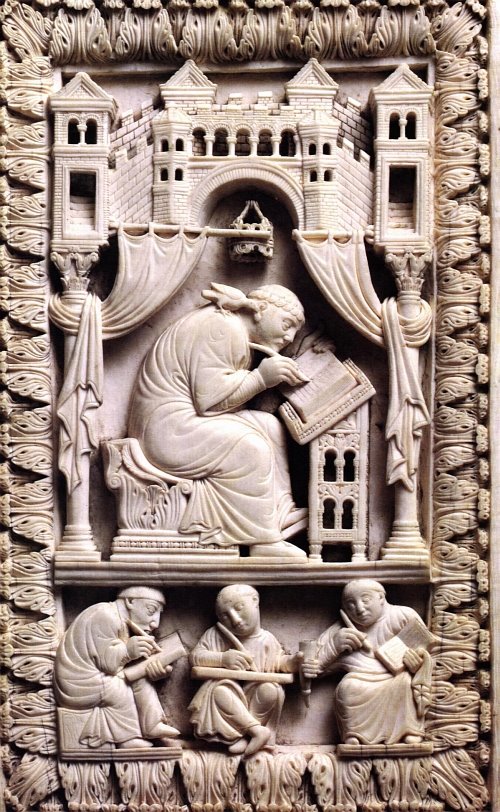 Living at a time when political and religious leadership in Europe often depended upon force of arms or strength of will more than the rule of law, Gregory became one of the continent's greatest leaders in both the secular and sacred arenas of his era. Born around AD 540, he became Prefect of Rome. In this capacity, he restored economic vitality to his native city following years of political upheaval and invasions by various Germanic tribes.
He later sold all his properties, donated the proceeds to help the poor, he entered into full-time service in the Church as a monk. Although he seemed content with the monastic life, his intellectual abilities and theological acumen led him on to ordination, which finally climaxed with his election on 3 September 590 as Bishop of Rome.
In this office, he oversaw growth in church music and liturgical development; the style of liturgical music known as Gregorian Chant is still used in much of Western Christendom. He also established a church-year calendar still used by many churches in the western World today. His concern for the poor continued and he oversaw the construction of a hospital that served dinner to the underprivileged next to his home.
A chance encounter led to his championing of missionary outreach to northern Europe: After meeting English prisoners in a Roman slave market, he directed a monk and prior of the Monastery of Saint Andrew named Augustine to begin mission work in the British Isles. This man, later known as Saint Augustine of Canterbury (not to be confused with the better-known Augustine of Hippo), did much to spread Christianity throughout Britain.
Gregory was the first pope of the Roman Church to come from a monastic background. His book Liber Regulae Pastoralis (The Book of the Pastoral Rule) was a standard text until the 20th Century. Church historians consider Gregory to be the last of the Latin Church Fathers and count him among the Doctors of the Church (see the commemoration of Saint Ambrose for the list of the eight great doctors). The Eastern Church remembers him as Gregory Dialogus in honor of the Dialogues he wrote.
Gregory died on 12 March AD 604. Rather than keeping the commemoration on his death date (or "heavenly birthday"), the LCMS moved it to the date of his consecration in order to avoid its observation during the penitential season of Lent.
Lection
Psalm 57:6-11 or 33:1-5, 20-21
1 Chronicles 25:1a, 6-8
Mark 10:42-45
Collect
Almighty and most merciful Lord, who raised up Gregory of Rome to be a servant of the people of God and inspired him to send missionaries to preach the Gospel to the English people, preserve in Your Church the catholic and apostolic faith he confessed, that Your people, being fruitful in every good work, may receive the crown of glory that never fades away; through Jesus Christ our Lord, who lives and reigns with you and the Holy Spirit, one God, now and forever.
Labels: biography, christianity, church history, commemoration, doctors of the church, european history, gregory, hagiography, music, papacy, patristics
¶ 00:00 | 0 comments |
Irenaeus (ca. AD 130-200), believed to be a native of Smyrna (modern Izmir, Turkey), studied in Rome and later became pastor in Lyons, France. Around 177, while Irenaeus was away from Lyons, a fierce persecution of Christians led to the martyrdom of his bishop. Upon Irenaeus' return, he became Bishop of Lyons.His most famous writing is Adversus Haereses (Against Heresies). This work condemned several errors but focused especially on Gnosticism, which denied the goodness of creation. In opposition, Irenaeus confessed that God has redeemed his creation through the incarnation of the Son. Irenaeus also affirmed the teachings of the Scriptures handed down to and through him as being normative for the Church.
Despite a few stray texts, very little suggests that he did not die a natural death. He was buried in Saint John's Church, Lyon — a congregation later renamed in his honor. Huegenot Calvinists destroyed his tomb and his remains during in 1522, during a period of iconoclasm.
Collect
Almighty God, You upheld your servant Irenaeus, giving him strength to confess the truth against every false doctrine; keep us, we pray, steadfast in Your Word and grant us the practice of true religion, that in constancy and peace we may walk in the way of eternal life; through Jesus Christ our Lord, who lives and reigns with You and the Holy Spirit, one God, now and forever.
Labels: biography, christianity, church history, commemoration, european history, french history, hagiography, irenaeus, lutheranism, lyons, patristics
¶ 00:00 | 0 comments |
Saint Cyril (ca. AD 376-444) became Patriarch of Alexandria, Egypt in 412. Throughout his career he defended a number of orthodox doctrines, among them the teaching that Mary, the mother of Jesus, is "rightly called and truly is the Mother of God" — Theotokos, "the God-Bearer" (Formula of Concord, Epitome, VIII:12). In 431 the Council of Ephesus affirmed this teaching that the Son of Mary is also true God.The Council was responding to the Nestorian heresy, which distinguished so completely between the divine and human natures of Christ that claims were made that the divine Christ did some things while the human Jesus did others.
Some of the differences are quite subtle; perhaps even Nestorius himself could not have foreseen the full ramifications of his position, including a "resurrection" of only the divine nature. Ephesus condemned the title of "Christ-Bearer" (Christotokos) for the Virgin, since the Nestorians would only claim that Mary bore the Christ, but not God Himself.
Cyril receives almost as many brickbats as he does bouquets, even from orthodox Christians, because he's also known for being what one person calls "an ill-tempered, quarrelsome, hasty, and violent man." This seems especially so during his early years as Bishop of Alexandria.
A particularly acute example of his extreme rigidity comes from his closing of Novatianist churches, although the Novationists weren't particularly unorthodox. Their "fault" was as much one of pride as of theology — they descended from those who'd stood firm in the persecutions of earlier years and refused to associate or worship with the heirs of those who recanted the Faith under persecution. Their main theological aberration were insisting upon rebaptism of converts from "lapsed" Christianity and an attitude that was, perhaps, less than Christ-like in dealing with erring brothers.
Cyril also ran the Jews out of town. The reason given was that they were seditious and violent, although we're left with little evidence. This action likely contributed to an ongoing feud with Orestes, the imperial prefect. These disagreements seemingly spilled over into a quarrel with the prefect's friend, the neo-platonist scholar Hypatia, who was later murdered by a mob.
Few have directly condemned Cyril for her death but the leaders of the mob certainly claimed the bishop as their leader. In modern times, Carl Sagan, in his book Cosmos, blamed Hypatia's death (and the destruction of the great Library of Alexandria) on dogmatic Christianity's desire to root out rational paganism. However, other scholars see the whole feud as an internal Church struggle and no one has yet established a definitive cause (or date) for the final destruction of Alexandria's library.
At any rate, and despite the considerable rancor that accompanied his early years as bishop, the mature Cyril worked diligently to reconcile the Nestorian and Orthodox parties. His efforts led many of the less virulent Nestorians back to full communion.
The writings of Cyril on the doctrines of the Trinity and the person of Christ reveal him to be one of the most able theologians of his time. Cyril's Christology influenced subsequent church councils and was a primary source for Lutheran confessional writings. He still speaks clearly to our age, especially as the old Christological heresies are trotted out under new guises.
Collect
Heavenly Father, You used Your servant Cyril to confess the mysteries of the Holy Trinity and of Your Son being one person with fully divine and human natures. Grant that we, also, might be constant in Your Word, bold in Your confession, and steadfast in Your worship, to the glory of Your holy Name; through Jesus Christ our Lord, who lives and reigns with You and the Holy Spirit, one God, now and forever.
Labels: alexandria, biography, christianity, church history, commemorations, cyril, hagiography, lutheranism, nestorianism, patristics, theotokos
¶ 00:00 | 0 comments |


