
 Pentecost, an Israelite festival connected to the spring harvest, was the time chosen by the Lord for the special outpouring of the Holy Spirit upon the disciples as they waited in Jerusalem.
With wind and fire, the Holy Spirit manifested Himself upon the apostles. Immediately, they rushed out to begin proclaiming the Gospel of Jesus Christ crucified for our sins and raised for our justification. The account is in Acts 2:1-41. Such was the power of the Holy Spirit working through Law and Gospel preaching that He converted over 3000 people faith in Christ at one time.
In Christianity, Pentecost is a "movable feast." Under the Old Covenant, including among modern Jews, Pentecost was (and is) the fiftieth day of Passover. The Christian Church, as more Gentiles swelled its ranks, kept the idea of the fiftieth day but based the celebration on the date for Easter rather than for Passover. See the second question under Notes on the Christian Calendar for a bit more on how we arrive at a date each year.
If you're preaching on the Genesis text, take a look at Upon the Plain of Shinar, a hymn by Pastor Walter Snyder.
Lection: Three Year Cycle, Series A
Psalm 25:1-15
Numbers 11:24-30
Acts 2:1-21
John 7:37-39
Lection: One Year Cycle
Psalm 143
Genesis 11:1-9
Acts 2:1-21
John 14:23-31
Collect
O God, on this day You once taught the hearts of Your faithful people by sending them the light of Your Holy Spirit. Grant us in our day by the same Spirit to have a right understanding in all things and evermore to rejoice in His holy consolation; through Jesus Christ, Your Son, our Lord, who lives and reigns with You and the Holy Spirit, one God, now and forever.
Labels: acts, apostle, christ, church history, conversion, disciple, easter, feasts, festivals, gospel, holy ghost, holy spirit, jesus, new testament, pentecost, pneumatology, translation
¶ 00:00 | 0 comments |

 This major Christological feast commemorates the joyous visit Mary paid to her relative (probably her cousin) Elizabeth, following The Annunciation. Inspired by the amazing news that she was to become the mother of the Christ and in response to the joyous word that her old and previously barren kinswoman was also pregnant, she joined Elizabeth during her sixth month of pregnancy (see Luke 1:39-56).
After Mary declared the wondrously good news, Elizabeth replied to the Virgin, "Blessed are you among women, and blessed is the fruit of your womb! ... Behold, when the sound of your greeting came to my ears, the baby in my womb leaped for joy. (vv. 42, 44)" She concluded by giving full credit and glory to God while also commending her young cousin's hearty faith: "Blessed is she who believed that there would be a fulfillment of what was spoken to her from the Lord. (v. 45)"
Mary responded with the Magnificat, the beautiful song of praise beginning, "My soul magnifies the Lord. (vv. 46-55)" It's not clear whether Mary stayed there until after the birth of John or if she left immediately beforehand; Luke merely said that the Virgin "remained with her about three months and returned to her home. (v. 56)"
And so, as we encounter God sending the Forerunner and the Messiah into the world, we see a study in contrasts. Two women stand before each other. One seemingly too old to bear children now carries the final prophet of the Old Covenant. The other, youthful and as yet unwed — completely unprepared in the eyes of the world — carries the One who brings both the Advent and the Fulfillment of the New Testament. And again we see, in the fullness of time, one age passing away while another age begins — an age that has no end but which lasts unto eternity.
The reaction of Jesus' unborn cousin and the words of his mother also serve as reminders to many Christians about the sanctity of life. Christian pro-lifers point to John's celebration as clear evidence of the humanity and the consciousness of children who are still in utero.
In Roman Catholicism, Vatican II changed the date of the observation from 2 July to 31 May in order to more accurately reflect the Bible's chronology regarding the life of Christ. Several other Western churches followed suit. In The Lutheran Church — Missouri Synod, today is celebrated in congregations following the Three Year Lectionary while the One Year Lectionary retains the July feast date.
Note: This illustration by Albrecht Dürer is from the Web Gallery of Art.
Lection
Psalm 138
Isaiah 11:1-5
Romans 12:9-16
Luke 1:39-56
Collect
Almighty God, You chose the virgin Mary to be the mother of Your Son and made known through her Your regard for the poor and lowly and despised. Grant that we may receive Your Word in humility and faith, and so be made one with Jesus Christ, Your Son, our Lord, who lives and reigns with You and the Holy Spirit, one God, now and forever.
The Magnificat
My soul magnifies the Lord,
and my spirit rejoices in God my Savior,
for He has looked on the humble estate of his servant.
For behold, from now on all generations will call me blessed;
for He who is mighty has done great things for me,
and holy is His name.
And His mercy is for those who fear Him
from generation to generation.
He has shown strength with His arm;
He has scattered the proud in the thoughts of their hearts;
He has brought down the mighty from their thrones
and exalted those of humble estate;
He has filled the hungry with good things,
and the rich He has sent empty away.
He has helped His servant Israel,
in remembrance of His mercy,
as He spoke to our fathers,
to Abraham and to his offspring forever.
Labels: christ, christology, elizabeth, feasts, festivals, gospels, incarnation, jesus, john the baptist, magnificat, mary, nativity, new testament, visitation
¶ 00:00 | 0 comments |
 Easter Sermon from John Chrysostom
Are there any who are devout lovers of God?
Let them enjoy this beautiful bright festival!
Are there any who are grateful servants?
Let them rejoice and enter into the joy of their Lord!
Are there any weary with fasting?
Let them now receive their wages!
If any have toiled from the first hour,
let them receive their due reward;
If any have come after the third hour,
let him with gratitude join in the Feast!
And he that arrived after the sixth hour,
let him not doubt; for he too shall sustain no loss.
And if any delayed until the ninth hour,
let him not hesitate; but let him come too.
And he who arrived only at the eleventh hour,
let him not be afraid by reason of his delay.
For the Lord is gracious and receives the last even as the first.
He gives rest to him that comes at the eleventh hour, as well as to him that toiled from the first.
To this one He gives, and upon another He bestows.
He accepts the works as He greets the endeavor.
The deed He honors and the intention He commends.
Let us all enter into the joy of the Lord!
First and last alike receive your reward; rich and poor, rejoice together!
Sober and slothful, celebrate the day!
You that have kept the fast, and you that have not, rejoice today for the Table is richly laden!
Feast royally on it, the calf is a fatted one.
Let no one go away hungry.
Partake, all, of the cup of faith.
Enjoy all the riches of His goodness!
Let no one grieve at his poverty,
for the universal kingdom has been revealed.
Let no one mourn that he has fallen again and again;
for forgiveness has risen from the grave.
Let no one fear death, for the Death of our Savior has set us free.
He has destroyed it by enduring it.
He destroyed Hell when He descended into it.
He put it into an uproar even as it tasted of His flesh.
Isaiah foretold this when he said, “You, O Hell, have been troubled by encountering Him below.”
Hell was in an uproar because it was done away with.
It was in an uproar because it is mocked.
It was in an uproar, for it is destroyed.
It is in an uproar, for it is annihilated.
It is in an uproar, for it is now made captive.
Hell took a body, and discovered God.
It took earth, and encountered Heaven.
It took what it saw, and was overcome by what it did not see.
O death, where is thy sting?
O Hell, where is thy victory?
Christ is Risen, and you, O Death, are annihilated!
Christ is Risen, and the evil ones are cast down!
Christ is Risen, and the angels rejoice!
Christ is Risen, and life is liberated!
Christ is Risen, and the tomb is emptied of its dead;
for Christ having risen from the dead,
is become the first-fruits of those who have fallen asleep.
To Him be Glory and Power forever and ever. Amen!
Lection (Series A)
Easter Sunrise
Psalm 118:15-29
Exodus 14:10-15:1
1 Corinthians 15:1-11
John 20:1-18
Easter Day
Psalm 16
Acts 10:34-43 or Jeremiah 31:1-6
1 Corinthians 15:19-26
Matthew 28:1-10
Easter Evening
Psalm 100
Exodus 15:1-18 or Daniel 12:1c-3
Acts 10:34-43 or 1 Corinthians 5:6b-8
Luke 24:13-35 (36-49)
Lection (One Year)
Easter Sunrise
Psalm 16
Isaiah 25:6-9 or Exodus 14:10-15:1
1 Corinthians 15:1-11 or 1 Corinthians 15:12-25
John 20:1-18
Easter Day
Psalm 118:15-29
Job 19:23-27
1 Corinthians 5:6-8 or 1 Corinthians 15:51-57
Mark 16:1-8
Easter Evening
Psalm 100
Exodus 15:1-18
Acts 10:34-43
Luke 24:13-35
Collect
Easter Sunrise
Almighty and most merciful God, pour out on us Your abundant blessing that all who in true faith share this time in joyful celebration of the resurrection of our Lord Jesus Christ from the dead may be filled with Your heavenly benediction. Once we were in darkness, but now we are in the Light, even Jesus Christ, our Lord.
Easter Day
Almighty God the Father, through Your only-begotten Son, Jesus Christ, You have overcome death and opened the gate of everlasting life to us. Grant that we, who celebrate with joy the day of our Lord’s resurrection, may be raised from the death of sin by Your life-giving Spirit; through Jesus Christ, our Lord, who lives and reigns with You and the Holy Spirit, one God, now and forever.
Labels: christ, christology, easter, feasts, festivals, gospels, jesus, john chrysostom, lectionary, life, new testament, resurrection, series a
¶ 00:00 | 0 comments |
 The Father chose to sacrifice His Son rather than banish sinful mankind to an eternity of suffering. Also, Christ died because the Scriptures which point to the coming Savior "require" his suffering and death.
The most noted of these prophecies is probably Isaiah 52:13-53:12. Through the prophet, the Lord predicts what would happen to His faithful Servant: "He was wounded for our transgressions; he was crushed for our iniquities. (53:5)" He was "like a lamb that is led to the slaughter (53:7)" and "was cut off out of the land of the living. (53:8)" Finally, "They made his grave with the wicked and with a rich man in his death, although he had done no violence, and there was no deceit in his mouth. (53:9)"
God cannot go back on His Word. From Creation's dawn, He warned that sin always results in death. Someone had to die, either one innocent Man or millions and billions of guilty people. Through Paul, God said, "The wages of sin is death (Romans 6:23a)"
However, God applied the life-giving "wages" earned by His sinless Son as payment in full on our accounts and credited us with Jesus' perfection. Likewise, the deadly wages that were our due were paid in full to Jesus in His suffering and death. Because of this, "the free gift of God is eternal life in Christ Jesus our Lord. (23b)" (Adapted from Jesus' Death at Ask the Pastor; used by permission.)
Lection — Three Year Cycle
Psalm 22 or Psalm 31
Isaiah 52:13-53:12
Hebrews 4:14-16; 5:7-9
John 18:1-19:42 or John 19:17-30
Lection — One Year Cycle
Psalm 22 or Psalm 31
Isaiah 52:13-53:12
2 Corinthians 5:14-21
John 18:1-19:42
Collects
Almighty God, Your Son Jesus Christ was lifted high upon the cross so that He might draw the whole world to Himself. Grant that we who glory in His death for our salvation may also glory in His call to take up our cross and follow Him; through Your Son, Jesus Christ, our Lord, who lives and reigns with You and the Holy Spirit, one God, now and forever.
Almighty God, graciously behold this Your family for whom our Lord Jesus Christ was willing to be betrayed, to be given into the hands of sinners, and to suffer death on the cross; through the same Jesus Christ, who now lives and reigns with You and the Holy Spirit, one God, now and forever.
Labels: christ, christology, crucifixion, death, feasts, festivals, good friday, holy week, jesus, series a, series b, series c, suffering
¶ 00:00 | 0 comments |
 The Church uses this fifth day of Holy Week to remember the institution of the Lord's Supper. From the account of the Upper Room in John 13:1-15, some have called it the Day of Foot Washing.
"Maundy" may come from the Latin Bible's rendering of John 13:34, where Jesus gave the disciples a new mandatum (commandment) in the upper room: "A new commandment I give to you, that you love one another: just as I have loved you, you also are to love one another."
Another idea is that it grew out from an ancient custom of carrying gifts to the poor in hand baskets (known as "maunds" or "maund baskets") on that day.
Of much more importance than the name of the day is the gift Jesus gave. For on this night on which He was betrayed, our Savior gave first to His disciples His very body and blood for them to eat and to drink. Under bread and wine, He continues to give this gift, that we also might eat His flesh, drink His blood, and receive forgiveness of sins, life, and salvation.
Lection — Three Year Cycle
Option I
Psalm 116:12-19
Exodus 24:3-11
Hebrews 9:11-22
Matthew 26:17-30
Option II
Psalm 116:12-19
Exodus 12:1-14
1 Corinthians 11:23-32
John 13:1-17, 31b-35
Lection — One Year Cycle
Psalm 116:12-19
Exodus 12:1-14 or Exodus 24:3-11
1 Corinthians 11:23-32
John 13:1-15 (34-35)
Collect
O Lord, in this wondrous Sacrament You have left us a remembrance of Your passion. Grant that we may so receive the sacred mystery of Your body and blood that the fruits of Your redemption may continually be manifest in us; for You live and reign with the Father and the Holy Spirit, one God, now and forever.
Labels: christ, communion, feasts, festivals, holy thursday, holy week, jesus, judas, last supper, lord's supper, maundy thursday, series a
¶ 00:00 | 0 comments |
9 April AD 2017
 The Sunday before His crucifixion, our Lord Christ rode into Jerusalem on a donkey. Accompanied by His disciples, He heard the people crying, "Hosanna!" This ancient petition translates, "Save now!" It stems from the same root as does the name "Jesus."
Palm Sunday thereby reminds us of the Annunciation, when Gabriel told Mary what to name the Child. Even more so, it recalls the angel's visit to Joseph, who heard the angel tell him of Mary's Son, "You shall call his name Jesus, for he will save his people from their sins (Matthew 1:21)" and also The Circumcision and Name of Jesus.
Jesus heard this prayer and answered according to His Father's will. Their salvation — and our salvation — was nigh, for in a few short days, He would gift His Church with a new meal of His own body and blood and would then be betrayed and would suffer and die to forgive us all our sins. All four evangelists record the events of this day. However, only Saint John included mention of palm branches being cut as part of the apparent victory parade, yet this one mention gave this day its classic title.
 More recently, many liturgical churches have begun using "Passion Sunday" or "Sunday of the Passion" instead. This name emphasizes less the triumphal entry at the week's beginning but points more to the blood-stained exit on Friday as Jesus went to Golgotha.
Actually, as some of the Church's hymnody points out, both titles have their place and both exist well in relationship to each other. For expanded commentary on palms, Passion, and hymns, see Hosannas and Palm Branches at Ask the Pastor.
The traditional color for this day is purple, as it has been throughout Lent. However, many church bodies have gone to using scarlet as the preferred color for Holy Week, either until Holy Thursday or Good Friday. White is the other appropriate color for Maundy Thursday while Good Friday's paraments and vestments should be black — or they should not be used at all.
Lection — Three Year Cycle: Series A
John 12:12-19 (Palm Sunday Procession)
Psalm 118:19-29 or 31:9-16
Isaiah 50:4-9a
Philippians 2:5-11
Matthew (26:1-27:10) 27:11-66 or John 12:20-43
Lection — One Year Cycle
Matthew 21:1-9 or John 12:12-19 (Palm Sunday Procession)
Psalm 118:19-29 or 31:9-16
Zechariah 9:9-12
Philippians 2:5-11
Matthew 26:1-27:66 or Matthew 27:11-54
Collects
Most merciful God, as the people of Jerusalem, with palms in their hands, gathered to greet Your dearly beloved Son when He came into His Holy City, grant that we may ever hail Him as our King and, when He comes again, may go forth to meet Him with trusting and steadfast hearts and follow Him in the way that leads to eternal life; through the same Jesus Christ, our Lord, who lives and reigns with You and the Holy Spirit, one God, now and forever. (Collect for the Palm Sunday Procession)
Almighty and everlasting God, You sent Your Son, our Savior Jesus Christ, to take upon Himself our flesh and to suffer death upon the cross. Mercifully grant that we may follow the example of His great humility and patience and be made partakers of His resurrection; through the same Jesus Christ, our Lord, who lives and reigns with You and the Holy Spirit, one God, now and forever. (Collect of the Day for the Sunday of the Passion)
Paintings by Pietro Lorenzetti from the Web Gallery of Art.
Tags: Palm Sunday | Passion Sunday | Sunday of the Passion | Lent | Holy Week | Good Friday | Easter | Jesus | Jesus Christ | Christ | Jerusalem | Church Year | liturgical calendar | Christianity | Christian feasts| historical theology | Church history | Bible history | New Testament | Gospel | palms | donkey
Labels: christ, christology, feasts, festivals, gospels, holy week, jerusalem, jesus, new testament, palm sunday, sunday of the passion
¶ 00:00 | 0 comments |
Transferred to 4 April AD 2016
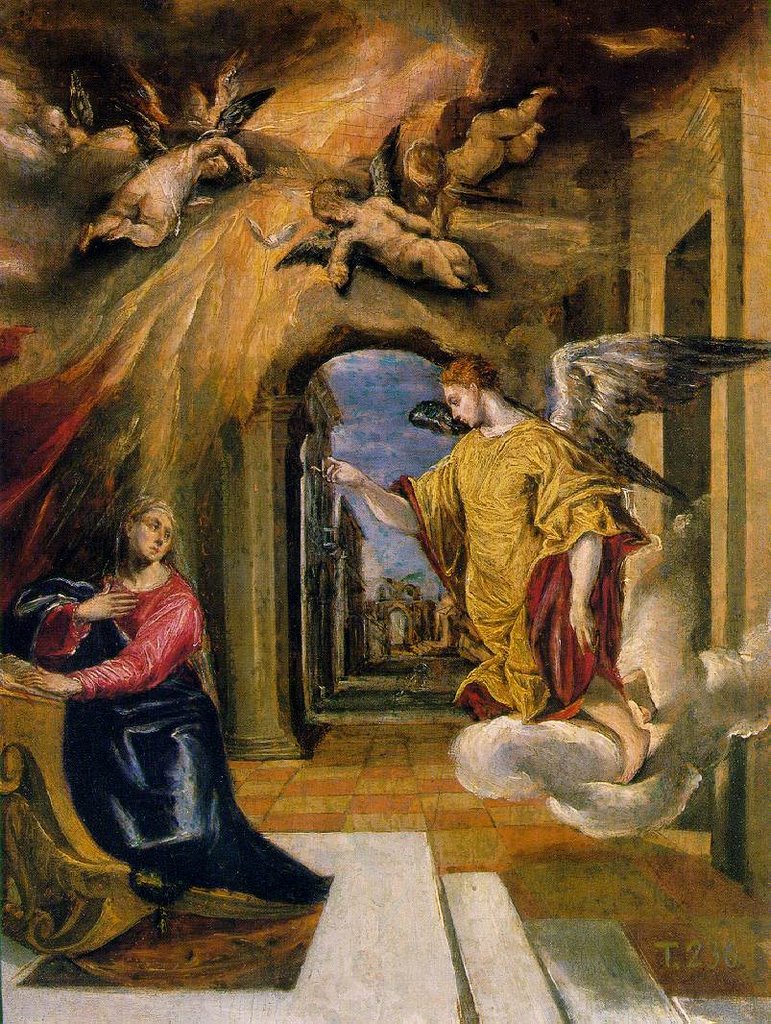 Luke 1:26-38 tells us how the angel Gabriel announced to Mary of Nazareth that she had been chosen to be the mother of the Christ and her response. Mary, a virgin pledged to marry Joseph, briefly wondered how this could be, since she had not had sex with any man.
Once Gabriel told her that the Child was conceived by the Holy Spirit, she humbly accepted this sacred obligation: "Behold, I am the servant of the Lord; let it be to me according to your word. (v. 38)"
Nothing prevents us from supposing that Our Lord was conceived immediately after this. Since the Church from early days observed 25 March as the date of the Annunciation, the celebration of the Christ's Nativity is observed on 25 December, nine months later.
For centuries in vast parts of Europe, 25 March also marked the change to the new year. While it seems somewhat odd and abrupt to change years in the middle of a month, we can imagine that those accustomed to that calendar easily made the adjustment. Furthermore, they could take to heart the reminder that God's chosen time, that most special time when He sent His Son into human flesh, merited such a "strange" circumstance.
Even though the Visitation of Mary to her cousin Elizabeth took place six months later (see Luke 1:39-56) — as Elizabeth neared the end of her own pregnancy with the child who would grow to become John the Baptizer — Mary's song of celebration at that time is also appropriate to remember on the Feast of the Annunciation. In the Magnificat (Luke 1:46-55) the virgin mother of God celebrated God's gift to her, to Israel, and to all people.
Martin Luther wrote a commentary on this canticle. About verse 49, he said, "The 'great things' are nothing less than that she became the Mother of God, in which work so many and such great good things are bestowed upon her as pass man's understanding. For on this there follows all honor, all blessedness, and her unique place in the whole of mankind, among whom she has no equal, namely, that she had a child by the Father in Heaven, and such a child.
"She herself is unable to find a name for this work, it is too exceedingly great; all she can do is break out in the fervent cry: 'They are great things,' impossible to describe or define. Hence men have crowded all her glory into a single word, calling her the Mother of God.
"No one can say anything greater of her or to her, though he had as many tongues as there are leaves on the trees, or grass in the fields, or stars in the sky, or sand by the sea. It needs to be pondered in the heart, what it means to be the Mother of God."
The Annunciation is such an important Christological feast that it takes precedence over even the Sundays in Lent in much of Christendom. See Looking Ahead at Weedon's Blog for details.
Lection
Psalm 45:7-17
Isaiah 7:10-14
Hebrews 10:4-10
Luke 1:26-38
Collect
O Lord, as we have known the incarnation of Your Son Jesus Christ by the message of the angel to the virgin Mary, so by His cross and Passion bring us to the glory of His resurrection; through the same Jesus Christ, our Lord, who lives and reigns with You and the Holy Spirit, one God, now and forever.
NOTE: Regarding the occasional transfer of this major feast, the Lutheran Service Book: Altar Book states on page 960, It is appropriate to observe this feast day in all its fullness during Lent. However, according to historical precedent, when the Annunciation falls during Holy Week or on Easter Day (or also on the Fifth Sunday in Lent in the one-year series), it should not be observed at those times but may be transferred to a weekday following the Second Sunday of Easter. In most of Eastern Christendom, rather than transferring the Annunciation, it is celebrated fully. In Orthodoxy, this normally means the celebratory Liturgy of John Chrysostom.
Luther quote from Luther's Works, Vol. 21, p. 326, ed. Jaroslav Pelikan, Concordia Publishing House © 1956.
Labels: annunciation, christ, christology, feasts, festivals, gabriel, gospels, incarnation, jesus, luke, mary, new testament, theotokos
¶ 00:00 | 0 comments |
 Today celebrates the Conversion of Saint Paul through the revelation of the risen Christ to him on the road to Damascus. The zealous Pharisee Saul was traveling to arrest followers of Jesus. Instead of capturing Christians, Paul found Himself made captive by his Savior's boundless grace and became Christ's primary apostle to the Gentiles. Accounts of the event are in Acts 9:1-22; Acts 26:9-21; and Galatians 1:11-24.
Paul's normal symbol in ecclesiastical art is a shield with sword and open Bible. The Latin words Spiritus Gladius (sword of the Spirit) come from the apostle's words about the armor of God, where he urges believers to take up "the sword of the Spirit, which is the Word of God. (Ephesians 6:17)" The sword also reminds us of the traditional accounts of his martyr's death, which speak of his beheading during the Neronian Persecution.
Lection
Psalm 67
Acts 9:1-22
Galatians 1:11-24
Matthew 19:27-30
Collect
Almighty God, as You turned the heart of him who persecuted the Church and by his preaching caused the light of the Gospel to shine throughout the world, grant us ever to rejoice in the saving light of Your Gospel and to spread it to the uttermost parts of the earth; through Jesus Christ, Your Son, our Lord, who lives and reigns with You and the Holy Spirit, one God, now and forever.
Labels: acts, ananias, apostle, christ, conversion, damascus, epistles, feasts, festivals, jesus, new testament, saint paul, saul
¶ 00:00 | 1 comments |
 Today we celebrate God's blessed revelation to the disciples that Jesus was more than a good man, a holy man, an outstanding teacher, or an awesome miracle worker: Thus, we also celebrate that through the Apostles and Evangelists, we also know and believe that Jesus is "the Christ, the Son of the living God. (Matthew 16:16)"
Flesh and blood still don't reveal this to us; faith is still a gift of the Holy Spirit working through the Word of God. However, with the primary means of the Gospel Word, God uses the secondary means of flesh and blood to proclaim and teach each new generation this central confession of the Christian Faith.
Thus, once the Father, working through the Holy Spirit, created faith in Peter and the others that Jesus was the Anointed One promised by the prophets, Jesus commissioned them to minister in His Name. Yet they weren't to begin immediately. Peter's great Christological "aha!" would sit in silence until after the Son of Man went to Jerusalem to "suffer many things from the elders and chief priests and scribes, and be killed, and on the third day be raised. (Matthew 16:21)"
After the Resurrection, the Apostles received the fullness of the Holy Spirit at Pentecost and immediately put this confession into the world. Preaching, teaching, baptizing, and absolving sinners, the original disciples discipled others. The Good News of the suffering, dying, and risen Messiah led thousands, then millions to the Faith.
 Using the Keys of the Kingdom of Heaven — the binding of unrepentant sinners' trangressions to them and the remission of sins for those who believe in Jesus as their Savior — remains the Church's mission. Their exercise is through the divinely created Office of the Holy Ministry, wherein Christ's called pastors continue to forgive sins on behalf of their Lord.
Through the pastoral office, Jesus continues to breathe His Spirit upon His appointed messengers. They continue the apostolic practice of forgiving sins in His stead and by His command while still firmly declaring the unremitting wrath of God against those who will not repent and believe: "If you forgive the sins of anyone, they are forgiven; if you withhold forgiveness from anyone, it is withheld. (John 20:23)"
The Lutheran Confessions are replete with many instances and expressions of this gracious office. One brief and clear section is in the Small Catechism in the writing on Confession.
Lection
Psalm 118:19-29
Acts 4:8-13
2 Peter 1:1-15
Mark 8:27-35 (36-9:1)
Collect
Dear Father in heaven, You revealed to the apostle Peter the blessed truth that Your Son Jesus is the Christ. Strengthen us by the proclamation of this truth that we too may joyfully confess that there is salvation in no one else; through the same Jesus Christ, our Lord, who lives and reigns with You and the Holy Spirit, one God, now and forever.
Labels: apostle, christ, confession, disciple, feasts, festivals, gospels, jesus, keys, new testament, saint peter
¶ 00:00 | 1 comments |
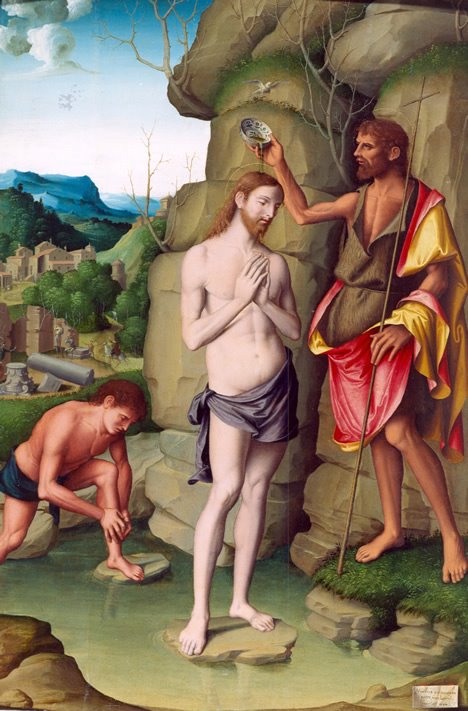 The Baptism of our Lord (Matthew 3:13-17; Mark 1:4-11; Luke 3:15-16, 21-22) is always celebrated on the first Sunday after the Epiphany. Christians remember how John baptized Jesus in the Jordan River. The Holy Spirit assumed the form of a dove and came down to rest on Jesus' head while the voice of the Father spoke from the heavens, saying, "This is my beloved Son, with whom I am well pleased. (Mark 1:11)"
His Baptism marks the first adult appearance of our Lord recorded in Holy Scripture. Prior to this day, the last we hear of Him was following His return from the temple as a twelve year old boy. Luke records, "And Jesus increased in wisdom and in stature and in favor with God and man. (2:52)"
 Following His baptism, "The Spirit immediately drove him out into the wilderness. (Mark 1:12)" There He remained for forty days of fasting and temptation by Satan. Once the time of temptation was over, Jesus entered into His public ministry as He called the disciples, worked miracles, preached and taught, forgave sins, and prepared Himself for the suffering and death awaiting Him.
With John, we might wonder why Jesus came to be baptized (see Matthew 3:14). However, Jesus told him, "It is fitting for us to fulfill all righteousness. (Matthew 3:15)" Jesus' baptism publicly marked Him as God's Anointed One (Messiah or Christ). He had nothing for which He needed to repent, so His entry into Baptism's waters was not to wash away sins. Instead, He took all the sins of mankind upon Himself. He identified Himself as one of us by being baptized and spent the rest of His earthly life fulfilling our righteousness, keeping the Law perfectly.
Lection
Series A
Psalm 29
Isaiah 42:1-9
Romans 6:1-11
Matthew 3:13-17
One Year Lectionary Cycle
Psalm 85
Joshua 3:1-3, 7-8, 13-17 or Isaiah 42:1-7
1 Corinthians 1:26-31
Matthew 3:13-17
Collect
Father in heaven, at the Baptism of Jesus in the Jordan River You proclaimed Him Your beloved Son and anointed Him with the Holy Spirit. Make all who are baptized in His name faithful in their calling as Your children and inheritors with Him of everlasting life; through the same Jesus Christ, our Lord, who lives and reigns with You and the Holy Spirit, one God, now and forever.
Labels: baptism, christ, christology, epiphany, epiphany 1, feasts, festivals, gospels, jesus, john the baptist, jordan river, messiah, synoptics
¶ 00:00 | 0 comments |
 The Epiphany season begins today, with the Feast of the Epiphany. This day celebrates the Wise Men bringing their gifts of gold, frankincense, and myrrh to the Christ Child.
The word Epiphany means "showing" or "manifestation" and the entire season from today until the beginning of Lent deals in one way with the ways in which Jesus was shown to be the Christ, either by His own words and deeds or by the actions of the Father and the Holy Spirit (as in His baptism). The hymn Songs of Thankfulness and Praise (printed below) praises many of these manifestations and anticipates that last, great Epiphany, when Jesus manifests Himself visibly before all mankind and brings His Church home to eternal glory.
In much of the world, Epiphany, not Christmas, is a day for giving gifts to family and friends. Rather than using the day in which the Father gave His Son to a sin-darkened and unexpecting world, many nations choose the day celebrating the gifts the Wise Men brought the Christ Child as a day of giving gifts to their own children (and to others). This Wikipedia article details some of the religious and cultural practices of the day. Of course, some countries are done with the presents before Christmas; they choose Saint Nicholas Day on 6 December as the time of giving gifts.
The Wise Men Traveled from Afar, another Epiphany hymn, is posted at the Happenings and Ask the Pastor blogs. Ask the Pastor also has several archived posts pertaining to the Epiphany: Unbiblical Christmas Carols, Jesus and the Wise Men, and Names of the Magi.
Lection
Psalm 72
Isaiah 60:1-6
Ephesians 3:1-12
Matthew 2:1-12
Collect
 O God, by the leading of a star You made known Your only-begotten Son to the Gentiles. Lead us, who know You by faith, to enjoy in heaven the fullness of Your divine presence; through the same Jesus Christ, our Lord, who lives and reigns with You and the Holy Spirit, one God, now and forever.
Hymn
Songs of Thankfulness and Praise
- Songs of thankfulness and praise,
Jesus, Lord, to Thee we raise,
Manifested by the star
To the sages from afar,
Branch of royal David's stem,
In Thy birth at Bethlehem.
Anthems be to Thee addressed
God in man made manifest. - Manifest at Jordan's stream,
Prophet, Priest, and King supreme,
And at Cana, Wedding-guest,
In Thy Godhead manifest;
Manifest in power divine,
Changing water into wine.
Anthems be to Thee addressed
God in man made manifest. - Manifest in making whole
Palsied limbs and fainting soul;
Manifest in valiant fight,
Quelling all the devil's might;
Manifest in gracious will,
Ever bringing good from ill.
Anthems be to Thee addressed,
God in man made manifest. - Sun and moon shall darkened be,
Stars shall fall, the heavens shall flee;
Christ will then like lightning shine,
All will see His glorious sign;
All will then the trumpet hear,
All will see the Judge appear;
Thou by all wilt be confessed,
God in man made manifest. - Grant us grace to see Thee, Lord,
Mirrored in Thy holy Word;
May we imitate Thee now
And be pure as pure art Thou
That we like to Thee may be
At Thy great Epiphany
And may praise Thee, ever blest,
God in man made manifest.
Labels: bethlehem, christ, christology, epiphany, feasts, festivals, gentiles, gospels, herod, jesus, magi, nativity, new testament, wise men
¶ 00:00 | 0 comments |
 This major feast day of the Christian Church marks the infant Jesus' eighth day of life. At this time, the Law required all boys of Israel to be circumcised (cf. Genesis 17:9-14; Leviticus 12:1-3).
On this day, our Savior also received His name (Luke 2:21). This fulfilled the command given to both Mary (Luke 1:31) and Joseph (Matthew 1:21) during their angelic visitations.
 Christ's circumcision placed Him fully under God's Law. His name Jesus, from the Hebrew "Joshua" (meaning "Yahweh saves" or "He saves"), bespeaks the purpose for which He assumed human flesh and came to live among us.
For more on this Christological feast, including the reason for using this particular date for the remembrance, please see On the Eighth Day of Christmas and Christianity and New Year's Day at Ask the Pastor.
Lection
Psalm 8
Numbers 6:22-27
Galatians 3:23-29
Luke 2:21
Collect
Lord God, You made Your beloved Son, our Savior, subject to the Law and caused Him to shed His blood on our behalf. Grant us the true circumcision of the Spirit that our hearts may be made pure from all sins; through Jesus Christ, our Lord, who lives and reigns with You and the Holy Spirit, one God, now and forever.
Labels: christ, christmas, christology, circumcision, covenant, feasts, festivals, gospels, jesus, law, luke, name, new testament
¶ 00:00 | 0 comments |
 Saint John, Apostle and Evangelist, a son of Zebedee, was one of the twelve apostles. With his brother James and Simon Peter, he formed an inner circle among the Twelve: Those three beheld the Great Catch of Fish (Luke 5:10), the healing of Peter's mother-in-law (Mark 1:29-31), the raising of Jairus' daughter(Mark 5:37; Luke 8:51), the Transfiguration (Matthew 17:1; Mark 9:2; Luke 9:28), and Gethsemane's agony (Matthew 26:37; Mark 14:33).
He expressed willingness to undergo martyrdom (Matthew 20:22; Mark 10:39) — as did the other apostles (Matthew 26:35; Mark 14:31). However, ancient testimony says that even though he was imprisoned and exiled, he was eventually released and died a natural death in Ephesus.
According to Mark 3:17, Jesus gave James and John "the name Boanerges, that is, Sons of Thunder." He is credited with the writing three epistles and one Gospel. He is also the probable author of Revelation, although this identification is less certain.
His symbol in ecclesiastical art is usually the eagle. This and the images used for the other evangelists come from the visions of the four living creatures around God's throne in heaven. See the biography of Saint Matthew for the specifics of each.
Lection
Psalm 11
Revelation 1:1-6
1 John 1:1-2:2
John 21:20-25
Collect
Merciful Lord, cast the bright beams of Your light upon Your Church that we, being instructed in the doctrine of Your blessed apostle and evangelist John, may come to the light of everlasting life; for You live and reign with the Father and the Holy Spirit, one God, now and forever.
Labels: apostle, boanerges, christ, disciple, evangelist, feasts, festivals, gospels, jesus, john, new testament, revelation
¶ 00:00 | 0 comments |
 Saint Stephen's Day remembers the first recorded martyr of the Church. Stephen knew the gift of Christmas: His Lord came in human flesh to bring forgiveness and as Jesus forgave His killers, so Stephen forgave those whose stones smashed away his life. The account of his calling, witness, and death is in Acts 6:1-8:2. Notice how closely the martyr's responses echo those of His Savior as each approached death.
In art, Stephen is often represented by the stones which took his life and by the palm branch, an ancient symbol of triumph and, especially in Christianity, of martyrdom. Both stones and branch are prominent in this Carlo Crivelli painting from the Demidoff Altarpiece.
Stephen's feast day supposedly occasioned of a great act of charity by the later martyred Wenceslaus, Kníže of Bohemia. Wenceslaus (or Václav) is remembered in the carol Good King Wenceslaus.
Lection
Psalm 119:137-144
2 Chronicles 24:17-22
Acts 6:8-7:2a, 51-60
Matthew 23:34-39
Collect
Heavenly Father, in the midst of our sufferings for Christ grant us grace to follow the example of the first martyr, Stephen, that we may also look to the One who suffered and was crucified on our behalf and pray for those who do us wrong; through our Jesus Christ, our Lord, who lives and reigns with You and the Holy Spirit, one God, now and forever.
Labels: acts, christ, christology, deacon, feasts, festivals, jesus, martyrdom, new testament, stephen, stoning
¶ 00:00 | 0 comments |
The Apostle Thomas (Hebrew or Aramaic for "twin") was also called Didymus (Greek for "twin"); either his parents gave him a most peculiar name or else he consistently went by his nickname.
 Absent when the Risen Lord appeared to the other apostles on the evening of Easter Day, He refused to believe that Christ had indeed risen until he had seen Him for himself. When he saw Him the following week, he said to Jesus, "My Lord and My God."
Because of this, he has been known ever since as "Doubting Thomas," although "Disbelieving Thomas" or even "Faithless Thomas" probably would be more accurate. See John 20:19-29 for the full account.
We also remember his earlier words, when Jesus announced His intention of going to Jerusalem, even though His life was in danger there: Thomas said to the others, "Let us also go, that we may die with him." (John 11:7-16) Thus, we see that Thomas was sturdily loyal.
At the Last Supper, Jesus said: "In my Father's house are many rooms. If it were not so, would I have told you that I go to prepare a place for you? And if I go and prepare a place for you, I will come again and will take you to myself, that where I am you may be also. And you know the way to where I am going." Thomas was the one who responded, "Lord, we do not know where you are going. How can we know the way?" To this Jesus answered: "I am the way, and the truth, and the life. No one comes to the Father except through me. (see John 14:1-6)"
 John 21 records Thomas as one of the seven disciples fishing on the Sea of Galilee when the Lord appeared to them. Aside from these Biblical accounts, he appears only as a name on lists of the Apostles.
A few centuries later, a story circulated in the Mediterranean world that he went to preach in India; a community in the Kerala district claims descent from Christians converted by the preaching of Thomas. Among Indian Christians, tradition claims that Thomas was speared to death near Madras, and accordingly is often pictured holding a spear.
Since he was credited with the building up of the Church through his missionary journeys, a carpenter's square also is a regular symbol of the apostle.
Lection
Psalm 136:1-4
Judges 6:36-40
Ephesians 4:7, 11-16
John 20:24-29
Collect
Almighty and ever living God, who upheld and strengthened Your apostle Thomas with sure and certain faith in Your Son's resurrection, grant us perfect and unwavering belief in Jesus Christ, our resurrected Lord and God, that our faith may never be found wanting in Your sight; through this same Jesus Christ, who lives and reigns with You and the Holy Spirit, one God, now and forever.
Labels: apostle, biography, christ, disciple, doubting thomas, feasts, festivals, gospels, hagiography, jesus, martyrdom, new testament, resurrection, saint thomas, thomas
¶ 00:00 | 0 comments |
 Today we celebrate the Feast of Saint Andrew, Apostle of our Lord Jesus Christ. Most New Testament references include him on a list of the Twelve Apostles or group him with his brother, Simon Peter. But we see him acting as an individual three times. When a number of Greeks (or Greek-speaking Jews) wished to speak with Jesus, they approached Philip, who told Andrew, and the two of them told Jesus (John 12:20-22). Since "Philip" and "Andrew" are Greek names, these petitioners may have sought them out. Before Jesus fed the Five Thousand, Andrew said, "There is a boy here who has five barley loaves and two fish, but what are they for so many? (John 6:9)"
The first two disciples whom John reports as attaching themselves to Jesus (John 1:35-42) are Andrew and another disciple (unnamed, but commonly supposed to be John himself — John never mentioned himself by name, a widespread literary convention). After meeting Jesus, Andrew found his brother Simon and brought him to Jesus. Thus, on each occasion when he is mentioned as an individual, we see him bringing others to meet the Savior.
Just as Andrew was the first of the Apostles, so the Western Church uses his feast to mark the beginning of the Church Year. The First Sunday of Advent is defined as the Sunday on or nearest his feast. (The way the reckoning was designed, it also means that there are always four Sundays in Advent. This year, the First Sunday in Advent was the day before Saint Andrew's Day.
 Scotland considers Andrew to be its national saint. Meanwhile, George (23 April), Pádraig (17 March), and Dewi (1 March) fill these roles for England, Ireland, and Wales, respectively. George, a soldier, is customarily pictured as a knight with a shield that bears a red cross on a white background. This became the national flag of England.
Tradition says that Andrew was crucified on a Cross Saltire — an "X"-shaped cross, which became his symbol and later, the national flag of Scotland. One symbol of Patrick is a red cross saltire on a white background. The crosses of George and Andrew were combined to form the Union Jack, or flag of Great Britain; later the cross of Patrick was added to create the present Union Jack.
Alas, poor Wales ... it doesn't appear on the British flag, perhaps because Dewi didn't have such a representative symbol.
Lection
Psalm 139:1-12
Ezekiel 3:16-21
Romans 10:8b-18
John 1:35-42a
Collect
Almighty God, by Your grace the blessed apostle Andrew obeyed the call of Your Son to be a disciple. Grant us also to follow the same Lord Jesus Christ in heart and life, who lives and reigns with You and the Holy Spirit, one God, now and forever.
Labels: advent, andrew, apostle, christ, church year, disciple, feasts, festivals, gospels, jesus, martyrdom, new testament, philip, scotland
¶ 00:00 | 0 comments |
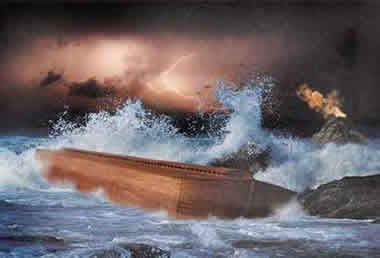 The world had become extremely corrupt, so God instructed Noah, the son of Lamech (Genesis 5:30) to build an ark to provide security for his family and selected living creatures from the waters of a devastating flood that God warned was coming. Read the entire account in (Genesis 6:1-9:17). Noah built the ark, and the flood came soon after its completion (Genesis 7). Over the next forty days and nights, the entire earth was flooded, blotting out "every living thing that was on the face of the ground, man and animals and creeping things and birds of the heavens. (7:23)"
After the flood subsided, the ark rested on the mountains of Ararat. When Noah determined it was safe, and God confirmed it, he and his family and all the animals disembarked (Genesis 8). Then Noah built an altar and offered a sacrifice to God for having saved his family from destruction. God declared a rainbow to be sign of His promise that never again would a similar flood destroy the entire earth (9:8-17).
We remember and honor Noah for his faithful obedience, as he believed that God would do what He said He would. Jesus (Matthew 24:36-39; Luke 17:22-27), Saint Peter (1 Peter 3:18-22; 2 Peter 2:4-10), and the author of Hebrews (11:7) each used Noah and the Flood as illustrations. These include God's judgment on sin, unwavering faith, a picture of Holy Baptism, and a prefiguring of Christ's suffering, death, descent into hell, and resurrection. Luke also listed Noah in Jesus' genealogy (3:36).
Lection
Psalm 29
Genesis 7:1-5, 11-12, 17-23
1 Peter 3:18-22 or Hebrews 11:1-3, 7; 12:1-2
Matthew 24:36-44
Collect
Lord God, heavenly Father, You kept Noah righteous in the midst of a sinful world and, through him, delivered life from the Flood's destruction, continuing also the human line of Your Son, our Lord Jesus Christ and foreshadowing the destruction of sin in Baptism and the preservation of new and eternal life in the Ark of the Holy Christian Church. Grant that we, the heirs of Noah by birth would likewise be heirs in faith of all Your promises, for the sake of our Lord and Savior Jesus Christ, who lives and reigns with You and the Holy Spirit, one God, now and forever. Amen.
Labels: ark, baptism, biography, christ, christology, commemoration, faith, flood, hagiography, jesus, noah, old testament
¶ 00:00 | 0 comments |
 Today begins the solemn season of Advent, a preparatory period as Christians ready themselves for both the celebration of Christ's coming at Bethlehem and His Second Coming on Judgment Day.
Purple has traditionally been the primary color of Advent, symbolizing repentance and fasting. Purple is also the color of royalty, demonstrating the anticipation and reception of the coming King celebrated during Advent. Today, however, many churches have begun to use blue instead of purple, as a means of distinguishing Advent from Lent.
Rose (pink) often replaces purple on the Third Sunday in Advent. It represents dawn, hopeful anticipation, and joy and begins a shift away from repentance toward celebration.
For more on this part of the Church Year, the so-called "three-fold coming of Christ," and Advent as a tonic for improper celebration of Christmas, please see Happy New Year! at Ask the Pastor.
Series A Lectionary
Psalm 122
Isaiah 2:1-5
Romans 13:(8-10) 11-14
Matthew 21:1-11 or Matthew 24:36-44
One Year Lectionary
Psalm 24
Jeremiah 23:5-8
Romans 13:(8-10) 11-14
Matthew 21:1-9
Collect
Stir up Your power, O Lord, and come, that by Your protection we may be rescued from the threatening perils of our sins and saved by Your mighty deliverance; for You live and reign with the Father and the Holy Spirit, one God, now and forever.
Labels: advent, christ, christmas, christology, church year, jesus, lectionary, second coming, series a
¶ 00:00 | 0 comments |
This major Christological feast commemorates the joyous visit Mary paid to her relative (probably her cousin) Elizabeth, following The Annunciation. Inspired by the amazing news that she was to become the mother of the Christ and in response to the joyous word that her old and previously barren kinswoman was also pregnant, she joined Elizabeth during her sixth month of pregnancy (see Luke 1:39-56).After Mary declared the wondrously good news, Elizabeth replied to the Virgin, "Blessed are you among women, and blessed is the fruit of your womb! ... Behold, when the sound of your greeting came to my ears, the baby in my womb leaped for joy. (vv. 42, 44)" She concluded by giving full credit and glory to God while also commending her young cousin's hearty faith: "Blessed is she who believed that there would be a fulfillment of what was spoken to her from the Lord. (v. 45)"
Mary responded with the Magnificat, the beautiful song of praise beginning, "My soul magnifies the Lord. (vv. 46-55)" It's not clear whether Mary stayed there until after the birth of John or if she left immediately beforehand; Luke merely said that the Virgin "remained with her about three months and returned to her home. (v. 56)"
And so, as we encounter God sending the Forerunner and the Messiah into the world, we see a study in contrasts. Two women stand before each other. One seemingly too old to bear children now carries the final prophet of the Old Covenant. The other, youthful and as yet unwed — completely unprepared in the eyes of the world — carries the One who brings both the Advent and the Fulfillment of the New Testament. And again we see, in the fullness of time, one age passing away while another age begins — an age that has no end but which lasts unto eternity.
The reaction of Jesus' unborn cousin and the words of his mother also serve as reminders to many Christians about the sanctity of life. Christian pro-lifers point to John's celebration as clear evidence of the humanity and the consciousness of children who are still in utero.
In Roman Catholicism, Vatican II changed the date of the observation from 2 July to 31 May in order to more accurately reflect the Bible's chronology regarding the life of Christ. Several other Western churches followed suit. In The Lutheran Church — Missouri Synod, today is celebrated in congregations following the Three Year Lectionary while the One Year Lectionary retains the July feast date.
Note: This illustration by Albrecht Dürer is from the Web Gallery of Art.
Lection
Psalm 138
Isaiah 11:1-5
Romans 12:9-16
Luke 1:39-56
Collect
Almighty God, You chose the virgin Mary to be the mother of Your Son and made known through her Your regard for the poor and lowly and despised. Grant that we may receive Your Word in humility and faith, and so be made one with Jesus Christ, Your Son, our Lord, who lives and reigns with You and the Holy Spirit, one God, now and forever.
The Magnificat
My soul magnifies the Lord,
and my spirit rejoices in God my Savior,
for He has looked on the humble estate of his servant.
For behold, from now on all generations will call me blessed;
for He who is mighty has done great things for me,
and holy is His name.
And His mercy is for those who fear Him
from generation to generation.
He has shown strength with His arm;
He has scattered the proud in the thoughts of their hearts;
He has brought down the mighty from their thrones
and exalted those of humble estate;
He has filled the hungry with good things,
and the rich He has sent empty away.
He has helped His servant Israel,
in remembrance of His mercy,
as He spoke to our fathers,
to Abraham and to his offspring forever.
Labels: christ, christology, elizabeth, feasts, festivals, gospels, incarnation, jesus, john the baptist, magnificat, mary, nativity, new testament, visitation
¶ 00:00 | 0 comments |


