
 Remembered as a disciple of Martin Luther, Robert Barnes is considered to be among the first Lutheran martyrs. Born in 1495, he became the prior of the Augustinian monastery at Cambridge, England. Converted to Lutheran teaching, he shared his insights with many English scholars through writings and personal contacts.
During a time of exile to Germany he became a friend of Luther and later wrote a Latin summary of the main doctrines of the Augsburg Confession titled Sententiae.
Upon his return to England, Barnes shared his Lutheran doctrines and views in person with King Henry VIII and initially had a positive reception. In 1529 Barnes was named royal chaplain.
The changing political and ecclesiastical climate in England later claimed him as a victim; he was burned at the stake in Smithfield in 1540.
His final confession of faith was published by Luther, who called his friend Barnes "our good, pious table companion and guest of our home, this holy martyr, Saint Robertus."
For a bit more on Barnes, please read the introduction to Lutheran Carnival 26 at A Beggar at the Table.
Labels: biography, christianity, church history, commemoration, english history, hagiography, lutheranism, martin luther, martyrdom, reformation, robert barnes
¶ 00:00 | 0 comments |

 Today marks the heavenly birthday of Bede (pronounced BĒD). Since his commemoration often falls near the end of Eastertide, it's quite likely that many Christians have close familiarity with one of Bede's best known (and one of this Aardvark's favorite) hymns, the Ascension anthem "A Hymn of Glory Let Us Sing."
Bede (673-735) was the last of the early church fathers and the first person to compile a history of the English church. Born in Northumbria, Bede was given by his parents to a monastery in Northern England at the age of seven. He was ordained when he was thirty.
Probably the most learned man of his time, he was a prolific writer of history and his careful use of sources provided a model for historians in the Middle Ages. His skill in both history and theology gave him the ability to complete a synthesis between the older Celtic monasticism and the later Rule of Saint Benedict.
Known best for his book Historia ecclesiastica gentis Anglorum (The Ecclesiastical History of the English People), he was also a profound interpreter of Scripture; his edition of the Vulgate was the standard in Catholicism until 1979 and his commentaries still provide fresh insights for today's readers.
Bede also popularized the use of Anno Domini Nostri Iesu Christi ("in the Year of Our Lord Jesus Christ") in speaking of the time since our Savior's birth. This is usually shortened to Anno Domini or AD.
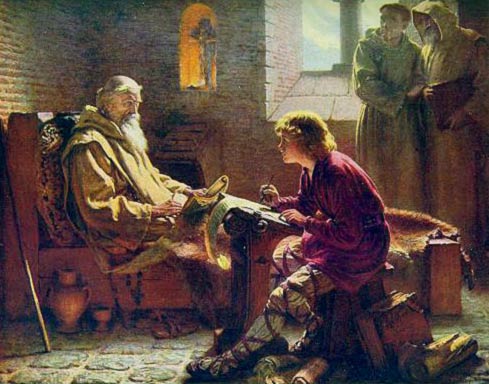 His most famous disciple, Cuthbert, reported that Bede was working on a translation of John's Gospel into English when death came. He also said that Bede died with the words of the Gloria Patri on his lips.
Attested hymns include Hymnum canentes martyrum ("The Hymn for Conquering Martyrs Raise"), Hymnum canamus Domino (translated variously as "A Hymn of Glory Let Us Sing," "The Hymn of Glory Sing We," and "Sing We Triumphant Hymns of Praise"), and Praecursor altus luminis ("The Great Forerunner of the Morn"). He also wrote vernacular poetry.
Bede received the title "Venerable" within two generations of his death and is buried in Durham Cathedral as one of England's greatest saints.
Lection — ESV Except as Noted
Psalm 78:1-4 or 19:7-14
Wisdom 7:15-22 (NRSV)
Matthew 13:47-52
Collect
Heavenly Father, who called your servant Bede, while still a child, to devote his life to Your service in the disciplines of religion and scholarship, grant that as he labored in the Spirit to bring the riches of Your truth to his generation, so we, in our various vocations, may strive to make You known in all the world; through Jesus Christ our Lord, who lives and reigns with you and the Holy Spirit, one God, now and forever.
A Hymn of Glory Let Us Sing
A hymn of glory let us sing New songs throughout the world shall ring
Alleluia, Alleluia.
Christ, by a road before untrod Ascendeth to the throne of God.
Alleluia, Alleluia, Alleluia, Alleluia, Alleluia.
The holy apostolic band Upon the Mount of Olives stand
Alleluia, Alleluia.
And with His followers they see Jesus' resplendent majesty
Alleluia, Alleluia, Alleluia, Alleluia, Alleluia.
To Whom the angels drawing nigh, "Why stand and gaze upon the sky?"
Alleluia, Alleluia.
"This is the Savior," thus they say. "This is His noble triumph day."
Alleluia, Alleluia, Alleluia, Alleluia, Alleluia.
"Again ye shall behold Him so, As ye have today seen Him go."
Alleluia, Alleluia.
"In glorious pomp ascending high Up to the portals of the sky."
Alleluia, Alleluia, Alleluia, Alleluia, Alleluia.
O grant us thitherward to tend And with unwearied hearts ascend,
Alleluia, Alleluia.
Unto Thy kingdom's throne, where Thou As is our faith, art seated now,
Alleluia, Alleluia, Alleluia, Alleluia, Alleluia.
Be Thou our Joy and strong Defense, Who art our future Recompense,
Alleluia, Alleluia.
So shall the light that springs from Thee Be ours through all eternity,
Alleluia, Alleluia, Alleluia, Alleluia, Alleluia.
O risen Christ, ascended Lord, All praise to Thee let earth accord,
Alleluia, Alleluia.
Who art, while endless ages run, With Father and with Spirit One,
Alleluia, Alleluia, Alleluia, Alleluia, Alleluia.
More on Bede's hymns and related information from NetHymnal.
Labels: bede, biography, church history, commemoration, english history, hagiography, historiography, hymnody, medieval history, patristics, the venerable bede, translation
¶ 00:00 | 0 comments |
Lancelot Andrewes was born in London in 1555. Possessed of a keen intellect, he studied at Cambridge and Oxford, was a distinguished lecturer, and entered religious orders in 1580. A career that saw him enjoy working among the people while still challenging himself and others intellectually led to royal associations and eventual consecration as Bishop of Chichester in 1605 and a position as lord almoner. In 1618, he attended the Synod of Dort, was made dean of the Chapel Royal, and became Bishop of Winchester.
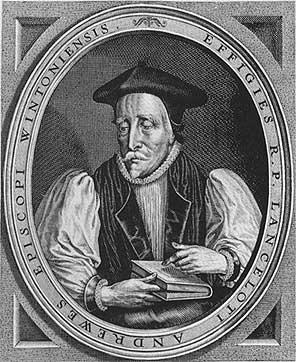 Active in church and secular politics, especially in their overlap, Andrewes advised James I of England and was on the committee of scholars responsible of the Authorized Version of the Bible. Indeed, his name is first on the list of translators, since he both provided translations of early parts of the Old Testament and served as an editor general of the entire work.
Versed in Latin, Greek, Hebrew and eighteen other languages, Andrewes enjoyed popularity during his life for writings. With Bishop Ussher, these two may have been the most learned and intellectually brilliant churchmen of the day. His apologetic writings included two essays against Robert Bellarmine. Large collections of his sermons remain and may still be read profitably both by lovers of Christ and by lovers of the English language.
Perhaps one of his finest works was the Preces Privatae (Private Prayers). The collection was, however, unavailable to contemporaries but were published after his death. Some sections are complete prayers and collects, other appear to be guides to devout meditation. A biography by James Kiefer includes quotes from the Preces. These selections from the Thursday prayers emphasize three important happenings on that day — the creation of birds and fish on the Fifth Day of Creation, the institution of the Lord's Supper, the Ascension of our Lord on Easter's 40th day.
Andrewes' impact on English arts and letters extended well beyond his life. T. S. Eliot considered him a major influence and wrote an essay in his honor.
Labels: andrewes, authorized version, bible, biography, christianity, church history, commemoration, english history, hagiography, king james i, kjv, theology, translation
¶ 00:00 | 0 comments |
Remembered as a disciple of Martin Luther, Robert Barnes is considered to be among the first Lutheran martyrs. Born in 1495, he became the prior of the Augustinian monastery at Cambridge, England. Converted to Lutheran teaching, he shared his insights with many English scholars through writings and personal contacts.During a time of exile to Germany he became a friend of Luther and later wrote a Latin summary of the main doctrines of the Augsburg Confession titled Sententiae.
Upon his return to England, Barnes shared his Lutheran doctrines and views in person with King Henry VIII and initially had a positive reception. In 1529 Barnes was named royal chaplain.
The changing political and ecclesiastical climate in England later claimed him as a victim; he was burned at the stake in Smithfield in 1540.
His final confession of faith was published by Luther, who called his friend Barnes "our good, pious table companion and guest of our home, this holy martyr, Saint Robertus."
For a bit more on Barnes, please read the introduction to Lutheran Carnival 26 at A Beggar at the Table.
Labels: biography, christianity, church history, commemoration, english history, hagiography, lutheranism, martin luther, martyrdom, reformation, robert barnes
¶ 00:00 | 0 comments |
Today marks the heavenly birthday of Bede (pronounced BĒD). Since his commemoration often falls near the end of Eastertide, it's quite likely that many Christians have close familiarity with one of Bede's best known (and one of this Aardvark's favorite) hymns, the Ascension anthem "A Hymn of Glory Let Us Sing."Bede (673-735) was the last of the early church fathers and the first person to compile a history of the English church. Born in Northumbria, Bede was given by his parents to a monastery in Northern England at the age of seven. He was ordained when he was thirty.
Probably the most learned man of his time, he was a prolific writer of history and his careful use of sources provided a model for historians in the Middle Ages. His skill in both history and theology gave him the ability to complete a synthesis between the older Celtic monasticism and the later Rule of Saint Benedict.
Known best for his book Historia ecclesiastica gentis Anglorum (The Ecclesiastical History of the English People), he was also a profound interpreter of Scripture; his edition of the Vulgate was the standard in Catholicism until 1979 and his commentaries still provide fresh insights for today's readers.
Bede also popularized the use of Anno Domini Nostri Iesu Christi ("in the Year of Our Lord Jesus Christ") in speaking of the time since our Savior's birth. This is usually shortened to Anno Domini or AD.
His most famous disciple, Cuthbert, reported that Bede was working on a translation of John's Gospel into English when death came. He also said that Bede died with the words of the Gloria Patri on his lips.Attested hymns include Hymnum canentes martyrum ("The Hymn for Conquering Martyrs Raise"), Hymnum canamus Domino (translated variously as "A Hymn of Glory Let Us Sing," "The Hymn of Glory Sing We," and "Sing We Triumphant Hymns of Praise"), and Praecursor altus luminis ("The Great Forerunner of the Morn"). He also wrote vernacular poetry.
Bede received the title "Venerable" within two generations of his death and is buried in Durham Cathedral as one of England's greatest saints.
Lection — ESV Except as Noted
Psalm 78:1-4 or 19:7-14
Wisdom 7:15-22 (NRSV)
Matthew 13:47-52
Collect
Heavenly Father, who called your servant Bede, while still a child, to devote his life to Your service in the disciplines of religion and scholarship, grant that as he labored in the Spirit to bring the riches of Your truth to his generation, so we, in our various vocations, may strive to make You known in all the world; through Jesus Christ our Lord, who lives and reigns with you and the Holy Spirit, one God, now and forever.
A Hymn of Glory Let Us Sing
A hymn of glory let us sing New songs throughout the world shall ring
Alleluia, Alleluia.
Christ, by a road before untrod Ascendeth to the throne of God.
Alleluia, Alleluia, Alleluia, Alleluia, Alleluia.
The holy apostolic band Upon the Mount of Olives stand
Alleluia, Alleluia.
And with His followers they see Jesus' resplendent majesty
Alleluia, Alleluia, Alleluia, Alleluia, Alleluia.
To Whom the angels drawing nigh, "Why stand and gaze upon the sky?"
Alleluia, Alleluia.
"This is the Savior," thus they say. "This is His noble triumph day."
Alleluia, Alleluia, Alleluia, Alleluia, Alleluia.
"Again ye shall behold Him so, As ye have today seen Him go."
Alleluia, Alleluia.
"In glorious pomp ascending high Up to the portals of the sky."
Alleluia, Alleluia, Alleluia, Alleluia, Alleluia.
O grant us thitherward to tend And with unwearied hearts ascend,
Alleluia, Alleluia.
Unto Thy kingdom's throne, where Thou As is our faith, art seated now,
Alleluia, Alleluia, Alleluia, Alleluia, Alleluia.
Be Thou our Joy and strong Defense, Who art our future Recompense,
Alleluia, Alleluia.
So shall the light that springs from Thee Be ours through all eternity,
Alleluia, Alleluia, Alleluia, Alleluia, Alleluia.
O risen Christ, ascended Lord, All praise to Thee let earth accord,
Alleluia, Alleluia.
Who art, while endless ages run, With Father and with Spirit One,
Alleluia, Alleluia, Alleluia, Alleluia, Alleluia.
More on Bede's hymns and related information from NetHymnal.
Labels: bede, biography, church history, commemoration, english history, hagiography, historiography, hymnody, medieval history, patristics, the venerable bede, translation
¶ 00:00 | 1 comments |
Lancelot Andrewes was born in London in 1555. Possessed of a keen intellect, he studied at Cambridge and Oxford, was a distinguished lecturer, and entered religious orders in 1580. A career that saw him enjoy working among the people while still challenging himself and others intellectually led to royal associations and eventual consecration as Bishop of Chichester in 1605 and a position as lord almoner. In 1618, he attended the Synod of Dort, was made dean of the Chapel Royal, and became Bishop of Winchester.
Active in church and secular politics, especially in their overlap, Andrewes advised James I of England and was on the committee of scholars responsible of the Authorized Version of the Bible. Indeed, his name is first on the list of translators, since he both provided translations of early parts of the Old Testament and served as an editor general of the entire work.Versed in Latin, Greek, Hebrew and eighteen other languages, Andrewes enjoyed popularity during his life for writings. With Bishop Ussher, these two may have been the most learned and intellectually brilliant churchmen of the day. His apologetic writings included two essays against Robert Bellarmine. Large collections of his sermons remain and may still be read profitably both by lovers of Christ and by lovers of the English language.
Perhaps one of his finest works was the Preces Privatae (Private Prayers). The collection was, however, unavailable to contemporaries but were published after his death. Some sections are complete prayers and collects, other appear to be guides to devout meditation. A biography by James Kiefer includes quotes from the Preces. These selections from the Thursday prayers emphasize three important happenings on that day — the creation of birds and fish on the Fifth Day of Creation, the institution of the Lord's Supper, the Ascension of our Lord on Easter's 40th day.
Andrewes' impact on English arts and letters extended well beyond his life. T. S. Eliot considered him a major influence and wrote an essay in his honor.
Labels: andrewes, bible, biography, christianity, church history, commemoration, english history, hagiography, king james i, kjv, theology, translation
¶ 00:00 | 0 comments |
Lancelot Andrewes was born in London in 1555. Possessed of a keen intellect, he studied at Cambridge and Oxford, was a distinguished lecturer, and entered religious orders in 1580. A career that saw him enjoy working among the people while still challenging himself and others intellectually led to royal associations and eventual consecration as Bishop of Chichester in 1605 and a position as lord almoner. In 1618, he attended the Synod of Dort, was made dean of the Chapel Royal, and became Bishop of Winchester.
Active in church and secular politics, especially in their overlap, Andrewes advised James I of England and was on the committee of scholars responsible of the Authorized Version of the Bible. Indeed, his name is first on the list of translators, since he both provided translations of early parts of the Old Testament and served as an editor general of the entire work.Versed in Latin, Greek, Hebrew and eighteen other languages, Andrewes enjoyed popularity during his life for writings. With Bishop Ussher, these two may have been the most learned and intellectually brilliant churchmen of the day. His apologetic writings included two essays against Robert Bellarmine. Large collections of his sermons remain and may still be read profitably both by lovers of Christ and by lovers of the English language.
Perhaps one of his finest works was the Preces Privatae (Private Prayers). The collection was, however, unavailable to contemporaries but were published after his death. Some sections are complete prayers and collects, other appear to be guides to devout meditation. A biography by James Kiefer includes quotes from the Preces. These selections from the Thursday prayers emphasize three important happenings on that day — the creation of birds and fish on the Fifth Day of Creation, the institution of the Lord's Supper, the Ascension of our Lord on Easter's 40th day.
Andrewes' impact on English arts and letters extended well beyond his life. T. S. Eliot considered him a major influence and wrote an essay in his honor.
Labels: andrewes, bible, biography, christianity, church history, commemoration, english history, hagiography, king james i, kjv, theology, translation
¶ 00:00 | 0 comments |


