
 Johann Sebastian Bach (1685-1750) is acknowledged as one of the most famous and gifted of all composers past and present in the entire western world. Orphaned at the age of ten, Bach studied with various family members but was mostly self-taught in music.
He began his professional career as conductor, performer, composer, teacher, and organ consultant at age 19 in the town of Arnstadt. He traveled wherever he received good commissions and steady employment, ending up in Leipzig, where the last 27 years of his life found him responsible for all the music in the city's four Lutheran churches.
 Acclaimed more in his own time as a superb keyboard artist, the majority of his compositions fell into disuse following his death, which musicologists use to date the end of the Baroque Period and the beginning of the Classical Era. However, his compositional ability was rediscovered, in large part due to the efforts of Felix Mendelssohn.
The genius and sheer magnitude of Bach's vocal and instrumental compositions remain overwhelming. Also, whether due to nature or nurture, he was but one of the giants in, perhaps, the most talented musical family of all time.
Christendom especially honors J. S. Bach, a staunch and devoted Lutheran, for his lifelong insistence that his music was written primarily for the liturgical life of the Church, glorifying God and edifying His people. For an overview of the Christological basis of his work and a strong argument that he was among the theological giants of Lutheranism, please read J. S. Bach: Orthodox Lutheran Theologian?.
Today we remember his "heavenly birthday," for it was on 28 July AD 1750 that the Lord translated Mr. Bach to glory.
Soli deo gloria — To God alone the glory! These words appear on most manuscripts of Bach's compositions as testimony to his faith and his idea of music's highest, noblest use.
Labels: bach, biography, christianity, church history, commemorations, german history, hagiography, liturgics, lutheranism, music
¶ 00:00 | 0 comments |

 Ezekiel, the son of Buzi, was a priest, called by God to be a prophet to the exiles during the Babylonian captivity (Ezekiel 1:3). In 597 B.C. King Nebuchadnezzar and the Babylonian army brought the king of Judah and thousands of the best citizens of Jerusalem — including Ezekiel — to Babylon (2 Kings 24:8-16).
Ezekiel's priestly background profoundly stamped his prophecy, as the holiness of God and the Temple figure prominently in his messages (for example, Ezekiel 9-10 and 40-48). From 593 B.C. to the destruction of Jerusalem and the temple in 586 B.C., Ezekiel prophesied the inevitability of divine judgment on Jerusalem, on the exiles in Babylon, and on seven nations that surrounded Israel (Ezekiel 1–32). Jerusalem would certainly fall and the exiles would not quickly return — the just consequences of their sins.
Especially in the early part of the book, much of what the Lord "said" to His people was delivered in the form of action prophecies. In these, Ezekiel acted out representations of coming events pertaining to the fall of Judah, the destruction of the temple, and the seeming end of the Davidic line of kings. These action prophecies included the eating of the scroll (3:1-2), being struck with dumbness (3:22-27), sketching of the city of Jerusalem (4:1-3), lying on one side and then the other (4:4-8), eating restricted rations cooked on a fire of dried dung (4:9-17), and shaving his hair and beard with a sword before dividing the hair (5:1-4). Some seem a bit strange at first glance, once we understand their meaning and context, their messages are quite easily comprehended.
Once word reached Ezekiel that Jerusalem and the temple were destroyed, his message became one of comfort and hope. Through him God promised that his people would experience future restoration, renewal, and revival in the coming Messianic kingdom (Ezekiel 33-48).
Much of the strange symbolism of Ezekiel's prophecies was later employed in the Revelation to Saint John. Among these are the visions of the four living creatures as seen in Ezekiel 1 and Revelation 4.
See Happenings for a hymn stanza written for the Commemoration of Ezekiel.
Labels: babylonian captivity, bible, biography, christianity, christology, commemorations, ezekiel, hagiography, israel, old testament, prophet, revelation
¶ 00:00 | 0 comments |
 The prophet Elijah, whose name means, "My God is Yahweh [the Lord]," prophesied in the northern kingdom of Israel, mostly during the reign of Ahab (874 – 853 B.C.).
Ahab, under the influence of his pagan wife Jezebel, had encouraged the worship of Baal throughout his kingdom, even as Jezebel sought to get rid of the worship of Yahweh. Elijah was called by God to denounce this idolatry and to call the people of Israel back to the worship Yahweh as the only true God (as he did in 1 Kings 18:20-40).
Elijah was a rugged and imposing figure, living in the wilderness and dressing in a garment of camel's hair and a leather belt (2 Kings 1:8). He was a prophet mighty in word and deed. The Lord worked many miracles through Elijah, including the raising of the dead (1 Kings 17:17-24) and the effecting of a long drought in Israel (1 Kings 17:1).
At the end of his ministry, he was taken up into heaven as Elisha, his successor, looked on (2 Kings 2:11). Later on, the Lord proclaimed through the prophet Malachi that Elijah would return before the coming of the Messiah (Malachi 4:5-6), a prophecy that was fulfilled in the prophetic ministry of John the Baptist (see Jesus' words in Matthew 11:1-19).
See Happenings for a hymn stanza written for the Commemoration of Elijah.
Labels: 1 kings, 2 kings, ahab, biography, commemorations, elijah, elisha, hagiography, israel, jezebel, john the baptist, old testament, prophet, transfiguration
¶ 00:00 | 0 comments |
 Ruth, the subject of the book bearing her name, is an inspiring example of God's grace. Although she was a Gentile, God made her the great-grandmother of King David (Ruth 4:17), and an ancestress of Jesus Himself (Matthew 1:1-17).
A famine in Israel led Elimelech and Naomi of Bethlehem to emigrate to the neighboring nation of Moab with their two sons. The sons married Moabite women, Orpah and Ruth, but after about ten years, Elimelech and his sons died (Ruth 1:1-5).
Naomi then decided to return to Bethlehem and urged her daughters-in-law to return to their families. Orpah listened to Naomi's plea, but Ruth refused, replying with the stirring words: "Where you go I will go, and where you lodge I will lodge. Your people shall be my people, and your God my God. (1:16)"
After Ruth arrived in Bethlehem, Boaz, a close relative of Elimelech, agreed to be Ruth's "redeemer" (3:7-13; 4:9-12). He took her as his wife, and Ruth gave birth to Obed, the grandfather of David (4:13-17), thus preserving the Messianic seed. See Boaz, Ruth, and the Genealogy of Jesus at Ask the Pastor for a deeper theological examination of the account of Ruth and Boaz, including its Christological connection.
Ruth's kindness and selfless loyalty toward Naomi — and her faith in Naomi's God — have long endeared her to the faithful and redounded to God's praise for His merciful choice of one so unexpected.
Labels: biography, boaz, christianity, christology, commemorations, david, feasts, festivals, genealogy, gospels, hagiography, jesus, matthew, naomi, old testament, ruth
¶ 00:00 | 1 comments |

In 1934, Giertz was ordained in the Linkoping Cathedral. He became assistant to the bishop and was given responsibility for working with the youth. His own faith and his conviction concerning the relevance of Christianity were on display for the thousands of young people who came under his care. Even as orthodox Lutherans lauded him, he also drew attacks from modernists in the Swedish state church and secularists as his writings spread in newspapers and periodicals. The public knew him as a talented and faithful confessor of a Church doctrine that was based in Scripture, confessed in the Creeds, and expounded in the Lutheran Confessions.
Giertz became a priest in Torpa in 1938, serving that parish until 1949, when he was consecrated as Bishop of Gothenburg. While serving Torpa, he wrote With My Own Eyes, a retelling of the Gospels (1947), four theological works, Christ's Church (1939), Church Piety (1939), The Great Lie and the Great Truth (1945), and The Battle for Man (1946), the catechetical book The Foundation (1942), and two novels The Hammer of God (1941) and Faith Alone (1943). These latter, particularly Hammer of God, became popular throughout Scandinavia and then around the globe.
The attention to theology and care for souls that Giertz evidenced in Torpa continued when he became Bishop of Gothenburg in 1949. As the youngest man elected and consecrated to serve the Church of Sweden as a diocesan bishop, he combined a somewhat pietistic type of pastoral care with High Church Lutheran theology, traits that are noticeable in his novels. Following the decisions of the Swedish Parliament and the Church Assembly to ordain women in the Church of Sweden (1958), Giertz became a leader of the opposition. In that same year, he invited all confessional groups in the Church of Sweden to form The Church Movement for Bible and Confession in response to the Assembly's decision.

Giertz pioneered a return to every Sunday celebration of the Lord's Supper, something that had largely vanished in the Church of Sweden due to the erosion caused by Pietism and Rationalism. He strongly urged pastors to pray the Daily Offices, something he applied in his own devotional life. Although often rejected by the leaders of the Church of Sweden, Giertz remains popular with true Lutherans in his own country, throughout Scandinavia, and across the world. Of him, the Reverend Hans O. Andrae wrote, "In his vision of the One Holy Christian and Apostolic Church, Giertz integrated a vibrant Evangelical-Lutheran orthodoxy, the Church's traditional liturgy, and sincere church piety into a harmonious and powerful wholeness."
Suggested Lection
Psalm 46
Isaiah 55:6-11
Romans 10:5-17
John 15:1-11
Collect
O Lord God, heavenly Father, we pray that, as You raised up Bo Harald Giertz to lead Swedish Lutherans into a renewed appreciation of their confessional heritage and trust in the saving Gospel of Jesus Christ, and as You spoke to the entire Church through his writings, so You would continue to provide faithful pastors and leaders, keep us steadfast in Your grace and truth, defend us against all enemies of Your Word, and bestow on Christ's Church Militant Your saving peace; through Jesus Christ, Your Son, our Lord, who lives and reigns with You and the Holy Spirit, one God, now and forever.
Labels: biography, bo giertz, christianity, church history, commemorations, european history, hagiography, lutheranism, sweden
¶ 00:00 | 0 comments |
The Confession of Saint Peter ("You are the Christ, the Son of the Living God") is commemorated on 18 January, and the Conversion of Saint Paul on his approach to Damascus a week later, on 25 January. On 29 June we commemorate the martyrdoms of both apostles. The date is the anniversary of a day around AD 258, under the Valerian persecution, when what were believed to be the remains of the two apostles were both moved temporarily to prevent them from falling into the hands of the persecutors.
 The Scriptures do not record the deaths of Peter or Paul, or indeed any of the Apostles' deaths except for James the son of Zebedee (Acts 12:2), but they are clearly anticipated (see the readings below), and from an early date it has been said that they were martyred at Rome at the command of the Emperor Nero, and buried there. As a Roman citizen, St. Paul would probably have been beheaded with a sword. An early tradition claims that St. Peter was crucified head downward.
The present Church of St. Peter in Rome replaces earlier churches built on the same site going back to the time of the Emperor Constantine, in whose reign a church was built on what was believed to be the burial site of Peter. Excavations under the church suggest that the belief that this is the true home of his burial predates Constantine.
Lection
Psalm 46
Acts 15:1-12 (13-21)
Galatians 2:1-10
Matthew 16:13-19
Collect
Merciful and eternal God, from whom the holy apostles Saint Peter and Saint Paul received grace and strength to lay down their lives for the sake of Your Son, grant that, strengthened by the Holy Spirit, we may with like constancy confess Your truth and be at all times ready to lay down our lives for Him who laid down His life for us; even Jesus Christ, our Lord, who lives and reigns with You and the Holy Spirit, one God, now and forever.
Labels: apostle, biography, commemorations, feasts, festivals, hagiography, martyrdom, nero, rome, saint paul, saint peter
¶ 00:00 | 2 comments |
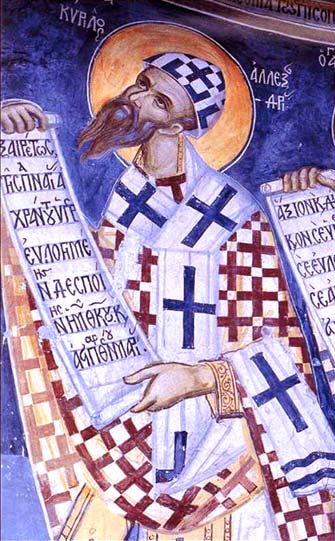 Saint Cyril (ca. AD 376-444) became Patriarch of Alexandria, Egypt in 412. Throughout his career he defended a number of orthodox doctrines, among them the teaching that Mary, the mother of Jesus, is "rightly called and truly is the Mother of God" — Theotokos, "the God-Bearer" (Formula of Concord, Epitome, VIII:12). In 431 the Council of Ephesus affirmed this teaching that the Son of Mary is also true God.
The Council was responding to the Nestorian heresy, which distinguished so completely between the divine and human natures of Christ that claims were made that the divine Christ did some things while the human Jesus did others.
Some of the differences are quite subtle; perhaps even Nestorius himself could not have foreseen the full ramifications of his position, including a "resurrection" of only the divine nature. Ephesus condemned the title of "Christ-Bearer" (Christotokos) for the Virgin, since the Nestorians would only claim that Mary bore the Christ, but not God Himself.
Cyril receives almost as many brickbats as he does bouquets, even from orthodox Christians, because he's also known for being what one person calls "an ill-tempered, quarrelsome, hasty, and violent man." This seems especially so during his early years as Bishop of Alexandria.
A particularly acute example of his extreme rigidity comes from his closing of Novatianist churches, although the Novationists weren't particularly unorthodox. Their "fault" was as much one of pride as of theology — they descended from those who'd stood firm in the persecutions of earlier years and refused to associate or worship with the heirs of those who recanted the Faith under persecution. Their main theological aberration were insisting upon rebaptism of converts from "lapsed" Christianity and an attitude that was, perhaps, less than Christ-like in dealing with erring brothers.
Cyril also ran the Jews out of town. The reason given was that they were seditious and violent, although we're left with little evidence. This action likely contributed to an ongoing feud with Orestes, the imperial prefect. These disagreements seemingly spilled over into a quarrel with the prefect's friend, the neo-platonist scholar Hypatia, who was later murdered by a mob.
Few have directly condemned Cyril for her death but the leaders of the mob certainly claimed the bishop as their leader. In modern times, Carl Sagan, in his book Cosmos, blamed Hypatia's death (and the destruction of the great Library of Alexandria) on dogmatic Christianity's desire to root out rational paganism. However, other scholars see the whole feud as an internal Church struggle and no one has yet established a definitive cause (or date) for the final destruction of Alexandria's library.
At any rate, and despite the considerable rancor that accompanied his early years as bishop, the mature Cyril worked diligently to reconcile the Nestorian and Orthodox parties. His efforts led many of the less virulent Nestorians back to full communion.
The writings of Cyril on the doctrines of the Trinity and the person of Christ reveal him to be one of the most able theologians of his time. Cyril's Christology influenced subsequent church councils and was a primary source for Lutheran confessional writings. He still speaks clearly to our age, especially as the old Christological heresies are trotted out under new guises.
Collect
Heavenly Father, You used Your servant Cyril to confess the mysteries of the Holy Trinity and of Your Son being one person with fully divine and human natures. Grant that we, also, might be constant in Your Word, bold in Your confession, and steadfast in Your worship, to the glory of Your holy Name; through Jesus Christ our Lord, who lives and reigns with You and the Holy Spirit, one God, now and forever.
Labels: alexandria, biography, christianity, church history, commemorations, cyril, hagiography, lutheranism, nestorianism, patristics, theotokos
¶ 00:00 | 0 comments |
The holy prophet Jeremiah is counted as one of the four "major prophets" of the Old Testament, along with Isaiah, Ezekiel, and Daniel. His name means "Established (or Raised up) by Yahweh (the Lord)."
He was active as God's prophet to the southern kingdom of Judah ca. 627 to 582 B.C. As he fulfilled his calling, he predicted, witnessed, and lived through the Babylonian siege and eventual destruction of Jerusalem in 587 B.C.
In his preaching he often used symbols such as an almond rod (Jeremiah 1:11-14), wine jars (13:12-14), or a potter at work (18:1-17). His entire prophetic ministry was a sermon, communicating through word and deed God's anger toward his rebellious people. He suffered repeated rejection and persecution by his countrymen. As far as can be known, he died in Egypt, having been taken there forcibly. He is remembered and honored for fearlessly calling God's people to repentance.
 Jeremiah also is credited by many as the author of the book of Lamentations. The book consists of five separate poems, of which the first four are acrostics consisting of verses whose first words begin with successive letters of the Hebrew alphabet. In English translations, of course, this style completely disappears.
Chapter 3 is an especially well-developed acrostic. There are twenty-two letters in Hebrew and the other chapters have 22 verses. However, this chapter has sixty-six, grouping sets of three verses under each letter of the alphabet. Thus, verses one through three begin with א (aleph), verses four through six with ב (beth), seven through nine with ג (gimel), and so-on down the line. Chapter Five, while not an acrostic, still has 22 verses.
The themes of Lamentations unfold as follows: Chapter 1 treats the fallen and desolate city of Jerusalem as a widow weeping over her loss. Chapter 2 connects her misery with the sins of the nation and her people which brought God's judgment. Chapter 3 expresses hope that the Lord's punishment will result in blessing for His people and affirms His goodness: "The steadfast love of the Lord never ceases; his mercies never come to an end; they are new every morning; great is your faithfulness. 'The Lord is my portion,' says my soul, 'therefore I will hope in him.' (vv. 22-24)" Chapter 4 is a lament on the destruction of city and temple but lays the blame upon the people's sins. The final chapter outlines the city's continuing troubles and prays that the Lord will finally restore Zion and not abandon His chosen people, although their sins are great and they certainly deserve it.
The book of Jeremiah similarly proclaims harsh judgment upon persistent sin while also reminding the Lord's people of His faithfulness. It looks to a time when the need for the Law's commands and punishments will cease and all will be made right. The clearest expression of this thought is in 31:31-34, where a "New Covenant" of grace is promised, a covenant established by the blood of the coming Messiah: "Behold, the days are coming, declares the Lord, when I will make a new covenant with the house of Israel and the house of Judah, not like the covenant that I made with their fathers on the day when I took them by the hand to bring them out of the land of Egypt, my covenant that they broke, though I was their husband, declares the Lord.
"But this is the covenant that I will make with the house of Israel after those days, declares the Lord: I will put my law within them, and I will write it on their hearts. And I will be their God, and they shall be my people. And no longer shall each one teach his neighbor and each his brother, saying, 'Know the Lord,' for they shall all know me, from the least of them to the greatest, declares the Lord. For I will forgive their iniquity, and I will remember their sin no more."
Scripture says nothing of how prophet's life ended. Chapter 43 reveals that Johanan took Jeremiah, the prophet's faithful scribe Baruch ben Neriah, and a remnant of Judean people, to live in Egypt. This directly contradicted the Word of the Lord Jeremiah had just spoken in Chapter 42, forbidding such a move and warning of dire consequences. Since Jeremiah 52:31 mentions the reign of Evil-merodach, the son of Nebuchadnezzar, many think that he may have been at least 90 years old when he died. Some ancient traditions claim that he was stoned to death in Babylon. Others say that he finally went to Babylon with Nebuchadnezzar's army.
See Happenings for a hymn stanza written for the Commemoration of Jeremiah.
Labels: biography, christianity, christology, commemorations, hagiography, jeremiah, lamentations, lutheranism, old testament, prophet
¶ 00:00 | 0 comments |
 After the prophet Elijah defeated the priests of Baal and then fled Jezebel's wrath, The Lord came to him on Mount Horeb. He told him to anoint new kings of Syria and Israel. He also commanded Elijah to anoint "Elisha the son of Shaphat of Abel-meholah, (1 Kings 19:16)" a member of the tribe of Issachar, to replace Elijah as the prophet of God to the northern kingdom of Israel ca. 849-786 B.C.
During Elijah's final days on earth, Elisha refused to leave his mentor's side. Elisha asked Elijah to grant him a final blessing, saying, "Please let there be a double portion of your spirit on me. (2 Kings 2:9)" Once he saw the elder prophet taken up into heaven, Elisha took up Elijah's mantle and assumed the prophetic office (2 Kings 2:1-14).
Like Elijah, Elisha played an active role in political affairs. He also performed many miracles, foreshadowing the miracles of God's own son. Among these, he cured the Syrian army commander Naaman of his leprosy (2 Kings 5:1-27), fed a multitude of hungry men (2 Kings 4:42-44), and restored life to the son of a Shunammite woman (4:8-37).
A vocal opponent of Baal worship, Elisha lived up to his name, which means "my God is salvation."
Labels: biography, christianity, commemorations, elijah, elisha, hagiography, lutheranism, old testament, prophet
¶ 00:00 | 0 comments |
Johann Sebastian Bach (1685-1750) is acknowledged as one of the most famous and gifted of all composers past and present in the entire western world. Orphaned at the age of ten, Bach studied with various family members but was mostly self-taught in music.He began his professional career as conductor, performer, composer, teacher, and organ consultant at age 19 in the town of Arnstadt. He traveled wherever he received good commissions and steady employment, ending up in Leipzig, where the last 27 years of his life found him responsible for all the music in the city's four Lutheran churches.
Acclaimed more in his own time as a superb keyboard artist, the majority of his compositions fell into disuse following his death, which musicologists use to date the end of the Baroque Period and the beginning of the Classical Era. However, his compositional ability was rediscovered, in large part due to the efforts of Felix Mendelssohn.The genius and sheer magnitude of Bach's vocal and instrumental compositions remain overwhelming. Also, whether due to nature or nurture, he was but one of the giants in, perhaps, the most talented musical family of all time.
Christendom especially honors J. S. Bach, a staunch and devoted Lutheran, for his lifelong insistence that his music was written primarily for the liturgical life of the Church, glorifying God and edifying His people. For an overview of the Christological basis of his work and a strong argument that he was among the theological giants of Lutheranism, please read J. S. Bach: Orthodox Lutheran Theologian?.
Today we remember his "heavenly birthday," for it was on 28 July AD 1750 that the Lord translated Mr. Bach to glory.
Soli deo gloria — To God alone the glory! These words appear on most manuscripts of Bach's compositions as testimony to his faith and his idea of music's highest, noblest use.
Labels: bach, biography, christianity, church history, commemorations, german history, hagiography, liturgics, lutheranism, music
¶ 00:00 | 0 comments |
Ezekiel, the son of Buzi, was a priest, called by God to be a prophet to the exiles during the Babylonian captivity (Ezekiel 1:3). In 597 B.C. King Nebuchadnezzar and the Babylonian army brought the king of Judah and thousands of the best citizens of Jerusalem — including Ezekiel — to Babylon (2 Kings 24:8-16).Ezekiel's priestly background profoundly stamped his prophecy, as the holiness of God and the Temple figure prominently in his messages (for example, Ezekiel 9-10 and 40-48). From 593 B.C. to the destruction of Jerusalem and the temple in 586 B.C., Ezekiel prophesied the inevitability of divine judgment on Jerusalem, on the exiles in Babylon, and on seven nations that surrounded Israel (Ezekiel 1–32). Jerusalem would certainly fall and the exiles would not quickly return — the just consequences of their sins.
Especially in the early part of the book, much of what the Lord "said" to His people was delivered in the form of action prophecies. In these, Ezekiel acted out representations of coming events pertaining to the fall of Judah, the destruction of the temple, and the seeming end of the Davidic line of kings. These action prophecies included the eating of the scroll (3:1-2), being struck with dumbness (3:22-27), sketching of the city of Jerusalem (4:1-3), lying on one side and then the other (4:4-8), eating restricted rations cooked on a fire of dried dung (4:9-17), and shaving his hair and beard with a sword before dividing the hair (5:1-4). Some seem a bit strange at first glance, once we understand their meaning and context, their messages are quite easily comprehended.
Once word reached Ezekiel that Jerusalem and the temple were destroyed, his message became one of comfort and hope. Through him God promised that his people would experience future restoration, renewal, and revival in the coming Messianic kingdom (Ezekiel 33-48).
Much of the strange symbolism of Ezekiel's prophecies was later employed in the Revelation to Saint John. Among these are the visions of the four living creatures as seen in Ezekiel 1 and Revelation 4.
See Happenings for a hymn stanza written for the Commemoration of Ezekiel.
Labels: babylonian captivity, biography, christianity, christology, commemorations, ezekiel, hagiography, israel, old testament, prophet, revelation
¶ 00:00 | 0 comments |
The prophet Elijah, whose name means, "My God is Yahweh [the Lord]," prophesied in the northern kingdom of Israel, mostly during the reign of Ahab (874 – 853 B.C.).Ahab, under the influence of his pagan wife Jezebel, had encouraged the worship of Baal throughout his kingdom, even as Jezebel sought to get rid of the worship of Yahweh. Elijah was called by God to denounce this idolatry and to call the people of Israel back to the worship Yahweh as the only true God (as he did in 1 Kings 18:20-40).
Elijah was a rugged and imposing figure, living in the wilderness and dressing in a garment of camel's hair and a leather belt (2 Kings 1:8). He was a prophet mighty in word and deed. The Lord worked many miracles through Elijah, including the raising of the dead (1 Kings 17:17-24) and the effecting of a long drought in Israel (1 Kings 17:1).
At the end of his ministry, he was taken up into heaven as Elisha, his successor, looked on (2 Kings 2:11). Later on, the Lord proclaimed through the prophet Malachi that Elijah would return before the coming of the Messiah (Malachi 4:5-6), a prophecy that was fulfilled in the prophetic ministry of John the Baptist (see Jesus' words in Matthew 11:1-19).
See Happenings for a hymn stanza written for the Commemoration of Elijah.
Labels: 1 kings, 2 kings, ahab, biography, commemorations, elijah, elisha, hagiography, israel, jezebel, john the baptist, old testament, prophet
¶ 00:00 | 0 comments |
Ruth, the subject of the book bearing her name, is an inspiring example of God's grace. Although she was a Gentile, God made her the great-grandmother of King David (Ruth 4:17), and an ancestress of Jesus Himself (Matthew 1:1-17).A famine in Israel led Elimelech and Naomi of Bethlehem to emigrate to the neighboring nation of Moab with their two sons. The sons married Moabite women, Orpah and Ruth, but after about ten years, Elimelech and his sons died (Ruth 1:1-5).
Naomi then decided to return to Bethlehem and urged her daughters-in-law to return to their families. Orpah listened to Naomi's plea, but Ruth refused, replying with the stirring words: "Where you go I will go, and where you lodge I will lodge. Your people shall be my people, and your God my God. (1:16)"
After Ruth arrived in Bethlehem, Boaz, a close relative of Elimelech, agreed to be Ruth's "redeemer" (3:7-13; 4:9-12). He took her as his wife, and Ruth gave birth to Obed, the grandfather of David (4:13-17), thus preserving the Messianic seed. See Boaz, Ruth, and the Genealogy of Jesus at Ask the Pastor for a deeper theological examination of the account of Ruth and Boaz, including its Christological connection.
Ruth's kindness and selfless loyalty toward Naomi — and her faith in Naomi's God — have long endeared her to the faithful and redounded to God's praise for His merciful choice of one so unexpected.
Labels: biography, boaz, christianity, christology, commemorations, david, feasts, festivals, hagiography, jesus, naomi, old testament, ruth
¶ 00:00 | 0 comments |
In 1934, Giertz was ordained in the Linkoping Cathedral. He became assistant to the bishop and was given responsibility for working with the youth. His own faith and his conviction concerning the relevance of Christianity were on display for the thousands of young people who came under his care. Even as orthodox Lutherans lauded him, he also drew attacks from modernists in the Swedish state church and secularists as his writings spread in newspapers and periodicals. The public knew him as a talented and faithful confessor of a Church doctrine that was based in Scripture, confessed in the Creeds, and expounded in the Lutheran Confessions.
Giertz became a priest in Torpa in 1938, serving that parish until 1949, when he was consecrated as Bishop of Gothenburg. While serving Torpa, he wrote With My Own Eyes, a retelling of the Gospels (1947), four theological works, Christ's Church (1939), Church Piety (1939), The Great Lie and the Great Truth (1945), and The Battle for Man (1946), the catechetical book The Foundation (1942), and two novels The Hammer of God (1941) and Faith Alone (1943). These latter, particularly Hammer of God, became popular throughout Scandinavia and then around the globe.
The attention to theology and care for souls that Giertz evidenced in Torpa continued when he became Bishop of Gothenburg in 1949. As the youngest man elected and consecrated to serve the Church of Sweden as a diocesan bishop, he combined a somewhat pietistic type of pastoral care with High Church Lutheran theology, traits that are noticeable in his novels. Following the decisions of the Swedish Parliament and the Church Assembly to ordain women in the Church of Sweden (1958), Giertz became a leader of the opposition. In that same year, he invited all confessional groups in the Church of Sweden to form The Church Movement for Bible and Confession in response to the Assembly's decision.
Giertz pioneered a return to every Sunday celebration of the Lord's Supper, something that had largely vanished in the Church of Sweden due to the erosion caused by Pietism and Rationalism. He strongly urged pastors to pray the Daily Offices, something he applied in his own devotional life. Although often rejected by the leaders of the Church of Sweden, Giertz remains popular with true Lutherans in his own country, throughout Scandinavia, and across the world. Of him, the Reverend Hans O. Andrae wrote, "In his vision of the One Holy Christian and Apostolic Church, Giertz integrated a vibrant Evangelical-Lutheran orthodoxy, the Church's traditional liturgy, and sincere church piety into a harmonious and powerful wholeness."
Suggested Lection
Psalm 46
Isaiah 55:6-11
Romans 10:5-17
John 15:1-11
Collect
O Lord God, heavenly Father, we pray that, as You raised up Bo Harald Giertz to lead Swedish Lutherans into a renewed appreciation of their confessional heritage and trust in the saving Gospel of Jesus Christ, and as You spoke to the entire Church through his writings, so You would continue to provide faithful pastors and leaders, keep us steadfast in Your grace and truth, defend us against all enemies of Your Word, and bestow on Christ's Church Militant Your saving peace; through Jesus Christ, Your Son, our Lord, who lives and reigns with You and the Holy Spirit, one God, now and forever.
Labels: biography, bo giertz, christianity, church history, commemorations, european history, hagiography, lutheranism, sweden
¶ 00:00 | 0 comments |
The Confession of Saint Peter ("You are the Christ, the Son of the Living God") is commemorated on 18 January, and the Conversion of Saint Paul on his approach to Damascus a week later, on 25 January. On 29 June we commemorate the martyrdoms of both apostles. The date is the anniversary of a day around AD 258, under the Valerian persecution, when what were believed to be the remains of the two apostles were both moved temporarily to prevent them from falling into the hands of the persecutors.
The Scriptures do not record the deaths of Peter or Paul, or indeed any of the Apostles' deaths except for James the son of Zebedee (Acts 12:2), but they are clearly anticipated (see the readings below), and from an early date it has been said that they were martyred at Rome at the command of the Emperor Nero, and buried there. As a Roman citizen, St. Paul would probably have been beheaded with a sword. An early tradition claims that St. Peter was crucified head downward.The present Church of St. Peter in Rome replaces earlier churches built on the same site going back to the time of the Emperor Constantine, in whose reign a church was built on what was believed to be the burial site of Peter. Excavations under the church suggest that the belief that this is the true home of his burial predates Constantine.
Lection
Psalm 46
Acts 15:1-12 (13-21)
Galatians 2:1-10
Matthew 16:13-19
Collect
Merciful and eternal God, from whom the holy apostles Saint Peter and Saint Paul received grace and strength to lay down their lives for the sake of Your Son, grant that, strengthened by the Holy Spirit, we may with like constancy confess Your truth and be at all times ready to lay down our lives for Him who laid down His life for us; even Jesus Christ, our Lord, who lives and reigns with You and the Holy Spirit, one God, now and forever.
Labels: biography, commemorations, feasts, festivals, hagiography, martyrdom, nero, saint paul, saint peter
¶ 00:00 | 0 comments |
Saint Cyril (ca. AD 376-444) became Patriarch of Alexandria, Egypt in 412. Throughout his career he defended a number of orthodox doctrines, among them the teaching that Mary, the mother of Jesus, is "rightly called and truly is the Mother of God" — Theotokos, "the God-Bearer" (Formula of Concord, Epitome, VIII:12). In 431 the Council of Ephesus affirmed this teaching that the Son of Mary is also true God.The Council was responding to the Nestorian heresy, which distinguished so completely between the divine and human natures of Christ that claims were made that the divine Christ did some things while the human Jesus did others.
Some of the differences are quite subtle; perhaps even Nestorius himself could not have foreseen the full ramifications of his position, including a "resurrection" of only the divine nature. Ephesus condemned the title of "Christ-Bearer" (Christotokos) for the Virgin, since the Nestorians would only claim that Mary bore the Christ, but not God Himself.
Cyril receives almost as many brickbats as he does bouquets, even from orthodox Christians, because he's also known for being what one person calls "an ill-tempered, quarrelsome, hasty, and violent man." This seems especially so during his early years as Bishop of Alexandria.
A particularly acute example of his extreme rigidity comes from his closing of Novatianist churches, although the Novationists weren't particularly unorthodox. Their "fault" was as much one of pride as of theology — they descended from those who'd stood firm in the persecutions of earlier years and refused to associate or worship with the heirs of those who recanted the Faith under persecution. Their main theological aberration were insisting upon rebaptism of converts from "lapsed" Christianity and an attitude that was, perhaps, less than Christ-like in dealing with erring brothers.
Cyril also ran the Jews out of town. The reason given was that they were seditious and violent, although we're left with little evidence. This action likely contributed to an ongoing feud with Orestes, the imperial prefect. These disagreements seemingly spilled over into a quarrel with the prefect's friend, the neo-platonist scholar Hypatia, who was later murdered by a mob.
Few have directly condemned Cyril for her death but the leaders of the mob certainly claimed the bishop as their leader. In modern times, Carl Sagan, in his book Cosmos, blamed Hypatia's death (and the destruction of the great Library of Alexandria) on dogmatic Christianity's desire to root out rational paganism. However, other scholars see the whole feud as an internal Church struggle and no one has yet established a definitive cause (or date) for the final destruction of Alexandria's library.
At any rate, and despite the considerable rancor that accompanied his early years as bishop, the mature Cyril worked diligently to reconcile the Nestorian and Orthodox parties. His efforts led many of the less virulent Nestorians back to full communion.
The writings of Cyril on the doctrines of the Trinity and the person of Christ reveal him to be one of the most able theologians of his time. Cyril's Christology influenced subsequent church councils and was a primary source for Lutheran confessional writings. He still speaks clearly to our age, especially as the old Christological heresies are trotted out under new guises.
Collect
Heavenly Father, You used Your servant Cyril to confess the mysteries of the Holy Trinity and of Your Son being one person with fully divine and human natures. Grant that we, also, might be constant in Your Word, bold in Your confession, and steadfast in Your worship, to the glory of Your holy Name; through Jesus Christ our Lord, who lives and reigns with You and the Holy Spirit, one God, now and forever.
Labels: alexandria, biography, christianity, church history, commemorations, cyril, hagiography, lutheranism, nestorianism, patristics, theotokos
¶ 00:00 | 0 comments |
The holy prophet Jeremiah is counted as one of the four "major prophets" of the Old Testament, along with Isaiah, Ezekiel, and Daniel. His name means "Established (or Raised up) by Yahweh (the Lord)."
He was active as God's prophet to the southern kingdom of Judah ca. 627 to 582 B.C. As he fulfilled his calling, he predicted, witnessed, and lived through the Babylonian siege and eventual destruction of Jerusalem in 587 B.C.
In his preaching he often used symbols such as an almond rod (Jeremiah 1:11-14), wine jars (13:12-14), or a potter at work (18:1-17). His entire prophetic ministry was a sermon, communicating through word and deed God's anger toward his rebellious people. He suffered repeated rejection and persecution by his countrymen. As far as can be known, he died in Egypt, having been taken there forcibly. He is remembered and honored for fearlessly calling God's people to repentance.
Jeremiah also is credited by many as the author of the book of Lamentations. The book consists of five separate poems, of which the first four are acrostics consisting of verses whose first words begin with successive letters of the Hebrew alphabet. In English translations, of course, this style completely disappears.Chapter 3 is an especially well-developed acrostic. There are twenty-two letters in Hebrew and the other chapters have 22 verses. However, this chapter has sixty-six, grouping sets of three verses under each letter of the alphabet. Thus, verses one through three begin with א (aleph), verses four through six with ב (beth), seven through nine with ג (gimel), and so-on down the line. Chapter Five, while not an acrostic, still has 22 verses.
The themes of Lamentations unfold as follows: Chapter 1 treats the fallen and desolate city of Jerusalem as a widow weeping over her loss. Chapter 2 connects her misery with the sins of the nation and her people which brought God's judgment. Chapter 3 expresses hope that the Lord's punishment will result in blessing for His people and affirms His goodness: "The steadfast love of the Lord never ceases; his mercies never come to an end; they are new every morning; great is your faithfulness. 'The Lord is my portion,' says my soul, 'therefore I will hope in him.' (vv. 22-24)" Chapter 4 is a lament on the destruction of city and temple but lays the blame upon the people's sins. The final chapter outlines the city's continuing troubles and prays that the Lord will finally restore Zion and not abandon His chosen people, although their sins are great and they certainly deserve it.
The book of Jeremiah similarly proclaims harsh judgment upon persistent sin while also reminding the Lord's people of His faithfulness. It looks to a time when the need for the Law's commands and punishments will cease and all will be made right. The clearest expression of this thought is in 31:31-34, where a "New Covenant" of grace is promised, a covenant established by the blood of the coming Messiah: "Behold, the days are coming, declares the Lord, when I will make a new covenant with the house of Israel and the house of Judah, not like the covenant that I made with their fathers on the day when I took them by the hand to bring them out of the land of Egypt, my covenant that they broke, though I was their husband, declares the Lord.
"But this is the covenant that I will make with the house of Israel after those days, declares the Lord: I will put my law within them, and I will write it on their hearts. And I will be their God, and they shall be my people. And no longer shall each one teach his neighbor and each his brother, saying, 'Know the Lord,' for they shall all know me, from the least of them to the greatest, declares the Lord. For I will forgive their iniquity, and I will remember their sin no more."
Scripture says nothing of how prophet's life ended. Chapter 43 reveals that Johanan took Jeremiah, the prophet's faithful scribe Baruch ben Neriah, and a remnant of Judean people, to live in Egypt. This directly contradicted the Word of the Lord Jeremiah had just spoken in Chapter 42, forbidding such a move and warning of dire consequences. Since Jeremiah 52:31 mentions the reign of Evil-merodach, the son of Nebuchadnezzar, many think that he may have been at least 90 years old when he died. Some ancient traditions claim that he was stoned to death in Babylon. Others say that he finally went to Babylon with Nebuchadnezzar's army.
See Happenings for a hymn stanza written for the Commemoration of Jeremiah.
Labels: biography, christianity, christology, commemorations, hagiography, jeremiah, lutheranism, old testament, prophet
¶ 00:00 | 0 comments |
After the prophet Elijah defeated the priests of Baal and then fled Jezebel's wrath, The Lord came to him on Mount Horeb. He told him to anoint new kings of Syria and Israel. He also commanded Elijah to anoint "Elisha the son of Shaphat of Abel-meholah, (1 Kings 19:16)" a member of the tribe of Issachar, to replace Elijah as the prophet of God to the northern kingdom of Israel ca. 849-786 B.C.During Elijah's final days on earth, Elisha refused to leave his mentor's side. Elisha asked Elijah to grant him a final blessing, saying, "Please let there be a double portion of your spirit on me. (2 Kings 2:9)" Once he saw the elder prophet taken up into heaven, Elisha took up Elijah's mantle and assumed the prophetic office (2 Kings 2:1-14).
Like Elijah, Elisha played an active role in political affairs. He also performed many miracles, foreshadowing the miracles of God's own son. Among these, he cured the Syrian army commander Naaman of his leprosy (2 Kings 5:1-27), fed a multitude of hungry men (2 Kings 4:42-44), and restored life to the son of a Shunammite woman (4:8-37).
A vocal opponent of Baal worship, Elisha lived up to his name, which means "my God is salvation."
Labels: biography, christianity, commemorations, elijah, elisha, hagiography, lutheranism, old testament, prophet
¶ 00:00 | 1 comments |
Johann Sebastian Bach (1685-1750) is acknowledged as one of the most famous and gifted of all composers past and present in the entire western world. Orphaned at the age of ten, Bach studied with various family members but was mostly self-taught in music.He began his professional career as conductor, performer, composer, teacher, and organ consultant at age 19 in the town of Arnstadt. He traveled wherever he received good commissions and steady employment, ending up in Leipzig, where the last 27 years of his life found him responsible for all the music in the city's four Lutheran churches.
Acclaimed more in his own time as a superb keyboard artist, the majority of his compositions fell into disuse following his death, which musicologists use to date the end of the Baroque Period and the beginning of the Classical Era. However, his compositional ability was rediscovered, in large part due to the efforts of Felix Mendelssohn.The genius and sheer magnitude of Bach's vocal and instrumental compositions remain overwhelming. Also, whether due to nature or nurture, he was but one of the giants in, perhaps, the most talented musical family of all time.
Christendom especially honors J. S. Bach, a staunch and devoted Lutheran, for his lifelong insistence that his music was written primarily for the liturgical life of the Church, glorifying God and edifying His people. For an overview of the Christological basis of his work and a strong argument that he was among the theological giants of Lutheranism, please read J. S. Bach: Orthodox Lutheran Theologian?.
Today we remember his "heavenly birthday," for it was on 28 July AD 1750 that the Lord translated Mr. Bach to glory.
Soli deo gloria — To God alone the glory! These words appear on most manuscripts of Bach's compositions as testimony to his faith and his idea of music's highest, noblest use.
Labels: bach, biography, christianity, church history, commemorations, hagiography, lutheranism, music
¶ 00:00 | 0 comments |
Ezekiel, the son of Buzi, was a priest, called by God to be a prophet to the exiles during the Babylonian captivity (Ezekiel 1:3). In 597 B.C. King Nebuchadnezzar and the Babylonian army brought the king of Judah and thousands of the best citizens of Jerusalem — including Ezekiel — to Babylon (2 Kings 24:8-16).Ezekiel's priestly background profoundly stamped his prophecy, as the holiness of God and the Temple figure prominently in his messages (for example, Ezekiel 9-10 and 40-48). From 593 B.C. to the destruction of Jerusalem and the temple in 586 B.C., Ezekiel prophesied the inevitability of divine judgment on Jerusalem, on the exiles in Babylon, and on seven nations that surrounded Israel (Ezekiel 1–32). Jerusalem would certainly fall and the exiles would not quickly return — the just consequences of their sins.
Especially in the early part of the book, much of what the Lord "said" to His people was delivered in the form of action prophecies. In these, Ezekiel acted out representations of coming events pertaining to the fall of Judah, the destruction of the temple, and the seeming end of the Davidic line of kings. These action prophecies included the eating of the scroll (3:1-2), being struck with dumbness (3:22-27), sketching of the city of Jerusalem (4:1-3), lying on one side and then the other (4:4-8), eating restricted rations cooked on a fire of dried dung (4:9-17), and shaving his hair and beard with a sword before dividing the hair (5:1-4). Some seem a bit strange at first glance, once we understand their meaning and context, their messages are quite easily comprehended.
Once word reached Ezekiel that Jerusalem and the temple were destroyed, his message became one of comfort and hope. Through him God promised that his people would experience future restoration, renewal, and revival in the coming Messianic kingdom (Ezekiel 33-48).
Much of the strange symbolism of Ezekiel's prophecies was later employed in the Revelation to Saint John. Among these are the visions of the four living creatures as seen in Ezekiel 1 and Revelation 4.
See Happenings for a hymn stanza written for the Commemoration of Ezekiel.
Labels: babylonian captivity, biography, christianity, christology, commemorations, ezekiel, hagiography, israel, old testament, prophet, revelation
¶ 00:00 | 0 comments |


