
 Samuel was the final Old Testament judge. Besides Deborah and an anonymous man in Judges 6:7-10, he is the first prophet mentioned after Moses, although we could consider some of the other judges among the prophets. He lived during the 11th century B.C. Samuel's mother Hannah was unable to have children and she prayed desperately before the tabernacle that the Lord would grant her to bear children to her husband Elkanah, an Ephraimite. Because the Lord heard and answered, Hannah called her son "Samuel," which can be translated "heard by God." This account is in the first chapter of 1 Samuel.
In response to God's love for them, Samuel's parents dedicated him to the Lord's service: "And when she had weaned him, she took him up with her, along with a three-year-old bull, an ephah of flour, and a skin of wine, and she brought him to the house of the Lord at Shiloh. And the child was young. Then they slaughtered the bull, and they brought the child to Eli [the priest in the Lord's house]. And she said, 'Oh, my lord! As you live, my lord, I am the woman who was standing here in your presence, praying to the Lord. For this child I prayed, and the Lord has granted me my petition that I made to him. Therefore I have lent him to the Lord. As long as he lives, he is lent to the Lord.' (1:24-28)" He entered sacred service and trained in the house of the Lord at Shiloh under Eli.
 God called Samuel to speak for Him in a series of night messages and established him as His prophet. One of Samuel's most difficult assignments came immediately after his call. Eli was allowing his sons to abuse their priestly offices and through the young man, the Lord condemned their behavior and pronounced God's judgment upon them (see chapter 3).
Samuel's own life didn't always go smoothly. Just as Eli's sons had betrayed their sacred trust as priests, so also "Joel and ... Abijah ..." the sons of Samuel, became unrighteous judges who "took bribes and perverted justice. (8:1-3)" Perceiving this as a problem in God's leadership as well as that of Samuel, Israel demanded that they be given a king such as the surrounding nations had. Samuel warned them that this would lead to even more problems and woes, but when they kept insisting, the Lord told him to do as the people requested.
Samuel anointed Saul to be Israel's first king (10:1). Because of Saul's continuing, flagrant disregard for God's Word, Samuel repudiated Saul's leadership and traveled to the house of Jesse, where he anointed David to be king in place of Saul (16:13).
Samuel's loyalty to God, his spiritual insight, and his ability to inspire others made him one of Israel's great leaders. When he died, "all Israel assembled and mourned for him, and they buried him in his house at Ramah. (25:1a)"
For more on this man of God, see an earlier post that focuses on a series of deceiving appearances in his life.
Labels: biography, commemoration, david, eli, hagiography, hannah, israel, judges, old testament, prophet, samuel, saul
¶ 00:00 | 23 comments |

 If any part of Scripture besides the Resurrection clearly indicates that God gets the last laugh, it must be the story of Isaac.
After giving new names to Abraham and Sarah, the Lord promised a them a son. At the time, Abraham was 99 and Sarah was 90 (see Genesis 17). When Abraham heard the news, he "fell on his face and laughed and said to himself, 'Shall a child be born to a man who is a hundred years old? Shall Sarah, who is ninety years old, bear a child?' (v. 17)"
In response to the laughter and doubting, the Lord said, "Sarah your wife shall bear you a son, and you shall call his name Isaac. I will establish my covenant with him as an everlasting covenant for his offspring after him. (v. 19)" Isaac means "He Laughs."
To reiterate His point, the Lord allowed Sarah to overhear Him repeat His promise to Abraham at the Oaks of Mamre (see Genesis 18). "So Sarah laughed to herself, saying, 'After I am worn out, and my lord is old, shall I have pleasure?' The Lord said to Abraham, 'Why did Sarah laugh and say, "Shall I indeed bear a child, now that I am old?" Is anything too hard for the Lord? At the appointed time I will return to you about this time next year, and Sarah shall have a son.' But Sarah denied it, saying, 'I did not laugh,' for she was afraid. He said, 'No, but you did laugh.' (vv. 12-15)"
Sure enough, things happened not as Abraham and Sarah may have expected, but as the Lord had planned and promised. When Abraham was 100 years old, Sarah gave birth and "Abraham called the name of his son who was born to him, whom Sarah bore him, Isaac. (21:3)" Sarah likewise reveled in the irony: "God has made laughter for me; everyone who hears will laugh over me. (v. 6)"
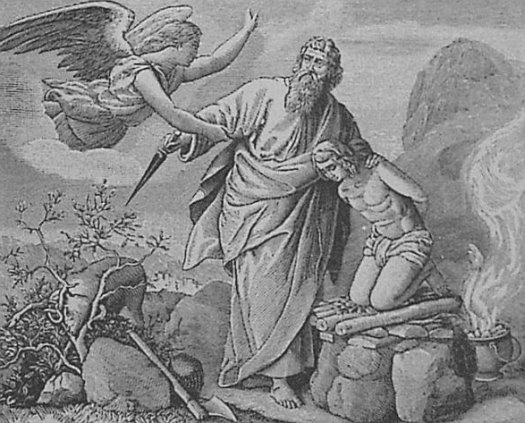
 When Isaac was a young man, Abraham took him to Mount Moriah. There, Abraham, obeying God's command, prepared to sacrifice his son as a burnt offering. But God intervened, sparing Isaac's life and providing a ram as a substitute offering (22:1-14).
In so doing, God also pointed to the substitutionary sacrifice of His own Son Jesus Christ for the sins of the world. When the author of Hebrews expounded on the faith of Abraham (11:8-19), he made special note of Abraham's belief that, in order to accomplish His purposes, "God was able even to raise [Isaac] from the dead, from which, figuratively speaking, he did receive him back. (v. 19)"
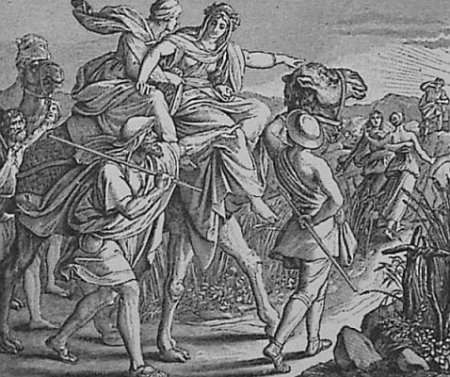
Abraham sent a faithful servant back among their kinfolk in order to find a bride for Isaac. There, the servant found Rebekah, who gladly traveled with this stranger to a new land, where she was given in marriage to Isaac (Genesis 24). They had twin sons, Esau and Jacob (25:19-26).
In his old age, Isaac became weak and blind. Before he died, he desired to give his blessing and the chief inheritance to Esau, his elder and favorite son, even though the Lord had promised Rebekah that their birth order would be reversed in the blessing and Jacob would be the favored son (25:23). However, Rebekah showed her favorite, Jacob, how to deceive his father and gain the blessing for himself (27:1-40). Of course, this resulted in years of bitter family strife, although Jacob and Esau later reconciled (Genesis 33).
Isaac lived to the age of 180 and was buried by his sons in the family burial cave of Machpelah (35:28-29).
Labels: abraham, biography, christianity, christology, commemoration, hagiography, isaac, israel, jacob, old testament, rebekah, sacrifice, sarah
¶ 00:00 | 1 comments |
 Ezekiel, the son of Buzi, was a priest, called by God to be a prophet to the exiles during the Babylonian captivity (Ezekiel 1:3). In 597 B.C. King Nebuchadnezzar and the Babylonian army brought the king of Judah and thousands of the best citizens of Jerusalem — including Ezekiel — to Babylon (2 Kings 24:8-16).
Ezekiel's priestly background profoundly stamped his prophecy, as the holiness of God and the Temple figure prominently in his messages (for example, Ezekiel 9-10 and 40-48). From 593 B.C. to the destruction of Jerusalem and the temple in 586 B.C., Ezekiel prophesied the inevitability of divine judgment on Jerusalem, on the exiles in Babylon, and on seven nations that surrounded Israel (Ezekiel 1–32). Jerusalem would certainly fall and the exiles would not quickly return — the just consequences of their sins.
Especially in the early part of the book, much of what the Lord "said" to His people was delivered in the form of action prophecies. In these, Ezekiel acted out representations of coming events pertaining to the fall of Judah, the destruction of the temple, and the seeming end of the Davidic line of kings. These action prophecies included the eating of the scroll (3:1-2), being struck with dumbness (3:22-27), sketching of the city of Jerusalem (4:1-3), lying on one side and then the other (4:4-8), eating restricted rations cooked on a fire of dried dung (4:9-17), and shaving his hair and beard with a sword before dividing the hair (5:1-4). Some seem a bit strange at first glance, once we understand their meaning and context, their messages are quite easily comprehended.
Once word reached Ezekiel that Jerusalem and the temple were destroyed, his message became one of comfort and hope. Through him God promised that his people would experience future restoration, renewal, and revival in the coming Messianic kingdom (Ezekiel 33-48).
Much of the strange symbolism of Ezekiel's prophecies was later employed in the Revelation to Saint John. Among these are the visions of the four living creatures as seen in Ezekiel 1 and Revelation 4.
See Happenings for a hymn stanza written for the Commemoration of Ezekiel.
Labels: babylonian captivity, bible, biography, christianity, christology, commemorations, ezekiel, hagiography, israel, old testament, prophet, revelation
¶ 00:00 | 0 comments |
 The prophet Elijah, whose name means, "My God is Yahweh [the Lord]," prophesied in the northern kingdom of Israel, mostly during the reign of Ahab (874 – 853 B.C.).
Ahab, under the influence of his pagan wife Jezebel, had encouraged the worship of Baal throughout his kingdom, even as Jezebel sought to get rid of the worship of Yahweh. Elijah was called by God to denounce this idolatry and to call the people of Israel back to the worship Yahweh as the only true God (as he did in 1 Kings 18:20-40).
Elijah was a rugged and imposing figure, living in the wilderness and dressing in a garment of camel's hair and a leather belt (2 Kings 1:8). He was a prophet mighty in word and deed. The Lord worked many miracles through Elijah, including the raising of the dead (1 Kings 17:17-24) and the effecting of a long drought in Israel (1 Kings 17:1).
At the end of his ministry, he was taken up into heaven as Elisha, his successor, looked on (2 Kings 2:11). Later on, the Lord proclaimed through the prophet Malachi that Elijah would return before the coming of the Messiah (Malachi 4:5-6), a prophecy that was fulfilled in the prophetic ministry of John the Baptist (see Jesus' words in Matthew 11:1-19).
See Happenings for a hymn stanza written for the Commemoration of Elijah.
Labels: 1 kings, 2 kings, ahab, biography, commemorations, elijah, elisha, hagiography, israel, jezebel, john the baptist, old testament, prophet, transfiguration
¶ 00:00 | 0 comments |
 Ruth, the subject of the book bearing her name, is an inspiring example of God's grace. Although she was a Gentile, God made her the great-grandmother of King David (Ruth 4:17), and an ancestress of Jesus Himself (Matthew 1:1-17).
A famine in Israel led Elimelech and Naomi of Bethlehem to emigrate to the neighboring nation of Moab with their two sons. The sons married Moabite women, Orpah and Ruth, but after about ten years, Elimelech and his sons died (Ruth 1:1-5).
Naomi then decided to return to Bethlehem and urged her daughters-in-law to return to their families. Orpah listened to Naomi's plea, but Ruth refused, replying with the stirring words: "Where you go I will go, and where you lodge I will lodge. Your people shall be my people, and your God my God. (1:16)"
After Ruth arrived in Bethlehem, Boaz, a close relative of Elimelech, agreed to be Ruth's "redeemer" (3:7-13; 4:9-12). He took her as his wife, and Ruth gave birth to Obed, the grandfather of David (4:13-17), thus preserving the Messianic seed. See Boaz, Ruth, and the Genealogy of Jesus at Ask the Pastor for a deeper theological examination of the account of Ruth and Boaz, including its Christological connection.
Ruth's kindness and selfless loyalty toward Naomi — and her faith in Naomi's God — have long endeared her to the faithful and redounded to God's praise for His merciful choice of one so unexpected.
Labels: biography, boaz, christianity, christology, commemorations, david, feasts, festivals, genealogy, gospels, hagiography, jesus, matthew, naomi, old testament, ruth
¶ 00:00 | 1 comments |
 Isaiah son of Amoz is considered to be the greatest of the writing prophets and is quoted in the New Testament more than any other Old Testament prophet. His name means "Yahweh [the Lord] saves." Isaiah prophesied to the people of Jerusalem and Judah from about 740 B.C. to 700 B.C. and was a contemporary of the prophets Amos, Hosea, and Micah.
Isaiah was a fierce preacher of God's Law, condemning the sin of idolatry. He was also a comforting proclaimer of the Gospel, repeatedly emphasizing the Lord's grace and forgiveness. For this he is sometimes called the "Evangelist of the Old Testament." No prophet more clearly prophesied about the coming Messiah and His saving kingdom. He foretold the Messiah's miraculous birth (Isaiah 7:14; 9:6), His endless reign (2:1–5; 11:1–16), and His public ministry (61:1–3), but most notably His "Suffering Servant" role and atoning death (52:13-53:12).
The apostle John's description of Isaiah, that Isaiah saw Jesus' glory and spoke of Him (John 12:41), is an apt summary of Isaiah's prophetic ministry. The seraphim's refrain of, "Holy, holy, holy is the Lord of hosts, (Isaiah 6:3)" during his call into the prophetic ministry (Isaiah 6) is the basis of many Christian hymns and liturgical pieces.
Hymn: Isaiah, Mighty Seer
Isaiah, mighty seer, in days of old
The Lord of all in Spirit did behold
High on a lofty throne, in splendor bright,
With flowing train that filled the Temple quite.
Above the throne were stately seraphim,
Six wings had they, these messengers of Him.
With twain they veiled their faces, as was meet,
With twain in reverent awe they hid their feet,
And with the other twain aloft they soared,
One to the other called and praised the Lord:
"Holy is God, the Lord of Sabaoth!
Holy is God, the Lord of Sabaoth!
Holy is God, the Lord of Sabaoth!
Behold, His glory filleth all the earth!"
The beams and lintels trembled at the cry,
And clouds of smoke enwrapped the throne on high. (from Isaiah 6:1-4)
Canticle: Isaiah 12
You will say in that day:
"I will give thanks to you, O Lord,
for though you were angry with me,
your anger turned away,
that you might comfort me.
Behold, God is my salvation;
I will trust, and will not be afraid;
for the Lord God is my strength and my song,
and he has become my salvation."
With joy you will draw water
from the wells of salvation.
And you will say in that day:
"Give thanks to the Lord,
call upon his name,
make known his deeds among the peoples,
proclaim that his name is exalted.
Sing praises to the Lord, for he has done gloriously;
let this be made known in all the earth.
Shout, and sing for joy, O inhabitant of Zion,
for great in your midst is the Holy One of Israel."
See Happenings for a hymn stanza written for the Commemoration of Isaiah.
Labels: biography, christianity, christology, church history, commemoration, hagiography, isaiah, jesus, lutheranism, old testament, prophet
¶ 00:00 | 3 comments |
The holy prophet Jeremiah is counted as one of the four "major prophets" of the Old Testament, along with Isaiah, Ezekiel, and Daniel. His name means "Established (or Raised up) by Yahweh (the Lord)."
He was active as God's prophet to the southern kingdom of Judah ca. 627 to 582 B.C. As he fulfilled his calling, he predicted, witnessed, and lived through the Babylonian siege and eventual destruction of Jerusalem in 587 B.C.
In his preaching he often used symbols such as an almond rod (Jeremiah 1:11-14), wine jars (13:12-14), or a potter at work (18:1-17). His entire prophetic ministry was a sermon, communicating through word and deed God's anger toward his rebellious people. He suffered repeated rejection and persecution by his countrymen. As far as can be known, he died in Egypt, having been taken there forcibly. He is remembered and honored for fearlessly calling God's people to repentance.
 Jeremiah also is credited by many as the author of the book of Lamentations. The book consists of five separate poems, of which the first four are acrostics consisting of verses whose first words begin with successive letters of the Hebrew alphabet. In English translations, of course, this style completely disappears.
Chapter 3 is an especially well-developed acrostic. There are twenty-two letters in Hebrew and the other chapters have 22 verses. However, this chapter has sixty-six, grouping sets of three verses under each letter of the alphabet. Thus, verses one through three begin with א (aleph), verses four through six with ב (beth), seven through nine with ג (gimel), and so-on down the line. Chapter Five, while not an acrostic, still has 22 verses.
The themes of Lamentations unfold as follows: Chapter 1 treats the fallen and desolate city of Jerusalem as a widow weeping over her loss. Chapter 2 connects her misery with the sins of the nation and her people which brought God's judgment. Chapter 3 expresses hope that the Lord's punishment will result in blessing for His people and affirms His goodness: "The steadfast love of the Lord never ceases; his mercies never come to an end; they are new every morning; great is your faithfulness. 'The Lord is my portion,' says my soul, 'therefore I will hope in him.' (vv. 22-24)" Chapter 4 is a lament on the destruction of city and temple but lays the blame upon the people's sins. The final chapter outlines the city's continuing troubles and prays that the Lord will finally restore Zion and not abandon His chosen people, although their sins are great and they certainly deserve it.
The book of Jeremiah similarly proclaims harsh judgment upon persistent sin while also reminding the Lord's people of His faithfulness. It looks to a time when the need for the Law's commands and punishments will cease and all will be made right. The clearest expression of this thought is in 31:31-34, where a "New Covenant" of grace is promised, a covenant established by the blood of the coming Messiah: "Behold, the days are coming, declares the Lord, when I will make a new covenant with the house of Israel and the house of Judah, not like the covenant that I made with their fathers on the day when I took them by the hand to bring them out of the land of Egypt, my covenant that they broke, though I was their husband, declares the Lord.
"But this is the covenant that I will make with the house of Israel after those days, declares the Lord: I will put my law within them, and I will write it on their hearts. And I will be their God, and they shall be my people. And no longer shall each one teach his neighbor and each his brother, saying, 'Know the Lord,' for they shall all know me, from the least of them to the greatest, declares the Lord. For I will forgive their iniquity, and I will remember their sin no more."
Scripture says nothing of how prophet's life ended. Chapter 43 reveals that Johanan took Jeremiah, the prophet's faithful scribe Baruch ben Neriah, and a remnant of Judean people, to live in Egypt. This directly contradicted the Word of the Lord Jeremiah had just spoken in Chapter 42, forbidding such a move and warning of dire consequences. Since Jeremiah 52:31 mentions the reign of Evil-merodach, the son of Nebuchadnezzar, many think that he may have been at least 90 years old when he died. Some ancient traditions claim that he was stoned to death in Babylon. Others say that he finally went to Babylon with Nebuchadnezzar's army.
See Happenings for a hymn stanza written for the Commemoration of Jeremiah.
Labels: biography, christianity, christology, commemorations, hagiography, jeremiah, lamentations, lutheranism, old testament, prophet
¶ 00:00 | 0 comments |
 This day celebrates the birth of a son to the elderly and previously childless couple Elizabeth and Zechariah the priest. On the eighth day, his parents had him circumcised according the the Law and named him John ("Yahweh is gracious").
John would grow up to be the last prophet of the Old Testament and the Forerunner of the coming Messiah, his younger cousin Jesus. Notice that today's date is six months before Christmas — the Nativity of Our Lord — since the Annunciation to Saint Mary came "in the sixth month" of Elizabeth's pregnancy.
The Christian Church remembers Saint John the Baptizer's prophetic ministry and commemorates his martyrdom on 29 August.
Lection
Psalm 85:(1-6) 7-13
Isaiah 40:1-5
Acts 13:13-26
Luke 1:57-80
Collect
Almighty God, through John the Baptist, the forerunner of Christ, You once proclaimed salvation; now grant that we may know this salvation and serve You in holiness and righteousness all the days of our life; through Jesus Christ, Your Son, who lives and reigns with You and the Holy Spirit, one God, now and forever.
Additional Reading
Past Elder's post on The Nativity of St. John has some background material and some interesting notes about the Christian Calendar, the dating of Biblical events, and the kalends.
Labels: christology, elizabeth, feasts, festivals, forerunner, gospels, hagiography, jesus, john the baptist, luke, new testament, old testament, prophecy, zechariah
¶ 22:56 | 0 comments |
 After the prophet Elijah defeated the priests of Baal and then fled Jezebel's wrath, The Lord came to him on Mount Horeb. He told him to anoint new kings of Syria and Israel. He also commanded Elijah to anoint "Elisha the son of Shaphat of Abel-meholah, (1 Kings 19:16)" a member of the tribe of Issachar, to replace Elijah as the prophet of God to the northern kingdom of Israel ca. 849-786 B.C.
During Elijah's final days on earth, Elisha refused to leave his mentor's side. Elisha asked Elijah to grant him a final blessing, saying, "Please let there be a double portion of your spirit on me. (2 Kings 2:9)" Once he saw the elder prophet taken up into heaven, Elisha took up Elijah's mantle and assumed the prophetic office (2 Kings 2:1-14).
Like Elijah, Elisha played an active role in political affairs. He also performed many miracles, foreshadowing the miracles of God's own son. Among these, he cured the Syrian army commander Naaman of his leprosy (2 Kings 5:1-27), fed a multitude of hungry men (2 Kings 4:42-44), and restored life to the son of a Shunammite woman (4:8-37).
A vocal opponent of Baal worship, Elisha lived up to his name, which means "my God is salvation."
Labels: biography, christianity, commemorations, elijah, elisha, hagiography, lutheranism, old testament, prophet
¶ 00:00 | 0 comments |
 Esther is the heroine of the biblical book that bears her name. Her Jewish name was Hadassah, which means "myrtle." Her beauty, charm, and courage served her well as queen to King Ahasuerus. In that role she was able to save her people from the mass extermination that Haman, the king's chief adviser, had planned (2:19-4:17).
Esther's efforts to uncover the plot resulted in the hanging of Haman on the very same gallows that he had built for Mordecai, her uncle and guardian. Then the king named Mordecai minister of state in Haman's place. This story is an example of how God intervenes on behalf of his people to deliver them from evil, as here through Esther he preserved the Old Testament people through whom the Messiah would come.
Even though the book nowhere bears the name of the Lord (Yahweh), it is included in the canon of Scripture because it shows His providential protection of His covenant people and His preservation of the line of the Messiah.
Labels: ahasurus, bible, biography, commemoration, esther, hagiography, haman, mordecai, old testament, providence
¶ 00:00 | 0 comments |
 Job was a blameless and upright man who came from Uz (Job 1:1), a land northeast of Canaan. The Book of Job examines the depths of his faith, which was severely tested through the sufferings God permitted.
Despite the sudden death of his ten children and the loss of all his wealth and his health, Job refused to curse God: "Naked I came from my mother's womb, and naked shall I return; the Lord gave, and the Lord has taken away; blessed be the name of the Lord. (1:21)"
In the midst of his tribulations, Job questioned the meaning and purpose of suffering to the point of asserting his own righteousness (34:5-6). Finally, the Lord revealed that a man cannot know the mysteries of God (chapters 38-41). Still, Job's faith in his Redeemer and the resurrection prevailed even in the midst of horrible testing and he made a beautiful confession of faith (19:25-27). In the end, the Lord restored his wealth and blessed him with another seven sons and three daughters.
For a present-day examination of the same issues faced by our brother Job, please see how Ask the Pastor addressed the question Why Suffering and Death? and A Loving God in a Disaster Filled World.
Lection
Psalm 18:1-6
Job 19:23-27
2 Corinthians 11:16-33
Matthew 27:33-50
Collect
O Lord, our Rock and our Salvation, the rejected Stone who became Cornerstone, as the hope of seeing Your Day sustained Job in his trials and gave voice to his confession, we pray that You would engrave Yourself in our hearts and minds and sustain all who trust in You. Let not our troubles in this life cast us down from our secure position in You but keep us steadfast in faith unto life everlasting; for You live and reign with Your Father and the Holy Spirit, one God, now and forever.
Notes on the Art
The Meditation on the Passion, c. 1510, by Vittore Carpaccio, depicts Job (right) and Saint Jerome meditating upon the body of the dead Christ. The marble block upon which Job sits bears the inscription, "I know that my Redeemer lives" and the chair holding the Savior's body includes other Old Testament references to Him. Many details underscore the themes of death and resurrection. Note how the bones next to Job, the crown of thorns propped up against Christ's broken throne, the desolate scenery and wild animals on the left all show death and decay. Meanwhile, the small bird flying upward from Jesus, the engraved words, and the lush landscape to the right give witness to the resurrection and new life in Christ. Painting digtized by the Web Gallery of Art.
Labels: biography, christology, commemoration, devil, hagiography, job, old testament, patience, resurrection, satan, suffering, temptation
¶ 00:00 | 0 comments |
 Joseph was the son of the patriarch Jacob and Rachel — and was his father's favorite son. He incurred his older brothers' jealousy and anger (both through Jacob's favoritism and by his own attitude toward them, particularly regarding his dreams) so they sold him into slavery in Egypt and told their father he was dead (Genesis 37). In Egypt he became the chief servant in the home of Potiphar, a military official. Joseph refused to commit adultery when his master's wife tempted him. In retaliation, she unjustly accused him of attempted rape and he was imprisoned (Genesis 39).
Years later, he interpreted dreams for Pharaoh, who then freed him from prison and placed him in charge of the entire country. When his brothers came from Canaan to Egypt in search of food, they did not recognize him. He eventually revealed his identity, forgave them, and invited them and his father to live in Egypt. When Jacob blessed his sons before his death, he gave a blessing to both of Joseph's sons, Ephraim and Manasseh. Thus, each became an ancestor of one of the twelve tribes of Israel.
We remember and honor him for his moral uprightness (Genesis 39) and for his willingness to forgive his brothers (Genesis 45 and 50). But we especially celebrate his role in saving the family of Israel (Jacob), thus also playing an important part in God's plan to bring Messiah to His people and to all mankind.
Labels: biography, christology, commemoration, egypt, ephraim, hagiography, israel, jacob, joseph, manasseh, old testament
¶ 00:00 | 0 comments |
 Jacob was the third of the three great Hebrews given the title of patriarch, following his grandfather Abraham and his father Isaac. Jacob was the younger of the twin sons of Isaac and Rebekah.
He received his name because before birth he gripped his brother Esau's heel, seeming even then to be struggling for supremacy (Jacob can mean "He grasps the heel" or "he cheats"). After wrestling with the Angel of the Lord, Jacob, who certainly had lived up to the name of "Deceiver," was renamed Israel, which means "he strives with God" (Genesis 25:26; 32:28).
His family life was filled with trouble, much of it caused by his acts of deception toward his father and his brother Esau and his parental favoritism toward his son Joseph (commemorated on 31 March). He spent many of his later years grieving over the death of his beloved wife Rachel and the presumed death of Joseph, who had been appointed by the Egyptian Pharaoh to be in charge of food distribution during a time of famine in the land.
Late in life, as he was blessing his sons, Jacob uttered God's prophetic promise that the Messiah would come through the line of his fourth son, Judah (Genesis 49:8-12).
Labels: abraham, biography, christology, commemoration, esau, hagiography, isaac, israel, jacob, joseph, judah, leah, old testament, patriarch, rachel, rebekah
¶ 00:00 | 0 comments |
Sarah, whose name means "princess," was wife (and half-sister) of Hebrew patriarch Abraham (Genesis 11:29; 20:12). In obedience to divine command (Genesis 12:1), she made the long and arduous journey west, along with her husband and his relatives, from Ur of the Chaldees to Haran and then finally to the land of Canaan.
She was originally named Sarai but the Lord commanded her change in name (Genesis 17:15). At the same time, He changed Abram's name to Abraham (from "exalted father" to "father of a people"; Genesis 17:5). While her new name held no change in meaning as did her husband's, the Lord still thought it proper to identify her in a new way as He continued the Messianic line through her.
 She remained childless until old age. Then, in keeping with God's long-standing promise, she gave birth to a son and heir of the covenant (Genesis 21:1-3). When first promising Abraham and Sarah a son of their own, He told Abraham, "You shall call his name Isaac [he laughs]. (Genesis 17:19)" Evidently, the Lord anticipated both Sarah's celebration at his birth (Genesis 21:6) and her previous disbelieving laughter when she first heard she would become pregnant (Genesis 18:12-15). Thus, God reminds subsequent generations that He always "gets the last laugh."
We remember and honor Sarah as faithful wife of Abraham and the mother of Isaac, the second of the three great patriarchs. Thus, she became biological mother to the people of Israel and spiritual mother to all who believe in Jesus Christ, her greatest descendant. We also acknowledge her gracious hospitality to strangers (Genesis 18:1-8).
Following her death at the age of 127, Abraham laid her to rest in the Cave of Machpelah (Genesis 23), where he was later buried (Genesis 25:7-10).
Saint Paul used the example of Sarah bearing Isaac according to divine promise to illustrate the relationship Christians have with God through the Gospel's promise. Galatians 4:21-31 contrasts Ishmael, the child of the slave woman Hagar, with Isaac, the promised child of the free woman Sarah. The author of Hebrews was inspired by the Holy Spirit to record that even though she initially laughed at the Lord's seemingly impossible prediction, "By faith Sarah herself received power to conceive, even when she was past the age, since she considered him faithful who had promised. (Hebrews 11:11)"
Scripture quoted from the ESV.
Labels: abraham, abram, biography, christology, commemoration, galatians, genesis, gospel, hagiography, isaac, ishmael, law, old testament, prophecy, sarah, sarai
¶ 00:00 | 0 comments |
 David, son of Jesse, went from tending his father's flocks to being the greatest of Israel's kings. He ruled from about 1010 to 970 B.C. He was chosen by the Lord and anointed by Samuel to replace the apostate King Saul, for whom David had provided years of faithful service. The events of his life are found from 1 Samuel 16 through 1 Kings 2 and in 1 Chronicles 10 through chapter 29. David's son Solomon succeeded him as king.
David was also gifted musically. Skilled in playing the lyre, he wrote at least seventy-three of the Psalms, including the beloved Psalm 23 and several Messianic prophecies, including the foreshadowing of Christ's crucifixion in Psalm 22.
David's public and private character displayed a mixture of good, for example, his defeat of the giant Goliath, (1 Samuel 17) and evil, as in his adultery with Bathsheba, Uriah's wife, followed by his murder of Uriah, (2 Samuel 11). David's greatness lay in his fierce loyalty to God as Israel's military and political leader. For example, under his leadership, the people of Israel were united into a single nation with Jerusalem as the capital city.
This devotion to the Lord and to the people was coupled with his willingness to acknowledge his sins and ask for God's forgiveness, as recorded in 2 Samuel 12.* The great penitential outpouring of Psalm 51** came as a result of his sins against Uriah, as did the thoughts and emotions expressed in Psalm 32.
David's standing before the Lord and his place in the Messianic line are mentioned in many places. Of all of these, Paul's words in Acts 13:22-23 provide a fitting summary: "[The Lord] raised up David to be their king, of whom he testified and said, 'I have found in David the son of Jesse a man after my heart, who will do all my will.' Of this man's offspring God has brought to Israel a Savior, Jesus, as he promised."
*You Da Man! — a sermon on 2 Samuel 12
**Mercy Me! — a sermon on Psalm 51
Labels: biography, christology, commemoration, david, goliath, hagiography, israel, jesus, king, old testament, psalms
¶ 00:00 | 0 comments |
Today we commemorate the Holy Prophet Daniel and the Three Young Men — Shadrach, Meshach, and Abednego. These four were among the young men of Judah who were taken into captivity in Babylon. Showing promise in leadership positions, their captors elevated them to positions or authority. Still, even in that strange and foreign land, regardless of persecution or pressure to worship false gods, they remained faithful to the one true God in piety, prayer, and life.
 On account of their steadfast faithfulness in the face of pagan idolatry, the Three Young Men were thrown into a fiery furnace, from which they were saved by the Lord and emerged unharmed (Daniel 3). Similarly, Daniel was thrown into a pit of lions, from which he also was saved (Daniel 6).
The canonical text of Daniel only tells us that a fourth person joined the Three Young Men in the furnace and that they were unharmed in the ordeal. Supplemental accounts from the Apocrypha provide insertions between verses 23 and 24 of chapter 3. The Prayer of Azariah and The Song of the Three Young Men are purported accounts of what they sang and prayed while amidst the flames. The latter song entered Jewish and then Christian worship as a canticle of praise. Much of Christendom knows the song by its Latin title and still sings Benedicite Omnia Opera (Bless Him, All You Works [of the Lord]). These verses also inspire hymnists and various metrical works based upon the Benedicite have been written and sung through the years.
Perhaps because of its apocalyptic nature, the book of Daniel inspired not only these two prayers but other "supplemental" writings. Some Bibles insert these various passages into the Masoretic Text while others include some or all of them as separate writings. Of these additions, the two most noted are Susanna and Bel and the Dragon. The former is a tale of moral integrity in the face of sexual blackmail while the latter is a loose collection of stories involving Babylonian gods, a literal beast slain by Daniel, and a different tale of the prophet amidst the lions.
 Blessed in all their endeavors by the Lord — and in spite of the hostility of some — Daniel and the Three Young Men performed admirably in the positions of leadership granted to them (Daniel 2:48-49; 3:30; 6:28). No doubt their fidelity in their vocations brought more animosity from others than did their faith and worship.
Daniel received special favor from the Lord and was given the ability to interpret the difficult dreams and strange signs that were given to King Nebuchadnezzar and King Belshazzar (Daniel 2; 4-5). To Daniel himself the Lord gave visions of the end times and a picture of "one like a son of man" who "came to the Ancient of Days. (Daniel 7:9-14)" This same imagery returns to Holy Scripture in portions of Revelation and was also a title Jesus favored for Himself, as Saint Matthew frequently noted.
As an aside, we note that the Babylonians gave new names to some of their captives. Although the book and most references to the prophet use his Hebrew name, Daniel was also known as Belteshazzar. Meanwhile, the Three Young Men are normally referred to by their captive names of Shadrach, Meshach, and Abednego. Their Hebrew names were, respectively, Hananiah, Mishael, and Azariah.
Labels: abednego, biography, commemoration, daniel, fiery furnace, hagiography, meshach, nebuchadnezzar, old testament, prophet, shadrach
¶ 00:00 | 0 comments |
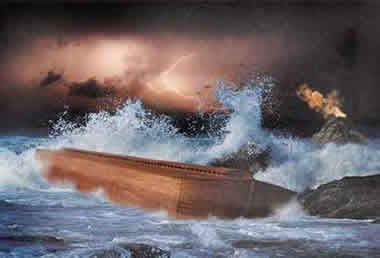 The world had become extremely corrupt, so God instructed Noah, the son of Lamech (Genesis 5:30) to build an ark to provide security for his family and selected living creatures from the waters of a devastating flood that God warned was coming. Read the entire account in (Genesis 6:1-9:17). Noah built the ark, and the flood came soon after its completion (Genesis 7). Over the next forty days and nights, the entire earth was flooded, blotting out "every living thing that was on the face of the ground, man and animals and creeping things and birds of the heavens. (7:23)"
After the flood subsided, the ark rested on the mountains of Ararat. When Noah determined it was safe, and God confirmed it, he and his family and all the animals disembarked (Genesis 8). Then Noah built an altar and offered a sacrifice to God for having saved his family from destruction. God declared a rainbow to be sign of His promise that never again would a similar flood destroy the entire earth (9:8-17).
We remember and honor Noah for his faithful obedience, as he believed that God would do what He said He would. Jesus (Matthew 24:36-39; Luke 17:22-27), Saint Peter (1 Peter 3:18-22; 2 Peter 2:4-10), and the author of Hebrews (11:7) each used Noah and the Flood as illustrations. These include God's judgment on sin, unwavering faith, a picture of Holy Baptism, and a prefiguring of Christ's suffering, death, descent into hell, and resurrection. Luke also listed Noah in Jesus' genealogy (3:36).
Lection
Psalm 29
Genesis 7:1-5, 11-12, 17-23
1 Peter 3:18-22 or Hebrews 11:1-3, 7; 12:1-2
Matthew 24:36-44
Collect
Lord God, heavenly Father, You kept Noah righteous in the midst of a sinful world and, through him, delivered life from the Flood's destruction, continuing also the human line of Your Son, our Lord Jesus Christ and foreshadowing the destruction of sin in Baptism and the preservation of new and eternal life in the Ark of the Holy Christian Church. Grant that we, the heirs of Noah by birth would likewise be heirs in faith of all Your promises, for the sake of our Lord and Savior Jesus Christ, who lives and reigns with You and the Holy Spirit, one God, now and forever. Amen.
Labels: ark, baptism, biography, christ, christology, commemoration, faith, flood, hagiography, jesus, noah, old testament
¶ 00:00 | 0 comments |
 The Lord called the Patriarch Abraham (first known as Abram) to become the father of a great nation (Genesis 12). At age 75, in obedience to God's command, he, his wife Sarai (later Sarah), and his nephew Lot moved southwest from the town of Haran to the land of Canaan. There, the Lord cut a covenant with Abram (Genesis 15), promising the land of Canaan to his descendants. In Genesis 17:1-16, the Lord established circumcision as a sign of His covenant people while also renaming Abram as Abraham and Sarai as Sarah.
At the age of 100 Abraham and Sarah were finally blessed with Isaac, the son long promised to them by God. A few years later, Abraham demonstrated supreme obedience when God commanded him to offer Isaac as a burnt offering. God spared the young man's life only at the last moment and provided a ram as a substitute offering (22:1-19).
Despite having his only child born at such an advanced age, Abraham lived to see the births of Isaac's twin sons Jacob and Esau. Abraham finally died at the age of 175 and was buried in the Cave of Machpelah, which he had purchased earlier as a burial site for Sarah. He is especially honored as the first of the three great Old Testament Patriarchs — and for his "righteousness before God through faith. (Romans 4:1-12)"
 In the great "Faith Chapter" of Hebrews 11, Abraham holds a prominent place. The writer noted several instances where Abraham acted "by faith," contrary to worldly evidence but in accordance with God's will. "By faith," he "obeyed when he was called to go out to a place that he was to receive as an inheritance (v. 8)"; he "went to live in the land of promise ... with Isaac and Jacob (v. 9)"; and he, "when he was tested, offered up Isaac. (v. 17)" Among the believers so listed, God also commended the faith of Sarah, Isaac, and Jacob through the epistle's writer.
The promised blessing of the nations came to fruition in the person of Jesus Christ. He was a son of Abraham by blood, by circumcision, and by His relationship with our heavenly Father. While the Jews traced their descent from Abraham according to his bloodlines, Christians are listed in Scripture as Abraham's true children by faith in Christ. Paul wrote that Abraham is "the father of us all" who share his faith in God (Romans 4:16). In Galatians, Paul also wrote, "Know then that it is those of faith who are the sons of Abraham. And the Scripture, foreseeing that God would justify the Gentiles by faith, preached the gospel beforehand to Abraham, saying, 'In you shall all the nations be blessed.' So then, those who are of faith are blessed along with Abraham, the man of faith. (3:7-9)"
We cannot definitively state that the patriarch saw his greatest Descendant "in the flesh" before he died, although some think that the Son of God was also the Angel of the Lord who spoke with him. However, whether by faith or by sight, we know from Jesus' words that "Abraham rejoiced that he would see my day. He saw it and was glad. (John 8:56)" When the Jews before Him mocked such an apparently outlandish statement, our Lord continued, "Truly, truly, I say to you, before Abraham was, I am, (v. 58)" thereby claiming to be not only a son of Abraham but also Abraham's God (cf. Exodus 3:13-14).
While most people shudder at the thought of Abraham taking Isaac up Mount Moriah as an intended sacrifice, some are more pained by his having a son with Sarai's servant Hagar (see Genesis 16). I'm one of these and, for many of us, it isn't the odd sharing of the marriage bed but the result of this wrong relationship that's more disturbing. Certainly the Lord assured blessing for Hagar's son Ishmael, a child born through human manipulation. However, He reserved the greater blessing for Isaac, the child born to Sarah of His divine promise (Genesis 17:15-21).
Sadly, both blessings were later forsaken by their bearers. The vast majority of Ishmael's descendants do not have Abraham's God as their own but instead have given themselves over to the pernicious religion of Islam and its false god Allah. Meanwhile, much of Israel disappeared, first during the Assyrian invasion and, later, the Babylonian Captivity. Of those who returned to Palestine, many slowly turned away from the God of Abraham, Isaac, and Jacob through the next four hundred years. When finally appeared the Blessing of the Nations, "He came to his own, and his own people did not receive him. (John 1:11)."
Labels: abraham, abram, biography, christology, commemoration, hagar, hagiography, isaac, ishmael, jacob, old testament, patristics, sarah
¶ 00:00 | 0 comments |
 On the Feast of St. Michael and all Angels (or Michaelmas) we thank God for the many ways in which He lovingly watches over us, both directly and indirectly. We also remember that the richness and variety of God's creation far exceeds our knowledge of it.
The angels are referred to as "messengers of God," or simply as "messengers." The word for a messenger in Hebrew is malach, in Greek, angelos, from which we get our word "angel."
 Michael (the name means "Who is like God?") is said to be the captain of the heavenly armies. In the Scriptures, Daniel (10:13, 21; 12:1) calls him prince of the people of Israel; Jude 9 notes an apocryphal story of a dispute with the devil about the body of Moses; Revelation 12:7 shows him leading the heavenly armies against those of the great dragon. He is often pictured in full armor, carrying a lance, and with his foot on the neck of a dragon.
Why do we call him "Saint" Michael? Isn't this word reserved for God's holy people? Well, the word actually means "holy," that is dedicated and set aside for a special Godly purpose or having an intrinisic goodness. All of God's people are holy because of Christ. Therefore, all are saints — especially the dead in Christ. Because they are completely sinless, Michael and all the angels are "holy" and thus may be called saints.
Many theologians through the centuries have suggested that Michael is actually a theophany, a divine manifestation of the Son of God. Reading the passages where he is mentioned doesn't convince me entirely one way or another. The name itself is intriguing: If we answer the question, "Who is like God?" we must say, "No one — except God."Also, while Christian literature, liturgics, and hymnody is filled with references to archangels, Michael is the only being in Scripture called an archangel. All other "archangel" names come from the Apocrypha or even more spurious writings. The prefix normally means ruling, chief, or principal and can also carry the meaning of a prototype or an earlier model.
We know that Jesus testifies of His Father: He was and remains the principal (arch-) messenger of God's grace. He also preceded the existence of the angels, being alive from all eternity. In fact, He not only is the great messenger of God's Word, He is God's Word. Thus, understanding the Son as the archangel, the primary and ruling messenger of the Father is totally congruent with Scripture's revelation.I say this not to attempt to persuade the reader to accept the idea that Michael is the Son of God but to open the mind to the possibility that they could be one and the same.
As for the angels, there are numerous times and places where they are mentioned. Yet all the spirit beings who serve God are not called angels by Scripture. While we often in our thinking lump them together, a number of distinct created beings exist.When reading the Pauline epistles, many early theologians took as titles some of the descriptive language he used in writing of the spiritual realm. They came up with nine "choirs" or ranks of angels, normally grouped in three triads. Their order varied among the different commentators. For example, Pseudo-Dionysias ranked them (in ascending order) as seraphim, cherubim, thrones, dominions, virtues, powers, principalities, archangels, and angels.
Cherubim, seraphim, angels and at least one archangel we know of definitely from the Bible. Whether or not "thrones, dominions, virtues," and the like are also specific creatures or whether they're rather general characteristics of the spirit beings, these lists appear to have identified the "four living creatures" mentioned in Ezekiel and Revelation as cherubim.These lists have made it into our liturgy, where the Communion Preface speaks of "angels and archangels and all the company of heaven." They've also been incorporated into our hymnody, most notably "Ye Watchers and Ye Holy Ones."
James Kiefer's Hagiographies give even more details on the choirs of angels and related material with Mr. Kiefer's article on Michael and All Angels.Lection
Psalm 91
Daniel 10:10-14; 12:1-3
Revelation 12:7-12
Matthew 18:1-11 or Luke 10:17-20
Collect
Everlasting God, You have ordained and constituted the service of angels and men in a wonderful order. Mercifully grant that, as Your holy angels always serve and worship You in heaven, so by Your appointment they may also help and defend us here on earth; through Jesus Christ, Your Son, our Lord, who lives and reigns with You and the Holy Spirit, one God, now and forever.
Hymn
Ye Watchers and Ye Holy Ones
Ye watchers and ye holy ones,
Bright seraphs, cherubim, and thrones,
Raise the glad strain, Alleluia!
Cry out, dominions, princedoms, powers,
Virtues, archangels, angels' choirs,
Alleluia! Alleluia!
O higher than the cherubim,
More glorious than the seraphim,
Lead their praises, Alleluia!
Thou Bearer of the eternal Word,
Most gracious, magnify the Lord,
Alleluia! Alleluia!
Respond, ye souls in endless rest,
Ye patriarchs and prophets blest,
Alleluia! Alleluia!
Ye holy Twelve, ye martyrs strong,
All saints triumphant, raise the song,
Alleluia! Alleluia!
O friend, in gladness let us sing,
Supernal anthems echoing,
Alleluia! Alleluia!
To God the Father, God the Son,
And God the Spirit, Three in One,
Alleluia! Alleluia!
Labels: angel, apocrypha, archangel, cherubum, christianity, christology, feasts, festivals, four living creatures, liturgics, michael, new testament, old testament, seraphim, theology
¶ 00:00 | 0 comments |
 A singular prophet among the many in the Old Testament, Jonah the son of Amittai was born about an hour's walk from Nazareth. His prophetic ministry involved a call to preach at Nineveh, capital of pagan Assyria (Jonah 1:1-2). His reluctance to respond and God's insistence that His call be heeded is the story of the book that bears Jonah's name.
Although the swallowing and disgorging of Jonah by the great fish is the most remembered detail of his life, the book address it in only three verses (Jonah 1:17; 2:1, 10). The important theme is how God deals compassionately with sinners. God spared sinful Nineveh — for a time. Eventually, their evil returned and brought about their eventual destruction.
The Lord also dealt mercifully with sinful Jonah who resisted God's call and fled toward Tarshish to escape it, who resented the Lord graciously saving the savage Assyrians, and who sat and sulked about their deliverance, saying, "I knew that you are a gracious God and merciful, slow to anger and abounding in steadfast love, and relenting from disaster. (Jonah 4:2)"
Jonah's three day sojourn in the belly of the fish is mentioned by Jesus as a sign of His own death, burial, and resurrection (Matthew 12:39-41).
Labels: biography, christology, commemoration, fish, hagiography, jonah, ninevah, old testament, prophet, resurrection
¶ 00:00 | 0 comments |


