
 Note: Please see Ask the Pastor for more on the history and theology of the Augsburg Confession and its presentation.
The Augsburg Confession, the principal doctrinal statement of the theology of Martin Luther and the Lutheran reformers, was written largely by Philipp Melanchthon. At its heart it confesses the justification of sinners by grace alone, through faith alone, for the sake of Christ alone.
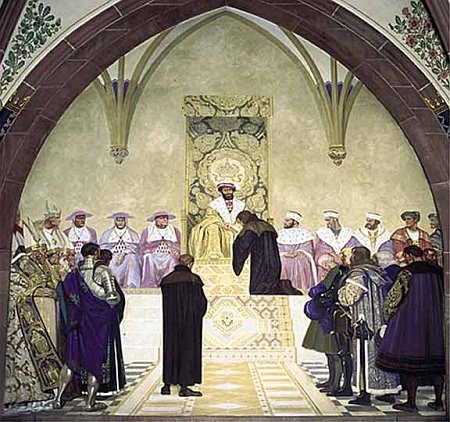
Signed by leaders of several German cities and regions, the confession was formally presented to the Holy Roman Emperor Charles V at Augsburg, Germany, on 25 June 1530. A few weeks later Roman Catholic authorities rejected the Confession, which Melanchthon defended in the Apology of the Augsburg Confession (1531). In 1580 the Unaltered Augsburg Confession was included in the Book of Concord.
An historical sidelight: Because of imperial protocol, Melanchthon wasn't allowed to make — or even attend — the presentation. Instead, two of the Saxon chancellors gave the oral reading and handed the written Latin and German copies to Charles V.
Lection
Psalm 46
Isaiah 55:6-11
Romans 10:5-17
John 15:1-11
Collects
O Lord God, heavenly Father, pour our Your Holy Spirit on Your faithful people, keep them steadfast in Your grace and truth, protect and comfort them in all temptation, defend them against all enemies of Your Word, and bestow on Christ's Church Militant Your saving peace; through Jesus Christ, Your Son, our Lord, who lives and reigns with You and the Holy Spirit, one God, now and forever.
Almighty God, we praise You for those You have sent to call the Church to its tasks and renew its life, including your servant Philipp Melanchthon. Raise up in our own day pastors, teachers, and theologians inspired by Your Spirit, whose voices will give strength to Your Church and proclaim Your kingdom; through Your Son, Jesus Christ our Lord.
Hymn
God's Word Is Our Great Heritage
God's Word is our great heritage
And shall be ours forever;
To spread its light from age to age
Shall be our chief endeavor.
Through life it guides our way,
In death it is our stay.
Lord, grant, while worlds endure,
We keep its teachings pure
Throughout all generations.
Notes on the Propers: The suggested readings come from the LCMS hymnal Lutheran Worship, as does the first collect. These propers may also used for the Commemoration of the Doctors of the Church, including Luther and C. F. W. Walther. The second collect is modified from James Kiefer's Hagiographies.
Labels: augsburg confession, book of concord, church history, commemoration, german history, lutheran confessions, lutheranism, martin luther, philipp melanchthon
¶ 00:00 | 0 comments |


He soon became an intimate friend of Luther and held tightly to the Reformer's teachings. When Luther attended the Leipzig Disputation (1519), Amsdorf accompanied him. He also followed with him to the Diet of Worms in 1521, and was one of the few who knew of Luther's whereabouts during his time at the Wartburg.
He became pastor and superintendent of the church Magdeburg in 1524 and actively introduced and championed the Reformation in that city. His church order closely paralled that of Wittenberg. He went on to similar positions in Goslar and Einbeck, where he continued to support reform. He participated in the Schmalkald discussions in 1537 and, in 1539, strongly opposed Philip of Hesse's bigamy.
His theological position, once firmly established, stayed in strict adherence with that of Luther. This led to dogmatic and ferocious opposition to Philipp Melanchthon, Martin Bucer, and others who represented a policy of conciliation and compromise both among other reformers and toward Roman Catholicism. Amsdorf's opposition was largely credited for the conciliatory Regensburg Conference of 1541. In that same year, and against strong opposition, Elector John Frederick appointed him Bishop of Naumburg-Zeitz.
The Battle of Mühlberg (1547) led him to seek refuge in from the Duke of Weimar. Seeing Wittenberg turn in a Melanchthonian direction, he worked under the Duke of Weimar to establish a new university at Jena in 1548. Theological differences likewise led him to take charge of compiling and editing the Jena Edition of Luther's works, as he sought to correct errors and omissions which Luther's staunchest followers claimed had crept into the Wittenberg edition.

Amsdorf deserves much of the credit — or blame, in the minds of some — for precipitating a formal and complete break between the Gnesio-Lutheran (orthodox) party and followers of Melanchthon at the colloquy of Worms (1557). Throughout much of his later career, he argued against those who claimed that good works were in any way responsible for salvation. Among the conflicts of this ongoing war were the Majoristic Controversy, the Osiandrian Controversy, and the Synergistic Controversy.
During these struggles, his theology and his personality led Amsdorf espouse the extreme position that good works are actually detrimental to the welfare of the soul. He seems to have meant those works that man thinks are good, God-pleasing, and done in order to attain salvation. However, other Lutherans judged that he and others of like mind had gone beyond (and even against) Scripture in this matter.
Flacius allowed his distrust of good works to become an extreme position regarding Original Sin. This led to his expulsion, along with others, from Jena in 1561. However, Amsdorf was spared because of his advanced age, his great service to Lutheranism, and the general opinion that he'd overreacted but likely didn't profess the same understanding of original sin as espoused by the Flacian party.
Nicolaus von Amsdorf died at Eisenach in 1565 and was buried in the Church of Saint George. There his effigy remains, showing a well-knit frame and sharp-cut features.
Labels: biography, commemoration, flacius, hagiography, john frederick, lutheranism, martin luther, philipp melanchthon, reformation
¶ 00:00 | 0 comments |
 Croatian reformer Matthias Flacius Illyricus (Matija Vlačić Ilirik) was born on 3 March 1520 in Labin (Albona in Latin). At that time, the region was under control of the Venetian Republic. He left home at age 16 to study in Venice. Baldo Lupetina a relative and Franciscan superior on the nearby island of Cres (who was later executed as a heretic) encouraged Matthias to continue studying in Germany.
Flacius traveled to Augsburg, arriving in 1539. He stayed only a short time before moving to Basel, where he enrolled at the university and studied Hebrew and Greek. There he also acquainted himself with many of the day's noted Protestant intellectuals. He moved on to Tübingen to continue his studies.
Traveling on, Flacius headed for the birth place of the Lutheran Reformation. He received his Master's degree from the University of Wittenberg at the age of 24 and lived for most of the 1540s in that town. His degree led to an immediate promotion to professor of theology.
Following Wittenberg, Matthias moved to Magdeburg. Between 1549 and 1557 and under his leadership, this city became a center of opposition to first the Augsburg and then the Leipzig Interims. These were forced truces between the Catholics and the Lutherans and certain other Protestants. During this period, Flacius began openly opposing Philipp Melanchthon and the theological and political compromises he was making with Rome and certain non-Lutheran reformers. Flacius believed that he was a faithful follower of Martin Luther and his theology and saw Melanchthon as one who would destroy much of what Luther had struggled so mightily to obtain.
 His time in Magdeburg was productive otherwise, as well. While there, he commenced work on on the 13-volume Ecclesiastica Historia (poplularly known as the Magdeburg Centuries) with Johannes Wigand and other scholars. He also wrote numerous tracts and pamphlets on various theological topics.
In 1557, Flacius was invited to head the newly founded theological faculty at the University of Jena. He served in this capacity until the end of 1561, when he was released due to his position in a controversy over original sin. He then moved to Regensburg, living there from 1562-1566. He was unable to achieve two great desires. First, he wanted to open a school for Southern Slavs and also hoped to relocate the Protestant printing press from Urach. Neither happened because Regensburg cancelled his asylum on the orders of Emperor Maximilian II.
At the invitation of the City Senate of Antwerp, Flacius moved there for a brief time, staying long enough to write a confession of faith for the Lutherans of the Low Countries. He was then in Strasbourg from 1567 to 1573. There he completed his final large work, the Glossa compendiaria, a commentary on the New Testament. He died at Frankfurt-am-Main in 1575.
Many would call Matthias Flacius' hermeneutical works his most important achievements and he certainly was a pioneer in the field. His Clavis Scripturae Sacrae (Key to Sacred Scripture) established that any passage of the Bible should be interpreted considering the purpose and the structure of the whole chapter or a given book. It also declared the rule that the literal sense of the text should have a priority over allegories and metaphors. He also contributed much to Church history and dogmatics. As overall proof of his learning and scholarship, we note that Flacius likely owned the single largest private collection of books during the 16th Century.
 Silesian and Swabian pastors asked Matthias to refute Caspar Schwenckfeld, who taught that "the inner word of the spirit must be differentiated from the external word spoken by the preacher; that the living Word of God is not the Scriptures but Christ, and that the Scriptures must be interpreted spiritually." This appeal to a subjective understanding and acceptance of an inner word hidden in the hearts of believers rather than the divinely inspired and clearly stated external Word went against all he'd learned from the reformers on the literal sense of the text. Of Schwenckfeld's spiritualizing of the Bible, Flacius said, "Spiritual exegesis [explanation] fits Scripture like a fist fits into an eye."
In all of his theology, Flacius tried to stay loyal to Luther, particularly the Reformer's emphasis on the bondage of the will. Unfortunately, his often abrasive style and his extreme position on original sin alienated many other staunch Lutherans. Because of this, his name fell into neglect and an undeserved degree of disrepute among many confessional Lutherans, even to the present day.
Additionally, he was a Croatian with Italian manners and mannerisms whose German was never good enough for those among whom he worked. In other words, Matthias Flacius Illyricus failed to fit in among his contemporaries in almost every way imaginable. However, we cannot underestimate his influence in preserving, promoting, and expounding the theology of the Lutheran Reformation.
In 1878, biographer Johann Wilhelm Preger eulogized Flacius: "A man of resolute courage, insuperable strength, possessing a wide-ranging knowledge one rarely encounters, with a broad vision and an industrious spirit."
Notes: See the Matthias Flacius Illyricus Memorial Collection on the Internet Archive for an extensive resource of things Flacius. Magdeburg Press sells How to Understand the Sacred Scriptures, a translated portion of the Clavis Scripturae Sacrae. Illyricus comes from the name of the former Roman province of Illyricum, which included his homeland. I also recommend Oliver K. Olson's book Mattias Flacius and the Survival of Luther's Reform. Flacius is not on the LCMS calendar of commemorations but is part of my ongoing addition of noted Lutherans and other Christians to a list of those I consider worthy of the Church's remembrance.
Labels: apologetics, baldo lupetina, biography, commemoration, croatia, european history, flacius, hagiography, lutheranism, martin luther, philipp melanchthon, reformation
¶ 00:00 | 0 comments |
 Martin Luther, born on 10 November 1483, in Eisleben, Germany, initially began studies leading toward a degree in law. However, after a close encounter with death, he switched to the study of theology, entered an Augustinian monastery, was ordained a priest in 1505, and received a doctorate in theology in 1512.
As a professor at the newly-established University of Wittenberg, his Scriptural studies led him to question many of the church's teachings and practices, especially the selling of indulgences. His refusal to back down from his convictions resulted in his excommunication in 1521. Following a period of seclusion at the Wartburg castle, Luther returned to Wittenberg, where he spent the rest of his life preaching and teaching, translating the Scriptures, and writing hymns and numerous theological treatises.
Of course, Luther didn't work alone. First of all, he knew that the Holy Spirit, working through the Word, was principal actor in the Reformation, and said, "While I slept, or drank Wittenberg beer with my friends ... the Word so greatly weakened the papacy that no prince or emperor ever inflicted such losses upon it. I did nothing; the Word did everything." However, his "friends," including Philipp Melanchthon, Nicholas Amsdorf, Johannes Bugenhagen, and others contributed mightily to the cause. Meanwhile, his prince, Frederick III of Saxony, defended him. Finally, he probably received no earthly support greater than that of his beloved wife Katie.
We remember and honor his lifelong emphasis on the Biblical truth that for Christ's sake God declares us righteous by grace through faith alone. He died on 18 February 1546, while visiting the town of his birth.
Please visit Xrysostom for The Life of Martin Luther: A Chronology. A number of recommended books and web sites are included along with this biographical outline.
Lection
Psalm 46
Isaiah 55:6-11
Romans 10:5-17
John 15:1-11
Collect
O Lord God, heavenly Father, pour our Your Holy Spirit on Your faithful people, keep them steadfast in Your grace and truth, protect and comfort them in all temptation, defend them against all enemies of Your Word, and bestow on Christ's Church Militant Your saving peace; through Jesus Christ, Your Son, our Lord, who lives and reigns with You and the Holy Spirit, one God, now and forever.
Tags: Martin Luther | Doctor Martin Luther | Dr. Martin Luther | Lutheran | Lutheranism | Christianity | Christian | Reformation | Lutheran Reformation | Book of Concord | Lutheran Confessions | Small Catechism | Large Catechism | Smalcald Articles | hagiography | biography | Church history | historical theology | exegetical theology | Bible translation | practical theology | hymn writing | liturgics | German history | European history| Aardvark Alley
Labels: biography, bugenhagen, commemoration, frederick the wise, german history, hagiography, hymnody, katharina luther, lutheran confessions, lutheranism, martin luther, philipp melanchthon, reformation, theology
¶ 00:00 | 0 comments |
 Philipp Melanchthon, a brilliant student of the classics and a humanist scholar, was appointed to teach along with Martin Luther at the University of Wittenberg in 1518. At Luther's urging, Melanchthon began teaching theology and Scripture in addition to his courses in classical studies.
In April of 1530, Emperor Charles V called an official meeting between the representative of Lutheranism and Roman Catholicism, hoping to effect a meeting of minds between two opposing groups. Since Luther was at that time under papal excommunication and an imperial ban, Melanchthon was assigned the duty of being the chief Lutheran representative at this meeting. Thus, he made the primary verbal and written defenses of the Evangelical (Lutheran) position.
We especially remember and honor him as the author of the Augsburg Confession, which was officially presented by the German princes to the emperor on 25 June 1530, as the defining document of Lutheranism within Christendom. Following the Roman Catholic response, Melanchthon wrote the Apology (Defense) of the Augsburg Confession.
Unfortunately, Melanchthon's desires for peace within Christendom led him to later rewrite and weaken some of the Augsburg Confession's language. The resulting Variata were palatable to some who disagreed with certain Lutheran teachings and allowed for false teaching to infiltrate Lutheranism. Ask the Pastor details some of this in a post on the Unaltered Augsburg Confession.
Lection
Psalm 46
Isaiah 55:6-11
Romans 10:5-17
John 15:1-11
Collect
O Lord God, heavenly Father, pour our Your Holy Spirit on Your faithful people, keep them steadfast in Your grace and truth, protect and comfort them in all temptation, defend them against all enemies of Your Word, and bestow on Christ's Church Militant Your saving peace; through Jesus Christ, Your Son, our Lord, who lives and reigns with You and the Holy Spirit, one God, now and forever.
Note: We commemorate Philipp Melanchthon's birth date because his death date often conflicts with Holy Week or Easter observances.
Labels: augsburg confession, biography, book of concord, commemoration, german history, hagiography, lutheran confessions, martin luther, philipp melanchthon, reformation, variata
¶ 00:00 | 0 comments |
Note: Please see Ask the Pastor for more on the history and theology of the Augsburg Confession and its presentation.The Augsburg Confession, the principal doctrinal statement of the theology of Martin Luther and the Lutheran reformers, was written largely by Philipp Melanchthon. At its heart it confesses the justification of sinners by grace alone, through faith alone, for the sake of Christ alone.
Signed by leaders of several German cities and regions, the confession was formally presented to the Holy Roman Emperor Charles V at Augsburg, Germany, on 25 June 1530. A few weeks later Roman Catholic authorities rejected the Confession, which Melanchthon defended in the Apology of the Augsburg Confession (1531). In 1580 the Unaltered Augsburg Confession was included in the Book of Concord.
An historical sidelight: Because of imperial protocol, Melanchthon wasn't allowed to make — or even attend — the presentation. Instead, two of the Saxon chancellors gave the oral reading and handed the written Latin and German copies to Charles V.
Lection
Psalm 46
Isaiah 55:6-11
Romans 10:5-17
John 15:1-11
Collects
O Lord God, heavenly Father, pour our Your Holy Spirit on Your faithful people, keep them steadfast in Your grace and truth, protect and comfort them in all temptation, defend them against all enemies of Your Word, and bestow on Christ's Church Militant Your saving peace; through Jesus Christ, Your Son, our Lord, who lives and reigns with You and the Holy Spirit, one God, now and forever.
Almighty God, we praise You for those You have sent to call the Church to its tasks and renew its life, including your servant Philipp Melanchthon. Raise up in our own day pastors, teachers, and theologians inspired by Your Spirit, whose voices will give strength to Your Church and proclaim Your kingdom; through Your Son, Jesus Christ our Lord.
Hymn
God's Word Is Our Great Heritage
God's Word is our great heritage
And shall be ours forever;
To spread its light from age to age
Shall be our chief endeavor.
Through life it guides our way,
In death it is our stay.
Lord, grant, while worlds endure,
We keep its teachings pure
Throughout all generations.
Notes on the Propers: The suggested readings come from the LCMS hymnal Lutheran Worship, as does the first collect. These propers may also used for the Commemoration of the Doctors of the Church, including Luther and C. F. W. Walther. The second collect is modified from James Kiefer's Hagiographies.
Labels: augsburg confession, book of concord, church history, commemoration, german history, lutheran confessions, lutheranism, martin luther, philipp melanchthon
¶ 00:00 | 0 comments |
Croatian reformer Matthias Flacius Illyricus (Matija Vlačić Ilirik) was born on 3 March 1520 in Labin (Albona in Latin). At that time, the region was under control of the Venetian Republic. He left home at age 16 to study in Venice. Baldo Lupetina a relative and Franciscan superior on the nearby island of Cres (who was later executed as a heretic) encouraged Matthias to continue studying in Germany.Flacius traveled to Augsburg, arriving in 1539. He stayed only a short time before moving to Basel, where he enrolled at the university and studied Hebrew and Greek. There he also acquainted himself with many of the day's noted Protestant intellectuals. He moved on to Tübingen to continue his studies.
Traveling on, Flacius headed for the birth place of the Lutheran Reformation. He received his Master's degree from the University of Wittenberg at the age of 24 and lived for most of the 1540s in that town. His degree led to an immediate promotion to professor of theology.
Following Wittenberg, Matthias moved to Magdeburg. Between 1549 and 1557 and under his leadership, this city became a center of opposition to first the Augsburg and then the Leipzig Interims. These were forced truces between the Catholics and the Lutherans and certain other Protestants. During this period, Flacius began openly opposing Philipp Melanchthon and the theological and political compromises he was making with Rome and certain non-Lutheran reformers. Flacius believed that he was a faithful follower of Martin Luther and his theology and saw Melanchthon as one who would destroy much of what Luther had struggled so mightily to obtain.
His time in Magdeburg was productive otherwise, as well. While there, he commenced work on on the 13-volume Ecclesiastica Historia (poplularly known as the Magdeburg Centuries) with Johannes Wigand and other scholars. He also wrote numerous tracts and pamphlets on various theological topics.In 1557, Flacius was invited to head the newly founded theological faculty at the University of Jena. He served in this capacity until the end of 1561, when he was released due to his position in a controversy over original sin. He then moved to Regensburg, living there from 1562-1566. He was unable to achieve two great desires. First, he wanted to open a school for Southern Slavs and also hoped to relocate the Protestant printing press from Urach. Neither happened because Regensburg cancelled his asylum on the orders of Emperor Maximilian II.
At the invitation of the City Senate of Antwerp, Flacius moved there for a brief time, staying long enough to write a confession of faith for the Lutherans of the Low Countries. He was then in Strasbourg from 1567 to 1573. There he completed his final large work, the Glossa compendiaria, a commentary on the New Testament. He died at Frankfurt-am-Main in 1575.
Many would call Matthias Flacius' hermeneutical works his most important achievements and he certainly was a pioneer in the field. His Clavis Scripturae Sacrae (Key to Sacred Scripture) established that any passage of the Bible should be interpreted considering the purpose and the structure of the whole chapter or a given book. It also declared the rule that the literal sense of the text should have a priority over allegories and metaphors. He also contributed much to Church history and dogmatics. As overall proof of his learning and scholarship, we note that Flacius likely owned the single largest private collection of books during the 16th Century.
Silesian and Swabian pastors asked Matthias to refute Caspar Schwenckfeld, who taught that "the inner word of the spirit must be differentiated from the external word spoken by the preacher; that the living Word of God is not the Scriptures but Christ, and that the Scriptures must be interpreted spiritually." This appeal to a subjective understanding and acceptance of an inner word hidden in the hearts of believers rather than the divinely inspired and clearly stated external Word went against all he'd learned from the reformers on the literal sense of the text. Of Schwenckfeld's spiritualizing of the Bible, Flacius said, "Spiritual exegesis [explanation] fits Scripture like a fist fits into an eye."In all of his theology, Flacius tried to stay loyal to Luther, particularly the Reformer's emphasis on the bondage of the will. Unfortunately, his often abrasive style and his extreme position on original sin alienated many other staunch Lutherans. Because of this, his name fell into neglect and an undeserved degree of disrepute among many confessional Lutherans, even to the present day.
Additionally, he was a Croatian with Italian manners and mannerisms whose German was never good enough for those among whom he worked. In other words, Matthias Flacius Illyricus failed to fit in among his contemporaries in almost every way imaginable. However, we cannot underestimate his influence in preserving, promoting, and expounding the theology of the Lutheran Reformation.
In 1878, biographer Johann Wilhelm Preger eulogized Flacius: "A man of resolute courage, insuperable strength, possessing a wide-ranging knowledge one rarely encounters, with a broad vision and an industrious spirit."
Notes: See the Matthias Flacius Illyricus Memorial Collection on the Internet Archive for an extensive resource of things Flacius. Magdeburg Press sells How to Understand the Sacred Scriptures, a translated portion of the Clavis Scripturae Sacrae. Illyricus comes from the name of the former Roman province of Illyricum, which included his homeland. I also recommend Oliver K. Olson's book Mattias Flacius and the Survival of Luther's Reform. Flacius is not on the LCMS calendar of commemorations but is part of my ongoing addition of noted Lutherans and other Christians to a list of those I consider worthy of the Church's remembrance.
Labels: apologetics, baldo lupetina, biography, commemoration, croatia, european history, flacius, hagiography, lutheranism, martin luther, philipp melanchthon, reformation
¶ 00:00 | 0 comments |
Martin Luther, born on 10 November 1483, in Eisleben, Germany, initially began studies leading toward a degree in law. However, after a close encounter with death, he switched to the study of theology, entered an Augustinian monastery, was ordained a priest in 1505, and received a doctorate in theology in 1512.As a professor at the newly-established University of Wittenberg, his Scriptural studies led him to question many of the church's teachings and practices, especially the selling of indulgences. His refusal to back down from his convictions resulted in his excommunication in 1521. Following a period of seclusion at the Wartburg castle, Luther returned to Wittenberg, where he spent the rest of his life preaching and teaching, translating the Scriptures, and writing hymns and numerous theological treatises.
Of course, Luther didn't work alone. First of all, he knew that the Holy Spirit, working through the Word, was principal actor in the Reformation, and said, "While I slept, or drank Wittenberg beer with my friends ... the Word so greatly weakened the papacy that no prince or emperor ever inflicted such losses upon it. I did nothing; the Word did everything." However, his "friends," including Philipp Melanchthon, Nicholas Amsdorf, Johannes Bugenhagen, and others contributed mightily to the cause. Meanwhile, his prince, Frederick III of Saxony, defended him. Finally, he probably received no earthly support greater than that of his beloved wife Katie.
We remember and honor his lifelong emphasis on the Biblical truth that for Christ's sake God declares us righteous by grace through faith alone. He died on 18 February 1546, while visiting the town of his birth.
Please visit Xrysostom for The Life of Martin Luther: A Chronology. A number of recommended books and web sites are included along with this biographical outline.
Lection
Psalm 46
Isaiah 55:6-11
Romans 10:5-17
John 15:1-11
Collect
O Lord God, heavenly Father, pour our Your Holy Spirit on Your faithful people, keep them steadfast in Your grace and truth, protect and comfort them in all temptation, defend them against all enemies of Your Word, and bestow on Christ's Church Militant Your saving peace; through Jesus Christ, Your Son, our Lord, who lives and reigns with You and the Holy Spirit, one God, now and forever.
Tags: Martin Luther | Doctor Martin Luther | Dr. Martin Luther | Lutheran | Lutheranism | Christianity | Christian | Reformation | Lutheran Reformation | Book of Concord | Lutheran Confessions | Small Catechism | Large Catechism | Smalcald Articles | hagiography | biography | Church history | historical theology | exegetical theology | Bible translation | practical theology | hymn writing | liturgics | German history | European history| Aardvark Alley
Labels: biography, bugenhagen, commemoration, frederick the wise, german history, hagiography, hymnody, katy luther, lutheran confessions, lutheranism, martin luther, philipp melanchthon, reformation, theology
¶ 00:00 | 0 comments |
Philipp Melanchthon, a brilliant student of the classics and a humanist scholar, was appointed to teach along with Martin Luther at the University of Wittenberg in 1518. At Luther's urging, Melanchthon began teaching theology and Scripture in addition to his courses in classical studies.In April of 1530, Emperor Charles V called an official meeting between the representative of Lutheranism and Roman Catholicism, hoping to effect a meeting of minds between two opposing groups. Since Luther was at that time under papal excommunication and an imperial ban, Melanchthon was assigned the duty of being the chief Lutheran representative at this meeting. Thus, he made the primary verbal and written defenses of the Evangelical (Lutheran) position.
We especially remember and honor him as the author of the Augsburg Confession, which was officially presented by the German princes to the emperor on 25 June 1530, as the defining document of Lutheranism within Christendom. Following the Roman Catholic response, Melanchthon wrote the Apology (Defense) of the Augsburg Confession.
Unfortunately, Melanchthon's desires for peace within Christendom led him to later rewrite and weaken some of the Augsburg Confession's language. The resulting Variata were palatable to some who disagreed with certain Lutheran teachings and allowed for false teaching to infiltrate Lutheranism. Ask the Pastor details some of this in a post on the Unaltered Augsburg Confession.
Lection
Psalm 46
Isaiah 55:6-11
Romans 10:5-17
John 15:1-11
Collect
O Lord God, heavenly Father, pour our Your Holy Spirit on Your faithful people, keep them steadfast in Your grace and truth, protect and comfort them in all temptation, defend them against all enemies of Your Word, and bestow on Christ's Church Militant Your saving peace; through Jesus Christ, Your Son, our Lord, who lives and reigns with You and the Holy Spirit, one God, now and forever.
Note: We commemorate Philipp Melanchthon's birth date because his death date often conflicts with Holy Week or Easter observances.
Labels: augsburg confession, biography, book of concord, commemoration, german history, hagiography, lutheran confessions, martin luther, philipp melanchthon, reformation, variata
¶ 00:00 | 0 comments |


