
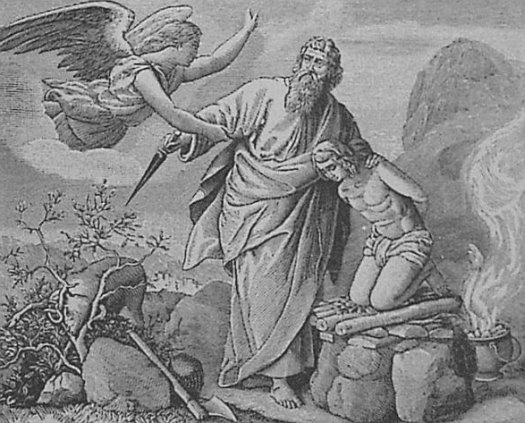
 If any part of Scripture besides the Resurrection clearly indicates that God gets the last laugh, it must be the story of Isaac.
After giving new names to Abraham and Sarah, the Lord promised a them a son. At the time, Abraham was 99 and Sarah was 90 (see Genesis 17). When Abraham heard the news, he "fell on his face and laughed and said to himself, 'Shall a child be born to a man who is a hundred years old? Shall Sarah, who is ninety years old, bear a child?' (v. 17)"
In response to the laughter and doubting, the Lord said, "Sarah your wife shall bear you a son, and you shall call his name Isaac. I will establish my covenant with him as an everlasting covenant for his offspring after him. (v. 19)" Isaac means "He Laughs."
To reiterate His point, the Lord allowed Sarah to overhear Him repeat His promise to Abraham at the Oaks of Mamre (see Genesis 18). "So Sarah laughed to herself, saying, 'After I am worn out, and my lord is old, shall I have pleasure?' The Lord said to Abraham, 'Why did Sarah laugh and say, "Shall I indeed bear a child, now that I am old?" Is anything too hard for the Lord? At the appointed time I will return to you about this time next year, and Sarah shall have a son.' But Sarah denied it, saying, 'I did not laugh,' for she was afraid. He said, 'No, but you did laugh.' (vv. 12-15)"
Sure enough, things happened not as Abraham and Sarah may have expected, but as the Lord had planned and promised. When Abraham was 100 years old, Sarah gave birth and "Abraham called the name of his son who was born to him, whom Sarah bore him, Isaac. (21:3)" Sarah likewise reveled in the irony: "God has made laughter for me; everyone who hears will laugh over me. (v. 6)"
 When Isaac was a young man, Abraham took him to Mount Moriah. There, Abraham, obeying God's command, prepared to sacrifice his son as a burnt offering. But God intervened, sparing Isaac's life and providing a ram as a substitute offering (22:1-14).
In so doing, God also pointed to the substitutionary sacrifice of His own Son Jesus Christ for the sins of the world. When the author of Hebrews expounded on the faith of Abraham (11:8-19), he made special note of Abraham's belief that, in order to accomplish His purposes, "God was able even to raise [Isaac] from the dead, from which, figuratively speaking, he did receive him back. (v. 19)"
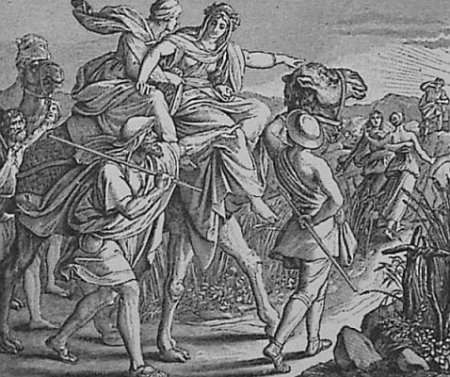
Abraham sent a faithful servant back among their kinfolk in order to find a bride for Isaac. There, the servant found Rebekah, who gladly traveled with this stranger to a new land, where she was given in marriage to Isaac (Genesis 24). They had twin sons, Esau and Jacob (25:19-26).
In his old age, Isaac became weak and blind. Before he died, he desired to give his blessing and the chief inheritance to Esau, his elder and favorite son, even though the Lord had promised Rebekah that their birth order would be reversed in the blessing and Jacob would be the favored son (25:23). However, Rebekah showed her favorite, Jacob, how to deceive his father and gain the blessing for himself (27:1-40). Of course, this resulted in years of bitter family strife, although Jacob and Esau later reconciled (Genesis 33).
Isaac lived to the age of 180 and was buried by his sons in the family burial cave of Machpelah (35:28-29).
Labels: abraham, biography, christianity, christology, commemoration, hagiography, isaac, israel, jacob, old testament, rebekah, sacrifice, sarah
¶ 00:00 | 1 comments |

 Ezekiel, the son of Buzi, was a priest, called by God to be a prophet to the exiles during the Babylonian captivity (Ezekiel 1:3). In 597 B.C. King Nebuchadnezzar and the Babylonian army brought the king of Judah and thousands of the best citizens of Jerusalem — including Ezekiel — to Babylon (2 Kings 24:8-16).
Ezekiel's priestly background profoundly stamped his prophecy, as the holiness of God and the Temple figure prominently in his messages (for example, Ezekiel 9-10 and 40-48). From 593 B.C. to the destruction of Jerusalem and the temple in 586 B.C., Ezekiel prophesied the inevitability of divine judgment on Jerusalem, on the exiles in Babylon, and on seven nations that surrounded Israel (Ezekiel 1–32). Jerusalem would certainly fall and the exiles would not quickly return — the just consequences of their sins.
Especially in the early part of the book, much of what the Lord "said" to His people was delivered in the form of action prophecies. In these, Ezekiel acted out representations of coming events pertaining to the fall of Judah, the destruction of the temple, and the seeming end of the Davidic line of kings. These action prophecies included the eating of the scroll (3:1-2), being struck with dumbness (3:22-27), sketching of the city of Jerusalem (4:1-3), lying on one side and then the other (4:4-8), eating restricted rations cooked on a fire of dried dung (4:9-17), and shaving his hair and beard with a sword before dividing the hair (5:1-4). Some seem a bit strange at first glance, once we understand their meaning and context, their messages are quite easily comprehended.
Once word reached Ezekiel that Jerusalem and the temple were destroyed, his message became one of comfort and hope. Through him God promised that his people would experience future restoration, renewal, and revival in the coming Messianic kingdom (Ezekiel 33-48).
Much of the strange symbolism of Ezekiel's prophecies was later employed in the Revelation to Saint John. Among these are the visions of the four living creatures as seen in Ezekiel 1 and Revelation 4.
See Happenings for a hymn stanza written for the Commemoration of Ezekiel.
Labels: babylonian captivity, bible, biography, christianity, christology, commemorations, ezekiel, hagiography, israel, old testament, prophet, revelation
¶ 00:00 | 0 comments |
 Ruth, the subject of the book bearing her name, is an inspiring example of God's grace. Although she was a Gentile, God made her the great-grandmother of King David (Ruth 4:17), and an ancestress of Jesus Himself (Matthew 1:1-17).
A famine in Israel led Elimelech and Naomi of Bethlehem to emigrate to the neighboring nation of Moab with their two sons. The sons married Moabite women, Orpah and Ruth, but after about ten years, Elimelech and his sons died (Ruth 1:1-5).
Naomi then decided to return to Bethlehem and urged her daughters-in-law to return to their families. Orpah listened to Naomi's plea, but Ruth refused, replying with the stirring words: "Where you go I will go, and where you lodge I will lodge. Your people shall be my people, and your God my God. (1:16)"
After Ruth arrived in Bethlehem, Boaz, a close relative of Elimelech, agreed to be Ruth's "redeemer" (3:7-13; 4:9-12). He took her as his wife, and Ruth gave birth to Obed, the grandfather of David (4:13-17), thus preserving the Messianic seed. See Boaz, Ruth, and the Genealogy of Jesus at Ask the Pastor for a deeper theological examination of the account of Ruth and Boaz, including its Christological connection.
Ruth's kindness and selfless loyalty toward Naomi — and her faith in Naomi's God — have long endeared her to the faithful and redounded to God's praise for His merciful choice of one so unexpected.
Labels: biography, boaz, christianity, christology, commemorations, david, feasts, festivals, genealogy, gospels, hagiography, jesus, matthew, naomi, old testament, ruth
¶ 00:00 | 1 comments |
 Isaiah son of Amoz is considered to be the greatest of the writing prophets and is quoted in the New Testament more than any other Old Testament prophet. His name means "Yahweh [the Lord] saves." Isaiah prophesied to the people of Jerusalem and Judah from about 740 B.C. to 700 B.C. and was a contemporary of the prophets Amos, Hosea, and Micah.
Isaiah was a fierce preacher of God's Law, condemning the sin of idolatry. He was also a comforting proclaimer of the Gospel, repeatedly emphasizing the Lord's grace and forgiveness. For this he is sometimes called the "Evangelist of the Old Testament." No prophet more clearly prophesied about the coming Messiah and His saving kingdom. He foretold the Messiah's miraculous birth (Isaiah 7:14; 9:6), His endless reign (2:1–5; 11:1–16), and His public ministry (61:1–3), but most notably His "Suffering Servant" role and atoning death (52:13-53:12).
The apostle John's description of Isaiah, that Isaiah saw Jesus' glory and spoke of Him (John 12:41), is an apt summary of Isaiah's prophetic ministry. The seraphim's refrain of, "Holy, holy, holy is the Lord of hosts, (Isaiah 6:3)" during his call into the prophetic ministry (Isaiah 6) is the basis of many Christian hymns and liturgical pieces.
Hymn: Isaiah, Mighty Seer
Isaiah, mighty seer, in days of old
The Lord of all in Spirit did behold
High on a lofty throne, in splendor bright,
With flowing train that filled the Temple quite.
Above the throne were stately seraphim,
Six wings had they, these messengers of Him.
With twain they veiled their faces, as was meet,
With twain in reverent awe they hid their feet,
And with the other twain aloft they soared,
One to the other called and praised the Lord:
"Holy is God, the Lord of Sabaoth!
Holy is God, the Lord of Sabaoth!
Holy is God, the Lord of Sabaoth!
Behold, His glory filleth all the earth!"
The beams and lintels trembled at the cry,
And clouds of smoke enwrapped the throne on high. (from Isaiah 6:1-4)
Canticle: Isaiah 12
You will say in that day:
"I will give thanks to you, O Lord,
for though you were angry with me,
your anger turned away,
that you might comfort me.
Behold, God is my salvation;
I will trust, and will not be afraid;
for the Lord God is my strength and my song,
and he has become my salvation."
With joy you will draw water
from the wells of salvation.
And you will say in that day:
"Give thanks to the Lord,
call upon his name,
make known his deeds among the peoples,
proclaim that his name is exalted.
Sing praises to the Lord, for he has done gloriously;
let this be made known in all the earth.
Shout, and sing for joy, O inhabitant of Zion,
for great in your midst is the Holy One of Israel."
See Happenings for a hymn stanza written for the Commemoration of Isaiah.
Labels: biography, christianity, christology, church history, commemoration, hagiography, isaiah, jesus, lutheranism, old testament, prophet
¶ 00:00 | 3 comments |
 This major Christological feast commemorates the joyous visit Mary paid to her relative (probably her cousin) Elizabeth, following The Annunciation. Inspired by the amazing news that she was to become the mother of the Christ and in response to the joyous word that her old and previously barren kinswoman was also pregnant, she joined Elizabeth during her sixth month of pregnancy (see Luke 1:39-56).
After Mary declared the wondrously good news, Elizabeth replied to the Virgin, "Blessed are you among women, and blessed is the fruit of your womb! ... Behold, when the sound of your greeting came to my ears, the baby in my womb leaped for joy. (vv. 42, 44)" She concluded by giving full credit and glory to God while also commending her young cousin's hearty faith: "Blessed is she who believed that there would be a fulfillment of what was spoken to her from the Lord. (av. 45)"
Mary responded with the Magnificat, the beautiful song of praise beginning, "My soul magnifies the Lord. (vv. 46-55)" It's not clear whether Mary stayed there until after the birth of John or if she left immediately beforehand; Luke merely said that the Virgin "remained with her about three months and returned to her home. (v. 56)"
And so, as we encounter God sending the Forerunner and the Messiah into the world, we see a study in contrasts. Two women stand before each other. One seemingly too old to bear children now carries the final prophet of the Old Covenant. The other, youthful and as yet unwed — completely unprepared in the eyes of the world — carries the One who brings both the Advent and the Fulfillment of the New Testament. And again we see, in the fullness of time, one age passing away while another age begins — an age that has no end but which lasts unto eternity.
The reaction of Jesus' unborn cousin and the words of his mother also serve as reminders to many Christians about the sanctity of life. Christian pro-lifers point to John's celebration as clear evidence of the humanity and the consciousness of children who are still in utero.
In Roman Catholicism, Vatican II changed the date of the observation from 2 July to 31 May in order to more accurately reflect the Bible's chronology regarding the life of Christ. Several other Western churches followed suit. In The Lutheran Church —Missouri Synod, today is celebrated in the One Year Lectionary while the Three Year Lectionary moves the feast date to 31 May.
Note: This illustration by Albrecht Dürer is from the Web Gallery of Art.
Lection
Psalm 138
Isaiah 11:1-5
Romans 12:9-16
Luke 1:39-56
Collect
Almighty God, You chose the virgin Mary to be the mother of Your Son and made known through her Your regard for the poor and lowly and despised. Grant that we may receive Your Word in humility and faith, and so be made one with Jesus Christ, Your Son, our Lord, who lives and reigns with You and the Holy Spirit, one God, now and forever.
The Magnificat
My soul magnifies the Lord,
and my spirit rejoices in God my Savior,
for He has looked on the humble estate of his servant.
For behold, from now on all generations will call me blessed;
for He who is mighty has done great things for me,
and holy is His name.
And His mercy is for those who fear Him
from generation to generation.
He has shown strength with His arm;
He has scattered the proud in the thoughts of their hearts;
He has brought down the mighty from their thrones
and exalted those of humble estate;
He has filled the hungry with good things,
and the rich He has sent empty away.
He has helped His servant Israel,
in remembrance of His mercy,
as He spoke to our fathers,
to Abraham and to his offspring forever.
Labels: christianity, christology, church history, elizabeth, feasts, festivals, gospels, jesus, john the baptist, luke, magnificat, mary, new testament, visitation
¶ 00:00 | 0 comments |
The holy prophet Jeremiah is counted as one of the four "major prophets" of the Old Testament, along with Isaiah, Ezekiel, and Daniel. His name means "Established (or Raised up) by Yahweh (the Lord)."
He was active as God's prophet to the southern kingdom of Judah ca. 627 to 582 B.C. As he fulfilled his calling, he predicted, witnessed, and lived through the Babylonian siege and eventual destruction of Jerusalem in 587 B.C.
In his preaching he often used symbols such as an almond rod (Jeremiah 1:11-14), wine jars (13:12-14), or a potter at work (18:1-17). His entire prophetic ministry was a sermon, communicating through word and deed God's anger toward his rebellious people. He suffered repeated rejection and persecution by his countrymen. As far as can be known, he died in Egypt, having been taken there forcibly. He is remembered and honored for fearlessly calling God's people to repentance.
 Jeremiah also is credited by many as the author of the book of Lamentations. The book consists of five separate poems, of which the first four are acrostics consisting of verses whose first words begin with successive letters of the Hebrew alphabet. In English translations, of course, this style completely disappears.
Chapter 3 is an especially well-developed acrostic. There are twenty-two letters in Hebrew and the other chapters have 22 verses. However, this chapter has sixty-six, grouping sets of three verses under each letter of the alphabet. Thus, verses one through three begin with א (aleph), verses four through six with ב (beth), seven through nine with ג (gimel), and so-on down the line. Chapter Five, while not an acrostic, still has 22 verses.
The themes of Lamentations unfold as follows: Chapter 1 treats the fallen and desolate city of Jerusalem as a widow weeping over her loss. Chapter 2 connects her misery with the sins of the nation and her people which brought God's judgment. Chapter 3 expresses hope that the Lord's punishment will result in blessing for His people and affirms His goodness: "The steadfast love of the Lord never ceases; his mercies never come to an end; they are new every morning; great is your faithfulness. 'The Lord is my portion,' says my soul, 'therefore I will hope in him.' (vv. 22-24)" Chapter 4 is a lament on the destruction of city and temple but lays the blame upon the people's sins. The final chapter outlines the city's continuing troubles and prays that the Lord will finally restore Zion and not abandon His chosen people, although their sins are great and they certainly deserve it.
The book of Jeremiah similarly proclaims harsh judgment upon persistent sin while also reminding the Lord's people of His faithfulness. It looks to a time when the need for the Law's commands and punishments will cease and all will be made right. The clearest expression of this thought is in 31:31-34, where a "New Covenant" of grace is promised, a covenant established by the blood of the coming Messiah: "Behold, the days are coming, declares the Lord, when I will make a new covenant with the house of Israel and the house of Judah, not like the covenant that I made with their fathers on the day when I took them by the hand to bring them out of the land of Egypt, my covenant that they broke, though I was their husband, declares the Lord.
"But this is the covenant that I will make with the house of Israel after those days, declares the Lord: I will put my law within them, and I will write it on their hearts. And I will be their God, and they shall be my people. And no longer shall each one teach his neighbor and each his brother, saying, 'Know the Lord,' for they shall all know me, from the least of them to the greatest, declares the Lord. For I will forgive their iniquity, and I will remember their sin no more."
Scripture says nothing of how prophet's life ended. Chapter 43 reveals that Johanan took Jeremiah, the prophet's faithful scribe Baruch ben Neriah, and a remnant of Judean people, to live in Egypt. This directly contradicted the Word of the Lord Jeremiah had just spoken in Chapter 42, forbidding such a move and warning of dire consequences. Since Jeremiah 52:31 mentions the reign of Evil-merodach, the son of Nebuchadnezzar, many think that he may have been at least 90 years old when he died. Some ancient traditions claim that he was stoned to death in Babylon. Others say that he finally went to Babylon with Nebuchadnezzar's army.
See Happenings for a hymn stanza written for the Commemoration of Jeremiah.
Labels: biography, christianity, christology, commemorations, hagiography, jeremiah, lamentations, lutheranism, old testament, prophet
¶ 00:00 | 0 comments |
 This day celebrates the birth of a son to the elderly and previously childless couple Elizabeth and Zechariah the priest. On the eighth day, his parents had him circumcised according the the Law and named him John ("Yahweh is gracious").
John would grow up to be the last prophet of the Old Testament and the Forerunner of the coming Messiah, his younger cousin Jesus. Notice that today's date is six months before Christmas — the Nativity of Our Lord — since the Annunciation to Saint Mary came "in the sixth month" of Elizabeth's pregnancy.
The Christian Church remembers Saint John the Baptizer's prophetic ministry and commemorates his martyrdom on 29 August.
Lection
Psalm 85:(1-6) 7-13
Isaiah 40:1-5
Acts 13:13-26
Luke 1:57-80
Collect
Almighty God, through John the Baptist, the forerunner of Christ, You once proclaimed salvation; now grant that we may know this salvation and serve You in holiness and righteousness all the days of our life; through Jesus Christ, Your Son, who lives and reigns with You and the Holy Spirit, one God, now and forever.
Additional Reading
Past Elder's post on The Nativity of St. John has some background material and some interesting notes about the Christian Calendar, the dating of Biblical events, and the kalends.
Labels: christology, elizabeth, feasts, festivals, forerunner, gospels, hagiography, jesus, john the baptist, luke, new testament, old testament, prophecy, zechariah
¶ 22:56 | 0 comments |
Transferred to 13 June for Trinity Sunday and Saint Barnabas Day
 The Christian Church's First Ecumenical Council was convened in Nicaea (modern Isnuk, Turkey) in the early summer of AD 325 by the Roman Emperor Constantine. The emperor presided at the opening of the council. The major intended topic was the ongoing Arian controversy.
The council ruled against the Arians, who taught that Jesus was not the eternal Son of God but was created by the Father and was called Son of God because of his righteousness. The chief opponents of the Arians were Alexander, bishop of Alexandria, and his deacon, Athanasius. The council confessed the eternal divinity of Jesus and adopted the earliest version of the Nicene Creed, which in its entirety was adopted at the Council of Constantinople in 381.
Other topics included celebration of the Resurrection and how the date for Easter would correspond with Passover, the Miletian schism, validity of baptism by heretics, and the restoration lapsed Christians who renounced the Faith under persecution. The Council also established a number of new canons (Church laws). Enumeration varies, but twenty is the number suggested by the editors of the Early Church Fathers:
1. prohibition of self-castration, as done by Origen;Their version of what we now call the Nicene Creed was almost identical to what is now used in the Church until the third section, where the original ends, "We believe in the Holy Spirit." It fell to the Second Ecumenical Council (First Council of Constantinople) to add what is now used. Therefore, the confession used in the churches may properly be called the Niceno-Constantinopolitan Creed. The so-called filioque (where "and the Son" was inserted after the words about the Spirit proceeding from the Father) was only later added by the Roman Catholic Church and never accepted in the East.
2. establishment of a minimum term for catechumens;
3. prohibition of the presence in the house of a cleric of a younger woman who might bring him under suspicion;
4. ordination of a bishop in the presence of at least three provincial bishops and confirmation by the metropolitan;
5. provision for two provincial synods to be held annually;
6. exceptional authority acknowledged for the bishops of Alexandria and Rome, for their respective regions;
7. recognition of the honorary rights of the see of Jerusalem;
8. provision for agreement with the Novatianists;
9-14. provision for mild procedure against the lapsed during the persecution under Licinius;
15-16. prohibition of the removal of priests;
17. prohibition of usury among the clergy;
18. precedence of bishops and presbyters before deacons in receiving Holy Communion, the Eucharist;
19. declaration of the invalidity of baptism by Paulian heretics;
20. prohibition of kneeling during the liturgy, on Sundays, and in the days of Eastertide.
(Summary from Wikipedia.)
The Council also saw the first major collaboration between Church and state since Christianity began and signaled a rise in imperial influence in affairs of the Church. Constantine called it, presided over the initial session, and, in many respects, set its agenda. While his personal religious beliefs may have been part of his reason, most scholars agree that his main fear was that a divided Christianity would result in a divided Empire. The historical irony is that the Roman Empire fractured before any major schisms in Christendom.
Nicene Creed
 I believe in one God, the Father Almighty, Maker of heaven and earth and of all things visible and invisible.
And in one Lord Jesus Christ, the only-begotten Son of God, begotten of His Father before all worlds, God of God, Light of Light, very God of very God, begotten, not made, being of one substance with the Father, by whom all things were made; who for us men and for our salvation came down from heaven and was incarnate by the Holy Spirit of the virgin Mary and was made man; and was crucified also for us under Pontius Pilate. He suffered, and was buried. And the third day He rose again according to the Scriptures and ascended into heaven and sits at the right hand of the Father. And He will come again with glory to judge both the living and the dead, whose kingdom will have no end.
And I believe in the Holy Spirit, the Lord and Giver of Life, who proceeds from the Father and the Son, who with the Father and the Son together is worshiped and glorified, who spoke by the prophets. And I believe in one holy Christian [catholic] and apostolic Church, I acknowledge one Baptism for the remission of sins, and I look for the resurrection of the dead and the life ✠ of the world to come. Amen.
Labels: arius, athanasius, christianity, christology, commemoration, constantine, creed, lutheranism, nicaea, nicene creed
¶ 00:00 | 1 comments |
This major Christological feast commemorates the joyous visit Mary paid to her relative (probably her cousin) Elizabeth, following The Annunciation. Inspired by the amazing news that she was to become the mother of the Christ and in response to the joyous word that her old and previously barren kinswoman was also pregnant, she joined Elizabeth during her sixth month of pregnancy (see Luke 1:39-56).After Mary declared the wondrously good news, Elizabeth replied to the Virgin, "Blessed are you among women, and blessed is the fruit of your womb! ... Behold, when the sound of your greeting came to my ears, the baby in my womb leaped for joy. (vv. 42, 44)" She concluded by giving full credit and glory to God while also commending her young cousin's hearty faith: "Blessed is she who believed that there would be a fulfillment of what was spoken to her from the Lord. (v. 45)"
Mary responded with the Magnificat, the beautiful song of praise beginning, "My soul magnifies the Lord. (vv. 46-55)" It's not clear whether Mary stayed there until after the birth of John or if she left immediately beforehand; Luke merely said that the Virgin "remained with her about three months and returned to her home. (v. 56)"
And so, as we encounter God sending the Forerunner and the Messiah into the world, we see a study in contrasts. Two women stand before each other. One seemingly too old to bear children now carries the final prophet of the Old Covenant. The other, youthful and as yet unwed — completely unprepared in the eyes of the world — carries the One who brings both the Advent and the Fulfillment of the New Testament. And again we see, in the fullness of time, one age passing away while another age begins — an age that has no end but which lasts unto eternity.
The reaction of Jesus' unborn cousin and the words of his mother also serve as reminders to many Christians about the sanctity of life. Christian pro-lifers point to John's celebration as clear evidence of the humanity and the consciousness of children who are still in utero.
In Roman Catholicism, Vatican II changed the date of the observation from 2 July to 31 May in order to more accurately reflect the Bible's chronology regarding the life of Christ. Several other Western churches followed suit. In The Lutheran Church — Missouri Synod, today is celebrated in congregations following the Three Year Lectionary while the One Year Lectionary retains the July feast date.
Note: This illustration by Albrecht Dürer is from the Web Gallery of Art.
Lection
Psalm 138
Isaiah 11:1-5
Romans 12:9-16
Luke 1:39-56
Collect
Almighty God, You chose the virgin Mary to be the mother of Your Son and made known through her Your regard for the poor and lowly and despised. Grant that we may receive Your Word in humility and faith, and so be made one with Jesus Christ, Your Son, our Lord, who lives and reigns with You and the Holy Spirit, one God, now and forever.
The Magnificat
My soul magnifies the Lord,
and my spirit rejoices in God my Savior,
for He has looked on the humble estate of his servant.
For behold, from now on all generations will call me blessed;
for He who is mighty has done great things for me,
and holy is His name.
And His mercy is for those who fear Him
from generation to generation.
He has shown strength with His arm;
He has scattered the proud in the thoughts of their hearts;
He has brought down the mighty from their thrones
and exalted those of humble estate;
He has filled the hungry with good things,
and the rich He has sent empty away.
He has helped His servant Israel,
in remembrance of His mercy,
as He spoke to our fathers,
to Abraham and to his offspring forever.
Labels: christ, christology, elizabeth, feasts, festivals, gospels, incarnation, jesus, john the baptist, magnificat, mary, nativity, new testament, visitation
¶ 00:00 | 0 comments |
Lection
† Psalm 110 (1-year Lectionary) or Psalm 47 (3-year)
† 2 Kings 2:5-15 (1-year) or Acts 1:1-11 (3-year)
† Acts 1:1-11 (1-year) or Ephesians 1:15-23 (3-year)
† Mark 16:14-20 or Luke 24:44-53 (1-year) or Luke 24:44-53 (3-year)
Collect
Almighty God, as Your only-begotten Son, our Lord Jesus Christ, ascended into the heavens, so may we also ascend in heart and mind and continually dwell there with Him, who lives and reigns with You and the Holy Spirit, one God, now and forever.
An Ascension Hymn
Alleluia! Sing to Jesus
Alleluia! Sing to Jesus; His the scepter, His the throne;
Alleluia! His the triumph, His the victory alone.
Hark! The songs of peaceful Zion Thunder like a mighty flood:
" Jesus out of every nation Has redeemed us by His blood."
Alleluia! Not as orphans Are we left in sorrow now;
Alleluia! He is near us: Faith believes, nor questions how.
Though the cloud from sight received Him When the forty days were over,
Shall our hearts forget His promise: "I am with you ever-more"?
Alleluia! Bread of heaven, Here on earth our food, our stay;
Alleluia! Here the sinful Flee to You from day to day.
Intercessor, Friend of sinners, Earth’s Redeemer, hear our plea
Where the songs of all the sinless Sweep across the crystal sea.
Alleluia! King eternal, Lord omnipotent we own;
Alleluia! Born of Mary, Earth Your foot-stool, heaven Your throne.
As within the veil You entered, Robed in flesh, our great high priest,
Here on earth both priest and victim In the eucharistic feast.
Alleluia! Sing to Jesus; His the scepter, His the throne;
Alleluia! His the triumph, His the victory alone.
Hark! The songs of peaceful Zion Thunder like a mighty flood:
"Jesus out of every nation Has redeemed us by His blood."
Labels: acts, ascension, christology, church year, easter, feasts, festivals, gospels, jesus, luke, new testament
¶ 16:56 | 0 comments |
 Job was a blameless and upright man who came from Uz (Job 1:1), a land northeast of Canaan. The Book of Job examines the depths of his faith, which was severely tested through the sufferings God permitted.
Despite the sudden death of his ten children and the loss of all his wealth and his health, Job refused to curse God: "Naked I came from my mother's womb, and naked shall I return; the Lord gave, and the Lord has taken away; blessed be the name of the Lord. (1:21)"
In the midst of his tribulations, Job questioned the meaning and purpose of suffering to the point of asserting his own righteousness (34:5-6). Finally, the Lord revealed that a man cannot know the mysteries of God (chapters 38-41). Still, Job's faith in his Redeemer and the resurrection prevailed even in the midst of horrible testing and he made a beautiful confession of faith (19:25-27). In the end, the Lord restored his wealth and blessed him with another seven sons and three daughters.
For a present-day examination of the same issues faced by our brother Job, please see how Ask the Pastor addressed the question Why Suffering and Death? and A Loving God in a Disaster Filled World.
Lection
Psalm 18:1-6
Job 19:23-27
2 Corinthians 11:16-33
Matthew 27:33-50
Collect
O Lord, our Rock and our Salvation, the rejected Stone who became Cornerstone, as the hope of seeing Your Day sustained Job in his trials and gave voice to his confession, we pray that You would engrave Yourself in our hearts and minds and sustain all who trust in You. Let not our troubles in this life cast us down from our secure position in You but keep us steadfast in faith unto life everlasting; for You live and reign with Your Father and the Holy Spirit, one God, now and forever.
Notes on the Art
The Meditation on the Passion, c. 1510, by Vittore Carpaccio, depicts Job (right) and Saint Jerome meditating upon the body of the dead Christ. The marble block upon which Job sits bears the inscription, "I know that my Redeemer lives" and the chair holding the Savior's body includes other Old Testament references to Him. Many details underscore the themes of death and resurrection. Note how the bones next to Job, the crown of thorns propped up against Christ's broken throne, the desolate scenery and wild animals on the left all show death and decay. Meanwhile, the small bird flying upward from Jesus, the engraved words, and the lush landscape to the right give witness to the resurrection and new life in Christ. Painting digtized by the Web Gallery of Art.
Labels: biography, christology, commemoration, devil, hagiography, job, old testament, patience, resurrection, satan, suffering, temptation
¶ 00:00 | 0 comments |
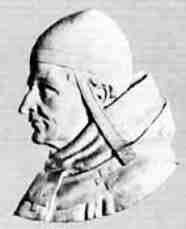 Known as the father of medieval Scholasticism, Anselm was born in Italy in 1033. Most closely associated with England, he first served as prior and abbot of the Benedictine Abbey in Bec, Normandy, later becoming Archbishop of Canterbury for many years.
A brilliant scholar and writer who loved the works and followed in the way of Augustine, Anselm used his political skills with the British kings on behalf of the established Christian Church, affirming that it is the leadership of the Church and not the state which has the responsibility of establishing structure and maintaining order among the clergy.
Anselm's book Cur Deus homo (Why God Became Man) expresses his thoughts on Christ's atonement and taught that the reason for the incarnation was that Jesus, the Son of God, would suffer and die in place of sinners. His Monologium shows the beginnings of his ontological argument for the existence of God. He further developed this philosophical argument in the Proslogion (also spelled Proslogium).
He was canonized in 1494 by Pope Alexander VI.
More at the Christian Cyclopedia, Wikipedia, and James Kiefer's Hagiographies.
Lection
Psalm 139:1-9 or 37:3-6,32-33
Romans 5:1-11
Matthew 11:25-30
Collect
Almighty God, who raised up Your servant Anselm to teach the Church of his day to understand its faith in Your eternal Being, perfect justice, and saving mercy, provide Your Church in every age with devout and learned scholars and teachers, that we may be able to give a reason for the hope that is in us; through Jesus Christ our Lord, who lives and reigns with You and the Holy Spirit, one God, now and forever.
Labels: anselm, apologetics, augustine, biography, british history, canterbury, christology, church history, commemoration, hagiography, scholasticism
¶ 00:00 | 0 comments |
 Easter Sermon from John Chrysostom
Are there any who are devout lovers of God?
Let them enjoy this beautiful bright festival!
Are there any who are grateful servants?
Let them rejoice and enter into the joy of their Lord!
Are there any weary with fasting?
Let them now receive their wages!
If any have toiled from the first hour,
let them receive their due reward;
If any have come after the third hour,
let him with gratitude join in the Feast!
And he that arrived after the sixth hour,
let him not doubt; for he too shall sustain no loss.
And if any delayed until the ninth hour,
let him not hesitate; but let him come too.
And he who arrived only at the eleventh hour,
let him not be afraid by reason of his delay.
For the Lord is gracious and receives the last even as the first.
He gives rest to him that comes at the eleventh hour, as well as to him that toiled from the first.
To this one He gives, and upon another He bestows.
He accepts the works as He greets the endeavor.
The deed He honors and the intention He commends.
Let us all enter into the joy of the Lord!
First and last alike receive your reward; rich and poor, rejoice together!
Sober and slothful, celebrate the day!
You that have kept the fast, and you that have not, rejoice today for the Table is richly laden!
Feast royally on it, the calf is a fatted one.
Let no one go away hungry.
Partake, all, of the cup of faith.
Enjoy all the riches of His goodness!
Let no one grieve at his poverty,
for the universal kingdom has been revealed.
Let no one mourn that he has fallen again and again;
for forgiveness has risen from the grave.
Let no one fear death, for the Death of our Savior has set us free.
He has destroyed it by enduring it.
He destroyed Hell when He descended into it.
He put it into an uproar even as it tasted of His flesh.
Isaiah foretold this when he said, “You, O Hell, have been troubled by encountering Him below.”
Hell was in an uproar because it was done away with.
It was in an uproar because it is mocked.
It was in an uproar, for it is destroyed.
It is in an uproar, for it is annihilated.
It is in an uproar, for it is now made captive.
Hell took a body, and discovered God.
It took earth, and encountered Heaven.
It took what it saw, and was overcome by what it did not see.
O death, where is thy sting?
O Hell, where is thy victory?
Christ is Risen, and you, O Death, are annihilated!
Christ is Risen, and the evil ones are cast down!
Christ is Risen, and the angels rejoice!
Christ is Risen, and life is liberated!
Christ is Risen, and the tomb is emptied of its dead;
for Christ having risen from the dead,
is become the first-fruits of those who have fallen asleep.
To Him be Glory and Power forever and ever. Amen!
Lection (Series A)
Easter Sunrise
Psalm 118:15-29
Exodus 14:10-15:1
1 Corinthians 15:1-11
John 20:1-18
Easter Day
Psalm 16
Acts 10:34-43 or Jeremiah 31:1-6
1 Corinthians 15:19-26
Matthew 28:1-10
Easter Evening
Psalm 100
Exodus 15:1-18 or Daniel 12:1c-3
Acts 10:34-43 or 1 Corinthians 5:6b-8
Luke 24:13-35 (36-49)
Lection (One Year)
Easter Sunrise
Psalm 16
Isaiah 25:6-9 or Exodus 14:10-15:1
1 Corinthians 15:1-11 or 1 Corinthians 15:12-25
John 20:1-18
Easter Day
Psalm 118:15-29
Job 19:23-27
1 Corinthians 5:6-8 or 1 Corinthians 15:51-57
Mark 16:1-8
Easter Evening
Psalm 100
Exodus 15:1-18
Acts 10:34-43
Luke 24:13-35
Collect
Easter Sunrise
Almighty and most merciful God, pour out on us Your abundant blessing that all who in true faith share this time in joyful celebration of the resurrection of our Lord Jesus Christ from the dead may be filled with Your heavenly benediction. Once we were in darkness, but now we are in the Light, even Jesus Christ, our Lord.
Easter Day
Almighty God the Father, through Your only-begotten Son, Jesus Christ, You have overcome death and opened the gate of everlasting life to us. Grant that we, who celebrate with joy the day of our Lord’s resurrection, may be raised from the death of sin by Your life-giving Spirit; through Jesus Christ, our Lord, who lives and reigns with You and the Holy Spirit, one God, now and forever.
Labels: christ, christology, easter, feasts, festivals, gospels, jesus, john chrysostom, lectionary, life, new testament, resurrection, series a
¶ 00:00 | 0 comments |
"On the seventh day God finished his work that he had done, and he rested on the seventh day from all his work that he had done. (Genesis 2:2 ESV)"

Ask the Pastor posted in 2006 on Christ's Sabbath in the tomb as He moved from His state of humiliation into His eternal exaltation at the right hand of the Father. We anticipate with quiet joy the first celebration of His resurrection during tonight's Vigil and, should God allow us the morrow, the fullness of the Feast of the Resurrection in Scripture, sermon, psalms, prayers, and hymns of gladness.
Lection
Psalm 16
Daniel 6:1-24
1 Peter 4:1-8 (Three Year Lectionary Cycle) or 1 Peter 3:17-22 (One Year Lectionary Cycle)
The Holy Gospel
"When it was evening, there came a rich man from Arimathea, named Joseph, who also was a disciple of Jesus. He went to Pilate and asked for the body of Jesus. Then Pilate ordered it to be given to him. And Joseph took the body and wrapped it in a clean linen shroud and laid it in his own new tomb, which he had cut in the rock. And he rolled a great stone to the entrance of the tomb and went away. Mary Magdalene and the other Mary were there, sitting opposite the tomb.
"Next day, that is, after the day of Preparation, the chief priests and the Pharisees gathered before Pilate and said, 'Sir, we remember how that impostor said, while he was still alive, "After three days I will rise." Therefore order the tomb to be made secure until the third day, lest his disciples go and steal him away and tell the people, "He has risen from the dead," and the last fraud will be worse than the first.' Pilate said to them, 'You have a guard of soldiers. Go, make it as secure as you can.' So they went and made the tomb secure by sealing the stone and setting a guard. (Matthew 27:57-66 ESV)"
Collect
Abide with us, Lord, for it is toward evening, and the day is far spent. Abide with us and with Your whole Church. Abide with us in the end of the day, in the end of our life, in the end of the world. Abide with us with Your strength and blessing. Abide with us when the night of affliction and temptation comes upon us, the night of fear and despair when death shall come. Abide with us and with all the faithful through time and eternity.
Painting of The Body of the Dead Christ in the Tomb by Hans Holbein the Younger at the Web Gallery of Art.
Labels: burial, christology, crucifixion, death, easter, feasts, festivals, gospels, holy saturday, holy week, new testament, resurrection, sabbath, vigil
¶ 00:00 | 0 comments |
 The Father chose to sacrifice His Son rather than banish sinful mankind to an eternity of suffering. Also, Christ died because the Scriptures which point to the coming Savior "require" his suffering and death.
The most noted of these prophecies is probably Isaiah 52:13-53:12. Through the prophet, the Lord predicts what would happen to His faithful Servant: "He was wounded for our transgressions; he was crushed for our iniquities. (53:5)" He was "like a lamb that is led to the slaughter (53:7)" and "was cut off out of the land of the living. (53:8)" Finally, "They made his grave with the wicked and with a rich man in his death, although he had done no violence, and there was no deceit in his mouth. (53:9)"
God cannot go back on His Word. From Creation's dawn, He warned that sin always results in death. Someone had to die, either one innocent Man or millions and billions of guilty people. Through Paul, God said, "The wages of sin is death (Romans 6:23a)"
However, God applied the life-giving "wages" earned by His sinless Son as payment in full on our accounts and credited us with Jesus' perfection. Likewise, the deadly wages that were our due were paid in full to Jesus in His suffering and death. Because of this, "the free gift of God is eternal life in Christ Jesus our Lord. (23b)" (Adapted from Jesus' Death at Ask the Pastor; used by permission.)
Lection — Three Year Cycle
Psalm 22 or Psalm 31
Isaiah 52:13-53:12
Hebrews 4:14-16; 5:7-9
John 18:1-19:42 or John 19:17-30
Lection — One Year Cycle
Psalm 22 or Psalm 31
Isaiah 52:13-53:12
2 Corinthians 5:14-21
John 18:1-19:42
Collects
Almighty God, Your Son Jesus Christ was lifted high upon the cross so that He might draw the whole world to Himself. Grant that we who glory in His death for our salvation may also glory in His call to take up our cross and follow Him; through Your Son, Jesus Christ, our Lord, who lives and reigns with You and the Holy Spirit, one God, now and forever.
Almighty God, graciously behold this Your family for whom our Lord Jesus Christ was willing to be betrayed, to be given into the hands of sinners, and to suffer death on the cross; through the same Jesus Christ, who now lives and reigns with You and the Holy Spirit, one God, now and forever.
Labels: christ, christology, crucifixion, death, feasts, festivals, good friday, holy week, jesus, series a, series b, series c, suffering
¶ 00:00 | 0 comments |
9 April AD 2017
 The Sunday before His crucifixion, our Lord Christ rode into Jerusalem on a donkey. Accompanied by His disciples, He heard the people crying, "Hosanna!" This ancient petition translates, "Save now!" It stems from the same root as does the name "Jesus."
Palm Sunday thereby reminds us of the Annunciation, when Gabriel told Mary what to name the Child. Even more so, it recalls the angel's visit to Joseph, who heard the angel tell him of Mary's Son, "You shall call his name Jesus, for he will save his people from their sins (Matthew 1:21)" and also The Circumcision and Name of Jesus.
Jesus heard this prayer and answered according to His Father's will. Their salvation — and our salvation — was nigh, for in a few short days, He would gift His Church with a new meal of His own body and blood and would then be betrayed and would suffer and die to forgive us all our sins. All four evangelists record the events of this day. However, only Saint John included mention of palm branches being cut as part of the apparent victory parade, yet this one mention gave this day its classic title.
 More recently, many liturgical churches have begun using "Passion Sunday" or "Sunday of the Passion" instead. This name emphasizes less the triumphal entry at the week's beginning but points more to the blood-stained exit on Friday as Jesus went to Golgotha.
Actually, as some of the Church's hymnody points out, both titles have their place and both exist well in relationship to each other. For expanded commentary on palms, Passion, and hymns, see Hosannas and Palm Branches at Ask the Pastor.
The traditional color for this day is purple, as it has been throughout Lent. However, many church bodies have gone to using scarlet as the preferred color for Holy Week, either until Holy Thursday or Good Friday. White is the other appropriate color for Maundy Thursday while Good Friday's paraments and vestments should be black — or they should not be used at all.
Lection — Three Year Cycle: Series A
John 12:12-19 (Palm Sunday Procession)
Psalm 118:19-29 or 31:9-16
Isaiah 50:4-9a
Philippians 2:5-11
Matthew (26:1-27:10) 27:11-66 or John 12:20-43
Lection — One Year Cycle
Matthew 21:1-9 or John 12:12-19 (Palm Sunday Procession)
Psalm 118:19-29 or 31:9-16
Zechariah 9:9-12
Philippians 2:5-11
Matthew 26:1-27:66 or Matthew 27:11-54
Collects
Most merciful God, as the people of Jerusalem, with palms in their hands, gathered to greet Your dearly beloved Son when He came into His Holy City, grant that we may ever hail Him as our King and, when He comes again, may go forth to meet Him with trusting and steadfast hearts and follow Him in the way that leads to eternal life; through the same Jesus Christ, our Lord, who lives and reigns with You and the Holy Spirit, one God, now and forever. (Collect for the Palm Sunday Procession)
Almighty and everlasting God, You sent Your Son, our Savior Jesus Christ, to take upon Himself our flesh and to suffer death upon the cross. Mercifully grant that we may follow the example of His great humility and patience and be made partakers of His resurrection; through the same Jesus Christ, our Lord, who lives and reigns with You and the Holy Spirit, one God, now and forever. (Collect of the Day for the Sunday of the Passion)
Paintings by Pietro Lorenzetti from the Web Gallery of Art.
Tags: Palm Sunday | Passion Sunday | Sunday of the Passion | Lent | Holy Week | Good Friday | Easter | Jesus | Jesus Christ | Christ | Jerusalem | Church Year | liturgical calendar | Christianity | Christian feasts| historical theology | Church history | Bible history | New Testament | Gospel | palms | donkey
Labels: christ, christology, feasts, festivals, gospels, holy week, jerusalem, jesus, new testament, palm sunday, sunday of the passion
¶ 00:00 | 0 comments |
 Joseph was the son of the patriarch Jacob and Rachel — and was his father's favorite son. He incurred his older brothers' jealousy and anger (both through Jacob's favoritism and by his own attitude toward them, particularly regarding his dreams) so they sold him into slavery in Egypt and told their father he was dead (Genesis 37). In Egypt he became the chief servant in the home of Potiphar, a military official. Joseph refused to commit adultery when his master's wife tempted him. In retaliation, she unjustly accused him of attempted rape and he was imprisoned (Genesis 39).
Years later, he interpreted dreams for Pharaoh, who then freed him from prison and placed him in charge of the entire country. When his brothers came from Canaan to Egypt in search of food, they did not recognize him. He eventually revealed his identity, forgave them, and invited them and his father to live in Egypt. When Jacob blessed his sons before his death, he gave a blessing to both of Joseph's sons, Ephraim and Manasseh. Thus, each became an ancestor of one of the twelve tribes of Israel.
We remember and honor him for his moral uprightness (Genesis 39) and for his willingness to forgive his brothers (Genesis 45 and 50). But we especially celebrate his role in saving the family of Israel (Jacob), thus also playing an important part in God's plan to bring Messiah to His people and to all mankind.
Labels: biography, christology, commemoration, egypt, ephraim, hagiography, israel, jacob, joseph, manasseh, old testament
¶ 00:00 | 0 comments |
Transferred to 4 April AD 2016
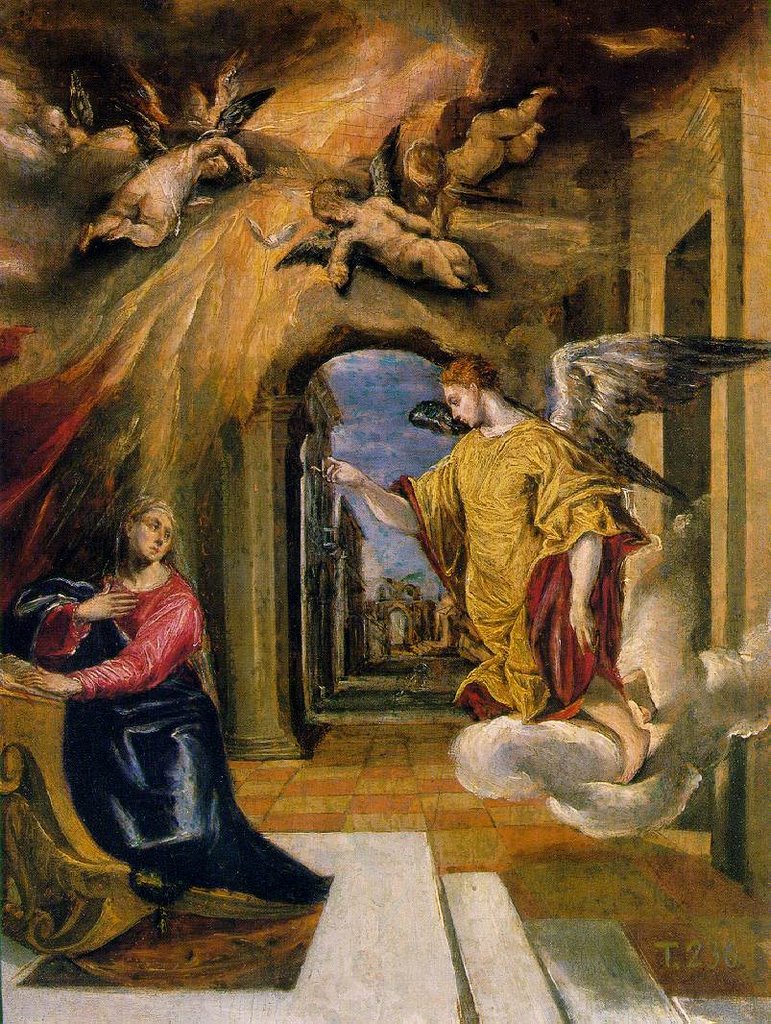 Luke 1:26-38 tells us how the angel Gabriel announced to Mary of Nazareth that she had been chosen to be the mother of the Christ and her response. Mary, a virgin pledged to marry Joseph, briefly wondered how this could be, since she had not had sex with any man.
Once Gabriel told her that the Child was conceived by the Holy Spirit, she humbly accepted this sacred obligation: "Behold, I am the servant of the Lord; let it be to me according to your word. (v. 38)"
Nothing prevents us from supposing that Our Lord was conceived immediately after this. Since the Church from early days observed 25 March as the date of the Annunciation, the celebration of the Christ's Nativity is observed on 25 December, nine months later.
For centuries in vast parts of Europe, 25 March also marked the change to the new year. While it seems somewhat odd and abrupt to change years in the middle of a month, we can imagine that those accustomed to that calendar easily made the adjustment. Furthermore, they could take to heart the reminder that God's chosen time, that most special time when He sent His Son into human flesh, merited such a "strange" circumstance.
Even though the Visitation of Mary to her cousin Elizabeth took place six months later (see Luke 1:39-56) — as Elizabeth neared the end of her own pregnancy with the child who would grow to become John the Baptizer — Mary's song of celebration at that time is also appropriate to remember on the Feast of the Annunciation. In the Magnificat (Luke 1:46-55) the virgin mother of God celebrated God's gift to her, to Israel, and to all people.
Martin Luther wrote a commentary on this canticle. About verse 49, he said, "The 'great things' are nothing less than that she became the Mother of God, in which work so many and such great good things are bestowed upon her as pass man's understanding. For on this there follows all honor, all blessedness, and her unique place in the whole of mankind, among whom she has no equal, namely, that she had a child by the Father in Heaven, and such a child.
"She herself is unable to find a name for this work, it is too exceedingly great; all she can do is break out in the fervent cry: 'They are great things,' impossible to describe or define. Hence men have crowded all her glory into a single word, calling her the Mother of God.
"No one can say anything greater of her or to her, though he had as many tongues as there are leaves on the trees, or grass in the fields, or stars in the sky, or sand by the sea. It needs to be pondered in the heart, what it means to be the Mother of God."
The Annunciation is such an important Christological feast that it takes precedence over even the Sundays in Lent in much of Christendom. See Looking Ahead at Weedon's Blog for details.
Lection
Psalm 45:7-17
Isaiah 7:10-14
Hebrews 10:4-10
Luke 1:26-38
Collect
O Lord, as we have known the incarnation of Your Son Jesus Christ by the message of the angel to the virgin Mary, so by His cross and Passion bring us to the glory of His resurrection; through the same Jesus Christ, our Lord, who lives and reigns with You and the Holy Spirit, one God, now and forever.
NOTE: Regarding the occasional transfer of this major feast, the Lutheran Service Book: Altar Book states on page 960, It is appropriate to observe this feast day in all its fullness during Lent. However, according to historical precedent, when the Annunciation falls during Holy Week or on Easter Day (or also on the Fifth Sunday in Lent in the one-year series), it should not be observed at those times but may be transferred to a weekday following the Second Sunday of Easter. In most of Eastern Christendom, rather than transferring the Annunciation, it is celebrated fully. In Orthodoxy, this normally means the celebratory Liturgy of John Chrysostom.
Luther quote from Luther's Works, Vol. 21, p. 326, ed. Jaroslav Pelikan, Concordia Publishing House © 1956.
Labels: annunciation, christ, christology, feasts, festivals, gabriel, gospels, incarnation, jesus, luke, mary, new testament, theotokos
¶ 00:00 | 0 comments |


