
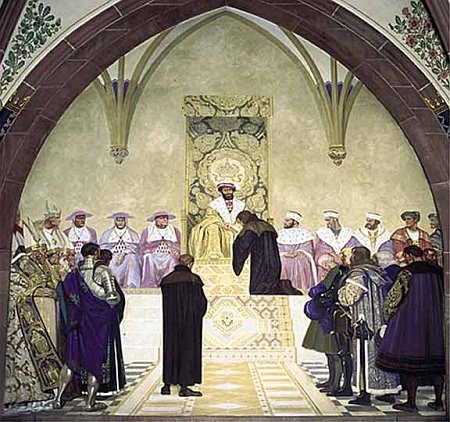
 Note: Please see Ask the Pastor for more on the history and theology of the Augsburg Confession and its presentation.
The Augsburg Confession, the principal doctrinal statement of the theology of Martin Luther and the Lutheran reformers, was written largely by Philipp Melanchthon. At its heart it confesses the justification of sinners by grace alone, through faith alone, for the sake of Christ alone.
Signed by leaders of several German cities and regions, the confession was formally presented to the Holy Roman Emperor Charles V at Augsburg, Germany, on 25 June 1530. A few weeks later Roman Catholic authorities rejected the Confession, which Melanchthon defended in the Apology of the Augsburg Confession (1531). In 1580 the Unaltered Augsburg Confession was included in the Book of Concord.
An historical sidelight: Because of imperial protocol, Melanchthon wasn't allowed to make — or even attend — the presentation. Instead, two of the Saxon chancellors gave the oral reading and handed the written Latin and German copies to Charles V.
Lection
Psalm 46
Isaiah 55:6-11
Romans 10:5-17
John 15:1-11
Collects
O Lord God, heavenly Father, pour our Your Holy Spirit on Your faithful people, keep them steadfast in Your grace and truth, protect and comfort them in all temptation, defend them against all enemies of Your Word, and bestow on Christ's Church Militant Your saving peace; through Jesus Christ, Your Son, our Lord, who lives and reigns with You and the Holy Spirit, one God, now and forever.
Almighty God, we praise You for those You have sent to call the Church to its tasks and renew its life, including your servant Philipp Melanchthon. Raise up in our own day pastors, teachers, and theologians inspired by Your Spirit, whose voices will give strength to Your Church and proclaim Your kingdom; through Your Son, Jesus Christ our Lord.
Hymn
God's Word Is Our Great Heritage
God's Word is our great heritage
And shall be ours forever;
To spread its light from age to age
Shall be our chief endeavor.
Through life it guides our way,
In death it is our stay.
Lord, grant, while worlds endure,
We keep its teachings pure
Throughout all generations.
Notes on the Propers: The suggested readings come from the LCMS hymnal Lutheran Worship, as does the first collect. These propers may also used for the Commemoration of the Doctors of the Church, including Luther and C. F. W. Walther. The second collect is modified from James Kiefer's Hagiographies.
Labels: augsburg confession, book of concord, church history, commemoration, german history, lutheran confessions, lutheranism, martin luther, philipp melanchthon
¶ 00:00 | 0 comments |

 After Martin Luther's death, political changes altered the face of the Evangelical (Lutheran) Church. Emperor Charles V exercised control over all of southern Germany and most of the north. The Augsburg Interim, a capitulation disguised as a compromise, denied justification by grace through faith alone. It also officially recognized seven sacraments, confessed transubstantiation, and re-instituted the Mass as a sacrificial thank offering. Most of the defeated Lutheran princes went along with the Interim.
Although Philipp Melanchthon initially opposed the Augsburg Interim, some combination of fear and his conciliatory nature led him to accept its demands. The damage continued with the Leipzig Interim, which continued to compromise justification by faith while also restoring Catholic rites to Baptism, reintroducing Corpus Christi processions, and otherwise granting favor to Roman practice.
During the same period, a number of doctrinal controversies intruded among the Lutherans. Some grew out of Melanchthon's ongoing compromises with either Rome or the Reformed. Others sprang from the reactionary excesses of his opponents, including Matthias Flacius. Almost two dozen confessions ranging widely across the doctrinal spectrum were composed between 1546 and 1577, variously appealing to the Augsburg Confession for support of often contradictory positions.
 In the early 1570s, Jakob Andreae published Six Christian Sermons against the Philippist party and other Crypto-Calvinists. Meanwhile, Elector Augustus of Saxony, a staunch Lutheran who had been deceived by the Crypto-Calvinists and had actively opposed Lutheran theologians, came to his senses when confronted with Joachim Cureus's refutation of the Evangelical understanding of the Lord's Supper. He imprisoned many of those who'd misled him and began active support and encouragement of a uniting Lutheran confession.
Martin Chemnitz urged Andreae to revise and edit his Six Sermons into a formal statement of harmony. Andreae responded with the eleven articles of the Swabian Concord. Chemnitz and David Chytraeus added further revisions, producing the Swabian-Saxon Concord. Meanwhile Balthasar Bidembach and Lukas Osiander the elder had also composed a proposed uniting document, the Maulbronn Formula. Andreae, Chemnitz, David Chytraeus, Nikolaus Selnecker, and others met in Torgau from 28 May-7 June 1576 and drew the Swabian-Saxon Concord and the Maulbronn Formula together into the Torgau Book.
Elector Augustus received and passed along suggestions and criticisms of the Torgau Book to its authors, hoping that one more round of work would complete the task. Chemnitz, Andreae, Selnecker, Chytraeus, Andreas Musculus, and Christophorus Cornerus joined to complete the Bergen Book, which became known as the Solid Declaration or the Thorough Declaration. As this was being done, Andreae also worked on an Epitome or summation of the same doctrinal articles. The six men's work was completed by 28 May 1577.
These two works were included together as the Formula of Concord in the Book of Concord of 1580, along with the three Creeds and the Unaltered Augsburg Confession, the Apology to the Augsburg Confession, the Small and Large Catechisms, the Smalcald Articles, and the Treatise on the Power and Primacy of the Pope. The Epitome briefly summarizes each controversy, confesses true doctrine, and rejects and condemns false teaching. The Solid Declaration is less rigid in structure, instead delving into each topic in much greater length.
Labels: book of concord, church history, david chytraeus, formula of concord, jakob andreae, lutheran confessions, lutheranism, martin chemnitz
¶ 00:00 | 2 comments |
 David Chytraeus (Chyträus) was born in Ingelfingen, Württemberg on 26 February 1531 to Matthew and Barbara Kochhafe. Kochhafe (German) and χυτρα (Greek) both mean "cook pot" and Chytraeus is a Latinized form of the Greek. It was common at that time for men to take Greek names after becoming noted scholars and young David achieved that status rather quickly.
Around the age of eight or nine, he began to study law, philology, philosophy, and theology at the University of Tübingen. By fourteen, he already held his master's degree and decided to move to Wittenberg in order to study under Philipp Melanchthon and Martin Luther. He became a favorite student of Melanchthon and boarded with him for much of his time there. He also gave great credit for his theological formation to Luther's lectures on Genesis and his sermons.
In 1551, Duke Heinrich V and Duke Johann Albrecht I of Mecklenburg offered him a teaching position at the University of Rostock. The university became his home and he spurned nine subsequent invitations to academic positions elsewhere. His earliest lectures were on classical Greek literature, concerning the works of the historians Herodotus and Thucydides. He began lectures on both the Old and the New Testament in 1553 although he didn't earn his Doctor of Theology until 29 April 1561.
Chytraeus married Margaretha Smedes in 1553. Of their seven children, only two daughters reached adulthood. Margaretha died in 1571 and he married Margaretha Pegel the following year. She bore him two sons, Ulrich and David. Chytraeus was known as a faithful husband and loving father. Doubtless this attitude and behavior was tested by the trials of losing wife and children and his own illnesses but the Lord certainly preserved and strengthened him through the Gospel and taught him a depth of understanding for the Theology of the Cross.
 Most of Chytraeus's adult life corresponded with the flux in Evangelical (Lutheran) theology following the Reformer's death in 1546. Like Martin Chemnitz and other centrists, he appreciated the unswerving confession of the Gnesio-Lutherans on the right but also embraced a more irenic attitude, resembling that of Melanchthon. However, we find no evidence that he ever was tempted à la Melanchthon to surrender key doctrinal points in order to achieve a surface agreement among church factions.
Because of his intellect and his positions in time, geography, and theology, Chytraeus became actively involved in events leading to the development and adoption of the Formula of Concord. In 1574, he completely rewrote the articles on Free will and the Lord's Supper from the Swabian Concord. This work was integrated with the Maulbronn Formula and led to the 1576 Torgau Book. While he completely approved of this confession, he saw it transformed over the next year into the Bergic Book, our present-day Formula of Concord. While he was uncomfortable with the vehemence of some of this book's statements, he still considered it a true and orthodox exposition of Scripture and Luther's teachings and signed it as one of the six theologian co-authors.
While Chytraeus wrote many books, only few have been translated. Two are available through Repristination Press, A Summary of the Christian Faith (translated by Richard Dinda) and On Sacrifice (translated by John Warwick Montgomery).
Generally heralded as "The last of the fathers of the Lutheran Church," David Chytraeus entered eternal rest on 25 June 1600, the 70th anniversary of the Presentation of the Augsburg Confession. Because of this date conflict and since the following several days are occupied on the LCMS sanctorial calendar, I've chosen to commemorate him on his birthday.
Jack Kilcrease posted a brief apologetic, David Chytraeus' Proof of Christian Teaching at Theologia Crucis. Biographical references: Nathaniel Biebert at Studium Excitare, the Christian Cyclopedia, and Wikipedia.
Labels: biography, book of concord, commemoration, formula of concord, hagiography, lutheran confessions, lutheransim, martin chemnitz, melanchthon, theology
¶ 00:00 | 0 comments |
 Martin Luther, born on 10 November 1483, in Eisleben, Germany, initially began studies leading toward a degree in law. However, after a close encounter with death, he switched to the study of theology, entered an Augustinian monastery, was ordained a priest in 1505, and received a doctorate in theology in 1512.
As a professor at the newly-established University of Wittenberg, his Scriptural studies led him to question many of the church's teachings and practices, especially the selling of indulgences. His refusal to back down from his convictions resulted in his excommunication in 1521. Following a period of seclusion at the Wartburg castle, Luther returned to Wittenberg, where he spent the rest of his life preaching and teaching, translating the Scriptures, and writing hymns and numerous theological treatises.
Of course, Luther didn't work alone. First of all, he knew that the Holy Spirit, working through the Word, was principal actor in the Reformation, and said, "While I slept, or drank Wittenberg beer with my friends ... the Word so greatly weakened the papacy that no prince or emperor ever inflicted such losses upon it. I did nothing; the Word did everything." However, his "friends," including Philipp Melanchthon, Nicholas Amsdorf, Johannes Bugenhagen, and others contributed mightily to the cause. Meanwhile, his prince, Frederick III of Saxony, defended him. Finally, he probably received no earthly support greater than that of his beloved wife Katie.
We remember and honor his lifelong emphasis on the Biblical truth that for Christ's sake God declares us righteous by grace through faith alone. He died on 18 February 1546, while visiting the town of his birth.
Please visit Xrysostom for The Life of Martin Luther: A Chronology. A number of recommended books and web sites are included along with this biographical outline.
Lection
Psalm 46
Isaiah 55:6-11
Romans 10:5-17
John 15:1-11
Collect
O Lord God, heavenly Father, pour our Your Holy Spirit on Your faithful people, keep them steadfast in Your grace and truth, protect and comfort them in all temptation, defend them against all enemies of Your Word, and bestow on Christ's Church Militant Your saving peace; through Jesus Christ, Your Son, our Lord, who lives and reigns with You and the Holy Spirit, one God, now and forever.
Tags: Martin Luther | Doctor Martin Luther | Dr. Martin Luther | Lutheran | Lutheranism | Christianity | Christian | Reformation | Lutheran Reformation | Book of Concord | Lutheran Confessions | Small Catechism | Large Catechism | Smalcald Articles | hagiography | biography | Church history | historical theology | exegetical theology | Bible translation | practical theology | hymn writing | liturgics | German history | European history| Aardvark Alley
Labels: biography, bugenhagen, commemoration, frederick the wise, german history, hagiography, hymnody, katharina luther, lutheran confessions, lutheranism, martin luther, philipp melanchthon, reformation, theology
¶ 00:00 | 0 comments |
 Philipp Melanchthon, a brilliant student of the classics and a humanist scholar, was appointed to teach along with Martin Luther at the University of Wittenberg in 1518. At Luther's urging, Melanchthon began teaching theology and Scripture in addition to his courses in classical studies.
In April of 1530, Emperor Charles V called an official meeting between the representative of Lutheranism and Roman Catholicism, hoping to effect a meeting of minds between two opposing groups. Since Luther was at that time under papal excommunication and an imperial ban, Melanchthon was assigned the duty of being the chief Lutheran representative at this meeting. Thus, he made the primary verbal and written defenses of the Evangelical (Lutheran) position.
We especially remember and honor him as the author of the Augsburg Confession, which was officially presented by the German princes to the emperor on 25 June 1530, as the defining document of Lutheranism within Christendom. Following the Roman Catholic response, Melanchthon wrote the Apology (Defense) of the Augsburg Confession.
Unfortunately, Melanchthon's desires for peace within Christendom led him to later rewrite and weaken some of the Augsburg Confession's language. The resulting Variata were palatable to some who disagreed with certain Lutheran teachings and allowed for false teaching to infiltrate Lutheranism. Ask the Pastor details some of this in a post on the Unaltered Augsburg Confession.
Lection
Psalm 46
Isaiah 55:6-11
Romans 10:5-17
John 15:1-11
Collect
O Lord God, heavenly Father, pour our Your Holy Spirit on Your faithful people, keep them steadfast in Your grace and truth, protect and comfort them in all temptation, defend them against all enemies of Your Word, and bestow on Christ's Church Militant Your saving peace; through Jesus Christ, Your Son, our Lord, who lives and reigns with You and the Holy Spirit, one God, now and forever.
Note: We commemorate Philipp Melanchthon's birth date because his death date often conflicts with Holy Week or Easter observances.
Labels: augsburg confession, biography, book of concord, commemoration, german history, hagiography, lutheran confessions, martin luther, philipp melanchthon, reformation, variata
¶ 00:00 | 0 comments |
 Matthias Loy (1828-1915) was born on 17 March to Matthias and Christina Loy, a pair of German immigrants. The family lived in near-poverty in Cumberland County, Pennsylvania, near Harrisburg. He was the fourth of seven children. Matthias, Senior was a lapsed Catholic who apparently held only nominal religious beliefs for most of his life. Christina came from pietistic Lutheran stock in Württemberg. She did what she could to give the family some semblance of a Christian education and made sure that all but the eldest child were baptized as infants. Even her first-born son eventually was confirmed into the Lutheran Church.
When Matthias was six years old, the family moved to Hogestown, Pennsylvania. He lived with his family until he was fourteen. They then apprenticed him to Baab and Hummel Printers of Harrisburg. During the next six years, he worked for them while attending school. Mr. Hummel brought Matthias to the attention of Harrisburg minister C. W. Schäffer. Pastor Schäffer urged Matthias to consider a pastoral vocation. To this end, he studied studied Greek and Latin under the Harrisburg Academy's principal. This led to enrollment as a full student at the Academy. He hoped to enter the Gettysburg Theological Seminary, perhaps the epicenter of Lutheran liberalism in America.
Illness led Loy's doctor to encourage the young man to move farther west. Matthias found an employment opportunity with the United Brethren Publishing House in Circleville, Ohio. There he would become printer for the Brethren's semimonthly German paper. Loy came to Circleville in 1847 and quickly met the Lutheran pastor. This good soul suggested that Matthias waste no more time getting on with his pastoral education and suggested that he enroll at the Theological Seminary in Columbus. The Evangelical Lutheran Synod of Ohio was much more conservative and confessional than the Lutherans he had left behind in Pennsylvania.
 With the promise of financial aid through the Lutheran pastor, Loy sought and received release from his printer's contract and left for Columbus. Of Matthias's time there, C. George Fry writes, "It was at this institution that he received the only two years of formal higher education deemed necessary to be a pastor. In 1849, after a two year 'cram course' that included academy, college, and seminary, Loy was graduated and installed as a minister in Delaware, Ohio."
Loy was finally surrounded by orthodox Lutheran theology and he made the most of his time at the seminary. As a student, he was immersed in Lutheran doctrine and began reading Der Lutheraner, edited by C. F. W. Walther. This led to a long relationship with Dr. Walther, a friendship that grew so great that even their eventual disagreements over predestination and the fracturing of the Synodical Conference couldn't destroy.
According to Fry, these two men, along with Charles Porterfield Krauth, "must be seen as a common effort to preserve traditional Lutheran theology from the corrosive effects of 'the acids of modernity' in the last half of the nineteenth century. These three titans — Walther in the West, Krauth in the East, and Loy in the middle — could be compared to three anchors holding fast the ship of Lutheran Confessionalism during the ferocious storms of the Modernist-Fundamentalist Controversy."
In 1860, the Joint Synod of Ohio elected Loy President. Four years later, he was appointed editor of the Lutheran Standard. After sixteen years in the ministry, Capital University, Columbus, Ohio called Loy as professor of theology. He resigned as president of the Ohio Synod in 1878. Around this time he also returned the call to become English-language professor of theology at Concordia Seminary, St. Louis. Wilhelm Friedrich Lehmann, Loy's successor as synodical president, died in 1880 and Loy returned to that office, succeeding him also as President of Capital University. He started the Columbus Theological Magazine in 1881. Loy retired as professor emeritus in 1902 and died on 26 January 1915.
 Loy was instrumental in the formation of the Synodical Conference. However, at the Ohio Synod meeting at Wheeling in 1881, the synod withdrew from the Conference. This came about over sharp differences in understanding Predestination. Many Ohio Synod pastors taught that God predestined people according to His foreknowledge of whether they would come to faith while the Missouri Synod condemned this as false doctrine.
During his life, Loy wrote several books. Of special note is his seminal work The Augsburg Confession: An Introduction to Its Study and an Exposition of Its Contents.
He also wrote at least twenty hymns, including An Awe-full Mystery Is Here, The Law of God Is Good and Wise, The Gospel Shows the Father's Grace, and Jesus, Thou Art Mine Forever. His hymn translations included All Mankind Fell in Adam's Fall, The Bridegroom Soon Will Call Us, Let Me Be Thine Forever, and Thy Table I Approach.
*Since his death date (26 January) and birth date (17 March) both conflict with long-standing festivals on the sanctorial calendar (Titus and Pádraig respectively) and since 27 January belongs to John Chrysostom, I moved Loy's commemoration the first open date, 28 January.
Sources
Quotes from C. George Fry's Matthias Loy: Theologian of American Lutheran Orthodoxy [PDF]. This excellent biography was printed in The Springfielder, October 1974, Volume 38, Number 4.
Additional Reading includes Loy's autobiography, The Story of My Life, which the Internet Archive has in several formats, including PDF, Nook (EPUB), and Kindle (MOBI). See also entries at Net Hymnal and the Christian Cyclopedia.
Suggested Lection
Psalm 46
Isaiah 55:6-11
Romans 10:5-17
John 15:1-11
Collect
O Lord God, heavenly Father, we pray that, as You raised up Matthias Loy to lead Lutherans in America into a renewed appreciation of their confessional heritage and to a fuller confidence in the saving Gospel of Jesus Christ, so You would continue to provide us with faithful pastors and leaders, keep us steadfast in Your grace and truth, defend us against all enemies of Your Word, and bestow on Christ's Church Militant Your saving peace; through Jesus Christ, Your Son, our Lord, who lives and reigns with You and the Holy Spirit, one God, now and forever.
Labels: american history, biography, commemoration, hagiography, hymnody, loy, lutheran confessions, lutheranism, matthias loy, synodical conference, theology
¶ 00:00 | 0 comments |
 Born 25 March 1528 to blacksmith Jakob Endriß and his wife Anna (née Weißkopf) in Waiblingen in the dukedom of Württemberg, Jakob Andreae (also Andreæ or Andreä) came from a family seemingly too poor to support any higher education. However, it was his good fortune to come of age at a time when Duke Ulrich began Evangelical reform in the duchy. Württemberg's mayor, aware of the young man's potential, procured for him a ducal scholarship.
In 1539 Andreae attended a preparatory school in Stuttgart, and two years later he entered the University of Tübingen — at the tender age of thirteen years. In 1545 he began his study of theology under the Tübingen faculty. He stayed only briefly. Württemberg was critically short of pastors and he was placed in the parish after one year of study. His enemies found ample ammunition for their opposition of him due in part to his arrested academic career.
The religious sea change that Martin Luther began with the German Reformation had spread through Europe. In many parts of the continent, the changes went much deeper than did those of the Lutherans. New ways of thinking and of doing theology led to new sects and confessions within Christendom. With all the change around them, some Lutherans began following other ways of thinking, although many remained orthodox followers of Luther.
The signing of the Augsburg Confession in 1530 appeared to signal full doctrinal consent among the Lutherans but agreement was brief. The interpretation of the Scriptures and the roles of the Augsburg Confession, its Apology, the Smalcald Articles, and the Catechisms became controverted. While Philipp Melanchthon and others were already altering the Confessions to suit their shifting interpretations of Scripture, Luther's death in 1546 hastened Lutheran disunity. Into the turmoil of the middle and latter Sixteenth Century stepped Jakob Andreae.
Andreae began this time in theology's public sphere with the intention of conciliation among Protestant Christianity. Yet even at his most irenic, Andreae never forsook fidelity to orthodox Lutheranism. Convinced that it was God's will that the Church would be one (cf. John 17:11-12, 20-23), he sought to reach out to those outside the Lutheran party while also challenging errorists within. The hardliners among the Gnesio-Lutherans unswervingly believed that anyone teaching falsely deserved immediate and absolute condemnation.This caught Andreae in a bind: He could continue his gentle methods in dealing with errorists, including John Calvin and invite the wrath of the staunchest Lutherans or he could be more forceful with the false teachers and alienate them completely from Luther's heirs.
The actions of others finally led him to give up hope of full unity. A 1570 meeting of theologians in Zerbst in agreed to espouse unity based upon the Augsburg Confession, the Apology, the Smalcald Articles, and the Catechisms. Initially elated with the agreement, Andreae soon saw the Wittenberg theologians qualifying their confessional subscription according to Melanchthon's revisions. This was followed by a series of Crypto-Calvinist reinterpretations of the Lutheran Confessions and led Andreae to realize that it would be impossible to build and maintain a truly Lutheran Electoral Saxony with such errorists in place.
With the entire spectrum of Germanic Protestantism calling upon the Augsburg Confession to support wildly contradictory theological positions, Andreae began arguing for a new confession around which true Lutherans could gather and which could be used to screen and reject errorists. Need for such a confession became even more apparent after Andreae visited Wittenberg and discovered for himself the depth of their Christological differences and found that on their home turf, these theologians had no interest in the unity he desired.
Finding himself stymied by these least Lutheran Protestants, Andreae turned his attention to those who still wanted to fully follow the reforms and the theology of Luther. He finally took of the gloves and started forceful condemnation of the Philippists and Crypto-Calvinists through the series Six Christian Sermons. Martin Chemnitz, David Chytraeus, and others read the copies sent them by Andreae, which asked that the sermons be used as the basis of the new confession. While they agreed with Andreae's theology, they didn't think that sermons were the proper means of making a confessional statement. They asked instead for a thesis-antithesis form.
Andreae responded by writing the Swabian Concord, built on the foundation of his Six Sermons. The finished document became the first draft of the Formula of Concord. After Chemnitz and Chytraeus read the document, they worked it into a revision known as the Swabian-Saxon Concord. Into this was assimilated Württemberg's Maulbronn Formula. Next came the Torgic Book, followed by the Bergic Book, developed in the years 1576-1577. The Bergic Book became the Solid Declaration of the Formula of Concord.The Formula was included in the Book of Concord, which was published on 25 June 1580, the fiftieth anniversary of the presentation of the Augsburg Confession. Included with the Solid Declaration was the Formula's Epitome, the Augsburg Confession, the Apology, the Smalcald Articles, the Treatise on the Power and Primacy of the Pope, Luther's Catechisms, and the three Ecumenical Creeds. Finally, German Lutheranism had the theological consensus which Andreae had so long desired.
Andreae's efforts for church unity based on doctrinal agreement didn't end with the Formula of Concord. In his later years, he continued to espouse pure Lutheran theology and to oppose all who denied or compromised it. This included his 1586 debate on the ubiquity of Christ with Calvinist theologian Theodore de Beza in Mömpelgard, Württemberg (now Montbéliard, France).
In addition to his tireless work on behalf of Lutheran unity, Jakob Andreae also found time for a large family. He married Anna Entringer in Tübingen in June 1546. She bore him twenty children between 1547 and 1579. Of these, eleven reached adulthood. Anna died in 1583. In 1585, he married Regensburg widow Regina Reitter, nee Schachner. Andreae died on 7 January 1590, followed 2 ½ years later by Regina.
Labels: book of concord, david chytraeus, formula of concord, german history, jakob andreae, lutheran confessions, lutheranism, martin chemnitz, melanchthon, reformation, theology
¶ 00:00 | 0 comments |
 Today marks the birthday of Martin Chemnitz, Pastor and Confessor. We regard him as, after Martin Luther, the Lutheran Church's most important theologian. He possessed a penetrating intellect and an almost encyclopedic knowledge of Scripture and the Church Fathers combined with a genuine love for the Church.
Doctrinal quarrels after Luther's death in 1546 led Chemnitz to give himself fully to the restoration of unity in the Lutheran Church. He became the leading spirit and a principal author of the 1577 Formula of Concord, which settled the doctrinal disputes on the basis of the Scriptures and largely succeeded in restoring unity among Lutherans. Work on the Formula led Chemnitz and others to gather all the normative doctrinal statements confessed by the Lutherans, from the ancient creeds through the Evangelical writings of the 16th Century, into one volume, the Book of Concord.
Chemnitz also authored the four volume Examination of the Council of Trent (1565-1573). This monumental work saw him rigorously subjecting the pronouncements of this Roman Catholic Council to judgment by Scripture and the Church Fathers. The Examination is the definitive Lutheran answer to the Concilium Tridentinum and an outstanding exposition of the faith of the Augsburg Confession.
 While he was an outstanding academic, Chemnitz also ably served in church administration. He joined the Wittenberg University faculty in January 1554 and was ordained into the Office of the Holy Ministry by Johannes Bugenhagen in November of that same year. Then, after several years as co-adjutor of the churches in the region of Brunswick-Wolfenbüttel, he became Superintendent (ecclesiastical supervisor), holding the post until his death. In this capacity, he worked diligently to balance the congregations' autonomy, particularly in calling pastors, with input and oversight by the the area ministerium.
As theologian and a churchman, "the Second Martin" was truly a gift of God to the Church. This is why the expression was coined, Si Martinus non fuisset, Martinus vix stetisset. ("If Martin [Chemnitz] had not come along, Martin [Luther] would hardly have survived.")
For a thorough yet highly readable biography, I recommend The Second Martin by J. A. O. Preus. And even though it spans four thick volumes, I found myself sailing through Fred Kramer's translation of the Examination of the Council of Trent. Believe it or not, Dr. Kramer caught Chemnitz's sense of humor to such a degree that I regularly chuckled to myself — and even laughed aloud a few times. I also recommend Two Natures in Christ and just about anything else he wrote.
As sometimes happens with other noted Christians, Chemnitz's commemoration was transferred from his death date to that of his birth in order to move it away from Holy Week and Eastertide. This also puts him in proximity with Luther's birthday and with the commemoration of Saint Martin of Tours, for whom Luther and Chemnitz both were named. Their shared names illustrates the practice of naming people for saints commemorated on their baptismal days.
Labels: biography, book of concord, church history, commemoration, formula of concord, german history, hagiography, lutheran confessions, lutheranism, martin chemnitz, martin luther, reformation
¶ 00:00 | 0 comments |
Note: Please see Ask the Pastor for more on the history and theology of the Augsburg Confession and its presentation.The Augsburg Confession, the principal doctrinal statement of the theology of Martin Luther and the Lutheran reformers, was written largely by Philipp Melanchthon. At its heart it confesses the justification of sinners by grace alone, through faith alone, for the sake of Christ alone.
Signed by leaders of several German cities and regions, the confession was formally presented to the Holy Roman Emperor Charles V at Augsburg, Germany, on 25 June 1530. A few weeks later Roman Catholic authorities rejected the Confession, which Melanchthon defended in the Apology of the Augsburg Confession (1531). In 1580 the Unaltered Augsburg Confession was included in the Book of Concord.
An historical sidelight: Because of imperial protocol, Melanchthon wasn't allowed to make — or even attend — the presentation. Instead, two of the Saxon chancellors gave the oral reading and handed the written Latin and German copies to Charles V.
Lection
Psalm 46
Isaiah 55:6-11
Romans 10:5-17
John 15:1-11
Collects
O Lord God, heavenly Father, pour our Your Holy Spirit on Your faithful people, keep them steadfast in Your grace and truth, protect and comfort them in all temptation, defend them against all enemies of Your Word, and bestow on Christ's Church Militant Your saving peace; through Jesus Christ, Your Son, our Lord, who lives and reigns with You and the Holy Spirit, one God, now and forever.
Almighty God, we praise You for those You have sent to call the Church to its tasks and renew its life, including your servant Philipp Melanchthon. Raise up in our own day pastors, teachers, and theologians inspired by Your Spirit, whose voices will give strength to Your Church and proclaim Your kingdom; through Your Son, Jesus Christ our Lord.
Hymn
God's Word Is Our Great Heritage
God's Word is our great heritage
And shall be ours forever;
To spread its light from age to age
Shall be our chief endeavor.
Through life it guides our way,
In death it is our stay.
Lord, grant, while worlds endure,
We keep its teachings pure
Throughout all generations.
Notes on the Propers: The suggested readings come from the LCMS hymnal Lutheran Worship, as does the first collect. These propers may also used for the Commemoration of the Doctors of the Church, including Luther and C. F. W. Walther. The second collect is modified from James Kiefer's Hagiographies.
Labels: augsburg confession, book of concord, church history, commemoration, german history, lutheran confessions, lutheranism, martin luther, philipp melanchthon
¶ 00:00 | 0 comments |
After Martin Luther's death, political changes altered the face of the Evangelical (Lutheran) Church. Emperor Charles V exercised control over all of southern Germany and most of the north. The Augsburg Interim, a capitulation disguised as a compromise, denied justification by grace through faith alone. It also officially recognized seven sacraments, confessed transubstantiation, and re-instituted the Mass as a sacrificial thank offering. Most of the defeated Lutheran princes went along with the Interim.Although Philipp Melanchthon initially opposed the Augsburg Interim, some combination of fear and his conciliatory nature led him to accept its demands. The damage continued with the Leipzig Interim, which continued to compromise justification by faith while also restoring Catholic rites to Baptism, reintroducing Corpus Christi processions, and otherwise granting favor to Roman practice.
During the same period, a number of doctrinal controversies intruded among the Lutherans. Some grew out of Melanchthon's ongoing compromises with either Rome or the Reformed. Others sprang from the reactionary excesses of his opponents, including Matthias Flacius. Almost two dozen confessions ranging widely across the doctrinal spectrum were composed between 1546 and 1577, variously appealing to the Augsburg Confession for support of often contradictory positions.
In the early 1570s, Jakob Andreae published Six Christian Sermons against the Philippist party and other Crypto-Calvinists. Meanwhile, Elector Augustus of Saxony, a staunch Lutheran who had been deceived by the Crypto-Calvinists and had actively opposed Lutheran theologians, came to his senses when confronted with Joachim Cureus's refutation of the Evangelical understanding of the Lord's Supper. He imprisoned many of those who'd misled him and began active support and encouragement of a uniting Lutheran confession.Martin Chemnitz urged Andreae to revise and edit his Six Sermons into a formal statement of harmony. Andreae responded with the eleven articles of the Swabian Concord. Chemnitz and David Chytraeus added further revisions, producing the Swabian-Saxon Concord. Meanwhile Balthasar Bidembach and Lukas Osiander the elder had also composed a proposed uniting document, the Maulbronn Formula. Andreae, Chemnitz, David Chytraeus, Nikolaus Selnecker, and others met in Torgau from 28 May-7 June 1576 and drew the Swabian-Saxon Concord and the Maulbronn Formula together into the Torgau Book.
Elector Augustus received and passed along suggestions and criticisms of the Torgau Book to its authors, hoping that one more round of work would complete the task. Chemnitz, Andreae, Selnecker, Chytraeus, Andreas Musculus, and Christophorus Cornerus joined to complete the Bergen Book, which became known as the Solid Declaration or the Thorough Declaration. As this was being done, Andreae also worked on an Epitome or summation of the same doctrinal articles. The six men's work was completed by 28 May 1577.
These two works were included together as the Formula of Concord in the Book of Concord of 1580, along with the three Creeds and the Unaltered Augsburg Confession, the Apology to the Augsburg Confession, the Small and Large Catechisms, the Smalcald Articles, and the Treatise on the Power and Primacy of the Pope. The Epitome briefly summarizes each controversy, confesses true doctrine, and rejects and condemns false teaching. The Solid Declaration is less rigid in structure, instead delving into each topic in much greater length.
Labels: book of concord, church history, david chytraeus, formula of concord, jakob andreae, lutheran confessions, lutheranism, martin chemnitz
¶ 00:00 | 3 comments |
David Chytraeus (Chyträus) was born in Ingelfingen, Württemberg on 26 February 1531 to Matthew and Barbara Kochhafe. Kochhafe (German) and χυτρα (Greek) both mean "cook pot" and Chytraeus is a Latinized form of the Greek. It was common at that time for men to take Greek names after becoming noted scholars and young David achieved that status rather quickly.Around the age of eight or nine, he began to study law, philology, philosophy, and theology at the University of Tübingen. By fourteen, he already held his master's degree and decided to move to Wittenberg in order to study under Philipp Melanchthon and Martin Luther. He became a favorite student of Melanchthon and boarded with him for much of his time there. He also gave great credit for his theological formation to Luther's lectures on Genesis and his sermons.
In 1551, Duke Heinrich V and Duke Johann Albrecht I of Mecklenburg offered him a teaching position at the University of Rostock. The university became his home and he spurned nine subsequent invitations to academic positions elsewhere. His earliest lectures were on classical Greek literature, concerning the works of the historians Herodotus and Thucydides. He began lectures on both the Old and the New Testament in 1553 although he didn't earn his Doctor of Theology until 29 April 1561.
Chytraeus married Margaretha Smedes in 1553. Of their seven children, only two daughters reached adulthood. Margaretha died in 1571 and he married Margaretha Pegel the following year. She bore him two sons, Ulrich and David. Chytraeus was known as a faithful husband and loving father. Doubtless this attitude and behavior was tested by the trials of losing wife and children and his own illnesses but the Lord certainly preserved and strengthened him through the Gospel and taught him a depth of understanding for the Theology of the Cross.
Most of Chytraeus's adult life corresponded with the flux in Evangelical (Lutheran) theology following the Reformer's death in 1546. Like Martin Chemnitz and other centrists, he appreciated the unswerving confession of the Gnesio-Lutherans on the right but also embraced a more irenic attitude, resembling that of Melanchthon. However, we find no evidence that he ever was tempted à la Melanchthon to surrender key doctrinal points in order to achieve a surface agreement among church factions.Because of his intellect and his positions in time, geography, and theology, Chytraeus became actively involved in events leading to the development and adoption of the Formula of Concord. In 1574, he completely rewrote the articles on Free will and the Lord's Supper from the Swabian Concord. This work was integrated with the Maulbronn Formula and led to the 1576 Torgau Book. While he completely approved of this confession, he saw it transformed over the next year into the Bergic Book, our present-day Formula of Concord. While he was uncomfortable with the vehemence of some of this book's statements, he still considered it a true and orthodox exposition of Scripture and Luther's teachings and signed it as one of the six theologian co-authors.
While Chytraeus wrote many books, only few have been translated. Two are available through Repristination Press, A Summary of the Christian Faith (translated by Richard Dinda) and On Sacrifice (translated by John Warwick Montgomery).
Generally heralded as "The last of the fathers of the Lutheran Church," David Chytraeus entered eternal rest on 25 June 1600, the 70th anniversary of the Presentation of the Augsburg Confession. Because of this date conflict and since the following several days are occupied on the LCMS sanctorial calendar, I've chosen to commemorate him on his birthday.
Jack Kilcrease posted a brief apologetic, David Chytraeus' Proof of Christian Teaching at Theologia Crucis. Biographical references: Nathaniel Biebert at Studium Excitare, the Christian Cyclopedia, and Wikipedia.
Labels: book of concord, formula of concord, lutheran confessions, lutheransim, martin chemnitz, melanchthon, theology
¶ 00:00 | 0 comments |
Martin Luther, born on 10 November 1483, in Eisleben, Germany, initially began studies leading toward a degree in law. However, after a close encounter with death, he switched to the study of theology, entered an Augustinian monastery, was ordained a priest in 1505, and received a doctorate in theology in 1512.As a professor at the newly-established University of Wittenberg, his Scriptural studies led him to question many of the church's teachings and practices, especially the selling of indulgences. His refusal to back down from his convictions resulted in his excommunication in 1521. Following a period of seclusion at the Wartburg castle, Luther returned to Wittenberg, where he spent the rest of his life preaching and teaching, translating the Scriptures, and writing hymns and numerous theological treatises.
Of course, Luther didn't work alone. First of all, he knew that the Holy Spirit, working through the Word, was principal actor in the Reformation, and said, "While I slept, or drank Wittenberg beer with my friends ... the Word so greatly weakened the papacy that no prince or emperor ever inflicted such losses upon it. I did nothing; the Word did everything." However, his "friends," including Philipp Melanchthon, Nicholas Amsdorf, Johannes Bugenhagen, and others contributed mightily to the cause. Meanwhile, his prince, Frederick III of Saxony, defended him. Finally, he probably received no earthly support greater than that of his beloved wife Katie.
We remember and honor his lifelong emphasis on the Biblical truth that for Christ's sake God declares us righteous by grace through faith alone. He died on 18 February 1546, while visiting the town of his birth.
Please visit Xrysostom for The Life of Martin Luther: A Chronology. A number of recommended books and web sites are included along with this biographical outline.
Lection
Psalm 46
Isaiah 55:6-11
Romans 10:5-17
John 15:1-11
Collect
O Lord God, heavenly Father, pour our Your Holy Spirit on Your faithful people, keep them steadfast in Your grace and truth, protect and comfort them in all temptation, defend them against all enemies of Your Word, and bestow on Christ's Church Militant Your saving peace; through Jesus Christ, Your Son, our Lord, who lives and reigns with You and the Holy Spirit, one God, now and forever.
Tags: Martin Luther | Doctor Martin Luther | Dr. Martin Luther | Lutheran | Lutheranism | Christianity | Christian | Reformation | Lutheran Reformation | Book of Concord | Lutheran Confessions | Small Catechism | Large Catechism | Smalcald Articles | hagiography | biography | Church history | historical theology | exegetical theology | Bible translation | practical theology | hymn writing | liturgics | German history | European history| Aardvark Alley
Labels: biography, bugenhagen, commemoration, frederick the wise, german history, hagiography, hymnody, katy luther, lutheran confessions, lutheranism, martin luther, philipp melanchthon, reformation, theology
¶ 00:00 | 0 comments |
Philipp Melanchthon, a brilliant student of the classics and a humanist scholar, was appointed to teach along with Martin Luther at the University of Wittenberg in 1518. At Luther's urging, Melanchthon began teaching theology and Scripture in addition to his courses in classical studies.In April of 1530, Emperor Charles V called an official meeting between the representative of Lutheranism and Roman Catholicism, hoping to effect a meeting of minds between two opposing groups. Since Luther was at that time under papal excommunication and an imperial ban, Melanchthon was assigned the duty of being the chief Lutheran representative at this meeting. Thus, he made the primary verbal and written defenses of the Evangelical (Lutheran) position.
We especially remember and honor him as the author of the Augsburg Confession, which was officially presented by the German princes to the emperor on 25 June 1530, as the defining document of Lutheranism within Christendom. Following the Roman Catholic response, Melanchthon wrote the Apology (Defense) of the Augsburg Confession.
Unfortunately, Melanchthon's desires for peace within Christendom led him to later rewrite and weaken some of the Augsburg Confession's language. The resulting Variata were palatable to some who disagreed with certain Lutheran teachings and allowed for false teaching to infiltrate Lutheranism. Ask the Pastor details some of this in a post on the Unaltered Augsburg Confession.
Lection
Psalm 46
Isaiah 55:6-11
Romans 10:5-17
John 15:1-11
Collect
O Lord God, heavenly Father, pour our Your Holy Spirit on Your faithful people, keep them steadfast in Your grace and truth, protect and comfort them in all temptation, defend them against all enemies of Your Word, and bestow on Christ's Church Militant Your saving peace; through Jesus Christ, Your Son, our Lord, who lives and reigns with You and the Holy Spirit, one God, now and forever.
Note: We commemorate Philipp Melanchthon's birth date because his death date often conflicts with Holy Week or Easter observances.
Labels: augsburg confession, biography, book of concord, commemoration, german history, hagiography, lutheran confessions, martin luther, philipp melanchthon, reformation, variata
¶ 00:00 | 0 comments |
Matthias Loy (1828-1915) was born on 17 March to Matthias and Christina Loy, a pair of German immigrants. The family lived in near-poverty in Cumberland County, Pennsylvania, near Harrisburg. He was the fourth of seven children. Matthias, Senior was a lapsed Catholic who apparently held only nominal religious beliefs for most of his life. Christina came from pietistic Lutheran stock in Württemberg. She did what she could to give the family some semblance of a Christian education and made sure that all but the eldest child were baptized as infants. Even her first-born son eventually was confirmed into the Lutheran Church.When Matthias was six years old, the family moved to Hogestown, Pennsylvania. He lived with his family until he was fourteen. They then apprenticed him to Baab and Hummel Printers of Harrisburg. During the next six years, he worked for them while attending school. Mr. Hummel brought Matthias to the attention of Harrisburg minister C. W. Schäffer. Pastor Schäffer urged Matthias to consider a pastoral vocation. To this end, he studied studied Greek and Latin under the Harrisburg Academy's principal. This led to enrollment as a full student at the Academy. He hoped to enter the Gettysburg Theological Seminary, perhaps the epicenter of Lutheran liberalism in America.
Illness led Loy's doctor to encourage the young man to move farther west. Matthias found an employment opportunity with the United Brethren Publishing House in Circleville, Ohio. There he would become printer for the Brethren's semimonthly German paper. Loy came to Circleville in 1847 and quickly met the Lutheran pastor. This good soul suggested that Matthias waste no more time getting on with his pastoral education and suggested that he enroll at the Theological Seminary in Columbus. The Evangelical Lutheran Synod of Ohio was much more conservative and confessional than the Lutherans he had left behind in Pennsylvania.
With the promise of financial aid through the Lutheran pastor, Loy sought and received release from his printer's contract and left for Columbus. Of Matthias's time there, C. George Fry writes, "It was at this institution that he received the only two years of formal higher education deemed necessary to be a pastor. In 1849, after a two year 'cram course' that included academy, college, and seminary, Loy was graduated and installed as a minister in Delaware, Ohio."Loy was finally surrounded by orthodox Lutheran theology and he made the most of his time at the seminary. As a student, he was immersed in Lutheran doctrine and began reading Der Lutheraner, edited by C. F. W. Walther. This led to a long relationship with Dr. Walther, a friendship that grew so great that even their eventual disagreements over predestination and the fracturing of the Synodical Conference couldn't destroy.
According to Fry, these two men, along with Charles Porterfield Krauth, "must be seen as a common effort to preserve traditional Lutheran theology from the corrosive effects of 'the acids of modernity' in the last half of the nineteenth century. These three titans — Walther in the West, Krauth in the East, and Loy in the middle — could be compared to three anchors holding fast the ship of Lutheran Confessionalism during the ferocious storms of the Modernist-Fundamentalist Controversy."
In 1860, the Joint Synod of Ohio elected Loy President. Four years later, he was appointed editor of the Lutheran Standard. After sixteen years in the ministry, Capital University, Columbus, Ohio called Loy as professor of theology. He resigned as president of the Ohio Synod in 1878. Around this time he also returned the call to become English-language professor of theology at Concordia Seminary, St. Louis. Wilhelm Friedrich Lehmann, Loy's successor as synodical president, died in 1880 and Loy returned to that office, succeeding him also as President of Capital University. He started the Columbus Theological Magazine in 1881. Loy retired as professor emeritus in 1902 and died on 26 January 1915.
Loy was instrumental in the formation of the Synodical Conference. However, at the Ohio Synod meeting at Wheeling in 1881, the synod withdrew from the Conference. This came about over sharp differences in understanding Predestination. Many Ohio Synod pastors taught that God predestined people according to His foreknowledge of whether they would come to faith while the Missouri Synod condemned this as false doctrine.During his life, Loy wrote several books. Of special note is his seminal work The Augsburg Confession: An Introduction to Its Study and an Exposition of Its Contents.
He also wrote at least twenty hymns, including An Awe-full Mystery Is Here, The Law of God Is Good and Wise, The Gospel Shows the Father's Grace, and Jesus, Thou Art Mine Forever. His hymn translations included All Mankind Fell in Adam's Fall, The Bridegroom Soon Will Call Us, Let Me Be Thine Forever, and Thy Table I Approach.
*Since his death date (26 January) and birth date (17 March) both conflict with long-standing festivals on the sanctorial calendar (Titus and Pádraig respectively) and since 27 January belongs to John Chrysostom, I moved Loy's commemoration the first open date, 28 January.
Sources
Quotes from C. George Fry's Matthias Loy: Theologian of American Lutheran Orthodoxy [PDF]. This excellent biography was printed in The Springfielder, October 1974, Volume 38, Number 4.
Additional Reading includes Loy's autobiography, The Story of My Life, which the Internet Archive has in several formats, including PDF, Nook (EPUB), and Kindle (MOBI). See also entries at Net Hymnal and the Christian Cyclopedia.
Suggested Lection
Psalm 46
Isaiah 55:6-11
Romans 10:5-17
John 15:1-11
Collect
O Lord God, heavenly Father, we pray that, as You raised up Matthias Loy to lead Lutherans in America into a renewed appreciation of their confessional heritage and to a fuller confidence in the saving Gospel of Jesus Christ, so You would continue to provide us with faithful pastors and leaders, keep us steadfast in Your grace and truth, defend us against all enemies of Your Word, and bestow on Christ's Church Militant Your saving peace; through Jesus Christ, Your Son, our Lord, who lives and reigns with You and the Holy Spirit, one God, now and forever.
Labels: american history, biography, commemoration, hagiography, hymnody, loy, lutheran confessions, lutheranism, matthias loy, synodical conference, theology
¶ 00:00 | 0 comments |
Born 25 March 1528 to blacksmith Jakob Endriß and his wife Anna (née Weißkopf) in Waiblingen in the dukedom of Württemberg, Jakob Andreae (also Andreæ or Andreä) came from a family seemingly too poor to support any higher education. However, it was his good fortune to come of age at a time when Duke Ulrich began Evangelical reform in the duchy. Württemberg's mayor, aware of the young man's potential, procured for him a ducal scholarship.In 1539 Andreae attended a preparatory school in Stuttgart, and two years later he entered the University of Tübingen — at the tender age of thirteen years. In 1545 he began his study of theology under the Tübingen faculty. He stayed only briefly. Württemberg was critically short of pastors and he was placed in the parish after one year of study. His enemies found ample ammunition for their opposition of him due in part to his arrested academic career.
The religious sea change that Martin Luther began with the German Reformation had spread through Europe. In many parts of the continent, the changes went much deeper than did those of the Lutherans. New ways of thinking and of doing theology led to new sects and confessions within Christendom. With all the change around them, some Lutherans began following other ways of thinking, although many remained orthodox followers of Luther.
The signing of the Augsburg Confession in 1530 appeared to signal full doctrinal consent among the Lutherans but agreement was brief. The interpretation of the Scriptures and the roles of the Augsburg Confession, its Apology, the Smalcald Articles, and the Catechisms became controverted. While Philipp Melanchthon and others were already altering the Confessions to suit their shifting interpretations of Scripture, Luther's death in 1546 hastened Lutheran disunity. Into the turmoil of the middle and latter Sixteenth Century stepped Jakob Andreae.
Andreae began this time in theology's public sphere with the intention of conciliation among Protestant Christianity. Yet even at his most irenic, Andreae never forsook fidelity to orthodox Lutheranism. Convinced that it was God's will that the Church would be one (cf. John 17:11-12, 20-23), he sought to reach out to those outside the Lutheran party while also challenging errorists within. The hardliners among the Gnesio-Lutherans unswervingly believed that anyone teaching falsely deserved immediate and absolute condemnation.This caught Andreae in a bind: He could continue his gentle methods in dealing with errorists, including John Calvin and invite the wrath of the staunchest Lutherans or he could be more forceful with the false teachers and alienate them completely from Luther's heirs.
The actions of others finally led him to give up hope of full unity. A 1570 meeting of theologians in Zerbst in agreed to espouse unity based upon the Augsburg Confession, the Apology, the Smalcald Articles, and the Catechisms. Initially elated with the agreement, Andreae soon saw the Wittenberg theologians qualifying their confessional subscription according to Melanchthon's revisions. This was followed by a series of Crypto-Calvinist reinterpretations of the Lutheran Confessions and led Andreae to realize that it would be impossible to build and maintain a truly Lutheran Electoral Saxony with such errorists in place.
With the entire spectrum of Germanic Protestantism calling upon the Augsburg Confession to support wildly contradictory theological positions, Andreae began arguing for a new confession around which true Lutherans could gather and which could be used to screen and reject errorists. Need for such a confession became even more apparent after Andreae visited Wittenberg and discovered for himself the depth of their Christological differences and found that on their home turf, these theologians had no interest in the unity he desired.
Finding himself stymied by these least Lutheran Protestants, Andreae turned his attention to those who still wanted to fully follow the reforms and the theology of Luther. He finally took of the gloves and started forceful condemnation of the Philippists and Crypto-Calvinists through the series Six Christian Sermons. Martin Chemnitz, David Chytraeus, and others read the copies sent them by Andreae, which asked that the sermons be used as the basis of the new confession. While they agreed with Andreae's theology, they didn't think that sermons were the proper means of making a confessional statement. They asked instead for a thesis-antithesis form.
Andreae responded by writing the Swabian Concord, built on the foundation of his Six Sermons. The finished document became the first draft of the Formula of Concord. After Chemnitz and Chytraeus read the document, they worked it into a revision known as the Swabian-Saxon Concord. Into this was assimilated Württemberg's Maulbronn Formula. Next came the Torgic Book, followed by the Bergic Book, developed in the years 1576-1577. The Bergic Book became the Solid Declaration of the Formula of Concord.The Formula was included in the Book of Concord, which was published on 25 June 1580, the fiftieth anniversary of the presentation of the Augsburg Confession. Included with the Solid Declaration was the Formula's Epitome, the Augsburg Confession, the Apology, the Smalcald Articles, the Treatise on the Power and Primacy of the Pope, Luther's Catechisms, and the three Ecumenical Creeds. Finally, German Lutheranism had the theological consensus which Andreae had so long desired.
Andreae's efforts for church unity based on doctrinal agreement didn't end with the Formula of Concord. In his later years, he continued to espouse pure Lutheran theology and to oppose all who denied or compromised it. This included his 1586 debate on the ubiquity of Christ with Calvinist theologian Theodore de Beza in Mömpelgard, Württemberg (now Montbéliard, France).
In addition to his tireless work on behalf of Lutheran unity, Jakob Andreae also found time for a large family. He married Anna Entringer in Tübingen in June 1546. She bore him twenty children between 1547 and 1579. Of these, eleven reached adulthood. Anna died in 1583. In 1585, he married Regensburg widow Regina Reitter, nee Schachner. Andreae died on 7 January 1590, followed 2 ½ years later by Regina.
Labels: book of concord, david chytraeus, formula of concord, german history, jakob andreae, lutheran confessions, lutheranism, martin chemnitz, melanchthon, reformation, theology
¶ 00:00 | 0 comments |


