
 Pentecost, an Israelite festival connected to the spring harvest, was the time chosen by the Lord for the special outpouring of the Holy Spirit upon the disciples as they waited in Jerusalem.
With wind and fire, the Holy Spirit manifested Himself upon the apostles. Immediately, they rushed out to begin proclaiming the Gospel of Jesus Christ crucified for our sins and raised for our justification. The account is in Acts 2:1-41. Such was the power of the Holy Spirit working through Law and Gospel preaching that He converted over 3000 people faith in Christ at one time.
In Christianity, Pentecost is a "movable feast." Under the Old Covenant, including among modern Jews, Pentecost was (and is) the fiftieth day of Passover. The Christian Church, as more Gentiles swelled its ranks, kept the idea of the fiftieth day but based the celebration on the date for Easter rather than for Passover. See the second question under Notes on the Christian Calendar for a bit more on how we arrive at a date each year.
If you're preaching on the Genesis text, take a look at Upon the Plain of Shinar, a hymn by Pastor Walter Snyder.
Lection: Three Year Cycle, Series A
Psalm 25:1-15
Numbers 11:24-30
Acts 2:1-21
John 7:37-39
Lection: One Year Cycle
Psalm 143
Genesis 11:1-9
Acts 2:1-21
John 14:23-31
Collect
O God, on this day You once taught the hearts of Your faithful people by sending them the light of Your Holy Spirit. Grant us in our day by the same Spirit to have a right understanding in all things and evermore to rejoice in His holy consolation; through Jesus Christ, Your Son, our Lord, who lives and reigns with You and the Holy Spirit, one God, now and forever.
Labels: acts, apostle, christ, church history, conversion, disciple, easter, feasts, festivals, gospel, holy ghost, holy spirit, jesus, new testament, pentecost, pneumatology, translation
¶ 00:00 | 0 comments |

 Today marks the heavenly birthday of Bede (pronounced BĒD). Since his commemoration often falls near the end of Eastertide, it's quite likely that many Christians have close familiarity with one of Bede's best known (and one of this Aardvark's favorite) hymns, the Ascension anthem "A Hymn of Glory Let Us Sing."
Bede (673-735) was the last of the early church fathers and the first person to compile a history of the English church. Born in Northumbria, Bede was given by his parents to a monastery in Northern England at the age of seven. He was ordained when he was thirty.
Probably the most learned man of his time, he was a prolific writer of history and his careful use of sources provided a model for historians in the Middle Ages. His skill in both history and theology gave him the ability to complete a synthesis between the older Celtic monasticism and the later Rule of Saint Benedict.
Known best for his book Historia ecclesiastica gentis Anglorum (The Ecclesiastical History of the English People), he was also a profound interpreter of Scripture; his edition of the Vulgate was the standard in Catholicism until 1979 and his commentaries still provide fresh insights for today's readers.
Bede also popularized the use of Anno Domini Nostri Iesu Christi ("in the Year of Our Lord Jesus Christ") in speaking of the time since our Savior's birth. This is usually shortened to Anno Domini or AD.
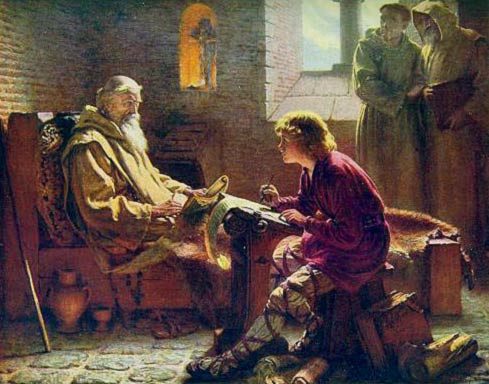 His most famous disciple, Cuthbert, reported that Bede was working on a translation of John's Gospel into English when death came. He also said that Bede died with the words of the Gloria Patri on his lips.
Attested hymns include Hymnum canentes martyrum ("The Hymn for Conquering Martyrs Raise"), Hymnum canamus Domino (translated variously as "A Hymn of Glory Let Us Sing," "The Hymn of Glory Sing We," and "Sing We Triumphant Hymns of Praise"), and Praecursor altus luminis ("The Great Forerunner of the Morn"). He also wrote vernacular poetry.
Bede received the title "Venerable" within two generations of his death and is buried in Durham Cathedral as one of England's greatest saints.
Lection — ESV Except as Noted
Psalm 78:1-4 or 19:7-14
Wisdom 7:15-22 (NRSV)
Matthew 13:47-52
Collect
Heavenly Father, who called your servant Bede, while still a child, to devote his life to Your service in the disciplines of religion and scholarship, grant that as he labored in the Spirit to bring the riches of Your truth to his generation, so we, in our various vocations, may strive to make You known in all the world; through Jesus Christ our Lord, who lives and reigns with you and the Holy Spirit, one God, now and forever.
A Hymn of Glory Let Us Sing
A hymn of glory let us sing New songs throughout the world shall ring
Alleluia, Alleluia.
Christ, by a road before untrod Ascendeth to the throne of God.
Alleluia, Alleluia, Alleluia, Alleluia, Alleluia.
The holy apostolic band Upon the Mount of Olives stand
Alleluia, Alleluia.
And with His followers they see Jesus' resplendent majesty
Alleluia, Alleluia, Alleluia, Alleluia, Alleluia.
To Whom the angels drawing nigh, "Why stand and gaze upon the sky?"
Alleluia, Alleluia.
"This is the Savior," thus they say. "This is His noble triumph day."
Alleluia, Alleluia, Alleluia, Alleluia, Alleluia.
"Again ye shall behold Him so, As ye have today seen Him go."
Alleluia, Alleluia.
"In glorious pomp ascending high Up to the portals of the sky."
Alleluia, Alleluia, Alleluia, Alleluia, Alleluia.
O grant us thitherward to tend And with unwearied hearts ascend,
Alleluia, Alleluia.
Unto Thy kingdom's throne, where Thou As is our faith, art seated now,
Alleluia, Alleluia, Alleluia, Alleluia, Alleluia.
Be Thou our Joy and strong Defense, Who art our future Recompense,
Alleluia, Alleluia.
So shall the light that springs from Thee Be ours through all eternity,
Alleluia, Alleluia, Alleluia, Alleluia, Alleluia.
O risen Christ, ascended Lord, All praise to Thee let earth accord,
Alleluia, Alleluia.
Who art, while endless ages run, With Father and with Spirit One,
Alleluia, Alleluia, Alleluia, Alleluia, Alleluia.
More on Bede's hymns and related information from NetHymnal.
Labels: bede, biography, church history, commemoration, english history, hagiography, historiography, hymnody, medieval history, patristics, the venerable bede, translation
¶ 00:00 | 0 comments |
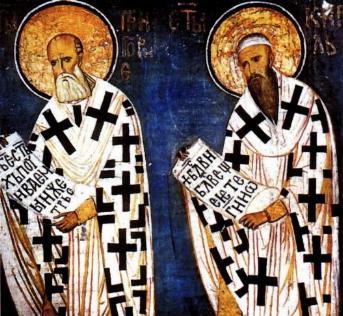 Saint Cyril and Saint Methodius were missionaries to the Slavs. The brothers Constantine and Methodius came from a Greek family in Thessalonica. Younger brother Constantine took the name Cyril when he became a monk in 868. After ordination, Cyril became librarian at the Church of Holy Wisdom (Hagia Sophia) in Constantinople.
In 862, Emperor Michael III and the Patriarch Photios sent the brothers as to what is now the Czech republic, where they taught in the native Slavic tongue. While the fact of their sending may have included the emperor's political designs, the brothers seem to have focused only upon the spiritual aspect of their task.
Cyril is said to have invented the alphabet known today as Cyrillic, which provided a written language for the liturgy and Scriptures for the Slavic peoples. Slavic alphabets include characters from Greek with extra symbols devised for sounds not expressed in Greek.
Their use of the vernacular established an important principle for evangelical missions. People could be taught directly without needing to first instruct them in the language of the Bible before teaching them what it said about their salvation.
Note: Cyril is traditionally celebrated in many places on 14 February, his date of death, and Methodius is often combined with him. I'm following the lectionary from the Lutheran Service Book, which moved the brothers' commemoration to 11 May, evidently because so much of the Western Church associates 14 February with Saint Valentine.
Collect
Almighty and everlasting God, who by the power of the Holy Spirit moved your servant Cyril and his brother Methodius to bring the light of the Gospel to a hostile and divided people, overcome all bitterness and strife among us by the love of Christ, and make us one united family under the banner of the Prince of Peace; who lives and reigns with You and the Holy Spirit, one God, now and forever.
Labels: biography, church history, commemoration, constantine, cyril, hagiography, methodius, missionary, patristics, slavic history, translation
¶ 00:00 | 0 comments |
 Johannes Bugenhagen (1485-1558), was from Pomerania in northern Germany. Because of his ancestral region, he took the Latin name Pomeranus and Martin Luther often called him "Doctor Pommer."
He was appointed pastor of Wittenberg in 1523 through the efforts of Luther and thus served as the reformer's pastor and confessor. One of the greatest scholars of the Reformation era, he helped translate the New Testament into Low German and wrote a commentary on the Psalms. He also worked to organize the Lutheran Church in northern Germany and Denmark, journeying to Copenhagen where he crowned both King and Queen and consecrated seven men to the offices of superintendent and bishop.
For those who think that their pastors preach too long, you share that complaint with Luther, who described Pomeranus' preaching as "whatever comes to mind, much like a maidservant chatting with another at the market." One story says that Luther recommended Bugenhagen cut his sermons in half and preach no more than an hour, lest all minds wander.
More information is available through the Christian Cyclopedia and Wikipedia.
Lection
Psalm 46
Isaiah 55:6-11
Romans 10:5-17
John 15:1-11
Collect
O Lord God, heavenly Father, who called Johannes Bugenhagen as pastor and confessor of the Faith, grant us faithful pastors in our time; pour our Your Holy Spirit on Your faithful people, keep them steadfast in Your grace and truth, protect and comfort them in all temptation, defend them against all enemies of Your Word, and bestow on Christ's Church Militant Your saving peace; through Jesus Christ, Your Son, our Lord, who lives and reigns with You and the Holy Spirit, one God, now and forever.
Labels: biography, commemoration, danish history, german history, hagiography, johannes bugenhagen, lutheranism, martin luther, reformation, translation
¶ 00:00 | 0 comments |
 Saint Jerome (Eusebius Sophronius Hieronymus), translator of Holy Scripture, was born in a little Dalmatian village on the Adriatic Sea around the year AD 345. Although he came from Christian parents, he wasn't baptized until he went to study in Rome in about AD 360.
After extensive travels, he chose the life of a monk and spent five years in the Syrian desert. There he learned Hebrew, the language of the Old Testament. However, the time spent there convinced him that the life of a hermit monk was not for him and he pursued holy orders and advanced education.
After ordination at Antioch and visits to Rome and Constantinople (where he studied under Gregory of Nazianzus), Jerome settled in Bethlehem. From the original Hebrew, Aramaic, and Greek, he used his ability with languages to translate the Bible into Latin, the common language of his time.
Jerome chose to use "street" or "vulgar" Latin rather than its classical form. Thus, his translation was called the Vulgate (from its vulgar Latin) and was the authoritative version of the Bible in the western Church for over 1,000 years.
 A man of considerable brilliance, Jerome could also be argumentative, arrogant, dogmatic in trivial matters, and easily swayed by people holding superior office. Yet he also was able to break with the influence of Origen under which he was raised and was a champion of understanding the original languages of Scripture and of exegesis over allegory in interpretation.
In Roman Catholic hagiography, Jerome is patron saint of translators and librarians. His symbol in Christianity is often a pen. In religious art, it isn't unusual to see him portrayed with an odd blend of clothing and trappings ranging from ascetic anchorite to opulently garbed cardinal. He is often posed with a crucifix, a skull, and a Bible.
Considered one of the great scholars of the early church, he is listed with Saints Augustine, Ambrose, and Gregory the Great as one of the original Four Doctors of the Western Church. These four, plus four Eastern theologians, compose the eight Great Doctors of the early Church (see this article on Saint Ambrose for the entire list).
Jerome died on 30 September AD 420. Originally interred at Bethlehem, his remains were eventually taken to Rome.
More information is available from James Kiefer's Hagiographies and Wikipedia.
Lection
Psalm 19:7-11(12-14) or 119:97-104
2 Timothy 3:14-17
Luke 24:44-48
Collect
O Lord, O God of truth, whose Word is a lantern to our feet and a light upon our path: We give you thanks for your servant Jerome, and those who, following in his steps, have labored to render the Holy Scriptures in the language of the people; and we pray that your Holy Spirit will overshadow us as we read the written Word, and that Christ, the living Word, will transform us according to your righteous will; through Jesus Christ our Lord, who lives and reigns with you and the Holy Spirit, one God, now and forever.
Labels: biography, christianity, church history, commemoration, doctors of the church, hagiography, jerome, patristics, theology, translation
¶ 00:00 | 0 comments |
Lancelot Andrewes was born in London in 1555. Possessed of a keen intellect, he studied at Cambridge and Oxford, was a distinguished lecturer, and entered religious orders in 1580. A career that saw him enjoy working among the people while still challenging himself and others intellectually led to royal associations and eventual consecration as Bishop of Chichester in 1605 and a position as lord almoner. In 1618, he attended the Synod of Dort, was made dean of the Chapel Royal, and became Bishop of Winchester.
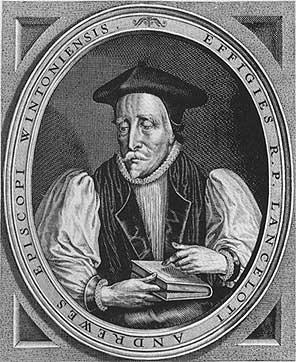 Active in church and secular politics, especially in their overlap, Andrewes advised James I of England and was on the committee of scholars responsible of the Authorized Version of the Bible. Indeed, his name is first on the list of translators, since he both provided translations of early parts of the Old Testament and served as an editor general of the entire work.
Versed in Latin, Greek, Hebrew and eighteen other languages, Andrewes enjoyed popularity during his life for writings. With Bishop Ussher, these two may have been the most learned and intellectually brilliant churchmen of the day. His apologetic writings included two essays against Robert Bellarmine. Large collections of his sermons remain and may still be read profitably both by lovers of Christ and by lovers of the English language.
Perhaps one of his finest works was the Preces Privatae (Private Prayers). The collection was, however, unavailable to contemporaries but were published after his death. Some sections are complete prayers and collects, other appear to be guides to devout meditation. A biography by James Kiefer includes quotes from the Preces. These selections from the Thursday prayers emphasize three important happenings on that day — the creation of birds and fish on the Fifth Day of Creation, the institution of the Lord's Supper, the Ascension of our Lord on Easter's 40th day.
Andrewes' impact on English arts and letters extended well beyond his life. T. S. Eliot considered him a major influence and wrote an essay in his honor.
Labels: andrewes, authorized version, bible, biography, christianity, church history, commemoration, english history, hagiography, king james i, kjv, theology, translation
¶ 00:00 | 0 comments |
Today marks the heavenly birthday of Bede (pronounced BĒD). Since his commemoration often falls near the end of Eastertide, it's quite likely that many Christians have close familiarity with one of Bede's best known (and one of this Aardvark's favorite) hymns, the Ascension anthem "A Hymn of Glory Let Us Sing."Bede (673-735) was the last of the early church fathers and the first person to compile a history of the English church. Born in Northumbria, Bede was given by his parents to a monastery in Northern England at the age of seven. He was ordained when he was thirty.
Probably the most learned man of his time, he was a prolific writer of history and his careful use of sources provided a model for historians in the Middle Ages. His skill in both history and theology gave him the ability to complete a synthesis between the older Celtic monasticism and the later Rule of Saint Benedict.
Known best for his book Historia ecclesiastica gentis Anglorum (The Ecclesiastical History of the English People), he was also a profound interpreter of Scripture; his edition of the Vulgate was the standard in Catholicism until 1979 and his commentaries still provide fresh insights for today's readers.
Bede also popularized the use of Anno Domini Nostri Iesu Christi ("in the Year of Our Lord Jesus Christ") in speaking of the time since our Savior's birth. This is usually shortened to Anno Domini or AD.
His most famous disciple, Cuthbert, reported that Bede was working on a translation of John's Gospel into English when death came. He also said that Bede died with the words of the Gloria Patri on his lips.Attested hymns include Hymnum canentes martyrum ("The Hymn for Conquering Martyrs Raise"), Hymnum canamus Domino (translated variously as "A Hymn of Glory Let Us Sing," "The Hymn of Glory Sing We," and "Sing We Triumphant Hymns of Praise"), and Praecursor altus luminis ("The Great Forerunner of the Morn"). He also wrote vernacular poetry.
Bede received the title "Venerable" within two generations of his death and is buried in Durham Cathedral as one of England's greatest saints.
Lection — ESV Except as Noted
Psalm 78:1-4 or 19:7-14
Wisdom 7:15-22 (NRSV)
Matthew 13:47-52
Collect
Heavenly Father, who called your servant Bede, while still a child, to devote his life to Your service in the disciplines of religion and scholarship, grant that as he labored in the Spirit to bring the riches of Your truth to his generation, so we, in our various vocations, may strive to make You known in all the world; through Jesus Christ our Lord, who lives and reigns with you and the Holy Spirit, one God, now and forever.
A Hymn of Glory Let Us Sing
A hymn of glory let us sing New songs throughout the world shall ring
Alleluia, Alleluia.
Christ, by a road before untrod Ascendeth to the throne of God.
Alleluia, Alleluia, Alleluia, Alleluia, Alleluia.
The holy apostolic band Upon the Mount of Olives stand
Alleluia, Alleluia.
And with His followers they see Jesus' resplendent majesty
Alleluia, Alleluia, Alleluia, Alleluia, Alleluia.
To Whom the angels drawing nigh, "Why stand and gaze upon the sky?"
Alleluia, Alleluia.
"This is the Savior," thus they say. "This is His noble triumph day."
Alleluia, Alleluia, Alleluia, Alleluia, Alleluia.
"Again ye shall behold Him so, As ye have today seen Him go."
Alleluia, Alleluia.
"In glorious pomp ascending high Up to the portals of the sky."
Alleluia, Alleluia, Alleluia, Alleluia, Alleluia.
O grant us thitherward to tend And with unwearied hearts ascend,
Alleluia, Alleluia.
Unto Thy kingdom's throne, where Thou As is our faith, art seated now,
Alleluia, Alleluia, Alleluia, Alleluia, Alleluia.
Be Thou our Joy and strong Defense, Who art our future Recompense,
Alleluia, Alleluia.
So shall the light that springs from Thee Be ours through all eternity,
Alleluia, Alleluia, Alleluia, Alleluia, Alleluia.
O risen Christ, ascended Lord, All praise to Thee let earth accord,
Alleluia, Alleluia.
Who art, while endless ages run, With Father and with Spirit One,
Alleluia, Alleluia, Alleluia, Alleluia, Alleluia.
More on Bede's hymns and related information from NetHymnal.
Labels: bede, biography, church history, commemoration, english history, hagiography, historiography, hymnody, medieval history, patristics, the venerable bede, translation
¶ 00:00 | 1 comments |
Pentecost, an Israelite festival connected to the spring harvest, was the time chosen by the Lord for the special outpouring of the Holy Spirit upon the disciples as they waited in Jerusalem.With wind and fire, the Holy Spirit manifested Himself upon the apostles. Immediately, they rushed out to begin proclaiming the Gospel of Jesus Christ crucified for our sins and raised for our justification. The account is in Acts 2:1-41. Such was the power of the Holy Spirit working through Law and Gospel preaching that He converted over 3000 people faith in Christ at one time.
In Christianity, Pentecost is a "movable feast." Under the Old Covenant, including among modern Jews, Pentecost was (and is) the fiftieth day of Passover. The Christian Church, as more Gentiles swelled its ranks, kept the idea of the fiftieth day but based the celebration on the date for Easter rather than for Passover. See the second question under Notes on the Christian Calendar for a bit more on how we arrive at a date each year.
If you're preaching on the Genesis text, take a look at Upon the Plain of Shinar, a hymn by Pastor Walter Snyder.
Lection: Three Year Cycle, Series C
Psalm 143
Genesis 11:1-9
Acts 2:1-21
John 14:23-31
Lection: One Year Cycle
Psalm 143
Genesis 11:1-9
Acts 2:1-21
John 14:23-31
Collect
O God, on this day You once taught the hearts of Your faithful people by sending them the light of Your Holy Spirit. Grant us in our day by the same Spirit to have a right understanding in all things and evermore to rejoice in His holy consolation; through Jesus Christ, Your Son, our Lord, who lives and reigns with You and the Holy Spirit, one God, now and forever.
Labels: acts, apostle, christ, church history, conversion, disciple, easter, feasts, festivals, gospel, holy ghost, holy spirit, jesus, new testament, pentecost, pneumatology, translation
¶ 00:00 | 0 comments |
Saint Cyril and Saint Methodius were missionaries to the Slavs. The brothers Constantine and Methodius came from a Greek family in Thessalonica. Younger brother Constantine took the name Cyril when he became a monk in 868. After ordination, Cyril became librarian at the Church of Holy Wisdom (Hagia Sophia) in Constantinople.In 862, Emperor Michael III and the Patriarch Photios sent the brothers as to what is now the Czech republic, where they taught in the native Slavic tongue. While the fact of their sending may have included the emperor's political designs, the brothers seem to have focused only upon the spiritual aspect of their task.
Cyril is said to have invented the alphabet known today as Cyrillic, which provided a written language for the liturgy and Scriptures for the Slavic peoples. Slavic alphabets include characters from Greek with extra symbols devised for sounds not expressed in Greek.
Their use of the vernacular established an important principle for evangelical missions. People could be taught directly without needing to first instruct them in the language of the Bible before teaching them what it said about their salvation.
Note: Cyril is traditionally celebrated in many places on 14 February, his date of death, and Methodius is often combined with him. I'm following the lectionary from the Lutheran Service Book, which moved the brothers' commemoration to 11 May, evidently because so much of the Western Church associates 14 February with Saint Valentine.
Collect
Almighty and everlasting God, who by the power of the Holy Spirit moved your servant Cyril and his brother Methodius to bring the light of the Gospel to a hostile and divided people, overcome all bitterness and strife among us by the love of Christ, and make us one united family under the banner of the Prince of Peace; who lives and reigns with You and the Holy Spirit, one God, now and forever.
Labels: biography, church history, commemoration, constantine, cyril, hagiography, methodius, missionary, patristics, slavic history, translation
¶ 00:00 | 0 comments |
Johannes Bugenhagen (1485-1558), was from Pomerania in northern Germany. Because of his ancestral region, he took the Latin name Pomeranus and Martin Luther often called him "Doctor Pommer."He was appointed pastor of Wittenberg in 1523 through the efforts of Luther and thus served as the reformer's pastor and confessor. One of the greatest scholars of the Reformation era, he helped translate the New Testament into Low German and wrote a commentary on the Psalms. He also worked to organize the Lutheran Church in northern Germany and Denmark, journeying to Copenhagen where he crowned both King and Queen and consecrated seven men to the offices of superintendent and bishop.
For those who think that their pastors preach too long, you share that complaint with Luther, who described Pomeranus' preaching as "whatever comes to mind, much like a maidservant chatting with another at the market." One story says that Luther recommended Bugenhagen cut his sermons in half and preach no more than an hour, lest all minds wander.
More information is available through the Christian Cyclopedia and Wikipedia.
Lection
Psalm 46
Isaiah 55:6-11
Romans 10:5-17
John 15:1-11
Collect
O Lord God, heavenly Father, who called Johannes Bugenhagen as pastor and confessor of the Faith, grant us faithful pastors in our time; pour our Your Holy Spirit on Your faithful people, keep them steadfast in Your grace and truth, protect and comfort them in all temptation, defend them against all enemies of Your Word, and bestow on Christ's Church Militant Your saving peace; through Jesus Christ, Your Son, our Lord, who lives and reigns with You and the Holy Spirit, one God, now and forever.
Labels: biography, commemoration, danish history, german history, hagiography, johannes bugenhagen, lutheranism, martin luther, reformation, translation
¶ 00:00 | 0 comments |
Saint Jerome (Eusebius Sophronius Hieronymus), translator of Holy Scripture, was born in a little Dalmatian village on the Adriatic Sea around the year AD 345. Although he came from Christian parents, he wasn't baptized until he went to study in Rome in about AD 360.After extensive travels, he chose the life of a monk and spent five years in the Syrian desert. There he learned Hebrew, the language of the Old Testament. However, the time spent there convinced him that the life of a hermit monk was not for him and he pursued holy orders and advanced education.
After ordination at Antioch and visits to Rome and Constantinople (where he studied under Gregory of Nazianzus), Jerome settled in Bethlehem. From the original Hebrew, Aramaic, and Greek, he used his ability with languages to translate the Bible into Latin, the common language of his time.
Jerome chose to use "street" or "vulgar" Latin rather than its classical form. Thus, his translation was called the Vulgate (from its vulgar Latin) and was the authoritative version of the Bible in the western Church for over 1,000 years.
A man of considerable brilliance, Jerome could also be argumentative, arrogant, dogmatic in trivial matters, and easily swayed by people holding superior office. Yet he also was able to break with the influence of Origen under which he was raised and was a champion of understanding the original languages of Scripture and of exegesis over allegory in interpretation.In Roman Catholic hagiography, Jerome is patron saint of translators and librarians. His symbol in Christianity is often a pen. In religious art, it isn't unusual to see him portrayed with an odd blend of clothing and trappings ranging from ascetic anchorite to opulently garbed cardinal. He is often posed with a crucifix, a skull, and a Bible.
Considered one of the great scholars of the early church, he is listed with Saints Augustine, Ambrose, and Gregory the Great as one of the original Four Doctors of the Western Church. These four, plus four Eastern theologians, compose the eight Great Doctors of the early Church (see this article on Saint Ambrose for the entire list).
Jerome died on 30 September AD 420. Originally interred at Bethlehem, his remains were eventually taken to Rome.
More information is available from James Kiefer's Hagiographies and Wikipedia.
Lection
Psalm 19:7-11(12-14) or 119:97-104
2 Timothy 3:14-17
Luke 24:44-48
Collect
O Lord, O God of truth, whose Word is a lantern to our feet and a light upon our path: We give you thanks for your servant Jerome, and those who, following in his steps, have labored to render the Holy Scriptures in the language of the people; and we pray that your Holy Spirit will overshadow us as we read the written Word, and that Christ, the living Word, will transform us according to your righteous will; through Jesus Christ our Lord, who lives and reigns with you and the Holy Spirit, one God, now and forever.
Labels: biography, christianity, church history, commemoration, doctors of the church, hagiography, jerome, patristics, theology, translation
¶ 00:00 | 0 comments |
Lancelot Andrewes was born in London in 1555. Possessed of a keen intellect, he studied at Cambridge and Oxford, was a distinguished lecturer, and entered religious orders in 1580. A career that saw him enjoy working among the people while still challenging himself and others intellectually led to royal associations and eventual consecration as Bishop of Chichester in 1605 and a position as lord almoner. In 1618, he attended the Synod of Dort, was made dean of the Chapel Royal, and became Bishop of Winchester.
Active in church and secular politics, especially in their overlap, Andrewes advised James I of England and was on the committee of scholars responsible of the Authorized Version of the Bible. Indeed, his name is first on the list of translators, since he both provided translations of early parts of the Old Testament and served as an editor general of the entire work.Versed in Latin, Greek, Hebrew and eighteen other languages, Andrewes enjoyed popularity during his life for writings. With Bishop Ussher, these two may have been the most learned and intellectually brilliant churchmen of the day. His apologetic writings included two essays against Robert Bellarmine. Large collections of his sermons remain and may still be read profitably both by lovers of Christ and by lovers of the English language.
Perhaps one of his finest works was the Preces Privatae (Private Prayers). The collection was, however, unavailable to contemporaries but were published after his death. Some sections are complete prayers and collects, other appear to be guides to devout meditation. A biography by James Kiefer includes quotes from the Preces. These selections from the Thursday prayers emphasize three important happenings on that day — the creation of birds and fish on the Fifth Day of Creation, the institution of the Lord's Supper, the Ascension of our Lord on Easter's 40th day.
Andrewes' impact on English arts and letters extended well beyond his life. T. S. Eliot considered him a major influence and wrote an essay in his honor.
Labels: andrewes, bible, biography, christianity, church history, commemoration, english history, hagiography, king james i, kjv, theology, translation
¶ 00:00 | 0 comments |


