
 Saint Joseph is mentioned in all four Gospels. He came from a small village called Arimathea in the hill country of Judea and was a respected member of the Sanhedrin, the Jewish ruling council in Jerusalem. Scholars presume that Joseph was a man of considerable means, since he owned his own unused tomb in a garden not far from the site of Jesus' crucifixion (Matthew 27:60).
A man waiting expectantly for the kingdom of God, he went to Pontius Pilate after the death of Jesus and asked for Jesus' body (Mark 15:43). Along with Nicodemus, Joseph removed the body and placed it in the tomb (John 19:39). Their public devotion contrasted greatly to the fearfulness of the disciples who abandoned Jesus.
The perfume flask depicted here reminds us of Joseph's hurried work of preparing Christ's body for burial, which would have included rubbing the spices brought by Nicodemus on the body and the wrapping cloths.
Labels: biography, commemoration, crucifixion, good friday, gospels, hagiography, jesus, john, joseph of arimathea, luke, mark, matthew, new testament, nicodemus
¶ 00:00 | 0 comments |

 Mary, Martha, and Lazarus were disciples with whom Jesus had a special bond of love and friendship. The Gospel According to Saint John records that "Jesus loved Martha and her sister and Lazarus (11:5)."
On one occasion, Martha welcomed Jesus into their home for a meal. While she did all the work, Mary sat at Jesus' feet listening to his Word and was commended by Jesus for choosing the "good portion, which will not be taken away from her (Luke 10:38-42)."
When their brother Lazarus died, Jesus spoke to Martha this beautiful Gospel promise: "I am the Resurrection and the Life. Whoever believes in me, though he die, yet shall he live." We note that in this instance, it was Martha who made the wonderful confessions of faith in Christ (John 11:1-44).
Ironically, raising Lazarus from the dead made Jesus' enemies among the Jewish leaders more determined than ever to kill Him (11:45-57).
Six days before Jesus was crucified, Mary anointed His feet with a very expensive fragrant oil and wiped them with her hair, not knowing at the time that she was doing it in preparation for her Lord's burial (John 12:1-8).
Labels: bethany, biography, commemoration, gospels, hagiography, jesus, john, lazarus, luke, martha, mary, new testament, resurrection
¶ 00:00 | 1 comments |
 This major Christological feast commemorates the joyous visit Mary paid to her relative (probably her cousin) Elizabeth, following The Annunciation. Inspired by the amazing news that she was to become the mother of the Christ and in response to the joyous word that her old and previously barren kinswoman was also pregnant, she joined Elizabeth during her sixth month of pregnancy (see Luke 1:39-56).
After Mary declared the wondrously good news, Elizabeth replied to the Virgin, "Blessed are you among women, and blessed is the fruit of your womb! ... Behold, when the sound of your greeting came to my ears, the baby in my womb leaped for joy. (vv. 42, 44)" She concluded by giving full credit and glory to God while also commending her young cousin's hearty faith: "Blessed is she who believed that there would be a fulfillment of what was spoken to her from the Lord. (av. 45)"
Mary responded with the Magnificat, the beautiful song of praise beginning, "My soul magnifies the Lord. (vv. 46-55)" It's not clear whether Mary stayed there until after the birth of John or if she left immediately beforehand; Luke merely said that the Virgin "remained with her about three months and returned to her home. (v. 56)"
And so, as we encounter God sending the Forerunner and the Messiah into the world, we see a study in contrasts. Two women stand before each other. One seemingly too old to bear children now carries the final prophet of the Old Covenant. The other, youthful and as yet unwed — completely unprepared in the eyes of the world — carries the One who brings both the Advent and the Fulfillment of the New Testament. And again we see, in the fullness of time, one age passing away while another age begins — an age that has no end but which lasts unto eternity.
The reaction of Jesus' unborn cousin and the words of his mother also serve as reminders to many Christians about the sanctity of life. Christian pro-lifers point to John's celebration as clear evidence of the humanity and the consciousness of children who are still in utero.
In Roman Catholicism, Vatican II changed the date of the observation from 2 July to 31 May in order to more accurately reflect the Bible's chronology regarding the life of Christ. Several other Western churches followed suit. In The Lutheran Church —Missouri Synod, today is celebrated in the One Year Lectionary while the Three Year Lectionary moves the feast date to 31 May.
Note: This illustration by Albrecht Dürer is from the Web Gallery of Art.
Lection
Psalm 138
Isaiah 11:1-5
Romans 12:9-16
Luke 1:39-56
Collect
Almighty God, You chose the virgin Mary to be the mother of Your Son and made known through her Your regard for the poor and lowly and despised. Grant that we may receive Your Word in humility and faith, and so be made one with Jesus Christ, Your Son, our Lord, who lives and reigns with You and the Holy Spirit, one God, now and forever.
The Magnificat
My soul magnifies the Lord,
and my spirit rejoices in God my Savior,
for He has looked on the humble estate of his servant.
For behold, from now on all generations will call me blessed;
for He who is mighty has done great things for me,
and holy is His name.
And His mercy is for those who fear Him
from generation to generation.
He has shown strength with His arm;
He has scattered the proud in the thoughts of their hearts;
He has brought down the mighty from their thrones
and exalted those of humble estate;
He has filled the hungry with good things,
and the rich He has sent empty away.
He has helped His servant Israel,
in remembrance of His mercy,
as He spoke to our fathers,
to Abraham and to his offspring forever.
Labels: christianity, christology, church history, elizabeth, feasts, festivals, gospels, jesus, john the baptist, luke, magnificat, mary, new testament, visitation
¶ 00:00 | 0 comments |
 This day celebrates the birth of a son to the elderly and previously childless couple Elizabeth and Zechariah the priest. On the eighth day, his parents had him circumcised according the the Law and named him John ("Yahweh is gracious").
John would grow up to be the last prophet of the Old Testament and the Forerunner of the coming Messiah, his younger cousin Jesus. Notice that today's date is six months before Christmas — the Nativity of Our Lord — since the Annunciation to Saint Mary came "in the sixth month" of Elizabeth's pregnancy.
The Christian Church remembers Saint John the Baptizer's prophetic ministry and commemorates his martyrdom on 29 August.
Lection
Psalm 85:(1-6) 7-13
Isaiah 40:1-5
Acts 13:13-26
Luke 1:57-80
Collect
Almighty God, through John the Baptist, the forerunner of Christ, You once proclaimed salvation; now grant that we may know this salvation and serve You in holiness and righteousness all the days of our life; through Jesus Christ, Your Son, who lives and reigns with You and the Holy Spirit, one God, now and forever.
Additional Reading
Past Elder's post on The Nativity of St. John has some background material and some interesting notes about the Christian Calendar, the dating of Biblical events, and the kalends.
Labels: christology, elizabeth, feasts, festivals, forerunner, gospels, hagiography, jesus, john the baptist, luke, new testament, old testament, prophecy, zechariah
¶ 22:56 | 0 comments |
Lection
† Psalm 110 (1-year Lectionary) or Psalm 47 (3-year)
† 2 Kings 2:5-15 (1-year) or Acts 1:1-11 (3-year)
† Acts 1:1-11 (1-year) or Ephesians 1:15-23 (3-year)
† Mark 16:14-20 or Luke 24:44-53 (1-year) or Luke 24:44-53 (3-year)
Collect
Almighty God, as Your only-begotten Son, our Lord Jesus Christ, ascended into the heavens, so may we also ascend in heart and mind and continually dwell there with Him, who lives and reigns with You and the Holy Spirit, one God, now and forever.
An Ascension Hymn
Alleluia! Sing to Jesus
Alleluia! Sing to Jesus; His the scepter, His the throne;
Alleluia! His the triumph, His the victory alone.
Hark! The songs of peaceful Zion Thunder like a mighty flood:
" Jesus out of every nation Has redeemed us by His blood."
Alleluia! Not as orphans Are we left in sorrow now;
Alleluia! He is near us: Faith believes, nor questions how.
Though the cloud from sight received Him When the forty days were over,
Shall our hearts forget His promise: "I am with you ever-more"?
Alleluia! Bread of heaven, Here on earth our food, our stay;
Alleluia! Here the sinful Flee to You from day to day.
Intercessor, Friend of sinners, Earth’s Redeemer, hear our plea
Where the songs of all the sinless Sweep across the crystal sea.
Alleluia! King eternal, Lord omnipotent we own;
Alleluia! Born of Mary, Earth Your foot-stool, heaven Your throne.
As within the veil You entered, Robed in flesh, our great high priest,
Here on earth both priest and victim In the eucharistic feast.
Alleluia! Sing to Jesus; His the scepter, His the throne;
Alleluia! His the triumph, His the victory alone.
Hark! The songs of peaceful Zion Thunder like a mighty flood:
"Jesus out of every nation Has redeemed us by His blood."
Labels: acts, ascension, christology, church year, easter, feasts, festivals, gospels, jesus, luke, new testament
¶ 16:56 | 0 comments |
Transferred to 4 April AD 2016
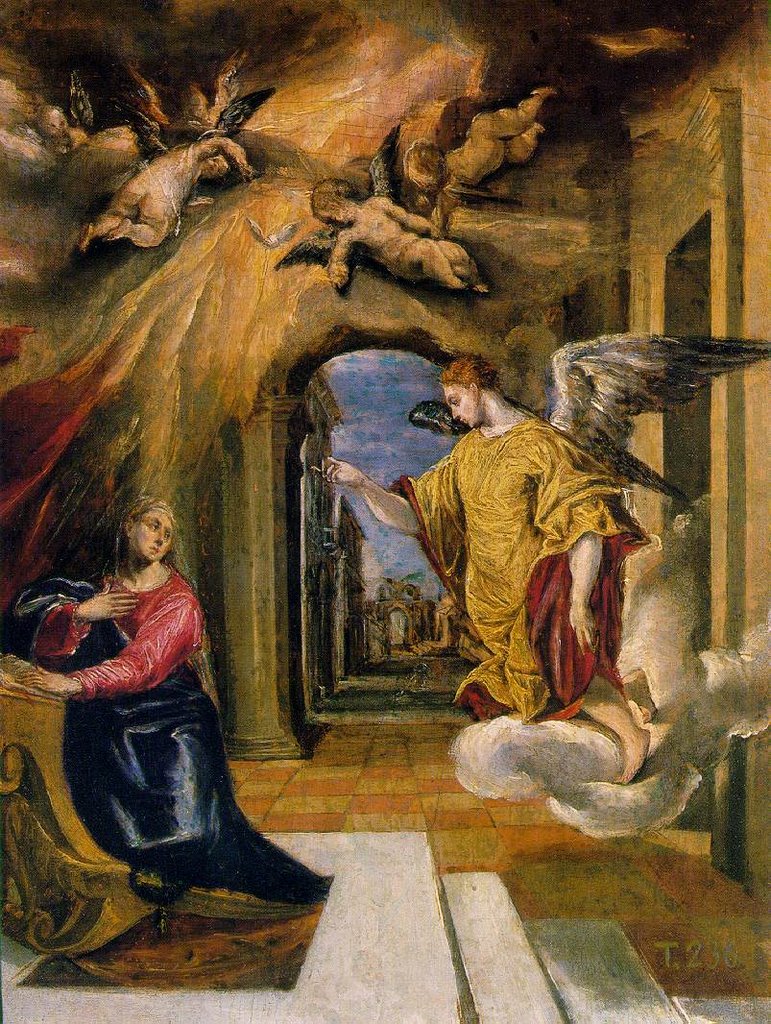 Luke 1:26-38 tells us how the angel Gabriel announced to Mary of Nazareth that she had been chosen to be the mother of the Christ and her response. Mary, a virgin pledged to marry Joseph, briefly wondered how this could be, since she had not had sex with any man.
Once Gabriel told her that the Child was conceived by the Holy Spirit, she humbly accepted this sacred obligation: "Behold, I am the servant of the Lord; let it be to me according to your word. (v. 38)"
Nothing prevents us from supposing that Our Lord was conceived immediately after this. Since the Church from early days observed 25 March as the date of the Annunciation, the celebration of the Christ's Nativity is observed on 25 December, nine months later.
For centuries in vast parts of Europe, 25 March also marked the change to the new year. While it seems somewhat odd and abrupt to change years in the middle of a month, we can imagine that those accustomed to that calendar easily made the adjustment. Furthermore, they could take to heart the reminder that God's chosen time, that most special time when He sent His Son into human flesh, merited such a "strange" circumstance.
Even though the Visitation of Mary to her cousin Elizabeth took place six months later (see Luke 1:39-56) — as Elizabeth neared the end of her own pregnancy with the child who would grow to become John the Baptizer — Mary's song of celebration at that time is also appropriate to remember on the Feast of the Annunciation. In the Magnificat (Luke 1:46-55) the virgin mother of God celebrated God's gift to her, to Israel, and to all people.
Martin Luther wrote a commentary on this canticle. About verse 49, he said, "The 'great things' are nothing less than that she became the Mother of God, in which work so many and such great good things are bestowed upon her as pass man's understanding. For on this there follows all honor, all blessedness, and her unique place in the whole of mankind, among whom she has no equal, namely, that she had a child by the Father in Heaven, and such a child.
"She herself is unable to find a name for this work, it is too exceedingly great; all she can do is break out in the fervent cry: 'They are great things,' impossible to describe or define. Hence men have crowded all her glory into a single word, calling her the Mother of God.
"No one can say anything greater of her or to her, though he had as many tongues as there are leaves on the trees, or grass in the fields, or stars in the sky, or sand by the sea. It needs to be pondered in the heart, what it means to be the Mother of God."
The Annunciation is such an important Christological feast that it takes precedence over even the Sundays in Lent in much of Christendom. See Looking Ahead at Weedon's Blog for details.
Lection
Psalm 45:7-17
Isaiah 7:10-14
Hebrews 10:4-10
Luke 1:26-38
Collect
O Lord, as we have known the incarnation of Your Son Jesus Christ by the message of the angel to the virgin Mary, so by His cross and Passion bring us to the glory of His resurrection; through the same Jesus Christ, our Lord, who lives and reigns with You and the Holy Spirit, one God, now and forever.
NOTE: Regarding the occasional transfer of this major feast, the Lutheran Service Book: Altar Book states on page 960, It is appropriate to observe this feast day in all its fullness during Lent. However, according to historical precedent, when the Annunciation falls during Holy Week or on Easter Day (or also on the Fifth Sunday in Lent in the one-year series), it should not be observed at those times but may be transferred to a weekday following the Second Sunday of Easter. In most of Eastern Christendom, rather than transferring the Annunciation, it is celebrated fully. In Orthodoxy, this normally means the celebratory Liturgy of John Chrysostom.
Luther quote from Luther's Works, Vol. 21, p. 326, ed. Jaroslav Pelikan, Concordia Publishing House © 1956.
Labels: annunciation, christ, christology, feasts, festivals, gabriel, gospels, incarnation, jesus, luke, mary, new testament, theotokos
¶ 00:00 | 0 comments |
 This major feast day of the Christian Church marks the infant Jesus' eighth day of life. At this time, the Law required all boys of Israel to be circumcised (cf. Genesis 17:9-14; Leviticus 12:1-3).
On this day, our Savior also received His name (Luke 2:21). This fulfilled the command given to both Mary (Luke 1:31) and Joseph (Matthew 1:21) during their angelic visitations.
 Christ's circumcision placed Him fully under God's Law. His name Jesus, from the Hebrew "Joshua" (meaning "Yahweh saves" or "He saves"), bespeaks the purpose for which He assumed human flesh and came to live among us.
For more on this Christological feast, including the reason for using this particular date for the remembrance, please see On the Eighth Day of Christmas and Christianity and New Year's Day at Ask the Pastor.
Lection
Psalm 8
Numbers 6:22-27
Galatians 3:23-29
Luke 2:21
Collect
Lord God, You made Your beloved Son, our Savior, subject to the Law and caused Him to shed His blood on our behalf. Grant us the true circumcision of the Spirit that our hearts may be made pure from all sins; through Jesus Christ, our Lord, who lives and reigns with You and the Holy Spirit, one God, now and forever.
Labels: christ, christmas, christology, circumcision, covenant, feasts, festivals, gospels, jesus, law, luke, name, new testament
¶ 00:00 | 0 comments |
 Saint Luke the Evangelist was a physician (Colossians 4:14) and a companion of St. Paul on some of his missionary journeys (see Acts 16:10ff; 20:5ff; 27-28).
Material found in his Gospel account and not elsewhere includes the Annunciation and almost all we know of Jesus' birth, infancy, and boyhood. He recounts some of the most moving parables, including the Good Samaritan and the Prodigal Son. He also provides three of the sayings of Christ on the Cross: "Father, forgive them (23:34)"; "Today, you will be with me in Paradise (23:43)"; and "Father, into your hands I commit my spirit! (23:46)"
Luke's Gospel account emphasizes the human love of Christ, His compassion for sinners and for suffering and unhappy persons, for outcasts such as the Samaritans, tax collectors, lepers, shepherds (not a respected profession), and for the poor. Christ's treatment of women and their important supporting role in His ministry is also emphasized in Luke more than in the other Gospels.
Much of Christianity uses each of the four living creatures (see Ezekiel 1 and Revelation 4) as a symbol one of the four evangelists. While attributions vary in parts of Christendom, most of the Western Church assigns the winged ox to Saint Luke. The association probably comes because the ox was one of the major sacrificial animals under the Old Covenant while Luke strongly highlighted the sacrificial elements of Christ's life, suffering, and death. See the commemoration of Saint Matthew for details of the other evangelists' symbols in ecclesiastical art.
Lection
Psalm 147:1-11
Isaiah 35:5-8
2 Timothy 4:5-18
Luke 10:1-9
Collect
Almighty God, our Father, Your blessed Son called Luke the physician to be an evangelist and physician of the soul. Grant that the healing medicine of the Gospel and the Sacraments may put to flight the diseases of our souls that with willing hearts we may ever love and serve You; through Jesus Christ, Your Son, our Lord, who lives and reigns with You and the Holy Spirit, one God, now and forever.
Scripture quoted from The Holy Bible, English Standard Version®, © 2001 by Crossway Bibles.
Labels: acts, biography, christianity, christology, church history, evangelist, feasts, festivals, gospels, hagiography, jesus, luke, new testament, paul
¶ 00:00 | 0 comments |
Saint Joseph is mentioned in all four Gospels. He came from a small village called Arimathea in the hill country of Judea and was a respected member of the Sanhedrin, the Jewish ruling council in Jerusalem. Scholars presume that Joseph was a man of considerable means, since he owned his own unused tomb in a garden not far from the site of Jesus' crucifixion (Matthew 27:60).A man waiting expectantly for the kingdom of God, he went to Pontius Pilate after the death of Jesus and asked for Jesus' body (Mark 15:43). Along with Nicodemus, Joseph removed the body and placed it in the tomb (John 19:39). Their public devotion contrasted greatly to the fearfulness of the disciples who abandoned Jesus.
The perfume flask depicted here reminds us of Joseph's hurried work of preparing Christ's body for burial, which would have included rubbing the spices brought by Nicodemus on the body and the wrapping cloths.
Labels: biography, commemoration, crucifixion, good friday, gospels, hagiography, jesus, john, joseph of arimathea, luke, mark, matthew, new testament, nicodemus
¶ 00:00 | 0 comments |
Mary, Martha, and Lazarus were disciples with whom Jesus had a special bond of love and friendship. The Gospel According to Saint John records that "Jesus loved Martha and her sister and Lazarus (11:5)."On one occasion, Martha welcomed Jesus into their home for a meal. While she did all the work, Mary sat at Jesus' feet listening to his Word and was commended by Jesus for choosing the "good portion, which will not be taken away from her (Luke 10:38-42)."
When their brother Lazarus died, Jesus spoke to Martha this beautiful Gospel promise: "I am the Resurrection and the Life. Whoever believes in me, though he die, yet shall he live." We note that in this instance, it was Martha who made the wonderful confessions of faith in Christ (John 11:1-44).
Ironically, raising Lazarus from the dead made Jesus' enemies among the Jewish leaders more determined than ever to kill Him (11:45-57).
Six days before Jesus was crucified, Mary anointed His feet with a very expensive fragrant oil and wiped them with her hair, not knowing at the time that she was doing it in preparation for her Lord's burial (John 12:1-8).
Labels: bethany, biography, commemoration, gospels, hagiography, jesus, john, lazarus, luke, martha, mary, new testament, resurrection
¶ 00:00 | 0 comments |
This major Christological feast commemorates the joyous visit Mary paid to her relative (probably her cousin) Elizabeth, following The Annunciation. Inspired by the amazing news that she was to become the mother of the Christ and in response to the joyous word that her old and previously barren kinswoman was also pregnant, she joined Elizabeth during her sixth month of pregnancy (see Luke 1:39-56).After Mary declared the wondrously good news, Elizabeth replied to the Virgin, "Blessed are you among women, and blessed is the fruit of your womb! ... Behold, when the sound of your greeting came to my ears, the baby in my womb leaped for joy. (vv. 42, 44)" She concluded by giving full credit and glory to God while also commending her young cousin's hearty faith: "Blessed is she who believed that there would be a fulfillment of what was spoken to her from the Lord. (av. 45)"
Mary responded with the Magnificat, the beautiful song of praise beginning, "My soul magnifies the Lord. (vv. 46-55)" It's not clear whether Mary stayed there until after the birth of John or if she left immediately beforehand; Luke merely said that the Virgin "remained with her about three months and returned to her home. (v. 56)"
And so, as we encounter God sending the Forerunner and the Messiah into the world, we see a study in contrasts. Two women stand before each other. One seemingly too old to bear children now carries the final prophet of the Old Covenant. The other, youthful and as yet unwed — completely unprepared in the eyes of the world — carries the One who brings both the Advent and the Fulfillment of the New Testament. And again we see, in the fullness of time, one age passing away while another age begins — an age that has no end but which lasts unto eternity.
The reaction of Jesus' unborn cousin and the words of his mother also serve as reminders to many Christians about the sanctity of life. Christian pro-lifers point to John's celebration as clear evidence of the humanity and the consciousness of children who are still in utero.
In Roman Catholicism, Vatican II changed the date of the observation from 2 July to 31 May in order to more accurately reflect the Bible's chronology regarding the life of Christ. Several other Western churches followed suit. In The Lutheran Church —Missouri Synod, today is celebrated in the One Year Lectionary while the Three Year Lectionary moves the feast date to 31 May.
Note: This illustration by Albrecht Dürer is from the Web Gallery of Art.
Lection
Psalm 138
Isaiah 11:1-5
Romans 12:9-16
Luke 1:39-56
Collect
Almighty God, You chose the virgin Mary to be the mother of Your Son and made known through her Your regard for the poor and lowly and despised. Grant that we may receive Your Word in humility and faith, and so be made one with Jesus Christ, Your Son, our Lord, who lives and reigns with You and the Holy Spirit, one God, now and forever.
The Magnificat
My soul magnifies the Lord,
and my spirit rejoices in God my Savior,
for He has looked on the humble estate of his servant.
For behold, from now on all generations will call me blessed;
for He who is mighty has done great things for me,
and holy is His name.
And His mercy is for those who fear Him
from generation to generation.
He has shown strength with His arm;
He has scattered the proud in the thoughts of their hearts;
He has brought down the mighty from their thrones
and exalted those of humble estate;
He has filled the hungry with good things,
and the rich He has sent empty away.
He has helped His servant Israel,
in remembrance of His mercy,
as He spoke to our fathers,
to Abraham and to his offspring forever.
Labels: christianity, christology, church history, elizabeth, feasts, festivals, gospels, jesus, john the baptist, luke, magnificat, mary, new testament, visitation
¶ 00:00 | 0 comments |
This day celebrates the birth of a son to the elderly and previously childless couple Elizabeth and Zechariah the priest. On the eighth day, his parents had him circumcised according the the Law and named him John ("Yahweh is gracious").John would grow up to be the last prophet of the Old Testament and the Forerunner of the coming Messiah, his younger cousin Jesus. Notice that today's date is six months before Christmas — the Nativity of Our Lord — since the Annunciation to Saint Mary came "in the sixth month" of Elizabeth's pregnancy.
The Christian Church remembers Saint John the Baptizer's prophetic ministry and commemorates his martyrdom on 29 August.
Lection
Psalm 85:(1-6) 7-13
Isaiah 40:1-5
Acts 13:13-26
Luke 1:57-80
Collect
Almighty God, through John the Baptist, the forerunner of Christ, You once proclaimed salvation; now grant that we may know this salvation and serve You in holiness and righteousness all the days of our life; through Jesus Christ, Your Son, who lives and reigns with You and the Holy Spirit, one God, now and forever.
Additional Reading
Past Elder's post on The Nativity of St. John has some background material and some interesting notes about the Christian Calendar, the dating of Biblical events, and the kalends.
Labels: christology, elizabeth, feasts, festivals, forerunner, gospels, hagiography, jesus, john the baptist, luke, new testament, zechariah
¶ 00:00 | 0 comments |
Lection
† Psalm 110 (1-year Lectionary) or Psalm 47 (3-year)
† 2 Kings 2:5-15 (1-year) or Acts 1:1-11 (3-year)
† Acts 1:1-11 (1-year) or Ephesians 1:15-23 (3-year)
† Mark 16:14-20 or Luke 24:44-53 (1-year) or Luke 24:44-53 (3-year)
Collect
Almighty God, as Your only-begotten Son, our Lord Jesus Christ, ascended into the heavens, so may we also ascend in heart and mind and continually dwell there with Him, who lives and reigns with You and the Holy Spirit, one God, now and forever.
An Ascension Hymn
Alleluia! Sing to Jesus
Alleluia! Sing to Jesus; His the scepter, His the throne;
Alleluia! His the triumph, His the victory alone.
Hark! The songs of peaceful Zion Thunder like a mighty flood:
" Jesus out of every nation Has redeemed us by His blood."
Alleluia! Not as orphans Are we left in sorrow now;
Alleluia! He is near us: Faith believes, nor questions how.
Though the cloud from sight received Him When the forty days were over,
Shall our hearts forget His promise: "I am with you ever-more"?
Alleluia! Bread of heaven, Here on earth our food, our stay;
Alleluia! Here the sinful Flee to You from day to day.
Intercessor, Friend of sinners, Earth’s Redeemer, hear our plea
Where the songs of all the sinless Sweep across the crystal sea.
Alleluia! King eternal, Lord omnipotent we own;
Alleluia! Born of Mary, Earth Your foot-stool, heaven Your throne.
As within the veil You entered, Robed in flesh, our great high priest,
Here on earth both priest and victim In the eucharistic feast.
Alleluia! Sing to Jesus; His the scepter, His the throne;
Alleluia! His the triumph, His the victory alone.
Hark! The songs of peaceful Zion Thunder like a mighty flood:
"Jesus out of every nation Has redeemed us by His blood."
Labels: acts, ascension, christology, church year, easter, feasts, festivals, gospels, jesus, luke, new testament
¶ 00:00 | 0 comments |
Transferred to 4 April AD 2016
NOTE: Regarding the transfer of this major feast, the Lutheran Service Book: Altar Book states on page 960, It is appropriate to observe this feast day in all its fullness during Lent. However, according to historical precedent, when the Annunciation falls during Holy Week or on Easter Day (or also on the Fifth Sunday in Lent in the one-year series), it should not be observed at those times but may be transferred to a weekday following the Second Sunday of Easter. In most of Eastern Christendom, rather than transferring the Annunciation, it is celebrated fully. In Orthodoxy, this normally means the celebratory Liturgy of John Chrysostom.
Luke 1:26-38 tells us how the angel Gabriel announced to Mary of Nazareth that she had been chosen to be the mother of the Christ and her response. Mary, a virgin pledged to marry Joseph, briefly wondered how this could be, since she had not had sex with any man.Once Gabriel told her that the Child was conceived by the Holy Spirit, she humbly accepted this sacred obligation: "Behold, I am the servant of the Lord; let it be to me according to your word. (v. 38)"
Nothing prevents us from supposing that Our Lord was conceived immediately after this. Since the Church from early days observed 25 March as the date of the Annunciation, the celebration of the Christ's Nativity is observed on 25 December, nine months later.
For centuries in vast parts of Europe, 25 March also marked the change to the new year. While it seems somewhat odd and abrupt to change years in the middle of a month, we can imagine that those accustomed to that calendar easily made the adjustment. Furthermore, they could take to heart the reminder that God's chosen time, that most special time when He sent His Son into human flesh, merited such a "strange" circumstance.
Even though the Visitation of Mary to her cousin Elizabeth took place six months later (see Luke 1:39-56) — as Elizabeth neared the end of her own pregnancy with the child who would grow to become John the Baptizer — Mary's song of celebration at that time is also appropriate to remember on the Feast of the Annunciation. In the Magnificat (Luke 1:46-55) the virgin mother of God celebrated God's gift to her, to Israel, and to all people.
Martin Luther wrote a commentary on this canticle. About verse 49, he said, "The 'great things' are nothing less than that she became the Mother of God, in which work so many and such great good things are bestowed upon her as pass man's understanding. For on this there follows all honor, all blessedness, and her unique place in the whole of mankind, among whom she has no equal, namely, that she had a child by the Father in Heaven, and such a child.
"She herself is unable to find a name for this work, it is too exceedingly great; all she can do is break out in the fervent cry: 'They are great things,' impossible to describe or define. Hence men have crowded all her glory into a single word, calling her the Mother of God.
"No one can say anything greater of her or to her, though he had as many tongues as there are leaves on the trees, or grass in the fields, or stars in the sky, or sand by the sea. It needs to be pondered in the heart, what it means to be the Mother of God."
The Annunciation is such an important Christological feast that it takes precedence over even the Sundays in Lent in much of Christendom. See Looking Ahead at Weedon's Blog for details.
Lection
Psalm 45:7-17
Isaiah 7:10-14
Hebrews 10:4-10
Luke 1:26-38
Collect
O Lord, as we have known the incarnation of Your Son Jesus Christ by the message of the angel to the virgin Mary, so by His cross and Passion bring us to the glory of His resurrection; through the same Jesus Christ, our Lord, who lives and reigns with You and the Holy Spirit, one God, now and forever.
Luther quote from Luther's Works, Vol. 21, p. 326, ed. Jaroslav Pelikan, Concordia Publishing House © 1956.
Labels: annunciation, christ, christology, feasts, festivals, gabriel, gospels, incarnation, jesus, luke, mary, new testament, theotokos
¶ 00:01 | 0 comments |
Saint Luke the Evangelist was a physician (Colossians 4:14) and a companion of St. Paul on some of his missionary journeys (see Acts 16:10ff; 20:5ff; 27-28).Material found in his Gospel account and not elsewhere includes the Annunciation and almost all we know of Jesus' birth, infancy, and boyhood. He recounts some of the most moving parables, including the Good Samaritan and the Prodigal Son. He also provides three of the sayings of Christ on the Cross: "Father, forgive them (23:34)"; "Today, you will be with me in Paradise (23:43)"; and "Father, into your hands I commit my spirit! (23:46)"
Luke's Gospel account emphasizes the human love of Christ, His compassion for sinners and for suffering and unhappy persons, for outcasts such as the Samaritans, tax collectors, lepers, shepherds (not a respected profession), and for the poor. Christ's treatment of women and their important supporting role in His ministry is also emphasized in Luke more than in the other Gospels.
Much of Christianity uses each of the four living creatures (see Ezekiel 1 and Revelation 4) as a symbol one of the four evangelists. While attributions vary in parts of Christendom, most of the Western Church assigns the winged ox to Saint Luke. The association probably comes because the ox was one of the major sacrificial animals under the Old Covenant while Luke strongly highlighted the sacrificial elements of Christ's life, suffering, and death. See the commemoration of Saint Matthew for details of the other evangelists' symbols in ecclesiastical art.
Lection
Psalm 147:1-11
Isaiah 35:5-8
2 Timothy 4:5-18
Luke 10:1-9
Collect
Almighty God, our Father, Your blessed Son called Luke the physician to be an evangelist and physician of the soul. Grant that the healing medicine of the Gospel and the Sacraments may put to flight the diseases of our souls that with willing hearts we may ever love and serve You; through Jesus Christ, Your Son, our Lord, who lives and reigns with You and the Holy Spirit, one God, now and forever.
Scripture quoted from The Holy Bible, English Standard Version®, © 2001 by Crossway Bibles.
Labels: acts, biography, christianity, christology, church history, evangelist, feasts, festivals, gospels, hagiography, jesus, luke, new testament, paul
¶ 00:00 | 0 comments |


