
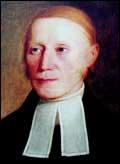
 Born 17 October 1582, Johann Gerhard, a Lutheran theologian in the tradition of Martin Luther (1483-1546) and Martin Chemnitz (1522-86), was the most influential 17th Century dogmatician. Many still consider his Loci Theologici in 23 large volumes to be the most definitive statement of Lutheran orthodoxy. Born in Quedlinburg, Germany, Gerhard was stricken with a life-threatening illness at age 15.
Following this experience, coupled with with guidance from his pastor, Johann Arndt, Gerhard experienced a turning point: He devoted the rest of his life to theology, serving many years as the Superintendent of Heldberg and, later, of the Duchy of Coburg. Eventually he become a professor at the University of Jena. With a sharp, critically trained mind, Gerhard also possessed deep evangelical piety and love for Jesus.
He wrote exegetical and theological works, devotional literature, history, and polemics. Many of his sermons remain in publication, still exercising wide influence upon confessional Lutheran thought. Since its writing and subsequent translation, his Sacred Meditations probably outsold every book in the Western world except the Bible and The Imitation of Christ by Thomas à Kempis.
His son Johann Ernst Gerhardt was also a Lutheran theologian and professor. An even more noted relative was his nephew, Johannes Andreas Quenstedt.
For more detailed information, see the Studium Excitare, Wikipedia, and the Christian Cyclopedia.
Partial List of Works
† Exegesis: Commentarius in harmoniam historiae evangelicae de passione Christi (A comentary harmonizing the Gospel accounts of Christ's Passion, 1617)
† Exegesis: Comment, super priorem D. Petri epistotam (1641)
† Exegesis: Commentaries on Genesis (1637) and Deuteronomy (1658)
† Theology: Confessio Catholice (Universal Confession, 1633-1637), a defense of the evangelical and catholic nature of the Augsburg Confession
† Theology: Loci communes theologici (1610-1622)
† Devotional: Meditationes sacrae (Sacred Meditations, 1606)
Suggested Lection
Psalm 46
Isaiah 55:6-11
Romans 10:5-17
John 15:1-11
Collect
O Lord God, heavenly Father, pour out Your Holy Spirit upon Your faithful people, keep them steadfast in Your grace and truth, protect and comfort them in all temptation, defend them against all enemies of Your Word, and bestow on Christ's Church Militant Your saving peace; through Jesus Christ, Your Son, our Lord, who lives and reigns with You and the Holy Spirit, one God, now and forever. Amen.
Lord, keep us steadfast in Your Word!
Labels: biography, christianity, church history, commemoration, german history, hagiography, johann gerhard, lutheranism, martin chemnitz, martin luther, theology
¶ 00:00 | 3 comments |

 Lutheran pastor and theologian Hermann Otto Erich Sasse was born on 17 July 1895 at Sonnewalde, Lower Lusatia (Lausitz), Germany. He was the eldest of five children born to pharmacist Hermann Sasse and his wife Maria, née Berger. In 1913,he began reading theology and ancient philology at the University of Berlin. In later years, he claimed that his tutor in practical theology was war, as he was one of only six survivors from his battalion after engaging in trench warfare in Flanders.
After the war, he continued his studies and was ordained in 1920 in St Matthew's Church, Berlin. He served in several Brandenburg parishes took the licentiate in theology in Berlin in 1923. Sasse came to Hartford Seminary, Connecticut in 1926, where he earned a master's degree.
Hermann Sasse married Charlotte Margarete Naumann (d. 1964) on 11 September 1928 in St. Nicolai's Church, Oranienburg, Germany. Their union was blessed with three children.
During the tough economic times of the Great Depression, During the Depression, Sasse was made a Sozialpfarrer (pastor with social duties). As such, he reached out to those in need in the community, particularly to factory workers in Berlin.
Although remembered as one who resisted the watered-down theology of unionism, Sasse participated in the Ecumenical Movement and was a delegate and interpreter during the first world conference of the Faith and Order Movement in Lausanne, Switzerland (1927). He also attended the 1932 disarmament conference in Geneva.
Among German theologians, he ranks as one of the the earliest to speak out against Nazism. While criticizing some of its theology, he participated actively in the Confessing Church Movement that had emerged under Martin Niemöller and others. Sasse and Dietrich Bonhoeffer were among the small but growing church opposition to Hitler. In 1933, they were the primary authors of the Bethel Confession. This strongly trinitarian document also clearly condemned discrimination against the Jews. Rejecting an all-Aryan German Church, the Confession stated, "Instead of giving up, either willingly or unwillingly, in one area the ecclesial fraternity with the Jewish Christian that is created by word and sacrament, the Gentile Christians should rather expose themselves to persecution."
 Although he'd been working hand-in-hand with its members, Sasse left the synod that produced the Barmen Declaration. He objected to Karl Barth and others leading the Confessing Movement to wrongly arrogate church authority for itself. During this time, he continued as professor in church history at the University of Erlangen, Bavaria, a position he received in 1933. The German government withdrew his passport in 1935 but his popularity as a lecturer and protection from the dean of the faculty helped him to retain his university post through the Nazi era.
Uncomfortable with its theological compromises, Sasse protested at the 1948 formation of the Evangelical Church in Germany. His opposed its policy of restoration rather than renewal and expressed disquiet over state-supported university faculties of theology. This led him to join the Lutheran Free Church.
After receiving a call to teach at Immanuel Seminary (now Australian Lutheran College) in North Adelaide, South Australia, he migrated in 1949. There, he worked mightily to unite Australia's divided Lutheran churches, devoting much energy to this cause. Exercising his considerable teaching and writing skills, he helped to formulate and forge new doctrinal bases of agreement and was rewarded by seeing the 1966 church union.
Sasse stayed active in the German Lutheran communities of Adelaide and Melbourne. Through his many contacts, he assisted immigrants with pastoral advice and care.
Sasse also retained his global Lutheran connections — many in the United States knew him as "Mr. Lutheran." He maintained world-wide correspondence through regular doctrinal and pastoral "Letters to Lutheran Pastors." He continued to encourage ongoing theological research, particularly in the areas of Scripture as Word of God and the Eucharist. While maintaining his justly deserved reputation for strongly defending confessional and conservative positions, Sasse also kept active personal contacts across denominational boundaries.
 From its inception, Sasse involved himself in Australian Roman Catholic-Lutheran dialog. He finally retired from the seminary in 1969 but stayed active in the affairs of the Church. The Federal Republic of Germany honored him with the Order of Merit in 1972.
Sasse saw over 450 of his works published. Included among them are Here We Stand (Minneapolis, 1946) and This is My Body (1959). A fire in his North Adelaide home claimed his life on 9 August 1976. Survived by two sons, he was buried in Centennial Park, Pasadena, South Australia. One obituary declared Sasse "Australia's most distinguished acquisition from the Continental theological scene."
Hermann Sasse was one of many who stood steadfast in confession of the Evangelical, Orthodox, Catholic, and Apostolic Faith. For a sampling of some of the others in Lutheranism, please see The Meanies of Grace. For more on and by Sasse, I recommend What Sasse Said and Hermann Sasse and the Liturgical Movement as possible starters. You can also find plenty of Sasse to read through this CPH search.
Suggested Lection
Psalm 46
Isaiah 55:6-11
Romans 10:5-17
John 15:1-11
Collect
O Lord God, heavenly Father, we pray that, as You raised up Hermann Sasse to resist the evils of Nazi philosophy and through him led Lutherans in Germany, Australia, and around the world into renewed appreciation of their confessional heritage and trust in the saving Gospel of Jesus Christ, so You would continue to provide Your Church with faithful pastors and leaders, keeping them steadfast in Your grace and truth, defending them against all enemies of Your Word, and bestowing on Christ's Church Militant Your saving peace; through Jesus Christ, Your Son, our Lord, who lives and reigns with You and the Holy Spirit, one God, now and forever.
Labels: australia, biography, christianity, church history, commemoration, confessionalism, ecumenical movement, german history, germany, hagiography, lutheranism, sasse, theology
¶ 00:00 | 0 comments |
 Johann Sebastian Bach (1685-1750) is acknowledged as one of the most famous and gifted of all composers past and present in the entire western world. Orphaned at the age of ten, Bach studied with various family members but was mostly self-taught in music.
He began his professional career as conductor, performer, composer, teacher, and organ consultant at age 19 in the town of Arnstadt. He traveled wherever he received good commissions and steady employment, ending up in Leipzig, where the last 27 years of his life found him responsible for all the music in the city's four Lutheran churches.
 Acclaimed more in his own time as a superb keyboard artist, the majority of his compositions fell into disuse following his death, which musicologists use to date the end of the Baroque Period and the beginning of the Classical Era. However, his compositional ability was rediscovered, in large part due to the efforts of Felix Mendelssohn.
The genius and sheer magnitude of Bach's vocal and instrumental compositions remain overwhelming. Also, whether due to nature or nurture, he was but one of the giants in, perhaps, the most talented musical family of all time.
Christendom especially honors J. S. Bach, a staunch and devoted Lutheran, for his lifelong insistence that his music was written primarily for the liturgical life of the Church, glorifying God and edifying His people. For an overview of the Christological basis of his work and a strong argument that he was among the theological giants of Lutheranism, please read J. S. Bach: Orthodox Lutheran Theologian?.
Today we remember his "heavenly birthday," for it was on 28 July AD 1750 that the Lord translated Mr. Bach to glory.
Soli deo gloria — To God alone the glory! These words appear on most manuscripts of Bach's compositions as testimony to his faith and his idea of music's highest, noblest use.
Labels: bach, biography, christianity, church history, commemorations, german history, hagiography, liturgics, lutheranism, music
¶ 00:00 | 0 comments |
 The first Protestants weren't Martin Luther and his fellow theologians. Instead, the word was originally applied to the German rulers who opposed the imperial laws adopted at the Second Diet of Speyer in 1529. Chief among these protesters was John, Elector of Saxony, who thereby gained a reputation as the first and foremost Protestant.
Although John is not well-known outside of Lutheran circles, he should be. He earned the title John the Steadfast (Johann der Beständige) for his steadfast confession and defense of the Evangelical (Lutheran) doctrine and its pastors and theologians. Without his unshaken conviction that Luther's teaching was true and his steadfast actions in defense of the Reformation probably there would be no Lutheran nor Protestant churches today. Without John's protection, Luther likely would have experienced the same fate as Jan Hus, who was burned at the stake at the Council of Constance. Without John's wisdom in political affairs, the Lutherans in Germany might have been murdered like the 70,000 French Calvinists on Saint Bartholomew's Day in 1572.
German Lutherans maintain special remembrance of the role that John the Steadfast played in defending their religion. The Wittenberg Castle Church has two prominent tombs today. These are not the graves of Luther and Philipp Melanchthon, who are buried in front of the pulpit, but the tombs of John and his elder brother, Elector Frederick III. The electors are buried in front of the altar under huge bronze memorial slabs. They are flanked by alabaster statues, depicting them kneeling in prayer, and by magnificent bronze sculptures of the two electors in ceremonial garb and sword.
 John the Steadfast was born on 30 June 1468 at Meissen, a city now known for its famous porcelain. He received a scholarly education, was trained in the arts of the knight, and gained prestige in battles against the Ottoman Turks.
John became an enthusiastic reader of Martin Luther's writings. When the papal bull was published against Luther in 1520, John was responsible for making sure it was not enacted in Electoral Saxony. At the Diet of Worms, his correspondence helped to convince and encourage his brother Frederick the Wise to be more bold in his defense of Luther, resulting in Luther's protection at the Wartburg.
In October 1522, John heard Luther preach sermons at the court of Weimar on the powers and limits of secular authority (German: Von weltlicher Obrigkeit). These sermons became John's personal political philosophy.
Upon the death of Frederick in May 1525, John became the Elector of Saxony. In those days, the Saxon Elector was second only to the emperor in power and influence in the Holy Roman Empire. Upon his accession, John announced to the clergy of Saxony that, in the future, the pure Word of God should be preached without human addition and that all useless ceremonies were to be abolished. In February 1526, John ratified a treaty with the Landgrave Philip of Hesse, which was soon joined by other Lutheran states. This was the beginning of political organization in defense of the Lutheran church.
 John the Steadfast also defended the Lutheran church from economic disaster. The Saxon aristocracy had been appropriating church lands, which had previously been used as capital assets to pay the salaries of clergy, teachers, janitors, maintenance, and capital improvements. John put a stop to this capital drain, ensuring that the church was properly endowed for the present and future. John also assisted Luther and Melanchthon in the reform of the University of Wittenberg, setting a pattern for Lutheran universities until the present day.
The imperial laws adopted at the Second Diet of Speyer in 1529, if enacted, would have resulted in the eradication of the Lutheran religion in the Holy Roman Empire. Along with his allies, John the Steadfast protested these laws. Emperor Charles the Fifth then challenged the Protestants to defend their new religion and its practices, which they did at the Diet of Augsburg in 1530. Their defense is known as the Augsburg Confession, with its first signature being that of Elector John the Steadfast.
From this history, we learn that the first defenders and confessors of the Lutheran church were laymen. Their spiritual heirs should remember that the Lutheran church cannot survive without laymen who continue to confess and defend this faith.
John the Steadfast met his Savior on 16 August 1532* and was succeeded by sons John Frederick I and John Ernest (Johann Friedrich and Johann Ernst). John Frederick became sole elector of Ernestine Saxony in 1542.
Thanks to Martin Noland for permission to use his article on Elector John posted at Brothers of John the Steadfast.
*Transferred to his birthday because the LCMS Calendar of Commemorations remembers the patriarch Isaac on 16 August.
Labels: biography, christianity, church history, commemoration, elector john, frederick the wise, german history, hagiography, john the steadfast, lutheranism, martin luther, reformation
¶ 00:00 | 0 comments |
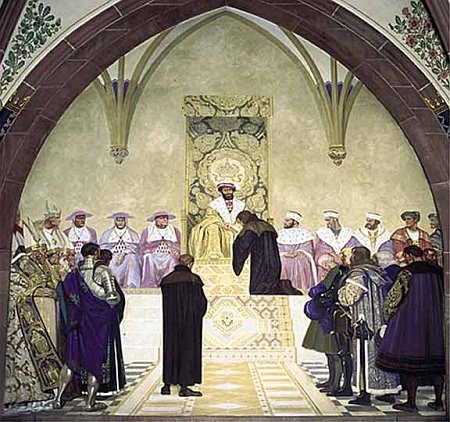 Note: Please see Ask the Pastor for more on the history and theology of the Augsburg Confession and its presentation.
The Augsburg Confession, the principal doctrinal statement of the theology of Martin Luther and the Lutheran reformers, was written largely by Philipp Melanchthon. At its heart it confesses the justification of sinners by grace alone, through faith alone, for the sake of Christ alone.
Signed by leaders of several German cities and regions, the confession was formally presented to the Holy Roman Emperor Charles V at Augsburg, Germany, on 25 June 1530. A few weeks later Roman Catholic authorities rejected the Confession, which Melanchthon defended in the Apology of the Augsburg Confession (1531). In 1580 the Unaltered Augsburg Confession was included in the Book of Concord.
An historical sidelight: Because of imperial protocol, Melanchthon wasn't allowed to make — or even attend — the presentation. Instead, two of the Saxon chancellors gave the oral reading and handed the written Latin and German copies to Charles V.
Lection
Psalm 46
Isaiah 55:6-11
Romans 10:5-17
John 15:1-11
Collects
O Lord God, heavenly Father, pour our Your Holy Spirit on Your faithful people, keep them steadfast in Your grace and truth, protect and comfort them in all temptation, defend them against all enemies of Your Word, and bestow on Christ's Church Militant Your saving peace; through Jesus Christ, Your Son, our Lord, who lives and reigns with You and the Holy Spirit, one God, now and forever.
Almighty God, we praise You for those You have sent to call the Church to its tasks and renew its life, including your servant Philipp Melanchthon. Raise up in our own day pastors, teachers, and theologians inspired by Your Spirit, whose voices will give strength to Your Church and proclaim Your kingdom; through Your Son, Jesus Christ our Lord.
Hymn
God's Word Is Our Great Heritage
God's Word is our great heritage
And shall be ours forever;
To spread its light from age to age
Shall be our chief endeavor.
Through life it guides our way,
In death it is our stay.
Lord, grant, while worlds endure,
We keep its teachings pure
Throughout all generations.
Notes on the Propers: The suggested readings come from the LCMS hymnal Lutheran Worship, as does the first collect. These propers may also used for the Commemoration of the Doctors of the Church, including Luther and C. F. W. Walther. The second collect is modified from James Kiefer's Hagiographies.
Labels: augsburg confession, book of concord, church history, commemoration, german history, lutheran confessions, lutheranism, martin luther, philipp melanchthon
¶ 00:00 | 0 comments |
 The man who later became known as Saint Boniface was born around AD 670-680 at Crediton, Devonshire, England and baptized Winfrid or Wynfrith. Although he was educated, he became a monk — at that time a calling often avoided by people of learning or means. While still in England, he was ordained as a presbyter and was inspired by the example of others to become a missionary.
Upon receiving a papal commission in 719 to work in Germany, Winfrid devoted himself to starting, organizing, and reforming churches and monasteries in Hesse, Thuringia, and Bavaria. After becoming an archbishop, Boniface was assigned to the See of Mainz in 743. Ten years later he resigned his position to engage in mission work in the Netherlands.
His time of activity overlapped the period in which Pippin the Younger and Charlemagne reigned and his work of converting the Saxons to Christianity was seen as a boon for expansion of Frankish rule. Yet Boniface never operated as a pawn of the kingdom of the left hand. Instead, he balanced alliances among the Carolingians, Bavarian rulers, and the papacy and often consecrated bishops who were already his followers in order to keep others from meddling in ecclesiastical affairs.
History isn't clear as to exactly when people began calling Winfrid "Boniface," Latin for "good deeds." However, his entire life gives ample testimony to events which would lead to this appellation.
Among his most famous exploits was the felling of Thor's Oak, an ancient tree believed sacred to the Nordic and Germanic god of thunder. Accounts from the period relate that when Thor (or Donar/Donner) didn't strike him dead with a lightning bolt, the locals agreed that the Christian God was supreme and agreed to be baptized. In a practical yet also symbolic gesture, Boniface used the wood of the fallen tree in the construction of a chapel in Fritzlar.
On June 5, 754, while awaiting a group of converts for confirmation, Boniface and his companions were murdered by a band of pagans in Friesland. The above picture is a commemorative statue in Dokkum, The Netherlands — a town near where he was martyred. Erected in 2004, it commemorated the 1250th anniversary of his death. Boniface is known as a great missionary and is sometimes called the "Apostle to the Germans." According to historian Christopher Dawson, no other Englishman had any greater influence upon Europe's history.
Suggested Lection
Psalm 115:1-8 or 31:1-5
Acts 20:17-28
Luke 24:44-53
Collect
Almighty God, who called Your faithful servant Boniface to be a witness and martyr in the lands of Germany and Friesland, and by his labor and suffering raised up a people for Your own possession, pour forth Your Holy Spirit upon your Church in every land, that by the service and sacrifice of many Your holy Name may be glorified and Your kingdom enlarged; through Jesus Christ our Lord, who lives and reigns with You and the Holy Spirit, one God, now and forever.
Labels: biography, boniface, charlemagne, commemoration, friesland, german history, hagiography, martyrdom, missionary, saxony, two kingdoms
¶ 00:00 | 0 comments |
 After Martin Chemnitz and Johann Gerhard, Johannes Andreas Quenstedt may have been the ablest theologian of the Lutheran church in the period following the death of Martin Luther. A shining light during the period of Lutheran orthodoxy, Quenstedt still offers much to the Church of our day.
Born on 13 August 1617 in Quedlinburg, Germany (modern Bundesland Saxony-Anhalt), Quenstedt was nephew to Johann Gerhard. His mother was the noted theologian's sister.
During his early school days, Quenstedt hoped to study under his uncle at the university at Jena. Unfortunately for young Johannes, Gerhard died before he could enroll at the university. Because of this, Quenstedt's mother changed plans and sent her son to Helmstedt. Many Lutherans had doubts about the overall orthodoxy of Helmstedt. However, its fifty mile distance from Quedlinburg allowed his mother to keep him closer to home.
Quenstedt spent six years in his university studies before moving on to Wittenberg in 1644 to continue his education. In spite of his new school's misgivings over his time at Helmstedt, Quenstedt excelled in Wittenberg. As various faculty members began to support and encourage him, he became ever more convinced of the correctness of Lutheran doctrine and gradually developed his own personal style of theological teaching.
As he delved into the Scriptures, the Confessions, and other Lutheran writings, Quenstedt publicly asserted the claims of Lutheran orthodoxy. Therefore, as he began his own career as author and lecturer, he was no mere parrot of his famous uncle. He set forth and defended his own convictions, firmly convinced that they rested on Biblical truth.
Quenstedt received an appointment from Wittenberg University as a lecturer in October 1644. At various times during his career he served as professor of theology, logic, and metaphysics. During his early years as lecturer, he continued his studies and received his Doctorate in Theology in 1650.
Despite the seeming ease with which Quenstedt's career progressed, much of his life was difficult. From childhood, he suffered ongoing illnesses and various physical ailments. Joined in marriage in 1651, he saw his wife die before their first wedding anniversary. He remarried in 1653 but his second wife died after only three years. Soon thereafter, Quenstedt married Anna Sabina Scharf. This 1556 union was long and successful, blessed by God with 12 children.
Friedrich August Tholuck referred to Quenstedt as the "bookkeeper and secretary" (Buchhalter und Schriftführer) of Lutheran orthodoxy. This verdict, however, disagrees with the facts and sells a great man short. Although he did much to catalog, organize, and disseminate that which came before him, he also expanded the scope of Lutheran teaching. Well-read and devout, he lived the life that his works espoused, ever displaying a keen intellect and deep understanding of Holy Scripture and Lutheran theology. For all his bold confession, Quenstedt was a quiet, pious, and somewhat private man.
Without question, Quenstedt's Theologia Didactico-Polemica Sive Systema Theologicum (Didactic-Polemic Theology or Systematic Theology) remains his great contribution to the Church. The Systema is no tidy compendium but a massive volume. When published, it would have cost most pastors several weeks' salary — if not more.
Despite the cost, the Systema underwent several printings, testifying to the book's value and the strong demand from clergy and university instructors. Unfortunately, most of the volume remains unavailable in English translation.
The Systema carefully outlines and expounds upon almost all debated and controverted doctrines from the period. Each section is divided into two portions, one didactic, the other polemic. Quenstedt's "polemic," however, differs from many others stemming from the period of Orthodoxy or elsewhere during Church history. Neither harsh or bombastic, his polemics thoughtfully and gently respond to contemporary critics of Lutheranism.
Since the attacks of earlier ages vary little from those of subsequent times, the Systema remains a valuable resource for present-day Lutherans beset by misguided assaults on our teachings and practices.
Suggested Lection
Psalm 46
Isaiah 55:6-11
Romans 10:5-17
John 15:1-11
Collect
O Lord God, heavenly Father, pour out Your Holy Spirit upon Your faithful people, keep them steadfast in Your grace and truth, protect and comfort them in all temptation, defend them against all enemies of Your Word, and bestow on Christ's Church Militant Your saving peace; through Jesus Christ, Your Son, our Lord, who lives and reigns with You and the Holy Spirit, one God, now and forever. Amen.
Lord, keep us steadfast in Your Word!
Sources
Studium (written by Caleb Bassett)
Christian Cyclopedia (Lueker, Poellot, Jackson, eds.)
Wikipedia
Labels: biography, church history, commemoration, european history, german history, hagiography, johann gerhard, lutheranism, martin chemnitz, martin luther, polemics, quenstedt, theology
¶ 00:00 | 0 comments |
 Frederick the Wise (Friedrich der Weise), elector of Saxony from 1486 to 1525, was Martin Luther's sovereign in the early years of the Reformation. Indeed, were it not for Frederick, there might not have been a Lutheran Reformation. Born in Torgau in 1463, he became so well known for his skill in political diplomacy and his sense of justice and fairness that he was called "the Wise" by his subjects.
Though he probably never met Luther face-to-face, Frederick repeatedly protected and provided for him. In all likelihood he saved the reformer from a martyr's fate. Even in earlier days, Frederick unknowingly contributed to the Reformation, for in 1512, Vicar-General Johannes von Staupitz of the Augustinian Order came to the Elector, asking him to subsidize the expenses of the promising but poor scholar-monk as a means of strengthening Frederick's prized university in Wittenberg.
While he never made public renunciation of Roman Catholicism, Frederick refused the pope's demand to extradite Luther to Rome for a heresy trial in 1518. When Emperor Charles V declared Luther an outlaw in 1521 at the Diet of Worms, Frederick provided sanctuary for Luther at the Wartburg castle.
 Finally, at the end of his life, the elector gave the clearest indication of his beliefs and sympathies. On his deathbed, Frederick received the Lord's Supper in both kinds — a clear confession of the Evangelical faith.
Frederick received great encouragement in his support of Luther and the Evangelical Reformation from his brother John, who wholeheartedly embraced the Reformation in its early years. Upon Frederick's death, Duke John became Elector of Saxony. John's nickname was "the Steadfast" — indicating how he continued his brother's protection and encouragement of the Reformation.
Frederick's life illustrates many of the rapid changes sweeping across Europe during the Renaissance and Reformation. He went from being a collector and venerator of relics — and a believer in meritorious human works — to one who trusted in God's salvation given by grace through faith in Christ.
Labels: biography, commemoration, frederick the wise, german history, hagiography, lutheranism, martin luther, reformation, saxony, staupitz, wittenberg
¶ 00:00 | 0 comments |
 Johann Walter (also Johannes Walther) was born in 1496 and began serving at the age of 21 as a composer and bass singer in the court chapel of Frederick the Wise. In 1524, he published a collection of hymns arranged according to the church year. It was well received and served as the model for numerous subsequent hymnals.
In addition to serving for 30 years as kantor (church musician and choir director) in the cities of Torgau and Dresden, he also assisted Martin Luther in the preparation of the Deutsche Messe of 1526, a setting of the Liturgy in the German language using hymn tunes.
Walter is remembered as the first Lutheran kantor and composer of church music. Among his most cherished works is Der Bräut'gam wird bald rufen (The Bridegroom Soon Will Call Us). Information on Walter, including some texts and music samples, may also be found through Hymnuts, Here of a Sunday Morning, and the Cyber Hymnal.
NB: Do not confuse this Johann Walter, whose output was largely hymns and other church music with the later Johann Jakob Walther (1650 - 1717), a Baroque composer best known for his violin works, or with Johann Gottfried Walther (1684 - 1748), also from the Baroque Period, who was a church organist and composer.
Labels: biography, commemoration, german history, hagiography, hymnody, johann walter, johannes walther, liturgics, lutheranism, martin luther, music, reformation
¶ 00:00 | 0 comments |
 Johannes Bugenhagen (1485-1558), was from Pomerania in northern Germany. Because of his ancestral region, he took the Latin name Pomeranus and Martin Luther often called him "Doctor Pommer."
He was appointed pastor of Wittenberg in 1523 through the efforts of Luther and thus served as the reformer's pastor and confessor. One of the greatest scholars of the Reformation era, he helped translate the New Testament into Low German and wrote a commentary on the Psalms. He also worked to organize the Lutheran Church in northern Germany and Denmark, journeying to Copenhagen where he crowned both King and Queen and consecrated seven men to the offices of superintendent and bishop.
For those who think that their pastors preach too long, you share that complaint with Luther, who described Pomeranus' preaching as "whatever comes to mind, much like a maidservant chatting with another at the market." One story says that Luther recommended Bugenhagen cut his sermons in half and preach no more than an hour, lest all minds wander.
More information is available through the Christian Cyclopedia and Wikipedia.
Lection
Psalm 46
Isaiah 55:6-11
Romans 10:5-17
John 15:1-11
Collect
O Lord God, heavenly Father, who called Johannes Bugenhagen as pastor and confessor of the Faith, grant us faithful pastors in our time; pour our Your Holy Spirit on Your faithful people, keep them steadfast in Your grace and truth, protect and comfort them in all temptation, defend them against all enemies of Your Word, and bestow on Christ's Church Militant Your saving peace; through Jesus Christ, Your Son, our Lord, who lives and reigns with You and the Holy Spirit, one God, now and forever.
Labels: biography, commemoration, danish history, german history, hagiography, johannes bugenhagen, lutheranism, martin luther, reformation, translation
¶ 00:00 | 0 comments |
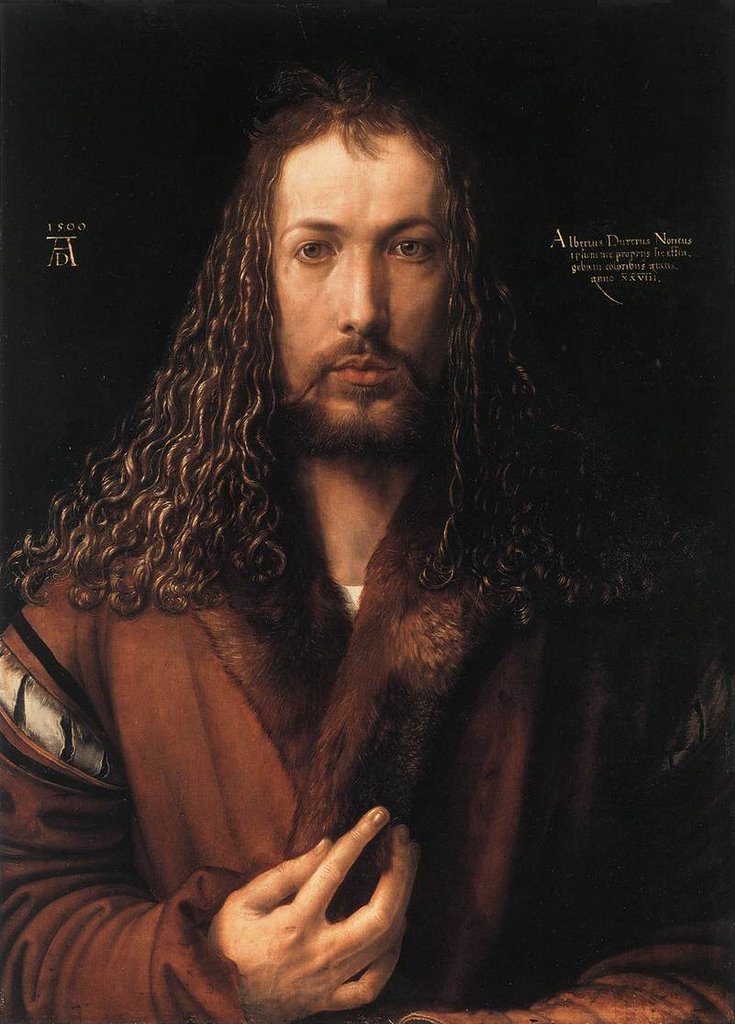 Albrecht Dürer (1471-1528), a native of Nuernberg, Germany, was one of the most learned of Renaissance artists and ranked among the great minds of Humanism. His paintings and woodcuts include examples of the splendor of creation and skilled portrayals of biblical narratives.
While great beauty and form characterize his paintings, most know him best for his woodcuts and etchings, often produced in extended series format. The Concordia Historical Institute displayed two of these series in one show: His "Life of Mary" and "Small Passion" were shown in an exhibit entitled A Sword Will Pierce Your Own Soul Too. CHI made digital copies of the individual works and they may be viewed by following the link.
Dürer never renounced Roman Catholicism, although his later writings and paintings show great sympathy toward the Reformation and ardent admiration for Martin Luther.
16 October AD 1553
 Lucas Cranach (1472-1553), a close friend of Martin Luther, was a celebrated painter of portraits and altar pieces and a producer of woodcuts of religious subjects.
Among his portraits are some of the most noted depictions of Martin and Katy Luther and Luther's co-worker Philipp Melanchthon. He also did a number of works from Greco-Roman mythology, Biblical and hagiographic scenes, and portrayed a number of wealthy people from his time.
Among his most noted works is the altarpiece from Weimar, often thought to have been completed by his son, Lucas Cranach the Younger. The painting depicts Old and New Testament themes centering on Law and Gospel and on the crucifixion and resurrection of Christ. Cranach's intentional anachronism of including himself, Martin Luther, and John the Baptizer at the foot of the cross shows how the Church always points to Christ and benefits from His suffering and death.
Some later scholars have tried to depict Cranach as a misogynist. However, examination of his writings and the content of his paintings allows little credence for this theory.
Both Cranach and Dürer are remembered and honored for the grandeur of their works of art that depict the glory and majesty and the grace and mercy of the triune God. Along with these two Germans, I've also included their approximate contemporary from Italy, Michelangelo Buonarroti. He also used his talents to illustrate Scripture's story and God's glory.
18 February AD 1564
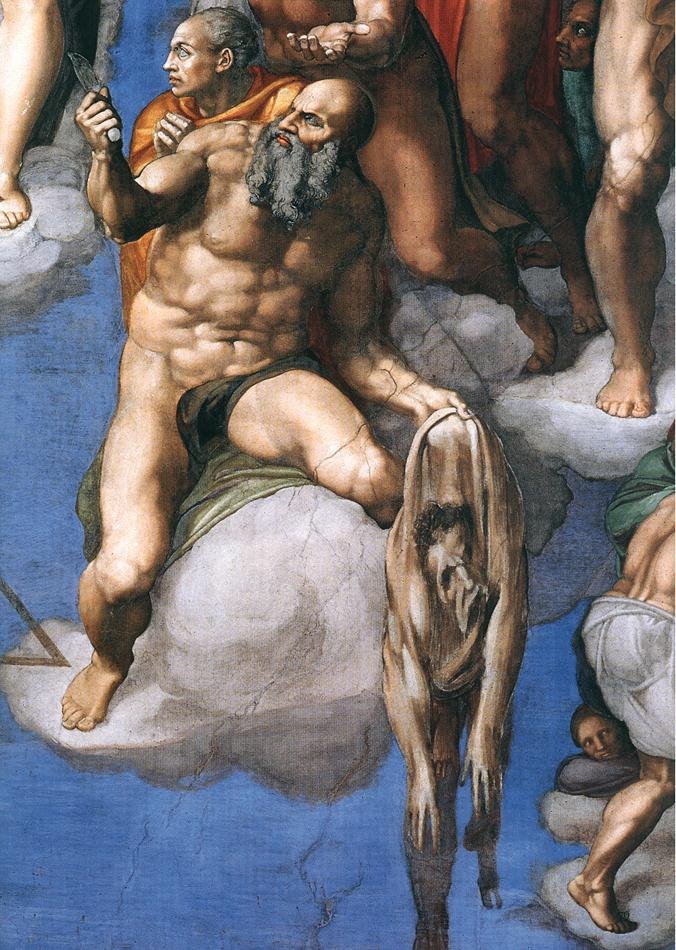 During roughly the same time that Cranach and Dürer worked in Germany, Florentine artist Michelangelo Buonarroti (1475-1564) was busy in Italy. By age 21, he'd already carved his famous Pietà, a scene of the Virgin holding her dead Son before His burial. Most will probably know him from his statue of David and his work in the Sistine Chapel.
The picture here is from his "Last Judgment" fresco; the person portrayed is Saint Bartholomew, holding the knife said to have flayed him in one hand and his peeled skin in the other. I include it because the face of the restored saint is a self-portrait by Michelangelo. Many have speculated as to why he chose this particular person to bear his image. Some think he used it to indict those who criticized him, as if to say, "You can cut away at me now, but I will be vindicated." Others believe that he wrestled throughout his life with temptation and sinful behavior but recognized that in the Resurrection he would be remade.
Collect
O God, who by your Holy Spirit give to some the word of wisdom, to others the word of knowledge, and to others the word of faith, we praise You for the gifts of proclaiming Your grace and glory through visual representation that you gave to your servants Albrecht and Lucas [and Michelangelo], and we pray that Your Church may never be destitute of such gifts; through Jesus Christ our Lord, who lives and reigns with You and the Holy Spirit, one God, now and forever.
Labels: art, biography, church history, commemoration, cranach, duerer, durer, dürer, european history, german history, hagiography, italian history, michelangelo, vocation
¶ 00:00 | 0 comments |
 John Frederick (Johann Friedrich), eldest son of John the Steadfast and nephew of Frederick the Wise of Saxony, was born in Torgau on 30 June 1503. He earned the appellation "John the Magnanimous" (der Grossmütige) because of his generous spirit and gracious bearing during trials.
John Frederick studied under George Spalatin and through him became an early supporter of Martin Luther. In 1530, he traveled to the Diet of Augsburg and joined his father in signing the Augsburg Confession. In 1532, he and his half-brother John Ernest (Johann Ernst) succeeded John the Steadfast He became sole Elector of Ernestine Saxony 1542, ruling until 1547.
Impulsive by nature, he lacked the foresight and forbearance of many politicians and he often ignored the wise counsel of Chancellor Brück, who had also worked under his father. Because of his staunch Lutheranism, he couldn't abide Philip of Hesse's desire to extend the Schmalkaldic League to include Swiss and Strasburg reformers. His personal piety also recoiled at Philip's bigamy and he insisted that the League retain a strict Evangelical (Lutheran) theology.
John Frederick set aside the 1541 election of Julius von Pflug to the see of Naumburg-Zeitz, promoting avowed Lutheran Nicholas von Amsdorf in his stead. In 1542, he unilaterally attempted to introduce the Reformation to the city of Wurzen, a city under the joint protection of Electoral and Ducal Saxony. This antagonized Maurice, Duke of Saxony. Only the efforts of Luther and Philip of Hesse were able to avert war between the two Saxonies.
His suspicious nature led him to doubt the efficacy of councils and colloquies and he neglected to attend diets and other meetings where he might have gained support and built alliances.
As Charles V prepared his attack on the Schmalkaldic League, John Frederick was misled and reacted slowly to the Emperor's threat. When the Schmalkaldic War broke out in July 1546, he took his army from Saxony to engage the imperial forces but returned when Maurice, who had joined with Charles V, invaded Electoral Saxony. He was able to repel Maurice and retake most of his lost lands but then suffered defeat at the hands of imperial forces at Mühlberg on 24 April 1547.
Charles V initially condemned him to death for his part in the rebellion against the Holy Roman Empire. However, the sentence was commuted to life in prison when Wittenberg surrendered. Maurice released him in 1552 after he defeated and drove off Charles V. However, his title remained in Maurice's hands.
To the end, John Frederick refused under any circumstances to renounce or compromise his Evangelical understanding of Scripture and his complete adherence to Lutheran doctrine.
Labels: biography, commemoration, elector john, frederick the wise, german history, hagiography, john frederick, lutheranism, martin luther, reformation
¶ 00:00 | 0 comments |
 Martin Luther, born on 10 November 1483, in Eisleben, Germany, initially began studies leading toward a degree in law. However, after a close encounter with death, he switched to the study of theology, entered an Augustinian monastery, was ordained a priest in 1505, and received a doctorate in theology in 1512.
As a professor at the newly-established University of Wittenberg, his Scriptural studies led him to question many of the church's teachings and practices, especially the selling of indulgences. His refusal to back down from his convictions resulted in his excommunication in 1521. Following a period of seclusion at the Wartburg castle, Luther returned to Wittenberg, where he spent the rest of his life preaching and teaching, translating the Scriptures, and writing hymns and numerous theological treatises.
Of course, Luther didn't work alone. First of all, he knew that the Holy Spirit, working through the Word, was principal actor in the Reformation, and said, "While I slept, or drank Wittenberg beer with my friends ... the Word so greatly weakened the papacy that no prince or emperor ever inflicted such losses upon it. I did nothing; the Word did everything." However, his "friends," including Philipp Melanchthon, Nicholas Amsdorf, Johannes Bugenhagen, and others contributed mightily to the cause. Meanwhile, his prince, Frederick III of Saxony, defended him. Finally, he probably received no earthly support greater than that of his beloved wife Katie.
We remember and honor his lifelong emphasis on the Biblical truth that for Christ's sake God declares us righteous by grace through faith alone. He died on 18 February 1546, while visiting the town of his birth.
Please visit Xrysostom for The Life of Martin Luther: A Chronology. A number of recommended books and web sites are included along with this biographical outline.
Lection
Psalm 46
Isaiah 55:6-11
Romans 10:5-17
John 15:1-11
Collect
O Lord God, heavenly Father, pour our Your Holy Spirit on Your faithful people, keep them steadfast in Your grace and truth, protect and comfort them in all temptation, defend them against all enemies of Your Word, and bestow on Christ's Church Militant Your saving peace; through Jesus Christ, Your Son, our Lord, who lives and reigns with You and the Holy Spirit, one God, now and forever.
Tags: Martin Luther | Doctor Martin Luther | Dr. Martin Luther | Lutheran | Lutheranism | Christianity | Christian | Reformation | Lutheran Reformation | Book of Concord | Lutheran Confessions | Small Catechism | Large Catechism | Smalcald Articles | hagiography | biography | Church history | historical theology | exegetical theology | Bible translation | practical theology | hymn writing | liturgics | German history | European history| Aardvark Alley
Labels: biography, bugenhagen, commemoration, frederick the wise, german history, hagiography, hymnody, katharina luther, lutheran confessions, lutheranism, martin luther, philipp melanchthon, reformation, theology
¶ 00:00 | 0 comments |
 Philipp Melanchthon, a brilliant student of the classics and a humanist scholar, was appointed to teach along with Martin Luther at the University of Wittenberg in 1518. At Luther's urging, Melanchthon began teaching theology and Scripture in addition to his courses in classical studies.
In April of 1530, Emperor Charles V called an official meeting between the representative of Lutheranism and Roman Catholicism, hoping to effect a meeting of minds between two opposing groups. Since Luther was at that time under papal excommunication and an imperial ban, Melanchthon was assigned the duty of being the chief Lutheran representative at this meeting. Thus, he made the primary verbal and written defenses of the Evangelical (Lutheran) position.
We especially remember and honor him as the author of the Augsburg Confession, which was officially presented by the German princes to the emperor on 25 June 1530, as the defining document of Lutheranism within Christendom. Following the Roman Catholic response, Melanchthon wrote the Apology (Defense) of the Augsburg Confession.
Unfortunately, Melanchthon's desires for peace within Christendom led him to later rewrite and weaken some of the Augsburg Confession's language. The resulting Variata were palatable to some who disagreed with certain Lutheran teachings and allowed for false teaching to infiltrate Lutheranism. Ask the Pastor details some of this in a post on the Unaltered Augsburg Confession.
Lection
Psalm 46
Isaiah 55:6-11
Romans 10:5-17
John 15:1-11
Collect
O Lord God, heavenly Father, pour our Your Holy Spirit on Your faithful people, keep them steadfast in Your grace and truth, protect and comfort them in all temptation, defend them against all enemies of Your Word, and bestow on Christ's Church Militant Your saving peace; through Jesus Christ, Your Son, our Lord, who lives and reigns with You and the Holy Spirit, one God, now and forever.
Note: We commemorate Philipp Melanchthon's birth date because his death date often conflicts with Holy Week or Easter observances.
Labels: augsburg confession, biography, book of concord, commemoration, german history, hagiography, lutheran confessions, martin luther, philipp melanchthon, reformation, variata
¶ 00:00 | 0 comments |
 Born 25 March 1528 to blacksmith Jakob Endriß and his wife Anna (née Weißkopf) in Waiblingen in the dukedom of Württemberg, Jakob Andreae (also Andreæ or Andreä) came from a family seemingly too poor to support any higher education. However, it was his good fortune to come of age at a time when Duke Ulrich began Evangelical reform in the duchy. Württemberg's mayor, aware of the young man's potential, procured for him a ducal scholarship.
In 1539 Andreae attended a preparatory school in Stuttgart, and two years later he entered the University of Tübingen — at the tender age of thirteen years. In 1545 he began his study of theology under the Tübingen faculty. He stayed only briefly. Württemberg was critically short of pastors and he was placed in the parish after one year of study. His enemies found ample ammunition for their opposition of him due in part to his arrested academic career.
The religious sea change that Martin Luther began with the German Reformation had spread through Europe. In many parts of the continent, the changes went much deeper than did those of the Lutherans. New ways of thinking and of doing theology led to new sects and confessions within Christendom. With all the change around them, some Lutherans began following other ways of thinking, although many remained orthodox followers of Luther.
The signing of the Augsburg Confession in 1530 appeared to signal full doctrinal consent among the Lutherans but agreement was brief. The interpretation of the Scriptures and the roles of the Augsburg Confession, its Apology, the Smalcald Articles, and the Catechisms became controverted. While Philipp Melanchthon and others were already altering the Confessions to suit their shifting interpretations of Scripture, Luther's death in 1546 hastened Lutheran disunity. Into the turmoil of the middle and latter Sixteenth Century stepped Jakob Andreae.
 Andreae began this time in theology's public sphere with the intention of conciliation among Protestant Christianity. Yet even at his most irenic, Andreae never forsook fidelity to orthodox Lutheranism. Convinced that it was God's will that the Church would be one (cf. John 17:11-12, 20-23), he sought to reach out to those outside the Lutheran party while also challenging errorists within. The hardliners among the Gnesio-Lutherans unswervingly believed that anyone teaching falsely deserved immediate and absolute condemnation.
This caught Andreae in a bind: He could continue his gentle methods in dealing with errorists, including John Calvin and invite the wrath of the staunchest Lutherans or he could be more forceful with the false teachers and alienate them completely from Luther's heirs.
The actions of others finally led him to give up hope of full unity. A 1570 meeting of theologians in Zerbst in agreed to espouse unity based upon the Augsburg Confession, the Apology, the Smalcald Articles, and the Catechisms. Initially elated with the agreement, Andreae soon saw the Wittenberg theologians qualifying their confessional subscription according to Melanchthon's revisions. This was followed by a series of Crypto-Calvinist reinterpretations of the Lutheran Confessions and led Andreae to realize that it would be impossible to build and maintain a truly Lutheran Electoral Saxony with such errorists in place.
With the entire spectrum of Germanic Protestantism calling upon the Augsburg Confession to support wildly contradictory theological positions, Andreae began arguing for a new confession around which true Lutherans could gather and which could be used to screen and reject errorists. Need for such a confession became even more apparent after Andreae visited Wittenberg and discovered for himself the depth of their Christological differences and found that on their home turf, these theologians had no interest in the unity he desired.
Finding himself stymied by these least Lutheran Protestants, Andreae turned his attention to those who still wanted to fully follow the reforms and the theology of Luther. He finally took of the gloves and started forceful condemnation of the Philippists and Crypto-Calvinists through the series Six Christian Sermons. Martin Chemnitz, David Chytraeus, and others read the copies sent them by Andreae, which asked that the sermons be used as the basis of the new confession. While they agreed with Andreae's theology, they didn't think that sermons were the proper means of making a confessional statement. They asked instead for a thesis-antithesis form.
 Andreae responded by writing the Swabian Concord, built on the foundation of his Six Sermons. The finished document became the first draft of the Formula of Concord. After Chemnitz and Chytraeus read the document, they worked it into a revision known as the Swabian-Saxon Concord. Into this was assimilated Württemberg's Maulbronn Formula. Next came the Torgic Book, followed by the Bergic Book, developed in the years 1576-1577. The Bergic Book became the Solid Declaration of the Formula of Concord.
The Formula was included in the Book of Concord, which was published on 25 June 1580, the fiftieth anniversary of the presentation of the Augsburg Confession. Included with the Solid Declaration was the Formula's Epitome, the Augsburg Confession, the Apology, the Smalcald Articles, the Treatise on the Power and Primacy of the Pope, Luther's Catechisms, and the three Ecumenical Creeds. Finally, German Lutheranism had the theological consensus which Andreae had so long desired.
Andreae's efforts for church unity based on doctrinal agreement didn't end with the Formula of Concord. In his later years, he continued to espouse pure Lutheran theology and to oppose all who denied or compromised it. This included his 1586 debate on the ubiquity of Christ with Calvinist theologian Theodore de Beza in Mömpelgard, Württemberg (now Montbéliard, France).
In addition to his tireless work on behalf of Lutheran unity, Jakob Andreae also found time for a large family. He married Anna Entringer in Tübingen in June 1546. She bore him twenty children between 1547 and 1579. Of these, eleven reached adulthood. Anna died in 1583. In 1585, he married Regensburg widow Regina Reitter, nee Schachner. Andreae died on 7 January 1590, followed 2 ½ years later by Regina.
Labels: book of concord, david chytraeus, formula of concord, german history, jakob andreae, lutheran confessions, lutheranism, martin chemnitz, melanchthon, reformation, theology
¶ 00:00 | 0 comments |
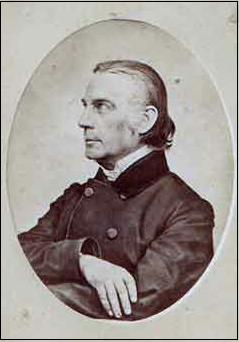 Christened Johann Konrad Wilhelm Löhe, he established a reputation already as a young pastor for being "too" theologically conservative and "too" politically progressive. This led to his being moved to at least twelve positions until he received his own parish in Neuendettelsau, Bavaria in 1837. Beginning his career with difficulty, he accomplished much from such a small place. Even though he had aspirations of a more prominent position in a major city, church and government officials never allowed that to pass.
The Catholic king of Bavaria was de facto leader of the Lutheran Church. His main desire was to keep the churches from becoming places of political unrest. Thus arose strict restrictions, such as an assembly of more than five people needing a police permit. He prohibited mission circles and other "subversive enterprises," thus relegating church activities to not much more than Sunday services only.
In 1840, Loehe read a newspaper account from America by Pastor Friedrich Wyneken. It told of German emigrants not having church or pastoral care — nobody could baptize their children, teach, visit the sick, or bury the dead. Pastor Loehe felt compelled to aid the German Lutherans in America and published an article in a church periodical asking for help. Beginning in the spring of 1841, several young men responded to Loehe's letter, expressing the desire help the settlers with their own skills and occupations. In the summer of 1842 he sent them to America at his own expense. He called them Nothelfer ("helpers in need") or "auxiliary saints", and trained them to be "emergency pastors."

After only six years of marriage, Loehe's wife died, leaving him to raise their four children alone. Even among such hardships, his dreams remained clear and his desire to serve the Lord strong. Indeed, recent years have brought recognition for his farsightedness. This contrasts sharply with the handed-down opinions of many contemporaries who, while recognizing him as a founder of social institutions and mission education in Neuendettelsau, regarded him as divisive, narrow-minded, or combative. Changes in attitude began taking place especially after 1985, when several thousand of his letters were published, many previously unknown to scholars in Germany.
Seeking to support and strengthen missions and pastoral ministry in the United States, Loehe established a large parish cooperative throughout Germany. As support grew, he could publish his 1845 "Letter from the Home Country to the German Lutheran Emigrants" which 946 people, including 350 theologians, signed.
With the home churches finally behind him, he could at last send pastors! Loehe saw to the training of twenty-two pastors for work in America. Due in large part to his direct influence a seminary was established in Fort Wayne, Indiana in 1846 as well as a teachers' institute in Saginaw, Michigan. Some of the men he sent to the U.S. helped to establish The Lutheran Church — Missouri Synod. Today, two LCMS seminaries, Concordia Theological Seminary, Fort Wayne, Indiana, and Concordia Seminary, St. Louis, Missouri continue equipping and forming men to send out into the Savior's harvest fields.
Besides his interest in the United States, Loehe also assisted in training and sending pastors to care for emigrants in Brazil and Australia, both of which still have relatively small but vital Lutheran populations. He will continue to be remembered for his confessional integrity and his interest in liturgy and catechetics. He also never forgot the physical needs of those less fortunate and his works of Christian charity include the establishment of a deaconess training house, homes for the aged, an asylum for the mentally ill, and other caring institutions.
Please see Loehe etexts translated through Project Wittenberg for his Sonntagsblatt Appeal, his 1842 Instructions of Adam Ernst and Georg Burger, a letter from C.F.W. Walther to Loehe About the Fort Wayne Seminary, and Loehe's Report of Walther's and Wyneken's Visit.
Suggested Lection
Psalm 46
Isaiah 55:6-11
Romans 10:5-17
John 15:1-11
Collect
O Lord God, heavenly Father, we pray that, as You led Wilhelm Loehe to establish and support Lutheran missions and ministry in the New World, so You would continue to raise up faithful Lutheran pastors and missionaries that the Gospel might be proclaimed in its truth and purity, the Sacraments rightly administered, believers ministered to, and unbelievers converted by Your saving Word and the power of the Holy Spirit, who lives and reigns with You and Your Son Jesus Christ, one God, now and forever.
Labels: american history, biography, commemoration, german history, hagiography, immigration, lcms, loehe, lutheranism, missouri synod, walther, wyneken
¶ 00:00 | 0 comments |
 The early Church entrusted some women, particularly widows, with helping to carry out the "social work" of the Church, particularly caring for the sick and needy of the congregation. From reading 1 Timothy 5:1-16, it appears that certain of these women were specially consecrated and made a lifetime commitment to works of mercy. The idea of a female deaconate or service order largely died out by the 7th Century AD, although some groups of nuns and a few informally organized groups undertook similar work.
The modern deaconess movement came mainly through the work of Theodor Fliedner, a German Lutheran. Born in Eppstein, Germany, in 1800, he became pastor of a small parish in Kaiserswerth in 1821 or 1822. Fliedner took the work of England's Elizabeth Fry and Dutch Mennonites as inspiration. Encountering Moravian deaconesses, he also drew from their example.
He began serving the Düsseldorf Prison, walking to and from Düsseldorf on alternating Sundays until the appointment of a regular prison chaplain. This led to more prisons engaging chaplains and establishing regular worship and aid services for the prisoners. He envisioned and opened a nursery school; eventually it became a sort of teachers' college and a starting point for what would become his first deaconess school.
 Becoming more involved in Christian social work among the disadvantaged, Fliedner convinced himself that he should revive the order of deaconesses. He opened a hospital and deaconess training center in Kaiserswerth on 13 October 1836. Florence Nightingale heard of his reputation, visited the school in the 1840s, came back to study nursing, and graduated in 1851.
The program was so successful that he could send deaconesses to other hospitals by 1838. New deaconess motherhouses grew up in Pittsburgh, Pennsylvania and in Jerusalem, Paris, Berlin, and Strasbourg, and elsewhere. When he died, 30 motherhouses already stood and over 1500 deaconesses served around the world. The middle of the 20th century saw more than 35,000 deaconesses serving world-wide.
Lutherans in the United States may also want to remember William Passavant, who pioneered the American deaconess movement in 1849. He also founded missions, hospitals, orphanages, and schools. Passavant died 3 January 1894.
Additional information available from Wikipedia and James Kiefer.
Labels: american history, biography, christianity, church history, commemoration, deaconess, german history, hagiography, lutheranism, theodor fliedner, william passavant
¶ 00:00 | 0 comments |
 Also known as Saint Elizabeth of Thuringia — Szent Erzsébet in her native tongue — Elisabeth was born in Sárospatak in 1207, the daughter of King András II and his wife Gertrude of Merania. When only four years old, she was betrothed by parental arrangement to Ludwig (Louis), son of Hermann I, Landgrave of Thuringia, and Duchess Sophia. At this tender age, the child moved to the Thuringian court. She married him in 1220, when just fourteen. He was only twenty and had been ruling as Ludwig IV since 1217.
Her spirit of Christian generosity and charity pervaded the home she established for her husband and three children in the Wartburg Castle at Eisenach. Their abode was known for hospitality and family love.
Elisabeth often supervised the care of the sick and needy, even giving up her bed to a leper at one time. Unlike many medieval men, particularly the rulers, Louis encouraged her efforts and contributed directly to them. This seems due, in large part, to a faith that depended much upon works in order to guarantee eternal reward — or, at least, to avoid Purgatory.
When she was widowed at 20, circumstances drastically changed. Already possessed of a charitable heart, Elisabeth increased her work on behalf of others — her confessor, the inquisitor Konrad von Marburg, encouraging (or pushing) her growing spiritual discipline. Some accounts say that Konrad not only enforced his will through a strong personality but that he also resorted to beatings and separating her from her children.
 Later, she arranged for her children's well-being and entered into life as a nun in the Order of Saint Francis. Her self-denial, quite possibly abetted by harsh treatment at the hands of her confessor, led to failing health and an early death in 1231 at age 24. Remembered for her self-sacrificing ways, Elisabeth is commemorated through the many hospitals named for her around the world.
She was laid to rest in a gold shrine in Elisabeth Kirche in Marburg. The second illustration above is a scene of her helping the poor from that church's Elizabeth Window. Her popular cultus, aided in large part by political considerations, led to a rapid canonization. In 1235, Pope Gregory IX named her St. Elisabeth. Her official canonization ceremony was Pentecost (28 May), only about three and a half years after her death. The lasting effect she had on individuals, the Church, and on health care has led many to call her "the greatest woman of the German Middle Ages." In honor of Elisabeth and her contributions to Church and society, the city of Erfurt chose her as its 2007 "cultural theme."
Note: For Lutherans, Wartburg Castle holds special significance because of events happening some three hundred years later. It was to the Wartburg that friends moved Martin Luther in 1521 to escape enforcement of the imperial ban and possible death. Hiding under the name Junker Jörg (Knight George), Luther employed himself by continuing his doctrinal and polemical writing and translating the New Testament.
Lection
Psalm 146:4-9 or 112:1-9
Tobit 12:6b-9
Matthew 25:31-40 or Luke 12:32-34
Collect
Almighty God, by whose grace your servant Elisabeth of Thuringia recognized and honored Jesus in the poor of this world, grant that we, following her example, may with love and gladness serve those in any need or trouble, in the name and for the sake of through Jesus Christ our Lord, who lives and reigns with you and the Holy Spirit, one God, now and forever.
Labels: biography, charity, church history, commemoration, elisabeth, elizabeth, erzsébet, european history, german history, hagiography, health, hungary, thuringia
¶ 00:00 | 0 comments |


