
 Johann Sebastian Bach (1685-1750) is acknowledged as one of the most famous and gifted of all composers past and present in the entire western world. Orphaned at the age of ten, Bach studied with various family members but was mostly self-taught in music.
He began his professional career as conductor, performer, composer, teacher, and organ consultant at age 19 in the town of Arnstadt. He traveled wherever he received good commissions and steady employment, ending up in Leipzig, where the last 27 years of his life found him responsible for all the music in the city's four Lutheran churches.
 Acclaimed more in his own time as a superb keyboard artist, the majority of his compositions fell into disuse following his death, which musicologists use to date the end of the Baroque Period and the beginning of the Classical Era. However, his compositional ability was rediscovered, in large part due to the efforts of Felix Mendelssohn.
The genius and sheer magnitude of Bach's vocal and instrumental compositions remain overwhelming. Also, whether due to nature or nurture, he was but one of the giants in, perhaps, the most talented musical family of all time.
Christendom especially honors J. S. Bach, a staunch and devoted Lutheran, for his lifelong insistence that his music was written primarily for the liturgical life of the Church, glorifying God and edifying His people. For an overview of the Christological basis of his work and a strong argument that he was among the theological giants of Lutheranism, please read J. S. Bach: Orthodox Lutheran Theologian?.
Today we remember his "heavenly birthday," for it was on 28 July AD 1750 that the Lord translated Mr. Bach to glory.
Soli deo gloria — To God alone the glory! These words appear on most manuscripts of Bach's compositions as testimony to his faith and his idea of music's highest, noblest use.
Labels: bach, biography, christianity, church history, commemorations, german history, hagiography, liturgics, lutheranism, music
¶ 00:00 | 0 comments |

Born in Flavia Neapolis, Palestine around AD 100, near the close of the New Testament period, Justin was the son of pagan Greek parents. He was a philosophy student who studied in Alexandria, moving from Stoicism to Pythagoreanism and then Platonism as he sought to make sense of life. He converted to the Christian faith and became a teacher in Ephesus and Rome. Justin wrote that his conversion came as he observed the steadfast faith of Ephesian martyrs and through an elderly Christian whom he met along the shore of the sea.
 Justin probably wrote much more than we have preserved, but three extant works show his intellect, his never completely abandoned Platonic philosophical education, and his inclination toward apologetics — that is, an intellectual defense of the Faith.
In his First Apology, addressed to Emperor Antoninus Pius and his adopted sons, Justin defended Christianity as the only rational creed. He included accounts of contemporary baptismal and communion rites, quite possibly designed to rebut distorted accounts from anti-Christian sources. Some of these anti-Christian writings claimed that Christians were cannibals (probably because of a distorted second hand understanding of the Lord's Supper).
He addressed his Second Apology to the Roman Senate. It counters spurious charges of immorality and the like that were being made against Christians. He said that only those who misunderstood the Faith would accuse it of undermining Roman society and countered that Christians made good citizens.
His Dialogue with Trypho the Jewish rabbi shows him at his strength. He carefully defended Christian teaching while allowing that the Church would continue to welcome Jews and would let them remain faithful to the laws of the Torah. While he may have edited it to provide himself with a few good lines, the text reads as a faithful exposition of an actual conversation.
Justin was living in Rome when the cynic philosopher Crescens stirred up trouble for the Christians. After refusing to make pagan sacrifices, Justin was arrested, tried and executed, along with six other believers, including Charites, Paeon, and Liberianus. The official Roman court proceedings of his trial before Rusticius, a Roman prelate, document his confession of faith. The account of his martyrdom became a source of great encouragement to the early Christian community.
Much of what we know of early liturgical practice comes from Justin. For example, in the First Apology he gave this brief description of Holy Communion: "On finishing the prayers we greet each other with a kiss. Then bread and a cup of water mixed with wine are brought to the leader and he, taking them, sends up praise and glory to the Father of the Universe through the name of the Son and of the Holy Spirit, and offers thanksgiving at some length that we have been deemed worthy to receive these things. When the leader has finished the prayers and thanksgivings, the whole congregation assents, saying, 'Amen.' ('Amen' is Hebrew for 'So be it.') Then those whom we call deacons give to each of those present a portion of the consecrated bread and wine and water, and they take it to the absent."
Suggested Lection
Psalm 16:5-11 or 116:1-8
1 Corinthians 1:18-25
John 12:44-50
Collect
Almighty and everlasting God, who found Your martyr Justin wandering from teacher to teacher, seeking the true God, and revealed to him the sublime wisdom of Your eternal Word, grant that all who seek You, or a deeper knowledge of You, may find and be found by You; through Jesus Christ our Lord, who lives and reigns with you and the Holy Spirit, one God, now and forever.
Labels: apologetics, biography, church history, dialogue, hagiography, justin, liturgics, martyr, martyrdom, patristics, philosophy, platonism, trypho
¶ 00:00 | 0 comments |
 Johann Walter (also Johannes Walther) was born in 1496 and began serving at the age of 21 as a composer and bass singer in the court chapel of Frederick the Wise. In 1524, he published a collection of hymns arranged according to the church year. It was well received and served as the model for numerous subsequent hymnals.
In addition to serving for 30 years as kantor (church musician and choir director) in the cities of Torgau and Dresden, he also assisted Martin Luther in the preparation of the Deutsche Messe of 1526, a setting of the Liturgy in the German language using hymn tunes.
Walter is remembered as the first Lutheran kantor and composer of church music. Among his most cherished works is Der Bräut'gam wird bald rufen (The Bridegroom Soon Will Call Us). Information on Walter, including some texts and music samples, may also be found through Hymnuts, Here of a Sunday Morning, and the Cyber Hymnal.
NB: Do not confuse this Johann Walter, whose output was largely hymns and other church music with the later Johann Jakob Walther (1650 - 1717), a Baroque composer best known for his violin works, or with Johann Gottfried Walther (1684 - 1748), also from the Baroque Period, who was a church organist and composer.
Labels: biography, commemoration, german history, hagiography, hymnody, johann walter, johannes walther, liturgics, lutheranism, martin luther, music, reformation
¶ 00:00 | 0 comments |
 Lutheran musician, composer, and musicologist Michael Praetorius (Prätorius) was born in Kreuzburg, Thuringia to Pastor and Mrs. Michael Schultheis (or Schultze), on 15 February 1571. Praetorius was a Latinization of the family name and Michael later favored the monogram MPC (Michael Praetorius Creutzbergensis). While still a boy, he began studying philosophy at the University of Frankfurt, where his brother Andreas was a professor.
Praetorius became organist at Frankfurt and later held the same post at Lüneburg. In this latter town he began his career as Kapellmeister. While only 18, he began serving Herzog Heinrich Julius of Braunschweig-Wolfenbüttel as a minor member of his court. In 1604, Praetorius became the prince's Kapellmeister and organist. He was also appointed honorary prior of the Ringelheim Monastery near Goslar but wasn't required to stay there. He died at Wolfenbüttel on 15 February 1621.
Praetorius was, by all accounts, an accomplished musician and certainly a prolific composer. He also involved himself in the study of musical art and practice. His major work in this field was The Syntagma musicum, "not a piece of music but a scholarly historico-theoretical masterpiece." Of this, he completed three volumes. The second volume of this work is the most elaborate and valuable treatise on instruments and instrumental music from the 16th Century and is considered one of the most remarkable examples of musical scholarship in existence. The planned but uncompleted fourth volume was to have involved counterpoint and we can only wonder how much of the history of that topic we lost with his death at age fifty.
 Among his other titles were Musae Sioniae, a compendium of over 1200 chorale and song arrangements published in nine parts, and Hymnodia Sionae. The 1612 Terpsichore, his sole surviving secular work, is a collection of more than 300 instrumental dances.
His harmonization of Es ist ein Ros entsprungen (Lo, How a Rose E'er Blooming) remains popular. He also arranged and composed the beautiful Mass for Christmas Morning.
His compositions and arrangements generally show a strong Christian faith filtered through his passionate Lutheran understanding of Scripture, grace, and faith. He helped move music from the late Renaissance into the early Baroque and forms the first half of a pair of Lutheran bookends to that period, the latter being J. S. Bach.
I chose to transfer his commemoration to this date since his birth and death both fell on 15 February, when the LCMS commemorates Philemon and Onesimus. The days adjacent are already reserved for Saint Valentine (the 14th) and Philipp Melanchthon (the 16th).
Labels: bach, baroque period, biography, commemoration, hagiography, hymnody, liturgics, lutheranism, music, praetorius, renaissance
¶ 00:24 | 0 comments |
Saint John Chrysostom, Preacher, Bishop, and Theologian, was called Chrysostom (Greek for"golden-mouthed") by his hearers. He was a dominant force in the fourth-century Christian church.
 Born in Antioch around AD 347, John was instructed in the Faith by his pious mother, Anthusa. After serving in a number of Christian offices, including acolyte and lector, John was ordained a presbyter and given preaching responsibilities.
His simple but direct messages found an audience well beyond his home town. His title came from his legendary preaching abilities. An unsubstantiated but widely circulated tale is that pickpockets and cutpurses would flock to services because he held his audience so spellbound that they could easily rob Saint John's hearers.
In 398, John was made Patriarch of Constantinople, where His determination to reform the church, court, and city brought him into conflict with established authorities. Eventually, he was exiled from his adopted city. Although removed from his parishes and people, he continued writing and preaching until his death in 407. It is reported that his final words were: "Glory be to God for all things. Amen."
John Chrysostom was one of four Eastern theologians among the eight Doctors of the undivided Church. The other three were Athanasius, Basil the Great, and Gregory of Nazianzus. The four great early Western (or Latin) doctors were Augustine, Jerome, Gregory the Great, and Ambrose of Milan.
Quote
The following excerpt is based on the passage, "[T]he letter kills, but the Spirit gives life. (2 Corinthians 3:6)" It comes from his Sixth Homily On 2 Corinthians.
Yet he says these things not in one sense only, but in reference to those who prided themselves on the things of Judaism. By the "letter" here he means the Law which punishes those who transgress; but by the "spirit" he means the grace which through Baptism gives life to those who by sins were made dead.Quoted from The Lord Will Answer: A Daily Prayer Catechism © 2004 by Concordia Publishing House.
In the Law he that has sin is punished. Here, he that has sins comes and is baptized and is made righteous, and being made righteous, he lives, being delivered from the death of sin. The Law, if it lay hold on a murderer, puts him to death. The Gospel, if it lay hold on a murderer, enlightens, and gives him life.
Lection
Psalm 49:1-8 or 34:15-22
Jeremiah 1:4-10
Luke 21:12-15
Collect
O God, who gave Your servant John Chrysostom the grace to proclaim eloquently Your righteousness in the great congregation, and fearlessly to bear reproach for the honor of Your Name, mercifully grant to all bishops and pastors such excellency in preaching and fidelity in ministering Your Word, that Your people shall be partakers with them of the glory that shall be revealed; through Jesus Christ our Lord, who lives and reigns with You and the Holy Spirit, one God, now and forever.
Labels: biography, chrysostom, church history, commemoration, doctors of the church, hagiography, hymnody, john chrysostom, liturgics, patristics, theology
¶ 00:00 | 0 comments |
23 December
 We now arrive at the seventh and final O Antiphon, including related Scriptures, Latin text and English translation, a Latin hymn stanza, and the English versification from the hymn known as O Come, O Come, Emmanuel. (The English language renditions are from the Lutheran Service Book.)
℣ O Emmanuel, Rex et legisfer noster, expectatio gentium, et Salvator erum:
℟ veni ad salvandum nos, Domine Deus noster.
℣ O Emmanuel, our King and our Lord, the Anointed for the nations and their | Savior:*
℟ Come and save us, O | Lord our God.
"Therefore the Lord himself will give you a sign. Behold, the virgin shall conceive and bear a son, and shall call his name Immanuel. (Isaiah 7:14)" See also Isaiah 8:6-8; Matthew 1:23; Haggai 2:7 (KJV).
Veni Veni, Emmanuel Captivum solve Israel,
Qui gemit in exsilio, Privatus Dei Filio.
O come, O come, Emmanuel, And ransom captive Israel,
That mourns in lonely exile here Until the Son of God appear.
Rejoice! Rejoice! Emmanuel Shall come to thee, O Israel!
Read the final daily meditation from the O Antiphons by Pastor Weedon.
Ero Cras!
Unless otherwise noted, Scriptures are quoted from the ESV®
Labels: advent, christmas, emmanuel, god with us, hymnody, immanuel, liturgics, magnificat, o antiphons, ransom, vespers, worship
¶ 00:00 | 0 comments |
22 December
 This brings us to the sixth O Antiphon. Again, we have the Latin text and English translation, a Latin hymn stanza, and the English versification from the hymn known as O Come, O Come, Emmanuel are included. (The English language renditions are from the Lutheran Service Book.)
℣ O Rex gentium, et desideratus earum, lapisque angularis, qui facis utraque unem:
℟ veni, et salva hominem, quem de limo formasti.
℣ O King of the Nations, the Ruler they long for, the Cornerstone uniting all | people:*
℟ Come and save us all, whom You formed | out of clay.
"For to us a child is born, to us a son is given; and the government shall be upon his shoulder, and his name shall be called Wonderful Counselor, Mighty God, Everlasting Father, Prince of Peace. (Isaiah 9:6)" Also, "He shall judge between the nations, and shall decide disputes for many peoples; and they shall beat their swords into plowshares, and their spears into pruning hooks; nation shall not lift up sword against nation, neither shall they learn war anymore. (Isaiah 2:4)." See also Revelation 15:3; Psalm 118:22; Isaiah 28:16; Matthew 21:42; Mark 12:10; Luke 20:17; Acts 4:11; Ephesians 2:19-21; 1 Peter 2:6.
Veni, Veni, Rex Gentium, Veni, Redemptor omnium,
Ut salvas tuos famulos Peccati sibi conscios.
Oh, come, Desire of nations, bind In one the hearts of all mankind;
Bid Thou our sad divisions cease, And be Thyself our King of Peace.
Rejoice! Rejoice! Emmanuel Shall come to thee, O Israel!
Read today's comments on O Rex Gentium from William Weedon.
Scripture quoted from the ESV®
Labels: advent, christmas, desire, emmanuel, gentiles, hymnody, immanuel, king, liturgics, magnificat, o antiphons, rex gentium, vespers, worship
¶ 00:00 | 1 comments |
21 December
 Here follows the fifth of the seven O Antiphons, with Latin text and English translation, a Latin hymn stanza, and the English versification from the hymn known as O Come, O Come, Emmanuel. (The English language renditions are from the Lutheran Service Book.)
℣ O Oriens, splendor lucis aeternae, et sol justitiae:
℟ veni, et illumina sedentis in tenebris, et umbra mortis.
℣ O Dayspring, splendor of light ever- | lasting:*
℟ Come and enlighten those who sit in darkness and in the sha- | dow of death.
"The people who walked in darkness have seen a great light; those who dwelt in a land of deep darkness, on them has light shined. (Isaiah 9:2)" See also Luke 1:78-79; Malachi 4:2.
Veni, Veni O Oriens, Solare nos adveniens,
Noctis depelle nebulas, Dirasque mortis tenebras.
O come, Thou Dayspring from on high, And cheer us by Thy drawing nigh,
Disperse the gloomy clouds of night, And death's dark shadows put to flight.
Rejoice! Rejoice! Emmanuel Shall come to thee, O Israel!
Continue by reading this from Pr. William Weedon
Scripture quoted from the ESV®
Labels: advent, christmas, dayspring, emmanuel, hymnody, immanuel, liturgics, magnificat, o antiphons, oriens, vespers, worship
¶ 00:10 | 0 comments |
20 December
 This is the fourth of the seven O Antiphons with Scriptures, Latin and English texts of the antiphon, a Latin hymn stanza, and the English versification from the hymn we know as O Come, O Come, Emmanuel. (The English language renditions are from the Lutheran Service Book.)
℣ O Clavis David, et sceptrum domus Israel: qui aperis, et nemo claudit; claudis, et nemo aperit:
℟ veni et educ vinctum de domo carceris, sedentem in tenebris, et umbra mortis.
℣ O Key of David, and Scepter of the House of Israel, You open and no one can close, You close and no one can | open:*
℟ Come and rescue the prisoners who are in darkness and the shad- | ow of death.
"I will place on his shoulder the key of the house of David. He shall open, and none shall shut; and he shall shut, and none shall open. (Isaiah 22:22)" "Of the increase of his government and of peace there will be no end, on the throne of David and over his kingdom, to establish it and to uphold it with justice and with righteousness from this time forth and forevermore. The zeal of the Lord of hosts will do this. (Isaiah 9:7)" See also Revelation 3:7.
Veni, Clavis Davidica, regna reclude caelica,
fac iter tutum superum, et claude vias inferum.
O come, Thou Key of David, come, And open wide our heav'nly home;
Make safe the way that leads on high, And close the path to misery.
Rejoice! Rejoice! Emmanuel Shall come to you, O Israel!
Here's more from Pastor Weedon.
Scripture quoted from the ESV®
Labels: advent, christmas, clavis david, david, emmanuel, hymnody, immanuel, key of david, liturgics, magnificat, o antiphons, vespers, worship
¶ 00:10 | 0 comments |
19 December
 Here follows the third of the O Antiphons with Scriptures, Latin and English texts of the antiphon, a Latin hymn stanza, and the English versification from the hymn we know as O Come, O Come, Emmanuel. (The English language renditions are from the Lutheran Service Book.)
℣ O Radix Jesse, qui stas in signum populorum, super quem continebunt reges os suum, quem gentes deprecabuntur;
℟ veni ad liberandum nos, iam noli tardere.
℣ O Root of Jesse, standing as an ensign before the peoples, before whom all kings are mute, to whom they will do | homage:*
℟ Come quickly to de- | liver us.
"There shall come forth a shoot from the stump of Jesse, and a branch from his roots shall bear fruit. (Isaiah 11:1)" "In that day the root of Jesse, who shall stand as a signal for the peoples — of him shall the nations inquire, and his resting place shall be glorious. (Isaiah 11:10)" Jesse was the father of King David; Micah prophesied that the Messiah would be of the house and lineage of David and be born in David's city, Bethlehem (Micah 5:2). See also Romans 15:12; Revelation 5:5.
Veni, O Jesse Virgula, Ex hostis tuos ungula,
De spectu tuos tartari Educ et antro barathri.
O come, Thou Branch of Jesse's tree, Free them from Satan's tyranny
That trust Thy mighty pow'r to save, And give them vict'ry o'er the grave.
Rejoice! Rejoice! Emmanuel Shall come to you, O Israel!
Please see also what Pastor Weedon wrote.
Scripture quoted from the ESV®
Labels: advent, christmas, emmanuel, hymnody, immanuel, jesse, liturgics, magnificat, o antiphons, radix, root, vespers, worship
¶ 00:10 | 0 comments |
18 December
 This is the second of the O Antiphons with Scriptures, Latin and English texts of the antiphon, a Latin hymn stanza, and the English versification from the hymn we know as O Come, O Come, Emmanuel. (The English language renditions are from the Lutheran Service Book.)
"With righteousness he shall judge the poor, and decide with equity for the meek of the earth; and he shall strike the earth with the rod of his mouth, and with the breath of his lips he shall kill the wicked. Righteousness shall be the belt of his waist, and faithfulness the belt of his loins. (Isaiah 11:4-5)" "For the Lord is our judge; the Lord is our lawgiver; the Lord is our king; he will save us. (Isaiah 33:22)" See also Exodus 3; Micah 5:2; Matthew 2:6.
℣ O Adonai, et dux domus Israel, qui Moysi in igne flammae rubi apparuisti, et ei in Sina legem dedisti:
℟ veni ad redimendum nos in brachio extento.
℣ O Adonai and Ruler of the House of Israel, who appeared to Moses in the burning bush and gave him the Law on | Sinai:*
℟ come with an outstretched arm and re- | deem us.
Veni, Veni, Adonai, Qui populo in Sinai
Legem dedisti vertice In maiestate gloriae.
O come, O come, Thou Lord of might, Who to Thy tribes on Sinai's height
In ancient times didst give the Law In cloud and majesty and awe.
Rejoice! Rejoice! Emmanuel Shall come to thee, O Israel!
Read some more from William Weedon.
Scripture quoted from the ESV®
Labels: adonai, advent, christmas, emmanuel, hymnody, immanuel, liturgics, lord, magnificat, o antiphons, vespers, worship
¶ 00:00 | 0 comments |
17 December
 This is the first of the O Antiphons with relevant Scriptures, Latin and English texts, the corresponding Latin hymn stanza, and the English versification from the hymn O Come, O Come, Emmanuel. (The English language renditions are from the Lutheran Service Book.)
℣ O Sapientia, quae ex ore Altissimi prodiisti, attingens a fine usque ad finem fortiter, suaviterque disponens omnia:
℟ veni ad docendum nos viam prudentiae.
℣ O Wisdom, proceeding from the mouth of the Most High, permeating all creation, mightily ordering | all things:*
℟ Come and teach us the way of | prudence.
"And the Spirit of the Lord shall rest upon him, the Spirit of wisdom and understanding, the Spirit of counsel and might, the Spirit of knowledge and the fear of the Lord. And his delight shall be in the fear of the Lord. (Isaiah 11:2-3)" "This also comes from the Lord of hosts; he is wonderful in counsel and excellent in wisdom. (Isaiah 28:29)" See also Proverbs 1:20; Proverbs 8-9 and 1 Corinthians 1:30.
Veni, O Sapientia, Quae hic disponis omnia,
Veni, viam prudentiae Ut doceas et gloriae.
O come, Thou Wisdom from on high, Who ord'rest all things mightily;
To us the path of knowledge show, And teach us in her ways to go.
Rejoice! Rejoice! Emmanuel Shall come to thee, O Israel!
You are invited to read more from Pastor Weedon. Also, I'm hoping to gain access to the audio of these antiphons as chanted by Kantor Nathan Beede.
Scripture quoted from the ESV®
Labels: advent, christmas, emmanuel, hymnody, immanuel, liturgics, magnificat, o antiphons, sapientia, vespers, wisdom, worship
¶ 00:10 | 0 comments |
 We count down the final days of Advent using the traditional monastic antiphons to the Magnificat. Most of English speaking Christendom knows these antiphons through their versification, Oh, Come, Oh, Come, Emmanuel. Beginning in eternity, the antiphons follow a rough chronology through history until the coming of Immanuel, Hebrew for "God [is] with Us" (see Isaiah 7:14; Matthew 1:23)
Thus, the first stanza that we normally sing of the hymn is actually the last of the antiphons, sung on 23 December. By Vespers on the 24th, it's time to remove the final vestiges of Advent and enter into Christmas.
 The order itself, whether by design or coincidence, forms a Latin reverse acrostic. The initial address for the coming Savior in each antiphon is as follows: Sapientia, Adonai, Radix, Clavis, Oriens, Rex, and Emmanuel. Taking each title's first letter and writing the result backwards yields "ero cras"; normally this is rendered, "I shall be [with you] tomorrow." Thus our Lord promises to return for us and so He leads us to pledge to join together in His worship while still on earth.
Through the next week, I'll post each day's antiphon in Latin, its translation from Lutheran Service Book, the Latin hymn verse, and the corresponding hymn stanza of O Come, O Come, Emmanuel from LSB. If you don't want to wait for each day's antiphon, I've linked to each individually from December 2007.
Posts in the Series:
† O Sapientia — O Wisdom
† O Adonai — O Lord and Ruler
† O Radix Jesse — O Root of Jesse
† O Clavis David — O Key of David
† O Oriens — O Dayspring
† O Rex Gentium — O King of the Nations
† O Emmanuel — O God with Us
Labels: advent, christmas, emmanuel, hymnody, immanuel, liturgics, magnificat, o antiphons, vespers, worship
¶ 00:00 | 0 comments |
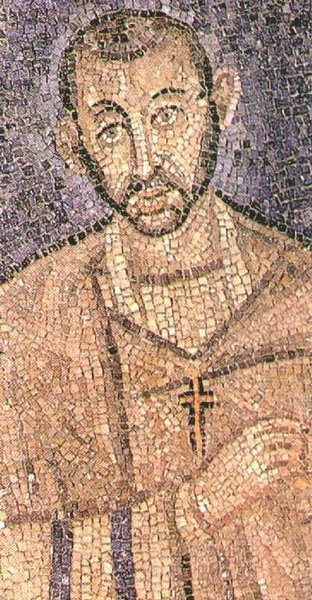
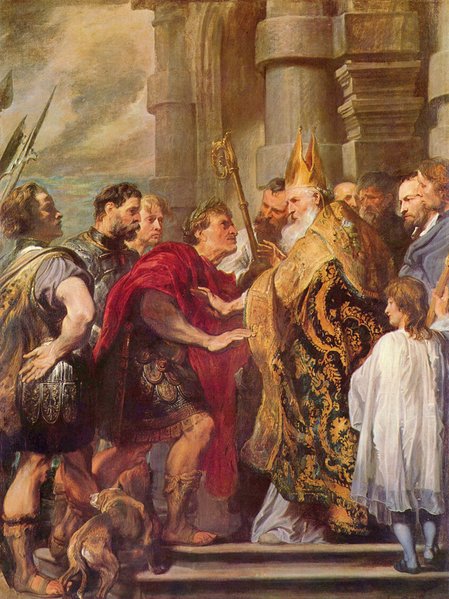 Saint Ambrose of Milan was born in Trier around AD 340. He became a Roman governor in northern Italy and the people of Milan later named him bishop by general acclaim. He stands as one of the four Latins among the eight Doctors of the undivided Church. Augustine, Jerome, and Gregory the Great are the West's other representatives; Athanasius, John Chrysostom, Basil the Great, and Gregory of Nazianzus represent the East.
Ambrose was also an author of hymns, the best known of which is probably Intende, qui regis Israel (usually known by its second stanza as Veni, Redemptor gentium). Martin Luther translated it into German (Nun komm, der Heiden Heiland); its English translations (from Luther or the original Latin) usually appear as Savior of the Nations, Come; Savior of the Heathen, Known; or Come, Thou Redeemer of the Earth).
His name is also associated with Ambrosian Chant. You can search the web for examples of the notation while YouTube has a number of recordings of sacred music performed according to Ambrosian sensibilities. This style of chanting the ancient liturgy took hold in the province of Milan. For more on his musical influence in the Church, see the NetHymnal for a detailed list with links to translations and adaptations of a number of the Hymns of Saint Ambrose.
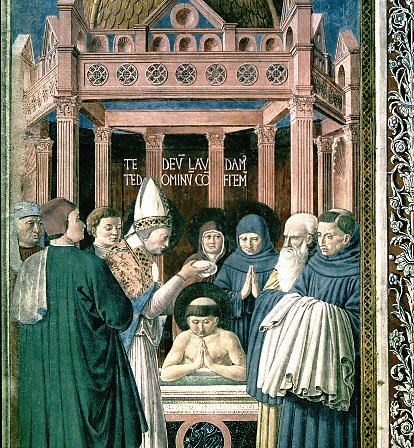
While serving as a civil governor, Ambrose sought to bring peace among Christians in Milan who were divided into quarreling factions. When a new bishop was to be elected in 374, Ambrose addressed the crowd, and someone cried out, "Ambrose, bishop!" The entire gathering gave their support. At this time, Ambrose was still a catechumen, an unbaptized person still under instruction before joining the church. The general acclaim hastened the catechetical process and the 34-year-old was baptized on December 7, after which he was consecrated bishop of Milan.
 A strong defender of the faith, Ambrose convinced the Roman emperor Gratian in 379 to forbid the Arian heresy in the West. At Ambrose's urging, Gratian's successor Theodosius also publicly opposed Arianism.
Ambrose died on Good Friday, 4 April 397, but the Church was unwilling to honor such a known and popular person on the day commemorating the death of Christ. Thus, his feast day was transferred from his "heavenly birthday" (or death date) to the date of his baptism and subsequent consecration as bishop.
Ambrose was also instrumental in the conversion of Augustine of Hippo. Some early traditions hold that the hymn Te Deum Laudamus ("We Praise You, O God") was a spontaneous composition by Ambrose, perhaps with Augustine's help, upon the baptism of the latter. While later researchers hold this to be unlikely, some scholars are convinced that he was largely responsible for authorship of the Athanasian Creed (14k PDF).
As a courageous doctor and musician he upheld the truth of God's Word. Once again this Advent-tide, thousands upon thousands of believers will use Savior of the Nations, Come to pray for the Second Coming of our Lord. Here is my favorite, passed on to us from Ambrose via Martin Luther and William Morton Reynolds:
Savior of the nations, come;
Virgin's Son, here make Thy home!
Marvel now, O heaven and earth,
That the Lord chose such a birth.
Not by human flesh and blood;
By the Spirit of our God
Was the Word of God made flesh,
Woman's offspring, pure and fresh.
Wondrous birth! O wondrous Child
Of the virgin undefiled!
Though by all the world disowned,
Still to be in heaven enthroned.
From the Father forth He came
And returneth to the same,
Captive leading death and hell
High the song of triumph swell!
Thou, the Father's only Son,
Hast over sin the victory won.
Boundless shall Thy kingdom be;
When shall we its glories see?
Brightly doth Thy manger shine,
Glorious is its light divine.
Let not sin o'ercloud this light;
Ever be our faith thus bright.
Praise to God the Father sing,
Praise to God the Son, our King,
Praise to God the Spirit be
Ever and eternally.
Lection
Psalm 27:5-11 or 33:1-5,20-21
Ecclesiasticus 2:7-11,16-18
1 Peter 1:3-9, 13-21
Luke 12:35-37, 42-44
Collect
O God, who graciously gave Your servant Ambrose eloquence to proclaim Your righteousness and fearlessness to bear reproach for the honor of Your Name, mercifully grant to all pastors and overseers such excellence in preaching and faithfulness in ministering Your Word that Your people may be partakers with them of the glory that shall be revealed; through Jesus Christ our Lord, who lives and reigns with You and the Holy Spirit, one God, now and forever.
Labels: ambrose, arianism, augustine, biography, chant, commemoration, european history, hagiography, hymnody, liturgics, music, roman empire, te deum, theology
¶ 00:00 | 0 comments |
 On the Feast of St. Michael and all Angels (or Michaelmas) we thank God for the many ways in which He lovingly watches over us, both directly and indirectly. We also remember that the richness and variety of God's creation far exceeds our knowledge of it.
The angels are referred to as "messengers of God," or simply as "messengers." The word for a messenger in Hebrew is malach, in Greek, angelos, from which we get our word "angel."
 Michael (the name means "Who is like God?") is said to be the captain of the heavenly armies. In the Scriptures, Daniel (10:13, 21; 12:1) calls him prince of the people of Israel; Jude 9 notes an apocryphal story of a dispute with the devil about the body of Moses; Revelation 12:7 shows him leading the heavenly armies against those of the great dragon. He is often pictured in full armor, carrying a lance, and with his foot on the neck of a dragon.
Why do we call him "Saint" Michael? Isn't this word reserved for God's holy people? Well, the word actually means "holy," that is dedicated and set aside for a special Godly purpose or having an intrinisic goodness. All of God's people are holy because of Christ. Therefore, all are saints — especially the dead in Christ. Because they are completely sinless, Michael and all the angels are "holy" and thus may be called saints.
Many theologians through the centuries have suggested that Michael is actually a theophany, a divine manifestation of the Son of God. Reading the passages where he is mentioned doesn't convince me entirely one way or another. The name itself is intriguing: If we answer the question, "Who is like God?" we must say, "No one — except God."Also, while Christian literature, liturgics, and hymnody is filled with references to archangels, Michael is the only being in Scripture called an archangel. All other "archangel" names come from the Apocrypha or even more spurious writings. The prefix normally means ruling, chief, or principal and can also carry the meaning of a prototype or an earlier model.
We know that Jesus testifies of His Father: He was and remains the principal (arch-) messenger of God's grace. He also preceded the existence of the angels, being alive from all eternity. In fact, He not only is the great messenger of God's Word, He is God's Word. Thus, understanding the Son as the archangel, the primary and ruling messenger of the Father is totally congruent with Scripture's revelation.I say this not to attempt to persuade the reader to accept the idea that Michael is the Son of God but to open the mind to the possibility that they could be one and the same.
As for the angels, there are numerous times and places where they are mentioned. Yet all the spirit beings who serve God are not called angels by Scripture. While we often in our thinking lump them together, a number of distinct created beings exist.When reading the Pauline epistles, many early theologians took as titles some of the descriptive language he used in writing of the spiritual realm. They came up with nine "choirs" or ranks of angels, normally grouped in three triads. Their order varied among the different commentators. For example, Pseudo-Dionysias ranked them (in ascending order) as seraphim, cherubim, thrones, dominions, virtues, powers, principalities, archangels, and angels.
Cherubim, seraphim, angels and at least one archangel we know of definitely from the Bible. Whether or not "thrones, dominions, virtues," and the like are also specific creatures or whether they're rather general characteristics of the spirit beings, these lists appear to have identified the "four living creatures" mentioned in Ezekiel and Revelation as cherubim.These lists have made it into our liturgy, where the Communion Preface speaks of "angels and archangels and all the company of heaven." They've also been incorporated into our hymnody, most notably "Ye Watchers and Ye Holy Ones."
James Kiefer's Hagiographies give even more details on the choirs of angels and related material with Mr. Kiefer's article on Michael and All Angels.Lection
Psalm 91
Daniel 10:10-14; 12:1-3
Revelation 12:7-12
Matthew 18:1-11 or Luke 10:17-20
Collect
Everlasting God, You have ordained and constituted the service of angels and men in a wonderful order. Mercifully grant that, as Your holy angels always serve and worship You in heaven, so by Your appointment they may also help and defend us here on earth; through Jesus Christ, Your Son, our Lord, who lives and reigns with You and the Holy Spirit, one God, now and forever.
Hymn
Ye Watchers and Ye Holy Ones
Ye watchers and ye holy ones,
Bright seraphs, cherubim, and thrones,
Raise the glad strain, Alleluia!
Cry out, dominions, princedoms, powers,
Virtues, archangels, angels' choirs,
Alleluia! Alleluia!
O higher than the cherubim,
More glorious than the seraphim,
Lead their praises, Alleluia!
Thou Bearer of the eternal Word,
Most gracious, magnify the Lord,
Alleluia! Alleluia!
Respond, ye souls in endless rest,
Ye patriarchs and prophets blest,
Alleluia! Alleluia!
Ye holy Twelve, ye martyrs strong,
All saints triumphant, raise the song,
Alleluia! Alleluia!
O friend, in gladness let us sing,
Supernal anthems echoing,
Alleluia! Alleluia!
To God the Father, God the Son,
And God the Spirit, Three in One,
Alleluia! Alleluia!
Labels: angel, apocrypha, archangel, cherubum, christianity, christology, feasts, festivals, four living creatures, liturgics, michael, new testament, old testament, seraphim, theology
¶ 00:00 | 0 comments |
Johann Sebastian Bach (1685-1750) is acknowledged as one of the most famous and gifted of all composers past and present in the entire western world. Orphaned at the age of ten, Bach studied with various family members but was mostly self-taught in music.He began his professional career as conductor, performer, composer, teacher, and organ consultant at age 19 in the town of Arnstadt. He traveled wherever he received good commissions and steady employment, ending up in Leipzig, where the last 27 years of his life found him responsible for all the music in the city's four Lutheran churches.
Acclaimed more in his own time as a superb keyboard artist, the majority of his compositions fell into disuse following his death, which musicologists use to date the end of the Baroque Period and the beginning of the Classical Era. However, his compositional ability was rediscovered, in large part due to the efforts of Felix Mendelssohn.The genius and sheer magnitude of Bach's vocal and instrumental compositions remain overwhelming. Also, whether due to nature or nurture, he was but one of the giants in, perhaps, the most talented musical family of all time.
Christendom especially honors J. S. Bach, a staunch and devoted Lutheran, for his lifelong insistence that his music was written primarily for the liturgical life of the Church, glorifying God and edifying His people. For an overview of the Christological basis of his work and a strong argument that he was among the theological giants of Lutheranism, please read J. S. Bach: Orthodox Lutheran Theologian?.
Today we remember his "heavenly birthday," for it was on 28 July AD 1750 that the Lord translated Mr. Bach to glory.
Soli deo gloria — To God alone the glory! These words appear on most manuscripts of Bach's compositions as testimony to his faith and his idea of music's highest, noblest use.
Labels: bach, biography, christianity, church history, commemorations, german history, hagiography, liturgics, lutheranism, music
¶ 00:00 | 0 comments |
Born in Flavia Neapolis, Palestine around AD 100, near the close of the New Testament period, Justin was the son of pagan Greek parents. He was a philosophy student who studied in Alexandria, moving from Stoicism to Pythagoreanism and then Platonism as he sought to make sense of life. He converted to the Christian faith and became a teacher in Ephesus and Rome. Justin wrote that his conversion came as he observed the steadfast faith of Ephesian martyrs and through an elderly Christian whom he met along the shore of the sea.
Justin probably wrote much more than we have preserved, but three extant works show his intellect, his never completely abandoned Platonic philosophical education, and his inclination toward apologetics — that is, an intellectual defense of the Faith.In his First Apology, addressed to Emperor Antoninus Pius and his adopted sons, Justin defended Christianity as the only rational creed. He included accounts of contemporary baptismal and communion rites, quite possibly designed to rebut distorted accounts from anti-Christian sources. Some of these anti-Christian writings claimed that Christians were cannibals (probably because of a distorted second hand understanding of the Lord's Supper).
He addressed his Second Apology to the Roman Senate. It counters spurious charges of immorality and the like that were being made against Christians. He said that only those who misunderstood the Faith would accuse it of undermining Roman society and countered that Christians made good citizens.
His Dialogue with Trypho the Jewish rabbi shows him at his strength. He carefully defended Christian teaching while allowing that the Church would continue to welcome Jews and would let them remain faithful to the laws of the Torah. While he may have edited it to provide himself with a few good lines, the text reads as a faithful exposition of an actual conversation.
Justin was living in Rome when the cynic philosopher Crescens stirred up trouble for the Christians. After refusing to make pagan sacrifices, Justin was arrested, tried and executed, along with six other believers, including Charites, Paeon, and Liberianus. The official Roman court proceedings of his trial before Rusticius, a Roman prelate, document his confession of faith. The account of his martyrdom became a source of great encouragement to the early Christian community.
Much of what we know of early liturgical practice comes from Justin. For example, in the First Apology he gave this brief description of Holy Communion: "On finishing the prayers we greet each other with a kiss. Then bread and a cup of water mixed with wine are brought to the leader and he, taking them, sends up praise and glory to the Father of the Universe through the name of the Son and of the Holy Spirit, and offers thanksgiving at some length that we have been deemed worthy to receive these things. When the leader has finished the prayers and thanksgivings, the whole congregation assents, saying, 'Amen.' ('Amen' is Hebrew for 'So be it.') Then those whom we call deacons give to each of those present a portion of the consecrated bread and wine and water, and they take it to the absent."
Suggested Lection
Psalm 16:5-11 or 116:1-8
1 Corinthians 1:18-25
John 12:44-50
Collect
Almighty and everlasting God, who found Your martyr Justin wandering from teacher to teacher, seeking the true God, and revealed to him the sublime wisdom of Your eternal Word, grant that all who seek You, or a deeper knowledge of You, may find and be found by You; through Jesus Christ our Lord, who lives and reigns with you and the Holy Spirit, one God, now and forever.
Labels: apologetics, biography, church history, dialogue, hagiography, justin, liturgics, martyr, martyrdom, patristics, trypho
¶ 00:00 | 0 comments |
Johann Walter (also Johannes Walther) was born in 1496 and began serving at the age of 21 as a composer and bass singer in the court chapel of Frederick the Wise. In 1524, he published a collection of hymns arranged according to the church year. It was well received and served as the model for numerous subsequent hymnals.In addition to serving for 30 years as kantor (church musician and choir director) in the cities of Torgau and Dresden, he also assisted Martin Luther in the preparation of the Deutsche Messe of 1526, a setting of the Liturgy in the German language using hymn tunes.
Walter is remembered as the first Lutheran kantor and composer of church music. Among his most cherished works is Der Bräut'gam wird bald rufen (The Bridegroom Soon Will Call Us). Information on Walter, including some texts and music samples, may also be found through Hymnuts, Here of a Sunday Morning, and the Cyber Hymnal.
NB: Do not confuse this Johann Walter, whose output was largely hymns and other church music with the later Johann Jakob Walther (1650 - 1717), a Baroque composer best known for his violin works, or with Johann Gottfried Walther (1684 - 1748), also from the Baroque Period, who was a church organist and composer.
Labels: biography, commemoration, german history, hagiography, hymnody, johann walter, johannes walther, liturgics, lutheranism, martin luther, music, reformation
¶ 00:00 | 0 comments |
Lutheran musician, composer, and musicologist Michael Praetorius (Prätorius) was born in Kreuzburg, Thuringia to Pastor and Mrs. Michael Schultheis (or Schultze), on 15 February 1571. Praetorius was a Latinization of the family name and Michael later favored the monogram MPC (Michael Praetorius Creutzbergensis). While still a boy, he began studying philosophy at the University of Frankfurt, where his brother Andreas was a professor.Praetorius became organist at Frankfurt and later held the same post at Lüneburg. In this latter town he began his career as Kapellmeister. While only 18, he began serving Herzog Heinrich Julius of Braunschweig-Wolfenbüttel as a minor member of his court. In 1604, Praetorius became the prince's Kapellmeister and organist. He was also appointed honorary prior of the Ringelheim Monastery near Goslar but wasn't required to stay there. He died at Wolfenbüttel on 15 February 1621.
Praetorius was, by all accounts, an accomplished musician and certainly a prolific composer. He also involved himself in the study of musical art and practice. His major work in this field was The Syntagma musicum, "not a piece of music but a scholarly historico-theoretical masterpiece." Of this, he completed three volumes. The second volume of this work is the most elaborate and valuable treatise on instruments and instrumental music from the 16th Century and is considered one of the most remarkable examples of musical scholarship in existence. The planned but uncompleted fourth volume was to have involved counterpoint and we can only wonder how much of the history of that topic we lost with his death at age fifty.
Among his other titles were Musae Sioniae, a compendium of over 1200 chorale and song arrangements published in nine parts, and Hymnodia Sionae. The 1612 Terpsichore, his sole surviving secular work, is a collection of more than 300 instrumental dances.His harmonization of Es ist ein Ros entsprungen (Lo, How a Rose E'er Blooming) remains popular. He also arranged and composed the beautiful Mass for Christmas Morning.
His compositions and arrangements generally show a strong Christian faith filtered through his passionate Lutheran understanding of Scripture, grace, and faith. He helped move music from the late Renaissance into the early Baroque and forms the first half of a pair of Lutheran bookends to that period, the latter being J. S. Bach.
I chose to transfer his commemoration to this date since his birth and death both fell on 15 February, when the LCMS commemorates Philemon and Onesimus. The days adjacent are already reserved for Saint Valentine (the 14th) and Philipp Melanchthon (the 16th).
Labels: bach, baroque period, biography, commemoration, hagiography, hymnody, liturgics, lutheranism, music, praetorius, renaissance
¶ 00:00 | 0 comments |
23 December
We now arrive at the seventh and final O Antiphon, including related Scriptures, Latin text and English translation, a Latin hymn stanza, and the English versification from the hymn known as O Come, O Come, Emmanuel. (The English language renditions are from the Lutheran Service Book.)℣ O Emmanuel, Rex et legisfer noster, expectatio gentium, et Salvator erum:
℟ veni ad salvandum nos, Domine Deus noster.
℣ O Emmanuel, our King and our Lord, the Anointed for the nations and their | Savior:*
℟ Come and save us, O | Lord our God.
"Therefore the Lord himself will give you a sign. Behold, the virgin shall conceive and bear a son, and shall call his name Immanuel. (Isaiah 7:14)" See also Isaiah 8:6-8; Matthew 1:23; Haggai 2:7 (KJV).
Veni Veni, Emmanuel Captivum solve Israel,
Qui gemit in exsilio, Privatus Dei Filio.
O come, O come, Emmanuel, And ransom captive Israel,
That mourns in lonely exile here Until the Son of God appear.
Rejoice! Rejoice! Emmanuel Shall come to thee, O Israel!
Read the final daily meditation from the O Antiphons by Pastor Weedon.
Ero Cras!
Unless otherwise noted, Scriptures are quoted from the ESV®
Labels: advent, christmas, emmanuel, god with us, hymnody, immanuel, liturgics, magnificat, o antiphons, ransom, vespers, worship
¶ 00:00 | 0 comments |


