Aardvark Alley

Confessional Lutheran theology, hagiography, philosophy, music, culture, sports, education,
and whatever else is on the fevered mind of Orycteropus Afer
28 July 2017
+ J. S. Bach, Musician, Composer, and Theologian +
28 July AD 1750
 Johann Sebastian Bach (1685-1750) is acknowledged as one of the most famous and gifted of all composers past and present in the entire western world. Orphaned at the age of ten, Bach studied with various family members but was mostly self-taught in music.
He began his professional career as conductor, performer, composer, teacher, and organ consultant at age 19 in the town of Arnstadt. He traveled wherever he received good commissions and steady employment, ending up in Leipzig, where the last 27 years of his life found him responsible for all the music in the city's four Lutheran churches.
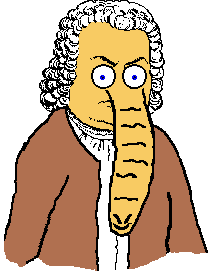 Acclaimed more in his own time as a superb keyboard artist, the majority of his compositions fell into disuse following his death, which musicologists use to date the end of the Baroque Period and the beginning of the Classical Era. However, his compositional ability was rediscovered, in large part due to the efforts of Felix Mendelssohn.
The genius and sheer magnitude of Bach's vocal and instrumental compositions remain overwhelming. Also, whether due to nature or nurture, he was but one of the giants in, perhaps, the most talented musical family of all time.
Christendom especially honors J. S. Bach, a staunch and devoted Lutheran, for his lifelong insistence that his music was written primarily for the liturgical life of the Church, glorifying God and edifying His people. For an overview of the Christological basis of his work and a strong argument that he was among the theological giants of Lutheranism, please read J. S. Bach: Orthodox Lutheran Theologian?.
Today we remember his "heavenly birthday," for it was on 28 July AD 1750 that the Lord translated Mr. Bach to glory.
Soli deo gloria — To God alone the glory! These words appear on most manuscripts of Bach's compositions as testimony to his faith and his idea of music's highest, noblest use.


Johann Sebastian Bach (1685-1750) is acknowledged as one of the most famous and gifted of all composers past and present in the entire western world. Orphaned at the age of ten, Bach studied with various family members but was mostly self-taught in music.He began his professional career as conductor, performer, composer, teacher, and organ consultant at age 19 in the town of Arnstadt. He traveled wherever he received good commissions and steady employment, ending up in Leipzig, where the last 27 years of his life found him responsible for all the music in the city's four Lutheran churches.
 Acclaimed more in his own time as a superb keyboard artist, the majority of his compositions fell into disuse following his death, which musicologists use to date the end of the Baroque Period and the beginning of the Classical Era. However, his compositional ability was rediscovered, in large part due to the efforts of Felix Mendelssohn.
The genius and sheer magnitude of Bach's vocal and instrumental compositions remain overwhelming. Also, whether due to nature or nurture, he was but one of the giants in, perhaps, the most talented musical family of all time.
Christendom especially honors J. S. Bach, a staunch and devoted Lutheran, for his lifelong insistence that his music was written primarily for the liturgical life of the Church, glorifying God and edifying His people. For an overview of the Christological basis of his work and a strong argument that he was among the theological giants of Lutheranism, please read J. S. Bach: Orthodox Lutheran Theologian?.
Today we remember his "heavenly birthday," for it was on 28 July AD 1750 that the Lord translated Mr. Bach to glory.
Soli deo gloria — To God alone the glory! These words appear on most manuscripts of Bach's compositions as testimony to his faith and his idea of music's highest, noblest use.
Labels: bach, biography, christianity, church history, commemorations, german history, hagiography, liturgics, lutheranism, music
¶ 00:00 | 0 comments |
17 February 2017
+ Michael Praetorius +
15 February AD 1621, transferred to 17 February
 Lutheran musician, composer, and musicologist Michael Praetorius (Prätorius) was born in Kreuzburg, Thuringia to Pastor and Mrs. Michael Schultheis (or Schultze), on 15 February 1571. Praetorius was a Latinization of the family name and Michael later favored the monogram MPC (Michael Praetorius Creutzbergensis). While still a boy, he began studying philosophy at the University of Frankfurt, where his brother Andreas was a professor.
Praetorius became organist at Frankfurt and later held the same post at Lüneburg. In this latter town he began his career as Kapellmeister. While only 18, he began serving Herzog Heinrich Julius of Braunschweig-Wolfenbüttel as a minor member of his court. In 1604, Praetorius became the prince's Kapellmeister and organist. He was also appointed honorary prior of the Ringelheim Monastery near Goslar but wasn't required to stay there. He died at Wolfenbüttel on 15 February 1621.
Praetorius was, by all accounts, an accomplished musician and certainly a prolific composer. He also involved himself in the study of musical art and practice. His major work in this field was The Syntagma musicum, "not a piece of music but a scholarly historico-theoretical masterpiece." Of this, he completed three volumes. The second volume of this work is the most elaborate and valuable treatise on instruments and instrumental music from the 16th Century and is considered one of the most remarkable examples of musical scholarship in existence. The planned but uncompleted fourth volume was to have involved counterpoint and we can only wonder how much of the history of that topic we lost with his death at age fifty.
 Among his other titles were Musae Sioniae, a compendium of over 1200 chorale and song arrangements published in nine parts, and Hymnodia Sionae. The 1612 Terpsichore, his sole surviving secular work, is a collection of more than 300 instrumental dances.
His harmonization of Es ist ein Ros entsprungen (Lo, How a Rose E'er Blooming) remains popular. He also arranged and composed the beautiful Mass for Christmas Morning.
His compositions and arrangements generally show a strong Christian faith filtered through his passionate Lutheran understanding of Scripture, grace, and faith. He helped move music from the late Renaissance into the early Baroque and forms the first half of a pair of Lutheran bookends to that period, the latter being J. S. Bach.
I chose to transfer his commemoration to this date since his birth and death both fell on 15 February, when the LCMS commemorates Philemon and Onesimus. The days adjacent are already reserved for Saint Valentine (the 14th) and Philipp Melanchthon (the 16th).
Lutheran musician, composer, and musicologist Michael Praetorius (Prätorius) was born in Kreuzburg, Thuringia to Pastor and Mrs. Michael Schultheis (or Schultze), on 15 February 1571. Praetorius was a Latinization of the family name and Michael later favored the monogram MPC (Michael Praetorius Creutzbergensis). While still a boy, he began studying philosophy at the University of Frankfurt, where his brother Andreas was a professor.Praetorius became organist at Frankfurt and later held the same post at Lüneburg. In this latter town he began his career as Kapellmeister. While only 18, he began serving Herzog Heinrich Julius of Braunschweig-Wolfenbüttel as a minor member of his court. In 1604, Praetorius became the prince's Kapellmeister and organist. He was also appointed honorary prior of the Ringelheim Monastery near Goslar but wasn't required to stay there. He died at Wolfenbüttel on 15 February 1621.
Praetorius was, by all accounts, an accomplished musician and certainly a prolific composer. He also involved himself in the study of musical art and practice. His major work in this field was The Syntagma musicum, "not a piece of music but a scholarly historico-theoretical masterpiece." Of this, he completed three volumes. The second volume of this work is the most elaborate and valuable treatise on instruments and instrumental music from the 16th Century and is considered one of the most remarkable examples of musical scholarship in existence. The planned but uncompleted fourth volume was to have involved counterpoint and we can only wonder how much of the history of that topic we lost with his death at age fifty.
Among his other titles were Musae Sioniae, a compendium of over 1200 chorale and song arrangements published in nine parts, and Hymnodia Sionae. The 1612 Terpsichore, his sole surviving secular work, is a collection of more than 300 instrumental dances.His harmonization of Es ist ein Ros entsprungen (Lo, How a Rose E'er Blooming) remains popular. He also arranged and composed the beautiful Mass for Christmas Morning.
His compositions and arrangements generally show a strong Christian faith filtered through his passionate Lutheran understanding of Scripture, grace, and faith. He helped move music from the late Renaissance into the early Baroque and forms the first half of a pair of Lutheran bookends to that period, the latter being J. S. Bach.
I chose to transfer his commemoration to this date since his birth and death both fell on 15 February, when the LCMS commemorates Philemon and Onesimus. The days adjacent are already reserved for Saint Valentine (the 14th) and Philipp Melanchthon (the 16th).
Labels: bach, baroque period, biography, commemoration, hagiography, hymnody, liturgics, lutheranism, music, praetorius, renaissance
¶ 00:24 | 0 comments |
28 July 2016
+ J. S. Bach, Musician, Composer, and Theologian +
28 July AD 1750
Johann Sebastian Bach (1685-1750) is acknowledged as one of the most famous and gifted of all composers past and present in the entire western world. Orphaned at the age of ten, Bach studied with various family members but was mostly self-taught in music.
He began his professional career as conductor, performer, composer, teacher, and organ consultant at age 19 in the town of Arnstadt. He traveled wherever he received good commissions and steady employment, ending up in Leipzig, where the last 27 years of his life found him responsible for all the music in the city's four Lutheran churches.
Acclaimed more in his own time as a superb keyboard artist, the majority of his compositions fell into disuse following his death, which musicologists use to date the end of the Baroque Period and the beginning of the Classical Era. However, his compositional ability was rediscovered, in large part due to the efforts of Felix Mendelssohn.
The genius and sheer magnitude of Bach's vocal and instrumental compositions remain overwhelming. Also, whether due to nature or nurture, he was but one of the giants in, perhaps, the most talented musical family of all time.
Christendom especially honors J. S. Bach, a staunch and devoted Lutheran, for his lifelong insistence that his music was written primarily for the liturgical life of the Church, glorifying God and edifying His people. For an overview of the Christological basis of his work and a strong argument that he was among the theological giants of Lutheranism, please read J. S. Bach: Orthodox Lutheran Theologian?.
Today we remember his "heavenly birthday," for it was on 28 July AD 1750 that the Lord translated Mr. Bach to glory.
Soli deo gloria — To God alone the glory! These words appear on most manuscripts of Bach's compositions as testimony to his faith and his idea of music's highest, noblest use.
Johann Sebastian Bach (1685-1750) is acknowledged as one of the most famous and gifted of all composers past and present in the entire western world. Orphaned at the age of ten, Bach studied with various family members but was mostly self-taught in music.He began his professional career as conductor, performer, composer, teacher, and organ consultant at age 19 in the town of Arnstadt. He traveled wherever he received good commissions and steady employment, ending up in Leipzig, where the last 27 years of his life found him responsible for all the music in the city's four Lutheran churches.
Acclaimed more in his own time as a superb keyboard artist, the majority of his compositions fell into disuse following his death, which musicologists use to date the end of the Baroque Period and the beginning of the Classical Era. However, his compositional ability was rediscovered, in large part due to the efforts of Felix Mendelssohn.The genius and sheer magnitude of Bach's vocal and instrumental compositions remain overwhelming. Also, whether due to nature or nurture, he was but one of the giants in, perhaps, the most talented musical family of all time.
Christendom especially honors J. S. Bach, a staunch and devoted Lutheran, for his lifelong insistence that his music was written primarily for the liturgical life of the Church, glorifying God and edifying His people. For an overview of the Christological basis of his work and a strong argument that he was among the theological giants of Lutheranism, please read J. S. Bach: Orthodox Lutheran Theologian?.
Today we remember his "heavenly birthday," for it was on 28 July AD 1750 that the Lord translated Mr. Bach to glory.
Soli deo gloria — To God alone the glory! These words appear on most manuscripts of Bach's compositions as testimony to his faith and his idea of music's highest, noblest use.
Labels: bach, biography, christianity, church history, commemorations, german history, hagiography, liturgics, lutheranism, music
¶ 00:00 | 0 comments |
17 February 2016
+ Michael Praetorius +
15 February AD 1621, transferred to 17 February
Lutheran musician, composer, and musicologist Michael Praetorius (Prätorius) was born in Kreuzburg, Thuringia to Pastor and Mrs. Michael Schultheis (or Schultze), on 15 February 1571. Praetorius was a Latinization of the family name and Michael later favored the monogram MPC (Michael Praetorius Creutzbergensis). While still a boy, he began studying philosophy at the University of Frankfurt, where his brother Andreas was a professor.
Praetorius became organist at Frankfurt and later held the same post at Lüneburg. In this latter town he began his career as Kapellmeister. While only 18, he began serving Herzog Heinrich Julius of Braunschweig-Wolfenbüttel as a minor member of his court. In 1604, Praetorius became the prince's Kapellmeister and organist. He was also appointed honorary prior of the Ringelheim Monastery near Goslar but wasn't required to stay there. He died at Wolfenbüttel on 15 February 1621.
Praetorius was, by all accounts, an accomplished musician and certainly a prolific composer. He also involved himself in the study of musical art and practice. His major work in this field was The Syntagma musicum, "not a piece of music but a scholarly historico-theoretical masterpiece." Of this, he completed three volumes. The second volume of this work is the most elaborate and valuable treatise on instruments and instrumental music from the 16th Century and is considered one of the most remarkable examples of musical scholarship in existence. The planned but uncompleted fourth volume was to have involved counterpoint and we can only wonder how much of the history of that topic we lost with his death at age fifty.
Among his other titles were Musae Sioniae, a compendium of over 1200 chorale and song arrangements published in nine parts, and Hymnodia Sionae. The 1612 Terpsichore, his sole surviving secular work, is a collection of more than 300 instrumental dances.
His harmonization of Es ist ein Ros entsprungen (Lo, How a Rose E'er Blooming) remains popular. He also arranged and composed the beautiful Mass for Christmas Morning.
His compositions and arrangements generally show a strong Christian faith filtered through his passionate Lutheran understanding of Scripture, grace, and faith. He helped move music from the late Renaissance into the early Baroque and forms the first half of a pair of Lutheran bookends to that period, the latter being J. S. Bach.
I chose to transfer his commemoration to this date since his birth and death both fell on 15 February, when the LCMS commemorates Philemon and Onesimus. The days adjacent are already reserved for Saint Valentine (the 14th) and Philipp Melanchthon (the 16th).
Lutheran musician, composer, and musicologist Michael Praetorius (Prätorius) was born in Kreuzburg, Thuringia to Pastor and Mrs. Michael Schultheis (or Schultze), on 15 February 1571. Praetorius was a Latinization of the family name and Michael later favored the monogram MPC (Michael Praetorius Creutzbergensis). While still a boy, he began studying philosophy at the University of Frankfurt, where his brother Andreas was a professor.Praetorius became organist at Frankfurt and later held the same post at Lüneburg. In this latter town he began his career as Kapellmeister. While only 18, he began serving Herzog Heinrich Julius of Braunschweig-Wolfenbüttel as a minor member of his court. In 1604, Praetorius became the prince's Kapellmeister and organist. He was also appointed honorary prior of the Ringelheim Monastery near Goslar but wasn't required to stay there. He died at Wolfenbüttel on 15 February 1621.
Praetorius was, by all accounts, an accomplished musician and certainly a prolific composer. He also involved himself in the study of musical art and practice. His major work in this field was The Syntagma musicum, "not a piece of music but a scholarly historico-theoretical masterpiece." Of this, he completed three volumes. The second volume of this work is the most elaborate and valuable treatise on instruments and instrumental music from the 16th Century and is considered one of the most remarkable examples of musical scholarship in existence. The planned but uncompleted fourth volume was to have involved counterpoint and we can only wonder how much of the history of that topic we lost with his death at age fifty.
Among his other titles were Musae Sioniae, a compendium of over 1200 chorale and song arrangements published in nine parts, and Hymnodia Sionae. The 1612 Terpsichore, his sole surviving secular work, is a collection of more than 300 instrumental dances.His harmonization of Es ist ein Ros entsprungen (Lo, How a Rose E'er Blooming) remains popular. He also arranged and composed the beautiful Mass for Christmas Morning.
His compositions and arrangements generally show a strong Christian faith filtered through his passionate Lutheran understanding of Scripture, grace, and faith. He helped move music from the late Renaissance into the early Baroque and forms the first half of a pair of Lutheran bookends to that period, the latter being J. S. Bach.
I chose to transfer his commemoration to this date since his birth and death both fell on 15 February, when the LCMS commemorates Philemon and Onesimus. The days adjacent are already reserved for Saint Valentine (the 14th) and Philipp Melanchthon (the 16th).
Labels: bach, baroque period, biography, commemoration, hagiography, hymnody, liturgics, lutheranism, music, praetorius, renaissance
¶ 00:00 | 0 comments |
28 July 2015
+ J. S. Bach, Musician, Composer, and Theologian +
28 July AD 1750
Johann Sebastian Bach (1685-1750) is acknowledged as one of the most famous and gifted of all composers past and present in the entire western world. Orphaned at the age of ten, Bach studied with various family members but was mostly self-taught in music.
He began his professional career as conductor, performer, composer, teacher, and organ consultant at age 19 in the town of Arnstadt. He traveled wherever he received good commissions and steady employment, ending up in Leipzig, where the last 27 years of his life found him responsible for all the music in the city's four Lutheran churches.
 Acclaimed more in his own time as a superb keyboard artist, the majority of his compositions fell into disuse following his death, which musicologists use to date the end of the Baroque Period and the beginning of the Classical Era. However, his compositional ability was rediscovered, in large part due to the efforts of Felix Mendelssohn.
The genius and sheer magnitude of Bach's vocal and instrumental compositions remain overwhelming. Also, whether due to nature or nurture, he was but one of the giants in, perhaps, the most talented musical family of all time.
Christendom especially honors J. S. Bach, a staunch and devoted Lutheran, for his lifelong insistence that his music was written primarily for the liturgical life of the Church, glorifying God and edifying His people. For an overview of the Christological basis of his work and a strong argument that he was among the theological giants of Lutheranism, please read J. S. Bach: Orthodox Lutheran Theologian?.
Today we remember his "heavenly birthday," for it was on 28 July AD 1750 that the Lord translated Mr. Bach to glory.
Soli deo gloria — To God alone the glory! These words appear on most manuscripts of Bach's compositions as testimony to his faith and his idea of music's highest, noblest use.
Johann Sebastian Bach (1685-1750) is acknowledged as one of the most famous and gifted of all composers past and present in the entire western world. Orphaned at the age of ten, Bach studied with various family members but was mostly self-taught in music.He began his professional career as conductor, performer, composer, teacher, and organ consultant at age 19 in the town of Arnstadt. He traveled wherever he received good commissions and steady employment, ending up in Leipzig, where the last 27 years of his life found him responsible for all the music in the city's four Lutheran churches.
Acclaimed more in his own time as a superb keyboard artist, the majority of his compositions fell into disuse following his death, which musicologists use to date the end of the Baroque Period and the beginning of the Classical Era. However, his compositional ability was rediscovered, in large part due to the efforts of Felix Mendelssohn.The genius and sheer magnitude of Bach's vocal and instrumental compositions remain overwhelming. Also, whether due to nature or nurture, he was but one of the giants in, perhaps, the most talented musical family of all time.
Christendom especially honors J. S. Bach, a staunch and devoted Lutheran, for his lifelong insistence that his music was written primarily for the liturgical life of the Church, glorifying God and edifying His people. For an overview of the Christological basis of his work and a strong argument that he was among the theological giants of Lutheranism, please read J. S. Bach: Orthodox Lutheran Theologian?.
Today we remember his "heavenly birthday," for it was on 28 July AD 1750 that the Lord translated Mr. Bach to glory.
Soli deo gloria — To God alone the glory! These words appear on most manuscripts of Bach's compositions as testimony to his faith and his idea of music's highest, noblest use.
Labels: bach, biography, christianity, church history, commemorations, hagiography, lutheranism, music
¶ 00:00 | 0 comments |


