
 Remembered as a disciple of Martin Luther, Robert Barnes is considered to be among the first Lutheran martyrs. Born in 1495, he became the prior of the Augustinian monastery at Cambridge, England. Converted to Lutheran teaching, he shared his insights with many English scholars through writings and personal contacts.
During a time of exile to Germany he became a friend of Luther and later wrote a Latin summary of the main doctrines of the Augsburg Confession titled Sententiae.
Upon his return to England, Barnes shared his Lutheran doctrines and views in person with King Henry VIII and initially had a positive reception. In 1529 Barnes was named royal chaplain.
The changing political and ecclesiastical climate in England later claimed him as a victim; he was burned at the stake in Smithfield in 1540.
His final confession of faith was published by Luther, who called his friend Barnes "our good, pious table companion and guest of our home, this holy martyr, Saint Robertus."
For a bit more on Barnes, please read the introduction to Lutheran Carnival 26 at A Beggar at the Table.
Labels: biography, christianity, church history, commemoration, english history, hagiography, lutheranism, martin luther, martyrdom, reformation, robert barnes
¶ 00:00 | 0 comments |

 The first Protestants weren't Martin Luther and his fellow theologians. Instead, the word was originally applied to the German rulers who opposed the imperial laws adopted at the Second Diet of Speyer in 1529. Chief among these protesters was John, Elector of Saxony, who thereby gained a reputation as the first and foremost Protestant.
Although John is not well-known outside of Lutheran circles, he should be. He earned the title John the Steadfast (Johann der Beständige) for his steadfast confession and defense of the Evangelical (Lutheran) doctrine and its pastors and theologians. Without his unshaken conviction that Luther's teaching was true and his steadfast actions in defense of the Reformation probably there would be no Lutheran nor Protestant churches today. Without John's protection, Luther likely would have experienced the same fate as Jan Hus, who was burned at the stake at the Council of Constance. Without John's wisdom in political affairs, the Lutherans in Germany might have been murdered like the 70,000 French Calvinists on Saint Bartholomew's Day in 1572.
German Lutherans maintain special remembrance of the role that John the Steadfast played in defending their religion. The Wittenberg Castle Church has two prominent tombs today. These are not the graves of Luther and Philipp Melanchthon, who are buried in front of the pulpit, but the tombs of John and his elder brother, Elector Frederick III. The electors are buried in front of the altar under huge bronze memorial slabs. They are flanked by alabaster statues, depicting them kneeling in prayer, and by magnificent bronze sculptures of the two electors in ceremonial garb and sword.
 John the Steadfast was born on 30 June 1468 at Meissen, a city now known for its famous porcelain. He received a scholarly education, was trained in the arts of the knight, and gained prestige in battles against the Ottoman Turks.
John became an enthusiastic reader of Martin Luther's writings. When the papal bull was published against Luther in 1520, John was responsible for making sure it was not enacted in Electoral Saxony. At the Diet of Worms, his correspondence helped to convince and encourage his brother Frederick the Wise to be more bold in his defense of Luther, resulting in Luther's protection at the Wartburg.
In October 1522, John heard Luther preach sermons at the court of Weimar on the powers and limits of secular authority (German: Von weltlicher Obrigkeit). These sermons became John's personal political philosophy.
Upon the death of Frederick in May 1525, John became the Elector of Saxony. In those days, the Saxon Elector was second only to the emperor in power and influence in the Holy Roman Empire. Upon his accession, John announced to the clergy of Saxony that, in the future, the pure Word of God should be preached without human addition and that all useless ceremonies were to be abolished. In February 1526, John ratified a treaty with the Landgrave Philip of Hesse, which was soon joined by other Lutheran states. This was the beginning of political organization in defense of the Lutheran church.
 John the Steadfast also defended the Lutheran church from economic disaster. The Saxon aristocracy had been appropriating church lands, which had previously been used as capital assets to pay the salaries of clergy, teachers, janitors, maintenance, and capital improvements. John put a stop to this capital drain, ensuring that the church was properly endowed for the present and future. John also assisted Luther and Melanchthon in the reform of the University of Wittenberg, setting a pattern for Lutheran universities until the present day.
The imperial laws adopted at the Second Diet of Speyer in 1529, if enacted, would have resulted in the eradication of the Lutheran religion in the Holy Roman Empire. Along with his allies, John the Steadfast protested these laws. Emperor Charles the Fifth then challenged the Protestants to defend their new religion and its practices, which they did at the Diet of Augsburg in 1530. Their defense is known as the Augsburg Confession, with its first signature being that of Elector John the Steadfast.
From this history, we learn that the first defenders and confessors of the Lutheran church were laymen. Their spiritual heirs should remember that the Lutheran church cannot survive without laymen who continue to confess and defend this faith.
John the Steadfast met his Savior on 16 August 1532* and was succeeded by sons John Frederick I and John Ernest (Johann Friedrich and Johann Ernst). John Frederick became sole elector of Ernestine Saxony in 1542.
Thanks to Martin Noland for permission to use his article on Elector John posted at Brothers of John the Steadfast.
*Transferred to his birthday because the LCMS Calendar of Commemorations remembers the patriarch Isaac on 16 August.
Labels: biography, christianity, church history, commemoration, elector john, frederick the wise, german history, hagiography, john the steadfast, lutheranism, martin luther, reformation
¶ 00:00 | 0 comments |

He soon became an intimate friend of Luther and held tightly to the Reformer's teachings. When Luther attended the Leipzig Disputation (1519), Amsdorf accompanied him. He also followed with him to the Diet of Worms in 1521, and was one of the few who knew of Luther's whereabouts during his time at the Wartburg.
He became pastor and superintendent of the church Magdeburg in 1524 and actively introduced and championed the Reformation in that city. His church order closely paralled that of Wittenberg. He went on to similar positions in Goslar and Einbeck, where he continued to support reform. He participated in the Schmalkald discussions in 1537 and, in 1539, strongly opposed Philip of Hesse's bigamy.
His theological position, once firmly established, stayed in strict adherence with that of Luther. This led to dogmatic and ferocious opposition to Philipp Melanchthon, Martin Bucer, and others who represented a policy of conciliation and compromise both among other reformers and toward Roman Catholicism. Amsdorf's opposition was largely credited for the conciliatory Regensburg Conference of 1541. In that same year, and against strong opposition, Elector John Frederick appointed him Bishop of Naumburg-Zeitz.
The Battle of Mühlberg (1547) led him to seek refuge in from the Duke of Weimar. Seeing Wittenberg turn in a Melanchthonian direction, he worked under the Duke of Weimar to establish a new university at Jena in 1548. Theological differences likewise led him to take charge of compiling and editing the Jena Edition of Luther's works, as he sought to correct errors and omissions which Luther's staunchest followers claimed had crept into the Wittenberg edition.

Amsdorf deserves much of the credit — or blame, in the minds of some — for precipitating a formal and complete break between the Gnesio-Lutheran (orthodox) party and followers of Melanchthon at the colloquy of Worms (1557). Throughout much of his later career, he argued against those who claimed that good works were in any way responsible for salvation. Among the conflicts of this ongoing war were the Majoristic Controversy, the Osiandrian Controversy, and the Synergistic Controversy.
During these struggles, his theology and his personality led Amsdorf espouse the extreme position that good works are actually detrimental to the welfare of the soul. He seems to have meant those works that man thinks are good, God-pleasing, and done in order to attain salvation. However, other Lutherans judged that he and others of like mind had gone beyond (and even against) Scripture in this matter.
Flacius allowed his distrust of good works to become an extreme position regarding Original Sin. This led to his expulsion, along with others, from Jena in 1561. However, Amsdorf was spared because of his advanced age, his great service to Lutheranism, and the general opinion that he'd overreacted but likely didn't profess the same understanding of original sin as espoused by the Flacian party.
Nicolaus von Amsdorf died at Eisenach in 1565 and was buried in the Church of Saint George. There his effigy remains, showing a well-knit frame and sharp-cut features.
Labels: biography, commemoration, flacius, hagiography, john frederick, lutheranism, martin luther, philipp melanchthon, reformation
¶ 00:00 | 0 comments |
 Frederick the Wise (Friedrich der Weise), elector of Saxony from 1486 to 1525, was Martin Luther's sovereign in the early years of the Reformation. Indeed, were it not for Frederick, there might not have been a Lutheran Reformation. Born in Torgau in 1463, he became so well known for his skill in political diplomacy and his sense of justice and fairness that he was called "the Wise" by his subjects.
Though he probably never met Luther face-to-face, Frederick repeatedly protected and provided for him. In all likelihood he saved the reformer from a martyr's fate. Even in earlier days, Frederick unknowingly contributed to the Reformation, for in 1512, Vicar-General Johannes von Staupitz of the Augustinian Order came to the Elector, asking him to subsidize the expenses of the promising but poor scholar-monk as a means of strengthening Frederick's prized university in Wittenberg.
While he never made public renunciation of Roman Catholicism, Frederick refused the pope's demand to extradite Luther to Rome for a heresy trial in 1518. When Emperor Charles V declared Luther an outlaw in 1521 at the Diet of Worms, Frederick provided sanctuary for Luther at the Wartburg castle.
 Finally, at the end of his life, the elector gave the clearest indication of his beliefs and sympathies. On his deathbed, Frederick received the Lord's Supper in both kinds — a clear confession of the Evangelical faith.
Frederick received great encouragement in his support of Luther and the Evangelical Reformation from his brother John, who wholeheartedly embraced the Reformation in its early years. Upon Frederick's death, Duke John became Elector of Saxony. John's nickname was "the Steadfast" — indicating how he continued his brother's protection and encouragement of the Reformation.
Frederick's life illustrates many of the rapid changes sweeping across Europe during the Renaissance and Reformation. He went from being a collector and venerator of relics — and a believer in meritorious human works — to one who trusted in God's salvation given by grace through faith in Christ.
Labels: biography, commemoration, frederick the wise, german history, hagiography, lutheranism, martin luther, reformation, saxony, staupitz, wittenberg
¶ 00:00 | 0 comments |
 Johann Walter (also Johannes Walther) was born in 1496 and began serving at the age of 21 as a composer and bass singer in the court chapel of Frederick the Wise. In 1524, he published a collection of hymns arranged according to the church year. It was well received and served as the model for numerous subsequent hymnals.
In addition to serving for 30 years as kantor (church musician and choir director) in the cities of Torgau and Dresden, he also assisted Martin Luther in the preparation of the Deutsche Messe of 1526, a setting of the Liturgy in the German language using hymn tunes.
Walter is remembered as the first Lutheran kantor and composer of church music. Among his most cherished works is Der Bräut'gam wird bald rufen (The Bridegroom Soon Will Call Us). Information on Walter, including some texts and music samples, may also be found through Hymnuts, Here of a Sunday Morning, and the Cyber Hymnal.
NB: Do not confuse this Johann Walter, whose output was largely hymns and other church music with the later Johann Jakob Walther (1650 - 1717), a Baroque composer best known for his violin works, or with Johann Gottfried Walther (1684 - 1748), also from the Baroque Period, who was a church organist and composer.
Labels: biography, commemoration, german history, hagiography, hymnody, johann walter, johannes walther, liturgics, lutheranism, martin luther, music, reformation
¶ 00:00 | 0 comments |
 Johannes Bugenhagen (1485-1558), was from Pomerania in northern Germany. Because of his ancestral region, he took the Latin name Pomeranus and Martin Luther often called him "Doctor Pommer."
He was appointed pastor of Wittenberg in 1523 through the efforts of Luther and thus served as the reformer's pastor and confessor. One of the greatest scholars of the Reformation era, he helped translate the New Testament into Low German and wrote a commentary on the Psalms. He also worked to organize the Lutheran Church in northern Germany and Denmark, journeying to Copenhagen where he crowned both King and Queen and consecrated seven men to the offices of superintendent and bishop.
For those who think that their pastors preach too long, you share that complaint with Luther, who described Pomeranus' preaching as "whatever comes to mind, much like a maidservant chatting with another at the market." One story says that Luther recommended Bugenhagen cut his sermons in half and preach no more than an hour, lest all minds wander.
More information is available through the Christian Cyclopedia and Wikipedia.
Lection
Psalm 46
Isaiah 55:6-11
Romans 10:5-17
John 15:1-11
Collect
O Lord God, heavenly Father, who called Johannes Bugenhagen as pastor and confessor of the Faith, grant us faithful pastors in our time; pour our Your Holy Spirit on Your faithful people, keep them steadfast in Your grace and truth, protect and comfort them in all temptation, defend them against all enemies of Your Word, and bestow on Christ's Church Militant Your saving peace; through Jesus Christ, Your Son, our Lord, who lives and reigns with You and the Holy Spirit, one God, now and forever.
Labels: biography, commemoration, danish history, german history, hagiography, johannes bugenhagen, lutheranism, martin luther, reformation, translation
¶ 00:00 | 0 comments |
 Croatian reformer Matthias Flacius Illyricus (Matija Vlačić Ilirik) was born on 3 March 1520 in Labin (Albona in Latin). At that time, the region was under control of the Venetian Republic. He left home at age 16 to study in Venice. Baldo Lupetina a relative and Franciscan superior on the nearby island of Cres (who was later executed as a heretic) encouraged Matthias to continue studying in Germany.
Flacius traveled to Augsburg, arriving in 1539. He stayed only a short time before moving to Basel, where he enrolled at the university and studied Hebrew and Greek. There he also acquainted himself with many of the day's noted Protestant intellectuals. He moved on to Tübingen to continue his studies.
Traveling on, Flacius headed for the birth place of the Lutheran Reformation. He received his Master's degree from the University of Wittenberg at the age of 24 and lived for most of the 1540s in that town. His degree led to an immediate promotion to professor of theology.
Following Wittenberg, Matthias moved to Magdeburg. Between 1549 and 1557 and under his leadership, this city became a center of opposition to first the Augsburg and then the Leipzig Interims. These were forced truces between the Catholics and the Lutherans and certain other Protestants. During this period, Flacius began openly opposing Philipp Melanchthon and the theological and political compromises he was making with Rome and certain non-Lutheran reformers. Flacius believed that he was a faithful follower of Martin Luther and his theology and saw Melanchthon as one who would destroy much of what Luther had struggled so mightily to obtain.
 His time in Magdeburg was productive otherwise, as well. While there, he commenced work on on the 13-volume Ecclesiastica Historia (poplularly known as the Magdeburg Centuries) with Johannes Wigand and other scholars. He also wrote numerous tracts and pamphlets on various theological topics.
In 1557, Flacius was invited to head the newly founded theological faculty at the University of Jena. He served in this capacity until the end of 1561, when he was released due to his position in a controversy over original sin. He then moved to Regensburg, living there from 1562-1566. He was unable to achieve two great desires. First, he wanted to open a school for Southern Slavs and also hoped to relocate the Protestant printing press from Urach. Neither happened because Regensburg cancelled his asylum on the orders of Emperor Maximilian II.
At the invitation of the City Senate of Antwerp, Flacius moved there for a brief time, staying long enough to write a confession of faith for the Lutherans of the Low Countries. He was then in Strasbourg from 1567 to 1573. There he completed his final large work, the Glossa compendiaria, a commentary on the New Testament. He died at Frankfurt-am-Main in 1575.
Many would call Matthias Flacius' hermeneutical works his most important achievements and he certainly was a pioneer in the field. His Clavis Scripturae Sacrae (Key to Sacred Scripture) established that any passage of the Bible should be interpreted considering the purpose and the structure of the whole chapter or a given book. It also declared the rule that the literal sense of the text should have a priority over allegories and metaphors. He also contributed much to Church history and dogmatics. As overall proof of his learning and scholarship, we note that Flacius likely owned the single largest private collection of books during the 16th Century.
 Silesian and Swabian pastors asked Matthias to refute Caspar Schwenckfeld, who taught that "the inner word of the spirit must be differentiated from the external word spoken by the preacher; that the living Word of God is not the Scriptures but Christ, and that the Scriptures must be interpreted spiritually." This appeal to a subjective understanding and acceptance of an inner word hidden in the hearts of believers rather than the divinely inspired and clearly stated external Word went against all he'd learned from the reformers on the literal sense of the text. Of Schwenckfeld's spiritualizing of the Bible, Flacius said, "Spiritual exegesis [explanation] fits Scripture like a fist fits into an eye."
In all of his theology, Flacius tried to stay loyal to Luther, particularly the Reformer's emphasis on the bondage of the will. Unfortunately, his often abrasive style and his extreme position on original sin alienated many other staunch Lutherans. Because of this, his name fell into neglect and an undeserved degree of disrepute among many confessional Lutherans, even to the present day.
Additionally, he was a Croatian with Italian manners and mannerisms whose German was never good enough for those among whom he worked. In other words, Matthias Flacius Illyricus failed to fit in among his contemporaries in almost every way imaginable. However, we cannot underestimate his influence in preserving, promoting, and expounding the theology of the Lutheran Reformation.
In 1878, biographer Johann Wilhelm Preger eulogized Flacius: "A man of resolute courage, insuperable strength, possessing a wide-ranging knowledge one rarely encounters, with a broad vision and an industrious spirit."
Notes: See the Matthias Flacius Illyricus Memorial Collection on the Internet Archive for an extensive resource of things Flacius. Magdeburg Press sells How to Understand the Sacred Scriptures, a translated portion of the Clavis Scripturae Sacrae. Illyricus comes from the name of the former Roman province of Illyricum, which included his homeland. I also recommend Oliver K. Olson's book Mattias Flacius and the Survival of Luther's Reform. Flacius is not on the LCMS calendar of commemorations but is part of my ongoing addition of noted Lutherans and other Christians to a list of those I consider worthy of the Church's remembrance.
Labels: apologetics, baldo lupetina, biography, commemoration, croatia, european history, flacius, hagiography, lutheranism, martin luther, philipp melanchthon, reformation
¶ 00:00 | 0 comments |
 John Frederick (Johann Friedrich), eldest son of John the Steadfast and nephew of Frederick the Wise of Saxony, was born in Torgau on 30 June 1503. He earned the appellation "John the Magnanimous" (der Grossmütige) because of his generous spirit and gracious bearing during trials.
John Frederick studied under George Spalatin and through him became an early supporter of Martin Luther. In 1530, he traveled to the Diet of Augsburg and joined his father in signing the Augsburg Confession. In 1532, he and his half-brother John Ernest (Johann Ernst) succeeded John the Steadfast He became sole Elector of Ernestine Saxony 1542, ruling until 1547.
Impulsive by nature, he lacked the foresight and forbearance of many politicians and he often ignored the wise counsel of Chancellor Brück, who had also worked under his father. Because of his staunch Lutheranism, he couldn't abide Philip of Hesse's desire to extend the Schmalkaldic League to include Swiss and Strasburg reformers. His personal piety also recoiled at Philip's bigamy and he insisted that the League retain a strict Evangelical (Lutheran) theology.
John Frederick set aside the 1541 election of Julius von Pflug to the see of Naumburg-Zeitz, promoting avowed Lutheran Nicholas von Amsdorf in his stead. In 1542, he unilaterally attempted to introduce the Reformation to the city of Wurzen, a city under the joint protection of Electoral and Ducal Saxony. This antagonized Maurice, Duke of Saxony. Only the efforts of Luther and Philip of Hesse were able to avert war between the two Saxonies.
His suspicious nature led him to doubt the efficacy of councils and colloquies and he neglected to attend diets and other meetings where he might have gained support and built alliances.
As Charles V prepared his attack on the Schmalkaldic League, John Frederick was misled and reacted slowly to the Emperor's threat. When the Schmalkaldic War broke out in July 1546, he took his army from Saxony to engage the imperial forces but returned when Maurice, who had joined with Charles V, invaded Electoral Saxony. He was able to repel Maurice and retake most of his lost lands but then suffered defeat at the hands of imperial forces at Mühlberg on 24 April 1547.
Charles V initially condemned him to death for his part in the rebellion against the Holy Roman Empire. However, the sentence was commuted to life in prison when Wittenberg surrendered. Maurice released him in 1552 after he defeated and drove off Charles V. However, his title remained in Maurice's hands.
To the end, John Frederick refused under any circumstances to renounce or compromise his Evangelical understanding of Scripture and his complete adherence to Lutheran doctrine.
Labels: biography, commemoration, elector john, frederick the wise, german history, hagiography, john frederick, lutheranism, martin luther, reformation
¶ 00:00 | 0 comments |
 Martin Luther, born on 10 November 1483, in Eisleben, Germany, initially began studies leading toward a degree in law. However, after a close encounter with death, he switched to the study of theology, entered an Augustinian monastery, was ordained a priest in 1505, and received a doctorate in theology in 1512.
As a professor at the newly-established University of Wittenberg, his Scriptural studies led him to question many of the church's teachings and practices, especially the selling of indulgences. His refusal to back down from his convictions resulted in his excommunication in 1521. Following a period of seclusion at the Wartburg castle, Luther returned to Wittenberg, where he spent the rest of his life preaching and teaching, translating the Scriptures, and writing hymns and numerous theological treatises.
Of course, Luther didn't work alone. First of all, he knew that the Holy Spirit, working through the Word, was principal actor in the Reformation, and said, "While I slept, or drank Wittenberg beer with my friends ... the Word so greatly weakened the papacy that no prince or emperor ever inflicted such losses upon it. I did nothing; the Word did everything." However, his "friends," including Philipp Melanchthon, Nicholas Amsdorf, Johannes Bugenhagen, and others contributed mightily to the cause. Meanwhile, his prince, Frederick III of Saxony, defended him. Finally, he probably received no earthly support greater than that of his beloved wife Katie.
We remember and honor his lifelong emphasis on the Biblical truth that for Christ's sake God declares us righteous by grace through faith alone. He died on 18 February 1546, while visiting the town of his birth.
Please visit Xrysostom for The Life of Martin Luther: A Chronology. A number of recommended books and web sites are included along with this biographical outline.
Lection
Psalm 46
Isaiah 55:6-11
Romans 10:5-17
John 15:1-11
Collect
O Lord God, heavenly Father, pour our Your Holy Spirit on Your faithful people, keep them steadfast in Your grace and truth, protect and comfort them in all temptation, defend them against all enemies of Your Word, and bestow on Christ's Church Militant Your saving peace; through Jesus Christ, Your Son, our Lord, who lives and reigns with You and the Holy Spirit, one God, now and forever.
Tags: Martin Luther | Doctor Martin Luther | Dr. Martin Luther | Lutheran | Lutheranism | Christianity | Christian | Reformation | Lutheran Reformation | Book of Concord | Lutheran Confessions | Small Catechism | Large Catechism | Smalcald Articles | hagiography | biography | Church history | historical theology | exegetical theology | Bible translation | practical theology | hymn writing | liturgics | German history | European history| Aardvark Alley
Labels: biography, bugenhagen, commemoration, frederick the wise, german history, hagiography, hymnody, katharina luther, lutheran confessions, lutheranism, martin luther, philipp melanchthon, reformation, theology
¶ 00:00 | 0 comments |
 Philipp Melanchthon, a brilliant student of the classics and a humanist scholar, was appointed to teach along with Martin Luther at the University of Wittenberg in 1518. At Luther's urging, Melanchthon began teaching theology and Scripture in addition to his courses in classical studies.
In April of 1530, Emperor Charles V called an official meeting between the representative of Lutheranism and Roman Catholicism, hoping to effect a meeting of minds between two opposing groups. Since Luther was at that time under papal excommunication and an imperial ban, Melanchthon was assigned the duty of being the chief Lutheran representative at this meeting. Thus, he made the primary verbal and written defenses of the Evangelical (Lutheran) position.
We especially remember and honor him as the author of the Augsburg Confession, which was officially presented by the German princes to the emperor on 25 June 1530, as the defining document of Lutheranism within Christendom. Following the Roman Catholic response, Melanchthon wrote the Apology (Defense) of the Augsburg Confession.
Unfortunately, Melanchthon's desires for peace within Christendom led him to later rewrite and weaken some of the Augsburg Confession's language. The resulting Variata were palatable to some who disagreed with certain Lutheran teachings and allowed for false teaching to infiltrate Lutheranism. Ask the Pastor details some of this in a post on the Unaltered Augsburg Confession.
Lection
Psalm 46
Isaiah 55:6-11
Romans 10:5-17
John 15:1-11
Collect
O Lord God, heavenly Father, pour our Your Holy Spirit on Your faithful people, keep them steadfast in Your grace and truth, protect and comfort them in all temptation, defend them against all enemies of Your Word, and bestow on Christ's Church Militant Your saving peace; through Jesus Christ, Your Son, our Lord, who lives and reigns with You and the Holy Spirit, one God, now and forever.
Note: We commemorate Philipp Melanchthon's birth date because his death date often conflicts with Holy Week or Easter observances.
Labels: augsburg confession, biography, book of concord, commemoration, german history, hagiography, lutheran confessions, martin luther, philipp melanchthon, reformation, variata
¶ 00:00 | 0 comments |
 Born 25 March 1528 to blacksmith Jakob Endriß and his wife Anna (née Weißkopf) in Waiblingen in the dukedom of Württemberg, Jakob Andreae (also Andreæ or Andreä) came from a family seemingly too poor to support any higher education. However, it was his good fortune to come of age at a time when Duke Ulrich began Evangelical reform in the duchy. Württemberg's mayor, aware of the young man's potential, procured for him a ducal scholarship.
In 1539 Andreae attended a preparatory school in Stuttgart, and two years later he entered the University of Tübingen — at the tender age of thirteen years. In 1545 he began his study of theology under the Tübingen faculty. He stayed only briefly. Württemberg was critically short of pastors and he was placed in the parish after one year of study. His enemies found ample ammunition for their opposition of him due in part to his arrested academic career.
The religious sea change that Martin Luther began with the German Reformation had spread through Europe. In many parts of the continent, the changes went much deeper than did those of the Lutherans. New ways of thinking and of doing theology led to new sects and confessions within Christendom. With all the change around them, some Lutherans began following other ways of thinking, although many remained orthodox followers of Luther.
The signing of the Augsburg Confession in 1530 appeared to signal full doctrinal consent among the Lutherans but agreement was brief. The interpretation of the Scriptures and the roles of the Augsburg Confession, its Apology, the Smalcald Articles, and the Catechisms became controverted. While Philipp Melanchthon and others were already altering the Confessions to suit their shifting interpretations of Scripture, Luther's death in 1546 hastened Lutheran disunity. Into the turmoil of the middle and latter Sixteenth Century stepped Jakob Andreae.
 Andreae began this time in theology's public sphere with the intention of conciliation among Protestant Christianity. Yet even at his most irenic, Andreae never forsook fidelity to orthodox Lutheranism. Convinced that it was God's will that the Church would be one (cf. John 17:11-12, 20-23), he sought to reach out to those outside the Lutheran party while also challenging errorists within. The hardliners among the Gnesio-Lutherans unswervingly believed that anyone teaching falsely deserved immediate and absolute condemnation.
This caught Andreae in a bind: He could continue his gentle methods in dealing with errorists, including John Calvin and invite the wrath of the staunchest Lutherans or he could be more forceful with the false teachers and alienate them completely from Luther's heirs.
The actions of others finally led him to give up hope of full unity. A 1570 meeting of theologians in Zerbst in agreed to espouse unity based upon the Augsburg Confession, the Apology, the Smalcald Articles, and the Catechisms. Initially elated with the agreement, Andreae soon saw the Wittenberg theologians qualifying their confessional subscription according to Melanchthon's revisions. This was followed by a series of Crypto-Calvinist reinterpretations of the Lutheran Confessions and led Andreae to realize that it would be impossible to build and maintain a truly Lutheran Electoral Saxony with such errorists in place.
With the entire spectrum of Germanic Protestantism calling upon the Augsburg Confession to support wildly contradictory theological positions, Andreae began arguing for a new confession around which true Lutherans could gather and which could be used to screen and reject errorists. Need for such a confession became even more apparent after Andreae visited Wittenberg and discovered for himself the depth of their Christological differences and found that on their home turf, these theologians had no interest in the unity he desired.
Finding himself stymied by these least Lutheran Protestants, Andreae turned his attention to those who still wanted to fully follow the reforms and the theology of Luther. He finally took of the gloves and started forceful condemnation of the Philippists and Crypto-Calvinists through the series Six Christian Sermons. Martin Chemnitz, David Chytraeus, and others read the copies sent them by Andreae, which asked that the sermons be used as the basis of the new confession. While they agreed with Andreae's theology, they didn't think that sermons were the proper means of making a confessional statement. They asked instead for a thesis-antithesis form.
 Andreae responded by writing the Swabian Concord, built on the foundation of his Six Sermons. The finished document became the first draft of the Formula of Concord. After Chemnitz and Chytraeus read the document, they worked it into a revision known as the Swabian-Saxon Concord. Into this was assimilated Württemberg's Maulbronn Formula. Next came the Torgic Book, followed by the Bergic Book, developed in the years 1576-1577. The Bergic Book became the Solid Declaration of the Formula of Concord.
The Formula was included in the Book of Concord, which was published on 25 June 1580, the fiftieth anniversary of the presentation of the Augsburg Confession. Included with the Solid Declaration was the Formula's Epitome, the Augsburg Confession, the Apology, the Smalcald Articles, the Treatise on the Power and Primacy of the Pope, Luther's Catechisms, and the three Ecumenical Creeds. Finally, German Lutheranism had the theological consensus which Andreae had so long desired.
Andreae's efforts for church unity based on doctrinal agreement didn't end with the Formula of Concord. In his later years, he continued to espouse pure Lutheran theology and to oppose all who denied or compromised it. This included his 1586 debate on the ubiquity of Christ with Calvinist theologian Theodore de Beza in Mömpelgard, Württemberg (now Montbéliard, France).
In addition to his tireless work on behalf of Lutheran unity, Jakob Andreae also found time for a large family. He married Anna Entringer in Tübingen in June 1546. She bore him twenty children between 1547 and 1579. Of these, eleven reached adulthood. Anna died in 1583. In 1585, he married Regensburg widow Regina Reitter, nee Schachner. Andreae died on 7 January 1590, followed 2 ½ years later by Regina.
Labels: book of concord, david chytraeus, formula of concord, german history, jakob andreae, lutheran confessions, lutheranism, martin chemnitz, melanchthon, reformation, theology
¶ 00:00 | 0 comments |
 Financial and marital circumstances led Katharina von Bora's (b.1499) parents to place her in a convent when she was but a child of five. In 1515, she became a nun. Later, she and some of her associates heard clear proclamation of Gospel through the Lutheran Reformation. This Gospel message soon changed their beliefs and their lives.
Convinced that the vows they had taken were contrary to God's word, Katharina joined eight other nuns who desired to renounce the cloistered life. In April 1523 they were rescued from the convent and smuggled away to Wittenberg among empty herring barrels. Martin Luther and his associates helped some of these women return to their former homes while placing others with good families. Most of them were soon married.
However, Luther and friends found that dealing with "Katie" was no easy task. She rejected a number of prospective husbands, finally declaring that she'd marry either Martin or Nikolaus von Amsdorf — and nobody else. While he worried that a violent death would soon part him from any bride, Martin gave in to the stubborn young woman. They were married on 13 June 1525. Their happy marriage was blessed with six children. Katie skillfully managed the Luther household, which seemed to grow ever larger because of his generous hospitality.
 Martin and Katie certainly butted heads at times. Perhaps that's why Luther sometimes called her kette (chain). However, the reformer truly adored his bride, also naming her "my Rib" and "my lord Katie." The freedom and joy that he experienced in his marriage received testimony from his 1535 Commentary on Galatians, which Luther lovingly called, "My Katie von Bora."
After Martin's death in 1546, Katie remained in Wittenberg. Sadly, she lived most of her remaining years in poverty. Her 1552 death came after an accident she suffered while traveling with her children to Torgau in order to escape the plague.
Katharina Luther remains a wonderful example of godly womanhood, beautifully portraying the "excellent wife" celebrated in Proverbs 31:10-31.
For more on Katie Luther, visit the online exhibit at Concordia Historical Institute. These portraits of Martin and Katharina Luther were painted by Lucas Cranach the Elder during the first year of their marriage. The originals are in the Wartburg Collection in Eisenach.
Lection
Psalm 128
Proverbs 31:10-31 or 31:10-12, 17, 20, 23, 25-31
1 Corinthians 7:1-9
John 3:25-30
Collect
Dear heavenly Father, You establish marriage to bless and benefit all mankind and to testify to the world of the marriage of Christ and His Bride the Church. Grant that, as You led Katharina von Bora to become the wife of Martin Luther and, through her, blessed not only him but all Christendom, so You would also seal and protect marriages in our day, that families, society, and Church would be strengthened, stabilized, and nurtured until You call us to the wedding feast of the Lamb in His kingdom, which has no end; through this same Bridegroom, our Lord Jesus Christ, who lives and reigns with You and the Holy Spirit, one God, now and forever.
Hymn Stanza
A world that disregarded The gift of married life
Saw God call saintly Katie As Martin’s faithful wife.
Her self she gave completely To him, who loved his Rib;
Submission, strength, and courage, Her testaments, still live.
Commemorative hymn stanza from Ask the Pastor is © 2006 by Walter P. Snyder and used according to permission granted.
Labels: biography, church history, commemoration, hagiography, katharina luther, katie luther, marriage, martin luther, reformation, von bora
¶ 00:00 | 0 comments |
 Today marks the birthday of Martin Chemnitz, Pastor and Confessor. We regard him as, after Martin Luther, the Lutheran Church's most important theologian. He possessed a penetrating intellect and an almost encyclopedic knowledge of Scripture and the Church Fathers combined with a genuine love for the Church.
Doctrinal quarrels after Luther's death in 1546 led Chemnitz to give himself fully to the restoration of unity in the Lutheran Church. He became the leading spirit and a principal author of the 1577 Formula of Concord, which settled the doctrinal disputes on the basis of the Scriptures and largely succeeded in restoring unity among Lutherans. Work on the Formula led Chemnitz and others to gather all the normative doctrinal statements confessed by the Lutherans, from the ancient creeds through the Evangelical writings of the 16th Century, into one volume, the Book of Concord.
Chemnitz also authored the four volume Examination of the Council of Trent (1565-1573). This monumental work saw him rigorously subjecting the pronouncements of this Roman Catholic Council to judgment by Scripture and the Church Fathers. The Examination is the definitive Lutheran answer to the Concilium Tridentinum and an outstanding exposition of the faith of the Augsburg Confession.
 While he was an outstanding academic, Chemnitz also ably served in church administration. He joined the Wittenberg University faculty in January 1554 and was ordained into the Office of the Holy Ministry by Johannes Bugenhagen in November of that same year. Then, after several years as co-adjutor of the churches in the region of Brunswick-Wolfenbüttel, he became Superintendent (ecclesiastical supervisor), holding the post until his death. In this capacity, he worked diligently to balance the congregations' autonomy, particularly in calling pastors, with input and oversight by the the area ministerium.
As theologian and a churchman, "the Second Martin" was truly a gift of God to the Church. This is why the expression was coined, Si Martinus non fuisset, Martinus vix stetisset. ("If Martin [Chemnitz] had not come along, Martin [Luther] would hardly have survived.")
For a thorough yet highly readable biography, I recommend The Second Martin by J. A. O. Preus. And even though it spans four thick volumes, I found myself sailing through Fred Kramer's translation of the Examination of the Council of Trent. Believe it or not, Dr. Kramer caught Chemnitz's sense of humor to such a degree that I regularly chuckled to myself — and even laughed aloud a few times. I also recommend Two Natures in Christ and just about anything else he wrote.
As sometimes happens with other noted Christians, Chemnitz's commemoration was transferred from his death date to that of his birth in order to move it away from Holy Week and Eastertide. This also puts him in proximity with Luther's birthday and with the commemoration of Saint Martin of Tours, for whom Luther and Chemnitz both were named. Their shared names illustrates the practice of naming people for saints commemorated on their baptismal days.
Labels: biography, book of concord, church history, commemoration, formula of concord, german history, hagiography, lutheran confessions, lutheranism, martin chemnitz, martin luther, reformation
¶ 00:00 | 0 comments |
 Throughout history, God has raised up and blessed many wise kings, wily generals, and heroic fighting men. In Gustav II Adolf, He did all three — and to that mix He added passionate faith in our Lord Jesus Christ and unswerving confidence that the Lutheran Reformation had restored proper Biblical teaching.
Born on 9 December 1594, Gustav was the oldest son of Charles (Karl) IX of Sweden and his second wife, Christina of Holstein-Gottorp. His grandfather Gustav I was the first of the House of Vasa to reign as King of Sweden. Through his mother, he was descended from German nobility, including Philip I, Landgrave of Hesse, who is remembered both for his support of the Reformation and for his bigamy which caused Luther and the other reformers much grief.
From his earliest childhood, Gustav was immersed in the art of governing. He played in Charles' study while a little boy as his father conducted affairs of state. At six, he accompanied the army on campaign. By the time he was ten, he was allowed to sit at the council table and voice his own opinions. As a teen, he received ambassadors. He knew at least a bit of ten languages, carried a life-long interest in learning, and held a passion for philosophy, especially of a practical nature. As an adult, he was seldom found without a volume of Grotius nearby and while he rejected the philosopher's Arminian theology, he embraced much of his apologetic and his theories on government.
Gustav ascended to the throne in 1611 as a seventeen year old but his claim was challenged by his cousin Sigismund III of Poland. The two engaged in intermittent dynastic struggle which led to open combat in the Polish-Swedish War (1625-29).
When Gustavus Adolphus brought Sweden into the Thirty Years' War, he did so both to defend German Lutheran states from the Catholic forces of the Holy Roman Empire and to extend Sweden's territory and international influence. Living at a time when Cardinal Richelieu was standard-bearer for statecraft, the king out-maneuvered the cardinal and turned French aid into Swedish domestic and military might. And because he strongly espoused both religious and political reasons for Swedish involvement in the affairs of lower Europe, particularly Germany and the Empire, Gustavus Adolphus could appeal to both the faith and the patriotism of his subjects.
 Gustav II customarily placed himself in the midst of combat, not only to inspire his troops but because his tactics often depended upon fast analysis of and reaction to battlefield conditions. However, it was the king's leading from the front that cost him his life. He'd already been wounded in other battles and had adopted what he thought a better suit of armor. At Lützen, during a crucial point in the battle, he led a cavalry charge into the powder smoke and fog. He became separated from his troops and was killed.
After he died, his widow initially kept his body (later only his heart) in the castle of Nyköping for over a year. His remains, including his heart, now rest in Stockholm's Riddarholmskyrkan, the burial site of Swedish monarchs. The German Protestants remembered him as "The Lion of the North" or "Der Löwe von Mitternacht" ("The Lion of Midnight") while the Riksdag named their fallen king "Gustaf Adolf den Store" ("Gustaf Adolph the Great"), a title bestowed on no other Swedish monarch before or since.
We sometimes speak of "winning the battle but losing the war." Lützen approached that level of calamity but the Swedish, Lutheran, and Protestant causes were not completely obliterated. Bernhard of Saxe-Weimar assumed command and completed the victory. Still, Gustavus Adolphus' death meant that France would assume a leading role among the anti-Hapsburg forces. The Lutherans would lose some territory but the gains of the Reformation would not be completely undone. And Sweden would still have some influence in European politics for years to come, although not to the degree enjoyed under their greatest king.
Although born after that historical era ended, Gustav II Adolf was a prototypical Renaissance man. He was well-versed in the Bible and in other literature. He understood both the art of war and the art of peace. A staunch aristocrat and monarch, he was able to keep his nobles in check and give them true ownership in Sweden's government. At the same time, he could also inspire the allegiance of the common people. Military historians and strategists often herald Gustavus Adolphus as the father of modern war. Later military geniuses, including Napoleon Bonaparte and Carl von Clausewitz, consider him as one of history's greatest generals, a thought continued in more modern times by George S. Patton and others.
Gustavus Adolphus pioneered the use of fast-firing musketeers and extreme mobility of troops and flexibility in engagements. His artillery was much more mobile than others' and he treated all branches of his army equally, refusing to favor cavalry over infantry or musketeers over pikemen. Indeed, he cross-trained as many of his soldiers as possible, so much of his infantry could ride and his pikemen could also use muskets.
Yet we Christians, in particular we Lutherans, most of all remember and give thanks for a man who used his intellect and leadership in political and military defense of the religious gains of the Reformation. And while not all in Sweden, Germany, or elsewhere continue to staunchly believe in justification by grace through faith, or to trust in Scripture's veracity and the truth of the Lutheran Confessions, it's nowhere the fault of godly King Gustavus Adolphus Magnus.
See also the biographical information at Wikipedia, Three Hierarchies, Biography Base, and eDigg.
*At the time of Gustavus Adolphus' death, Sweden still used the Julian Calendar. The nation kept the traditional death date for their most revered monarch rather than moving it to 16 November on the Gregorian Calendar.
Suggested Lection
Psalm 146
Daniel 10:18-20
Romans 13:1-7
John 15:9-11
Collect
Almighty and everlasting God, who kindled the flame of Your love in the heart of Gustav Adolf, who inspired his kingship under Jesus, the King of kings, and who led him to bold confession and humble service, grant to us, Your people, like faith and humble service, that we who rejoice in his triumphs may profit by his example; through Jesus Christ our Lord, who lives and reigns with You and the Holy Spirit, one God, now and forever.
Labels: biography, church history, commemoration, european history, gustav adolf, gustavus adolphus, hagiography, lutheranism, reformation, sweden
¶ 00:00 | 0 comments |
 The beginnings of the Reformation came well before its birth date. Renaissance Humanism ushered in an age of classical studies, including the teaching of Greek and Hebrew. This paved the way for in-depth study of the Scriptures in their original languages. Theological errors and moral abuses were rife in the Western Church and certain individuals had already been moved to challenge and resist these errors.
By the time Martin Luther was born, John Hus and Girolamo Savonarola had been killed for their efforts at reform and the remains of John Wycliffe had been exhumed and burned. Wycliffe and Hus, especially, tried to bring the Bible into the vernacular. Nationalism and territorial pride, pressure from the Turks, and a general restlessness all joined into making the early 16th Century a time to foment change — even violent change and revolt.
Into this mix stepped Augustinian friar and university professor Martin Luther. Stricken for years by an active conscience and a false understanding of Jesus Christ as a terrible judge, he was driven to the Scriptures by the work of the Holy Spirit, especially through the strong but gentle guidance of Johann von Staupitz. His studies led him to the understanding that grace, not wrath, is Scripture's central theme and that justification by grace through faith in Christ is Christianity's cardinal doctrine.
As he began looking without himself more than within, Luther saw that his misunderstanding of the Gospel came not only from inside, by the resistance of his Old Adam to God's Word. Instead, he more clearly perceived how far from Scripture many teachings and practices were. Therefore, he resolved to address certain abuses based upon his enlightened understanding. Triggered by the sale of indulgences by Johann Tetzel, he composed ninety-five topics for theological debate, many of which focused directly on matters of God's grace versus human works.
 Luther's prince, Elector Frederick III of Saxony, didn't involve himself in crassly selling escape from punishment after death. However, he did have a large collection of religious relics which he would display annually on the Feast of All Saints. People would come to view them, trusting that looking, praying, and leaving an offering would greatly reduce the time they would spend in Purgatory following their deaths.
According to many contemporary sources, Luther took his debate topics to the community's main bulletin board, the doors of Wittenberg's castle church, on All Hallows' Eve and nailed his 95 Theses to them. On the same day, he mailed copies to friends, other universities, the Archbishop of Mainz, and the pope.
Luther apparently intended for the initial discussion to take place within the confines of the Church, especially among trained theologians and academics. Therefore, he wrote them in Latin, the Church's official language of teaching and communication. This intent was thwarted by others — printers sensed a huge story and quickly translated, published, and widely disseminated them so their content soon became also food for the common people's thoughts.
Luther never intended to foster a revolt or to found a new church; both happened because his teaching on salvation was so at odds with the organized church. As noted above, this theological fault line then felt other forces, including nationalism's increasing resistance to foreign popes and emperors. With all these pressures, the fracture between the followers of Luther and those who clung to Roman Catholic dogma widened. The pope excommunicated Luther and the break was complete. He who'd hoped to clean up the mess clinging to his mother church was forced instead to continue his life, studies, and exercises of the Faith in a new, Evangelical confession that later became known as Lutheranism.
The Reformation spread through much of Northern and Western Europe and Evangelical Christianity largely filled Germany and Scandinavia. Subsequent wars and treaties later shifted some of the boundaries. However, the basic division from Luther's day remains in Europe. Following the ejection of the Lutheran party from the Roman Catholic Church, others who disagreed with Rome began their own Reformation movement.
Some joined the Lutherans for a time but later split over doctrine. Later, some of these splintered into still other bodies. England, which was protected by water from threats of force, had a bit of direct Lutheran influence, particularly through Robert Barnes. However, the English Reformation began following other teachings and soon went its own way. Soon, this English (Anglican) Reformation also divided for both doctrinal and political reasons.
 Since it began with Luther, and since Lutherans were the original Protestants, we traditionally celebrate the day with more zeal than does any other part of Christendom. Our annual commemorations may carry a strong, positive influence, reminding us of the core reason why it all happened: Martin Luther, convinced that the saving Gospel of Jesus Christ was being obscured by legalism and empty, unchristian ceremonialism, restored the doctrine of justification to its central position. Therefore, gathering to receive and confess salvation by grace through faith in Christ marks such celebrations as good.
However, when we use the the day to bash Catholicism, to boast upon ourselves, to almost worship Luther, or to attack other believers in a mean and petty fashion, we ignore our heritage and risk returning to the legalistic bondage from which the the Reformation brought escape. Also, we misunderstand both the purpose and the methods of the Luther's Reformation if we callously reject and stray from the ancient and good ceremonies and traditions that the reformers kept, just because some think of them as being "too old-fashioned" or "too Catholic." Luther sought no novelty. He wanted to restore the centrality of God's grace in Christ Jesus to the Church rather than radically altering her theology and practice.
See also Lutheran-Catholic Differences at Ask the Pastor.
Regarding what is often called the "Luther Rose," Martin Luther said of the emblem he chose for himself, "I shall ... tell you my original thoughts and reason about why my seal is a symbol of my theology. The first should be a black cross in a heart, which retains its natural color, so that I myself would be reminded that faith in the Crucified saves us. 'For one who believes from the heart will be justified' (Rom. 10:10). Although it is indeed a black cross, which mortifies and which should also cause pain, it leaves the heart in its natural color. It does not corrupt nature, that is, it does not kill but keeps alive. 'The just shall live by faith' (Rom. 1:17) but by faith in the crucified.
"Such a heart should stand in the middle of a white rose, to show that faith gives joy, comfort, and peace. In other words, it places the believer into a white, joyous rose, for this faith does not give peace and joy like the world gives (John 14:27). That is why the rose should be white and not red, for white is the color of the spirits and the angels (cf. Matthew 28:3; John 20:12).
"Such a rose should stand in a sky-blue field, symbolizing that such joy in spirit and faith is a beginning of the heavenly future joy, which begins already, but is grasped in hope, not yet revealed. And around this field is a golden ring, symbolizing that such blessedness in Heaven lasts forever and has no end. Such blessedness is exquisite, beyond all joy and goods, just as gold is the most valuable, most precious and best metal. This is my compendium theoligae [summary of theology]. I have wanted to show it to you in good friendship, hoping for your appreciation. May Christ, our beloved Lord, be with your spirit until the life hereafter. Amen."
Martin Luther, "Letter to Lazarus Spengler," July 8, 1530, as included in the translation by Amy Marga from "Luthers Siegel: Eine elementare Deutung seiner Theologie," in Luther 67 (1996):66–87. Translation printed in Lutheran Quarterly, Vol. XIV, Num. 4, Winter 2000, pg. 409-410.
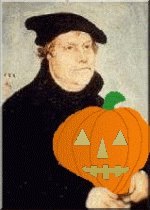
The "Reforween" illustration was spurred by a brother pastor in my circuit. He noted that Luther gets the credit for the widespread popularity of the Christmas tree. He figures that with this picture we might also be able to promote a folk belief that he introduced the Halloween jack o' lantern. This could have the collateral benefit of providing our church youth groups with a new source of income, October pumpkin sales.
Lection
Psalm 46
Revelation 14:6-7
Romans 3:19-28
John 8:31-36 or Matthew 11:12-19
Collect
Almighty and gracious Lord, pour out Your Holy Spirit on Your faithful people. Keep us steadfast in Your grace and truth, protect and deliver us in times of temptation, defend us against all enemies, and grant to Your Church Your saving peace; through Jesus Christ, Your Son, our Lord, who lives and reigns with You and the Holy Spirit, one God, now and forever.
Labels: church history, commemoration, european history, faith, feasts, festivals, german history, gospel, grace, justification, lutheranism, martin luther, reformation
¶ 00:00 | 0 comments |
Philipp Nicolai: 26 October AD 1608
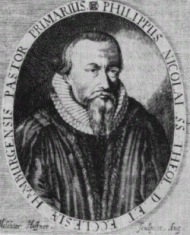 Nicolai was born in Waldeck, Germany 10 August 1556, the son of a Lutheran pastor. He entered the University of Erfurt and in 1576 he went to Wittenberg. For four years after his graduation, he lived at Volkhardinghousen and frequently preached for his father. In 1583, he was appointed Lutheran preacher at Herdecke, but because of a Roman Catholic town council, he found many difficulties there Following an invasion by Spanish troops in April 1586, a colleague re-introduced the Mass and Nicolai resigned his call.
In the end of 1586 he was appointed diaconus at Niederwildungen, near Waldeck and became pastor in 1587. In November 1588, he became chief pastor at Altwildungen, court preacher to the widowed Countess Margaretha of Waldeck, and tutor to her son, Count Wilhelm Ernst. He found himself in disagreement with Calvinists on the meaning of the Lord's Supper and worked toward having principality's clergy adopt the Formula of Concord. These and subsequent writings and actions led people to label him the "Arch Foe of Calvinism." Indeed, most of his scholarly works are criticisms of Calvinism, some making interesting comparisons with Islam.
 He went to Unna in Westphalia in 1596 which led to more controversy with the Calvinists. Unna fell victim to the plague in 1597 and 1598, which took the lives of 1,300 of its inhabitants. From the parsonage which overlooked the churchyard, Nicolai was saddened by the continual burials. On one day thirty graves were dug.
In the midst of this distress he wrote a series of meditations which he titled, Freudenspiegel deß ewigen Lebens (Joyful Mirror of Eternal Life). In these writings Nicolai looked to the hope of eternal life in Christ. On 27 December 1598, he fled before the invasion of the Spaniards, not returning until the end of April 1599. During this time Nicolai completed his Freudenspiegel.
In April 1601, he was elected chief pastor of Saint Katherine's Church, Hamburg, beginning his duties on 6 August. Life passed without many recorded incidents until 22 October 1608, when he participated in an ordination and returned home feeling ill. He developed a violent fever, dying 26 October 1608.
While in Hamburg, Nicolai gained fame for his preaching and was hailed at times as a "second Chrysostom." Still, we remember him most for his hymns, of which only three seem to have been published. A fourth hymn appearing in Mirror was written by a brother. These "Jesus hymns" began a new era of hymn writing in the 17th Century. Published only a few years before Arndt's True Christianity, they show a similar devotional feeling toward Jesus. However, Nicolai's theology never softened along the lines of Johann Arndt and his successors.
Johann Heermann: 17 February AD 1647
 Johann Heermann, considered the greatest Lutheran chorale writer between Luther and Gerhardt, was influenced by Valerius Herberger, writer of the hymn, Valet will ich dir geben. Heermann was born in Silesia, studied in Leipzig, Jena, and Strasbourg, and was called to be pastor in Köben in 1611. He contracted tuberculosis in 1634 and resigned his pastorate in 1638 because of declining health. He moved from there to Lissa, Poland, dying nine years later.
Many of Heermann's hymns were written for family devotions, so much of his output was based on Johann Arndt's Paradies Gärtlein ("Garden of Paradise"). His life was filled with suffering and sadness. During the Thirty Years War, he lost everything he owned three times. His first wife died young, he developed chronic sinusitis and bronchitis, rendering him unable to speak any length without terrible coughing. In spite of this, he helped his parishoners deal with their own difficulties as they, along with him, lost everything in war, pestilence and plague. After moving to Poland on the advice of his doctor son-in-law, he was built a small home. However, his sufferings overwhelmed him more and more. By the end of his life, he could neither sit or lie down, and slept while leaning against a wall.
In spite of his afflictions, he continued writing hymns of praise and comfort. Many consider his famous "Ah! Holy Jesus" to be among the finest of all passion hymns. His writing, rooted in the Jesus mysticism of the Middle Ages, is thought to have been one of the sources for the Pietist movement.
Paul Gerhardt: 27 May AD 1676
 Paul Gerhardt was dubbed the "sweet singer of Lutheranism." He was born on 12 March 1607 in Gräfenhaim, near Wittenberg and lived during the religious wars of the 17th century. He received training as a Lutheran pastor at Wittenberg, where Martin Luther had taught a century before. However, Gerhardt didn't receive a call to a church until 1651, when he was ordained to serve the congregation in Mittenwalde, southeast of Berlin.
While awaiting a call, he taught the children of Andreas Barthold — one of whom, Anna Maria, he later married. During that time he met Johann Crüger, the kantor and organist of Saint Nicholas Church, Berlin. Together they produced some of the greatest Lutheran chorales, including "Awake, My Heart with Gladness," (Auf, auf, mein Herz), "Now All the Woods Are Sleeping," and "All My Heart this Night Rejoices," among others.
Gerhardt's hymns combine a strong, objective faith in justification as a free gift from God with his own warm, subjective experience of that gift. In all, he wrote more than 120 hymns, many of which are still known and loved throughout the world.
His life, however, was difficult. He suffered greatly because of the religious wars. When asked to refrain from preaching against Calvinism by Elector Friedrich Wilhelm of Prussia, conscience would not allow him to compromise his Lutheran beliefs. He was soon deposed from office and barred from holding services even in his own home. During this time his wife and one son died, leaving him alone with a boy of six.
In May 1669, the congregation in Lübben, near the southeastern border of Germany, called him as pastor. He served there until his death on 27 May 1676. The Lübben congregation commissioned a life-sized painting of him for the church and in 1930, following renovation, the church was renamed Paul-Gerhardt-Kirche in his honor. The painting still hangs there. Beneath it is inscribed a fitting epitaph: "A theologian sifted in Satan's sieve."
Thank you to brother pastor and fellow blogger Charles Lehmann, who provided additional details on Nicolai's life and work.
Suggested Lection
Psalm 40
Deuteronomy 31:30-32:47
Colossians 3:12-17
John 16:16-24
Collect
Almighty God, through your holy apostle You taught us to praise You in psalms and hymns and spiritual songs; we give You thanks this day for the gift of hymn writing which confesses the Faith and inspires the faithful which You gave to Your servants Philipp Nicolai, Johann Heermann, and Paul Gerhardt, and we pray that Christ's Church may never lack those with the gifts of writing words and music to Your praise. May the Church be ever filled with the desire to praise and thank You for your grace, mercy, and faithfulness; through Jesus Christ, Your Son, our Lord, who lives and reigns with You and the Holy Spirit, one God, now and forever.
Labels: biography, christianity, church history, commemoration, european history, gerhardt, german history, hagiography, heermann, hymns, lutheranism, music, nicolai, reformation
¶ 00:00 | 0 comments |


