

In 1934, Giertz was ordained in the Linkoping Cathedral. He became assistant to the bishop and was given responsibility for working with the youth. His own faith and his conviction concerning the relevance of Christianity were on display for the thousands of young people who came under his care. Even as orthodox Lutherans lauded him, he also drew attacks from modernists in the Swedish state church and secularists as his writings spread in newspapers and periodicals. The public knew him as a talented and faithful confessor of a Church doctrine that was based in Scripture, confessed in the Creeds, and expounded in the Lutheran Confessions.
Giertz became a priest in Torpa in 1938, serving that parish until 1949, when he was consecrated as Bishop of Gothenburg. While serving Torpa, he wrote With My Own Eyes, a retelling of the Gospels (1947), four theological works, Christ's Church (1939), Church Piety (1939), The Great Lie and the Great Truth (1945), and The Battle for Man (1946), the catechetical book The Foundation (1942), and two novels The Hammer of God (1941) and Faith Alone (1943). These latter, particularly Hammer of God, became popular throughout Scandinavia and then around the globe.
The attention to theology and care for souls that Giertz evidenced in Torpa continued when he became Bishop of Gothenburg in 1949. As the youngest man elected and consecrated to serve the Church of Sweden as a diocesan bishop, he combined a somewhat pietistic type of pastoral care with High Church Lutheran theology, traits that are noticeable in his novels. Following the decisions of the Swedish Parliament and the Church Assembly to ordain women in the Church of Sweden (1958), Giertz became a leader of the opposition. In that same year, he invited all confessional groups in the Church of Sweden to form The Church Movement for Bible and Confession in response to the Assembly's decision.

Giertz pioneered a return to every Sunday celebration of the Lord's Supper, something that had largely vanished in the Church of Sweden due to the erosion caused by Pietism and Rationalism. He strongly urged pastors to pray the Daily Offices, something he applied in his own devotional life. Although often rejected by the leaders of the Church of Sweden, Giertz remains popular with true Lutherans in his own country, throughout Scandinavia, and across the world. Of him, the Reverend Hans O. Andrae wrote, "In his vision of the One Holy Christian and Apostolic Church, Giertz integrated a vibrant Evangelical-Lutheran orthodoxy, the Church's traditional liturgy, and sincere church piety into a harmonious and powerful wholeness."
Suggested Lection
Psalm 46
Isaiah 55:6-11
Romans 10:5-17
John 15:1-11
Collect
O Lord God, heavenly Father, we pray that, as You raised up Bo Harald Giertz to lead Swedish Lutherans into a renewed appreciation of their confessional heritage and trust in the saving Gospel of Jesus Christ, and as You spoke to the entire Church through his writings, so You would continue to provide faithful pastors and leaders, keep us steadfast in Your grace and truth, defend us against all enemies of Your Word, and bestow on Christ's Church Militant Your saving peace; through Jesus Christ, Your Son, our Lord, who lives and reigns with You and the Holy Spirit, one God, now and forever.
Labels: biography, bo giertz, christianity, church history, commemorations, european history, hagiography, lutheranism, sweden
¶ 00:00 | 0 comments |

 Irenaeus (ca. AD 130-200), believed to be a native of Smyrna (modern Izmir, Turkey), studied in Rome and later became pastor in Lyons, France. Around 177, while Irenaeus was away from Lyons, a fierce persecution of Christians led to the martyrdom of his bishop. Upon Irenaeus' return, he became Bishop of Lyons.
His most famous writing is Adversus Haereses (Against Heresies). This work condemned several errors but focused especially on Gnosticism, which denied the goodness of creation. In opposition, Irenaeus confessed that God has redeemed his creation through the incarnation of the Son. Irenaeus also affirmed the teachings of the Scriptures handed down to and through him as being normative for the Church.
Despite a few stray texts, very little suggests that he did not die a natural death. He was buried in Saint John's Church, Lyon — a congregation later renamed in his honor. Huegenot Calvinists destroyed his tomb and his remains during in 1522, during a period of iconoclasm.
Collect
Almighty God, You upheld your servant Irenaeus, giving him strength to confess the truth against every false doctrine; keep us, we pray, steadfast in Your Word and grant us the practice of true religion, that in constancy and peace we may walk in the way of eternal life; through Jesus Christ our Lord, who lives and reigns with You and the Holy Spirit, one God, now and forever.
Labels: biography, christianity, church history, commemoration, european history, french history, hagiography, irenaeus, lutheranism, lyons, patristics
¶ 00:00 | 0 comments |
 After Martin Chemnitz and Johann Gerhard, Johannes Andreas Quenstedt may have been the ablest theologian of the Lutheran church in the period following the death of Martin Luther. A shining light during the period of Lutheran orthodoxy, Quenstedt still offers much to the Church of our day.
Born on 13 August 1617 in Quedlinburg, Germany (modern Bundesland Saxony-Anhalt), Quenstedt was nephew to Johann Gerhard. His mother was the noted theologian's sister.
During his early school days, Quenstedt hoped to study under his uncle at the university at Jena. Unfortunately for young Johannes, Gerhard died before he could enroll at the university. Because of this, Quenstedt's mother changed plans and sent her son to Helmstedt. Many Lutherans had doubts about the overall orthodoxy of Helmstedt. However, its fifty mile distance from Quedlinburg allowed his mother to keep him closer to home.
Quenstedt spent six years in his university studies before moving on to Wittenberg in 1644 to continue his education. In spite of his new school's misgivings over his time at Helmstedt, Quenstedt excelled in Wittenberg. As various faculty members began to support and encourage him, he became ever more convinced of the correctness of Lutheran doctrine and gradually developed his own personal style of theological teaching.
As he delved into the Scriptures, the Confessions, and other Lutheran writings, Quenstedt publicly asserted the claims of Lutheran orthodoxy. Therefore, as he began his own career as author and lecturer, he was no mere parrot of his famous uncle. He set forth and defended his own convictions, firmly convinced that they rested on Biblical truth.
Quenstedt received an appointment from Wittenberg University as a lecturer in October 1644. At various times during his career he served as professor of theology, logic, and metaphysics. During his early years as lecturer, he continued his studies and received his Doctorate in Theology in 1650.
Despite the seeming ease with which Quenstedt's career progressed, much of his life was difficult. From childhood, he suffered ongoing illnesses and various physical ailments. Joined in marriage in 1651, he saw his wife die before their first wedding anniversary. He remarried in 1653 but his second wife died after only three years. Soon thereafter, Quenstedt married Anna Sabina Scharf. This 1556 union was long and successful, blessed by God with 12 children.
Friedrich August Tholuck referred to Quenstedt as the "bookkeeper and secretary" (Buchhalter und Schriftführer) of Lutheran orthodoxy. This verdict, however, disagrees with the facts and sells a great man short. Although he did much to catalog, organize, and disseminate that which came before him, he also expanded the scope of Lutheran teaching. Well-read and devout, he lived the life that his works espoused, ever displaying a keen intellect and deep understanding of Holy Scripture and Lutheran theology. For all his bold confession, Quenstedt was a quiet, pious, and somewhat private man.
Without question, Quenstedt's Theologia Didactico-Polemica Sive Systema Theologicum (Didactic-Polemic Theology or Systematic Theology) remains his great contribution to the Church. The Systema is no tidy compendium but a massive volume. When published, it would have cost most pastors several weeks' salary — if not more.
Despite the cost, the Systema underwent several printings, testifying to the book's value and the strong demand from clergy and university instructors. Unfortunately, most of the volume remains unavailable in English translation.
The Systema carefully outlines and expounds upon almost all debated and controverted doctrines from the period. Each section is divided into two portions, one didactic, the other polemic. Quenstedt's "polemic," however, differs from many others stemming from the period of Orthodoxy or elsewhere during Church history. Neither harsh or bombastic, his polemics thoughtfully and gently respond to contemporary critics of Lutheranism.
Since the attacks of earlier ages vary little from those of subsequent times, the Systema remains a valuable resource for present-day Lutherans beset by misguided assaults on our teachings and practices.
Suggested Lection
Psalm 46
Isaiah 55:6-11
Romans 10:5-17
John 15:1-11
Collect
O Lord God, heavenly Father, pour out Your Holy Spirit upon Your faithful people, keep them steadfast in Your grace and truth, protect and comfort them in all temptation, defend them against all enemies of Your Word, and bestow on Christ's Church Militant Your saving peace; through Jesus Christ, Your Son, our Lord, who lives and reigns with You and the Holy Spirit, one God, now and forever. Amen.
Lord, keep us steadfast in Your Word!
Sources
Studium (written by Caleb Bassett)
Christian Cyclopedia (Lueker, Poellot, Jackson, eds.)
Wikipedia
Labels: biography, church history, commemoration, european history, german history, hagiography, johann gerhard, lutheranism, martin chemnitz, martin luther, polemics, quenstedt, theology
¶ 00:00 | 0 comments |
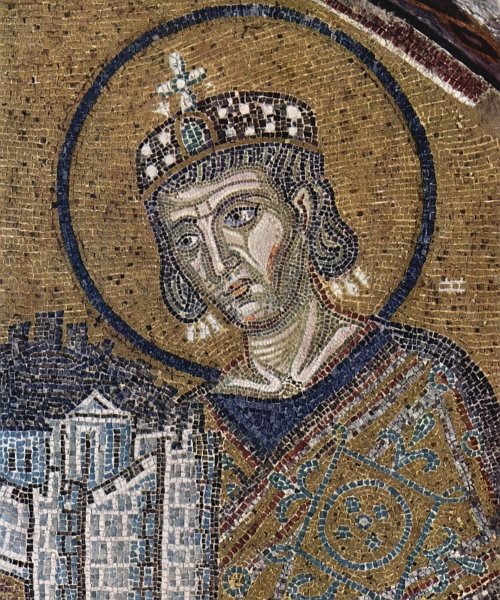
 Flavius Valerius Aurelius Constantinus served as Roman Emperor from AD 306 to 337. During his reign the persecution of Christians was forbidden by the Edict of Milan in 313. Ultimately, the faith gained full imperial support.
Constantine took an active interest in the life and teachings of the church. He called the First Council of Nicaea in 325 at which Saint Athanasius and others defended and defined orthodox Christianity. Among the fruits of this council was one of Christendom's major confessions of faith, the Nicene Creed.
Some argue that Constantine may not have been true believer since he wasn't baptized until his death bed. However, he actively supported Christianity in his later life and even preached upon occasion. Other scholars speculate that he delayed baptism for the same reason as did many others during portions of the Church's history, that of a general misunderstanding of Holy Baptism.
 Many theologians spoke of the need for "satisfaction" — making amends for sins committed during one's life — and warned about time that would be spent in Purgatory by those who didn't make full satisfaction while still living. Indeed, some even taught that unless proper penance was done, one might find himself forever barred from Heaven!
Since Baptism truly washes away all sin — both that of our birth nature and any transgressions committed later — some thought the best way to avoid Purgatory (or Hell) was to be baptized when one was at death's door. In so doing, people believed that there would be no unrepented, unsatisfied sins remaining that would leave one waiting for eternal bliss or forever denied its blessings.
I'll not argue here the reasons why Lutherans reject the notion of satisfaction or the idea of Purgatory. I'll merely say that if Constantine had such worries, he wasn't alone during his day, and his decision to delay would be understandable in light of such teaching.
Saint Helena, ca. AD 255-329
Constantine's mother Helena strongly influenced her son throughout his life. Her great interest in locating the holy sites of the Christian faith led her to become one of the first Christian pilgrims to the Holy Land. Her research led to the identification of Biblical locations in Jerusalem, Bethlehem, and beyond, which are still maintained as places of worship today. One of Christianity's annual festivals, Holy Cross Day, has its origin in her explorations of Palestine.
Collects
O Lord, our God, King of the universe, who raises up earthly rulers to work Your will in this life, You called Constantine to the imperial throne and ended wide-spread persecution of Your Son's Church; grant that as he served You by fulfilling his vocation, so we would continue to receive from You rulers who allow the Church to proclaim the saving Gospel of Your Son, Jesus Christ, our Lord, who lives and reigns with You and the Holy Spirit, one God, now and forever.
Almighty God, who called your servant Helena to an earthly position of authority so that she might advance your heavenly kingdom, filling her with zeal for your Church and love for Your people, grant that we may be fruitful in good works and steadfast in our faith in Your Son, and finally by your mercy attain everlasting life; through Jesus Christ our Lord, who lives and reigns with you and the Holy Spirit, one God, now and forever.
Labels: athanasius, biography, church history, commemoration, constantine, edict of milan, european history, hagiography, helena, holy cross, nicaea, nicene creed, patristics, roman empire
¶ 00:00 | 0 comments |
 Erik Jedvardsson (Edward's Son) ruled much of Sweden from 1150 to 1160. He headed a Christian kingdom bordered by various pagan realms, all of which shared an ancient tradition of fighting with each other. During the middle of his reign, about 1155, he led a Swedish expedition into Finland, which was then loosely under Swedish rule. The objects were the consolidation of Swedish authority and the establishment of a protected Christian mission. This latter was headed by the English-born Henry of Uppsala, considered by many the founder of the Church in Finland.
Erik also gained renown for measures designed to to provide Sweden with fair laws and just courts, including steps designed to assist the poor and the infirm. One story of his death goes as follows: On 18 May 1160, the day after Ascension Day, while worshiping in an Uppsala church, word came that a pagan Danish army was approaching to kill him. He replied, "Let us at least finish the sacrifice. The rest of the feast I shall keep elsewhere." As he left the church, the pagans rushed upon him and killed him.
Other accounts claim that he was assassinated by Emund Ulvbane, who worked for the rival house of Sverker. Still another story says that the rival claimant Magnus Henriksson either caused or arranged Erik's death. The history of his recognition and official canonization is somewhat blurred. Regional fervor favored him but church politics seemingly denied him papal recognition. Indeed, Pope Alexander III, using the pretext that Erik was a boozer who died in a drunken brawl, censured his cult in 1172. Although no sources say anything officially, one must wonder if Swedish nationalism following this slight might have helped the Reformation later gain rapid inroads in Sweden.
Erik was honored both as an upholder of the Christian faith and as a national hero, the ancestor of a long line of Swedish kings. His bloodline also spread by marriage into the courts of Norway and Denmark. Within thirty years of his death, he was listed on the Swedish sanctorial calendar. He remains honored as the patron of the city of Stockholm and his likeness is on the city's coat of arms (above). He is also held as the principal patron of Sweden. His silver casket still sits in Uppsala's cathedral.
Collect
O God, who called Your servant Erik of Sweden to an earthly throne and allowed him to advance Your heavenly kingdom, giving him zeal for Your Church and love for Your people, mercifully grant that we who commemorate him this day may be fruitful in good works, and attain to the glorious crown of Your saints; through Jesus Christ our Lord, who lives and reigns with you and the Holy Spirit, one God, now and forever.
Labels: biography, church history, commemoration, erik, erik ix, european history, hagiography, lutheranism, patron saint, sweden
¶ 00:00 | 0 comments |
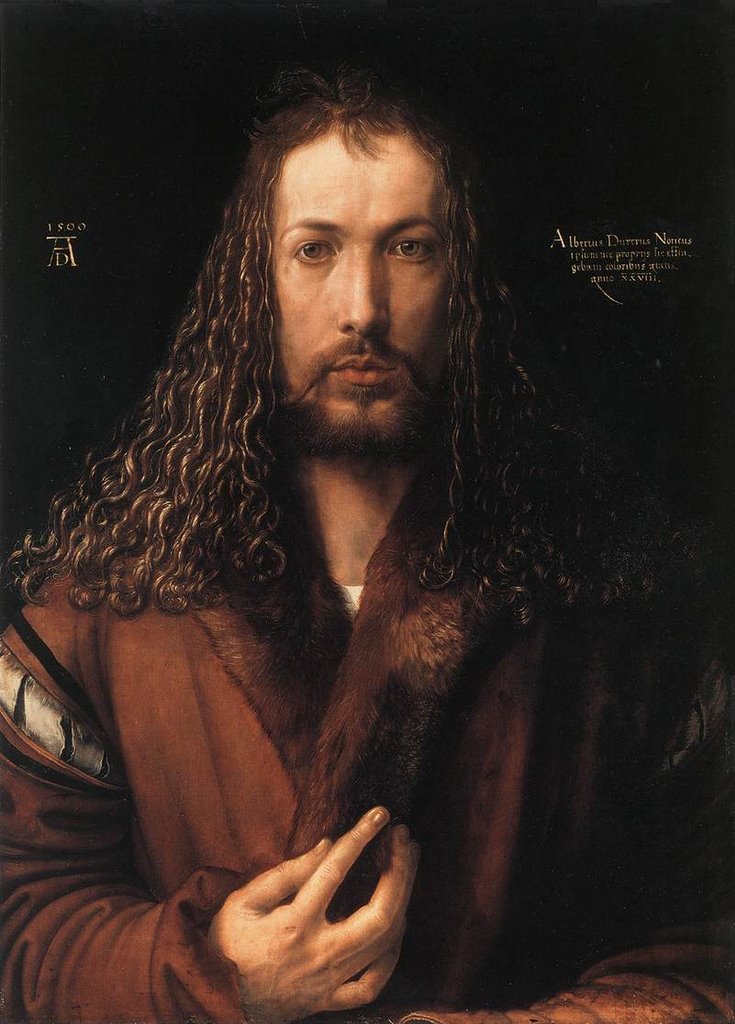 Albrecht Dürer (1471-1528), a native of Nuernberg, Germany, was one of the most learned of Renaissance artists and ranked among the great minds of Humanism. His paintings and woodcuts include examples of the splendor of creation and skilled portrayals of biblical narratives.
While great beauty and form characterize his paintings, most know him best for his woodcuts and etchings, often produced in extended series format. The Concordia Historical Institute displayed two of these series in one show: His "Life of Mary" and "Small Passion" were shown in an exhibit entitled A Sword Will Pierce Your Own Soul Too. CHI made digital copies of the individual works and they may be viewed by following the link.
Dürer never renounced Roman Catholicism, although his later writings and paintings show great sympathy toward the Reformation and ardent admiration for Martin Luther.
16 October AD 1553
 Lucas Cranach (1472-1553), a close friend of Martin Luther, was a celebrated painter of portraits and altar pieces and a producer of woodcuts of religious subjects.
Among his portraits are some of the most noted depictions of Martin and Katy Luther and Luther's co-worker Philipp Melanchthon. He also did a number of works from Greco-Roman mythology, Biblical and hagiographic scenes, and portrayed a number of wealthy people from his time.
Among his most noted works is the altarpiece from Weimar, often thought to have been completed by his son, Lucas Cranach the Younger. The painting depicts Old and New Testament themes centering on Law and Gospel and on the crucifixion and resurrection of Christ. Cranach's intentional anachronism of including himself, Martin Luther, and John the Baptizer at the foot of the cross shows how the Church always points to Christ and benefits from His suffering and death.
Some later scholars have tried to depict Cranach as a misogynist. However, examination of his writings and the content of his paintings allows little credence for this theory.
Both Cranach and Dürer are remembered and honored for the grandeur of their works of art that depict the glory and majesty and the grace and mercy of the triune God. Along with these two Germans, I've also included their approximate contemporary from Italy, Michelangelo Buonarroti. He also used his talents to illustrate Scripture's story and God's glory.
18 February AD 1564
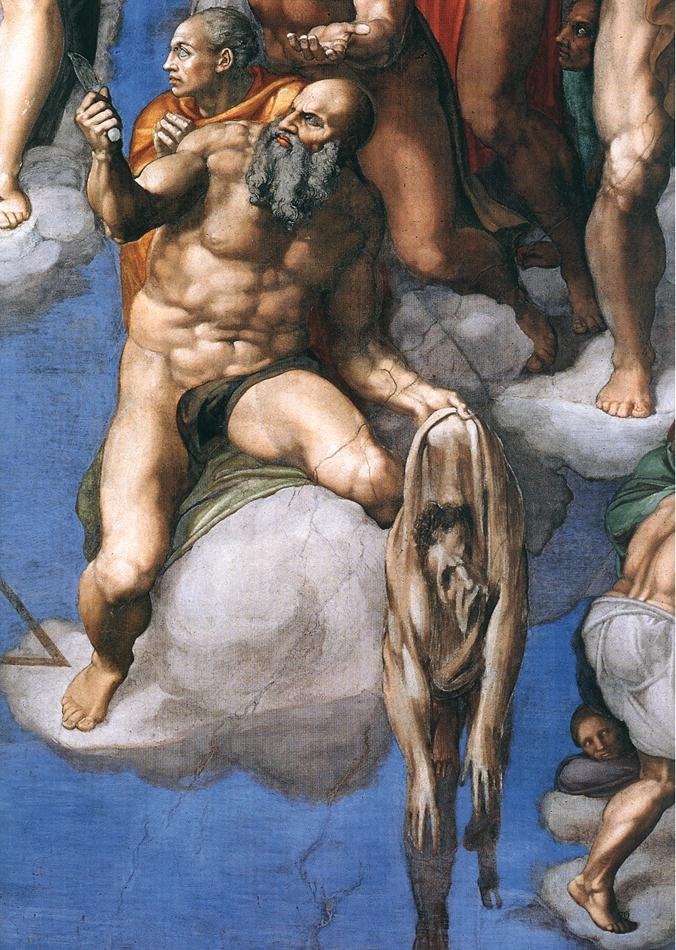 During roughly the same time that Cranach and Dürer worked in Germany, Florentine artist Michelangelo Buonarroti (1475-1564) was busy in Italy. By age 21, he'd already carved his famous Pietà, a scene of the Virgin holding her dead Son before His burial. Most will probably know him from his statue of David and his work in the Sistine Chapel.
The picture here is from his "Last Judgment" fresco; the person portrayed is Saint Bartholomew, holding the knife said to have flayed him in one hand and his peeled skin in the other. I include it because the face of the restored saint is a self-portrait by Michelangelo. Many have speculated as to why he chose this particular person to bear his image. Some think he used it to indict those who criticized him, as if to say, "You can cut away at me now, but I will be vindicated." Others believe that he wrestled throughout his life with temptation and sinful behavior but recognized that in the Resurrection he would be remade.
Collect
O God, who by your Holy Spirit give to some the word of wisdom, to others the word of knowledge, and to others the word of faith, we praise You for the gifts of proclaiming Your grace and glory through visual representation that you gave to your servants Albrecht and Lucas [and Michelangelo], and we pray that Your Church may never be destitute of such gifts; through Jesus Christ our Lord, who lives and reigns with You and the Holy Spirit, one God, now and forever.
Labels: art, biography, church history, commemoration, cranach, duerer, durer, dürer, european history, german history, hagiography, italian history, michelangelo, vocation
¶ 00:00 | 0 comments |
 Croatian reformer Matthias Flacius Illyricus (Matija Vlačić Ilirik) was born on 3 March 1520 in Labin (Albona in Latin). At that time, the region was under control of the Venetian Republic. He left home at age 16 to study in Venice. Baldo Lupetina a relative and Franciscan superior on the nearby island of Cres (who was later executed as a heretic) encouraged Matthias to continue studying in Germany.
Flacius traveled to Augsburg, arriving in 1539. He stayed only a short time before moving to Basel, where he enrolled at the university and studied Hebrew and Greek. There he also acquainted himself with many of the day's noted Protestant intellectuals. He moved on to Tübingen to continue his studies.
Traveling on, Flacius headed for the birth place of the Lutheran Reformation. He received his Master's degree from the University of Wittenberg at the age of 24 and lived for most of the 1540s in that town. His degree led to an immediate promotion to professor of theology.
Following Wittenberg, Matthias moved to Magdeburg. Between 1549 and 1557 and under his leadership, this city became a center of opposition to first the Augsburg and then the Leipzig Interims. These were forced truces between the Catholics and the Lutherans and certain other Protestants. During this period, Flacius began openly opposing Philipp Melanchthon and the theological and political compromises he was making with Rome and certain non-Lutheran reformers. Flacius believed that he was a faithful follower of Martin Luther and his theology and saw Melanchthon as one who would destroy much of what Luther had struggled so mightily to obtain.
 His time in Magdeburg was productive otherwise, as well. While there, he commenced work on on the 13-volume Ecclesiastica Historia (poplularly known as the Magdeburg Centuries) with Johannes Wigand and other scholars. He also wrote numerous tracts and pamphlets on various theological topics.
In 1557, Flacius was invited to head the newly founded theological faculty at the University of Jena. He served in this capacity until the end of 1561, when he was released due to his position in a controversy over original sin. He then moved to Regensburg, living there from 1562-1566. He was unable to achieve two great desires. First, he wanted to open a school for Southern Slavs and also hoped to relocate the Protestant printing press from Urach. Neither happened because Regensburg cancelled his asylum on the orders of Emperor Maximilian II.
At the invitation of the City Senate of Antwerp, Flacius moved there for a brief time, staying long enough to write a confession of faith for the Lutherans of the Low Countries. He was then in Strasbourg from 1567 to 1573. There he completed his final large work, the Glossa compendiaria, a commentary on the New Testament. He died at Frankfurt-am-Main in 1575.
Many would call Matthias Flacius' hermeneutical works his most important achievements and he certainly was a pioneer in the field. His Clavis Scripturae Sacrae (Key to Sacred Scripture) established that any passage of the Bible should be interpreted considering the purpose and the structure of the whole chapter or a given book. It also declared the rule that the literal sense of the text should have a priority over allegories and metaphors. He also contributed much to Church history and dogmatics. As overall proof of his learning and scholarship, we note that Flacius likely owned the single largest private collection of books during the 16th Century.
 Silesian and Swabian pastors asked Matthias to refute Caspar Schwenckfeld, who taught that "the inner word of the spirit must be differentiated from the external word spoken by the preacher; that the living Word of God is not the Scriptures but Christ, and that the Scriptures must be interpreted spiritually." This appeal to a subjective understanding and acceptance of an inner word hidden in the hearts of believers rather than the divinely inspired and clearly stated external Word went against all he'd learned from the reformers on the literal sense of the text. Of Schwenckfeld's spiritualizing of the Bible, Flacius said, "Spiritual exegesis [explanation] fits Scripture like a fist fits into an eye."
In all of his theology, Flacius tried to stay loyal to Luther, particularly the Reformer's emphasis on the bondage of the will. Unfortunately, his often abrasive style and his extreme position on original sin alienated many other staunch Lutherans. Because of this, his name fell into neglect and an undeserved degree of disrepute among many confessional Lutherans, even to the present day.
Additionally, he was a Croatian with Italian manners and mannerisms whose German was never good enough for those among whom he worked. In other words, Matthias Flacius Illyricus failed to fit in among his contemporaries in almost every way imaginable. However, we cannot underestimate his influence in preserving, promoting, and expounding the theology of the Lutheran Reformation.
In 1878, biographer Johann Wilhelm Preger eulogized Flacius: "A man of resolute courage, insuperable strength, possessing a wide-ranging knowledge one rarely encounters, with a broad vision and an industrious spirit."
Notes: See the Matthias Flacius Illyricus Memorial Collection on the Internet Archive for an extensive resource of things Flacius. Magdeburg Press sells How to Understand the Sacred Scriptures, a translated portion of the Clavis Scripturae Sacrae. Illyricus comes from the name of the former Roman province of Illyricum, which included his homeland. I also recommend Oliver K. Olson's book Mattias Flacius and the Survival of Luther's Reform. Flacius is not on the LCMS calendar of commemorations but is part of my ongoing addition of noted Lutherans and other Christians to a list of those I consider worthy of the Church's remembrance.
Labels: apologetics, baldo lupetina, biography, commemoration, croatia, european history, flacius, hagiography, lutheranism, martin luther, philipp melanchthon, reformation
¶ 00:00 | 0 comments |
 Lucia (also Lucy or Lukia) was one of the victims of the great persecution under the Roman emperor Diocletian. She met her death at Syracuse on the island of Sicily because of her Christian faith. Known for her charity, "Santa Lucia" (as she is called in Italy) gave away her dowry and remained a virgin until her execution by the sword. Some accounts, similar to those surrounding Saint Polycarp, claim that Lucy was first sentenced to be burned and that when this failed, she was stabbed to death.
Various stories are told about her. Some claim that she refused to marry a pagan and was killed; others say that forfeiting her dowry led her unbelieving fiancé to denounce her to the authorities as a Christian. Another account tells us that either during or at a time before her execution, her eyes were gouged out but that God restored her sight.
 The name Lucia means "light." Because of that, festivals of light held in her honor became popular throughout Europe, especially in the Scandinavian countries. There, her feast day corresponds with the time of year when there is the least amount of daylight. Under the Julian Calendar, her feast day actually fell on the shortest, darkest day of the year but this connection vanished with adoption of the Gregorian Calendar.
Ecclesiastical art often portrays Saint Lucia holding a palm branch, the traditional sign of victory or martyrdom; a sword may also be shown piercing her breast or throat. Sometimes, as in the pictures above, we see her holding her missing eyes in her hand or on a plate before her.
 Another common portrayal has the saint dressed in a white baptismal gown, wearing a wreath of candles upon her head. In many Nordic homes, this attire is mimicked on her feast day. One of the girls or women of a household, often the eldest daughter, wakes early on Lucy's feast day, prepares a special breakfast, dons a headpiece of candles, and moves through the home with the meal honoring the saint.
Lucy's name was applied to various people and places in the centuries following her death. Among the most noted would be the Santa Lucia area of Naples, celebrated in the Neapolitan song Santa Lucia. The tune calls Lucy's namesake area impero dell'armonia (the empire of harmony).
Agatha, 5 February AD 290
With Lucy, the Church sometimes also honors the virgin martyr Agatha. She came from Catania in Sicily, and was most likely martyred in the late 200s. Aside from her name on the lists of early martyrs, we know nothing of her.
Lection
Psalm 65:1-8
Deuteronomy 33:1-3
Revelation 7:2-17
Matthew 5:1-12
Collect
O Almighty God, by whose grace and power Your holy martyr(s) Lucy (and Agatha) triumphed over suffering and was (were) faithful even unto death, grant us, who now remember her (them) with thanksgiving, to be so faithful in our witness to You in this world, that we may receive with her (them) the crown of life; through Jesus Christ our Lord, who lives and reigns with You and the Holy Spirit, one God, forever and ever.
Hymn Stanza
For holy martyr Lucy, Who faced the tyrant's sword
And through her death gave witness, We praise Your name, O Lord.
Your light she showed in darkness; May we thus also shine
Until, our struggles ended, We see Your face divine.
Hymn text © 2006 by Walter P. Snyder. Permission granted for use with proper attestation.
Labels: agatha, biography, church history, commemoration, diocletian, european history, italian history, light, lucia, lucy hagiography, martyrdom, roman empire, scandanavia
¶ 00:00 | 0 comments |
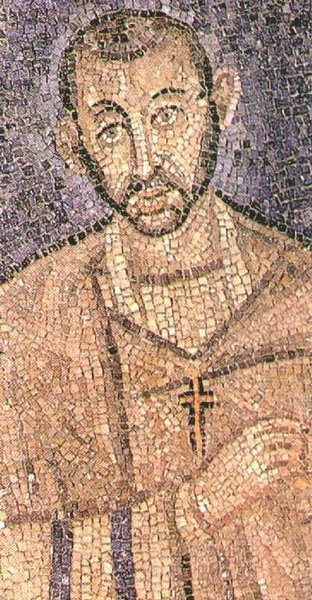
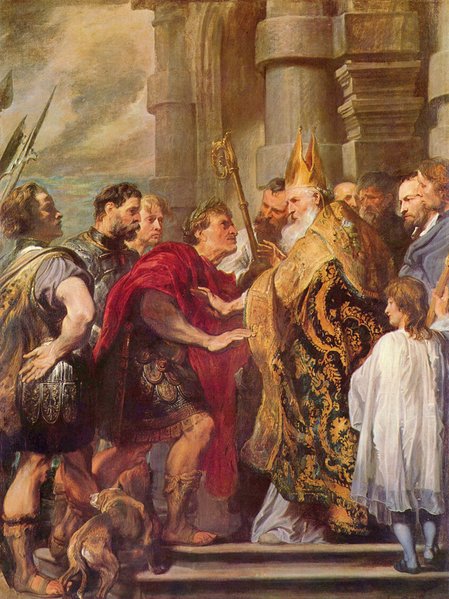 Saint Ambrose of Milan was born in Trier around AD 340. He became a Roman governor in northern Italy and the people of Milan later named him bishop by general acclaim. He stands as one of the four Latins among the eight Doctors of the undivided Church. Augustine, Jerome, and Gregory the Great are the West's other representatives; Athanasius, John Chrysostom, Basil the Great, and Gregory of Nazianzus represent the East.
Ambrose was also an author of hymns, the best known of which is probably Intende, qui regis Israel (usually known by its second stanza as Veni, Redemptor gentium). Martin Luther translated it into German (Nun komm, der Heiden Heiland); its English translations (from Luther or the original Latin) usually appear as Savior of the Nations, Come; Savior of the Heathen, Known; or Come, Thou Redeemer of the Earth).
His name is also associated with Ambrosian Chant. You can search the web for examples of the notation while YouTube has a number of recordings of sacred music performed according to Ambrosian sensibilities. This style of chanting the ancient liturgy took hold in the province of Milan. For more on his musical influence in the Church, see the NetHymnal for a detailed list with links to translations and adaptations of a number of the Hymns of Saint Ambrose.
While serving as a civil governor, Ambrose sought to bring peace among Christians in Milan who were divided into quarreling factions. When a new bishop was to be elected in 374, Ambrose addressed the crowd, and someone cried out, "Ambrose, bishop!" The entire gathering gave their support. At this time, Ambrose was still a catechumen, an unbaptized person still under instruction before joining the church. The general acclaim hastened the catechetical process and the 34-year-old was baptized on December 7, after which he was consecrated bishop of Milan.
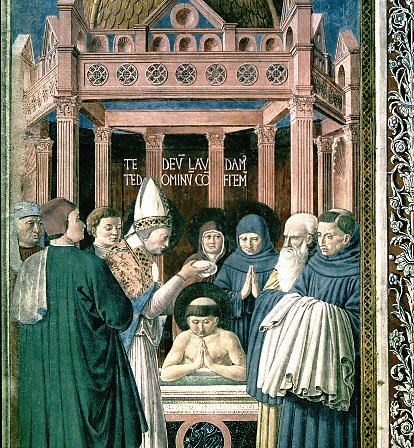 A strong defender of the faith, Ambrose convinced the Roman emperor Gratian in 379 to forbid the Arian heresy in the West. At Ambrose's urging, Gratian's successor Theodosius also publicly opposed Arianism.
Ambrose died on Good Friday, 4 April 397, but the Church was unwilling to honor such a known and popular person on the day commemorating the death of Christ. Thus, his feast day was transferred from his "heavenly birthday" (or death date) to the date of his baptism and subsequent consecration as bishop.
Ambrose was also instrumental in the conversion of Augustine of Hippo. Some early traditions hold that the hymn Te Deum Laudamus ("We Praise You, O God") was a spontaneous composition by Ambrose, perhaps with Augustine's help, upon the baptism of the latter. While later researchers hold this to be unlikely, some scholars are convinced that he was largely responsible for authorship of the Athanasian Creed (14k PDF).
As a courageous doctor and musician he upheld the truth of God's Word. Once again this Advent-tide, thousands upon thousands of believers will use Savior of the Nations, Come to pray for the Second Coming of our Lord. Here is my favorite, passed on to us from Ambrose via Martin Luther and William Morton Reynolds:
Savior of the nations, come;
Virgin's Son, here make Thy home!
Marvel now, O heaven and earth,
That the Lord chose such a birth.
Not by human flesh and blood;
By the Spirit of our God
Was the Word of God made flesh,
Woman's offspring, pure and fresh.
Wondrous birth! O wondrous Child
Of the virgin undefiled!
Though by all the world disowned,
Still to be in heaven enthroned.
From the Father forth He came
And returneth to the same,
Captive leading death and hell
High the song of triumph swell!
Thou, the Father's only Son,
Hast over sin the victory won.
Boundless shall Thy kingdom be;
When shall we its glories see?
Brightly doth Thy manger shine,
Glorious is its light divine.
Let not sin o'ercloud this light;
Ever be our faith thus bright.
Praise to God the Father sing,
Praise to God the Son, our King,
Praise to God the Spirit be
Ever and eternally.
Lection
Psalm 27:5-11 or 33:1-5,20-21
Ecclesiasticus 2:7-11,16-18
1 Peter 1:3-9, 13-21
Luke 12:35-37, 42-44
Collect
O God, who graciously gave Your servant Ambrose eloquence to proclaim Your righteousness and fearlessness to bear reproach for the honor of Your Name, mercifully grant to all pastors and overseers such excellence in preaching and faithfulness in ministering Your Word that Your people may be partakers with them of the glory that shall be revealed; through Jesus Christ our Lord, who lives and reigns with You and the Holy Spirit, one God, now and forever.
Labels: ambrose, arianism, augustine, biography, chant, commemoration, european history, hagiography, hymnody, liturgics, music, roman empire, te deum, theology
¶ 00:00 | 0 comments |
 Also known as Saint Elizabeth of Thuringia — Szent Erzsébet in her native tongue — Elisabeth was born in Sárospatak in 1207, the daughter of King András II and his wife Gertrude of Merania. When only four years old, she was betrothed by parental arrangement to Ludwig (Louis), son of Hermann I, Landgrave of Thuringia, and Duchess Sophia. At this tender age, the child moved to the Thuringian court. She married him in 1220, when just fourteen. He was only twenty and had been ruling as Ludwig IV since 1217.
Her spirit of Christian generosity and charity pervaded the home she established for her husband and three children in the Wartburg Castle at Eisenach. Their abode was known for hospitality and family love.
Elisabeth often supervised the care of the sick and needy, even giving up her bed to a leper at one time. Unlike many medieval men, particularly the rulers, Louis encouraged her efforts and contributed directly to them. This seems due, in large part, to a faith that depended much upon works in order to guarantee eternal reward — or, at least, to avoid Purgatory.
When she was widowed at 20, circumstances drastically changed. Already possessed of a charitable heart, Elisabeth increased her work on behalf of others — her confessor, the inquisitor Konrad von Marburg, encouraging (or pushing) her growing spiritual discipline. Some accounts say that Konrad not only enforced his will through a strong personality but that he also resorted to beatings and separating her from her children.
 Later, she arranged for her children's well-being and entered into life as a nun in the Order of Saint Francis. Her self-denial, quite possibly abetted by harsh treatment at the hands of her confessor, led to failing health and an early death in 1231 at age 24. Remembered for her self-sacrificing ways, Elisabeth is commemorated through the many hospitals named for her around the world.
She was laid to rest in a gold shrine in Elisabeth Kirche in Marburg. The second illustration above is a scene of her helping the poor from that church's Elizabeth Window. Her popular cultus, aided in large part by political considerations, led to a rapid canonization. In 1235, Pope Gregory IX named her St. Elisabeth. Her official canonization ceremony was Pentecost (28 May), only about three and a half years after her death. The lasting effect she had on individuals, the Church, and on health care has led many to call her "the greatest woman of the German Middle Ages." In honor of Elisabeth and her contributions to Church and society, the city of Erfurt chose her as its 2007 "cultural theme."
Note: For Lutherans, Wartburg Castle holds special significance because of events happening some three hundred years later. It was to the Wartburg that friends moved Martin Luther in 1521 to escape enforcement of the imperial ban and possible death. Hiding under the name Junker Jörg (Knight George), Luther employed himself by continuing his doctrinal and polemical writing and translating the New Testament.
Lection
Psalm 146:4-9 or 112:1-9
Tobit 12:6b-9
Matthew 25:31-40 or Luke 12:32-34
Collect
Almighty God, by whose grace your servant Elisabeth of Thuringia recognized and honored Jesus in the poor of this world, grant that we, following her example, may with love and gladness serve those in any need or trouble, in the name and for the sake of through Jesus Christ our Lord, who lives and reigns with you and the Holy Spirit, one God, now and forever.
Labels: biography, charity, church history, commemoration, elisabeth, elizabeth, erzsébet, european history, german history, hagiography, health, hungary, thuringia
¶ 00:00 | 0 comments |
 Justinian, Christian Ruler and Confessor of Christ, was emperor of the East from A.D. 527 to 565, during the time of decline of the Roman Empire. Aided by his beautiful and capable wife, Theodora, he restored majesty to the Byzantine court and is considered by historians to be the last true "Roman" emperor. During his reign the Empire experienced a renaissance, due in large part to his ambition, intelligence, and strong religious convictions.
His beginnings rival most any tale of rags to riches. Born into a peasant family, he was adopted by his uncle Justin, his mother's brother. Justin went from being a member of the imperial guard to Emperor and even, before reaching this pinnacle of power, was in a position to provide the best education possible for his nephew cum son. Justinian partially repaid his uncle's kindness by supporting Justin's selection as emperor.
Perhaps due in part to his own family's peasant members, Justin decreed that differences in social class were no longer barriers to marriage. Some time later, Justinian found a woman to claim as his bride. Since Justin had removed class barriers, Justinian made full advantage of the changes by taking Theodora as his wife. Here was a truly disparate set of individuals: While the emperor in waiting had ascended from peasant stock to ruling class, his bride came from a background considered lower than peasant — perhaps even lower than slave, for she was an actress and a courtesan.
Despite such unsavory beginnings, Theodora proved herself a worthy companion for the Emperor. Throughout her life she was Justinian's staunchest supporter and one of his most trusted advisers. Many historians believe that without her intellect and decisiveness, Justinian might have been deposed and the empire torn apart in the Nika riots.
Although he was responsible for a considerable number of civil and military accomplishments, Christians chose to remember Justinian for his religious contributions. He was a champion of orthodox Christianity. From this confessional position, he attempted to unite a sharply divided Church, seeking agreement among the parties in the Christological controversies of the day. He was particularly eager to bridge the gap between Chalcedonian Christians and the Monophysites. These parties disputed the relationship between the divine and human natures in the Person of Christ. His special interest likely because a large number of Monophysite Christians lived within the empire — including, at least in her younger years, his own wife. The Fifth Ecumenical Council in Constantinople in AD 533 addressed these disagreements but a full solution never presented itself.
 Both Justianian and Theodora accomplished much. However, as with many other renowned champions of the faith, the emperor sometimes exhibited less than exemplary behavior. He often fostered overzealous attempts to forward or defend Christianity by fiat or force of arms. The list of those he suppressed, condemned, and sometimes killed is considerable. He set Athens' Neoplatonic Academy under state control, ending its teaching of unchristian Hellenistic philosophy. He suppressed Paganism. He halted the worship of Amun at Augila in the Libyan desert and that of Isis on the island of Philae.
Justinian's government restricted the civil rights of Jews and the emperor actively interfered with the synagogues, going so far as to forbid the use of the Hebrew language in worship. Resistance might be met with corporal penalties, exile, and property confiscation. The empire likewise persecuted the Manicheans. They, too, faced punishment and threats including exile and capital punishment. The incident that probably leaves the darkest stain on his reputation occurred at Constantinople. There, after severe questioning, a number of Manicheans were executed in his presence. Some were burned, others drowned.
The other side of his enthusiasm for God's Word and orthodox Christianity exhibited itself in his missionary zeal. Missionary ventures that Justinian sponsored helped to lead thousands in Africa and Asia Minor to the Christian Faith. For example, John of Ephesus claimed to be involved in the the conversion of some 70,000 pagans in Asia Minor. Others led to Christianity included Huns dwelling near the Don, the Abasgi, the Heruli, and the Tzani of Caucasia. A mission to the Nabataeans was led by Julian the Presbyter and the Bishop Longinus. Justinian also tried to strengthen Christianity in Yemen by sending a bishop from Egypt to that region.
Theodora, born about twenty years after her husband, died about twenty years before he did. Meanwhile, Justinian died in his eighties, without seeing the completion of his desire for a solidly orthodox Christian empire. Due to his ongoing championing of the faith, the Eastern Church counts him as a saint, as it also does Theodora.
Labels: biography, byzantine empire, church history, commemoration, european history, hagiography, justinian, roman empire, theodora
¶ 00:00 | 0 comments |
Martin of Tours, pastor and bishop of the Church, was born into a pagan family in what is now Hungary around the year AD 316. He grew up in Lombardy (a region in Italy) and came to the Christian faith as a young man. He then began a career in the Roman army. But sensing a call to a church vocation, Martin left the military and became a monk, affirming that he was "Christ's soldier."
 According to early stories, the change came about when Martin was about 21 years old. It was said that he passed the gates of Amiens and saw a man freezing on the side of the road. Taking pity on him, Martin ripped his army issue cloak in half and gave it to the man to help comfort him. That night, Martin dreamt of Jesus Christ wearing that half cloak. This vision shook Martin to the core. No longer wanting to be part of the army, he succeeded in attaining a discharge from service.
Martin journeyed to the city of Poitiers where he met Bishop Hilary. As was not uncommon at the time, even though Martin already considered himself a Christian, he was not yet baptized. Therefore, Hilary administered the sacrament before Martin left Poitiers.
Returning to Gaul, Martin found that the Arian heresy had taken a firm hold. He spoke out against it and was singled out for persecution and forced to flee. The same happened shortly thereafter to Saint Hilary. Martin fled to an island in the Tyrrhenian Sea, living as a hermit. In 361, Martin discovered that Hilary had regained his seat in Pontiers; this news moved Martin to return to Gaul.
Hilary sent Martin to Leguge, a Benedictine monastery, to continue his ways as a hermit; there Martin spent the next ten years. In 371, the Bishop of Tours died and Martin was asked twice to assume that seat — he respectfully refused both times. Martin was tricked into coming to Tours to administer the Anointing of the Sick to a friend's wife. This time Martin was persuaded to accept the responsibility as Bishop of Tours. We remember him for his simple lifestyle and his determination to share the Gospel throughout rural Gaul, as well as his work as bishop in successfully staving off numerous heresies.
Hilary was named as a Doctor of the Church by Pope Pius IX in 1851. However, both he and Martin were already acclaimed as saints by general consensus before any official system of canonization was established.
Over a millennium later, on St. Martin's Day 1483, the one-day-old son of Hans and Margarette Luther was baptized and given the name Martin. Coincidentally, much of the world commemorates the armistice ending World War I and honors veterans on 11 November. Thus we also note that St. Martin is a traditional patron saint of soldiers.
Lection
Psalm 15 or 34:15-22
Isaiah 58:6-12
Matthew 25:34-40
Collect
Lord God of hosts, You clothed Your servant Martin the soldier with the spirit of sacrifice and set him as a bishop in Your Church to be a defender of the orthodox, catholic, and apostolic Faith. Give us grace to follow in his holy steps, that at the last we may be found clothed with righteousness in the dwellings of peace; through Jesus Christ our Lord, who lives and reigns with You and the Holy Spirit, one God now and forever.
Labels: arius, biography, charity, church history, commemoration, european history, german history, hagiography, heresy, hilary of poitiers, martin of tours
¶ 00:00 | 0 comments |

Staupitz was born in Saxony, studied at the universities in Leipzig and Cologne, and served on the faculty at Cologne. In 1503 Frederick the Wise called him to serve as dean of the theological faculty at the newly founded University of Wittenberg. There, Staupitz encouraged Luther to attain a doctorate in theology and appointed him as his successor to professor of Bible.
During Luther's early struggles to understand God's grace, it was Staupitz who counseled Luther to focus on Christ and not on himself. In later years, Luther said, "If it had not been for Dr. Staupitz, I should have sunk in hell."
Staupitz died on 28 December 1524 but the LCMS commemoration was moved away from the Nativity season and linked to this time in November immediately preceding the birthdays of reformers Martin Chemnitz and Luther.
Labels: biography, church history, commemoration, european history, german history, hagiography, lutheranism, martin luther, staupitz
¶ 00:00 | 1 comments |
 Throughout history, God has raised up and blessed many wise kings, wily generals, and heroic fighting men. In Gustav II Adolf, He did all three — and to that mix He added passionate faith in our Lord Jesus Christ and unswerving confidence that the Lutheran Reformation had restored proper Biblical teaching.
Born on 9 December 1594, Gustav was the oldest son of Charles (Karl) IX of Sweden and his second wife, Christina of Holstein-Gottorp. His grandfather Gustav I was the first of the House of Vasa to reign as King of Sweden. Through his mother, he was descended from German nobility, including Philip I, Landgrave of Hesse, who is remembered both for his support of the Reformation and for his bigamy which caused Luther and the other reformers much grief.
From his earliest childhood, Gustav was immersed in the art of governing. He played in Charles' study while a little boy as his father conducted affairs of state. At six, he accompanied the army on campaign. By the time he was ten, he was allowed to sit at the council table and voice his own opinions. As a teen, he received ambassadors. He knew at least a bit of ten languages, carried a life-long interest in learning, and held a passion for philosophy, especially of a practical nature. As an adult, he was seldom found without a volume of Grotius nearby and while he rejected the philosopher's Arminian theology, he embraced much of his apologetic and his theories on government.
Gustav ascended to the throne in 1611 as a seventeen year old but his claim was challenged by his cousin Sigismund III of Poland. The two engaged in intermittent dynastic struggle which led to open combat in the Polish-Swedish War (1625-29).
When Gustavus Adolphus brought Sweden into the Thirty Years' War, he did so both to defend German Lutheran states from the Catholic forces of the Holy Roman Empire and to extend Sweden's territory and international influence. Living at a time when Cardinal Richelieu was standard-bearer for statecraft, the king out-maneuvered the cardinal and turned French aid into Swedish domestic and military might. And because he strongly espoused both religious and political reasons for Swedish involvement in the affairs of lower Europe, particularly Germany and the Empire, Gustavus Adolphus could appeal to both the faith and the patriotism of his subjects.
 Gustav II customarily placed himself in the midst of combat, not only to inspire his troops but because his tactics often depended upon fast analysis of and reaction to battlefield conditions. However, it was the king's leading from the front that cost him his life. He'd already been wounded in other battles and had adopted what he thought a better suit of armor. At Lützen, during a crucial point in the battle, he led a cavalry charge into the powder smoke and fog. He became separated from his troops and was killed.
After he died, his widow initially kept his body (later only his heart) in the castle of Nyköping for over a year. His remains, including his heart, now rest in Stockholm's Riddarholmskyrkan, the burial site of Swedish monarchs. The German Protestants remembered him as "The Lion of the North" or "Der Löwe von Mitternacht" ("The Lion of Midnight") while the Riksdag named their fallen king "Gustaf Adolf den Store" ("Gustaf Adolph the Great"), a title bestowed on no other Swedish monarch before or since.
We sometimes speak of "winning the battle but losing the war." Lützen approached that level of calamity but the Swedish, Lutheran, and Protestant causes were not completely obliterated. Bernhard of Saxe-Weimar assumed command and completed the victory. Still, Gustavus Adolphus' death meant that France would assume a leading role among the anti-Hapsburg forces. The Lutherans would lose some territory but the gains of the Reformation would not be completely undone. And Sweden would still have some influence in European politics for years to come, although not to the degree enjoyed under their greatest king.
Although born after that historical era ended, Gustav II Adolf was a prototypical Renaissance man. He was well-versed in the Bible and in other literature. He understood both the art of war and the art of peace. A staunch aristocrat and monarch, he was able to keep his nobles in check and give them true ownership in Sweden's government. At the same time, he could also inspire the allegiance of the common people. Military historians and strategists often herald Gustavus Adolphus as the father of modern war. Later military geniuses, including Napoleon Bonaparte and Carl von Clausewitz, consider him as one of history's greatest generals, a thought continued in more modern times by George S. Patton and others.
Gustavus Adolphus pioneered the use of fast-firing musketeers and extreme mobility of troops and flexibility in engagements. His artillery was much more mobile than others' and he treated all branches of his army equally, refusing to favor cavalry over infantry or musketeers over pikemen. Indeed, he cross-trained as many of his soldiers as possible, so much of his infantry could ride and his pikemen could also use muskets.
Yet we Christians, in particular we Lutherans, most of all remember and give thanks for a man who used his intellect and leadership in political and military defense of the religious gains of the Reformation. And while not all in Sweden, Germany, or elsewhere continue to staunchly believe in justification by grace through faith, or to trust in Scripture's veracity and the truth of the Lutheran Confessions, it's nowhere the fault of godly King Gustavus Adolphus Magnus.
See also the biographical information at Wikipedia, Three Hierarchies, Biography Base, and eDigg.
*At the time of Gustavus Adolphus' death, Sweden still used the Julian Calendar. The nation kept the traditional death date for their most revered monarch rather than moving it to 16 November on the Gregorian Calendar.
Suggested Lection
Psalm 146
Daniel 10:18-20
Romans 13:1-7
John 15:9-11
Collect
Almighty and everlasting God, who kindled the flame of Your love in the heart of Gustav Adolf, who inspired his kingship under Jesus, the King of kings, and who led him to bold confession and humble service, grant to us, Your people, like faith and humble service, that we who rejoice in his triumphs may profit by his example; through Jesus Christ our Lord, who lives and reigns with You and the Holy Spirit, one God, now and forever.
Labels: biography, church history, commemoration, european history, gustav adolf, gustavus adolphus, hagiography, lutheranism, reformation, sweden
¶ 00:00 | 0 comments |
 The beginnings of the Reformation came well before its birth date. Renaissance Humanism ushered in an age of classical studies, including the teaching of Greek and Hebrew. This paved the way for in-depth study of the Scriptures in their original languages. Theological errors and moral abuses were rife in the Western Church and certain individuals had already been moved to challenge and resist these errors.
By the time Martin Luther was born, John Hus and Girolamo Savonarola had been killed for their efforts at reform and the remains of John Wycliffe had been exhumed and burned. Wycliffe and Hus, especially, tried to bring the Bible into the vernacular. Nationalism and territorial pride, pressure from the Turks, and a general restlessness all joined into making the early 16th Century a time to foment change — even violent change and revolt.
Into this mix stepped Augustinian friar and university professor Martin Luther. Stricken for years by an active conscience and a false understanding of Jesus Christ as a terrible judge, he was driven to the Scriptures by the work of the Holy Spirit, especially through the strong but gentle guidance of Johann von Staupitz. His studies led him to the understanding that grace, not wrath, is Scripture's central theme and that justification by grace through faith in Christ is Christianity's cardinal doctrine.
As he began looking without himself more than within, Luther saw that his misunderstanding of the Gospel came not only from inside, by the resistance of his Old Adam to God's Word. Instead, he more clearly perceived how far from Scripture many teachings and practices were. Therefore, he resolved to address certain abuses based upon his enlightened understanding. Triggered by the sale of indulgences by Johann Tetzel, he composed ninety-five topics for theological debate, many of which focused directly on matters of God's grace versus human works.
 Luther's prince, Elector Frederick III of Saxony, didn't involve himself in crassly selling escape from punishment after death. However, he did have a large collection of religious relics which he would display annually on the Feast of All Saints. People would come to view them, trusting that looking, praying, and leaving an offering would greatly reduce the time they would spend in Purgatory following their deaths.
According to many contemporary sources, Luther took his debate topics to the community's main bulletin board, the doors of Wittenberg's castle church, on All Hallows' Eve and nailed his 95 Theses to them. On the same day, he mailed copies to friends, other universities, the Archbishop of Mainz, and the pope.
Luther apparently intended for the initial discussion to take place within the confines of the Church, especially among trained theologians and academics. Therefore, he wrote them in Latin, the Church's official language of teaching and communication. This intent was thwarted by others — printers sensed a huge story and quickly translated, published, and widely disseminated them so their content soon became also food for the common people's thoughts.
Luther never intended to foster a revolt or to found a new church; both happened because his teaching on salvation was so at odds with the organized church. As noted above, this theological fault line then felt other forces, including nationalism's increasing resistance to foreign popes and emperors. With all these pressures, the fracture between the followers of Luther and those who clung to Roman Catholic dogma widened. The pope excommunicated Luther and the break was complete. He who'd hoped to clean up the mess clinging to his mother church was forced instead to continue his life, studies, and exercises of the Faith in a new, Evangelical confession that later became known as Lutheranism.
The Reformation spread through much of Northern and Western Europe and Evangelical Christianity largely filled Germany and Scandinavia. Subsequent wars and treaties later shifted some of the boundaries. However, the basic division from Luther's day remains in Europe. Following the ejection of the Lutheran party from the Roman Catholic Church, others who disagreed with Rome began their own Reformation movement.
Some joined the Lutherans for a time but later split over doctrine. Later, some of these splintered into still other bodies. England, which was protected by water from threats of force, had a bit of direct Lutheran influence, particularly through Robert Barnes. However, the English Reformation began following other teachings and soon went its own way. Soon, this English (Anglican) Reformation also divided for both doctrinal and political reasons.
 Since it began with Luther, and since Lutherans were the original Protestants, we traditionally celebrate the day with more zeal than does any other part of Christendom. Our annual commemorations may carry a strong, positive influence, reminding us of the core reason why it all happened: Martin Luther, convinced that the saving Gospel of Jesus Christ was being obscured by legalism and empty, unchristian ceremonialism, restored the doctrine of justification to its central position. Therefore, gathering to receive and confess salvation by grace through faith in Christ marks such celebrations as good.
However, when we use the the day to bash Catholicism, to boast upon ourselves, to almost worship Luther, or to attack other believers in a mean and petty fashion, we ignore our heritage and risk returning to the legalistic bondage from which the the Reformation brought escape. Also, we misunderstand both the purpose and the methods of the Luther's Reformation if we callously reject and stray from the ancient and good ceremonies and traditions that the reformers kept, just because some think of them as being "too old-fashioned" or "too Catholic." Luther sought no novelty. He wanted to restore the centrality of God's grace in Christ Jesus to the Church rather than radically altering her theology and practice.
See also Lutheran-Catholic Differences at Ask the Pastor.
Regarding what is often called the "Luther Rose," Martin Luther said of the emblem he chose for himself, "I shall ... tell you my original thoughts and reason about why my seal is a symbol of my theology. The first should be a black cross in a heart, which retains its natural color, so that I myself would be reminded that faith in the Crucified saves us. 'For one who believes from the heart will be justified' (Rom. 10:10). Although it is indeed a black cross, which mortifies and which should also cause pain, it leaves the heart in its natural color. It does not corrupt nature, that is, it does not kill but keeps alive. 'The just shall live by faith' (Rom. 1:17) but by faith in the crucified.
"Such a heart should stand in the middle of a white rose, to show that faith gives joy, comfort, and peace. In other words, it places the believer into a white, joyous rose, for this faith does not give peace and joy like the world gives (John 14:27). That is why the rose should be white and not red, for white is the color of the spirits and the angels (cf. Matthew 28:3; John 20:12).
"Such a rose should stand in a sky-blue field, symbolizing that such joy in spirit and faith is a beginning of the heavenly future joy, which begins already, but is grasped in hope, not yet revealed. And around this field is a golden ring, symbolizing that such blessedness in Heaven lasts forever and has no end. Such blessedness is exquisite, beyond all joy and goods, just as gold is the most valuable, most precious and best metal. This is my compendium theoligae [summary of theology]. I have wanted to show it to you in good friendship, hoping for your appreciation. May Christ, our beloved Lord, be with your spirit until the life hereafter. Amen."
Martin Luther, "Letter to Lazarus Spengler," July 8, 1530, as included in the translation by Amy Marga from "Luthers Siegel: Eine elementare Deutung seiner Theologie," in Luther 67 (1996):66–87. Translation printed in Lutheran Quarterly, Vol. XIV, Num. 4, Winter 2000, pg. 409-410.
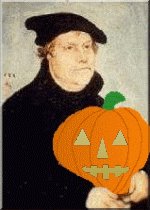
The "Reforween" illustration was spurred by a brother pastor in my circuit. He noted that Luther gets the credit for the widespread popularity of the Christmas tree. He figures that with this picture we might also be able to promote a folk belief that he introduced the Halloween jack o' lantern. This could have the collateral benefit of providing our church youth groups with a new source of income, October pumpkin sales.
Lection
Psalm 46
Revelation 14:6-7
Romans 3:19-28
John 8:31-36 or Matthew 11:12-19
Collect
Almighty and gracious Lord, pour out Your Holy Spirit on Your faithful people. Keep us steadfast in Your grace and truth, protect and deliver us in times of temptation, defend us against all enemies, and grant to Your Church Your saving peace; through Jesus Christ, Your Son, our Lord, who lives and reigns with You and the Holy Spirit, one God, now and forever.
Labels: church history, commemoration, european history, faith, feasts, festivals, german history, gospel, grace, justification, lutheranism, martin luther, reformation
¶ 00:00 | 0 comments |


