
 The honor paid to Saint Mary, the virgin mother of Jesus Christ our Lord, God, and Savior goes back to the earliest days of the Church. Indeed, it goes back farther: Even before the birth of her Son, Mary prophesied, "From now on all generations will call me blessed. (Luke 1:48 ESV)" Confessing her as "Mother of God" also confesses that the One whom she bore was and is, indeed, true God.
The New Testament records several incidents from the life of the Virgin: her betrothal to Joseph, the Annunciation by the angel Gabriel that she was to bear the Messiah, her Visitation to Elizabeth the mother of John the Baptist, the Nativity of our Lord, the visits of the shepherds and the magi, her Purification and the Presentation of the infant Jesus in the Temple at the age of forty days, the flight into Egypt, the Passover visit to the Temple when Jesus was twelve, (Matthew 1:16, 18-25; Matthew 2; Luke 1:26-56; Luke 2); the wedding at Cana in Galilee and the performance of her Son's first miracle (at Mary's intercession, see John 2:1-11), the occasions when observers basically said of Jesus, "How can this man be special? We know his family!" (Matthew 13:54-56; Mark 6:1-3; Luke 4:22; see also John 6:42); an instance when she came with others to see Him while he was preaching (Matthew 12:46-50; Mark 3:31-35; Luke 8:19-21); and her presence at His crucifixion, where Jesus commended her to the care of His Beloved Disciple (John 19:25-27). Mary was also present with the apostles in Jerusalem following the Ascension, waiting for the promised Spirit (Acts 1:14). Thus, we see her present at many of the chief events of her Son's life.

The other name in the Creeds is that of Mary. They say that Christ was "born of the virgin Mary." That is, they assert that he was truly and fully human, born of a woman and not descended from the skies like an angel. Jesus was not a spirit temporarily cloaked in a robe of human-seeming flesh.
Telling us that His mother was a virgin excludes the theory that Jesus was an ordinary man who was so virtuous that he eventually, at His baptism, became filled with a "Christ Spirit" by God. His virgin birth attests that He was always more than merely human, always one whose presence among us was in itself a miracle, from the first moment of His earthly existence. In Mary, Virgin and Mother, God gives us a sign that Jesus is both truly God and truly man. Emphasizing this point, the Council of Ephesis in AD 431 officially titled her Theotokos (God-bearer) and rejected and condemned the title Christotokos (Christ-bearer). Ask the Pastor comments on the distinction in Blessed Virgin Mary: Mother of God.
We know Little of Mary's life except as it intersects with the life of her Son; this is appropriate. The Scriptures record her words to the angel Gabriel, to her kinswoman Elizabeth, and to her Son on two occasions. The only recorded saying of hers to "ordinary" hearers is her instruction to the servants at the wedding feast: "Do whatever he [Jesus] tells you. (John 2:5 ESV)" Perhaps this should be the summation of her message to the world. To this day, she reminds us, "Listen to Jesus. Pay attention to my Son. Do as He says."

In different parts of the Church, the date is remembered in various ways. Roman Catholicism celebrates the Assumption of Mary and claims that she was taken, body and soul, to heaven. However, I've found contradictory teachings in the Roman Church, arguing whether she was translated in the manner of Enoch or Elijah, if she died and was resurrected on earth and then taken to heaven, or if her dead body was taken and then rejoined with her soul in heaven.
Meanwhile, Eastern Orthodoxy celebrates the Dormition of the Theotokos. It claims that Mary certainly died but that when Thomas visited three days later, her body was gone from the tomb. As to whether the body will be kept in heaven until the general resurrection on the Last Day or already rejoined with her spirit, Orthodoxy will not make a final dogmatic pronouncement.
In the rest of Christendom that follows a sanctorial calendar, the general belief seems to be that she likely died and awaits the resurrection with all others who departed in the Faith.
Lection
Psalm 45:10-17
Isaiah 61:7-11
Galatians 4:4-7
Luke 1:(39-45) 46-55
Collect of the Day
Almighty God, You chose the virgin Mary to be the mother of Your only Son. Grant that we, who are redeemed by His blood, may share with her in the glory of Your eternal kingdom; through Jesus Christ, Your Son, our Lord, who lives and reigns with You and the Holy Spirit, one God, now and forever.
or
Grant, we humbly pray, O Lord, to Your servants the gift of Your heavenly blessing that, as the Son of the Virgin Mary has granted us salvation, we may daily grow in Your favor; through Jesus Christ, Your Son, our Lord, who lives and reigns with You and the Holy Spirit, one God, now and forever.
Labels: acts, assumption, biography, christianity, creed, dormition, feasts, festivals, gospels, hagiography, jesus, mary, new testament, theotokos, virgin
¶ 00:00 | 0 comments |

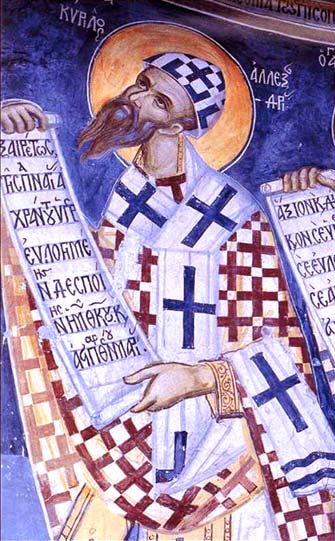 Saint Cyril (ca. AD 376-444) became Patriarch of Alexandria, Egypt in 412. Throughout his career he defended a number of orthodox doctrines, among them the teaching that Mary, the mother of Jesus, is "rightly called and truly is the Mother of God" — Theotokos, "the God-Bearer" (Formula of Concord, Epitome, VIII:12). In 431 the Council of Ephesus affirmed this teaching that the Son of Mary is also true God.
The Council was responding to the Nestorian heresy, which distinguished so completely between the divine and human natures of Christ that claims were made that the divine Christ did some things while the human Jesus did others.
Some of the differences are quite subtle; perhaps even Nestorius himself could not have foreseen the full ramifications of his position, including a "resurrection" of only the divine nature. Ephesus condemned the title of "Christ-Bearer" (Christotokos) for the Virgin, since the Nestorians would only claim that Mary bore the Christ, but not God Himself.
Cyril receives almost as many brickbats as he does bouquets, even from orthodox Christians, because he's also known for being what one person calls "an ill-tempered, quarrelsome, hasty, and violent man." This seems especially so during his early years as Bishop of Alexandria.
A particularly acute example of his extreme rigidity comes from his closing of Novatianist churches, although the Novationists weren't particularly unorthodox. Their "fault" was as much one of pride as of theology — they descended from those who'd stood firm in the persecutions of earlier years and refused to associate or worship with the heirs of those who recanted the Faith under persecution. Their main theological aberration were insisting upon rebaptism of converts from "lapsed" Christianity and an attitude that was, perhaps, less than Christ-like in dealing with erring brothers.
Cyril also ran the Jews out of town. The reason given was that they were seditious and violent, although we're left with little evidence. This action likely contributed to an ongoing feud with Orestes, the imperial prefect. These disagreements seemingly spilled over into a quarrel with the prefect's friend, the neo-platonist scholar Hypatia, who was later murdered by a mob.
Few have directly condemned Cyril for her death but the leaders of the mob certainly claimed the bishop as their leader. In modern times, Carl Sagan, in his book Cosmos, blamed Hypatia's death (and the destruction of the great Library of Alexandria) on dogmatic Christianity's desire to root out rational paganism. However, other scholars see the whole feud as an internal Church struggle and no one has yet established a definitive cause (or date) for the final destruction of Alexandria's library.
At any rate, and despite the considerable rancor that accompanied his early years as bishop, the mature Cyril worked diligently to reconcile the Nestorian and Orthodox parties. His efforts led many of the less virulent Nestorians back to full communion.
The writings of Cyril on the doctrines of the Trinity and the person of Christ reveal him to be one of the most able theologians of his time. Cyril's Christology influenced subsequent church councils and was a primary source for Lutheran confessional writings. He still speaks clearly to our age, especially as the old Christological heresies are trotted out under new guises.
Collect
Heavenly Father, You used Your servant Cyril to confess the mysteries of the Holy Trinity and of Your Son being one person with fully divine and human natures. Grant that we, also, might be constant in Your Word, bold in Your confession, and steadfast in Your worship, to the glory of Your holy Name; through Jesus Christ our Lord, who lives and reigns with You and the Holy Spirit, one God, now and forever.
Labels: alexandria, biography, christianity, church history, commemorations, cyril, hagiography, lutheranism, nestorianism, patristics, theotokos
¶ 00:00 | 0 comments |
Transferred to 4 April AD 2016
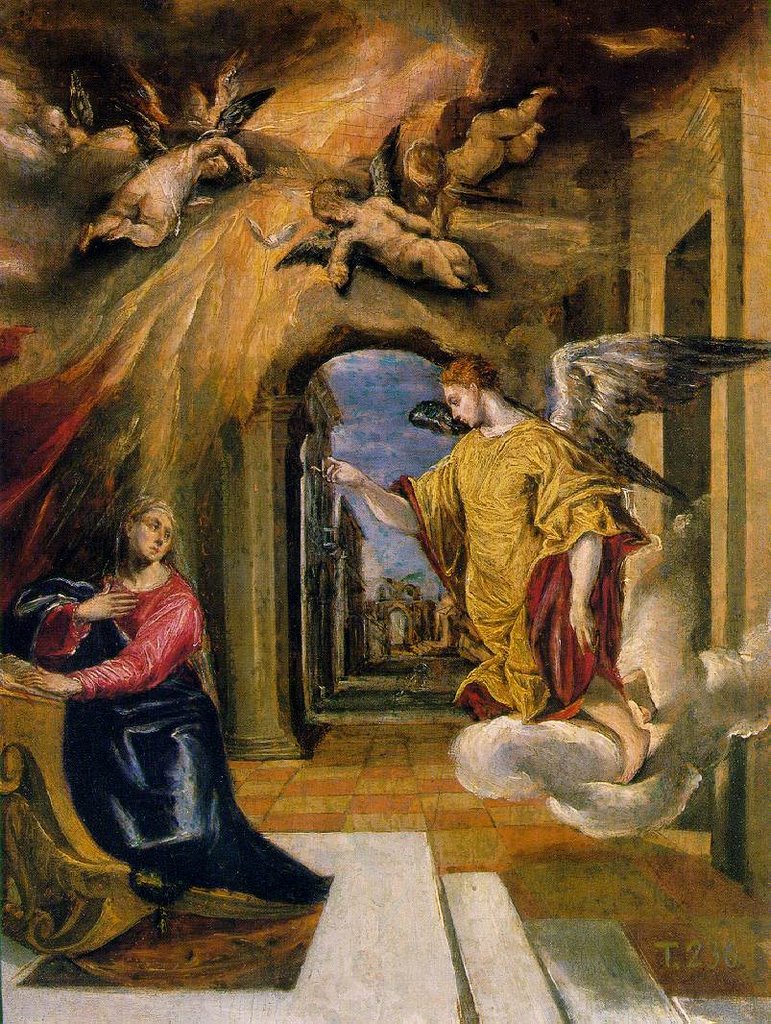 Luke 1:26-38 tells us how the angel Gabriel announced to Mary of Nazareth that she had been chosen to be the mother of the Christ and her response. Mary, a virgin pledged to marry Joseph, briefly wondered how this could be, since she had not had sex with any man.
Once Gabriel told her that the Child was conceived by the Holy Spirit, she humbly accepted this sacred obligation: "Behold, I am the servant of the Lord; let it be to me according to your word. (v. 38)"
Nothing prevents us from supposing that Our Lord was conceived immediately after this. Since the Church from early days observed 25 March as the date of the Annunciation, the celebration of the Christ's Nativity is observed on 25 December, nine months later.
For centuries in vast parts of Europe, 25 March also marked the change to the new year. While it seems somewhat odd and abrupt to change years in the middle of a month, we can imagine that those accustomed to that calendar easily made the adjustment. Furthermore, they could take to heart the reminder that God's chosen time, that most special time when He sent His Son into human flesh, merited such a "strange" circumstance.
Even though the Visitation of Mary to her cousin Elizabeth took place six months later (see Luke 1:39-56) — as Elizabeth neared the end of her own pregnancy with the child who would grow to become John the Baptizer — Mary's song of celebration at that time is also appropriate to remember on the Feast of the Annunciation. In the Magnificat (Luke 1:46-55) the virgin mother of God celebrated God's gift to her, to Israel, and to all people.
Martin Luther wrote a commentary on this canticle. About verse 49, he said, "The 'great things' are nothing less than that she became the Mother of God, in which work so many and such great good things are bestowed upon her as pass man's understanding. For on this there follows all honor, all blessedness, and her unique place in the whole of mankind, among whom she has no equal, namely, that she had a child by the Father in Heaven, and such a child.
"She herself is unable to find a name for this work, it is too exceedingly great; all she can do is break out in the fervent cry: 'They are great things,' impossible to describe or define. Hence men have crowded all her glory into a single word, calling her the Mother of God.
"No one can say anything greater of her or to her, though he had as many tongues as there are leaves on the trees, or grass in the fields, or stars in the sky, or sand by the sea. It needs to be pondered in the heart, what it means to be the Mother of God."
The Annunciation is such an important Christological feast that it takes precedence over even the Sundays in Lent in much of Christendom. See Looking Ahead at Weedon's Blog for details.
Lection
Psalm 45:7-17
Isaiah 7:10-14
Hebrews 10:4-10
Luke 1:26-38
Collect
O Lord, as we have known the incarnation of Your Son Jesus Christ by the message of the angel to the virgin Mary, so by His cross and Passion bring us to the glory of His resurrection; through the same Jesus Christ, our Lord, who lives and reigns with You and the Holy Spirit, one God, now and forever.
NOTE: Regarding the occasional transfer of this major feast, the Lutheran Service Book: Altar Book states on page 960, It is appropriate to observe this feast day in all its fullness during Lent. However, according to historical precedent, when the Annunciation falls during Holy Week or on Easter Day (or also on the Fifth Sunday in Lent in the one-year series), it should not be observed at those times but may be transferred to a weekday following the Second Sunday of Easter. In most of Eastern Christendom, rather than transferring the Annunciation, it is celebrated fully. In Orthodoxy, this normally means the celebratory Liturgy of John Chrysostom.
Luther quote from Luther's Works, Vol. 21, p. 326, ed. Jaroslav Pelikan, Concordia Publishing House © 1956.
Labels: annunciation, christ, christology, feasts, festivals, gabriel, gospels, incarnation, jesus, luke, mary, new testament, theotokos
¶ 00:00 | 0 comments |
The honor paid to Saint Mary, the virgin mother of Jesus Christ our Lord, God, and Savior goes back to the earliest days of the Church. Indeed, it goes back farther: Even before the birth of her Son, Mary prophesied, "From now on all generations will call me blessed. (Luke 1:48 ESV)" Confessing her as "Mother of God" also confesses that the One whom she bore was and is, indeed, true God.The New Testament records several incidents from the life of the Virgin: her betrothal to Joseph, the Annunciation by the angel Gabriel that she was to bear the Messiah, her Visitation to Elizabeth the mother of John the Baptist, the Nativity of our Lord, the visits of the shepherds and the magi, her Purification and the Presentation of the infant Jesus in the Temple at the age of forty days, the flight into Egypt, the Passover visit to the Temple when Jesus was twelve, (Matthew 1:16, 18-25; Matthew 2; Luke 1:26-56; Luke 2); the wedding at Cana in Galilee and the performance of her Son's first miracle (at Mary's intercession, see John 2:1-11), the occasions when observers basically said of Jesus, "How can this man be special? We know his family!" (Matthew 13:54-56; Mark 6:1-3; Luke 4:22; see also John 6:42); an instance when she came with others to see Him while he was preaching (Matthew 12:46-50; Mark 3:31-35; Luke 8:19-21); and her presence at His crucifixion, where Jesus commended her to the care of His Beloved Disciple (John 19:25-27). Mary was also present with the apostles in Jerusalem following the Ascension, waiting for the promised Spirit (Acts 1:14). Thus, we see her present at many of the chief events of her Son's life.
The other name in the Creeds is that of Mary. They say that Christ was "born of the virgin Mary." That is, they assert that he was truly and fully human, born of a woman and not descended from the skies like an angel. Jesus was not a spirit temporarily cloaked in a robe of human-seeming flesh.
Telling us that His mother was a virgin excludes the theory that Jesus was an ordinary man who was so virtuous that he eventually, at His baptism, became filled with a "Christ Spirit" by God. His virgin birth attests that He was always more than merely human, always one whose presence among us was in itself a miracle, from the first moment of His earthly existence. In Mary, Virgin and Mother, God gives us a sign that Jesus is both truly God and truly man. Emphasizing this point, the Council of Ephesis in AD 431 officially titled her Theotokos (God-bearer) and rejected and condemned the title Christotokos (Christ-bearer). Ask the Pastor comments on the distinction in Blessed Virgin Mary: Mother of God.
We know Little of Mary's life except as it intersects with the life of her Son; this is appropriate. The Scriptures record her words to the angel Gabriel, to her kinswoman Elizabeth, and to her Son on two occasions. The only recorded saying of hers to "ordinary" hearers is her instruction to the servants at the wedding feast: "Do whatever he [Jesus] tells you. (John 2:5 ESV)" Perhaps this should be the summation of her message to the world. To this day, she reminds us, "Listen to Jesus. Pay attention to my Son. Do as He says."
In different parts of the Church, the date is remembered in various ways. Roman Catholicism celebrates the Assumption of Mary and claims that she was taken, body and soul, to heaven. However, I've found contradictory teachings in the Roman Church, arguing whether she was translated in the manner of Enoch or Elijah, if she died and was resurrected on earth and then taken to heaven, or if her dead body was taken and then rejoined with her soul in heaven.
Meanwhile, Eastern Orthodoxy celebrates the Dormition of the Theotokos. It claims that Mary certainly died but that when Thomas visited three days later, her body was gone from the tomb. As to whether the body will be kept in heaven until the general resurrection on the Last Day or already rejoined with her spirit, Orthodoxy will not make a final dogmatic pronouncement.
In the rest of Christendom that follows a sanctorial calendar, the general belief seems to be that she likely died and awaits the resurrection with all others who departed in the Faith.
Lection
Psalm 45:10-17
Isaiah 61:7-11
Galatians 4:4-7
Luke 1:(39-45) 46-55
Collect of the Day
Almighty God, You chose the virgin Mary to be the mother of Your only Son. Grant that we, who are redeemed by His blood, may share with her in the glory of Your eternal kingdom; through Jesus Christ, Your Son, our Lord, who lives and reigns with You and the Holy Spirit, one God, now and forever.
or
Grant, we humbly pray, O Lord, to Your servants the gift of Your heavenly blessing that, as the Son of the Virgin Mary has granted us salvation, we may daily grow in Your favor; through Jesus Christ, Your Son, our Lord, who lives and reigns with You and the Holy Spirit, one God, now and forever.
Labels: acts, assumption, biography, christianity, creed, dormition, feasts, festivals, gospels, hagiography, jesus, mary, new testament, theotokos, virgin
¶ 00:00 | 0 comments |
Saint Cyril (ca. AD 376-444) became Patriarch of Alexandria, Egypt in 412. Throughout his career he defended a number of orthodox doctrines, among them the teaching that Mary, the mother of Jesus, is "rightly called and truly is the Mother of God" — Theotokos, "the God-Bearer" (Formula of Concord, Epitome, VIII:12). In 431 the Council of Ephesus affirmed this teaching that the Son of Mary is also true God.The Council was responding to the Nestorian heresy, which distinguished so completely between the divine and human natures of Christ that claims were made that the divine Christ did some things while the human Jesus did others.
Some of the differences are quite subtle; perhaps even Nestorius himself could not have foreseen the full ramifications of his position, including a "resurrection" of only the divine nature. Ephesus condemned the title of "Christ-Bearer" (Christotokos) for the Virgin, since the Nestorians would only claim that Mary bore the Christ, but not God Himself.
Cyril receives almost as many brickbats as he does bouquets, even from orthodox Christians, because he's also known for being what one person calls "an ill-tempered, quarrelsome, hasty, and violent man." This seems especially so during his early years as Bishop of Alexandria.
A particularly acute example of his extreme rigidity comes from his closing of Novatianist churches, although the Novationists weren't particularly unorthodox. Their "fault" was as much one of pride as of theology — they descended from those who'd stood firm in the persecutions of earlier years and refused to associate or worship with the heirs of those who recanted the Faith under persecution. Their main theological aberration were insisting upon rebaptism of converts from "lapsed" Christianity and an attitude that was, perhaps, less than Christ-like in dealing with erring brothers.
Cyril also ran the Jews out of town. The reason given was that they were seditious and violent, although we're left with little evidence. This action likely contributed to an ongoing feud with Orestes, the imperial prefect. These disagreements seemingly spilled over into a quarrel with the prefect's friend, the neo-platonist scholar Hypatia, who was later murdered by a mob.
Few have directly condemned Cyril for her death but the leaders of the mob certainly claimed the bishop as their leader. In modern times, Carl Sagan, in his book Cosmos, blamed Hypatia's death (and the destruction of the great Library of Alexandria) on dogmatic Christianity's desire to root out rational paganism. However, other scholars see the whole feud as an internal Church struggle and no one has yet established a definitive cause (or date) for the final destruction of Alexandria's library.
At any rate, and despite the considerable rancor that accompanied his early years as bishop, the mature Cyril worked diligently to reconcile the Nestorian and Orthodox parties. His efforts led many of the less virulent Nestorians back to full communion.
The writings of Cyril on the doctrines of the Trinity and the person of Christ reveal him to be one of the most able theologians of his time. Cyril's Christology influenced subsequent church councils and was a primary source for Lutheran confessional writings. He still speaks clearly to our age, especially as the old Christological heresies are trotted out under new guises.
Collect
Heavenly Father, You used Your servant Cyril to confess the mysteries of the Holy Trinity and of Your Son being one person with fully divine and human natures. Grant that we, also, might be constant in Your Word, bold in Your confession, and steadfast in Your worship, to the glory of Your holy Name; through Jesus Christ our Lord, who lives and reigns with You and the Holy Spirit, one God, now and forever.
Labels: alexandria, biography, christianity, church history, commemorations, cyril, hagiography, lutheranism, nestorianism, patristics, theotokos
¶ 00:00 | 0 comments |
Transferred to 4 April AD 2016
NOTE: Regarding the transfer of this major feast, the Lutheran Service Book: Altar Book states on page 960, It is appropriate to observe this feast day in all its fullness during Lent. However, according to historical precedent, when the Annunciation falls during Holy Week or on Easter Day (or also on the Fifth Sunday in Lent in the one-year series), it should not be observed at those times but may be transferred to a weekday following the Second Sunday of Easter. In most of Eastern Christendom, rather than transferring the Annunciation, it is celebrated fully. In Orthodoxy, this normally means the celebratory Liturgy of John Chrysostom.
Luke 1:26-38 tells us how the angel Gabriel announced to Mary of Nazareth that she had been chosen to be the mother of the Christ and her response. Mary, a virgin pledged to marry Joseph, briefly wondered how this could be, since she had not had sex with any man.Once Gabriel told her that the Child was conceived by the Holy Spirit, she humbly accepted this sacred obligation: "Behold, I am the servant of the Lord; let it be to me according to your word. (v. 38)"
Nothing prevents us from supposing that Our Lord was conceived immediately after this. Since the Church from early days observed 25 March as the date of the Annunciation, the celebration of the Christ's Nativity is observed on 25 December, nine months later.
For centuries in vast parts of Europe, 25 March also marked the change to the new year. While it seems somewhat odd and abrupt to change years in the middle of a month, we can imagine that those accustomed to that calendar easily made the adjustment. Furthermore, they could take to heart the reminder that God's chosen time, that most special time when He sent His Son into human flesh, merited such a "strange" circumstance.
Even though the Visitation of Mary to her cousin Elizabeth took place six months later (see Luke 1:39-56) — as Elizabeth neared the end of her own pregnancy with the child who would grow to become John the Baptizer — Mary's song of celebration at that time is also appropriate to remember on the Feast of the Annunciation. In the Magnificat (Luke 1:46-55) the virgin mother of God celebrated God's gift to her, to Israel, and to all people.
Martin Luther wrote a commentary on this canticle. About verse 49, he said, "The 'great things' are nothing less than that she became the Mother of God, in which work so many and such great good things are bestowed upon her as pass man's understanding. For on this there follows all honor, all blessedness, and her unique place in the whole of mankind, among whom she has no equal, namely, that she had a child by the Father in Heaven, and such a child.
"She herself is unable to find a name for this work, it is too exceedingly great; all she can do is break out in the fervent cry: 'They are great things,' impossible to describe or define. Hence men have crowded all her glory into a single word, calling her the Mother of God.
"No one can say anything greater of her or to her, though he had as many tongues as there are leaves on the trees, or grass in the fields, or stars in the sky, or sand by the sea. It needs to be pondered in the heart, what it means to be the Mother of God."
The Annunciation is such an important Christological feast that it takes precedence over even the Sundays in Lent in much of Christendom. See Looking Ahead at Weedon's Blog for details.
Lection
Psalm 45:7-17
Isaiah 7:10-14
Hebrews 10:4-10
Luke 1:26-38
Collect
O Lord, as we have known the incarnation of Your Son Jesus Christ by the message of the angel to the virgin Mary, so by His cross and Passion bring us to the glory of His resurrection; through the same Jesus Christ, our Lord, who lives and reigns with You and the Holy Spirit, one God, now and forever.
Luther quote from Luther's Works, Vol. 21, p. 326, ed. Jaroslav Pelikan, Concordia Publishing House © 1956.
Labels: annunciation, christ, christology, feasts, festivals, gabriel, gospels, incarnation, jesus, luke, mary, new testament, theotokos
¶ 00:01 | 0 comments |
The honor paid to Saint Mary, the virgin mother of Jesus Christ our Lord, God, and Savior goes back to the earliest days of the Church. Indeed, it goes back farther: Even before the birth of her Son, Mary prophesied, "From now on all generations will call me blessed. (Luke 1:48 ESV)" Confessing her as "Mother of God" also confesses that the One whom she bore was and is, indeed, true God.The New Testament records several incidents from the life of the Virgin: her betrothal to Joseph, the Annunciation by the angel Gabriel that she was to bear the Messiah, her Visitation to Elizabeth the mother of John the Baptist, the Nativity of our Lord, the visits of the shepherds and the magi, her Purification and the Presentation of the infant Jesus in the Temple at the age of forty days, the flight into Egypt, the Passover visit to the Temple when Jesus was twelve, (Matthew 1:16, 18-25; Matthew 2; Luke 1:26-56; Luke 2); the wedding at Cana in Galilee and the performance of her Son's first miracle (at Mary's intercession, see John 2:1-11), the occasions when observers basically said of Jesus, "How can this man be special? We know his family!" (Matthew 13:54-56; Mark 6:1-3; Luke 4:22; see also John 6:42); an instance when she came with others to see Him while he was preaching (Matthew 12:46-50; Mark 3:31-35; Luke 8:19-21); and her presence at His crucifixion, where Jesus commended her to the care of His Beloved Disciple (John 19:25-27). Mary was also present with the apostles in Jerusalem following the Ascension, waiting for the promised Spirit (Acts 1:14). Thus, we see her present at many of the chief events of her Son's life.
The other name in the Creeds is that of Mary. They say that Christ was "born of the virgin Mary." That is, they assert that he was truly and fully human, born of a woman and not descended from the skies like an angel. Jesus was not a spirit temporarily cloaked in a robe of human-seeming flesh.
Telling us that His mother was a virgin excludes the theory that Jesus was an ordinary man who was so virtuous that he eventually, at His baptism, became filled with a "Christ Spirit" by God. His virgin birth attests that He was always more than merely human, always one whose presence among us was in itself a miracle, from the first moment of His earthly existence. In Mary, Virgin and Mother, God gives us a sign that Jesus is both truly God and truly man. Emphasizing this point, the Council of Ephesis in AD 431 officially titled her Theotokos (God-bearer) and rejected and condemned the title Christotokos (Christ-bearer). Ask the Pastor comments on the distinction in Blessed Virgin Mary: Mother of God.
We know Little of Mary's life except as it intersects with the life of her Son; this is appropriate. The Scriptures record her words to the angel Gabriel, to her kinswoman Elizabeth, and to her Son on two occasions. The only recorded saying of hers to "ordinary" hearers is her instruction to the servants at the wedding feast: "Do whatever he [Jesus] tells you. (John 2:5 ESV)" Perhaps this should be the summation of her message to the world. To this day, she reminds us, "Listen to Jesus. Pay attention to my Son. Do as He says."
In different parts of the Church, the date is remembered in various ways. Roman Catholicism celebrates the Assumption of Mary and claims that she was taken, body and soul, to heaven. However, I've found contradictory teachings in the Roman Church, arguing whether she was translated in the manner of Enoch or Elijah, if she died and was resurrected on earth and then taken to heaven, or if her dead body was taken and then rejoined with her soul in heaven.
Meanwhile, Eastern Orthodoxy celebrates the Dormition of the Theotokos. It claims that Mary certainly died but that when Thomas visited three days later, her body was gone from the tomb. As to whether the body will be kept in heaven until the general resurrection on the Last Day or already rejoined with her spirit, Orthodoxy will not make a final dogmatic pronouncement.
In the rest of Christendom that follows a sanctorial calendar, the general belief seems to be that she likely died and awaits the resurrection with all others who departed in the Faith.
Lection
Psalm 45:10-17
Isaiah 61:7-11
Galatians 4:4-7
Luke 1:(39-45) 46-55
Collect of the Day
Almighty God, You chose the virgin Mary to be the mother of Your only Son. Grant that we, who are redeemed by His blood, may share with her in the glory of Your eternal kingdom; through Jesus Christ, Your Son, our Lord, who lives and reigns with You and the Holy Spirit, one God, now and forever.
or
Grant, we humbly pray, O Lord, to Your servants the gift of Your heavenly blessing that, as the Son of the Virgin Mary has granted us salvation, we may daily grow in Your favor; through Jesus Christ, Your Son, our Lord, who lives and reigns with You and the Holy Spirit, one God, now and forever.
Labels: biography, christianity, creed, feasts, festivals, gospels, hagiography, jesus, mary, new testament, theotokos, virgin
¶ 00:00 | 0 comments |
Saint Cyril (ca. AD 376-444) became Patriarch of Alexandria, Egypt in 412. Throughout his career he defended a number of orthodox doctrines, among them the teaching that Mary, the mother of Jesus, is "rightly called and truly is the Mother of God" — Theotokos, "the God-Bearer" (Formula of Concord, Epitome, VIII:12). In 431 the Council of Ephesus affirmed this teaching that the Son of Mary is also true God.The Council was responding to the Nestorian heresy, which distinguished so completely between the divine and human natures of Christ that claims were made that the divine Christ did some things while the human Jesus did others.
Some of the differences are quite subtle; perhaps even Nestorius himself could not have foreseen the full ramifications of his position, including a "resurrection" of only the divine nature. Ephesus condemned the title of "Christ-Bearer" (Christotokos) for the Virgin, since the Nestorians would only claim that Mary bore the Christ, but not God Himself.
Cyril receives almost as many brickbats as he does bouquets, even from orthodox Christians, because he's also known for being what one person calls "an ill-tempered, quarrelsome, hasty, and violent man." This seems especially so during his early years as Bishop of Alexandria.
A particularly acute example of his extreme rigidity comes from his closing of Novatianist churches, although the Novationists weren't particularly unorthodox. Their "fault" was as much one of pride as of theology — they descended from those who'd stood firm in the persecutions of earlier years and refused to associate or worship with the heirs of those who recanted the Faith under persecution. Their main theological aberration were insisting upon rebaptism of converts from "lapsed" Christianity and an attitude that was, perhaps, less than Christ-like in dealing with erring brothers.
Cyril also ran the Jews out of town. The reason given was that they were seditious and violent, although we're left with little evidence. This action likely contributed to an ongoing feud with Orestes, the imperial prefect. These disagreements seemingly spilled over into a quarrel with the prefect's friend, the neo-platonist scholar Hypatia, who was later murdered by a mob.
Few have directly condemned Cyril for her death but the leaders of the mob certainly claimed the bishop as their leader. In modern times, Carl Sagan, in his book Cosmos, blamed Hypatia's death (and the destruction of the great Library of Alexandria) on dogmatic Christianity's desire to root out rational paganism. However, other scholars see the whole feud as an internal Church struggle and no one has yet established a definitive cause (or date) for the final destruction of Alexandria's library.
At any rate, and despite the considerable rancor that accompanied his early years as bishop, the mature Cyril worked diligently to reconcile the Nestorian and Orthodox parties. His efforts led many of the less virulent Nestorians back to full communion.
The writings of Cyril on the doctrines of the Trinity and the person of Christ reveal him to be one of the most able theologians of his time. Cyril's Christology influenced subsequent church councils and was a primary source for Lutheran confessional writings. He still speaks clearly to our age, especially as the old Christological heresies are trotted out under new guises.
Collect
Heavenly Father, You used Your servant Cyril to confess the mysteries of the Holy Trinity and of Your Son being one person with fully divine and human natures. Grant that we, also, might be constant in Your Word, bold in Your confession, and steadfast in Your worship, to the glory of Your holy Name; through Jesus Christ our Lord, who lives and reigns with You and the Holy Spirit, one God, now and forever.
Labels: alexandria, biography, christianity, church history, commemorations, cyril, hagiography, lutheranism, nestorianism, patristics, theotokos
¶ 00:00 | 0 comments |


