Aardvark Alley

Confessional Lutheran theology, hagiography, philosophy, music, culture, sports, education,
and whatever else is on the fevered mind of Orycteropus Afer
27 July 2017
+ Olaf II of Norway +
29 July AD 1030; transferred to 27 July
 Ólafr Haraldsson (also known as Olav, Olafe, Oláfr hinn helgi, and Olavus rex) was born in 995 to Harald Grenske and Åsta Gudbrandsdatter. While Snoore says that he was baptized in 998 in Norway, it's more likely that it was by the hand of Archbishop Robert in Rouen, France around 1010. As was common among young Norsemen, he spent much of his youth going a-viking (raiding), first in the Baltic, then Denmark, and finally in the British Isles. He was nicknamed "Digre" (physically large) and some believed him to be a reincarnation of a previous (pagan) Viking king Olav Digre. While involved in numerous armed conflicts, Olaf also developed a deep interest in Christianity.
Olaf declared himself King of Norway in 1015. Following battles with various petty kings, he ruled until 1029, although his strength was greatly reduced following his loss in the Battle of the Helgeå (1026). As monarch, he struggled to root out heathenism and make Christianity the religion of the realm. Like his ancestor Olaf Trygvesson, he frequently attacked the old faith and customs. Olaf destroyed pagan temples and built Christian churches in their place. He brought many bishops and priests from England, a practice later followed by King Saint Canute of Denmark. It appears that he based ecclesiastical organization on the Anglo-Saxon model.
The rebellion against Olaf stemmed but in part from his unflinching Christianity. Many of the nobles were also exasperated by his ongoing struggle with the old Norse method of governance and his never-ending desire for a truly united Norway. The governing clans enlisted King Canute of Denmark and England for help in ousting Olaf. Once he was banished, the clans elected Canute as King of Norway. Therefore, he became not only an icon of the Christian Faith but also one of Norwegian nationalism — an image he carries even among secular Norwegians to this day.
 After Canute's vassal Håkon Eiriksson died, Olaf returned from his two year exile and met the rebellious clans at Stiklestad on 29 July 1030. Although neither King Canute or the Danes took part, Olaf — who fought courageously — was mortally wounded at that battle and died in the battlefield. His final recorded words were the prayer, "God help me."
He was disinterred a year after his death and his remains moved to the Church of St. Clement in Nidaros (current Trondhjem). There, Bishop Grimkel and Earl Einar Tambeskjelver placed his corpse in a coffin and laid it on the church's high altar. At that time, the bishop also declared Olaf a saint. Although Olaf was embraced by most Norwegian Lutherans, his remains disappeared as part of the iconoclasm that occasionally accompanied the Reformation.
His cult spread widely in the Middle Ages, moving from Norway to Denmark, Sweden, and even parts of England. Although a rather harsh ruler and prone to rough treatment of his enemies, Olaf became Norway's patron saint. The cult of Olaf not only unified the country, it also fulfilled the conversion of the people, something for which the king had fought so hard. While divisive in life, Olaf in death held a unifying power that defied outside state and religious rulers attempts to undo his dream.
Although Olav was certainly not the first to introduce Christianity to Norway, he first codified the faith in 1024, laying the basis for the Church of Norway. So high did Olaf's legal arrangements for the Church of Norway come to stand in the eyes of the Norwegian people and clergy, that when Pope Gregory VII attempted to make clerical celibacy binding on the priests of Western Europe in 1074-75, the Norwegians largely ignored him, since celibacy wasn't mentioned in Olaf's legal code for their church. Although he continued to be known through most of his life as Olaf digre, in death he remains best known by as Olav den hellige (Olaf the Holy).
The coat of arms of Norway is a lion holding the battle axe of St. Olaf in his forepaws.
Suggested Lection
Wisdom 10:10-14
Psalm 31:1-7
James 1:2-4, 12
Matthew 16:24-28
Collect
Almighty, eternal God, you are the crown of kings and the triumph of martyrs. We thank You for the bold confession made by Your blessed martyr, Olav We praise your greatness in his death and we pray You give us the crown of life that You have promised those who believe in Your Son Jesus Christ, who lives and reigns with you and the Holy Spirit, one God, forever and ever.
See Wikipedia, the Catholic Encyclopedia, and the Christian Cyclopedia for more.


 Ólafr Haraldsson (also known as Olav, Olafe, Oláfr hinn helgi, and Olavus rex) was born in 995 to Harald Grenske and Åsta Gudbrandsdatter. While Snoore says that he was baptized in 998 in Norway, it's more likely that it was by the hand of Archbishop Robert in Rouen, France around 1010. As was common among young Norsemen, he spent much of his youth going a-viking (raiding), first in the Baltic, then Denmark, and finally in the British Isles. He was nicknamed "Digre" (physically large) and some believed him to be a reincarnation of a previous (pagan) Viking king Olav Digre. While involved in numerous armed conflicts, Olaf also developed a deep interest in Christianity.
Olaf declared himself King of Norway in 1015. Following battles with various petty kings, he ruled until 1029, although his strength was greatly reduced following his loss in the Battle of the Helgeå (1026). As monarch, he struggled to root out heathenism and make Christianity the religion of the realm. Like his ancestor Olaf Trygvesson, he frequently attacked the old faith and customs. Olaf destroyed pagan temples and built Christian churches in their place. He brought many bishops and priests from England, a practice later followed by King Saint Canute of Denmark. It appears that he based ecclesiastical organization on the Anglo-Saxon model.
The rebellion against Olaf stemmed but in part from his unflinching Christianity. Many of the nobles were also exasperated by his ongoing struggle with the old Norse method of governance and his never-ending desire for a truly united Norway. The governing clans enlisted King Canute of Denmark and England for help in ousting Olaf. Once he was banished, the clans elected Canute as King of Norway. Therefore, he became not only an icon of the Christian Faith but also one of Norwegian nationalism — an image he carries even among secular Norwegians to this day.
 After Canute's vassal Håkon Eiriksson died, Olaf returned from his two year exile and met the rebellious clans at Stiklestad on 29 July 1030. Although neither King Canute or the Danes took part, Olaf — who fought courageously — was mortally wounded at that battle and died in the battlefield. His final recorded words were the prayer, "God help me."
He was disinterred a year after his death and his remains moved to the Church of St. Clement in Nidaros (current Trondhjem). There, Bishop Grimkel and Earl Einar Tambeskjelver placed his corpse in a coffin and laid it on the church's high altar. At that time, the bishop also declared Olaf a saint. Although Olaf was embraced by most Norwegian Lutherans, his remains disappeared as part of the iconoclasm that occasionally accompanied the Reformation.
His cult spread widely in the Middle Ages, moving from Norway to Denmark, Sweden, and even parts of England. Although a rather harsh ruler and prone to rough treatment of his enemies, Olaf became Norway's patron saint. The cult of Olaf not only unified the country, it also fulfilled the conversion of the people, something for which the king had fought so hard. While divisive in life, Olaf in death held a unifying power that defied outside state and religious rulers attempts to undo his dream.
Although Olav was certainly not the first to introduce Christianity to Norway, he first codified the faith in 1024, laying the basis for the Church of Norway. So high did Olaf's legal arrangements for the Church of Norway come to stand in the eyes of the Norwegian people and clergy, that when Pope Gregory VII attempted to make clerical celibacy binding on the priests of Western Europe in 1074-75, the Norwegians largely ignored him, since celibacy wasn't mentioned in Olaf's legal code for their church. Although he continued to be known through most of his life as Olaf digre, in death he remains best known by as Olav den hellige (Olaf the Holy).
The coat of arms of Norway is a lion holding the battle axe of St. Olaf in his forepaws.
Suggested Lection
Wisdom 10:10-14
Psalm 31:1-7
James 1:2-4, 12
Matthew 16:24-28
Collect
Almighty, eternal God, you are the crown of kings and the triumph of martyrs. We thank You for the bold confession made by Your blessed martyr, Olav We praise your greatness in his death and we pray You give us the crown of life that You have promised those who believe in Your Son Jesus Christ, who lives and reigns with you and the Holy Spirit, one God, forever and ever.
See Wikipedia, the Catholic Encyclopedia, and the Christian Cyclopedia for more.
Labels: biography, christianity, church history, commemoration, hagiography, iconoclasm, lutheranism, martyrdom, norway, olaf, scandanavia
¶ 00:00 | 0 comments |
13 December 2016
+ Lucia of Syracuse, Martyr +
13 December AD 304
 Lucia (also Lucy or Lukia) was one of the victims of the great persecution under the Roman emperor Diocletian. She met her death at Syracuse on the island of Sicily because of her Christian faith. Known for her charity, "Santa Lucia" (as she is called in Italy) gave away her dowry and remained a virgin until her execution by the sword. Some accounts, similar to those surrounding Saint Polycarp, claim that Lucy was first sentenced to be burned and that when this failed, she was stabbed to death.
Various stories are told about her. Some claim that she refused to marry a pagan and was killed; others say that forfeiting her dowry led her unbelieving fiancé to denounce her to the authorities as a Christian. Another account tells us that either during or at a time before her execution, her eyes were gouged out but that God restored her sight.
 The name Lucia means "light." Because of that, festivals of light held in her honor became popular throughout Europe, especially in the Scandinavian countries. There, her feast day corresponds with the time of year when there is the least amount of daylight. Under the Julian Calendar, her feast day actually fell on the shortest, darkest day of the year but this connection vanished with adoption of the Gregorian Calendar.
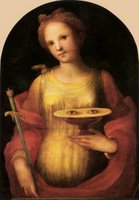
Ecclesiastical art often portrays Saint Lucia holding a palm branch, the traditional sign of victory or martyrdom; a sword may also be shown piercing her breast or throat. Sometimes, as in the pictures above, we see her holding her missing eyes in her hand or on a plate before her.
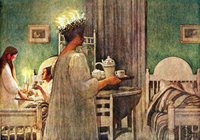 Another common portrayal has the saint dressed in a white baptismal gown, wearing a wreath of candles upon her head. In many Nordic homes, this attire is mimicked on her feast day. One of the girls or women of a household, often the eldest daughter, wakes early on Lucy's feast day, prepares a special breakfast, dons a headpiece of candles, and moves through the home with the meal honoring the saint.
Lucy's name was applied to various people and places in the centuries following her death. Among the most noted would be the Santa Lucia area of Naples, celebrated in the Neapolitan song Santa Lucia. The tune calls Lucy's namesake area impero dell'armonia (the empire of harmony).
Agatha, 5 February AD 290
With Lucy, the Church sometimes also honors the virgin martyr Agatha. She came from Catania in Sicily, and was most likely martyred in the late 200s. Aside from her name on the lists of early martyrs, we know nothing of her.
Lection
Psalm 65:1-8
Deuteronomy 33:1-3
Revelation 7:2-17
Matthew 5:1-12
Collect
O Almighty God, by whose grace and power Your holy martyr(s) Lucy (and Agatha) triumphed over suffering and was (were) faithful even unto death, grant us, who now remember her (them) with thanksgiving, to be so faithful in our witness to You in this world, that we may receive with her (them) the crown of life; through Jesus Christ our Lord, who lives and reigns with You and the Holy Spirit, one God, forever and ever.
Hymn Stanza
For holy martyr Lucy, Who faced the tyrant's sword
And through her death gave witness, We praise Your name, O Lord.
Your light she showed in darkness; May we thus also shine
Until, our struggles ended, We see Your face divine.
Hymn text © 2006 by Walter P. Snyder. Permission granted for use with proper attestation.
 Lucia (also Lucy or Lukia) was one of the victims of the great persecution under the Roman emperor Diocletian. She met her death at Syracuse on the island of Sicily because of her Christian faith. Known for her charity, "Santa Lucia" (as she is called in Italy) gave away her dowry and remained a virgin until her execution by the sword. Some accounts, similar to those surrounding Saint Polycarp, claim that Lucy was first sentenced to be burned and that when this failed, she was stabbed to death.
Various stories are told about her. Some claim that she refused to marry a pagan and was killed; others say that forfeiting her dowry led her unbelieving fiancé to denounce her to the authorities as a Christian. Another account tells us that either during or at a time before her execution, her eyes were gouged out but that God restored her sight.
 The name Lucia means "light." Because of that, festivals of light held in her honor became popular throughout Europe, especially in the Scandinavian countries. There, her feast day corresponds with the time of year when there is the least amount of daylight. Under the Julian Calendar, her feast day actually fell on the shortest, darkest day of the year but this connection vanished with adoption of the Gregorian Calendar.
Ecclesiastical art often portrays Saint Lucia holding a palm branch, the traditional sign of victory or martyrdom; a sword may also be shown piercing her breast or throat. Sometimes, as in the pictures above, we see her holding her missing eyes in her hand or on a plate before her.
 Another common portrayal has the saint dressed in a white baptismal gown, wearing a wreath of candles upon her head. In many Nordic homes, this attire is mimicked on her feast day. One of the girls or women of a household, often the eldest daughter, wakes early on Lucy's feast day, prepares a special breakfast, dons a headpiece of candles, and moves through the home with the meal honoring the saint.
Lucy's name was applied to various people and places in the centuries following her death. Among the most noted would be the Santa Lucia area of Naples, celebrated in the Neapolitan song Santa Lucia. The tune calls Lucy's namesake area impero dell'armonia (the empire of harmony).
Agatha, 5 February AD 290
With Lucy, the Church sometimes also honors the virgin martyr Agatha. She came from Catania in Sicily, and was most likely martyred in the late 200s. Aside from her name on the lists of early martyrs, we know nothing of her.
Lection
Psalm 65:1-8
Deuteronomy 33:1-3
Revelation 7:2-17
Matthew 5:1-12
Collect
O Almighty God, by whose grace and power Your holy martyr(s) Lucy (and Agatha) triumphed over suffering and was (were) faithful even unto death, grant us, who now remember her (them) with thanksgiving, to be so faithful in our witness to You in this world, that we may receive with her (them) the crown of life; through Jesus Christ our Lord, who lives and reigns with You and the Holy Spirit, one God, forever and ever.
Hymn Stanza
For holy martyr Lucy, Who faced the tyrant's sword
And through her death gave witness, We praise Your name, O Lord.
Your light she showed in darkness; May we thus also shine
Until, our struggles ended, We see Your face divine.
Hymn text © 2006 by Walter P. Snyder. Permission granted for use with proper attestation.
Labels: agatha, biography, church history, commemoration, diocletian, european history, italian history, light, lucia, lucy hagiography, martyrdom, roman empire, scandanavia
¶ 00:00 | 0 comments |
13 December 2015
+ Lucia of Syracuse, Martyr +
13 December AD 304
Lucia (also Lucy or Lukia) was one of the victims of the great persecution under the Roman emperor Diocletian. She met her death at Syracuse on the island of Sicily because of her Christian faith. Known for her charity, "Santa Lucia" (as she is called in Italy) gave away her dowry and remained a virgin until her execution by the sword. Some accounts, similar to those surrounding Saint Polycarp, claim that Lucy was first sentenced to be burned and that when this failed, she was stabbed to death.
Various stories are told about her. Some claim that she refused to marry a pagan and was killed; others say that forfeiting her dowry led her unbelieving fiancé to denounce her to the authorities as a Christian. Another account tells us that either during or at a time before her execution, her eyes were gouged out but that God restored her sight.
The name Lucia means "light." Because of that, festivals of light held in her honor became popular throughout Europe, especially in the Scandinavian countries. There, her feast day corresponds with the time of year when there is the least amount of daylight. Under the Julian Calendar, her feast day actually fell on the shortest, darkest day of the year but this connection vanished with adoption of the Gregorian Calendar.
Ecclesiastical art often portrays Saint Lucia holding a palm branch, the traditional sign of victory or martyrdom; a sword may also be shown piercing her breast or throat. Sometimes, as in the pictures above, we see her holding her missing eyes in her hand or on a plate before her.
Another common portrayal has the saint dressed in a white baptismal gown, wearing a wreath of candles upon her head. In many Nordic homes, this attire is mimicked on her feast day. One of the girls or women of a household, often the eldest daughter, wakes early on Lucy's feast day, prepares a special breakfast, dons a headpiece of candles, and moves through the home with the meal honoring the saint.
Lucy's name was applied to various people and places in the centuries following her death. Among the most noted would be the Santa Lucia area of Naples, celebrated in the Neapolitan song Santa Lucia. The tune calls Lucy's namesake area impero dell'armonia (the empire of harmony).
Agatha, 5 February AD 290
With Lucy, the Church sometimes also honors the virgin martyr Agatha. She came from Catania in Sicily, and was most likely martyred in the late 200s. Aside from her name on the lists of early martyrs, we know nothing of her.
Lection
Psalm 65:1-8
Deuteronomy 33:1-3
Revelation 7:2-17
Matthew 5:1-12
Collect
O Almighty God, by whose grace and power Your holy martyr(s) Lucy (and Agatha) triumphed over suffering and was (were) faithful even unto death, grant us, who now remember her (them) with thanksgiving, to be so faithful in our witness to You in this world, that we may receive with her (them) the crown of life; through Jesus Christ our Lord, who lives and reigns with You and the Holy Spirit, one God, forever and ever.
Hymn Stanza
For holy martyr Lucy, Who faced the tyrant's sword
And through her death gave witness, We praise Your name, O Lord.
Your light she showed in darkness; May we thus also shine
Until, our struggles ended, We see Your face divine.
Hymn text © 2006 by Walter P. Snyder. Permission granted for use with proper attestation.
Lucia (also Lucy or Lukia) was one of the victims of the great persecution under the Roman emperor Diocletian. She met her death at Syracuse on the island of Sicily because of her Christian faith. Known for her charity, "Santa Lucia" (as she is called in Italy) gave away her dowry and remained a virgin until her execution by the sword. Some accounts, similar to those surrounding Saint Polycarp, claim that Lucy was first sentenced to be burned and that when this failed, she was stabbed to death.Various stories are told about her. Some claim that she refused to marry a pagan and was killed; others say that forfeiting her dowry led her unbelieving fiancé to denounce her to the authorities as a Christian. Another account tells us that either during or at a time before her execution, her eyes were gouged out but that God restored her sight.
The name Lucia means "light." Because of that, festivals of light held in her honor became popular throughout Europe, especially in the Scandinavian countries. There, her feast day corresponds with the time of year when there is the least amount of daylight. Under the Julian Calendar, her feast day actually fell on the shortest, darkest day of the year but this connection vanished with adoption of the Gregorian Calendar.Ecclesiastical art often portrays Saint Lucia holding a palm branch, the traditional sign of victory or martyrdom; a sword may also be shown piercing her breast or throat. Sometimes, as in the pictures above, we see her holding her missing eyes in her hand or on a plate before her.
Another common portrayal has the saint dressed in a white baptismal gown, wearing a wreath of candles upon her head. In many Nordic homes, this attire is mimicked on her feast day. One of the girls or women of a household, often the eldest daughter, wakes early on Lucy's feast day, prepares a special breakfast, dons a headpiece of candles, and moves through the home with the meal honoring the saint.Lucy's name was applied to various people and places in the centuries following her death. Among the most noted would be the Santa Lucia area of Naples, celebrated in the Neapolitan song Santa Lucia. The tune calls Lucy's namesake area impero dell'armonia (the empire of harmony).
Agatha, 5 February AD 290
With Lucy, the Church sometimes also honors the virgin martyr Agatha. She came from Catania in Sicily, and was most likely martyred in the late 200s. Aside from her name on the lists of early martyrs, we know nothing of her.
Lection
Psalm 65:1-8
Deuteronomy 33:1-3
Revelation 7:2-17
Matthew 5:1-12
Collect
O Almighty God, by whose grace and power Your holy martyr(s) Lucy (and Agatha) triumphed over suffering and was (were) faithful even unto death, grant us, who now remember her (them) with thanksgiving, to be so faithful in our witness to You in this world, that we may receive with her (them) the crown of life; through Jesus Christ our Lord, who lives and reigns with You and the Holy Spirit, one God, forever and ever.
Hymn Stanza
For holy martyr Lucy, Who faced the tyrant's sword
And through her death gave witness, We praise Your name, O Lord.
Your light she showed in darkness; May we thus also shine
Until, our struggles ended, We see Your face divine.
Hymn text © 2006 by Walter P. Snyder. Permission granted for use with proper attestation.
Labels: agatha, biography, church history, commemoration, diocletian, european history, italian history, light, lucia, lucy hagiography, martyrdom, roman empire, scandanavia
¶ 00:00 | 0 comments |


