
 Today marks the heavenly birthday of Bede (pronounced BĒD). Since his commemoration often falls near the end of Eastertide, it's quite likely that many Christians have close familiarity with one of Bede's best known (and one of this Aardvark's favorite) hymns, the Ascension anthem "A Hymn of Glory Let Us Sing."
Bede (673-735) was the last of the early church fathers and the first person to compile a history of the English church. Born in Northumbria, Bede was given by his parents to a monastery in Northern England at the age of seven. He was ordained when he was thirty.
Probably the most learned man of his time, he was a prolific writer of history and his careful use of sources provided a model for historians in the Middle Ages. His skill in both history and theology gave him the ability to complete a synthesis between the older Celtic monasticism and the later Rule of Saint Benedict.
Known best for his book Historia ecclesiastica gentis Anglorum (The Ecclesiastical History of the English People), he was also a profound interpreter of Scripture; his edition of the Vulgate was the standard in Catholicism until 1979 and his commentaries still provide fresh insights for today's readers.
Bede also popularized the use of Anno Domini Nostri Iesu Christi ("in the Year of Our Lord Jesus Christ") in speaking of the time since our Savior's birth. This is usually shortened to Anno Domini or AD.
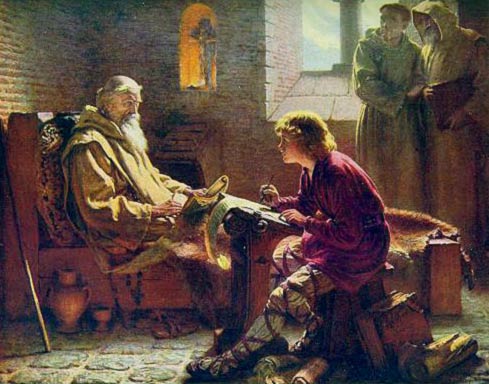 His most famous disciple, Cuthbert, reported that Bede was working on a translation of John's Gospel into English when death came. He also said that Bede died with the words of the Gloria Patri on his lips.
Attested hymns include Hymnum canentes martyrum ("The Hymn for Conquering Martyrs Raise"), Hymnum canamus Domino (translated variously as "A Hymn of Glory Let Us Sing," "The Hymn of Glory Sing We," and "Sing We Triumphant Hymns of Praise"), and Praecursor altus luminis ("The Great Forerunner of the Morn"). He also wrote vernacular poetry.
Bede received the title "Venerable" within two generations of his death and is buried in Durham Cathedral as one of England's greatest saints.
Lection — ESV Except as Noted
Psalm 78:1-4 or 19:7-14
Wisdom 7:15-22 (NRSV)
Matthew 13:47-52
Collect
Heavenly Father, who called your servant Bede, while still a child, to devote his life to Your service in the disciplines of religion and scholarship, grant that as he labored in the Spirit to bring the riches of Your truth to his generation, so we, in our various vocations, may strive to make You known in all the world; through Jesus Christ our Lord, who lives and reigns with you and the Holy Spirit, one God, now and forever.
A Hymn of Glory Let Us Sing
A hymn of glory let us sing New songs throughout the world shall ring
Alleluia, Alleluia.
Christ, by a road before untrod Ascendeth to the throne of God.
Alleluia, Alleluia, Alleluia, Alleluia, Alleluia.
The holy apostolic band Upon the Mount of Olives stand
Alleluia, Alleluia.
And with His followers they see Jesus' resplendent majesty
Alleluia, Alleluia, Alleluia, Alleluia, Alleluia.
To Whom the angels drawing nigh, "Why stand and gaze upon the sky?"
Alleluia, Alleluia.
"This is the Savior," thus they say. "This is His noble triumph day."
Alleluia, Alleluia, Alleluia, Alleluia, Alleluia.
"Again ye shall behold Him so, As ye have today seen Him go."
Alleluia, Alleluia.
"In glorious pomp ascending high Up to the portals of the sky."
Alleluia, Alleluia, Alleluia, Alleluia, Alleluia.
O grant us thitherward to tend And with unwearied hearts ascend,
Alleluia, Alleluia.
Unto Thy kingdom's throne, where Thou As is our faith, art seated now,
Alleluia, Alleluia, Alleluia, Alleluia, Alleluia.
Be Thou our Joy and strong Defense, Who art our future Recompense,
Alleluia, Alleluia.
So shall the light that springs from Thee Be ours through all eternity,
Alleluia, Alleluia, Alleluia, Alleluia, Alleluia.
O risen Christ, ascended Lord, All praise to Thee let earth accord,
Alleluia, Alleluia.
Who art, while endless ages run, With Father and with Spirit One,
Alleluia, Alleluia, Alleluia, Alleluia, Alleluia.
More on Bede's hymns and related information from NetHymnal.
Labels: bede, biography, church history, commemoration, english history, hagiography, historiography, hymnody, medieval history, patristics, the venerable bede, translation
¶ 00:00 | 0 comments |

 Johann Walter (also Johannes Walther) was born in 1496 and began serving at the age of 21 as a composer and bass singer in the court chapel of Frederick the Wise. In 1524, he published a collection of hymns arranged according to the church year. It was well received and served as the model for numerous subsequent hymnals.
In addition to serving for 30 years as kantor (church musician and choir director) in the cities of Torgau and Dresden, he also assisted Martin Luther in the preparation of the Deutsche Messe of 1526, a setting of the Liturgy in the German language using hymn tunes.
Walter is remembered as the first Lutheran kantor and composer of church music. Among his most cherished works is Der Bräut'gam wird bald rufen (The Bridegroom Soon Will Call Us). Information on Walter, including some texts and music samples, may also be found through Hymnuts, Here of a Sunday Morning, and the Cyber Hymnal.
NB: Do not confuse this Johann Walter, whose output was largely hymns and other church music with the later Johann Jakob Walther (1650 - 1717), a Baroque composer best known for his violin works, or with Johann Gottfried Walther (1684 - 1748), also from the Baroque Period, who was a church organist and composer.
Labels: biography, commemoration, german history, hagiography, hymnody, johann walter, johannes walther, liturgics, lutheranism, martin luther, music, reformation
¶ 00:00 | 0 comments |
 Martin Luther, born on 10 November 1483, in Eisleben, Germany, initially began studies leading toward a degree in law. However, after a close encounter with death, he switched to the study of theology, entered an Augustinian monastery, was ordained a priest in 1505, and received a doctorate in theology in 1512.
As a professor at the newly-established University of Wittenberg, his Scriptural studies led him to question many of the church's teachings and practices, especially the selling of indulgences. His refusal to back down from his convictions resulted in his excommunication in 1521. Following a period of seclusion at the Wartburg castle, Luther returned to Wittenberg, where he spent the rest of his life preaching and teaching, translating the Scriptures, and writing hymns and numerous theological treatises.
Of course, Luther didn't work alone. First of all, he knew that the Holy Spirit, working through the Word, was principal actor in the Reformation, and said, "While I slept, or drank Wittenberg beer with my friends ... the Word so greatly weakened the papacy that no prince or emperor ever inflicted such losses upon it. I did nothing; the Word did everything." However, his "friends," including Philipp Melanchthon, Nicholas Amsdorf, Johannes Bugenhagen, and others contributed mightily to the cause. Meanwhile, his prince, Frederick III of Saxony, defended him. Finally, he probably received no earthly support greater than that of his beloved wife Katie.
We remember and honor his lifelong emphasis on the Biblical truth that for Christ's sake God declares us righteous by grace through faith alone. He died on 18 February 1546, while visiting the town of his birth.
Please visit Xrysostom for The Life of Martin Luther: A Chronology. A number of recommended books and web sites are included along with this biographical outline.
Lection
Psalm 46
Isaiah 55:6-11
Romans 10:5-17
John 15:1-11
Collect
O Lord God, heavenly Father, pour our Your Holy Spirit on Your faithful people, keep them steadfast in Your grace and truth, protect and comfort them in all temptation, defend them against all enemies of Your Word, and bestow on Christ's Church Militant Your saving peace; through Jesus Christ, Your Son, our Lord, who lives and reigns with You and the Holy Spirit, one God, now and forever.
Tags: Martin Luther | Doctor Martin Luther | Dr. Martin Luther | Lutheran | Lutheranism | Christianity | Christian | Reformation | Lutheran Reformation | Book of Concord | Lutheran Confessions | Small Catechism | Large Catechism | Smalcald Articles | hagiography | biography | Church history | historical theology | exegetical theology | Bible translation | practical theology | hymn writing | liturgics | German history | European history| Aardvark Alley
Labels: biography, bugenhagen, commemoration, frederick the wise, german history, hagiography, hymnody, katharina luther, lutheran confessions, lutheranism, martin luther, philipp melanchthon, reformation, theology
¶ 00:00 | 0 comments |
 Lutheran musician, composer, and musicologist Michael Praetorius (Prätorius) was born in Kreuzburg, Thuringia to Pastor and Mrs. Michael Schultheis (or Schultze), on 15 February 1571. Praetorius was a Latinization of the family name and Michael later favored the monogram MPC (Michael Praetorius Creutzbergensis). While still a boy, he began studying philosophy at the University of Frankfurt, where his brother Andreas was a professor.
Praetorius became organist at Frankfurt and later held the same post at Lüneburg. In this latter town he began his career as Kapellmeister. While only 18, he began serving Herzog Heinrich Julius of Braunschweig-Wolfenbüttel as a minor member of his court. In 1604, Praetorius became the prince's Kapellmeister and organist. He was also appointed honorary prior of the Ringelheim Monastery near Goslar but wasn't required to stay there. He died at Wolfenbüttel on 15 February 1621.
Praetorius was, by all accounts, an accomplished musician and certainly a prolific composer. He also involved himself in the study of musical art and practice. His major work in this field was The Syntagma musicum, "not a piece of music but a scholarly historico-theoretical masterpiece." Of this, he completed three volumes. The second volume of this work is the most elaborate and valuable treatise on instruments and instrumental music from the 16th Century and is considered one of the most remarkable examples of musical scholarship in existence. The planned but uncompleted fourth volume was to have involved counterpoint and we can only wonder how much of the history of that topic we lost with his death at age fifty.
 Among his other titles were Musae Sioniae, a compendium of over 1200 chorale and song arrangements published in nine parts, and Hymnodia Sionae. The 1612 Terpsichore, his sole surviving secular work, is a collection of more than 300 instrumental dances.
His harmonization of Es ist ein Ros entsprungen (Lo, How a Rose E'er Blooming) remains popular. He also arranged and composed the beautiful Mass for Christmas Morning.
His compositions and arrangements generally show a strong Christian faith filtered through his passionate Lutheran understanding of Scripture, grace, and faith. He helped move music from the late Renaissance into the early Baroque and forms the first half of a pair of Lutheran bookends to that period, the latter being J. S. Bach.
I chose to transfer his commemoration to this date since his birth and death both fell on 15 February, when the LCMS commemorates Philemon and Onesimus. The days adjacent are already reserved for Saint Valentine (the 14th) and Philipp Melanchthon (the 16th).
Labels: bach, baroque period, biography, commemoration, hagiography, hymnody, liturgics, lutheranism, music, praetorius, renaissance
¶ 00:24 | 0 comments |
 German pastor and theologian Klaus Harms was born at Fahrstedt, Schleswig-Holstein on 25 May 1778 and baptized the next day in the neighboring community of Marne. Before entering university, he worked in his father's mill. He also farmed for a brief time.
His early religious and philosophical leanings tended strongly toward Rationalism but change commenced after he began studies at the University of Kiel. First, Friedrich Schleiermacher led Harms toward a less extreme, slightly more Evangelical understanding of Christianity. Further study of Scripture and older Lutheran writers pulled him away from the liberal, inner-conscious Christianity of Schleiermacher toward traditional, orthodox Lutheranism.
By the time of his graduation, it's unlikely that Harms would have been certified for the ministry by the crass Rationalists or the disciples of Schleiermacher. Therefore, he took his oral and written examinations before J. L. Callisen, the orthodox Lutheran superintendent of Holstein.
Following his studies and a stint as tutor and guest preacher, Harms was married in Probsteierhagen in 1806. Later that year, he was called as deacon (assitant pastor) at Lunden. After serving there for ten years, he accepted a call to serve the St. Nikolai Church in Kiel as archdeacon. He became chief pastor and superintendent in 1835. All through this period he continued to distance himself from Rationalism and the feeling- and experience-based theology of Schleiermacher to increasingly espouse the pure Lutheran doctrine of the 16th Century.
 Harms's personality and preaching style led to growing popularity in Kiel and beyond. He drew international attention in 1817. On the 300th anniversary of the Reformation, he published Luther's original Ninety-five Theses and ninety-five additional theses of his own composition, "directed against all sorts of false and confused knowledge within the Lutheran church." These latter attacked Rationalism and unionism and called for a return to pure Lutheran theology and practice.
Much as Luther condemned the magisterial use of reason which placed rational thought above faith in Christ, Harms wrote, "We could call reason our time's pope, our antichrist.... (Thesis 9)" He claimed the right of Lutherans to have authentic Lutheran clergy: "Reason rages in the Lutheran church: it tears Christ from the altar, throws God's word from the pulpit, casts excrements into the baptismal water, mixes all sorts of people when it comes to God-parents, erases the address of the confessional chair, hisses out the priests, and all people with them, and has been doing this for a long time. (Thesis 71)"
Furthermore, Harms lauded a proper balance in Word and Sacrament ministry. Theses 92-94 say, "The evangelical-catholic church is a glorious church. It rests on and builds itself preferably by the sacrament. The evangelical-reformed church is a glorious church. It rests on and builds itself by God's word. More glorious than both is the evangelical-Lutheran church. It rests on and builds itself by the sacrament as well as God's word."
While Harms had considerable influence throughout Germany, we must also recognize his huge, albeit indirect, contribution to American Lutheranism. His Christ-centered, confessional Lutheranism led C. F. W. Walther and others to their awakening into true Lutheranism later during the 19th Century.
Besides his credentials as a theologian, Harms was a qualified musician. As such, his growing Lutheran identity led him to restore Lutheran hymnody to the church. Many of his textual reforms remain to present times. However, he never had the same success with the restoration of the original melodies and the bold syncopation of the traditional chorales stayed buried under the bland metrical style for many years following.
Among his writings are the aforementioned Theses, volumes of his sermons, an autobiography, and his 1830 Pastoraltheologie. Due to blindness, Harms resigned his pastorate in 1849. He died on 1 February 1855.
Quotes from The 95 Theses of Claus Harms at the Internet Archive's copy of LutheranWiki.
See also the articles at Christian Cyclopedia, the 1911 Encyclopædia Britannica, and Wikipedia.
Labels: biography, claus harms, commemoration, hagiography, hymnody, lutheranism, pietism, rationalism, schleiermacher, theology, walther
¶ 00:00 | 0 comments |
 Matthias Loy (1828-1915) was born on 17 March to Matthias and Christina Loy, a pair of German immigrants. The family lived in near-poverty in Cumberland County, Pennsylvania, near Harrisburg. He was the fourth of seven children. Matthias, Senior was a lapsed Catholic who apparently held only nominal religious beliefs for most of his life. Christina came from pietistic Lutheran stock in Württemberg. She did what she could to give the family some semblance of a Christian education and made sure that all but the eldest child were baptized as infants. Even her first-born son eventually was confirmed into the Lutheran Church.
When Matthias was six years old, the family moved to Hogestown, Pennsylvania. He lived with his family until he was fourteen. They then apprenticed him to Baab and Hummel Printers of Harrisburg. During the next six years, he worked for them while attending school. Mr. Hummel brought Matthias to the attention of Harrisburg minister C. W. Schäffer. Pastor Schäffer urged Matthias to consider a pastoral vocation. To this end, he studied studied Greek and Latin under the Harrisburg Academy's principal. This led to enrollment as a full student at the Academy. He hoped to enter the Gettysburg Theological Seminary, perhaps the epicenter of Lutheran liberalism in America.
Illness led Loy's doctor to encourage the young man to move farther west. Matthias found an employment opportunity with the United Brethren Publishing House in Circleville, Ohio. There he would become printer for the Brethren's semimonthly German paper. Loy came to Circleville in 1847 and quickly met the Lutheran pastor. This good soul suggested that Matthias waste no more time getting on with his pastoral education and suggested that he enroll at the Theological Seminary in Columbus. The Evangelical Lutheran Synod of Ohio was much more conservative and confessional than the Lutherans he had left behind in Pennsylvania.
 With the promise of financial aid through the Lutheran pastor, Loy sought and received release from his printer's contract and left for Columbus. Of Matthias's time there, C. George Fry writes, "It was at this institution that he received the only two years of formal higher education deemed necessary to be a pastor. In 1849, after a two year 'cram course' that included academy, college, and seminary, Loy was graduated and installed as a minister in Delaware, Ohio."
Loy was finally surrounded by orthodox Lutheran theology and he made the most of his time at the seminary. As a student, he was immersed in Lutheran doctrine and began reading Der Lutheraner, edited by C. F. W. Walther. This led to a long relationship with Dr. Walther, a friendship that grew so great that even their eventual disagreements over predestination and the fracturing of the Synodical Conference couldn't destroy.
According to Fry, these two men, along with Charles Porterfield Krauth, "must be seen as a common effort to preserve traditional Lutheran theology from the corrosive effects of 'the acids of modernity' in the last half of the nineteenth century. These three titans — Walther in the West, Krauth in the East, and Loy in the middle — could be compared to three anchors holding fast the ship of Lutheran Confessionalism during the ferocious storms of the Modernist-Fundamentalist Controversy."
In 1860, the Joint Synod of Ohio elected Loy President. Four years later, he was appointed editor of the Lutheran Standard. After sixteen years in the ministry, Capital University, Columbus, Ohio called Loy as professor of theology. He resigned as president of the Ohio Synod in 1878. Around this time he also returned the call to become English-language professor of theology at Concordia Seminary, St. Louis. Wilhelm Friedrich Lehmann, Loy's successor as synodical president, died in 1880 and Loy returned to that office, succeeding him also as President of Capital University. He started the Columbus Theological Magazine in 1881. Loy retired as professor emeritus in 1902 and died on 26 January 1915.
 Loy was instrumental in the formation of the Synodical Conference. However, at the Ohio Synod meeting at Wheeling in 1881, the synod withdrew from the Conference. This came about over sharp differences in understanding Predestination. Many Ohio Synod pastors taught that God predestined people according to His foreknowledge of whether they would come to faith while the Missouri Synod condemned this as false doctrine.
During his life, Loy wrote several books. Of special note is his seminal work The Augsburg Confession: An Introduction to Its Study and an Exposition of Its Contents.
He also wrote at least twenty hymns, including An Awe-full Mystery Is Here, The Law of God Is Good and Wise, The Gospel Shows the Father's Grace, and Jesus, Thou Art Mine Forever. His hymn translations included All Mankind Fell in Adam's Fall, The Bridegroom Soon Will Call Us, Let Me Be Thine Forever, and Thy Table I Approach.
*Since his death date (26 January) and birth date (17 March) both conflict with long-standing festivals on the sanctorial calendar (Titus and Pádraig respectively) and since 27 January belongs to John Chrysostom, I moved Loy's commemoration the first open date, 28 January.
Sources
Quotes from C. George Fry's Matthias Loy: Theologian of American Lutheran Orthodoxy [PDF]. This excellent biography was printed in The Springfielder, October 1974, Volume 38, Number 4.
Additional Reading includes Loy's autobiography, The Story of My Life, which the Internet Archive has in several formats, including PDF, Nook (EPUB), and Kindle (MOBI). See also entries at Net Hymnal and the Christian Cyclopedia.
Suggested Lection
Psalm 46
Isaiah 55:6-11
Romans 10:5-17
John 15:1-11
Collect
O Lord God, heavenly Father, we pray that, as You raised up Matthias Loy to lead Lutherans in America into a renewed appreciation of their confessional heritage and to a fuller confidence in the saving Gospel of Jesus Christ, so You would continue to provide us with faithful pastors and leaders, keep us steadfast in Your grace and truth, defend us against all enemies of Your Word, and bestow on Christ's Church Militant Your saving peace; through Jesus Christ, Your Son, our Lord, who lives and reigns with You and the Holy Spirit, one God, now and forever.
Labels: american history, biography, commemoration, hagiography, hymnody, loy, lutheran confessions, lutheranism, matthias loy, synodical conference, theology
¶ 00:00 | 0 comments |
Saint John Chrysostom, Preacher, Bishop, and Theologian, was called Chrysostom (Greek for"golden-mouthed") by his hearers. He was a dominant force in the fourth-century Christian church.
 Born in Antioch around AD 347, John was instructed in the Faith by his pious mother, Anthusa. After serving in a number of Christian offices, including acolyte and lector, John was ordained a presbyter and given preaching responsibilities.
His simple but direct messages found an audience well beyond his home town. His title came from his legendary preaching abilities. An unsubstantiated but widely circulated tale is that pickpockets and cutpurses would flock to services because he held his audience so spellbound that they could easily rob Saint John's hearers.
In 398, John was made Patriarch of Constantinople, where His determination to reform the church, court, and city brought him into conflict with established authorities. Eventually, he was exiled from his adopted city. Although removed from his parishes and people, he continued writing and preaching until his death in 407. It is reported that his final words were: "Glory be to God for all things. Amen."
John Chrysostom was one of four Eastern theologians among the eight Doctors of the undivided Church. The other three were Athanasius, Basil the Great, and Gregory of Nazianzus. The four great early Western (or Latin) doctors were Augustine, Jerome, Gregory the Great, and Ambrose of Milan.
Quote
The following excerpt is based on the passage, "[T]he letter kills, but the Spirit gives life. (2 Corinthians 3:6)" It comes from his Sixth Homily On 2 Corinthians.
Yet he says these things not in one sense only, but in reference to those who prided themselves on the things of Judaism. By the "letter" here he means the Law which punishes those who transgress; but by the "spirit" he means the grace which through Baptism gives life to those who by sins were made dead.Quoted from The Lord Will Answer: A Daily Prayer Catechism © 2004 by Concordia Publishing House.
In the Law he that has sin is punished. Here, he that has sins comes and is baptized and is made righteous, and being made righteous, he lives, being delivered from the death of sin. The Law, if it lay hold on a murderer, puts him to death. The Gospel, if it lay hold on a murderer, enlightens, and gives him life.
Lection
Psalm 49:1-8 or 34:15-22
Jeremiah 1:4-10
Luke 21:12-15
Collect
O God, who gave Your servant John Chrysostom the grace to proclaim eloquently Your righteousness in the great congregation, and fearlessly to bear reproach for the honor of Your Name, mercifully grant to all bishops and pastors such excellency in preaching and fidelity in ministering Your Word, that Your people shall be partakers with them of the glory that shall be revealed; through Jesus Christ our Lord, who lives and reigns with You and the Holy Spirit, one God, now and forever.
Labels: biography, chrysostom, church history, commemoration, doctors of the church, hagiography, hymnody, john chrysostom, liturgics, patristics, theology
¶ 00:00 | 0 comments |
23 December
 We now arrive at the seventh and final O Antiphon, including related Scriptures, Latin text and English translation, a Latin hymn stanza, and the English versification from the hymn known as O Come, O Come, Emmanuel. (The English language renditions are from the Lutheran Service Book.)
℣ O Emmanuel, Rex et legisfer noster, expectatio gentium, et Salvator erum:
℟ veni ad salvandum nos, Domine Deus noster.
℣ O Emmanuel, our King and our Lord, the Anointed for the nations and their | Savior:*
℟ Come and save us, O | Lord our God.
"Therefore the Lord himself will give you a sign. Behold, the virgin shall conceive and bear a son, and shall call his name Immanuel. (Isaiah 7:14)" See also Isaiah 8:6-8; Matthew 1:23; Haggai 2:7 (KJV).
Veni Veni, Emmanuel Captivum solve Israel,
Qui gemit in exsilio, Privatus Dei Filio.
O come, O come, Emmanuel, And ransom captive Israel,
That mourns in lonely exile here Until the Son of God appear.
Rejoice! Rejoice! Emmanuel Shall come to thee, O Israel!
Read the final daily meditation from the O Antiphons by Pastor Weedon.
Ero Cras!
Unless otherwise noted, Scriptures are quoted from the ESV®
Labels: advent, christmas, emmanuel, god with us, hymnody, immanuel, liturgics, magnificat, o antiphons, ransom, vespers, worship
¶ 00:00 | 0 comments |
22 December
 This brings us to the sixth O Antiphon. Again, we have the Latin text and English translation, a Latin hymn stanza, and the English versification from the hymn known as O Come, O Come, Emmanuel are included. (The English language renditions are from the Lutheran Service Book.)
℣ O Rex gentium, et desideratus earum, lapisque angularis, qui facis utraque unem:
℟ veni, et salva hominem, quem de limo formasti.
℣ O King of the Nations, the Ruler they long for, the Cornerstone uniting all | people:*
℟ Come and save us all, whom You formed | out of clay.
"For to us a child is born, to us a son is given; and the government shall be upon his shoulder, and his name shall be called Wonderful Counselor, Mighty God, Everlasting Father, Prince of Peace. (Isaiah 9:6)" Also, "He shall judge between the nations, and shall decide disputes for many peoples; and they shall beat their swords into plowshares, and their spears into pruning hooks; nation shall not lift up sword against nation, neither shall they learn war anymore. (Isaiah 2:4)." See also Revelation 15:3; Psalm 118:22; Isaiah 28:16; Matthew 21:42; Mark 12:10; Luke 20:17; Acts 4:11; Ephesians 2:19-21; 1 Peter 2:6.
Veni, Veni, Rex Gentium, Veni, Redemptor omnium,
Ut salvas tuos famulos Peccati sibi conscios.
Oh, come, Desire of nations, bind In one the hearts of all mankind;
Bid Thou our sad divisions cease, And be Thyself our King of Peace.
Rejoice! Rejoice! Emmanuel Shall come to thee, O Israel!
Read today's comments on O Rex Gentium from William Weedon.
Scripture quoted from the ESV®
Labels: advent, christmas, desire, emmanuel, gentiles, hymnody, immanuel, king, liturgics, magnificat, o antiphons, rex gentium, vespers, worship
¶ 00:00 | 1 comments |
21 December
 Here follows the fifth of the seven O Antiphons, with Latin text and English translation, a Latin hymn stanza, and the English versification from the hymn known as O Come, O Come, Emmanuel. (The English language renditions are from the Lutheran Service Book.)
℣ O Oriens, splendor lucis aeternae, et sol justitiae:
℟ veni, et illumina sedentis in tenebris, et umbra mortis.
℣ O Dayspring, splendor of light ever- | lasting:*
℟ Come and enlighten those who sit in darkness and in the sha- | dow of death.
"The people who walked in darkness have seen a great light; those who dwelt in a land of deep darkness, on them has light shined. (Isaiah 9:2)" See also Luke 1:78-79; Malachi 4:2.
Veni, Veni O Oriens, Solare nos adveniens,
Noctis depelle nebulas, Dirasque mortis tenebras.
O come, Thou Dayspring from on high, And cheer us by Thy drawing nigh,
Disperse the gloomy clouds of night, And death's dark shadows put to flight.
Rejoice! Rejoice! Emmanuel Shall come to thee, O Israel!
Continue by reading this from Pr. William Weedon
Scripture quoted from the ESV®
Labels: advent, christmas, dayspring, emmanuel, hymnody, immanuel, liturgics, magnificat, o antiphons, oriens, vespers, worship
¶ 00:10 | 0 comments |
20 December
 This is the fourth of the seven O Antiphons with Scriptures, Latin and English texts of the antiphon, a Latin hymn stanza, and the English versification from the hymn we know as O Come, O Come, Emmanuel. (The English language renditions are from the Lutheran Service Book.)
℣ O Clavis David, et sceptrum domus Israel: qui aperis, et nemo claudit; claudis, et nemo aperit:
℟ veni et educ vinctum de domo carceris, sedentem in tenebris, et umbra mortis.
℣ O Key of David, and Scepter of the House of Israel, You open and no one can close, You close and no one can | open:*
℟ Come and rescue the prisoners who are in darkness and the shad- | ow of death.
"I will place on his shoulder the key of the house of David. He shall open, and none shall shut; and he shall shut, and none shall open. (Isaiah 22:22)" "Of the increase of his government and of peace there will be no end, on the throne of David and over his kingdom, to establish it and to uphold it with justice and with righteousness from this time forth and forevermore. The zeal of the Lord of hosts will do this. (Isaiah 9:7)" See also Revelation 3:7.
Veni, Clavis Davidica, regna reclude caelica,
fac iter tutum superum, et claude vias inferum.
O come, Thou Key of David, come, And open wide our heav'nly home;
Make safe the way that leads on high, And close the path to misery.
Rejoice! Rejoice! Emmanuel Shall come to you, O Israel!
Here's more from Pastor Weedon.
Scripture quoted from the ESV®
Labels: advent, christmas, clavis david, david, emmanuel, hymnody, immanuel, key of david, liturgics, magnificat, o antiphons, vespers, worship
¶ 00:10 | 0 comments |
19 December
 Here follows the third of the O Antiphons with Scriptures, Latin and English texts of the antiphon, a Latin hymn stanza, and the English versification from the hymn we know as O Come, O Come, Emmanuel. (The English language renditions are from the Lutheran Service Book.)
℣ O Radix Jesse, qui stas in signum populorum, super quem continebunt reges os suum, quem gentes deprecabuntur;
℟ veni ad liberandum nos, iam noli tardere.
℣ O Root of Jesse, standing as an ensign before the peoples, before whom all kings are mute, to whom they will do | homage:*
℟ Come quickly to de- | liver us.
"There shall come forth a shoot from the stump of Jesse, and a branch from his roots shall bear fruit. (Isaiah 11:1)" "In that day the root of Jesse, who shall stand as a signal for the peoples — of him shall the nations inquire, and his resting place shall be glorious. (Isaiah 11:10)" Jesse was the father of King David; Micah prophesied that the Messiah would be of the house and lineage of David and be born in David's city, Bethlehem (Micah 5:2). See also Romans 15:12; Revelation 5:5.
Veni, O Jesse Virgula, Ex hostis tuos ungula,
De spectu tuos tartari Educ et antro barathri.
O come, Thou Branch of Jesse's tree, Free them from Satan's tyranny
That trust Thy mighty pow'r to save, And give them vict'ry o'er the grave.
Rejoice! Rejoice! Emmanuel Shall come to you, O Israel!
Please see also what Pastor Weedon wrote.
Scripture quoted from the ESV®
Labels: advent, christmas, emmanuel, hymnody, immanuel, jesse, liturgics, magnificat, o antiphons, radix, root, vespers, worship
¶ 00:10 | 0 comments |
18 December
 This is the second of the O Antiphons with Scriptures, Latin and English texts of the antiphon, a Latin hymn stanza, and the English versification from the hymn we know as O Come, O Come, Emmanuel. (The English language renditions are from the Lutheran Service Book.)
"With righteousness he shall judge the poor, and decide with equity for the meek of the earth; and he shall strike the earth with the rod of his mouth, and with the breath of his lips he shall kill the wicked. Righteousness shall be the belt of his waist, and faithfulness the belt of his loins. (Isaiah 11:4-5)" "For the Lord is our judge; the Lord is our lawgiver; the Lord is our king; he will save us. (Isaiah 33:22)" See also Exodus 3; Micah 5:2; Matthew 2:6.
℣ O Adonai, et dux domus Israel, qui Moysi in igne flammae rubi apparuisti, et ei in Sina legem dedisti:
℟ veni ad redimendum nos in brachio extento.
℣ O Adonai and Ruler of the House of Israel, who appeared to Moses in the burning bush and gave him the Law on | Sinai:*
℟ come with an outstretched arm and re- | deem us.
Veni, Veni, Adonai, Qui populo in Sinai
Legem dedisti vertice In maiestate gloriae.
O come, O come, Thou Lord of might, Who to Thy tribes on Sinai's height
In ancient times didst give the Law In cloud and majesty and awe.
Rejoice! Rejoice! Emmanuel Shall come to thee, O Israel!
Read some more from William Weedon.
Scripture quoted from the ESV®
Labels: adonai, advent, christmas, emmanuel, hymnody, immanuel, liturgics, lord, magnificat, o antiphons, vespers, worship
¶ 00:00 | 0 comments |
17 December
 This is the first of the O Antiphons with relevant Scriptures, Latin and English texts, the corresponding Latin hymn stanza, and the English versification from the hymn O Come, O Come, Emmanuel. (The English language renditions are from the Lutheran Service Book.)
℣ O Sapientia, quae ex ore Altissimi prodiisti, attingens a fine usque ad finem fortiter, suaviterque disponens omnia:
℟ veni ad docendum nos viam prudentiae.
℣ O Wisdom, proceeding from the mouth of the Most High, permeating all creation, mightily ordering | all things:*
℟ Come and teach us the way of | prudence.
"And the Spirit of the Lord shall rest upon him, the Spirit of wisdom and understanding, the Spirit of counsel and might, the Spirit of knowledge and the fear of the Lord. And his delight shall be in the fear of the Lord. (Isaiah 11:2-3)" "This also comes from the Lord of hosts; he is wonderful in counsel and excellent in wisdom. (Isaiah 28:29)" See also Proverbs 1:20; Proverbs 8-9 and 1 Corinthians 1:30.
Veni, O Sapientia, Quae hic disponis omnia,
Veni, viam prudentiae Ut doceas et gloriae.
O come, Thou Wisdom from on high, Who ord'rest all things mightily;
To us the path of knowledge show, And teach us in her ways to go.
Rejoice! Rejoice! Emmanuel Shall come to thee, O Israel!
You are invited to read more from Pastor Weedon. Also, I'm hoping to gain access to the audio of these antiphons as chanted by Kantor Nathan Beede.
Scripture quoted from the ESV®
Labels: advent, christmas, emmanuel, hymnody, immanuel, liturgics, magnificat, o antiphons, sapientia, vespers, wisdom, worship
¶ 00:10 | 0 comments |
 We count down the final days of Advent using the traditional monastic antiphons to the Magnificat. Most of English speaking Christendom knows these antiphons through their versification, Oh, Come, Oh, Come, Emmanuel. Beginning in eternity, the antiphons follow a rough chronology through history until the coming of Immanuel, Hebrew for "God [is] with Us" (see Isaiah 7:14; Matthew 1:23)
Thus, the first stanza that we normally sing of the hymn is actually the last of the antiphons, sung on 23 December. By Vespers on the 24th, it's time to remove the final vestiges of Advent and enter into Christmas.
 The order itself, whether by design or coincidence, forms a Latin reverse acrostic. The initial address for the coming Savior in each antiphon is as follows: Sapientia, Adonai, Radix, Clavis, Oriens, Rex, and Emmanuel. Taking each title's first letter and writing the result backwards yields "ero cras"; normally this is rendered, "I shall be [with you] tomorrow." Thus our Lord promises to return for us and so He leads us to pledge to join together in His worship while still on earth.
Through the next week, I'll post each day's antiphon in Latin, its translation from Lutheran Service Book, the Latin hymn verse, and the corresponding hymn stanza of O Come, O Come, Emmanuel from LSB. If you don't want to wait for each day's antiphon, I've linked to each individually from December 2007.
Posts in the Series:
† O Sapientia — O Wisdom
† O Adonai — O Lord and Ruler
† O Radix Jesse — O Root of Jesse
† O Clavis David — O Key of David
† O Oriens — O Dayspring
† O Rex Gentium — O King of the Nations
† O Emmanuel — O God with Us
Labels: advent, christmas, emmanuel, hymnody, immanuel, liturgics, magnificat, o antiphons, vespers, worship
¶ 00:00 | 0 comments |
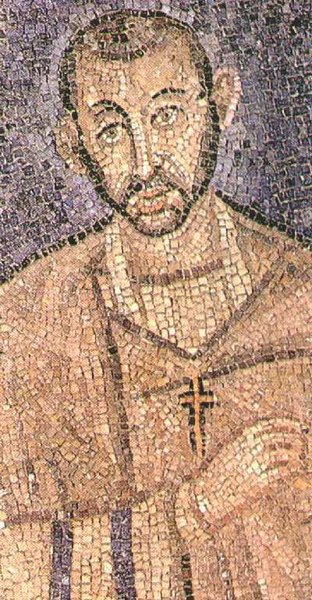
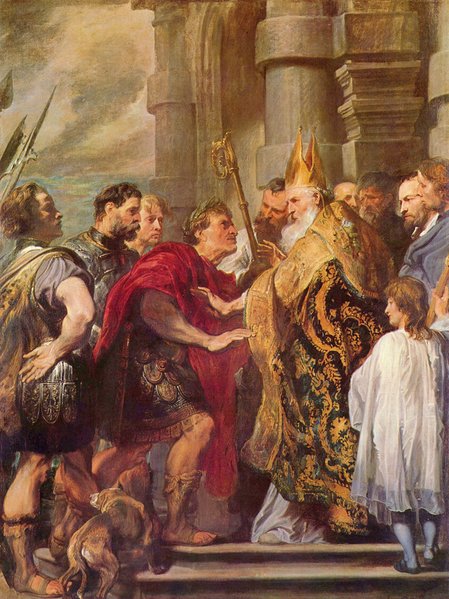 Saint Ambrose of Milan was born in Trier around AD 340. He became a Roman governor in northern Italy and the people of Milan later named him bishop by general acclaim. He stands as one of the four Latins among the eight Doctors of the undivided Church. Augustine, Jerome, and Gregory the Great are the West's other representatives; Athanasius, John Chrysostom, Basil the Great, and Gregory of Nazianzus represent the East.
Ambrose was also an author of hymns, the best known of which is probably Intende, qui regis Israel (usually known by its second stanza as Veni, Redemptor gentium). Martin Luther translated it into German (Nun komm, der Heiden Heiland); its English translations (from Luther or the original Latin) usually appear as Savior of the Nations, Come; Savior of the Heathen, Known; or Come, Thou Redeemer of the Earth).
His name is also associated with Ambrosian Chant. You can search the web for examples of the notation while YouTube has a number of recordings of sacred music performed according to Ambrosian sensibilities. This style of chanting the ancient liturgy took hold in the province of Milan. For more on his musical influence in the Church, see the NetHymnal for a detailed list with links to translations and adaptations of a number of the Hymns of Saint Ambrose.
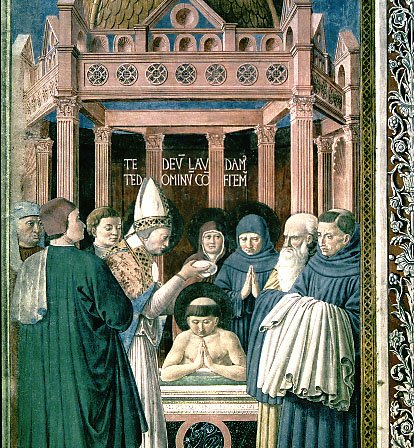
While serving as a civil governor, Ambrose sought to bring peace among Christians in Milan who were divided into quarreling factions. When a new bishop was to be elected in 374, Ambrose addressed the crowd, and someone cried out, "Ambrose, bishop!" The entire gathering gave their support. At this time, Ambrose was still a catechumen, an unbaptized person still under instruction before joining the church. The general acclaim hastened the catechetical process and the 34-year-old was baptized on December 7, after which he was consecrated bishop of Milan.
 A strong defender of the faith, Ambrose convinced the Roman emperor Gratian in 379 to forbid the Arian heresy in the West. At Ambrose's urging, Gratian's successor Theodosius also publicly opposed Arianism.
Ambrose died on Good Friday, 4 April 397, but the Church was unwilling to honor such a known and popular person on the day commemorating the death of Christ. Thus, his feast day was transferred from his "heavenly birthday" (or death date) to the date of his baptism and subsequent consecration as bishop.
Ambrose was also instrumental in the conversion of Augustine of Hippo. Some early traditions hold that the hymn Te Deum Laudamus ("We Praise You, O God") was a spontaneous composition by Ambrose, perhaps with Augustine's help, upon the baptism of the latter. While later researchers hold this to be unlikely, some scholars are convinced that he was largely responsible for authorship of the Athanasian Creed (14k PDF).
As a courageous doctor and musician he upheld the truth of God's Word. Once again this Advent-tide, thousands upon thousands of believers will use Savior of the Nations, Come to pray for the Second Coming of our Lord. Here is my favorite, passed on to us from Ambrose via Martin Luther and William Morton Reynolds:
Savior of the nations, come;
Virgin's Son, here make Thy home!
Marvel now, O heaven and earth,
That the Lord chose such a birth.
Not by human flesh and blood;
By the Spirit of our God
Was the Word of God made flesh,
Woman's offspring, pure and fresh.
Wondrous birth! O wondrous Child
Of the virgin undefiled!
Though by all the world disowned,
Still to be in heaven enthroned.
From the Father forth He came
And returneth to the same,
Captive leading death and hell
High the song of triumph swell!
Thou, the Father's only Son,
Hast over sin the victory won.
Boundless shall Thy kingdom be;
When shall we its glories see?
Brightly doth Thy manger shine,
Glorious is its light divine.
Let not sin o'ercloud this light;
Ever be our faith thus bright.
Praise to God the Father sing,
Praise to God the Son, our King,
Praise to God the Spirit be
Ever and eternally.
Lection
Psalm 27:5-11 or 33:1-5,20-21
Ecclesiasticus 2:7-11,16-18
1 Peter 1:3-9, 13-21
Luke 12:35-37, 42-44
Collect
O God, who graciously gave Your servant Ambrose eloquence to proclaim Your righteousness and fearlessness to bear reproach for the honor of Your Name, mercifully grant to all pastors and overseers such excellence in preaching and faithfulness in ministering Your Word that Your people may be partakers with them of the glory that shall be revealed; through Jesus Christ our Lord, who lives and reigns with You and the Holy Spirit, one God, now and forever.
Labels: ambrose, arianism, augustine, biography, chant, commemoration, european history, hagiography, hymnody, liturgics, music, roman empire, te deum, theology
¶ 00:00 | 0 comments |
Today marks the heavenly birthday of Bede (pronounced BĒD). Since his commemoration often falls near the end of Eastertide, it's quite likely that many Christians have close familiarity with one of Bede's best known (and one of this Aardvark's favorite) hymns, the Ascension anthem "A Hymn of Glory Let Us Sing."Bede (673-735) was the last of the early church fathers and the first person to compile a history of the English church. Born in Northumbria, Bede was given by his parents to a monastery in Northern England at the age of seven. He was ordained when he was thirty.
Probably the most learned man of his time, he was a prolific writer of history and his careful use of sources provided a model for historians in the Middle Ages. His skill in both history and theology gave him the ability to complete a synthesis between the older Celtic monasticism and the later Rule of Saint Benedict.
Known best for his book Historia ecclesiastica gentis Anglorum (The Ecclesiastical History of the English People), he was also a profound interpreter of Scripture; his edition of the Vulgate was the standard in Catholicism until 1979 and his commentaries still provide fresh insights for today's readers.
Bede also popularized the use of Anno Domini Nostri Iesu Christi ("in the Year of Our Lord Jesus Christ") in speaking of the time since our Savior's birth. This is usually shortened to Anno Domini or AD.
His most famous disciple, Cuthbert, reported that Bede was working on a translation of John's Gospel into English when death came. He also said that Bede died with the words of the Gloria Patri on his lips.Attested hymns include Hymnum canentes martyrum ("The Hymn for Conquering Martyrs Raise"), Hymnum canamus Domino (translated variously as "A Hymn of Glory Let Us Sing," "The Hymn of Glory Sing We," and "Sing We Triumphant Hymns of Praise"), and Praecursor altus luminis ("The Great Forerunner of the Morn"). He also wrote vernacular poetry.
Bede received the title "Venerable" within two generations of his death and is buried in Durham Cathedral as one of England's greatest saints.
Lection — ESV Except as Noted
Psalm 78:1-4 or 19:7-14
Wisdom 7:15-22 (NRSV)
Matthew 13:47-52
Collect
Heavenly Father, who called your servant Bede, while still a child, to devote his life to Your service in the disciplines of religion and scholarship, grant that as he labored in the Spirit to bring the riches of Your truth to his generation, so we, in our various vocations, may strive to make You known in all the world; through Jesus Christ our Lord, who lives and reigns with you and the Holy Spirit, one God, now and forever.
A Hymn of Glory Let Us Sing
A hymn of glory let us sing New songs throughout the world shall ring
Alleluia, Alleluia.
Christ, by a road before untrod Ascendeth to the throne of God.
Alleluia, Alleluia, Alleluia, Alleluia, Alleluia.
The holy apostolic band Upon the Mount of Olives stand
Alleluia, Alleluia.
And with His followers they see Jesus' resplendent majesty
Alleluia, Alleluia, Alleluia, Alleluia, Alleluia.
To Whom the angels drawing nigh, "Why stand and gaze upon the sky?"
Alleluia, Alleluia.
"This is the Savior," thus they say. "This is His noble triumph day."
Alleluia, Alleluia, Alleluia, Alleluia, Alleluia.
"Again ye shall behold Him so, As ye have today seen Him go."
Alleluia, Alleluia.
"In glorious pomp ascending high Up to the portals of the sky."
Alleluia, Alleluia, Alleluia, Alleluia, Alleluia.
O grant us thitherward to tend And with unwearied hearts ascend,
Alleluia, Alleluia.
Unto Thy kingdom's throne, where Thou As is our faith, art seated now,
Alleluia, Alleluia, Alleluia, Alleluia, Alleluia.
Be Thou our Joy and strong Defense, Who art our future Recompense,
Alleluia, Alleluia.
So shall the light that springs from Thee Be ours through all eternity,
Alleluia, Alleluia, Alleluia, Alleluia, Alleluia.
O risen Christ, ascended Lord, All praise to Thee let earth accord,
Alleluia, Alleluia.
Who art, while endless ages run, With Father and with Spirit One,
Alleluia, Alleluia, Alleluia, Alleluia, Alleluia.
More on Bede's hymns and related information from NetHymnal.
Labels: bede, biography, church history, commemoration, english history, hagiography, historiography, hymnody, medieval history, patristics, the venerable bede, translation
¶ 00:00 | 1 comments |
Johann Walter (also Johannes Walther) was born in 1496 and began serving at the age of 21 as a composer and bass singer in the court chapel of Frederick the Wise. In 1524, he published a collection of hymns arranged according to the church year. It was well received and served as the model for numerous subsequent hymnals.In addition to serving for 30 years as kantor (church musician and choir director) in the cities of Torgau and Dresden, he also assisted Martin Luther in the preparation of the Deutsche Messe of 1526, a setting of the Liturgy in the German language using hymn tunes.
Walter is remembered as the first Lutheran kantor and composer of church music. Among his most cherished works is Der Bräut'gam wird bald rufen (The Bridegroom Soon Will Call Us). Information on Walter, including some texts and music samples, may also be found through Hymnuts, Here of a Sunday Morning, and the Cyber Hymnal.
NB: Do not confuse this Johann Walter, whose output was largely hymns and other church music with the later Johann Jakob Walther (1650 - 1717), a Baroque composer best known for his violin works, or with Johann Gottfried Walther (1684 - 1748), also from the Baroque Period, who was a church organist and composer.
Labels: biography, commemoration, german history, hagiography, hymnody, johann walter, johannes walther, liturgics, lutheranism, martin luther, music, reformation
¶ 00:00 | 0 comments |
Martin Luther, born on 10 November 1483, in Eisleben, Germany, initially began studies leading toward a degree in law. However, after a close encounter with death, he switched to the study of theology, entered an Augustinian monastery, was ordained a priest in 1505, and received a doctorate in theology in 1512.As a professor at the newly-established University of Wittenberg, his Scriptural studies led him to question many of the church's teachings and practices, especially the selling of indulgences. His refusal to back down from his convictions resulted in his excommunication in 1521. Following a period of seclusion at the Wartburg castle, Luther returned to Wittenberg, where he spent the rest of his life preaching and teaching, translating the Scriptures, and writing hymns and numerous theological treatises.
Of course, Luther didn't work alone. First of all, he knew that the Holy Spirit, working through the Word, was principal actor in the Reformation, and said, "While I slept, or drank Wittenberg beer with my friends ... the Word so greatly weakened the papacy that no prince or emperor ever inflicted such losses upon it. I did nothing; the Word did everything." However, his "friends," including Philipp Melanchthon, Nicholas Amsdorf, Johannes Bugenhagen, and others contributed mightily to the cause. Meanwhile, his prince, Frederick III of Saxony, defended him. Finally, he probably received no earthly support greater than that of his beloved wife Katie.
We remember and honor his lifelong emphasis on the Biblical truth that for Christ's sake God declares us righteous by grace through faith alone. He died on 18 February 1546, while visiting the town of his birth.
Please visit Xrysostom for The Life of Martin Luther: A Chronology. A number of recommended books and web sites are included along with this biographical outline.
Lection
Psalm 46
Isaiah 55:6-11
Romans 10:5-17
John 15:1-11
Collect
O Lord God, heavenly Father, pour our Your Holy Spirit on Your faithful people, keep them steadfast in Your grace and truth, protect and comfort them in all temptation, defend them against all enemies of Your Word, and bestow on Christ's Church Militant Your saving peace; through Jesus Christ, Your Son, our Lord, who lives and reigns with You and the Holy Spirit, one God, now and forever.
Tags: Martin Luther | Doctor Martin Luther | Dr. Martin Luther | Lutheran | Lutheranism | Christianity | Christian | Reformation | Lutheran Reformation | Book of Concord | Lutheran Confessions | Small Catechism | Large Catechism | Smalcald Articles | hagiography | biography | Church history | historical theology | exegetical theology | Bible translation | practical theology | hymn writing | liturgics | German history | European history| Aardvark Alley
Labels: biography, bugenhagen, commemoration, frederick the wise, german history, hagiography, hymnody, katy luther, lutheran confessions, lutheranism, martin luther, philipp melanchthon, reformation, theology
¶ 00:00 | 0 comments |


