
 At the dawn of the Third Century, Roman emperor Septimus Severus banned conversions to Christianity. Among those disobeying that edict were Vibia Perpetua, a young noblewoman, and her maidservant Felicitas. Both were jailed at Carthage in North Africa along with three fellow Christians, Saturus and his pupils Revocatus and Saturninus.
Perpetua and at least some of the others had not completed catechesis and weren't yet baptized when arrested. Evidently, they received Holy Baptism before being taken to prison. She was also a new mother and a fairly recent widow. Felicitas (or Felicity) was near the end of her own pregnancy when arrested.
During their imprisonment, Perpetua and Felicitas witnessed to their faith with such conviction that the officer in charge became a follower of Jesus. For some time, doubts remained about their fates, but Perpetua had a vision of a golden ladder guarded by a fierce dragon. She climbed it, stepping on the dragon's head to do so. At the top, she found a green meadow with many white-robed figures. In their midst stood a Shepherd, who welcomed her and gave her cheese from the sheep's milk. She awoke understanding that martyrdom was assured but that she would triumph.
 Perpetua's father came to plead that she recant her confession of faith and renounce Jesus Christ. This she steadfastly refused.
Roman law forbade the execution of pregnant women and Felicitas feared that Perpetua and the men being held at the same time would face martyrdom but leave her behind. However, she gave birth two days before the scheduled execution and was allowed to join her companions in the arena on 7 March.
The women first made arrangements for the well-being of their children. This was possible because the imperial decree only concerned recent converts to Christianity (or Judaism). Since those entrusted with their children's care were believers of long standing, they were safe from persecution, at least for the time being.
The accounts say that the five were first scourged at the crowd's urging. Then the men faced a boar, a bear, and a leopard while a wild cow was set against the women. After they were all injured, Perpetua and Felicity exchanged the kiss of peace before the Romans put them to the sword. One tradition holds that Perpetua showed mercy to her captors by guiding the sword of a trembling young gladiator to her own heart because he could not bear to put her to death.
The martyrs were interred in Carthage in North Africa and the story spread throughout Christendom. Later, a basilica was erected over their tomb. The story of the martyrdom of Saint Perpetua, Saint Felicitas, and their faithful companions has served for centuries as encouragement to persecuted Christians.
Lection
Psalm 34:1-8 or 124
Hebrews 10:32-39
Matthew 24:9-14
Collect
O God the true Emperor of Your saints, who strengthened Your servants Perpetua and Felicitas and their companions to make a good confession, staunchly resisting, for the cause of Christ, the claims of human affection, and encouraging one another in their time of trial, grant that we who cherish their blessed memory may share their pure and steadfast faith, and win with them the palm of victory; through Jesus Christ our Lord, who lives and reigns with You and the Holy Spirit, one God, forever and ever.
Labels: african history, biography, carthage, church history, commemoration, felicitas, hagiography, martyrdom, perpetua, roman empire, saints
¶ 00:00 | 0 comments |

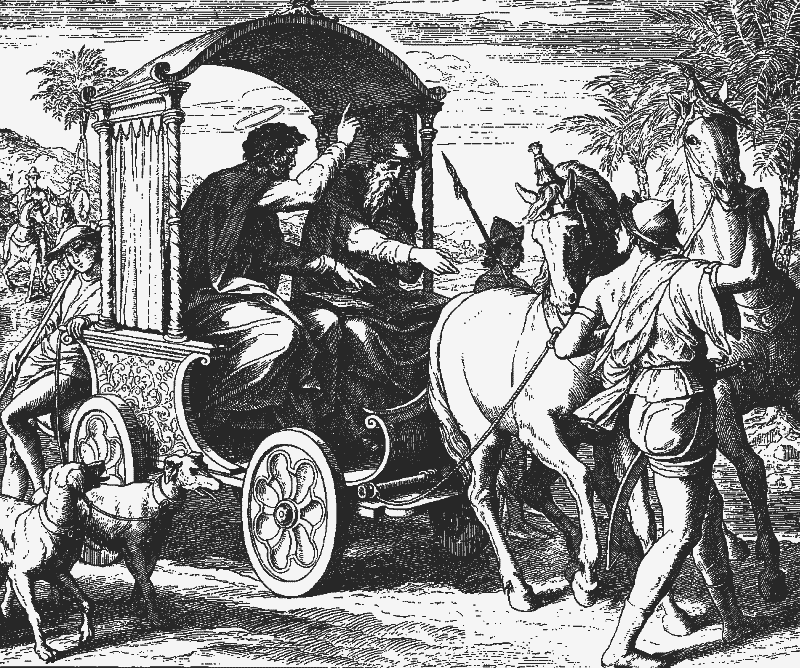 The deacon Philip, was also called an evangelist (see Acts 21:8). He was one of the seven men appointed to assist in the work of the twelve Apostles and of the rapidly growing early church by overseeing the distribution of food to the poor, especially to the widows who had limited support (6:1-6).
Unless Saint Luke omitted some portion of the selection process, this Philip is not the Philip we meet in the Gospels, whose feast is celebrated on 1 May with James, son of Alphaeus. For if they are the same person, why would one of the twelve Apostles separate himself from the ministry into which Christ had called him and go off to "serve tables" (Acts 6:2)? Therefore, we are dealing with at least two separate Philips in the New Testament.
Following the martyrdom of Stephen, Philip proclaimed the Gospel in Samaria and led Simon the Sorcerer to become a believer in Christ (8:4-13). He was also instrumental in bringing about the conversion of the Ethiopian eunuch (8:26-39), through whom Philip became indirectly responsible for bringing the Good News of Jesus to the people on the continent of Africa.
Here we make two historical asides. First, the "Ethiopia" known to the Mediterranean world of Philip's time may actually have been part of modern-day Sudan. Second, while a "eunuch" is technically a castrated male, it also served at times as a generic term for royal officials, including some where records indicate that they were capable of siring children.
Saint Philip's final appearance in Scripture comes in conjunction with Saint Paul. He hosted the apostle in the town of Caesarea before the apostle completed his final visit to Jerusalem (21:8-15). During this meeting, Luke also discovered and informs his readers that Philip "had four unmarried daughters, who prophesied (21:9)"
Collect
Almighty and everlasting God, we thank You for Your servant Philip the Deacon, whom You called to proclaim the Gospel to the peoples of Samaria and Ethiopia. Raise up in this and every land heralds and evangelists of Your kingdom, that your Church may make known the immeasurable riches of our Savior Jesus Christ, who lives and reigns with you and the Holy Spirit, one God, now and forever.
Labels: acts, african history, biography, christianity, church history, commemoration, deacon, hagiography, new testament, philip
¶ 00:00 | 0 comments |
 Cyprian (Thascius Caecilius Cyprianus) was born around AD 200 in the north African city of Carthage to a well-established pagan family. Most scholars believe that he came from either Punic or Berber stock. That he was of the privileged class may be shown, in part, from his place of death: He was martyred in his own villa.
After receiving a quality (albeit pagan) education, Cyprian became a Christian and was baptized sometime between 245 and 248. He passed quickly through the ranks of clergy, being ordained in short order as deacon, then presbyter. Election and consecration as Bishop of Carthage followed in short order, sometime during 248 or 249. This delighted the poor of the community, who'd benefited greatly from Cyprian giving away much of his wealth after his baptism, but a party in the Carthage church opposed him throughout his episcopacy.
During the persecution of Roman Emperor Decius, Cyprian fled Carthage but returned two years later. During his absence, some accused him of cowardice or lack of faith while others defended him for remaining alive to help govern the church. His own testimony was that he acted as God willed him to do through visions and divine commands. From hiding, he remained a faithful ruler of his flock, acting through a deacon brave enough to carry his words back to Carthage.
Upon his return from exile, Cyprian had to deal with the problem of Christians who had lapsed from their faith under persecution and now wanted to return to the Church. He decided that they could be restored, but that restoration would come only after a period of penance demonstrating their faithfulness. During the following years, Cyprian also became part of the debate over the efficacy of baptism administered by heretics. While some said only the form was essential, Cyprian claimed that even if all the words and actions were correct, it was no baptism if administered outside the Church. Therefore, Cyprian directed that any who were baptized in heretical sects would be given Christian baptisms before being joined to the Church. A majority of the North African bishops agreed with him, but this rigorous interpretation of dogma was later moderated by the Church.
His position in the matter of heretic baptisms places him squarely among many North African theologians of the period. He seems to be a way station between the strictness of Tertullian and the even more extreme doctrinal interpretations of the Donatists, who concerned themselves with the efficacy of the Lord's Supper being administered by a priest who lapsed or recanted the faith during times of persecution.
During persecution under Emperor Valerian, Cyprian first went into hiding and later gave himself up to the authorities. He was beheaded for the faith in Carthage in the year 258. According to witnesses, his only words upon hearing the death sentence pronounced were, "Thanks be to God!"
Besides fulfilling his pastoral and episcopal obligations, Saint Cyprian gave himself to theological writing. His most noted work was De unitate ecclesiae, where he professed belief in one episcopate — not that of Rome, but of the Church at large — as the foundation of the Church. In this treatise he wrote, "He can no longer have God for his Father who has not the Church for his mother; ... he who gathers elsewhere than in the Church scatters the Church of Christ." In the same work, he also said, "Nor is there any other home to believers but the one Church." Unlike some of his contemporaries, especially those who may have acted out of jealousy over his popularity, most modern scholars and average Christians who study him are left with a quite favorable impression of the man.
Note: The liturgical calendar of The Lutheran Church — Missouri Synod transfers the commemoration of Saint Cyprian to this day since 14 September is Holy Cross Day. This is in line with the practice of much of the Christian Church.
Lection
Psalm 23 or 116:10-17
1 Peter 5:1-4, 10-11
John 10:11-16
Collect
Almighty God, who gave Your servant Cyprian boldness to confess the Name of our Savior Jesus Christ before the rulers of this world and courage to die for this faith, grant that we may always be ready to give a reason for the hope that is in us, and to suffer gladly for the sake of our Lord Jesus Christ; who lives and reigns with You and the Holy Spirit, one God, now and forever.
Labels: african history, biography, carthage, christianity, church history, commemoration, cyprian, hagiography, martyrdom, patristics
¶ 00:00 | 0 comments |
At the dawn of the Third Century, Roman emperor Septimus Severus banned conversions to Christianity. Among those disobeying that edict were Vibia Perpetua, a young noblewoman, and her maidservant Felicitas. Both were jailed at Carthage in North Africa along with three fellow Christians, Saturus and his pupils Revocatus and Saturninus.Perpetua and at least some of the others had not completed catechesis and weren't yet baptized when arrested. Evidently, they received Holy Baptism before being taken to prison. She was also a new mother and a fairly recent widow. Felicitas (or Felicity) was near the end of her own pregnancy when arrested.
During their imprisonment, Perpetua and Felicitas witnessed to their faith with such conviction that the officer in charge became a follower of Jesus. For some time, doubts remained about their fates, but Perpetua had a vision of a golden ladder guarded by a fierce dragon. She climbed it, stepping on the dragon's head to do so. At the top, she found a green meadow with many white-robed figures. In their midst stood a Shepherd, who welcomed her and gave her cheese from the sheep's milk. She awoke understanding that martyrdom was assured but that she would triumph.
Perpetua's father came to plead that she recant her confession of faith and renounce Jesus Christ. This she steadfastly refused.Roman law forbade the execution of pregnant women and Felicitas feared that Perpetua and the men being held at the same time would face martyrdom but leave her behind. However, she gave birth two days before the scheduled execution and was allowed to join her companions in the arena on 7 March.
The women first made arrangements for the well-being of their children. This was possible because the imperial decree only concerned recent converts to Christianity (or Judaism). Since those entrusted with their children's care were believers of long standing, they were safe from persecution, at least for the time being.
The accounts say that the five were first scourged at the crowd's urging. Then the men faced a boar, a bear, and a leopard while a wild cow was set against the women. After they were all injured, Perpetua and Felicity exchanged the kiss of peace before the Romans put them to the sword. One tradition holds that Perpetua showed mercy to her captors by guiding the sword of a trembling young gladiator to her own heart because he could not bear to put her to death.
The martyrs were interred in Carthage in North Africa and the story spread throughout Christendom. Later, a basilica was erected over their tomb. The story of the martyrdom of Saint Perpetua, Saint Felicitas, and their faithful companions has served for centuries as encouragement to persecuted Christians.
Lection
Psalm 34:1-8 or 124
Hebrews 10:32-39
Matthew 24:9-14
Collect
O God the true Emperor of Your saints, who strengthened Your servants Perpetua and Felicitas and their companions to make a good confession, staunchly resisting, for the cause of Christ, the claims of human affection, and encouraging one another in their time of trial, grant that we who cherish their blessed memory may share their pure and steadfast faith, and win with them the palm of victory; through Jesus Christ our Lord, who lives and reigns with You and the Holy Spirit, one God, forever and ever.
Labels: african history, biography, carthage, church history, commemoration, felicitas, hagiography, martyrdom, perpetua, roman empire, saints
¶ 00:00 | 0 comments |
The deacon Philip, was also called an evangelist (see Acts 21:8). He was one of the seven men appointed to assist in the work of the twelve Apostles and of the rapidly growing early church by overseeing the distribution of food to the poor, especially to the widows who had limited support (6:1-6).Unless Saint Luke omitted some portion of the selection process, this Philip is not the Philip we meet in the Gospels, whose feast is celebrated on 1 May with James, son of Alphaeus. For if they are the same person, why would one of the twelve Apostles separate himself from the ministry into which Christ had called him and go off to "serve tables" (Acts 6:2)? Therefore, we are dealing with at least two separate Philips in the New Testament.
Following the martyrdom of Stephen, Philip proclaimed the Gospel in Samaria and led Simon the Sorcerer to become a believer in Christ (8:4-13). He was also instrumental in bringing about the conversion of the Ethiopian eunuch (8:26-39), through whom Philip became indirectly responsible for bringing the Good News of Jesus to the people on the continent of Africa.
Here we make two historical asides. First, the "Ethiopia" known to the Mediterranean world of Philip's time may actually have been part of modern-day Sudan. Second, while a "eunuch" is technically a castrated male, it also served at times as a generic term for royal officials, including some where records indicate that they were capable of siring children.
Saint Philip's final appearance in Scripture comes in conjunction with Saint Paul. He hosted the apostle in the town of Caesarea before the apostle completed his final visit to Jerusalem (21:8-15). During this meeting, Luke also discovered and informs his readers that Philip "had four unmarried daughters, who prophesied (21:9)"
Collect
Almighty and everlasting God, we thank You for Your servant Philip the Deacon, whom You called to proclaim the Gospel to the peoples of Samaria and Ethiopia. Raise up in this and every land heralds and evangelists of Your kingdom, that your Church may make known the immeasurable riches of our Savior Jesus Christ, who lives and reigns with you and the Holy Spirit, one God, now and forever.
Labels: acts, african history, biography, christianity, church history, commemoration, deacon, hagiography, new testament, philip
¶ 00:00 | 0 comments |
Saint Augustine was one of the greatest of the Latin church fathers and was among the most significant influences in the formation of Western Christianity, including Lutheranism. He was born to Monica and Patricius, a Christian mother and a pagan father, in AD 354 in Tagaste, Numidia (now Souk Ahras in Algeria).
Augustine's early life was distinguished by exceptional advancement as a teacher of rhetoric. He described his life before his conversion to Christianity in his book Confessions. He was drawn into the moral laxity of the day, plagued by lust, and fathered an illegitimate son. He also joined himself to the Manichaeian religion.
 Although he wandered (and sometimes wallowed) through a sinful, unchristian life for many years, Monica continued faithfully praying for Augustine's conversion. During his times of spiritual unrest, he moved first to Rome and later to Milan in order to find and hold teaching positions.
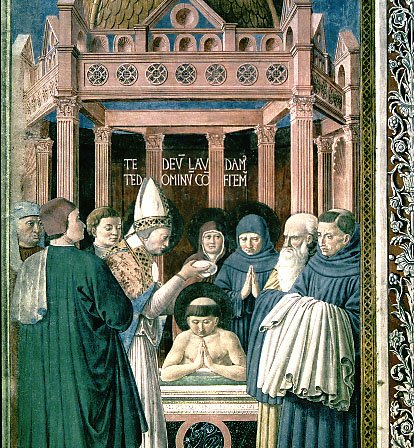
Monica's prayers were answered as her son responded to God's Word and the work of the Holy Spirit through the the preaching of Ambrose, Bishop of Milan. Certainly Monica must have rejoiced to see her son baptized by Ambrose during the Easter Vigil of 387. However, her earthly joy was short-lived; she died at Ostia Antica, just outside Rome, as she was beginning a journey back to Africa with her sons Augustine and Navigius.
During the Pelagian Controversies* of the Fifth Century, Augustine fought the notion of salvation by works and emphasized the unilateral grace of God in the salvation of mankind. The great theologian served as Bishop of Hippo in North Africa from AD 395 until his death in 430. Augustine was a man of immense intellect and deep love, a fierce defender of the orthodox faith, and a prolific writer. In addition to his Confessions, Augustine's book City of God (De Civitate Dei) had great impact upon the Church throughout the Middle Ages and Renaissance.
His monastic rule was used and emulated in much of the Western Church. The Order of Saint Augustine adhered closely to his teachings. Through the Order, Augustine's theology had a profound impact upon the thinking of the young German monk, Martin Luther. Luther espoused and refined Augustine's understanding of divine grace and of original sin, becoming part of the theology that forged the Reformation.
The barbarian invasions of the 5th Century form the backdrop for his death. Saint Augustine died during the Vandal siege of Hippo. He urged resistance, at least in part because the Vandals held to the Arian heresy.** He is listed with Saint Ambrose as two of the Western (or Latin) fathers among the eight great Doctors of the undivided Church. Jerome and Gregory the Great are the West's other representatives; Athanasius, John Chrysostom, Basil the Great, and Gregory of Nazianzus represent Eastern (Greek) Christendom.
The picture above represents Augustine's baptism at the hands of Ambrose. The text behind his head is the opening of the medieval hymn, Te Deum Laudamus. Some legends tell of Augustine and Ambrose jointly improvising it at this moment.
Lection
Psalm 87 or 84:7-12
Hebrews 12:22-24,28-29
John 14:6-15
Collect
Lord God, the Light of minds who know You, the Life of souls who love You, and the Strength of hearts who serve You, help us to follow the example of Your servant Augustine of Hippo, knowing You that we may truly love You, and loving You that we may fully serve You, whom to serve is perfect freedom; through Jesus Christ our Lord, who lives and reigns with You and the Holy Spirit, one God, now and forever.
Hymn: Holy God, We Praise Your Name
Holy God, we praise your name;
Lord of all, we bow before you.
All on earth your scepter claim,
All in heaven above adore you.
Infinite your vast domain,
Everlasting is your reign.
Hark! The glad celestial hymn
Angel choirs above are raising;
Cherubim and seraphim,
In unceasing chorus praising,
Fill the heavens with sweet accord:
"Holy, holy, holy Lord!"
Lo, the apostolic train
Join your sacred name to hallow;
Prophets swell the glad refrain,
And the white robed martyrs follow;
And from morn to set of sun
Through the Church the song goes on.
You are King of Glory, Christ;
Son of God, yet born of Mary.
For us sinners sacrificed,
As to death a Tributary,
First to break the bars of death,
You have opened heaven to faith.
Holy Father, holy Son,
Holy Spirit, three we name you,
Though in essence only one;
Undivided God we claim you
And, adoring, bend the knee
While we own the mystery.
Canticle: Te Deum Laudamus
*See Alex Klages' blog A Beggar at the Table for details on this heresiarch, his false teachings, and the implications of his corrupt doctrine with Pelagius, Part 1 and Part 2.
**Pr. Klages also has more information on Arius.
Labels: african history, ambrose, arianism, augustine, biography, christianity, church history, commemoration, european history, hagiography, pelagianism
¶ 00:00 | 0 comments |
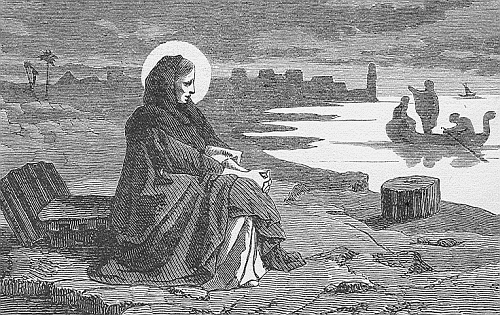 A native of North Africa of Berber descent, Monica was the devoted mother of one of the great theologians of early Christianity. She was born to a Christian family in Tagaste, Numidia (now Souk Ahras in Algeria) but her parents married her to a pagan named Patricius. Throughout her life she sought the spiritual welfare of her children, especially that of her brilliant son, Augustine, who provides us with the details of his mother's life.
Patricius was prone to both adultery and violent rages. Still, Augustine reported that his father never beat Monica, likely because she remained obedient and faithful to her husband. She also faced ongoing interference and resentment from her mother-in-law. After she was widowed at a fairly young age, Monica devoted herself to her family. She prayed especially for many years for Augustine's conversion from Manichaeism, a dualistic religious philosophy, and for his release from an immoral lifestyle that included a concubine and a son born out of wedlock.
When Augustine left North Africa to go to Italy, she followed him to Rome and then Milan. There she had the joy of witnessing her son's conversion to the Christian faith and his baptism by the Bishop of Milan, Saint Ambrose.
Following her son's conversion and baptism, Saint Monica hoped to travel back to Africa with her sons Augustine and Navigius. However, her travels weakened her and she died at Ostia Antica, Italy, the Roman seaport. On some ecclesial calendars, Monica is remembered on 4 May. Following changes during Vatican II, many churches have moved her commemoration to the day before Christendom celebrates the life and work of her famous son.
The customary spelling of this saint's name has been with one "n." However, her original tomb in Ostia was discovered after World War II bearing the name "Monnica." Was it for many years misspelled (even by her son) or did an artisan make a mistake when carving her inscription? Whichever the spelling, her remains no longer rest in the tomb in Ostia; they were transferred in 1430 to the Church of St. Augustine in Rome.
That she remains in Italy is, in part, testimony to her own thoughts and beliefs. Just before she died, she told her sons, "It does not matter where you bury my body. Do not let that worry you. All I ask of you is that, wherever you may be, you should remember me at the altar of the Lord." When asked of her fears at the thought of leaving her body in an strange land, she replied, "Nothing is far from God, and I need have no fear that he will not know where to find me, when he comes to raise me to life at the end of the world."
Because the region was visited by missionaries on her feast day, the city of Santa Monica, California was named in her honor.
Labels: african history, augustine, biography, church history, commemoration, european history, hagiography, monica
¶ 00:00 | 0 comments |


