
 Athanasius was born in Alexandria in Egypt in AD.295. He served as a church leader in a time of great controversy and ecclesiastical disagreements. While he was still a deacon, around the year 319, a presbyter (pastor) named Arius began a non-Biblical teaching about Jesus Christ. At the Council of Nicaea in 325, Athanasius, despite his relative inexperience in ecclesiastical office, defended Christian orthodoxy against the proponents of the Arian heresy. This belief denied the full divinity of Jesus Christ, claiming that there was a time when the Son was not and that He was thus inferior to the Father according to His "essence."
Results of the Orthodox party's eventual victory included the Nicene Creed.
During his 45-year tenure as bishop of Alexandria, Athanasius wrote numerous works that defended the orthodox teaching. His enemies had him exiled five times; on two occasions he was almost murdered.
Looking back, we see that there were times when Athanasius equaled his opponents' misbehavior, going so far as to engage mercenaries to enforce his episcopacy in Alexandria. Yet Athanasius remained steadfast and ended his days restored fully to his church responsibilities. The Athanasian Creed, though not composed by him, is named in his honor because it confesses the doctrinal orthodoxy he championed throughout his life.
Athanasius became known in the West as one of the four Easterners among the Eight Great Doctors of the Undivided Church. See the biography of Saint Ambrose for all eight.
Lection
Psalm 71:1-8 or 112:1-9
1 John 5:1-5
Matthew 10:22-32
Collect
Uphold Your Church, O God of truth, as You upheld Your servant Athanasius, to maintain and proclaim boldly the catholic faith against all opposition, trusting solely in the grace of Your eternal Word, who took upon Himself our humanity that we might share His holiness; who lives and reigns with you and the Holy Spirit, one God, now and forever.
Labels: alexandria, arianism, arius, athanasius, biography, church history, commemoration, creed, doctors of the church, hagiography, nicaea, nicene creed, patristics
¶ 00:00 | 0 comments |

Saint John Chrysostom, Preacher, Bishop, and Theologian, was called Chrysostom (Greek for"golden-mouthed") by his hearers. He was a dominant force in the fourth-century Christian church.
 Born in Antioch around AD 347, John was instructed in the Faith by his pious mother, Anthusa. After serving in a number of Christian offices, including acolyte and lector, John was ordained a presbyter and given preaching responsibilities.
His simple but direct messages found an audience well beyond his home town. His title came from his legendary preaching abilities. An unsubstantiated but widely circulated tale is that pickpockets and cutpurses would flock to services because he held his audience so spellbound that they could easily rob Saint John's hearers.
In 398, John was made Patriarch of Constantinople, where His determination to reform the church, court, and city brought him into conflict with established authorities. Eventually, he was exiled from his adopted city. Although removed from his parishes and people, he continued writing and preaching until his death in 407. It is reported that his final words were: "Glory be to God for all things. Amen."
John Chrysostom was one of four Eastern theologians among the eight Doctors of the undivided Church. The other three were Athanasius, Basil the Great, and Gregory of Nazianzus. The four great early Western (or Latin) doctors were Augustine, Jerome, Gregory the Great, and Ambrose of Milan.
Quote
The following excerpt is based on the passage, "[T]he letter kills, but the Spirit gives life. (2 Corinthians 3:6)" It comes from his Sixth Homily On 2 Corinthians.
Yet he says these things not in one sense only, but in reference to those who prided themselves on the things of Judaism. By the "letter" here he means the Law which punishes those who transgress; but by the "spirit" he means the grace which through Baptism gives life to those who by sins were made dead.Quoted from The Lord Will Answer: A Daily Prayer Catechism © 2004 by Concordia Publishing House.
In the Law he that has sin is punished. Here, he that has sins comes and is baptized and is made righteous, and being made righteous, he lives, being delivered from the death of sin. The Law, if it lay hold on a murderer, puts him to death. The Gospel, if it lay hold on a murderer, enlightens, and gives him life.
Lection
Psalm 49:1-8 or 34:15-22
Jeremiah 1:4-10
Luke 21:12-15
Collect
O God, who gave Your servant John Chrysostom the grace to proclaim eloquently Your righteousness in the great congregation, and fearlessly to bear reproach for the honor of Your Name, mercifully grant to all bishops and pastors such excellency in preaching and fidelity in ministering Your Word, that Your people shall be partakers with them of the glory that shall be revealed; through Jesus Christ our Lord, who lives and reigns with You and the Holy Spirit, one God, now and forever.
Labels: biography, chrysostom, church history, commemoration, doctors of the church, hagiography, hymnody, john chrysostom, liturgics, patristics, theology
¶ 00:00 | 0 comments |
with Gregory of Nazianzus, 9 May AD 389
and Gregory of Nyssa, 9 March AD 395
 Saints Basil and the two Gregorys, collectively known as the Cappadocian Fathers, were leaders of Christian orthodoxy in Asia Minor (modern Turkey) in the later fourth century. Basil and Gregory of Nyssa were brothers; Gregory Nazianzus, Patriarch of Constantinople, was their friend. All three were influential in shaping the theology ratified by the Council of Constantinople of 381, which is expressed in the Nicene Creed.
Their defense of the doctrines of the Holy Spirit and the Holy Trinity, together with their contributions to the liturgy of the Eastern Church, make them among the most influential Christian teachers and theologians of their time. Their knowledge and wisdom continues to be heard and known in the Christian Church today.
 When we commemorate the brothers, we also do well to remember their sister Macrina (Makrina). The eldest child of their generation, she did much to support and encourage the brothers' theological studies, moral development, and later work. Gregory of Nyssa wrote a Life of Macrina, one that actually focuses more on his sister's last days and death.
Please note that this day of celebration was chosen by The Lutheran Church — Missouri Synod for its list of commemorations. Basil is remembered in the East on his heavenly birthday (death date) while the West traditionally celebrated him on 14 June, the anniversary of his consecration.
The occidental Church doesn't commemorate him on his date of death because of its conflict with the Western celebration of a major Christological feast, The Circumcision and Name of Jesus. Recently, Roman Catholicism adopted 2 January for the commemoration. The LCMS chose to remember Wilhelm Loehe on that date and transferred Basil to an open day, combining his commemoration with those of the two others with whom he worked so closely.
Basil and Gregory of Nazianzus were two of the four Eastern theologians among the eight great Doctors of the undivided Church. The other two were Athanasius and John Chrysostom. The four great early Western (or Latin) doctors were Augustine, Jerome, Gregory the Great, and Ambrose of Milan. When the commemoration falls on the Baptism of Our Lord, it is normally transferred to the next open day.
Lection
Psalm 139:1-9 or 34:1-8
Wisdom 7:7-14
1 Corinthians 2:6-13
Luke 10:21-24
Collect
Almighty God, who revealed to Your Church Your eternal Being of glorious majesty and perfect love as one God in a Trinity of Persons, give us grace that, like Your servants Basil of Caesarea, Gregory of Nazianzus, and Gregory of Nyssa, we may continue steadfast in the confession of this faith, and constant in our worship of You, Father, Son, and Holy Spirit; who live and reign one God, now and forever.
Labels: basil the great, biography, christology, church history, commemoration, doctors of the church, gregory of nazianzs, gregory of nyssa, hagiography, macrina, nicene creed
¶ 00:00 | 0 comments |
 Saint Jerome (Eusebius Sophronius Hieronymus), translator of Holy Scripture, was born in a little Dalmatian village on the Adriatic Sea around the year AD 345. Although he came from Christian parents, he wasn't baptized until he went to study in Rome in about AD 360.
After extensive travels, he chose the life of a monk and spent five years in the Syrian desert. There he learned Hebrew, the language of the Old Testament. However, the time spent there convinced him that the life of a hermit monk was not for him and he pursued holy orders and advanced education.
After ordination at Antioch and visits to Rome and Constantinople (where he studied under Gregory of Nazianzus), Jerome settled in Bethlehem. From the original Hebrew, Aramaic, and Greek, he used his ability with languages to translate the Bible into Latin, the common language of his time.
Jerome chose to use "street" or "vulgar" Latin rather than its classical form. Thus, his translation was called the Vulgate (from its vulgar Latin) and was the authoritative version of the Bible in the western Church for over 1,000 years.
 A man of considerable brilliance, Jerome could also be argumentative, arrogant, dogmatic in trivial matters, and easily swayed by people holding superior office. Yet he also was able to break with the influence of Origen under which he was raised and was a champion of understanding the original languages of Scripture and of exegesis over allegory in interpretation.
In Roman Catholic hagiography, Jerome is patron saint of translators and librarians. His symbol in Christianity is often a pen. In religious art, it isn't unusual to see him portrayed with an odd blend of clothing and trappings ranging from ascetic anchorite to opulently garbed cardinal. He is often posed with a crucifix, a skull, and a Bible.
Considered one of the great scholars of the early church, he is listed with Saints Augustine, Ambrose, and Gregory the Great as one of the original Four Doctors of the Western Church. These four, plus four Eastern theologians, compose the eight Great Doctors of the early Church (see this article on Saint Ambrose for the entire list).
Jerome died on 30 September AD 420. Originally interred at Bethlehem, his remains were eventually taken to Rome.
More information is available from James Kiefer's Hagiographies and Wikipedia.
Lection
Psalm 19:7-11(12-14) or 119:97-104
2 Timothy 3:14-17
Luke 24:44-48
Collect
O Lord, O God of truth, whose Word is a lantern to our feet and a light upon our path: We give you thanks for your servant Jerome, and those who, following in his steps, have labored to render the Holy Scriptures in the language of the people; and we pray that your Holy Spirit will overshadow us as we read the written Word, and that Christ, the living Word, will transform us according to your righteous will; through Jesus Christ our Lord, who lives and reigns with you and the Holy Spirit, one God, now and forever.
Labels: biography, christianity, church history, commemoration, doctors of the church, hagiography, jerome, patristics, theology, translation
¶ 00:00 | 0 comments |
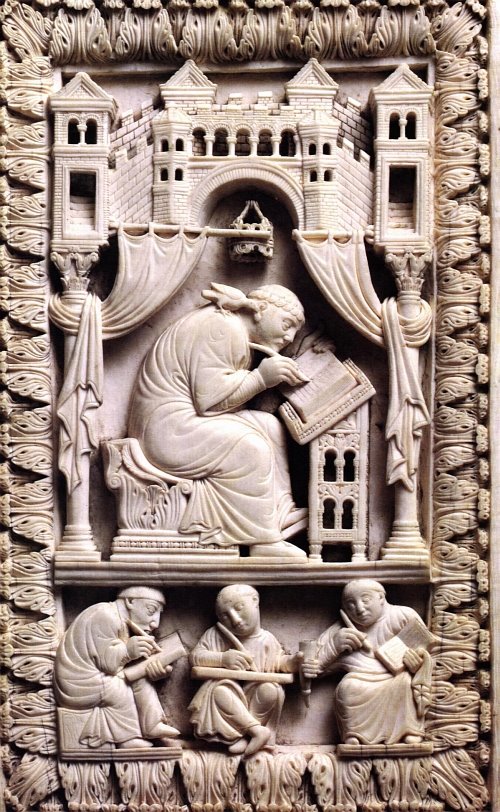 Living at a time when political and religious leadership in Europe often depended upon force of arms or strength of will more than the rule of law, Gregory became one of the continent's greatest leaders in both the secular and sacred arenas of his era. Born around AD 540, he became Prefect of Rome. In this capacity, he restored economic vitality to his native city following years of political upheaval and invasions by various Germanic tribes.
He later sold all his properties, donated the proceeds to help the poor, he entered into full-time service in the Church as a monk. Although he seemed content with the monastic life, his intellectual abilities and theological acumen led him on to ordination, which finally climaxed with his election on 3 September 590 as Bishop of Rome.
In this office, he oversaw growth in church music and liturgical development; the style of liturgical music known as Gregorian Chant is still used in much of Western Christendom. He also established a church-year calendar still used by many churches in the western World today. His concern for the poor continued and he oversaw the construction of a hospital that served dinner to the underprivileged next to his home.
A chance encounter led to his championing of missionary outreach to northern Europe: After meeting English prisoners in a Roman slave market, he directed a monk and prior of the Monastery of Saint Andrew named Augustine to begin mission work in the British Isles. This man, later known as Saint Augustine of Canterbury (not to be confused with the better-known Augustine of Hippo), did much to spread Christianity throughout Britain.
Gregory was the first pope of the Roman Church to come from a monastic background. His book Liber Regulae Pastoralis (The Book of the Pastoral Rule) was a standard text until the 20th Century. Church historians consider Gregory to be the last of the Latin Church Fathers and count him among the Doctors of the Church (see the commemoration of Saint Ambrose for the list of the eight great doctors). The Eastern Church remembers him as Gregory Dialogus in honor of the Dialogues he wrote.
Gregory died on 12 March AD 604. Rather than keeping the commemoration on his death date (or "heavenly birthday"), the LCMS moved it to the date of his consecration in order to avoid its observation during the penitential season of Lent.
Lection
Psalm 57:6-11 or 33:1-5, 20-21
1 Chronicles 25:1a, 6-8
Mark 10:42-45
Collect
Almighty and most merciful Lord, who raised up Gregory of Rome to be a servant of the people of God and inspired him to send missionaries to preach the Gospel to the English people, preserve in Your Church the catholic and apostolic faith he confessed, that Your people, being fruitful in every good work, may receive the crown of glory that never fades away; through Jesus Christ our Lord, who lives and reigns with you and the Holy Spirit, one God, now and forever.
Labels: biography, christianity, church history, commemoration, doctors of the church, european history, gregory, hagiography, music, papacy, patristics
¶ 00:00 | 0 comments |
with Gregory of Nazianzus, 9 May AD 389
and Gregory of Nyssa, 9 March AD 395
Saints Basil and the two Gregorys, collectively known as the Cappadocian Fathers, were leaders of Christian orthodoxy in Asia Minor (modern Turkey) in the later fourth century. Basil and Gregory of Nyssa were brothers; Gregory Nazianzus, Patriarch of Constantinople, was their friend. All three were influential in shaping the theology ratified by the Council of Constantinople of 381, which is expressed in the Nicene Creed.Their defense of the doctrines of the Holy Spirit and the Holy Trinity, together with their contributions to the liturgy of the Eastern Church, make them among the most influential Christian teachers and theologians of their time. Their knowledge and wisdom continues to be heard and known in the Christian Church today.
When we commemorate the brothers, we also do well to remember their sister Macrina (Makrina). The eldest child of their generation, she did much to support and encourage the brothers' theological studies, moral development, and later work. Gregory of Nyssa wrote a Life of Macrina, one that actually focuses more on his sister's last days and death.Please note that this day of celebration was chosen by The Lutheran Church — Missouri Synod for its list of commemorations. Basil is remembered in the East on his heavenly birthday (death date) while the West traditionally celebrated him on 14 June, the anniversary of his consecration.
The occidental Church doesn't commemorate him on his date of death because of its conflict with the Western celebration of a major Christological feast, The Circumcision and Name of Jesus. Recently, Roman Catholicism adopted 2 January for the commemoration. The LCMS chose to remember Wilhelm Loehe on that date and transferred Basil to an open day, combining his commemoration with those of the two others with whom he worked so closely.
Basil and Gregory of Nazianzus were two of the four Eastern theologians among the eight great Doctors of the undivided Church. The other two were Athanasius and John Chrysostom. The four great early Western (or Latin) doctors were Augustine, Jerome, Gregory the Great, and Ambrose of Milan. When the commemoration falls on the Baptism of Our Lord, it is normally transferred to the next open day.
Lection
Psalm 139:1-9 or 34:1-8
Wisdom 7:7-14
1 Corinthians 2:6-13
Luke 10:21-24
Collect
Almighty God, who revealed to Your Church Your eternal Being of glorious majesty and perfect love as one God in a Trinity of Persons, give us grace that, like Your servants Basil of Caesarea, Gregory of Nazianzus, and Gregory of Nyssa, we may continue steadfast in the confession of this faith, and constant in our worship of You, Father, Son, and Holy Spirit; who live and reign one God, now and forever.
Labels: basil the great, biography, christology, church history, commemoration, doctors of the church, gregory of nazianzs, gregory of nyssa, hagiography, macrina, nicene creed
¶ 00:00 | 0 comments |
Saint Jerome (Eusebius Sophronius Hieronymus), translator of Holy Scripture, was born in a little Dalmatian village on the Adriatic Sea around the year AD 345. Although he came from Christian parents, he wasn't baptized until he went to study in Rome in about AD 360.After extensive travels, he chose the life of a monk and spent five years in the Syrian desert. There he learned Hebrew, the language of the Old Testament. However, the time spent there convinced him that the life of a hermit monk was not for him and he pursued holy orders and advanced education.
After ordination at Antioch and visits to Rome and Constantinople (where he studied under Gregory of Nazianzus), Jerome settled in Bethlehem. From the original Hebrew, Aramaic, and Greek, he used his ability with languages to translate the Bible into Latin, the common language of his time.
Jerome chose to use "street" or "vulgar" Latin rather than its classical form. Thus, his translation was called the Vulgate (from its vulgar Latin) and was the authoritative version of the Bible in the western Church for over 1,000 years.
A man of considerable brilliance, Jerome could also be argumentative, arrogant, dogmatic in trivial matters, and easily swayed by people holding superior office. Yet he also was able to break with the influence of Origen under which he was raised and was a champion of understanding the original languages of Scripture and of exegesis over allegory in interpretation.In Roman Catholic hagiography, Jerome is patron saint of translators and librarians. His symbol in Christianity is often a pen. In religious art, it isn't unusual to see him portrayed with an odd blend of clothing and trappings ranging from ascetic anchorite to opulently garbed cardinal. He is often posed with a crucifix, a skull, and a Bible.
Considered one of the great scholars of the early church, he is listed with Saints Augustine, Ambrose, and Gregory the Great as one of the original Four Doctors of the Western Church. These four, plus four Eastern theologians, compose the eight Great Doctors of the early Church (see this article on Saint Ambrose for the entire list).
Jerome died on 30 September AD 420. Originally interred at Bethlehem, his remains were eventually taken to Rome.
More information is available from James Kiefer's Hagiographies and Wikipedia.
Lection
Psalm 19:7-11(12-14) or 119:97-104
2 Timothy 3:14-17
Luke 24:44-48
Collect
O Lord, O God of truth, whose Word is a lantern to our feet and a light upon our path: We give you thanks for your servant Jerome, and those who, following in his steps, have labored to render the Holy Scriptures in the language of the people; and we pray that your Holy Spirit will overshadow us as we read the written Word, and that Christ, the living Word, will transform us according to your righteous will; through Jesus Christ our Lord, who lives and reigns with you and the Holy Spirit, one God, now and forever.
Labels: biography, christianity, church history, commemoration, doctors of the church, hagiography, jerome, patristics, theology, translation
¶ 00:00 | 0 comments |


