
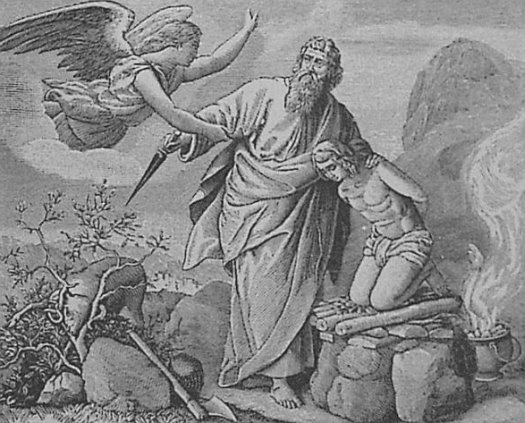
 If any part of Scripture besides the Resurrection clearly indicates that God gets the last laugh, it must be the story of Isaac.
After giving new names to Abraham and Sarah, the Lord promised a them a son. At the time, Abraham was 99 and Sarah was 90 (see Genesis 17). When Abraham heard the news, he "fell on his face and laughed and said to himself, 'Shall a child be born to a man who is a hundred years old? Shall Sarah, who is ninety years old, bear a child?' (v. 17)"
In response to the laughter and doubting, the Lord said, "Sarah your wife shall bear you a son, and you shall call his name Isaac. I will establish my covenant with him as an everlasting covenant for his offspring after him. (v. 19)" Isaac means "He Laughs."
To reiterate His point, the Lord allowed Sarah to overhear Him repeat His promise to Abraham at the Oaks of Mamre (see Genesis 18). "So Sarah laughed to herself, saying, 'After I am worn out, and my lord is old, shall I have pleasure?' The Lord said to Abraham, 'Why did Sarah laugh and say, "Shall I indeed bear a child, now that I am old?" Is anything too hard for the Lord? At the appointed time I will return to you about this time next year, and Sarah shall have a son.' But Sarah denied it, saying, 'I did not laugh,' for she was afraid. He said, 'No, but you did laugh.' (vv. 12-15)"
Sure enough, things happened not as Abraham and Sarah may have expected, but as the Lord had planned and promised. When Abraham was 100 years old, Sarah gave birth and "Abraham called the name of his son who was born to him, whom Sarah bore him, Isaac. (21:3)" Sarah likewise reveled in the irony: "God has made laughter for me; everyone who hears will laugh over me. (v. 6)"
 When Isaac was a young man, Abraham took him to Mount Moriah. There, Abraham, obeying God's command, prepared to sacrifice his son as a burnt offering. But God intervened, sparing Isaac's life and providing a ram as a substitute offering (22:1-14).
In so doing, God also pointed to the substitutionary sacrifice of His own Son Jesus Christ for the sins of the world. When the author of Hebrews expounded on the faith of Abraham (11:8-19), he made special note of Abraham's belief that, in order to accomplish His purposes, "God was able even to raise [Isaac] from the dead, from which, figuratively speaking, he did receive him back. (v. 19)"
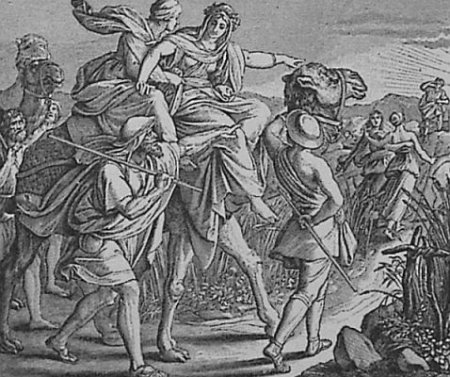
Abraham sent a faithful servant back among their kinfolk in order to find a bride for Isaac. There, the servant found Rebekah, who gladly traveled with this stranger to a new land, where she was given in marriage to Isaac (Genesis 24). They had twin sons, Esau and Jacob (25:19-26).
In his old age, Isaac became weak and blind. Before he died, he desired to give his blessing and the chief inheritance to Esau, his elder and favorite son, even though the Lord had promised Rebekah that their birth order would be reversed in the blessing and Jacob would be the favored son (25:23). However, Rebekah showed her favorite, Jacob, how to deceive his father and gain the blessing for himself (27:1-40). Of course, this resulted in years of bitter family strife, although Jacob and Esau later reconciled (Genesis 33).
Isaac lived to the age of 180 and was buried by his sons in the family burial cave of Machpelah (35:28-29).
Labels: abraham, biography, christianity, christology, commemoration, hagiography, isaac, israel, jacob, old testament, rebekah, sacrifice, sarah
¶ 00:00 | 1 comments |

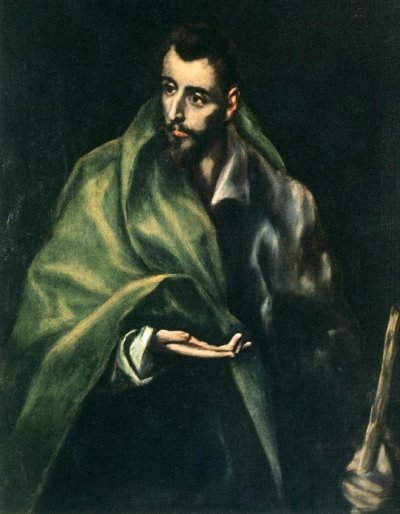 James, son of Zebedee, and his brother John were among Our Lord's twelve disciples. Together with Peter, these two were privileged to behold the Transfiguration (Matthew 17:1; Mark 9:2; Luke 9:28). They witnessed the healing of Peter's mother-in-law (Mark 1:29-31) and the raising of the daughter of Jairus (Mark 5:37; Luke 8:51). Jesus called them aside to watch and pray with Him in the garden of Gethsemane on the night before His death (Matthew 26:37; Mark 14:33).
James and John may have been from a higher social level than the average fisherman. Their father could afford hired servants (Mark 1:20), and John (assuming him to be identical with the "beloved disciple") had connections with the high priest (John 18:15).
Jesus nicknamed the brothers Boanerges — Sons of Thunder — (Mark 3:17), probably commenting upon their headstrong, hot-tempered, and impulsive natures. So they seem to be in two incidents reported in the Gospels. Once, Jesus and the disciples were refused the hospitality of a Samaritan village, and James and John proposed to call down fire from heaven on the offenders (Luke 9:51-56). On another occasion, they asked Jesus for a special place of honor in the Kingdom, and were told that the place of honor is the place of suffering (Matthew 20:20-23; Mark 10:35-41).
 In about AD 42, shortly before Passover (Acts 12:1-2), James was beheaded by order of Herod Agrippa I, grandson of Herod the Great (who tried to kill the infant Jesus; see Matthew 2), nephew of Herod Antipas (who killed John the Baptist — Mark 6:14-29 — and examined Jesus on Good Friday — Luke 23:6-16), and father of Herod Agrippa II (who heard the defense of Paul before Festus — Acts 25:13-26:32). James was first among the Twelve to suffer martyrdom, and the only one whose death is recorded in the New Testament.
James is often called "James Major" (also "the Greater" or "the Elder") to distinguish him from other New Testament people named James. Tradition has it that he made a missionary journey to Spain, and that after his death his body was taken to Spain and buried there at Compostela. His supposed burial place there was a major site of pilgrimage in the Middle Ages, and the Spaniards fighting to drive their Moorish conquerors out of Spain took "Santiago de Compostela!" (Saint James of Compostela) as one of their chief war-cries. (The Spanish form of "James" is Diego or Iago. In most languages, "James" and "Jacob" are identical. Where an English Bible has "James," a Greek Bible has Iakobos.
The sword (the instrument of his death) and the scallop shell are both traditional representations of the apostle.
Lection
Psalm 56
Acts 11:27-12:5
Romans 8:28-39
Mark 10:35-45
Collect
Grant, O Lord, that as Saint James the apostle readily followed the calling of Your Son Jesus Christ, we may by Your grace be enabled to forsake all false and passing allurements and follow Him alone; through Jesus Christ, our Lord, who lives and reigns with You and the Holy Spirit, one God, now and forever.
Labels: apostle, bible, biography, disciple, feasts, festivals, gospels, hagiography, jacob, james, jesus, john, martyrdom, new testament, zebedee
¶ 00:00 | 0 comments |
 Joseph was the son of the patriarch Jacob and Rachel — and was his father's favorite son. He incurred his older brothers' jealousy and anger (both through Jacob's favoritism and by his own attitude toward them, particularly regarding his dreams) so they sold him into slavery in Egypt and told their father he was dead (Genesis 37). In Egypt he became the chief servant in the home of Potiphar, a military official. Joseph refused to commit adultery when his master's wife tempted him. In retaliation, she unjustly accused him of attempted rape and he was imprisoned (Genesis 39).
Years later, he interpreted dreams for Pharaoh, who then freed him from prison and placed him in charge of the entire country. When his brothers came from Canaan to Egypt in search of food, they did not recognize him. He eventually revealed his identity, forgave them, and invited them and his father to live in Egypt. When Jacob blessed his sons before his death, he gave a blessing to both of Joseph's sons, Ephraim and Manasseh. Thus, each became an ancestor of one of the twelve tribes of Israel.
We remember and honor him for his moral uprightness (Genesis 39) and for his willingness to forgive his brothers (Genesis 45 and 50). But we especially celebrate his role in saving the family of Israel (Jacob), thus also playing an important part in God's plan to bring Messiah to His people and to all mankind.
Labels: biography, christology, commemoration, egypt, ephraim, hagiography, israel, jacob, joseph, manasseh, old testament
¶ 00:00 | 0 comments |
 Jacob was the third of the three great Hebrews given the title of patriarch, following his grandfather Abraham and his father Isaac. Jacob was the younger of the twin sons of Isaac and Rebekah.
He received his name because before birth he gripped his brother Esau's heel, seeming even then to be struggling for supremacy (Jacob can mean "He grasps the heel" or "he cheats"). After wrestling with the Angel of the Lord, Jacob, who certainly had lived up to the name of "Deceiver," was renamed Israel, which means "he strives with God" (Genesis 25:26; 32:28).
His family life was filled with trouble, much of it caused by his acts of deception toward his father and his brother Esau and his parental favoritism toward his son Joseph (commemorated on 31 March). He spent many of his later years grieving over the death of his beloved wife Rachel and the presumed death of Joseph, who had been appointed by the Egyptian Pharaoh to be in charge of food distribution during a time of famine in the land.
Late in life, as he was blessing his sons, Jacob uttered God's prophetic promise that the Messiah would come through the line of his fourth son, Judah (Genesis 49:8-12).
Labels: abraham, biography, christology, commemoration, esau, hagiography, isaac, israel, jacob, joseph, judah, leah, old testament, patriarch, rachel, rebekah
¶ 00:00 | 0 comments |
 The Lord called the Patriarch Abraham (first known as Abram) to become the father of a great nation (Genesis 12). At age 75, in obedience to God's command, he, his wife Sarai (later Sarah), and his nephew Lot moved southwest from the town of Haran to the land of Canaan. There, the Lord cut a covenant with Abram (Genesis 15), promising the land of Canaan to his descendants. In Genesis 17:1-16, the Lord established circumcision as a sign of His covenant people while also renaming Abram as Abraham and Sarai as Sarah.
At the age of 100 Abraham and Sarah were finally blessed with Isaac, the son long promised to them by God. A few years later, Abraham demonstrated supreme obedience when God commanded him to offer Isaac as a burnt offering. God spared the young man's life only at the last moment and provided a ram as a substitute offering (22:1-19).
Despite having his only child born at such an advanced age, Abraham lived to see the births of Isaac's twin sons Jacob and Esau. Abraham finally died at the age of 175 and was buried in the Cave of Machpelah, which he had purchased earlier as a burial site for Sarah. He is especially honored as the first of the three great Old Testament Patriarchs — and for his "righteousness before God through faith. (Romans 4:1-12)"
 In the great "Faith Chapter" of Hebrews 11, Abraham holds a prominent place. The writer noted several instances where Abraham acted "by faith," contrary to worldly evidence but in accordance with God's will. "By faith," he "obeyed when he was called to go out to a place that he was to receive as an inheritance (v. 8)"; he "went to live in the land of promise ... with Isaac and Jacob (v. 9)"; and he, "when he was tested, offered up Isaac. (v. 17)" Among the believers so listed, God also commended the faith of Sarah, Isaac, and Jacob through the epistle's writer.
The promised blessing of the nations came to fruition in the person of Jesus Christ. He was a son of Abraham by blood, by circumcision, and by His relationship with our heavenly Father. While the Jews traced their descent from Abraham according to his bloodlines, Christians are listed in Scripture as Abraham's true children by faith in Christ. Paul wrote that Abraham is "the father of us all" who share his faith in God (Romans 4:16). In Galatians, Paul also wrote, "Know then that it is those of faith who are the sons of Abraham. And the Scripture, foreseeing that God would justify the Gentiles by faith, preached the gospel beforehand to Abraham, saying, 'In you shall all the nations be blessed.' So then, those who are of faith are blessed along with Abraham, the man of faith. (3:7-9)"
We cannot definitively state that the patriarch saw his greatest Descendant "in the flesh" before he died, although some think that the Son of God was also the Angel of the Lord who spoke with him. However, whether by faith or by sight, we know from Jesus' words that "Abraham rejoiced that he would see my day. He saw it and was glad. (John 8:56)" When the Jews before Him mocked such an apparently outlandish statement, our Lord continued, "Truly, truly, I say to you, before Abraham was, I am, (v. 58)" thereby claiming to be not only a son of Abraham but also Abraham's God (cf. Exodus 3:13-14).
While most people shudder at the thought of Abraham taking Isaac up Mount Moriah as an intended sacrifice, some are more pained by his having a son with Sarai's servant Hagar (see Genesis 16). I'm one of these and, for many of us, it isn't the odd sharing of the marriage bed but the result of this wrong relationship that's more disturbing. Certainly the Lord assured blessing for Hagar's son Ishmael, a child born through human manipulation. However, He reserved the greater blessing for Isaac, the child born to Sarah of His divine promise (Genesis 17:15-21).
Sadly, both blessings were later forsaken by their bearers. The vast majority of Ishmael's descendants do not have Abraham's God as their own but instead have given themselves over to the pernicious religion of Islam and its false god Allah. Meanwhile, much of Israel disappeared, first during the Assyrian invasion and, later, the Babylonian Captivity. Of those who returned to Palestine, many slowly turned away from the God of Abraham, Isaac, and Jacob through the next four hundred years. When finally appeared the Blessing of the Nations, "He came to his own, and his own people did not receive him. (John 1:11)."
Labels: abraham, abram, biography, christology, commemoration, hagar, hagiography, isaac, ishmael, jacob, old testament, patristics, sarah
¶ 00:00 | 0 comments |
If any part of Scripture besides the Resurrection clearly indicates that God gets the last laugh, it must be the story of Isaac.After giving new names to Abraham and Sarah, the Lord promised a them a son. At the time, Abraham was 99 and Sarah was 90 (see Genesis 17). When Abraham heard the news, he "fell on his face and laughed and said to himself, 'Shall a child be born to a man who is a hundred years old? Shall Sarah, who is ninety years old, bear a child?' (v. 17)"
In response to the laughter and doubting, the Lord said, "Sarah your wife shall bear you a son, and you shall call his name Isaac. I will establish my covenant with him as an everlasting covenant for his offspring after him. (v. 19)" Isaac means "He Laughs."
To reiterate His point, the Lord allowed Sarah to overhear Him repeat His promise to Abraham at the Oaks of Mamre (see Genesis 18). "So Sarah laughed to herself, saying, 'After I am worn out, and my lord is old, shall I have pleasure?' The Lord said to Abraham, 'Why did Sarah laugh and say, "Shall I indeed bear a child, now that I am old?" Is anything too hard for the Lord? At the appointed time I will return to you about this time next year, and Sarah shall have a son.' But Sarah denied it, saying, 'I did not laugh,' for she was afraid. He said, 'No, but you did laugh.' (vv. 12-15)"
Sure enough, things happened not as Abraham and Sarah may have expected, but as the Lord had planned and promised. When Abraham was 100 years old, Sarah gave birth and "Abraham called the name of his son who was born to him, whom Sarah bore him, Isaac. (21:3)" Sarah likewise reveled in the irony: "God has made laughter for me; everyone who hears will laugh over me. (v. 6)"
When Isaac was a young man, Abraham took him to Mount Moriah. There, Abraham, obeying God's command, prepared to sacrifice his son as a burnt offering. But God intervened, sparing Isaac's life and providing a ram as a substitute offering (22:1-14).In so doing, God also pointed to the substitutionary sacrifice of His own Son Jesus Christ for the sins of the world. When the author of Hebrews expounded on the faith of Abraham (11:8-19), he made special note of Abraham's belief that, in order to accomplish His purposes, "God was able even to raise [Isaac] from the dead, from which, figuratively speaking, he did receive him back. (v. 19)"
Abraham sent a faithful servant back among their kinfolk in order to find a bride for Isaac. There, the servant found Rebekah, who gladly traveled with this stranger to a new land, where she was given in marriage to Isaac (Genesis 24). They had twin sons, Esau and Jacob (25:19-26).
In his old age, Isaac became weak and blind. Before he died, he desired to give his blessing and the chief inheritance to Esau, his elder and favorite son, even though the Lord had promised Rebekah that their birth order would be reversed in the blessing and Jacob would be the favored son (25:23). However, Rebekah showed her favorite, Jacob, how to deceive his father and gain the blessing for himself (27:1-40). Of course, this resulted in years of bitter family strife, although Jacob and Esau later reconciled (Genesis 33).
Isaac lived to the age of 180 and was buried by his sons in the family burial cave of Machpelah (35:28-29).
Labels: abraham, biography, christianity, christology, commemoration, hagiography, isaac, jacob, old testament, rebekah, sacrifice, sarah
¶ 00:00 | 0 comments |
James, son of Zebedee, and his brother John were among Our Lord's twelve disciples. Together with Peter, these two were privileged to behold the Transfiguration (Matthew 17:1; Mark 9:2; Luke 9:28). They witnessed the healing of Peter's mother-in-law (Mark 1:29-31) and the raising of the daughter of Jairus (Mark 5:37; Luke 8:51). Jesus called them aside to watch and pray with Him in the garden of Gethsemane on the night before His death (Matthew 26:37; Mark 14:33).James and John may have been from a higher social level than the average fisherman. Their father could afford hired servants (Mark 1:20), and John (assuming him to be identical with the "beloved disciple") had connections with the high priest (John 18:15).
Jesus nicknamed the brothers Boanerges — Sons of Thunder — (Mark 3:17), probably commenting upon their headstrong, hot-tempered, and impulsive natures. So they seem to be in two incidents reported in the Gospels. Once, Jesus and the disciples were refused the hospitality of a Samaritan village, and James and John proposed to call down fire from heaven on the offenders (Luke 9:51-56). On another occasion, they asked Jesus for a special place of honor in the Kingdom, and were told that the place of honor is the place of suffering (Matthew 20:20-23; Mark 10:35-41).
In about AD 42, shortly before Passover (Acts 12:1-2), James was beheaded by order of Herod Agrippa I, grandson of Herod the Great (who tried to kill the infant Jesus; see Matthew 2), nephew of Herod Antipas (who killed John the Baptist — Mark 6:14-29 — and examined Jesus on Good Friday — Luke 23:6-16), and father of Herod Agrippa II (who heard the defense of Paul before Festus — Acts 25:13-26:32). James was first among the Twelve to suffer martyrdom, and the only one whose death is recorded in the New Testament.James is often called "James Major" (also "the Greater" or "the Elder") to distinguish him from other New Testament people named James. Tradition has it that he made a missionary journey to Spain, and that after his death his body was taken to Spain and buried there at Compostela. His supposed burial place there was a major site of pilgrimage in the Middle Ages, and the Spaniards fighting to drive their Moorish conquerors out of Spain took "Santiago de Compostela!" (Saint James of Compostela) as one of their chief war-cries. (The Spanish form of "James" is Diego or Iago. In most languages, "James" and "Jacob" are identical. Where an English Bible has "James," a Greek Bible has Iakobos.
The sword (the instrument of his death) and the scallop shell are both traditional representations of the apostle.
Lection
Psalm 56
Acts 11:27-12:5
Romans 8:28-39
Mark 10:35-45
Collect
Grant, O Lord, that as Saint James the apostle readily followed the calling of Your Son Jesus Christ, we may by Your grace be enabled to forsake all false and passing allurements and follow Him alone; through Jesus Christ, our Lord, who lives and reigns with You and the Holy Spirit, one God, now and forever.
Labels: apostle, biography, disciple, feasts, festivals, gospels, hagiography, jacob, james, jesus, john, martyrdom, new testament, zebedee
¶ 00:00 | 0 comments |
Joseph was the son of the patriarch Jacob and Rachel — and was his father's favorite son. He incurred his older brothers' jealousy and anger (both through Jacob's favoritism and by his own attitude toward them, particularly regarding his dreams) so they sold him into slavery in Egypt and told their father he was dead (Genesis 37). In Egypt he became the chief servant in the home of Potiphar, a military official. Joseph refused to commit adultery when his master's wife tempted him. In retaliation, she unjustly accused him of attempted rape and he was imprisoned (Genesis 39).Years later, he interpreted dreams for Pharaoh, who then freed him from prison and placed him in charge of the entire country. When his brothers came from Canaan to Egypt in search of food, they did not recognize him. He eventually revealed his identity, forgave them, and invited them and his father to live in Egypt. We remember and honor him for his moral uprightness (Genesis 39) and for his willingness to forgive his brothers (Genesis 45 and 50). We also celebrate his role in saving the family of Israel (Jacob), thus also playing an important part in God's plan to bring Messiah to His people and to all mankind.
Labels: biography, christology, commemoration, egypt, hagiography, israel, jacob, joseph, old testament, patriarch, rachel
¶ 00:00 | 0 comments |
Jacob was the third of the three great Hebrews given the title of patriarch, following his grandfather Abraham and his father Isaac. Jacob was the younger of the twin sons of Isaac and Rebekah.He received his name because before birth he gripped his brother Esau's heel, seeming even then to be struggling for supremacy (Jacob can mean "He grasps the heel" or "he cheats"). After wrestling with the Angel of the Lord, Jacob, who certainly had lived up to the name of "Deceiver," was renamed Israel, which means "he strives with God" (Genesis 25:26; 32:28).
His family life was filled with trouble, much of it caused by his acts of deception toward his father and his brother Esau and his parental favoritism toward his son Joseph (commemorated on 31 March). He spent many of his later years grieving over the death of his beloved wife Rachel and the presumed death of Joseph, who had been appointed by the Egyptian Pharaoh to be in charge of food distribution during a time of famine in the land.
Late in life, as he was blessing his sons, Jacob uttered God's prophetic promise that the Messiah would come through the line of his fourth son, Judah (Genesis 49:8-12).
Labels: abraham, biography, christology, commemoration, esau, hagiography, isaac, israel, jacob, joseph, judah, leah, old testament, patriarch, rachel, rebekah
¶ 00:00 | 0 comments |
The Lord called the Patriarch Abraham (first known as Abram) to become the father of a great nation (Genesis 12). At age 75, in obedience to God's command, he, his wife Sarai (later Sarah), and his nephew Lot moved southwest from the town of Haran to the land of Canaan. There, the Lord cut a covenant with Abram (Genesis 15), promising the land of Canaan to his descendants. In Genesis 17:1-16, the Lord established circumcision as a sign of His covenant people while also renaming Abram as Abraham and Sarai as Sarah.At the age of 100 Abraham and Sarah were finally blessed with Isaac, the son long promised to them by God. A few years later, Abraham demonstrated supreme obedience when God commanded him to offer Isaac as a burnt offering. God spared the young man's life only at the last moment and provided a ram as a substitute offering (22:1-19).
Despite having his only child born at such an advanced age, Abraham lived to see the births of Isaac's twin sons Jacob and Esau. Abraham finally died at the age of 175 and was buried in the Cave of Machpelah, which he had purchased earlier as a burial site for Sarah. He is especially honored as the first of the three great Old Testament Patriarchs — and for his "righteousness before God through faith. (Romans 4:1-12)"
In the great "Faith Chapter" of Hebrews 11, Abraham holds a prominent place. The writer noted several instances where Abraham acted "by faith," contrary to worldly evidence but in accordance with God's will. "By faith," he "obeyed when he was called to go out to a place that he was to receive as an inheritance (v. 8)"; he "went to live in the land of promise ... with Isaac and Jacob (v. 9)"; and he, "when he was tested, offered up Isaac. (v. 17)" Among the believers so listed, God also commended the faith of Sarah, Isaac, and Jacob through the epistle's writer.The promised blessing of the nations came to fruition in the person of Jesus Christ. He was a son of Abraham by blood, by circumcision, and by His relationship with our heavenly Father. While the Jews traced their descent from Abraham according to his bloodlines, Christians are listed in Scripture as Abraham's true children by faith in Christ. Paul wrote that Abraham is "the father of us all" who share his faith in God (Romans 4:16). In Galatians, Paul also wrote, "Know then that it is those of faith who are the sons of Abraham. And the Scripture, foreseeing that God would justify the Gentiles by faith, preached the gospel beforehand to Abraham, saying, 'In you shall all the nations be blessed.' So then, those who are of faith are blessed along with Abraham, the man of faith. (3:7-9)"
We cannot definitively state that the patriarch saw his greatest Descendant "in the flesh" before he died, although some think that the Son of God was also the Angel of the Lord who spoke with him. However, whether by faith or by sight, we know from Jesus' words that "Abraham rejoiced that he would see my day. He saw it and was glad. (John 8:56)" When the Jews before Him mocked such an apparently outlandish statement, our Lord continued, "Truly, truly, I say to you, before Abraham was, I am, (v. 58)" thereby claiming to be not only a son of Abraham but also Abraham's God (cf. Exodus 3:13-14).
While most people shudder at the thought of Abraham taking Isaac up Mount Moriah as an intended sacrifice, some are more pained by his having a son with Sarai's servant Hagar (see Genesis 16). I'm one of these and, for many of us, it isn't the odd sharing of the marriage bed but the result of this wrong relationship that's more disturbing. Certainly the Lord assured blessing for Hagar's son Ishmael, a child born through human manipulation. However, He reserved the greater blessing for Isaac, the child born to Sarah of His divine promise (Genesis 17:15-21).
Sadly, both blessings were later forsaken by their bearers. The vast majority of Ishmael's descendants do not have Abraham's God as their own but instead have given themselves over to the pernicious religion of Islam and its false god Allah. Meanwhile, much of Israel disappeared, first during the Assyrian invasion and, later, the Babylonian Captivity. Of those who returned to Palestine, many slowly turned away from the God of Abraham, Isaac, and Jacob through the next four hundred years. When finally appeared the Blessing of the Nations, "He came to his own, and his own people did not receive him. (John 1:11)."
Labels: abraham, abram, biography, christology, commemoration, hagar, hagiography, isaac, ishmael, jacob, old testament, patristics, sarah
¶ 00:00 | 0 comments |
If any part of Scripture besides the Resurrection clearly indicates that God gets the last laugh, it must be the story of Isaac.After giving new names to Abraham and Sarah, the Lord promised a them a son. At the time, Abraham was 99 and Sarah was 90 (see Genesis 17). When Abraham heard the news, he "fell on his face and laughed and said to himself, 'Shall a child be born to a man who is a hundred years old? Shall Sarah, who is ninety years old, bear a child?' (v. 17)"
In response to the laughter and doubting, the Lord said, "Sarah your wife shall bear you a son, and you shall call his name Isaac. I will establish my covenant with him as an everlasting covenant for his offspring after him. (v. 19)" Isaac means "He Laughs."
To reiterate His point, the Lord allowed Sarah to overhear Him repeat His promise to Abraham at the Oaks of Mamre (see Genesis 18). "So Sarah laughed to herself, saying, 'After I am worn out, and my lord is old, shall I have pleasure?' The Lord said to Abraham, 'Why did Sarah laugh and say, "Shall I indeed bear a child, now that I am old?" Is anything too hard for the Lord? At the appointed time I will return to you about this time next year, and Sarah shall have a son.' But Sarah denied it, saying, 'I did not laugh,' for she was afraid. He said, 'No, but you did laugh.' (vv. 12-15)"
Sure enough, things happened not as Abraham and Sarah may have expected, but as the Lord had planned and promised. When Abraham was 100 years old, Sarah gave birth and "Abraham called the name of his son who was born to him, whom Sarah bore him, Isaac. (21:3)" Sarah likewise reveled in the irony: "God has made laughter for me; everyone who hears will laugh over me. (v. 6)"
When Isaac was a young man, Abraham took him to Mount Moriah. There, Abraham, obeying God's command, prepared to sacrifice his son as a burnt offering. But God intervened, sparing Isaac's life and providing a ram as a substitute offering (22:1-14).In so doing, God also pointed to the substitutionary sacrifice of His own Son Jesus Christ for the sins of the world. When the author of Hebrews expounded on the faith of Abraham (11:8-19), he made special note of Abraham's belief that, in order to accomplish His purposes, "God was able even to raise [Isaac] from the dead, from which, figuratively speaking, he did receive him back. (v. 19)"
Abraham sent a faithful servant back among their kinfolk in order to find a bride for Isaac. There, the servant found Rebekah, who gladly traveled with this stranger to a new land, where she was given in marriage to Isaac (Genesis 24). They had twin sons, Esau and Jacob (25:19-26).
In his old age, Isaac became weak and blind. Before he died, he desired to give his blessing and the chief inheritance to Esau, his elder and favorite son, even though the Lord had promised Rebekah that their birth order would be reversed in the blessing and Jacob would be the favored son (25:23). However, Rebekah showed her favorite, Jacob, how to deceive his father and gain the blessing for himself (27:1-40). Of course, this resulted in years of bitter family strife, although Jacob and Esau later reconciled (Genesis 33).
Isaac lived to the age of 180 and was buried by his sons in the family burial cave of Machpelah (35:28-29).
Labels: abraham, biography, christianity, christology, commemoration, hagiography, isaac, jacob, old testament, rebekah, sacrifice, sarah
¶ 00:00 | 0 comments |
James, son of Zebedee, and his brother John were among Our Lord's twelve disciples. Together with Peter, these two were privileged to behold the Transfiguration (Matthew 17:1; Mark 9:2; Luke 9:28). They witnessed the healing of Peter's mother-in-law (Mark 1:29-31) and the raising of the daughter of Jairus (Mark 5:37; Luke 8:51). Jesus called them aside to watch and pray with Him in the garden of Gethsemane on the night before His death (Matthew 26:37; Mark 14:33).James and John may have been from a higher social level than the average fisherman. Their father could afford hired servants (Mark 1:20), and John (assuming him to be identical with the "beloved disciple") had connections with the high priest (John 18:15).
Jesus nicknamed the brothers Boanerges — Sons of Thunder — (Mark 3:17), probably commenting upon their headstrong, hot-tempered, and impulsive natures. So they seem to be in two incidents reported in the Gospels. Once, Jesus and the disciples were refused the hospitality of a Samaritan village, and James and John proposed to call down fire from heaven on the offenders (Luke 9:51-56). On another occasion, they asked Jesus for a special place of honor in the Kingdom, and were told that the place of honor is the place of suffering (Matthew 20:20-23; Mark 10:35-41).
In about AD 42, shortly before Passover (Acts 12:1-2), James was beheaded by order of Herod Agrippa I, grandson of Herod the Great (who tried to kill the infant Jesus; see Matthew 2), nephew of Herod Antipas (who killed John the Baptist — Mark 6:14-29 — and examined Jesus on Good Friday — Luke 23:6-16), and father of Herod Agrippa II (who heard the defense of Paul before Festus — Acts 25:13-26:32). James was first among the Twelve to suffer martyrdom, and the only one whose death is recorded in the New Testament.James is often called "James Major" (also "the Greater" or "the Elder") to distinguish him from other New Testament people named James. Tradition has it that he made a missionary journey to Spain, and that after his death his body was taken to Spain and buried there at Compostela. His supposed burial place there was a major site of pilgrimage in the Middle Ages, and the Spaniards fighting to drive their Moorish conquerors out of Spain took "Santiago de Compostela!" (Saint James of Compostela) as one of their chief war-cries. (The Spanish form of "James" is Diego or Iago. In most languages, "James" and "Jacob" are identical. Where an English Bible has "James," a Greek Bible has Iakobos.
The sword (the instrument of his death) and the scallop shell are both traditional representations of the apostle.
Lection
Psalm 56
Acts 11:27-12:5
Romans 8:28-39
Mark 10:35-45
Collect
Grant, O Lord, that as Saint James the apostle readily followed the calling of Your Son Jesus Christ, we may by Your grace be enabled to forsake all false and passing allurements and follow Him alone; through Jesus Christ, our Lord, who lives and reigns with You and the Holy Spirit, one God, now and forever.
Labels: apostle, biography, disciple, feasts, festivals, gospels, hagiography, jacob, james, jesus, john, martyrdom, new testament, zebedee
¶ 00:00 | 0 comments |


