
Transferred to 13 June for Trinity Sunday and Saint Barnabas Day
 The Christian Church's First Ecumenical Council was convened in Nicaea (modern Isnuk, Turkey) in the early summer of AD 325 by the Roman Emperor Constantine. The emperor presided at the opening of the council. The major intended topic was the ongoing Arian controversy.
The council ruled against the Arians, who taught that Jesus was not the eternal Son of God but was created by the Father and was called Son of God because of his righteousness. The chief opponents of the Arians were Alexander, bishop of Alexandria, and his deacon, Athanasius. The council confessed the eternal divinity of Jesus and adopted the earliest version of the Nicene Creed, which in its entirety was adopted at the Council of Constantinople in 381.
Other topics included celebration of the Resurrection and how the date for Easter would correspond with Passover, the Miletian schism, validity of baptism by heretics, and the restoration lapsed Christians who renounced the Faith under persecution. The Council also established a number of new canons (Church laws). Enumeration varies, but twenty is the number suggested by the editors of the Early Church Fathers:
1. prohibition of self-castration, as done by Origen;Their version of what we now call the Nicene Creed was almost identical to what is now used in the Church until the third section, where the original ends, "We believe in the Holy Spirit." It fell to the Second Ecumenical Council (First Council of Constantinople) to add what is now used. Therefore, the confession used in the churches may properly be called the Niceno-Constantinopolitan Creed. The so-called filioque (where "and the Son" was inserted after the words about the Spirit proceeding from the Father) was only later added by the Roman Catholic Church and never accepted in the East.
2. establishment of a minimum term for catechumens;
3. prohibition of the presence in the house of a cleric of a younger woman who might bring him under suspicion;
4. ordination of a bishop in the presence of at least three provincial bishops and confirmation by the metropolitan;
5. provision for two provincial synods to be held annually;
6. exceptional authority acknowledged for the bishops of Alexandria and Rome, for their respective regions;
7. recognition of the honorary rights of the see of Jerusalem;
8. provision for agreement with the Novatianists;
9-14. provision for mild procedure against the lapsed during the persecution under Licinius;
15-16. prohibition of the removal of priests;
17. prohibition of usury among the clergy;
18. precedence of bishops and presbyters before deacons in receiving Holy Communion, the Eucharist;
19. declaration of the invalidity of baptism by Paulian heretics;
20. prohibition of kneeling during the liturgy, on Sundays, and in the days of Eastertide.
(Summary from Wikipedia.)
The Council also saw the first major collaboration between Church and state since Christianity began and signaled a rise in imperial influence in affairs of the Church. Constantine called it, presided over the initial session, and, in many respects, set its agenda. While his personal religious beliefs may have been part of his reason, most scholars agree that his main fear was that a divided Christianity would result in a divided Empire. The historical irony is that the Roman Empire fractured before any major schisms in Christendom.
Nicene Creed
 I believe in one God, the Father Almighty, Maker of heaven and earth and of all things visible and invisible.
And in one Lord Jesus Christ, the only-begotten Son of God, begotten of His Father before all worlds, God of God, Light of Light, very God of very God, begotten, not made, being of one substance with the Father, by whom all things were made; who for us men and for our salvation came down from heaven and was incarnate by the Holy Spirit of the virgin Mary and was made man; and was crucified also for us under Pontius Pilate. He suffered, and was buried. And the third day He rose again according to the Scriptures and ascended into heaven and sits at the right hand of the Father. And He will come again with glory to judge both the living and the dead, whose kingdom will have no end.
And I believe in the Holy Spirit, the Lord and Giver of Life, who proceeds from the Father and the Son, who with the Father and the Son together is worshiped and glorified, who spoke by the prophets. And I believe in one holy Christian [catholic] and apostolic Church, I acknowledge one Baptism for the remission of sins, and I look for the resurrection of the dead and the life ✠ of the world to come. Amen.
Labels: arius, athanasius, christianity, christology, commemoration, constantine, creed, lutheranism, nicaea, nicene creed
¶ 00:00 | 1 comments |

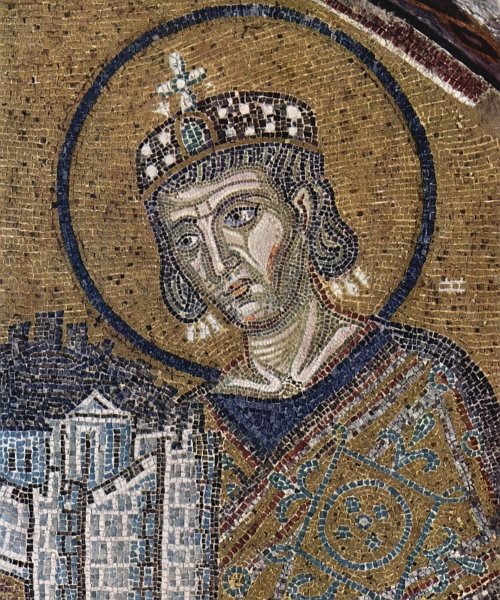
 Flavius Valerius Aurelius Constantinus served as Roman Emperor from AD 306 to 337. During his reign the persecution of Christians was forbidden by the Edict of Milan in 313. Ultimately, the faith gained full imperial support.
Constantine took an active interest in the life and teachings of the church. He called the First Council of Nicaea in 325 at which Saint Athanasius and others defended and defined orthodox Christianity. Among the fruits of this council was one of Christendom's major confessions of faith, the Nicene Creed.
Some argue that Constantine may not have been true believer since he wasn't baptized until his death bed. However, he actively supported Christianity in his later life and even preached upon occasion. Other scholars speculate that he delayed baptism for the same reason as did many others during portions of the Church's history, that of a general misunderstanding of Holy Baptism.
 Many theologians spoke of the need for "satisfaction" — making amends for sins committed during one's life — and warned about time that would be spent in Purgatory by those who didn't make full satisfaction while still living. Indeed, some even taught that unless proper penance was done, one might find himself forever barred from Heaven!
Since Baptism truly washes away all sin — both that of our birth nature and any transgressions committed later — some thought the best way to avoid Purgatory (or Hell) was to be baptized when one was at death's door. In so doing, people believed that there would be no unrepented, unsatisfied sins remaining that would leave one waiting for eternal bliss or forever denied its blessings.
I'll not argue here the reasons why Lutherans reject the notion of satisfaction or the idea of Purgatory. I'll merely say that if Constantine had such worries, he wasn't alone during his day, and his decision to delay would be understandable in light of such teaching.
Saint Helena, ca. AD 255-329
Constantine's mother Helena strongly influenced her son throughout his life. Her great interest in locating the holy sites of the Christian faith led her to become one of the first Christian pilgrims to the Holy Land. Her research led to the identification of Biblical locations in Jerusalem, Bethlehem, and beyond, which are still maintained as places of worship today. One of Christianity's annual festivals, Holy Cross Day, has its origin in her explorations of Palestine.
Collects
O Lord, our God, King of the universe, who raises up earthly rulers to work Your will in this life, You called Constantine to the imperial throne and ended wide-spread persecution of Your Son's Church; grant that as he served You by fulfilling his vocation, so we would continue to receive from You rulers who allow the Church to proclaim the saving Gospel of Your Son, Jesus Christ, our Lord, who lives and reigns with You and the Holy Spirit, one God, now and forever.
Almighty God, who called your servant Helena to an earthly position of authority so that she might advance your heavenly kingdom, filling her with zeal for your Church and love for Your people, grant that we may be fruitful in good works and steadfast in our faith in Your Son, and finally by your mercy attain everlasting life; through Jesus Christ our Lord, who lives and reigns with you and the Holy Spirit, one God, now and forever.
Labels: athanasius, biography, church history, commemoration, constantine, edict of milan, european history, hagiography, helena, holy cross, nicaea, nicene creed, patristics, roman empire
¶ 00:00 | 0 comments |
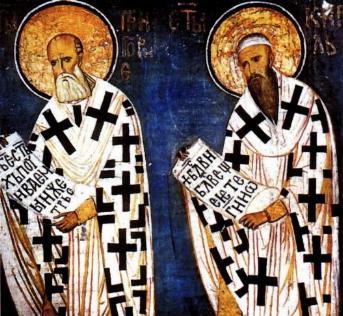 Saint Cyril and Saint Methodius were missionaries to the Slavs. The brothers Constantine and Methodius came from a Greek family in Thessalonica. Younger brother Constantine took the name Cyril when he became a monk in 868. After ordination, Cyril became librarian at the Church of Holy Wisdom (Hagia Sophia) in Constantinople.
In 862, Emperor Michael III and the Patriarch Photios sent the brothers as to what is now the Czech republic, where they taught in the native Slavic tongue. While the fact of their sending may have included the emperor's political designs, the brothers seem to have focused only upon the spiritual aspect of their task.
Cyril is said to have invented the alphabet known today as Cyrillic, which provided a written language for the liturgy and Scriptures for the Slavic peoples. Slavic alphabets include characters from Greek with extra symbols devised for sounds not expressed in Greek.
Their use of the vernacular established an important principle for evangelical missions. People could be taught directly without needing to first instruct them in the language of the Bible before teaching them what it said about their salvation.
Note: Cyril is traditionally celebrated in many places on 14 February, his date of death, and Methodius is often combined with him. I'm following the lectionary from the Lutheran Service Book, which moved the brothers' commemoration to 11 May, evidently because so much of the Western Church associates 14 February with Saint Valentine.
Collect
Almighty and everlasting God, who by the power of the Holy Spirit moved your servant Cyril and his brother Methodius to bring the light of the Gospel to a hostile and divided people, overcome all bitterness and strife among us by the love of Christ, and make us one united family under the banner of the Prince of Peace; who lives and reigns with You and the Holy Spirit, one God, now and forever.
Labels: biography, church history, commemoration, constantine, cyril, hagiography, methodius, missionary, patristics, slavic history, translation
¶ 00:00 | 0 comments |
 During the reign of Constantine the Great, the first Roman Emperor to profess the Christian faith, his mother Helena went to Israel, hoping to find the places especially significant to Christians. Having located, close together, what she believed to be the sites of the Crucifixion and of the Burial (at locations that many modern archaeologists think may be correct), she then had built over them the Church of the Holy Sepulcher, which was dedicated on 13 September 335.
On the next day, the purported section of the cross was brought outside the church for others to view. Thus began a day for recognizing the cross of Christ in a festal atmosphere that would be inappropriate on Good Friday. It stands as a symbol of triumph, as a sign of Christ's victory over death, and a reminder of His promise, "And I, when I am lifted up from the earth, will draw all people to myself. (John 12:32)"
The day is known by different names in various parts of Christendom. The Eastern Orthodox and Eastern Rite Catholic Churches know it as "Feast of the Exaltation of the Cross" while the Latin Rite of the Roman Catholic Church calls it the "Triumph of the Cross." Most other liturgical churches simply call it "Holy Cross Day."
 The Christian custom of tracing the sign of the cross on people and things as a sign of blessing is very old. Some think that it goes back to the very origins of Christianity and earlier. In Ezekiel 9, we read that Ezekiel had a vision of the throne-room of God, in which an angel was sent to go through Jerusalem and put a mark on the foreheads of the faithful few who mourned for the sins of the city. Afterwards, other angels were sent through the city to destroy all those who had not the mark.
We find similar visionary material in Revelation 7:2-4; 9:4; and 14:1, where the mark on the forehead again protects the faithful few in the day of wrath. There, it is said to be the name of the Lamb and of His Father.
What is the significance of the sign of the cross? In the first place, we often place our initials or other personal mark on something to show that it belongs to us. The cross is the personal mark of Our Lord Jesus Christ, often traced upon our foreheads and hearts at our baptisms. We mark it on ourselves as a sign that we belong to Him, just as in the book of Revelation, as noted above, the servants of God are sealed or marked on their foreheads as a sign that they are His.
One pastor noted that, if you were telling someone how to make a cross, you might say, "Draw an 'I' and then cross it out." As we make the sign, we first draw a vertical stroke, as if to say to God, "Lord, here am I." Then we cancel it with a horizontal stroke, as if to say, "Help me, Lord, to abandon my self-centeredness and self-will; make Yourself the center of my life instead. Fix all my attention and all my desire on You, Lord, that I may forget my self, cancel my self, abandon myself completely to Your love and service."
Lection
Psalm 40:1-11
Numbers 21:4-9
1 Corinthians 1:18-25
John 12:20-33
Collect of the Day
Merciful God, Your Son, Jesus Christ, was lifted high upon the cross that He might bear the sins of the world and draw all people to Himself. Grant that we who glory in His death for our redemption may faithfully heed His call to bear the cross and follow Him, who lives and reigns with You and the Holy Spirit, one God, now and forever.
Labels: christianity, christology, church history, constantine, crucifixion, feasts, festivals, good friday, helena, holy cross
¶ 00:00 | 0 comments |
The Christian Church's First Ecumenical Council was convened in Nicaea (modern Isnuk, Turkey) in the early summer of AD 325 by the Roman Emperor Constantine. The emperor presided at the opening of the council. The major intended topic was the ongoing Arian controversy.The council ruled against the Arians, who taught that Jesus was not the eternal Son of God but was created by the Father and was called Son of God because of his righteousness. The chief opponents of the Arians were Alexander, bishop of Alexandria, and his deacon, Athanasius. The council confessed the eternal divinity of Jesus and adopted the earliest version of the Nicene Creed, which in its entirety was adopted at the Council of Constantinople in 381.
Other topics included celebration of the Resurrection and how the date for Easter would correspond with Passover, the Miletian schism, validity of baptism by heretics, and the restoration lapsed Christians who renounced the Faith under persecution. The Council also established a number of new canons (Church laws). Enumeration varies, but twenty is the number suggested by the editors of the Early Church Fathers:
1. prohibition of self-castration, as done by Origen;Their version of what we now call the Nicene Creed was almost identical to what is now used in the Church until the third section, where the original ends, "We believe in the Holy Spirit." It fell to the Second Ecumenical Council (First Council of Constantinople) to add what is now used. Therefore, the confession used in the churches may properly be called the Niceno-Constantinopolitan Creed. The so-called filioque (where "and the Son" was inserted after the words about the Spirit proceeding from the Father) was only later added by the Roman Catholic Church and never accepted in the East.
2. establishment of a minimum term for catechumens;
3. prohibition of the presence in the house of a cleric of a younger woman who might bring him under suspicion;
4. ordination of a bishop in the presence of at least three provincial bishops and confirmation by the metropolitan;
5. provision for two provincial synods to be held annually;
6. exceptional authority acknowledged for the bishops of Alexandria and Rome, for their respective regions;
7. recognition of the honorary rights of the see of Jerusalem;
8. provision for agreement with the Novatianists;
9-14. provision for mild procedure against the lapsed during the persecution under Licinius;
15-16. prohibition of the removal of priests;
17. prohibition of usury among the clergy;
18. precedence of bishops and presbyters before deacons in receiving Holy Communion, the Eucharist;
19. declaration of the invalidity of baptism by Paulian heretics;
20. prohibition of kneeling during the liturgy, on Sundays, and in the days of Eastertide.
(Summary from Wikipedia.)
The Council also saw the first major collaboration between Church and state since Christianity began and signaled a rise in imperial influence in affairs of the Church. Constantine called it, presided over the initial session, and, in many respects, set its agenda. While his personal religious beliefs may have been part of his reason, most scholars agree that his main fear was that a divided Christianity would result in a divided Empire. The historical irony is that the Roman Empire fractured before any major schisms in Christendom.
Nicene Creed
I believe in one God, the Father Almighty, Maker of heaven and earth and of all things visible and invisible.And in one Lord Jesus Christ, the only-begotten Son of God, begotten of His Father before all worlds, God of God, Light of Light, very God of very God, begotten, not made, being of one substance with the Father, by whom all things were made; who for us men and for our salvation came down from heaven and was incarnate by the Holy Spirit of the virgin Mary and was made man; and was crucified also for us under Pontius Pilate. He suffered, and was buried. And the third day He rose again according to the Scriptures and ascended into heaven and sits at the right hand of the Father. And He will come again with glory to judge both the living and the dead, whose kingdom will have no end.
And I believe in the Holy Spirit, the Lord and Giver of Life, who proceeds from the Father and the Son, who with the Father and the Son together is worshiped and glorified, who spoke by the prophets. And I believe in one holy Christian [catholic] and apostolic Church, I acknowledge one Baptism for the remission of sins, and I look for the resurrection of the dead and the life ✠ of the world to come. Amen.
Labels: arius, athanasius, christianity, christology, commemoration, constantine, creed, lutheranism, nicaea, nicene creed
¶ 00:00 | 1 comments |
Flavius Valerius Aurelius Constantinus served as Roman Emperor from AD 306 to 337. During his reign the persecution of Christians was forbidden by the Edict of Milan in 313. Ultimately, the faith gained full imperial support.Constantine took an active interest in the life and teachings of the church and. He called the First Council of Nicaea in 325 at which Saint Athanasius and others defended and defined orthodox Christianity. Among the fruits of this council was one of Christendom's major confessions of faith, the Nicene Creed.
Some argue that Constantine may not have been true believer since he wasn't baptized until his death bed. However, he actively supported Christianity in his later life and even preached upon occasion. Other scholars speculate that he delayed baptism for the same reason as did many others during portions of the Church's history, that of a general misunderstanding of Holy Baptism.
Many theologians spoke of the need for "satisfaction" — making amends for sins committed during one's life — and warned about time that would be spent in Purgatory by those who didn't make full satisfaction while still living. Indeed, some even taught that unless proper penance was done, one might find himself forever barred from Heaven!Since Baptism truly washes away all sin — both that of our birth nature and any transgressions committed later — some thought the best way to avoid Purgatory (or Hell) was to be baptized when one was at death's door. In so doing, people believed that there would be no unrepented, unsatisfied sins remaining that would leave one waiting for eternal bliss or forever denied its blessings.
I'll not argue here the reasons why Lutherans reject the notion of satisfaction or the idea of Purgatory. I'll merely say that if Constantine had such worries, he wasn't alone during his day, and his decision to delay would be understandable in light of such teaching.
Saint Helena, ca. AD 255-329
Constantine's mother Helena strongly influenced her son throughout his life. Her great interest in locating the holy sites of the Christian faith led her to become one of the first Christian pilgrims to the Holy Land. Her research led to the identification of Biblical locations in Jerusalem, Bethlehem, and beyond, which are still maintained as places of worship today. One of Christianity's annual festivals, Holy Cross Day, has its origin in her explorations of Palestine.
Collects
O Lord, our God, King of the universe, who raises up earthly rulers to work Your will in this life, You called Constantine to the imperial throne and ended wide-spread persecution of Your Son's Church; grant that as he served You by fulfilling his vocation, so we would continue to receive from You rulers who allow the Church to proclaim the saving Gospel of Your Son, Jesus Christ, our Lord, who lives and reigns with You and the Holy Spirit, one God, now and forever.
Almighty God, who called your servant Helena to an earthly position of authority so that she might advance your heavenly kingdom, filling her with zeal for your Church and love for Your people, grant that we may be fruitful in good works and steadfast in our faith in Your Son, and finally by your mercy attain everlasting life; through Jesus Christ our Lord, who lives and reigns with you and the Holy Spirit, one God, now and forever.
Labels: athanasius, biography, church history, commemoration, constantine, edict of milan, european history, hagiography, helena, holy cross, nicaea, nicene creed, patristics, roman empire
¶ 00:00 | 0 comments |
Saint Cyril and Saint Methodius were missionaries to the Slavs. The brothers Constantine and Methodius came from a Greek family in Thessalonica. Younger brother Constantine took the name Cyril when he became a monk in 868. After ordination, Cyril became librarian at the Church of Holy Wisdom (Hagia Sophia) in Constantinople.In 862, Emperor Michael III and the Patriarch Photios sent the brothers as to what is now the Czech republic, where they taught in the native Slavic tongue. While the fact of their sending may have included the emperor's political designs, the brothers seem to have focused only upon the spiritual aspect of their task.
Cyril is said to have invented the alphabet known today as Cyrillic, which provided a written language for the liturgy and Scriptures for the Slavic peoples. Slavic alphabets include characters from Greek with extra symbols devised for sounds not expressed in Greek.
Their use of the vernacular established an important principle for evangelical missions. People could be taught directly without needing to first instruct them in the language of the Bible before teaching them what it said about their salvation.
Note: Cyril is traditionally celebrated in many places on 14 February, his date of death, and Methodius is often combined with him. I'm following the lectionary from the Lutheran Service Book, which moved the brothers' commemoration to 11 May, evidently because so much of the Western Church associates 14 February with Saint Valentine.
Collect
Almighty and everlasting God, who by the power of the Holy Spirit moved your servant Cyril and his brother Methodius to bring the light of the Gospel to a hostile and divided people, overcome all bitterness and strife among us by the love of Christ, and make us one united family under the banner of the Prince of Peace; who lives and reigns with You and the Holy Spirit, one God, now and forever.
Labels: biography, church history, commemoration, constantine, cyril, hagiography, methodius, missionary, patristics, slavic history, translation
¶ 00:00 | 0 comments |
During the reign of Constantine the Great, the first Roman Emperor to profess the Christian faith, his mother Helena went to Israel, hoping to find the places especially significant to Christians. Having located, close together, what she believed to be the sites of the Crucifixion and of the Burial (at locations that many modern archaeologists think may be correct), she then had built over them the Church of the Holy Sepulcher, which was dedicated on 13 September 335.On the next day, the purported section of the cross was brought outside the church for others to view. Thus began a day for recognizing the cross of Christ in a festal atmosphere that would be inappropriate on Good Friday. It stands as a symbol of triumph, as a sign of Christ's victory over death, and a reminder of His promise, "And I, when I am lifted up from the earth, will draw all people to myself. (John 12:32)"
The day is known by different names in various parts of Christendom. The Eastern Orthodox and Eastern Rite Catholic Churches know it as "Feast of the Exaltation of the Cross" while the Latin Rite of the Roman Catholic Church calls it the "Triumph of the Cross." Most other liturgical churches simply call it "Holy Cross Day."
The Christian custom of tracing the sign of the cross on people and things as a sign of blessing is very old. Some think that it goes back to the very origins of Christianity and earlier. In Ezekiel 9, we read that Ezekiel had a vision of the throne-room of God, in which an angel was sent to go through Jerusalem and put a mark on the foreheads of the faithful few who mourned for the sins of the city. Afterwards, other angels were sent through the city to destroy all those who had not the mark.We find similar visionary material in Revelation 7:2-4; 9:4; and 14:1, where the mark on the forehead again protects the faithful few in the day of wrath. There, it is said to be the name of the Lamb and of His Father.
What is the significance of the sign of the cross? In the first place, we often place our initials or other personal mark on something to show that it belongs to us. The cross is the personal mark of Our Lord Jesus Christ, often traced upon our foreheads and hearts at our baptisms. We mark it on ourselves as a sign that we belong to Him, just as in the book of Revelation, as noted above, the servants of God are sealed or marked on their foreheads as a sign that they are His.
One pastor noted that, if you were telling someone how to make a cross, you might say, "Draw an 'I' and then cross it out." As we make the sign, we first draw a vertical stroke, as if to say to God, "Lord, here am I." Then we cancel it with a horizontal stroke, as if to say, "Help me, Lord, to abandon my self-centeredness and self-will; make Yourself the center of my life instead. Fix all my attention and all my desire on You, Lord, that I may forget my self, cancel my self, abandon myself completely to Your love and service."
Lection
Psalm 40:1-11
Numbers 21:4-9
1 Corinthians 1:18-25
John 12:20-33
Collect of the Day
Merciful God, Your Son, Jesus Christ, was lifted high upon the cross that He might bear the sins of the world and draw all people to Himself. Grant that we who glory in His death for our redemption may faithfully heed His call to bear the cross and follow Him, who lives and reigns with You and the Holy Spirit, one God, now and forever.
Labels: christianity, church history, constantine, crucifixion, feasts, festivals, helena, holy cross
¶ 00:00 | 0 comments |


