
Transferred to 12 June for Trinity Sunday
 "Joseph, who was also called by the apostles Barnabas (which means son of encouragement), a Levite, a native of Cyprus, sold a field that belonged to him and brought the money and laid it at the apostles' feet" (Acts 4:36-37). Here Scripture makes first mention of Saint Barnabas.
This name given by the Apostles matches what we know of his actions. When Saul of Tarsus (or Paul) came to Jerusalem after his conversion, most of the congregation wanted nothing to do with him. They knew him only as a persecutor and an enemy of Christ's Church. Barnabas, however, willingly gave him a second chance. He sought him out, spoke with him, and brought him to meet the other Christians, vouching for him.
Later, Paul and Barnabas went on a missionary journey together, taking Barnabas's cousin Mark along. Part way, Mark turned back and went home. When Paul and Barnabas were about to set out on another such journey, Barnabas proposed to take Mark along, and Paul was against it, saying that Mark had shown himself undependable. Barnabas wanted to give Mark a second chance, and so he and Mark went off on one journey, while Paul took Silas and went on another. Apparently Mark responded well to the trust given him by the "son of encouragement," since we find that Paul later spoke of him as a valuable assistant (2 Timothy 4:11; see also Colossians 4:10 and Philemon 24).
Lection
Psalm 112
Isaiah 42:5-12
Acts 11:19-30; 13:1-3
Mark 6:7-13
Collect
Almighty God, Your faithful servant Barnabas sought not his own renown but gave generously of his life and substance for the encouragement of the apostles and their ministry. Grant that we may follow his example in lives given to charity and the proclamation of the Gospel; through Your Son, Jesus Christ, our Lord, who lives and reigns with You and the Holy Spirit, one God, now and forever.
Labels: acts, barnabas, feasts, festivals, missionary, new testament, saint mark, saint paul, saint peter
¶ 00:00 | 0 comments |

 The man who later became known as Saint Boniface was born around AD 670-680 at Crediton, Devonshire, England and baptized Winfrid or Wynfrith. Although he was educated, he became a monk — at that time a calling often avoided by people of learning or means. While still in England, he was ordained as a presbyter and was inspired by the example of others to become a missionary.
Upon receiving a papal commission in 719 to work in Germany, Winfrid devoted himself to starting, organizing, and reforming churches and monasteries in Hesse, Thuringia, and Bavaria. After becoming an archbishop, Boniface was assigned to the See of Mainz in 743. Ten years later he resigned his position to engage in mission work in the Netherlands.
His time of activity overlapped the period in which Pippin the Younger and Charlemagne reigned and his work of converting the Saxons to Christianity was seen as a boon for expansion of Frankish rule. Yet Boniface never operated as a pawn of the kingdom of the left hand. Instead, he balanced alliances among the Carolingians, Bavarian rulers, and the papacy and often consecrated bishops who were already his followers in order to keep others from meddling in ecclesiastical affairs.
History isn't clear as to exactly when people began calling Winfrid "Boniface," Latin for "good deeds." However, his entire life gives ample testimony to events which would lead to this appellation.
Among his most famous exploits was the felling of Thor's Oak, an ancient tree believed sacred to the Nordic and Germanic god of thunder. Accounts from the period relate that when Thor (or Donar/Donner) didn't strike him dead with a lightning bolt, the locals agreed that the Christian God was supreme and agreed to be baptized. In a practical yet also symbolic gesture, Boniface used the wood of the fallen tree in the construction of a chapel in Fritzlar.
On June 5, 754, while awaiting a group of converts for confirmation, Boniface and his companions were murdered by a band of pagans in Friesland. The above picture is a commemorative statue in Dokkum, The Netherlands — a town near where he was martyred. Erected in 2004, it commemorated the 1250th anniversary of his death. Boniface is known as a great missionary and is sometimes called the "Apostle to the Germans." According to historian Christopher Dawson, no other Englishman had any greater influence upon Europe's history.
Suggested Lection
Psalm 115:1-8 or 31:1-5
Acts 20:17-28
Luke 24:44-53
Collect
Almighty God, who called Your faithful servant Boniface to be a witness and martyr in the lands of Germany and Friesland, and by his labor and suffering raised up a people for Your own possession, pour forth Your Holy Spirit upon your Church in every land, that by the service and sacrifice of many Your holy Name may be glorified and Your kingdom enlarged; through Jesus Christ our Lord, who lives and reigns with You and the Holy Spirit, one God, now and forever.
Labels: biography, boniface, charlemagne, commemoration, friesland, german history, hagiography, martyrdom, missionary, saxony, two kingdoms
¶ 00:00 | 0 comments |
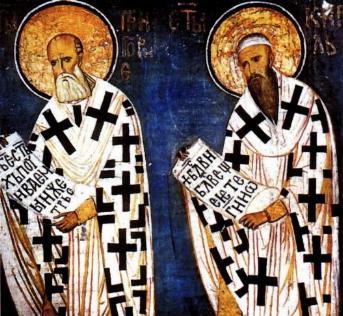 Saint Cyril and Saint Methodius were missionaries to the Slavs. The brothers Constantine and Methodius came from a Greek family in Thessalonica. Younger brother Constantine took the name Cyril when he became a monk in 868. After ordination, Cyril became librarian at the Church of Holy Wisdom (Hagia Sophia) in Constantinople.
In 862, Emperor Michael III and the Patriarch Photios sent the brothers as to what is now the Czech republic, where they taught in the native Slavic tongue. While the fact of their sending may have included the emperor's political designs, the brothers seem to have focused only upon the spiritual aspect of their task.
Cyril is said to have invented the alphabet known today as Cyrillic, which provided a written language for the liturgy and Scriptures for the Slavic peoples. Slavic alphabets include characters from Greek with extra symbols devised for sounds not expressed in Greek.
Their use of the vernacular established an important principle for evangelical missions. People could be taught directly without needing to first instruct them in the language of the Bible before teaching them what it said about their salvation.
Note: Cyril is traditionally celebrated in many places on 14 February, his date of death, and Methodius is often combined with him. I'm following the lectionary from the Lutheran Service Book, which moved the brothers' commemoration to 11 May, evidently because so much of the Western Church associates 14 February with Saint Valentine.
Collect
Almighty and everlasting God, who by the power of the Holy Spirit moved your servant Cyril and his brother Methodius to bring the light of the Gospel to a hostile and divided people, overcome all bitterness and strife among us by the love of Christ, and make us one united family under the banner of the Prince of Peace; who lives and reigns with You and the Holy Spirit, one God, now and forever.
Labels: biography, church history, commemoration, constantine, cyril, hagiography, methodius, missionary, patristics, slavic history, translation
¶ 00:00 | 0 comments |
 Pádraig (Patrick, Padraic), one of the best-known missionary saints, was born to a Christian family in southwest Britain around the year 389. While he was a teenager, raiders captured and took him to Ireland. There, he was forced to serve as a herdsman.
After six years he escaped and found his way, home, and then traveled to a monastery community in France. Imagine the surprise of those who knew him — even by his own reckoning, he left Britain as one who cared little for God.
With his new trust in the Lord, Patrick threw himself wholeheartedly into monastic life. Ordained a bishop in 432, he made his way back to Ireland, where he spent the rest of his long life spreading the Gospel and organizing Christian communities.
He staunchly defended the doctrine of the Holy Trinity during a time when it was not popular to do so. His writings include his spiritual autobiography, the Confessio, and several prayers and hymns still used in the church today.
 Pádraig died around the year 466. Many people attribute the Lorica (see below) to him. One of the symbols used for Patrick in ecclesiastical art is a red Cross Saltire on a white background. This was added to the overlaid crosses of Saint George and Saint Andrew to form the current Union Jack of the United Kingdom.
The legendary account of Patrick driving snakes off of the Emerald Isle is just that — a legend. There's no evidence that snakes ever slithered across Irish soil. Much more likely is the story that he used the shamrock or some other type of clover to roughly illustrate the Holy Trinity to the unconverted folk of Ireland.
If he were to return to earth in present day, one can only imagine the disdain with which this hero of the faith would view the drunken celebrations in many places which are held to "honor" his memory.
Lection
Psalm 97:1-2,7-12 or 96:1-7
1 Thessalonians 2:2b-12
Matthew 28:16-20
Collect
Almighty God, in Your providence You chose your servant Pádraig to be the apostle of the Irish people, to bring those who wandered in darkness and error to the true light and knowledge of You; grant us so to walk in that light, that we may come at last to the light of everlasting life; through Jesus Christ our Lord, who lives and reigns with You and the Holy Spirit, one God, now forever.
The Lorica or Saint Patrick's Breastplate
 I bind unto myself today
the strong Name of the Trinity,
by invocation of the same,
the Three in One, and One in Three.
I bind this day to me forever,
by power of faith, Christ's Incarnation;
his baptism in the Jordan river;
his death on cross for my salvation;
his bursting from the spiced tomb;
his riding up he heavenly way;
his coming at the day of doom:
I bind unto myself today.
I bind unto myself the power
of the great love of cherubim;
the sweet "Well done" in judgement hour;
the service of the seraphim;
confessors' faith, apostles' word,
the patriarchs' prayers, the prophets' scrolls;
all good deeds done unto the Lord,
and purity of virgin souls.
I bind unto myself today
the virtues of the starlit heaven,
the glorious sun's life-giving ray,
the whiteness of the moon at even,
the flashing of the lightning free,
the whirling wind's tempestuous shocks,
the stable earth, the deep salt sea,
around the old eternal rocks.
I bind unto myself today
the power of God to hold and lead,
his eye to watch, his might to stay,
his ear to hearken to my need;
the wisdom of my God to teach,
his hand to guide, his shield to ward;
the word of God to give me speech,
his heavenly host to be my guard.
Against the demon snares of sin,
the vice that gives temptation force,
the natural lusts that war within,
the hostile men that mar my course;
of few or many, far or nigh,
in every place, and in all hours
against their fierce hostility,
I bind to me these holy powers.
Against all Satan's spells and wiles,
against false words of heresy,
against the knowledge that defiles
against the heart's idolatry,
against the wizard's evil craft,
against the death-wound and the burning
the choking wave and poisoned shaft,
protect me, Christ, till thy returning.
Christ be with me, Christ within me,
Christ behind me, Christ before me,
Christ beside me, Christ to win me,
Christ to comfort and restore me,
Christ beneath me, Christ above me,
Christ in quiet, Christ in danger,
Christ in hearts of all that love me,
Christ in mouth of friend and stranger.
I bind unto myself the Name,
the strong Name of the Trinity,
by invocation of the same,
the Three in One, and One in Three.
Of whom all nature hath creation,
eternal Father, Spirit, Word:
praise to the Lord of my salvation,
salvation is of Christ the Lord.
Translation by Cecil Francis Alexander
Labels: biography, church history, commemoration, hagiography, irish history, missionary, pádraig, patrick, patron saint
¶ 00:00 | 0 comments |
 Dewi Sant (also Degui or David), Bishop and Confessor and patron of Wales, is usually represented standing on a little hill, with a dove on his shoulder. From ancient times, the Welsh have worn a leek on St. David's Day in memory of a battle against the Saxons. There, it is said they wore leeks in their hats at St. David's advice, to distinguish them from their enemies. The Welsh honor him not only as their patron saint but as special evangelist of their land, just as Pádraig holds that honor for Ireland.
The earliest mention of St. David is found in a tenth-century manuscript, the Annales Cambriae, which assigns his death to AD 601. Many other writers, from Geoffrey of Monmouth down to Father Richard Stanton, hold that he died about 544; their opinion is based solely on data given in various late "lives" of St. David, and there seems no good reason for setting aside the definite statement of the Annales Cambriae, which is now generally accepted.
Speculation that he was born at Henvynyw (Vetus-Menevia) in Cardiganshire is not improbable. He was prominent at the Synod of Brevi (Llandewi Brefi in Cardiganshire). Dewi was active in refuting heresy in Wales and in promoting Nicene Christology and the orthodox Christian faith.
 According to tradition, Saints Dubricius and Deiniol sought him out, calling him to the Synod of Brevi "against the Pelagians."* Only with great difficulty was Dewi persuaded to accompany them, since he preferred the quiet monastic life. However, once he arrived at the Synod, he preached so loudly and so eloquently that all the heretics were confounded. Shortly afterwards, in 569, he presided over another synod held at a place called Lucus Victoriae.
David is the only one of the four patron saints of the British Isles not to be represented on the British Union Jack flag. The Alley's biography for Saint Andrew touches upon each of these and their respective emblems.
*For more information on Pelagianism, please see Pelagius, Part 1 and Pelagius, Part 2 by Pastor Alex Klages.
Lection
Psalm 16:5-11 or 96:1-7
1 Thessalonians 2:2b-12
Mark 4:26-29
Collect
Almighty God, who called your servant Dewi to be a faithful and wise steward of your mysteries for the people of Wales, mercifully grant that, following his purity of life and zeal for the gospel of Christ, we may with him receive the crown of everlasting life; through Jesus Christ our Lord, who lives and reigns with you and the Holy Spirit, one God, now and forever.
Labels: biography, british history, church history, commemoration, david, dewi, hagiography, missionary, patron saint, pelagianism, wales
¶ 00:10 | 0 comments |
"Joseph, who was also called by the apostles Barnabas (which means son of encouragement), a Levite, a native of Cyprus, sold a field that belonged to him and brought the money and laid it at the apostles' feet" (Acts 4:36-37). Here Scripture makes first mention of Saint Barnabas.This name given by the Apostles matches what we know of his actions. When Saul of Tarsus (or Paul) came to Jerusalem after his conversion, most of the congregation wanted nothing to do with him. They knew him only as a persecutor and an enemy of Christ's Church. Barnabas, however, willingly gave him a second chance. He sought him out, spoke with him, and brought him to meet the other Christians, vouching for him.
Later, Paul and Barnabas went on a missionary journey together, taking Barnabas's cousin Mark along. Part way, Mark turned back and went home. When Paul and Barnabas were about to set out on another such journey, Barnabas proposed to take Mark along, and Paul was against it, saying that Mark had shown himself undependable. Barnabas wanted to give Mark a second chance, and so he and Mark went off on one journey, while Paul took Silas and went on another. Apparently Mark responded well to the trust given him by the "son of encouragement," since we find that Paul later spoke of him as a valuable assistant (2 Timothy 4:11; see also Colossians 4:10 and Philemon 24).
Lection
Psalm 112
Isaiah 42:5-12
Acts 11:19-30; 13:1-3
Mark 6:7-13
Collect
Almighty God, Your faithful servant Barnabas sought not his own renown but gave generously of his life and substance for the encouragement of the apostles and their ministry. Grant that we may follow his example in lives given to charity and the proclamation of the Gospel; through Your Son, Jesus Christ, our Lord, who lives and reigns with You and the Holy Spirit, one God, now and forever.
Tags: Saint Barnabas | St. Barnabas | Barnabas | Joseph | apostle | missionary | missions | Saint Paul | Saint Mark | Jesus | Jesus Christ | Christ | Church Year | liturgical calendar | Christianity | Christian feasts | biography | hagiography | commemoration | historical theology | Church history | Bible history | New Testament | The Acts of the Apostles
Labels: acts, barnabas, feasts, festivals, missionary, new testament, saint mark, saint paul, saint peter
¶ 00:00 | 0 comments |
The man who later became known as Saint Boniface was born around AD 670-680 at Crediton, Devonshire, England and baptized Winfrid or Wynfrith. Although he was educated, he became a monk — at that time a calling often avoided by people of learning or means. While still in England, he was ordained as a presbyter and was inspired by the example of others to become a missionary.Upon receiving a papal commission in 719 to work in Germany, Winfrid devoted himself to starting, organizing, and reforming churches and monasteries in Hesse, Thuringia, and Bavaria. After becoming an archbishop, Boniface was assigned to the See of Mainz in 743. Ten years later he resigned his position to engage in mission work in the Netherlands.
His time of activity overlapped the period in which Pippin the Younger and Charlemagne reigned and his work of converting the Saxons to Christianity was seen as a boon for expansion of Frankish rule. Yet Boniface never operated as a pawn of the kingdom of the left hand. Instead, he balanced alliances among the Carolingians, Bavarian rulers, and the papacy and often consecrated bishops who were already his followers in order to keep others from meddling in ecclesiastical affairs.
History isn't clear as to exactly when people began calling Winfrid "Boniface," Latin for "good deeds." However, his entire life gives ample testimony to events which would lead to this appellation.
Among his most famous exploits was the felling of Thor's Oak, an ancient tree believed sacred to the Nordic and Germanic god of thunder. Accounts from the period relate that when Thor (or Donar/Donner) didn't strike him dead with a lightning bolt, the locals agreed that the Christian God was supreme and agreed to be baptized. In a practical yet also symbolic gesture, Boniface used the wood of the fallen tree in the construction of a chapel in Fritzlar.
On June 5, 754, while awaiting a group of converts for confirmation, Boniface and his companions were murdered by a band of pagans in Friesland. The above picture is a commemorative statue in Dokkum, The Netherlands — a town near where he was martyred. Erected in 2004, it commemorated the 1250th anniversary of his death. Boniface is known as a great missionary and is sometimes called the "Apostle to the Germans." According to historian Christopher Dawson, no other Englishman had any greater influence upon Europe's history.
Suggested Lection
Psalm 115:1-8 or 31:1-5
Acts 20:17-28
Luke 24:44-53
Collect
Almighty God, who called Your faithful servant Boniface to be a witness and martyr in the lands of Germany and Friesland, and by his labor and suffering raised up a people for Your own possession, pour forth Your Holy Spirit upon your Church in every land, that by the service and sacrifice of many Your holy Name may be glorified and Your kingdom enlarged; through Jesus Christ our Lord, who lives and reigns with You and the Holy Spirit, one God, now and forever.
Labels: biography, boniface, charlemagne, commemoration, friesland, german history, hagiography, martyrdom, missionary, saxony, two kingdoms
¶ 00:00 | 0 comments |
Saint Cyril and Saint Methodius were missionaries to the Slavs. The brothers Constantine and Methodius came from a Greek family in Thessalonica. Younger brother Constantine took the name Cyril when he became a monk in 868. After ordination, Cyril became librarian at the Church of Holy Wisdom (Hagia Sophia) in Constantinople.In 862, Emperor Michael III and the Patriarch Photios sent the brothers as to what is now the Czech republic, where they taught in the native Slavic tongue. While the fact of their sending may have included the emperor's political designs, the brothers seem to have focused only upon the spiritual aspect of their task.
Cyril is said to have invented the alphabet known today as Cyrillic, which provided a written language for the liturgy and Scriptures for the Slavic peoples. Slavic alphabets include characters from Greek with extra symbols devised for sounds not expressed in Greek.
Their use of the vernacular established an important principle for evangelical missions. People could be taught directly without needing to first instruct them in the language of the Bible before teaching them what it said about their salvation.
Note: Cyril is traditionally celebrated in many places on 14 February, his date of death, and Methodius is often combined with him. I'm following the lectionary from the Lutheran Service Book, which moved the brothers' commemoration to 11 May, evidently because so much of the Western Church associates 14 February with Saint Valentine.
Collect
Almighty and everlasting God, who by the power of the Holy Spirit moved your servant Cyril and his brother Methodius to bring the light of the Gospel to a hostile and divided people, overcome all bitterness and strife among us by the love of Christ, and make us one united family under the banner of the Prince of Peace; who lives and reigns with You and the Holy Spirit, one God, now and forever.
Labels: biography, church history, commemoration, constantine, cyril, hagiography, methodius, missionary, patristics, slavic history, translation
¶ 00:00 | 0 comments |
Pádraig (Patrick, Padraic), one of the best-known missionary saints, was born to a Christian family in southwest Britain around the year 389. While he was a teenager, raiders captured and took him to Ireland. There, he was forced to serve as a herdsman.After six years he escaped and found his way, home, and then traveled to a monastery community in France. Imagine the surprise of those who knew him — even by his own reckoning, he left Britain as one who cared little for God.
With his new trust in the Lord, Patrick threw himself wholeheartedly into monastic life. Ordained a bishop in 432, he made his way back to Ireland, where he spent the rest of his long life spreading the Gospel and organizing Christian communities.
He staunchly defended the doctrine of the Holy Trinity during a time when it was not popular to do so. His writings include his spiritual autobiography, the Confessio, and several prayers and hymns still used in the church today.
Pádraig died around the year 466. Many people attribute the Lorica (see below) to him. One of the symbols used for Patrick in ecclesiastical art is a red Cross Saltire on a white background. This was added to the overlaid crosses of Saint George and Saint Andrew to form the current Union Jack of the United Kingdom.The legendary account of Patrick driving snakes off of the Emerald Isle is just that — a legend. There's no evidence that snakes ever slithered across Irish soil. Much more likely is the story that he used the shamrock or some other type of clover to roughly illustrate the Holy Trinity to the unconverted folk of Ireland.
If he were to return to earth in present day, one can only imagine the disdain with which this hero of the faith would view the drunken celebrations in many places which are held to "honor" his memory.
Lection
Psalm 97:1-2,7-12 or 96:1-7
1 Thessalonians 2:2b-12
Matthew 28:16-20
Collect
Almighty God, in Your providence You chose your servant Pádraig to be the apostle of the Irish people, to bring those who wandered in darkness and error to the true light and knowledge of You; grant us so to walk in that light, that we may come at last to the light of everlasting life; through Jesus Christ our Lord, who lives and reigns with You and the Holy Spirit, one God, now forever.
The Lorica or Saint Patrick's Breastplate
I bind unto myself todaythe strong Name of the Trinity,
by invocation of the same,
the Three in One, and One in Three.
I bind this day to me forever,
by power of faith, Christ's Incarnation;
his baptism in the Jordan river;
his death on cross for my salvation;
his bursting from the spiced tomb;
his riding up he heavenly way;
his coming at the day of doom:
I bind unto myself today.
I bind unto myself the power
of the great love of cherubim;
the sweet "Well done" in judgement hour;
the service of the seraphim;
confessors' faith, apostles' word,
the patriarchs' prayers, the prophets' scrolls;
all good deeds done unto the Lord,
and purity of virgin souls.
I bind unto myself today
the virtues of the starlit heaven,
the glorious sun's life-giving ray,
the whiteness of the moon at even,
the flashing of the lightning free,
the whirling wind's tempestuous shocks,
the stable earth, the deep salt sea,
around the old eternal rocks.
I bind unto myself today
the power of God to hold and lead,
his eye to watch, his might to stay,
his ear to hearken to my need;
the wisdom of my God to teach,
his hand to guide, his shield to ward;
the word of God to give me speech,
his heavenly host to be my guard.
Against the demon snares of sin,
the vice that gives temptation force,
the natural lusts that war within,
the hostile men that mar my course;
of few or many, far or nigh,
in every place, and in all hours
against their fierce hostility,
I bind to me these holy powers.
Against all Satan's spells and wiles,
against false words of heresy,
against the knowledge that defiles
against the heart's idolatry,
against the wizard's evil craft,
against the death-wound and the burning
the choking wave and poisoned shaft,
protect me, Christ, till thy returning.
Christ be with me, Christ within me,
Christ behind me, Christ before me,
Christ beside me, Christ to win me,
Christ to comfort and restore me,
Christ beneath me, Christ above me,
Christ in quiet, Christ in danger,
Christ in hearts of all that love me,
Christ in mouth of friend and stranger.
I bind unto myself the Name,
the strong Name of the Trinity,
by invocation of the same,
the Three in One, and One in Three.
Of whom all nature hath creation,
eternal Father, Spirit, Word:
praise to the Lord of my salvation,
salvation is of Christ the Lord.
Translation by Cecil Francis Alexander
Labels: biography, church history, commemoration, hagiography, irish history, missionary, pádraig, patrick, patron saint
¶ 00:00 | 0 comments |
Dewi Sant (also Degui or David), Bishop and Confessor and patron of Wales, is usually represented standing on a little hill, with a dove on his shoulder. From ancient times, the Welsh have worn a leek on St. David's Day in memory of a battle against the Saxons. There, it is said they wore leeks in their hats at St. David's advice, to distinguish them from their enemies. The Welsh honor him not only as their patron saint but as special evangelist of their land, just as Pádraig holds that honor for Ireland.The earliest mention of St. David is found in a tenth-century manuscript, the Annales Cambriae, which assigns his death to AD 601. Many other writers, from Geoffrey of Monmouth down to Father Richard Stanton, hold that he died about 544; their opinion is based solely on data given in various late "lives" of St. David, and there seems no good reason for setting aside the definite statement of the Annales Cambriae, which is now generally accepted.
Speculation that he was born at Henvynyw (Vetus-Menevia) in Cardiganshire is not improbable. He was prominent at the Synod of Brevi (Llandewi Brefi in Cardiganshire). Dewi was active in refuting heresy in Wales and in promoting Nicene Christology and the orthodox Christian faith.
According to tradition, Saints Dubricius and Deiniol sought him out, calling him to the Synod of Brevi "against the Pelagians."* Only with great difficulty was Dewi persuaded to accompany them, since he preferred the quiet monastic life. However, once he arrived at the Synod, he preached so loudly and so eloquently that all the heretics were confounded. Shortly afterwards, in 569, he presided over another synod held at a place called Lucus Victoriae.David is the only one of the four patron saints of the British Isles not to be represented on the British Union Jack flag. The Alley's biography for Saint Andrew touches upon each of these and their respective emblems.
*For more information on Pelagianism, please see Pelagius, Part 1 and Pelagius, Part 2 by Pastor Alex Klages.
Lection
Psalm 16:5-11 or 96:1-7
1 Thessalonians 2:2b-12
Mark 4:26-29
Collect
Almighty God, who called your servant Dewi to be a faithful and wise steward of your mysteries for the people of Wales, mercifully grant that, following his purity of life and zeal for the gospel of Christ, we may with him receive the crown of everlasting life; through Jesus Christ our Lord, who lives and reigns with you and the Holy Spirit, one God, now and forever.
Labels: biography, british history, church history, commemoration, david, dewi, hagiography, missionary, patron saint, pelagianism, wales
¶ 00:00 | 0 comments |


