
Transferred to 13 June for Trinity Sunday and Saint Barnabas Day
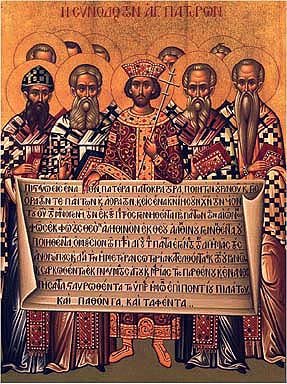
 The Christian Church's First Ecumenical Council was convened in Nicaea (modern Isnuk, Turkey) in the early summer of AD 325 by the Roman Emperor Constantine. The emperor presided at the opening of the council. The major intended topic was the ongoing Arian controversy.
The council ruled against the Arians, who taught that Jesus was not the eternal Son of God but was created by the Father and was called Son of God because of his righteousness. The chief opponents of the Arians were Alexander, bishop of Alexandria, and his deacon, Athanasius. The council confessed the eternal divinity of Jesus and adopted the earliest version of the Nicene Creed, which in its entirety was adopted at the Council of Constantinople in 381.
Other topics included celebration of the Resurrection and how the date for Easter would correspond with Passover, the Miletian schism, validity of baptism by heretics, and the restoration lapsed Christians who renounced the Faith under persecution. The Council also established a number of new canons (Church laws). Enumeration varies, but twenty is the number suggested by the editors of the Early Church Fathers:
1. prohibition of self-castration, as done by Origen;Their version of what we now call the Nicene Creed was almost identical to what is now used in the Church until the third section, where the original ends, "We believe in the Holy Spirit." It fell to the Second Ecumenical Council (First Council of Constantinople) to add what is now used. Therefore, the confession used in the churches may properly be called the Niceno-Constantinopolitan Creed. The so-called filioque (where "and the Son" was inserted after the words about the Spirit proceeding from the Father) was only later added by the Roman Catholic Church and never accepted in the East.
2. establishment of a minimum term for catechumens;
3. prohibition of the presence in the house of a cleric of a younger woman who might bring him under suspicion;
4. ordination of a bishop in the presence of at least three provincial bishops and confirmation by the metropolitan;
5. provision for two provincial synods to be held annually;
6. exceptional authority acknowledged for the bishops of Alexandria and Rome, for their respective regions;
7. recognition of the honorary rights of the see of Jerusalem;
8. provision for agreement with the Novatianists;
9-14. provision for mild procedure against the lapsed during the persecution under Licinius;
15-16. prohibition of the removal of priests;
17. prohibition of usury among the clergy;
18. precedence of bishops and presbyters before deacons in receiving Holy Communion, the Eucharist;
19. declaration of the invalidity of baptism by Paulian heretics;
20. prohibition of kneeling during the liturgy, on Sundays, and in the days of Eastertide.
(Summary from Wikipedia.)
The Council also saw the first major collaboration between Church and state since Christianity began and signaled a rise in imperial influence in affairs of the Church. Constantine called it, presided over the initial session, and, in many respects, set its agenda. While his personal religious beliefs may have been part of his reason, most scholars agree that his main fear was that a divided Christianity would result in a divided Empire. The historical irony is that the Roman Empire fractured before any major schisms in Christendom.
Nicene Creed
 I believe in one God, the Father Almighty, Maker of heaven and earth and of all things visible and invisible.
And in one Lord Jesus Christ, the only-begotten Son of God, begotten of His Father before all worlds, God of God, Light of Light, very God of very God, begotten, not made, being of one substance with the Father, by whom all things were made; who for us men and for our salvation came down from heaven and was incarnate by the Holy Spirit of the virgin Mary and was made man; and was crucified also for us under Pontius Pilate. He suffered, and was buried. And the third day He rose again according to the Scriptures and ascended into heaven and sits at the right hand of the Father. And He will come again with glory to judge both the living and the dead, whose kingdom will have no end.
And I believe in the Holy Spirit, the Lord and Giver of Life, who proceeds from the Father and the Son, who with the Father and the Son together is worshiped and glorified, who spoke by the prophets. And I believe in one holy Christian [catholic] and apostolic Church, I acknowledge one Baptism for the remission of sins, and I look for the resurrection of the dead and the life ✠ of the world to come. Amen.
Labels: arius, athanasius, christianity, christology, commemoration, constantine, creed, lutheranism, nicaea, nicene creed
¶ 00:00 | 1 comments |

 Athanasius was born in Alexandria in Egypt in AD.295. He served as a church leader in a time of great controversy and ecclesiastical disagreements. While he was still a deacon, around the year 319, a presbyter (pastor) named Arius began a non-Biblical teaching about Jesus Christ. At the Council of Nicaea in 325, Athanasius, despite his relative inexperience in ecclesiastical office, defended Christian orthodoxy against the proponents of the Arian heresy. This belief denied the full divinity of Jesus Christ, claiming that there was a time when the Son was not and that He was thus inferior to the Father according to His "essence."
Results of the Orthodox party's eventual victory included the Nicene Creed.
During his 45-year tenure as bishop of Alexandria, Athanasius wrote numerous works that defended the orthodox teaching. His enemies had him exiled five times; on two occasions he was almost murdered.
Looking back, we see that there were times when Athanasius equaled his opponents' misbehavior, going so far as to engage mercenaries to enforce his episcopacy in Alexandria. Yet Athanasius remained steadfast and ended his days restored fully to his church responsibilities. The Athanasian Creed, though not composed by him, is named in his honor because it confesses the doctrinal orthodoxy he championed throughout his life.
Athanasius became known in the West as one of the four Easterners among the Eight Great Doctors of the Undivided Church. See the biography of Saint Ambrose for all eight.
Lection
Psalm 71:1-8 or 112:1-9
1 John 5:1-5
Matthew 10:22-32
Collect
Uphold Your Church, O God of truth, as You upheld Your servant Athanasius, to maintain and proclaim boldly the catholic faith against all opposition, trusting solely in the grace of Your eternal Word, who took upon Himself our humanity that we might share His holiness; who lives and reigns with you and the Holy Spirit, one God, now and forever.
Labels: alexandria, arianism, arius, athanasius, biography, church history, commemoration, creed, doctors of the church, hagiography, nicaea, nicene creed, patristics
¶ 00:00 | 0 comments |
 Of the many saints recognized by the Christian Church, Nicholas is one of the most widely commemorated. However, very little is known historically of him, although there was a church of Saint Nicholas in Constantinople as early as the sixth century. Research affirms that there was a bishop by the name of Nicholas in the city of Myra in Lycia (part of Turkey today) in the fourth century.
While we don't know a tremendous amount about him, scholars are certain that he was not a "jolly old elf" and that he espoused an austere lifestyle incompatible with "a round little belly" shaking "like a bowl full of jelly."
From that coastal location, legends about Nicholas have traveled across time and distance. He is associated with charitable giving in many countries around the world and is portrayed as the rescuer of sailors, the protector of children, and the friend of people in distress or need. In commemoration of Sinterklaas (a Dutch version of Saint Nicholas), 6 December is a day for giving and receiving gifts in many parts of Europe.
 See the article at Ask the Pastor for a famous apocryphal story and related information on his patronage and "transformation" into the American Santa Claus. There you'll learn about his connection with money lending and his status as patron saint for pawnbrokers.
Also, Ask the Pastor includes the following St. Nicholas Day hymn stanza as part of a previous year's article on midweek Advent services based upon sanctorial commemorations in the Christian calendar:
With joy Your Church remembers
Saint Nicholas, the blest,
Who gave up earthly treasures
And Jesus' name confessed.
The poor and weak he welcomed,
The heretic he scorned;
Through faith and life and preaching,
Christ's Gospel he adorned.
Meanwhile, Pastor Alex Klages focused on Nicholas as a staunchly orthodox bishop who grew so weary of the arch-heretic of Nicaea that he slapped Arius for continually professing false doctrine concerning the Lord Jesus Christ.
Lection
Psalm 78:3-7 or 145:8-13
Isaiah 58:6-10
1 John 4:7-14
Mark 10:13-16
Collect
O Lord, let Your continual mercy enkindle in Your Church the unfailing gifts of charity and faith, that, following the example of your servant Nicholas of Myra, we may have grace to deal in generosity and love with children and with all who are poor and distressed, to uphold the cause of those who have no helper, and to strive for purity of doctrine in the Church; for the sake of Him who gave His life for us, Your Son our Savior Jesus Christ, who lives and reigns with You and the Holy Spirit, one God, now and forever.
Labels: arius, biography, church history, commemoration, hagiography, nicholas of myra, patristics, saint nicholas, santa claus, sinterklaas, theology, turkish history
¶ 00:00 | 0 comments |
Martin of Tours, pastor and bishop of the Church, was born into a pagan family in what is now Hungary around the year AD 316. He grew up in Lombardy (a region in Italy) and came to the Christian faith as a young man. He then began a career in the Roman army. But sensing a call to a church vocation, Martin left the military and became a monk, affirming that he was "Christ's soldier."
 According to early stories, the change came about when Martin was about 21 years old. It was said that he passed the gates of Amiens and saw a man freezing on the side of the road. Taking pity on him, Martin ripped his army issue cloak in half and gave it to the man to help comfort him. That night, Martin dreamt of Jesus Christ wearing that half cloak. This vision shook Martin to the core. No longer wanting to be part of the army, he succeeded in attaining a discharge from service.
Martin journeyed to the city of Poitiers where he met Bishop Hilary. As was not uncommon at the time, even though Martin already considered himself a Christian, he was not yet baptized. Therefore, Hilary administered the sacrament before Martin left Poitiers.
Returning to Gaul, Martin found that the Arian heresy had taken a firm hold. He spoke out against it and was singled out for persecution and forced to flee. The same happened shortly thereafter to Saint Hilary. Martin fled to an island in the Tyrrhenian Sea, living as a hermit. In 361, Martin discovered that Hilary had regained his seat in Pontiers; this news moved Martin to return to Gaul.
Hilary sent Martin to Leguge, a Benedictine monastery, to continue his ways as a hermit; there Martin spent the next ten years. In 371, the Bishop of Tours died and Martin was asked twice to assume that seat — he respectfully refused both times. Martin was tricked into coming to Tours to administer the Anointing of the Sick to a friend's wife. This time Martin was persuaded to accept the responsibility as Bishop of Tours. We remember him for his simple lifestyle and his determination to share the Gospel throughout rural Gaul, as well as his work as bishop in successfully staving off numerous heresies.
Hilary was named as a Doctor of the Church by Pope Pius IX in 1851. However, both he and Martin were already acclaimed as saints by general consensus before any official system of canonization was established.
Over a millennium later, on St. Martin's Day 1483, the one-day-old son of Hans and Margarette Luther was baptized and given the name Martin. Coincidentally, much of the world commemorates the armistice ending World War I and honors veterans on 11 November. Thus we also note that St. Martin is a traditional patron saint of soldiers.
Lection
Psalm 15 or 34:15-22
Isaiah 58:6-12
Matthew 25:34-40
Collect
Lord God of hosts, You clothed Your servant Martin the soldier with the spirit of sacrifice and set him as a bishop in Your Church to be a defender of the orthodox, catholic, and apostolic Faith. Give us grace to follow in his holy steps, that at the last we may be found clothed with righteousness in the dwellings of peace; through Jesus Christ our Lord, who lives and reigns with You and the Holy Spirit, one God now and forever.
Labels: arius, biography, charity, church history, commemoration, european history, german history, hagiography, heresy, hilary of poitiers, martin of tours
¶ 00:00 | 0 comments |
The Christian Church's First Ecumenical Council was convened in Nicaea (modern Isnuk, Turkey) in the early summer of AD 325 by the Roman Emperor Constantine. The emperor presided at the opening of the council. The major intended topic was the ongoing Arian controversy.The council ruled against the Arians, who taught that Jesus was not the eternal Son of God but was created by the Father and was called Son of God because of his righteousness. The chief opponents of the Arians were Alexander, bishop of Alexandria, and his deacon, Athanasius. The council confessed the eternal divinity of Jesus and adopted the earliest version of the Nicene Creed, which in its entirety was adopted at the Council of Constantinople in 381.
Other topics included celebration of the Resurrection and how the date for Easter would correspond with Passover, the Miletian schism, validity of baptism by heretics, and the restoration lapsed Christians who renounced the Faith under persecution. The Council also established a number of new canons (Church laws). Enumeration varies, but twenty is the number suggested by the editors of the Early Church Fathers:
1. prohibition of self-castration, as done by Origen;Their version of what we now call the Nicene Creed was almost identical to what is now used in the Church until the third section, where the original ends, "We believe in the Holy Spirit." It fell to the Second Ecumenical Council (First Council of Constantinople) to add what is now used. Therefore, the confession used in the churches may properly be called the Niceno-Constantinopolitan Creed. The so-called filioque (where "and the Son" was inserted after the words about the Spirit proceeding from the Father) was only later added by the Roman Catholic Church and never accepted in the East.
2. establishment of a minimum term for catechumens;
3. prohibition of the presence in the house of a cleric of a younger woman who might bring him under suspicion;
4. ordination of a bishop in the presence of at least three provincial bishops and confirmation by the metropolitan;
5. provision for two provincial synods to be held annually;
6. exceptional authority acknowledged for the bishops of Alexandria and Rome, for their respective regions;
7. recognition of the honorary rights of the see of Jerusalem;
8. provision for agreement with the Novatianists;
9-14. provision for mild procedure against the lapsed during the persecution under Licinius;
15-16. prohibition of the removal of priests;
17. prohibition of usury among the clergy;
18. precedence of bishops and presbyters before deacons in receiving Holy Communion, the Eucharist;
19. declaration of the invalidity of baptism by Paulian heretics;
20. prohibition of kneeling during the liturgy, on Sundays, and in the days of Eastertide.
(Summary from Wikipedia.)
The Council also saw the first major collaboration between Church and state since Christianity began and signaled a rise in imperial influence in affairs of the Church. Constantine called it, presided over the initial session, and, in many respects, set its agenda. While his personal religious beliefs may have been part of his reason, most scholars agree that his main fear was that a divided Christianity would result in a divided Empire. The historical irony is that the Roman Empire fractured before any major schisms in Christendom.
Nicene Creed
I believe in one God, the Father Almighty, Maker of heaven and earth and of all things visible and invisible.And in one Lord Jesus Christ, the only-begotten Son of God, begotten of His Father before all worlds, God of God, Light of Light, very God of very God, begotten, not made, being of one substance with the Father, by whom all things were made; who for us men and for our salvation came down from heaven and was incarnate by the Holy Spirit of the virgin Mary and was made man; and was crucified also for us under Pontius Pilate. He suffered, and was buried. And the third day He rose again according to the Scriptures and ascended into heaven and sits at the right hand of the Father. And He will come again with glory to judge both the living and the dead, whose kingdom will have no end.
And I believe in the Holy Spirit, the Lord and Giver of Life, who proceeds from the Father and the Son, who with the Father and the Son together is worshiped and glorified, who spoke by the prophets. And I believe in one holy Christian [catholic] and apostolic Church, I acknowledge one Baptism for the remission of sins, and I look for the resurrection of the dead and the life ✠ of the world to come. Amen.
Labels: arius, athanasius, christianity, christology, commemoration, constantine, creed, lutheranism, nicaea, nicene creed
¶ 00:00 | 1 comments |
Of the many saints recognized by the Christian Church, Nicholas is one of the most widely commemorated. However, very little is known historically of him, although there was a church of Saint Nicholas in Constantinople as early as the sixth century. Research affirms that there was a bishop by the name of Nicholas in the city of Myra in Lycia (part of Turkey today) in the fourth century.While we don't know a tremendous amount about him, scholars are certain that he was not a "jolly old elf" and that he espoused an austere lifestyle incompatible with "a round little belly" shaking "like a bowl full of jelly."
From that coastal location, legends about Nicholas have traveled across time and distance. He is associated with charitable giving in many countries around the world and is portrayed as the rescuer of sailors, the protector of children, and the friend of people in distress or need. In commemoration of Sinterklaas (a Dutch version of Saint Nicholas), 6 December is a day for giving and receiving gifts in many parts of Europe.
See the article at Ask the Pastor for a famous apocryphal story and related information on his patronage and "transformation" into the American Santa Claus. There you'll learn about his connection with money lending and his status as patron saint for pawnbrokers.Also, Ask the Pastor includes the following St. Nicholas Day hymn stanza as part of a previous year's article on midweek Advent services based upon sanctorial commemorations in the Christian calendar:
With joy Your Church remembers
Saint Nicholas, the blest,
Who gave up earthly treasures
And Jesus' name confessed.
The poor and weak he welcomed,
The heretic he scorned;
Through faith and life and preaching,
Christ's Gospel he adorned.
Meanwhile, Pastor Alex Klages focused on Nicholas as a staunchly orthodox bishop who grew so weary of the arch-heretic of Nicaea that he slapped Arius for continually professing false doctrine concerning the Lord Jesus Christ.
Lection
Psalm 78:3-7 or 145:8-13
Isaiah 58:6-10
1 John 4:7-14
Mark 10:13-16
Collect
O Lord, let Your continual mercy enkindle in Your Church the unfailing gifts of charity and faith, that, following the example of your servant Nicholas of Myra, we may have grace to deal in generosity and love with children and with all who are poor and distressed, to uphold the cause of those who have no helper, and to strive for purity of doctrine in the Church; for the sake of Him who gave His life for us, Your Son our Savior Jesus Christ, who lives and reigns with You and the Holy Spirit, one God, now and forever.
Labels: arius, biography, church history, commemoration, hagiography, nicholas of myra, patristics, saint nicholas, santa claus, sinterklaas, theology, turkish history
¶ 00:00 | 0 comments |
Martin of Tours, pastor and bishop of the Church, was born into a pagan family in what is now Hungary around the year AD 316. He grew up in Lombardy (a region in Italy) and came to the Christian faith as a young man. He then began a career in the Roman army. But sensing a call to a church vocation, Martin left the military and became a monk, affirming that he was "Christ's soldier."
According to early stories, the change came about when Martin was about 21 years old. It was said that he passed the gates of Amiens and saw a man freezing on the side of the road. Taking pity on him, Martin ripped his army issue cloak in half and gave it to the man to help comfort him. That night, Martin dreamt of Jesus Christ wearing that half cloak. This vision shook Martin to the core. No longer wanting to be part of the army, he succeeded in attaining a discharge from service.Martin journeyed to the city of Poitiers where he met Bishop Hilary. As was not uncommon at the time, even though Martin already considered himself a Christian, he was not yet baptized. Therefore, Hilary administered the sacrament before Martin left Poitiers.
Returning to Gaul, Martin found that the Arian heresy had taken a firm hold. He spoke out against it and was singled out for persecution and forced to flee. The same happened shortly thereafter to Saint Hilary. Martin fled to an island in the Tyrrhenian Sea, living as a hermit. In 361, Martin discovered that Hilary had regained his seat in Pontiers; this news moved Martin to return to Gaul.
Hilary sent Martin to Leguge, a Benedictine monastery, to continue his ways as a hermit; there Martin spent the next ten years. In 371, the Bishop of Tours died and Martin was asked twice to assume that seat — he respectfully refused both times. Martin was tricked into coming to Tours to administer the Anointing of the Sick to a friend's wife. This time Martin was persuaded to accept the responsibility as Bishop of Tours. We remember him for his simple lifestyle and his determination to share the Gospel throughout rural Gaul, as well as his work as bishop in successfully staving off numerous heresies.
Hilary was named as a Doctor of the Church by Pope Pius IX in 1851. However, both he and Martin were already acclaimed as saints by general consensus before any official system of canonization was established.
Over a millennium later, on St. Martin's Day 1483, the one-day-old son of Hans and Margarette Luther was baptized and given the name Martin. Coincidentally, much of the world commemorates the armistice ending World War I and honors veterans on 11 November. Thus we also note that St. Martin is a traditional patron saint of soldiers.
Lection
Psalm 15 or 34:15-22
Isaiah 58:6-12
Matthew 25:34-40
Collect
Lord God of hosts, You clothed Your servant Martin the soldier with the spirit of sacrifice and set him as a bishop in Your Church to be a defender of the orthodox, catholic, and apostolic Faith. Give us grace to follow in his holy steps, that at the last we may be found clothed with righteousness in the dwellings of peace; through Jesus Christ our Lord, who lives and reigns with You and the Holy Spirit, one God now and forever.
Labels: arius, biography, charity, church history, commemoration, european history, german history, hagiography, heresy, hilary of poitiers, martin of tours
¶ 00:00 | 0 comments |
 The Christian Church's First Ecumenical Council was convened in Nicaea (modern Isnuk, Turkey) in the early summer of AD 325 by the Roman Emperor Constantine. The emperor presided at the opening of the council. The major intended topic was the ongoing Arian controversy.
The council ruled against the Arians, who taught that Jesus was not the eternal Son of God but was created by the Father and was called Son of God because of his righteousness. The chief opponents of the Arians were Alexander, bishop of Alexandria, and his deacon, Athanasius. The council confessed the eternal divinity of Jesus and adopted the earliest version of the Nicene Creed, which in its entirety was adopted at the Council of Constantinople in 381.
Other topics included celebration of the Resurrection and how the date for Easter would correspond with Passover, the Miletian schism, validity of baptism by heretics, and the restoration lapsed Christians who renounced the Faith under persecution. The Council also established a number of new canons (Church laws). Enumeration varies, but twenty is the number suggested by the editors of the Early Church Fathers:
1. prohibition of self-castration, as done by Origen;Their version of what we now call the Nicene Creed was almost identical to what is now used in the Church until the third section, where the original ends, "We believe in the Holy Spirit." It fell to the Second Ecumenical Council (First Council of Constantinople) to add what is now used. Therefore, the confession used in the churches may properly be called the Niceno-Constantinopolitan Creed. The so-called filioque (where "and the Son" was inserted after the words about the Spirit proceeding from the Father) was only later added by the Roman Catholic Church and never accepted in the East.
2. establishment of a minimum term for catechumens;
3. prohibition of the presence in the house of a cleric of a younger woman who might bring him under suspicion;
4. ordination of a bishop in the presence of at least three provincial bishops and confirmation by the metropolitan;
5. provision for two provincial synods to be held annually;
6. exceptional authority acknowledged for the bishops of Alexandria and Rome, for their respective regions;
7. recognition of the honorary rights of the see of Jerusalem;
8. provision for agreement with the Novatianists;
9-14. provision for mild procedure against the lapsed during the persecution under Licinius;
15-16. prohibition of the removal of priests;
17. prohibition of usury among the clergy;
18. precedence of bishops and presbyters before deacons in receiving Holy Communion, the Eucharist;
19. declaration of the invalidity of baptism by Paulian heretics;
20. prohibition of kneeling during the liturgy, on Sundays, and in the days of Eastertide.
(Summary from Wikipedia.)
The Council also saw the first major collaboration between Church and state since Christianity began and signaled a rise in imperial influence in affairs of the Church. Constantine called it, presided over the initial session, and, in many respects, set its agenda. While his personal religious beliefs may have been part of his reason, most scholars agree that his main fear was that a divided Christianity would result in a divided Empire. The historical irony is that the Roman Empire fractured before any major schisms in Christendom.
Nicene Creed
 I believe in one God, the Father Almighty, Maker of heaven and earth and of all things visible and invisible.
And in one Lord Jesus Christ, the only-begotten Son of God, begotten of His Father before all worlds, God of God, Light of Light, very God of very God, begotten, not made, being of one substance with the Father, by whom all things were made; who for us men and for our salvation came down from heaven and was incarnate by the Holy Spirit of the virgin Mary and was made man; and was crucified also for us under Pontius Pilate. He suffered, and was buried. And the third day He rose again according to the Scriptures and ascended into heaven and sits at the right hand of the Father. And He will come again with glory to judge both the living and the dead, whose kingdom will have no end.
And I believe in the Holy Spirit, the Lord and Giver of Life, who proceeds from the Father and the Son, who with the Father and the Son together is worshiped and glorified, who spoke by the prophets. And I believe in one holy Christian [catholic] and apostolic Church, I acknowledge one Baptism for the remission of sins, and I look for the resurrection of the dead and the life ✠ of the world to come. Amen.
Labels: arius, athanasius, christianity, christology, lutheranism, nicaea, nicene creed
¶ 00:00 | 0 comments |


