
The second Sunday of May is Mother's Day here in these United States. From its origins in 19th Century feminism and pacifism, the day grew into a general celebration of motherhood — and a bonanza for greeting card companies, florists, and gift sellers looking to make a few bucks on others' holiday zeal (or guilt). I won't belabor any of these points, although if you and your mom are somehow estranged, you have no day like today to start getting in touch with her.
No, the "Mom" in the apologetic title is another mother — the Mother of all Believers. And every Sunday is chock-full of kids who should be sorry about their neglect of her the day, the week, the month, or the year(s) before. Yeah, that Mother ... Holy Mother Church, the Bride of Christ, the woman of Revelation 12 whose offspring are borne in her womb and birthed in her font.
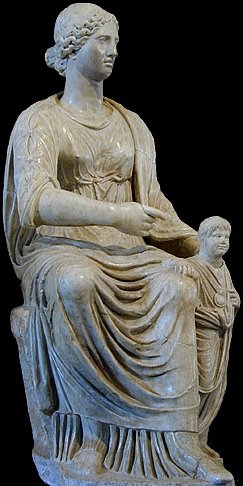 Mom doesn't want the kids just to visit on Christmas, Easter, and maybe Mother's Day. She'd like to have every one of us around all the time. All the good our Father brings home — reconciliation, protection, guidance, and direction — she readily shares with her family. She sets the table with the wonderful meal provided by her Firstborn Son and invites the rest of us to eat and drink. She misses the kids when they're too busy with other stuff to even drop by for a couple hours each week.
Like any good parent, Mother wants us to grow up. Unlike most parents, she doesn't want us to move out. Instead, she wants us to bring up our own families within the family the she's been raising with our Father. Another mouth to feed? No problem! Huge loads of soiled linens? Bring 'em on! Like Father, like Mother: She insists you behave yourself, yet she's always ready to forgive you when you don't.
So, how are you and Mom getting along? Even if it's been a while, she's always glad to see you. Just don't try to fool yourself into thinking that as long as you and Father are on good terms, you can forget about her. You see, they go together. Disrespect and neglect of Mother is disrespect and neglect of Father.
Our Mother's place is our Father's house, and He warns us not to be "neglecting to meet together, as is the habit of some" but rather to cherish and seek out every opportunity to join the rest of the family in encouraging "one another to love and good works. (Hebrews 10:24-25)" Unlike our American secular holiday, the Lord's Day comes around every week — and each new Lord's Day also brings a fresh Mother's Day. With it comes a fresh opportunity to join with our Mother — and all our brothers and sisters — to celebrate our family, to have our dirty clothes replaced with the clean robes of righteousness, to have our spiritual hunger nourished and our need for communion and community met.
One last thing to consider — I remember asking my dad, "If you get Father's Day and Mom gets Mother's Day, why isn't there a Kids' Day?" Echoing who knows how many parents before him, Dad said, "Every day is Children's Day." For the Christian, this is especially true. Every day we live in our Father's grace is a blessed day for us. All our days are extra special when we spend them with our Heavenly Father, our Holy Mother, and all the rest of the family.
So this Mother's Day — and every Sunday — don't forget Mother. Bring a gift if you want; it's not required and she's happy if you just bring yourself. Come back home and rediscover how much she and Father love you.
A friend who regularly wrote love letters to and about our Mother is Emily Carder of Quicunque Vult. She teaches and regularly reminds us that all Christians — men and women, boys and girls — are "Momma's Boys." Back in 2007, she posted Celebrating Mothers. Along with it, you might also check out 2005's False Momma's Boys.
Labels: baptism, birth, church, communion, family, father, holy mother church, life, lord's supper, mother, mother's day, worship
¶ 00:10 | 0 comments |

 Born around AD 69, Saint Polycarp was a central figure in the early church. Said to be disciple of the holy evangelist and apostle Saint John, he provides a link between the first generation of believers and later Christians, including Saint Irenaeus, Bishop of Lyons, who later wrote of him. Saint Ignatius of Antioch also knew and wrote to him. His home town of Smryna (modern Izmir, Turkey) was one of the seven churches addressed in Revelation (see 2:8-11 for the details).
After serving for many years as bishop of Smyrna, Polycarp was caught up in a local persecution of Christians. While willing to be martyred, others encouraged him to flee. However, he was later arrested, tried, and executed for his faith on 23 February c. AD 156. An eyewitness narrative of his death, The Martyrdom of Polycarp, continues to encourage believers in times of persecution.
 According to the ancient records, he was tried solely on the charge of being a Christian. When the proconsul urged him to save his life by cursing Christ, he replied: "Eighty-six years I have served Him, and He never did me any wrong. How can I blaspheme my King who saved me?" According the the customary reckoning of his birth and death, this means that he must have been baptized as an infant, raised as a Christian, and lived his entire life as in the Faith. His fidelity follows the encouragement given by the Lord to the church in Smyrna in Revelation 2:10, "Be faithful unto death, and I will give you the crown of life. (ESV)"
The following prayer is recorded as his immediately prior to the fire being kindled for his martyrdom:
Lord God Almighty, Father of Your blessed and beloved Son Jesus Christ, through whom we have received knowledge of You, God of angels and hosts and all creation, and of the whole race of the upright who live in Your presence: I bless You that You have thought me worthy of this day and hour, to be numbered among the martyrs and share in the cup of Christ, for resurrection to eternal life, for soul and body in the incorruptibility of the Holy Spirit. Among them may I be accepted before You today, as a rich and acceptable sacrifice, just as You, the faithful and true God, have prepared and foreshown and brought about. For this reason and for all things I praise You, I bless You, I glorify You, through the eternal heavenly high priest Jesus Christ, Your beloved Son, through whom be glory to You, with Him and the Holy Spirit, now and for the ages to come. Amen.
Collect
O God, the maker of heaven and earth, who gave to Your venerable servant, the holy and gentle Polycarp, boldness to confess Jesus Christ as King and Savior, and steadfastness to die for the Faith, give us grace, following his example, to share the cup of Christ and rise to eternal life; through Jesus Christ our Lord, who lives and reigns with You and the Holy Spirit, one God, now and forever.
Labels: baptism, biography, church history, commemoration, hagiography, irenaeus, john, martyrdom, patristics, polycarp, smyrna, turkish history
¶ 00:00 | 0 comments |
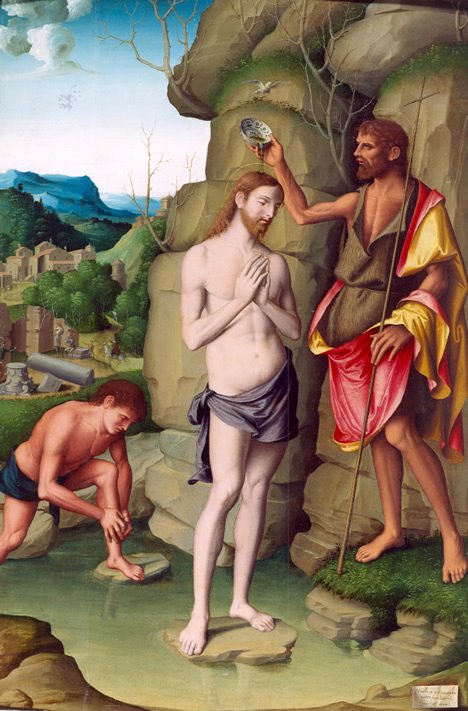 The Baptism of our Lord (Matthew 3:13-17; Mark 1:4-11; Luke 3:15-16, 21-22) is always celebrated on the first Sunday after the Epiphany. Christians remember how John baptized Jesus in the Jordan River. The Holy Spirit assumed the form of a dove and came down to rest on Jesus' head while the voice of the Father spoke from the heavens, saying, "This is my beloved Son, with whom I am well pleased. (Mark 1:11)"
His Baptism marks the first adult appearance of our Lord recorded in Holy Scripture. Prior to this day, the last we hear of Him was following His return from the temple as a twelve year old boy. Luke records, "And Jesus increased in wisdom and in stature and in favor with God and man. (2:52)"
 Following His baptism, "The Spirit immediately drove him out into the wilderness. (Mark 1:12)" There He remained for forty days of fasting and temptation by Satan. Once the time of temptation was over, Jesus entered into His public ministry as He called the disciples, worked miracles, preached and taught, forgave sins, and prepared Himself for the suffering and death awaiting Him.
With John, we might wonder why Jesus came to be baptized (see Matthew 3:14). However, Jesus told him, "It is fitting for us to fulfill all righteousness. (Matthew 3:15)" Jesus' baptism publicly marked Him as God's Anointed One (Messiah or Christ). He had nothing for which He needed to repent, so His entry into Baptism's waters was not to wash away sins. Instead, He took all the sins of mankind upon Himself. He identified Himself as one of us by being baptized and spent the rest of His earthly life fulfilling our righteousness, keeping the Law perfectly.
Lection
Series A
Psalm 29
Isaiah 42:1-9
Romans 6:1-11
Matthew 3:13-17
One Year Lectionary Cycle
Psalm 85
Joshua 3:1-3, 7-8, 13-17 or Isaiah 42:1-7
1 Corinthians 1:26-31
Matthew 3:13-17
Collect
Father in heaven, at the Baptism of Jesus in the Jordan River You proclaimed Him Your beloved Son and anointed Him with the Holy Spirit. Make all who are baptized in His name faithful in their calling as Your children and inheritors with Him of everlasting life; through the same Jesus Christ, our Lord, who lives and reigns with You and the Holy Spirit, one God, now and forever.
Labels: baptism, christ, christology, epiphany, epiphany 1, feasts, festivals, gospels, jesus, john the baptist, jordan river, messiah, synoptics
¶ 00:00 | 0 comments |
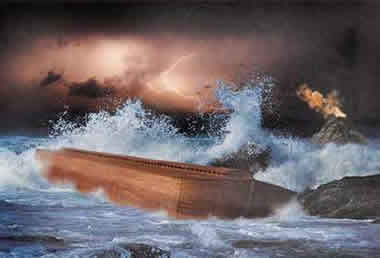 The world had become extremely corrupt, so God instructed Noah, the son of Lamech (Genesis 5:30) to build an ark to provide security for his family and selected living creatures from the waters of a devastating flood that God warned was coming. Read the entire account in (Genesis 6:1-9:17). Noah built the ark, and the flood came soon after its completion (Genesis 7). Over the next forty days and nights, the entire earth was flooded, blotting out "every living thing that was on the face of the ground, man and animals and creeping things and birds of the heavens. (7:23)"
After the flood subsided, the ark rested on the mountains of Ararat. When Noah determined it was safe, and God confirmed it, he and his family and all the animals disembarked (Genesis 8). Then Noah built an altar and offered a sacrifice to God for having saved his family from destruction. God declared a rainbow to be sign of His promise that never again would a similar flood destroy the entire earth (9:8-17).
We remember and honor Noah for his faithful obedience, as he believed that God would do what He said He would. Jesus (Matthew 24:36-39; Luke 17:22-27), Saint Peter (1 Peter 3:18-22; 2 Peter 2:4-10), and the author of Hebrews (11:7) each used Noah and the Flood as illustrations. These include God's judgment on sin, unwavering faith, a picture of Holy Baptism, and a prefiguring of Christ's suffering, death, descent into hell, and resurrection. Luke also listed Noah in Jesus' genealogy (3:36).
Lection
Psalm 29
Genesis 7:1-5, 11-12, 17-23
1 Peter 3:18-22 or Hebrews 11:1-3, 7; 12:1-2
Matthew 24:36-44
Collect
Lord God, heavenly Father, You kept Noah righteous in the midst of a sinful world and, through him, delivered life from the Flood's destruction, continuing also the human line of Your Son, our Lord Jesus Christ and foreshadowing the destruction of sin in Baptism and the preservation of new and eternal life in the Ark of the Holy Christian Church. Grant that we, the heirs of Noah by birth would likewise be heirs in faith of all Your promises, for the sake of our Lord and Savior Jesus Christ, who lives and reigns with You and the Holy Spirit, one God, now and forever. Amen.
Labels: ark, baptism, biography, christ, christology, commemoration, faith, flood, hagiography, jesus, noah, old testament
¶ 00:00 | 0 comments |
The second Sunday of May is Mother's Day here in these United States. From its origins in 19th Century feminism and pacifism, the day grew into a general celebration of motherhood — and a bonanza for greeting card companies, florists, and gift sellers looking to make a few bucks on others' holiday zeal (or guilt). I won't belabor any of these points, although if you and your mom are somehow estranged, you have no day like today to start getting in touch with her.
No, the "Mom" in the apologetic title is another mother — the Mother of all Believers. And every Sunday is chock-full of kids who should be sorry about their neglect of her the day, the week, the month, or the year(s) before. Yeah, that Mother ... Holy Mother Church, the Bride of Christ, the woman of Revelation 12 whose offspring are borne in her womb and birthed in her font.
Mom doesn't want the kids just to visit on Christmas, Easter, and maybe Mother's Day. She'd like to have every one of us around all the time. All the good our Father brings home — reconciliation, protection, guidance, and direction — she readily shares with her family. She sets the table with the wonderful meal provided by her Firstborn Son and invites the rest of us to eat and drink. She misses the kids when they're too busy with other stuff to even drop by for a couple hours each week.Like any good parent, Mother wants us to grow up. Unlike most parents, she doesn't want us to move out. Instead, she wants us to bring up our own families within the family the she's been raising with our Father. Another mouth to feed? No problem! Huge loads of soiled linens? Bring 'em on! Like Father, like Mother: She insists you behave yourself, yet she's always ready to forgive you when you don't.
So, how are you and Mom getting along? Even if it's been a while, she's always glad to see you. Just don't try to fool yourself into thinking that as long as you and Father are on good terms, you can forget about her. You see, they go together. Disrespect and neglect of Mother is disrespect and neglect of Father.
Our Mother's place is our Father's house, and He warns us not to be "neglecting to meet together, as is the habit of some" but rather to cherish and seek out every opportunity to join the rest of the family in encouraging "one another to love and good works. (Hebrews 10:24-25)" Unlike our American secular holiday, the Lord's Day comes around every week — and each new Lord's Day also brings a fresh Mother's Day. With it comes a fresh opportunity to join with our Mother — and all our brothers and sisters — to celebrate our family, to have our dirty clothes replaced with the clean robes of righteousness, to have our spiritual hunger nourished and our need for communion and community met.
One last thing to consider — I remember asking my dad, "If you get Father's Day and Mom gets Mother's Day, why isn't there a Kids' Day?" Echoing who knows how many parents before him, Dad said, "Every day is Children's Day." For the Christian, this is especially true. Every day we live in our Father's grace is a blessed day for us. All our days are extra special when we spend them with our Heavenly Father, our Holy Mother, and all the rest of the family.
So this Mother's Day — and every Sunday — don't forget Mother. Bring a gift if you want; it's not required and she's happy if you just bring yourself. Come back home and rediscover how much she and Father love you.
A friend who regularly wrote love letters to and about our Mother is Emily Carder of Quicunque Vult. She teaches and regularly reminds us that all Christians — men and women, boys and girls — are "Momma's Boys." Back in 2007, she posted Celebrating Mothers. Along with it, you might also check out 2005's False Momma's Boys.
Labels: baptism, birth, church, communion, family, father, life, lord's supper, mother, mother's day, worship
¶ 00:00 | 0 comments |
Born around AD 69, Saint Polycarp was a central figure in the early church. Said to be disciple of the holy evangelist and apostle Saint John, he provides a link between the first generation of believers and later Christians, including Saint Irenaeus, Bishop of Lyons, who later wrote of him. Saint Ignatius of Antioch also knew and wrote to him. His home town of Smryna (modern Izmir, Turkey) was one of the seven churches addressed in Revelation (see 2:8-11 for the details).After serving for many years as bishop of Smyrna, Polycarp was caught up in a local persecution of Christians. While willing to be martyred, others encouraged him to flee. However, he was later arrested, tried, and executed for his faith on 23 February c. AD 156. An eyewitness narrative of his death, The Martyrdom of Polycarp, continues to encourage believers in times of persecution.
According to the ancient records, he was tried solely on the charge of being a Christian. When the proconsul urged him to save his life by cursing Christ, he replied: "Eighty-six years I have served Him, and He never did me any wrong. How can I blaspheme my King who saved me?" According the the customary reckoning of his birth and death, this means that he must have been baptized as an infant, raised as a Christian, and lived his entire life as in the Faith. His fidelity follows the encouragement given by the Lord to the church in Smyrna in Revelation 2:10, "Be faithful unto death, and I will give you the crown of life. (ESV)"The following prayer is recorded as his immediately prior to the fire being kindled for his martyrdom:
Lord God Almighty, Father of Your blessed and beloved Son Jesus Christ, through whom we have received knowledge of You, God of angels and hosts and all creation, and of the whole race of the upright who live in Your presence: I bless You that You have thought me worthy of this day and hour, to be numbered among the martyrs and share in the cup of Christ, for resurrection to eternal life, for soul and body in the incorruptibility of the Holy Spirit. Among them may I be accepted before You today, as a rich and acceptable sacrifice, just as You, the faithful and true God, have prepared and foreshown and brought about. For this reason and for all things I praise You, I bless You, I glorify You, through the eternal heavenly high priest Jesus Christ, Your beloved Son, through whom be glory to You, with Him and the Holy Spirit, now and for the ages to come. Amen.
Collect
O God, the maker of heaven and earth, who gave to Your venerable servant, the holy and gentle Polycarp, boldness to confess Jesus Christ as King and Savior, and steadfastness to die for the Faith, give us grace, following his example, to share the cup of Christ and rise to eternal life; through Jesus Christ our Lord, who lives and reigns with You and the Holy Spirit, one God, now and forever.
Labels: baptism, biography, church history, commemoration, hagiography, irenaeus, john, martyrdom, patristics, polycarp, smyrna, turkish history
¶ 00:00 | 0 comments |
The Baptism of our Lord (Matthew 3:13-17; Mark 1:4-11; Luke 3:15-16, 21-22) is always celebrated on the first Sunday after the Epiphany. Christians remember how John baptized Jesus in the Jordan River. The Holy Spirit assumed the form of a dove and came down to rest on Jesus' head while the voice of the Father spoke from the heavens, saying, "This is my beloved Son, with whom I am well pleased. (Mark 1:11)"His Baptism marks the first adult appearance of our Lord recorded in Holy Scripture. Prior to this day, the last we hear of Him was following His return from the temple as a twelve year old boy. Luke records, "And Jesus increased in wisdom and in stature and in favor with God and man. (2:52)"
Following His baptism, "The Spirit immediately drove him out into the wilderness. (Mark 1:12)" There He remained for forty days of fasting and temptation by Satan. Once the time of temptation was over, Jesus entered into His public ministry as He called the disciples, worked miracles, preached and taught, forgave sins, and prepared Himself for the suffering and death awaiting Him.With John, we might wonder why Jesus came to be baptized (see Matthew 3:14). However, Jesus told him, "It is fitting for us to fulfill all righteousness. (Matthew 3:15)" Jesus' baptism publicly marked Him as God's Anointed One (Messiah or Christ). He had nothing for which He needed to repent, so His entry into Baptism's waters was not to wash away sins. Instead, He took all the sins of mankind upon Himself. He identified Himself as one of us by being baptized and spent the rest of His earthly life fulfilling our righteousness, keeping the Law perfectly.
Lection (Series C)
Psalm 29
Isaiah 43:1-7
Romans 6:1-11
Luke 3:15-22
Collect
Father in heaven, at the Baptism of Jesus in the Jordan River You proclaimed Him Your beloved Son and anointed Him with the Holy Spirit. Make all who are baptized in His name faithful in their calling as Your children and inheritors with Him of everlasting life; through the same Jesus Christ, our Lord, who lives and reigns with You and the Holy Spirit, one God, now and forever.
Labels: baptism, christ, christology, epiphany, epiphany 1, feasts, festivals, gospels, jesus, john the baptist
¶ 00:00 | 0 comments |
The world had become extremely corrupt, so God instructed Noah, the son of Lamech (Genesis 5:30) to build an ark to provide security for his family and selected living creatures from the waters of a devastating flood that God warned was coming. Read the entire account in (Genesis 6:1-9:17). Noah built the ark, and the flood came soon after its completion (Genesis 7). Over the next forty days and nights, the entire earth was flooded, blotting out "every living thing that was on the face of the ground, man and animals and creeping things and birds of the heavens. (7:23)"After the flood subsided, the ark rested on the mountains of Ararat. When Noah determined it was safe, and God confirmed it, he and his family and all the animals disembarked (Genesis 8). Then Noah built an altar and offered a sacrifice to God for having saved his family from destruction. God declared a rainbow to be sign of His promise that never again would a similar flood destroy the entire earth (9:8-17).
We remember and honor Noah for his faithful obedience, as he believed that God would do what He said He would. Jesus (Matthew 24:36-39; Luke 17:22-27), Saint Peter (1 Peter 3:18-22; 2 Peter 2:4-10), and the author of Hebrews (11:7) each used Noah and the Flood as illustrations. These include God's judgment on sin, unwavering faith, a picture of Holy Baptism, and a prefiguring of Christ's suffering, death, descent into hell, and resurrection. Luke also listed Noah in Jesus' genealogy (3:36).
Lection
Psalm 29
Genesis 7:1-5, 11-12, 17-23
1 Peter 3:18-22 or Hebrews 11:1-3, 7; 12:1-2
Matthew 24:36-44
Collect
Lord God, heavenly Father, You kept Noah righteous in the midst of a sinful world and, through him, delivered life from the Flood's destruction, continuing also the human line of Your Son, our Lord Jesus Christ and foreshadowing the destruction of sin in Baptism and the preservation of new and eternal life in the Ark of the Holy Christian Church. Grant that we, the heirs of Noah by birth would likewise be heirs in faith of all Your promises, for the sake of our Lord and Savior Jesus Christ, who lives and reigns with You and the Holy Spirit, one God, now and forever. Amen.
Labels: ark, baptism, biography, christ, christology, commemoration, faith, flood, hagiography, jesus, noah, old testament
¶ 00:10 | 0 comments |


