Aardvark Alley

Confessional Lutheran theology, hagiography, philosophy, music, culture, sports, education,
and whatever else is on the fevered mind of Orycteropus Afer
05 June 2017
+ Boniface of Mainz, Bishop, Missionary, and Martyr +
5 June AD 754
 The man who later became known as Saint Boniface was born around AD 670-680 at Crediton, Devonshire, England and baptized Winfrid or Wynfrith. Although he was educated, he became a monk — at that time a calling often avoided by people of learning or means. While still in England, he was ordained as a presbyter and was inspired by the example of others to become a missionary.
Upon receiving a papal commission in 719 to work in Germany, Winfrid devoted himself to starting, organizing, and reforming churches and monasteries in Hesse, Thuringia, and Bavaria. After becoming an archbishop, Boniface was assigned to the See of Mainz in 743. Ten years later he resigned his position to engage in mission work in the Netherlands.
His time of activity overlapped the period in which Pippin the Younger and Charlemagne reigned and his work of converting the Saxons to Christianity was seen as a boon for expansion of Frankish rule. Yet Boniface never operated as a pawn of the kingdom of the left hand. Instead, he balanced alliances among the Carolingians, Bavarian rulers, and the papacy and often consecrated bishops who were already his followers in order to keep others from meddling in ecclesiastical affairs.
History isn't clear as to exactly when people began calling Winfrid "Boniface," Latin for "good deeds." However, his entire life gives ample testimony to events which would lead to this appellation.
Among his most famous exploits was the felling of Thor's Oak, an ancient tree believed sacred to the Nordic and Germanic god of thunder. Accounts from the period relate that when Thor (or Donar/Donner) didn't strike him dead with a lightning bolt, the locals agreed that the Christian God was supreme and agreed to be baptized. In a practical yet also symbolic gesture, Boniface used the wood of the fallen tree in the construction of a chapel in Fritzlar.
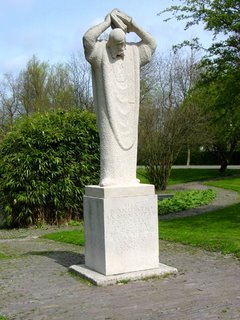
On June 5, 754, while awaiting a group of converts for confirmation, Boniface and his companions were murdered by a band of pagans in Friesland. The above picture is a commemorative statue in Dokkum, The Netherlands — a town near where he was martyred. Erected in 2004, it commemorated the 1250th anniversary of his death. Boniface is known as a great missionary and is sometimes called the "Apostle to the Germans." According to historian Christopher Dawson, no other Englishman had any greater influence upon Europe's history.
Suggested Lection
Psalm 115:1-8 or 31:1-5
Acts 20:17-28
Luke 24:44-53
Collect
Almighty God, who called Your faithful servant Boniface to be a witness and martyr in the lands of Germany and Friesland, and by his labor and suffering raised up a people for Your own possession, pour forth Your Holy Spirit upon your Church in every land, that by the service and sacrifice of many Your holy Name may be glorified and Your kingdom enlarged; through Jesus Christ our Lord, who lives and reigns with You and the Holy Spirit, one God, now and forever.


 The man who later became known as Saint Boniface was born around AD 670-680 at Crediton, Devonshire, England and baptized Winfrid or Wynfrith. Although he was educated, he became a monk — at that time a calling often avoided by people of learning or means. While still in England, he was ordained as a presbyter and was inspired by the example of others to become a missionary.
Upon receiving a papal commission in 719 to work in Germany, Winfrid devoted himself to starting, organizing, and reforming churches and monasteries in Hesse, Thuringia, and Bavaria. After becoming an archbishop, Boniface was assigned to the See of Mainz in 743. Ten years later he resigned his position to engage in mission work in the Netherlands.
His time of activity overlapped the period in which Pippin the Younger and Charlemagne reigned and his work of converting the Saxons to Christianity was seen as a boon for expansion of Frankish rule. Yet Boniface never operated as a pawn of the kingdom of the left hand. Instead, he balanced alliances among the Carolingians, Bavarian rulers, and the papacy and often consecrated bishops who were already his followers in order to keep others from meddling in ecclesiastical affairs.
History isn't clear as to exactly when people began calling Winfrid "Boniface," Latin for "good deeds." However, his entire life gives ample testimony to events which would lead to this appellation.
Among his most famous exploits was the felling of Thor's Oak, an ancient tree believed sacred to the Nordic and Germanic god of thunder. Accounts from the period relate that when Thor (or Donar/Donner) didn't strike him dead with a lightning bolt, the locals agreed that the Christian God was supreme and agreed to be baptized. In a practical yet also symbolic gesture, Boniface used the wood of the fallen tree in the construction of a chapel in Fritzlar.
On June 5, 754, while awaiting a group of converts for confirmation, Boniface and his companions were murdered by a band of pagans in Friesland. The above picture is a commemorative statue in Dokkum, The Netherlands — a town near where he was martyred. Erected in 2004, it commemorated the 1250th anniversary of his death. Boniface is known as a great missionary and is sometimes called the "Apostle to the Germans." According to historian Christopher Dawson, no other Englishman had any greater influence upon Europe's history.
Suggested Lection
Psalm 115:1-8 or 31:1-5
Acts 20:17-28
Luke 24:44-53
Collect
Almighty God, who called Your faithful servant Boniface to be a witness and martyr in the lands of Germany and Friesland, and by his labor and suffering raised up a people for Your own possession, pour forth Your Holy Spirit upon your Church in every land, that by the service and sacrifice of many Your holy Name may be glorified and Your kingdom enlarged; through Jesus Christ our Lord, who lives and reigns with You and the Holy Spirit, one God, now and forever.
Labels: biography, boniface, charlemagne, commemoration, friesland, german history, hagiography, martyrdom, missionary, saxony, two kingdoms
¶ 00:00 | 0 comments |
05 June 2016
+ Boniface of Mainz, Bishop, Missionary, and Martyr +
5 June AD 754
The man who later became known as Saint Boniface was born around AD 670-680 at Crediton, Devonshire, England and baptized Winfrid or Wynfrith. Although he was educated, he became a monk — at that time a calling often avoided by people of learning or means. While still in England, he was ordained as a presbyter and was inspired by the example of others to become a missionary.
Upon receiving a papal commission in 719 to work in Germany, Winfrid devoted himself to starting, organizing, and reforming churches and monasteries in Hesse, Thuringia, and Bavaria. After becoming an archbishop, Boniface was assigned to the See of Mainz in 743. Ten years later he resigned his position to engage in mission work in the Netherlands.
His time of activity overlapped the period in which Pippin the Younger and Charlemagne reigned and his work of converting the Saxons to Christianity was seen as a boon for expansion of Frankish rule. Yet Boniface never operated as a pawn of the kingdom of the left hand. Instead, he balanced alliances among the Carolingians, Bavarian rulers, and the papacy and often consecrated bishops who were already his followers in order to keep others from meddling in ecclesiastical affairs.
History isn't clear as to exactly when people began calling Winfrid "Boniface," Latin for "good deeds." However, his entire life gives ample testimony to events which would lead to this appellation.
Among his most famous exploits was the felling of Thor's Oak, an ancient tree believed sacred to the Nordic and Germanic god of thunder. Accounts from the period relate that when Thor (or Donar/Donner) didn't strike him dead with a lightning bolt, the locals agreed that the Christian God was supreme and agreed to be baptized. In a practical yet also symbolic gesture, Boniface used the wood of the fallen tree in the construction of a chapel in Fritzlar.
On June 5, 754, while awaiting a group of converts for confirmation, Boniface and his companions were murdered by a band of pagans in Friesland. The above picture is a commemorative statue in Dokkum, The Netherlands — a town near where he was martyred. Erected in 2004, it commemorated the 1250th anniversary of his death. Boniface is known as a great missionary and is sometimes called the "Apostle to the Germans." According to historian Christopher Dawson, no other Englishman had any greater influence upon Europe's history.
Suggested Lection
Psalm 115:1-8 or 31:1-5
Acts 20:17-28
Luke 24:44-53
Collect
Almighty God, who called Your faithful servant Boniface to be a witness and martyr in the lands of Germany and Friesland, and by his labor and suffering raised up a people for Your own possession, pour forth Your Holy Spirit upon your Church in every land, that by the service and sacrifice of many Your holy Name may be glorified and Your kingdom enlarged; through Jesus Christ our Lord, who lives and reigns with You and the Holy Spirit, one God, now and forever.
The man who later became known as Saint Boniface was born around AD 670-680 at Crediton, Devonshire, England and baptized Winfrid or Wynfrith. Although he was educated, he became a monk — at that time a calling often avoided by people of learning or means. While still in England, he was ordained as a presbyter and was inspired by the example of others to become a missionary.Upon receiving a papal commission in 719 to work in Germany, Winfrid devoted himself to starting, organizing, and reforming churches and monasteries in Hesse, Thuringia, and Bavaria. After becoming an archbishop, Boniface was assigned to the See of Mainz in 743. Ten years later he resigned his position to engage in mission work in the Netherlands.
His time of activity overlapped the period in which Pippin the Younger and Charlemagne reigned and his work of converting the Saxons to Christianity was seen as a boon for expansion of Frankish rule. Yet Boniface never operated as a pawn of the kingdom of the left hand. Instead, he balanced alliances among the Carolingians, Bavarian rulers, and the papacy and often consecrated bishops who were already his followers in order to keep others from meddling in ecclesiastical affairs.
History isn't clear as to exactly when people began calling Winfrid "Boniface," Latin for "good deeds." However, his entire life gives ample testimony to events which would lead to this appellation.
Among his most famous exploits was the felling of Thor's Oak, an ancient tree believed sacred to the Nordic and Germanic god of thunder. Accounts from the period relate that when Thor (or Donar/Donner) didn't strike him dead with a lightning bolt, the locals agreed that the Christian God was supreme and agreed to be baptized. In a practical yet also symbolic gesture, Boniface used the wood of the fallen tree in the construction of a chapel in Fritzlar.
On June 5, 754, while awaiting a group of converts for confirmation, Boniface and his companions were murdered by a band of pagans in Friesland. The above picture is a commemorative statue in Dokkum, The Netherlands — a town near where he was martyred. Erected in 2004, it commemorated the 1250th anniversary of his death. Boniface is known as a great missionary and is sometimes called the "Apostle to the Germans." According to historian Christopher Dawson, no other Englishman had any greater influence upon Europe's history.
Suggested Lection
Psalm 115:1-8 or 31:1-5
Acts 20:17-28
Luke 24:44-53
Collect
Almighty God, who called Your faithful servant Boniface to be a witness and martyr in the lands of Germany and Friesland, and by his labor and suffering raised up a people for Your own possession, pour forth Your Holy Spirit upon your Church in every land, that by the service and sacrifice of many Your holy Name may be glorified and Your kingdom enlarged; through Jesus Christ our Lord, who lives and reigns with You and the Holy Spirit, one God, now and forever.
Labels: biography, boniface, charlemagne, commemoration, friesland, german history, hagiography, martyrdom, missionary, saxony, two kingdoms
¶ 00:00 | 0 comments |


