Aardvark Alley

Confessional Lutheran theology, hagiography, philosophy, music, culture, sports, education,
and whatever else is on the fevered mind of Orycteropus Afer
06 April 2017
+ Albrecht Dürer and Lucas Cranach +
6 April AD 1528
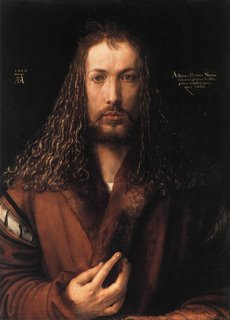 Albrecht Dürer (1471-1528), a native of Nuernberg, Germany, was one of the most learned of Renaissance artists and ranked among the great minds of Humanism. His paintings and woodcuts include examples of the splendor of creation and skilled portrayals of biblical narratives.
While great beauty and form characterize his paintings, most know him best for his woodcuts and etchings, often produced in extended series format. The Concordia Historical Institute displayed two of these series in one show: His "Life of Mary" and "Small Passion" were shown in an exhibit entitled A Sword Will Pierce Your Own Soul Too. CHI made digital copies of the individual works and they may be viewed by following the link.
Dürer never renounced Roman Catholicism, although his later writings and paintings show great sympathy toward the Reformation and ardent admiration for Martin Luther.
16 October AD 1553
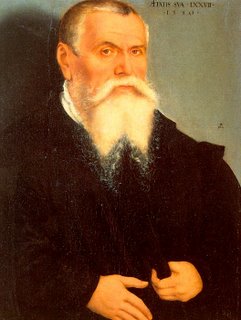 Lucas Cranach (1472-1553), a close friend of Martin Luther, was a celebrated painter of portraits and altar pieces and a producer of woodcuts of religious subjects.
Among his portraits are some of the most noted depictions of Martin and Katy Luther and Luther's co-worker Philipp Melanchthon. He also did a number of works from Greco-Roman mythology, Biblical and hagiographic scenes, and portrayed a number of wealthy people from his time.
Among his most noted works is the altarpiece from Weimar, often thought to have been completed by his son, Lucas Cranach the Younger. The painting depicts Old and New Testament themes centering on Law and Gospel and on the crucifixion and resurrection of Christ. Cranach's intentional anachronism of including himself, Martin Luther, and John the Baptizer at the foot of the cross shows how the Church always points to Christ and benefits from His suffering and death.
Some later scholars have tried to depict Cranach as a misogynist. However, examination of his writings and the content of his paintings allows little credence for this theory.
Both Cranach and Dürer are remembered and honored for the grandeur of their works of art that depict the glory and majesty and the grace and mercy of the triune God. Along with these two Germans, I've also included their approximate contemporary from Italy, Michelangelo Buonarroti. He also used his talents to illustrate Scripture's story and God's glory.
18 February AD 1564
 During roughly the same time that Cranach and Dürer worked in Germany, Florentine artist Michelangelo Buonarroti (1475-1564) was busy in Italy. By age 21, he'd already carved his famous Pietà, a scene of the Virgin holding her dead Son before His burial. Most will probably know him from his statue of David and his work in the Sistine Chapel.
The picture here is from his "Last Judgment" fresco; the person portrayed is Saint Bartholomew, holding the knife said to have flayed him in one hand and his peeled skin in the other. I include it because the face of the restored saint is a self-portrait by Michelangelo. Many have speculated as to why he chose this particular person to bear his image. Some think he used it to indict those who criticized him, as if to say, "You can cut away at me now, but I will be vindicated." Others believe that he wrestled throughout his life with temptation and sinful behavior but recognized that in the Resurrection he would be remade.
Collect
O God, who by your Holy Spirit give to some the word of wisdom, to others the word of knowledge, and to others the word of faith, we praise You for the gifts of proclaiming Your grace and glory through visual representation that you gave to your servants Albrecht and Lucas [and Michelangelo], and we pray that Your Church may never be destitute of such gifts; through Jesus Christ our Lord, who lives and reigns with You and the Holy Spirit, one God, now and forever.


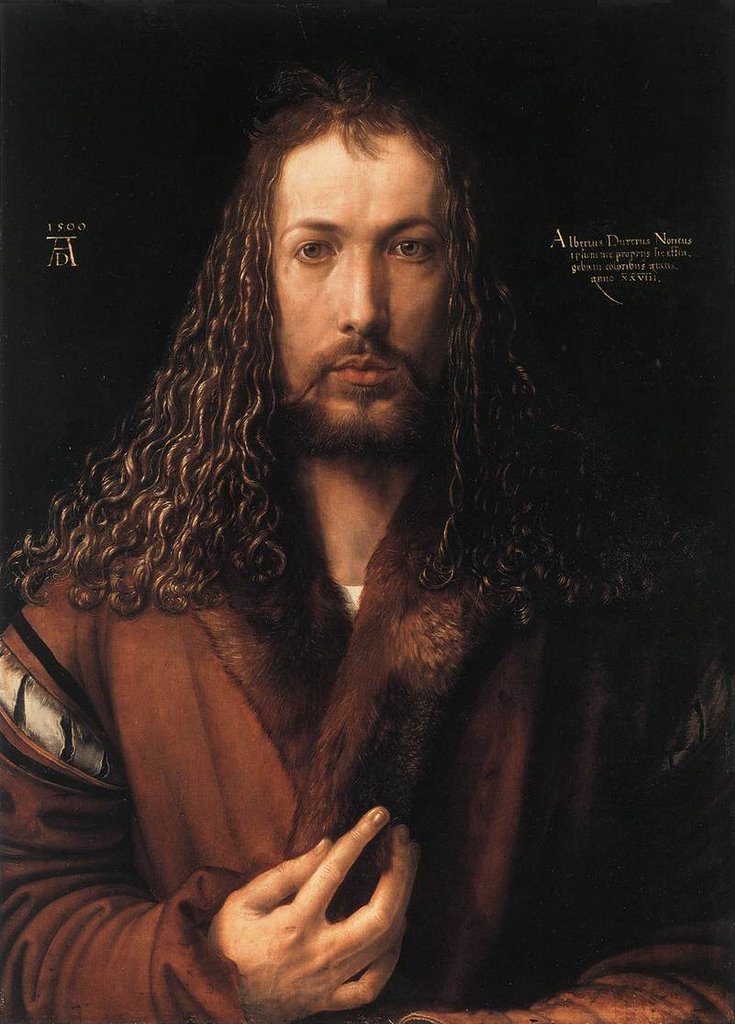 Albrecht Dürer (1471-1528), a native of Nuernberg, Germany, was one of the most learned of Renaissance artists and ranked among the great minds of Humanism. His paintings and woodcuts include examples of the splendor of creation and skilled portrayals of biblical narratives.
While great beauty and form characterize his paintings, most know him best for his woodcuts and etchings, often produced in extended series format. The Concordia Historical Institute displayed two of these series in one show: His "Life of Mary" and "Small Passion" were shown in an exhibit entitled A Sword Will Pierce Your Own Soul Too. CHI made digital copies of the individual works and they may be viewed by following the link.
Dürer never renounced Roman Catholicism, although his later writings and paintings show great sympathy toward the Reformation and ardent admiration for Martin Luther.
16 October AD 1553
 Lucas Cranach (1472-1553), a close friend of Martin Luther, was a celebrated painter of portraits and altar pieces and a producer of woodcuts of religious subjects.
Among his portraits are some of the most noted depictions of Martin and Katy Luther and Luther's co-worker Philipp Melanchthon. He also did a number of works from Greco-Roman mythology, Biblical and hagiographic scenes, and portrayed a number of wealthy people from his time.
Among his most noted works is the altarpiece from Weimar, often thought to have been completed by his son, Lucas Cranach the Younger. The painting depicts Old and New Testament themes centering on Law and Gospel and on the crucifixion and resurrection of Christ. Cranach's intentional anachronism of including himself, Martin Luther, and John the Baptizer at the foot of the cross shows how the Church always points to Christ and benefits from His suffering and death.
Some later scholars have tried to depict Cranach as a misogynist. However, examination of his writings and the content of his paintings allows little credence for this theory.
Both Cranach and Dürer are remembered and honored for the grandeur of their works of art that depict the glory and majesty and the grace and mercy of the triune God. Along with these two Germans, I've also included their approximate contemporary from Italy, Michelangelo Buonarroti. He also used his talents to illustrate Scripture's story and God's glory.
18 February AD 1564
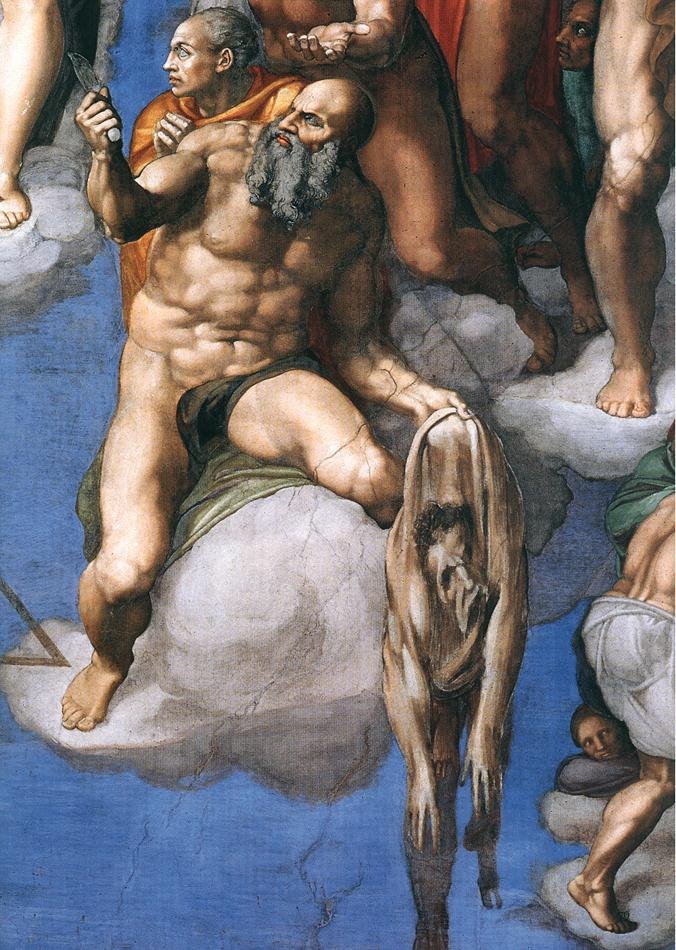 During roughly the same time that Cranach and Dürer worked in Germany, Florentine artist Michelangelo Buonarroti (1475-1564) was busy in Italy. By age 21, he'd already carved his famous Pietà, a scene of the Virgin holding her dead Son before His burial. Most will probably know him from his statue of David and his work in the Sistine Chapel.
The picture here is from his "Last Judgment" fresco; the person portrayed is Saint Bartholomew, holding the knife said to have flayed him in one hand and his peeled skin in the other. I include it because the face of the restored saint is a self-portrait by Michelangelo. Many have speculated as to why he chose this particular person to bear his image. Some think he used it to indict those who criticized him, as if to say, "You can cut away at me now, but I will be vindicated." Others believe that he wrestled throughout his life with temptation and sinful behavior but recognized that in the Resurrection he would be remade.
Collect
O God, who by your Holy Spirit give to some the word of wisdom, to others the word of knowledge, and to others the word of faith, we praise You for the gifts of proclaiming Your grace and glory through visual representation that you gave to your servants Albrecht and Lucas [and Michelangelo], and we pray that Your Church may never be destitute of such gifts; through Jesus Christ our Lord, who lives and reigns with You and the Holy Spirit, one God, now and forever.
Labels: art, biography, church history, commemoration, cranach, duerer, durer, dürer, european history, german history, hagiography, italian history, michelangelo, vocation
¶ 00:00 | 0 comments |
13 December 2016
+ Lucia of Syracuse, Martyr +
13 December AD 304
 Lucia (also Lucy or Lukia) was one of the victims of the great persecution under the Roman emperor Diocletian. She met her death at Syracuse on the island of Sicily because of her Christian faith. Known for her charity, "Santa Lucia" (as she is called in Italy) gave away her dowry and remained a virgin until her execution by the sword. Some accounts, similar to those surrounding Saint Polycarp, claim that Lucy was first sentenced to be burned and that when this failed, she was stabbed to death.
Various stories are told about her. Some claim that she refused to marry a pagan and was killed; others say that forfeiting her dowry led her unbelieving fiancé to denounce her to the authorities as a Christian. Another account tells us that either during or at a time before her execution, her eyes were gouged out but that God restored her sight.
 The name Lucia means "light." Because of that, festivals of light held in her honor became popular throughout Europe, especially in the Scandinavian countries. There, her feast day corresponds with the time of year when there is the least amount of daylight. Under the Julian Calendar, her feast day actually fell on the shortest, darkest day of the year but this connection vanished with adoption of the Gregorian Calendar.
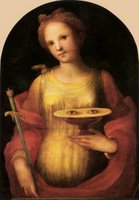
Ecclesiastical art often portrays Saint Lucia holding a palm branch, the traditional sign of victory or martyrdom; a sword may also be shown piercing her breast or throat. Sometimes, as in the pictures above, we see her holding her missing eyes in her hand or on a plate before her.
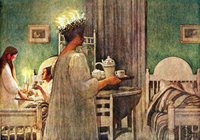 Another common portrayal has the saint dressed in a white baptismal gown, wearing a wreath of candles upon her head. In many Nordic homes, this attire is mimicked on her feast day. One of the girls or women of a household, often the eldest daughter, wakes early on Lucy's feast day, prepares a special breakfast, dons a headpiece of candles, and moves through the home with the meal honoring the saint.
Lucy's name was applied to various people and places in the centuries following her death. Among the most noted would be the Santa Lucia area of Naples, celebrated in the Neapolitan song Santa Lucia. The tune calls Lucy's namesake area impero dell'armonia (the empire of harmony).
Agatha, 5 February AD 290
With Lucy, the Church sometimes also honors the virgin martyr Agatha. She came from Catania in Sicily, and was most likely martyred in the late 200s. Aside from her name on the lists of early martyrs, we know nothing of her.
Lection
Psalm 65:1-8
Deuteronomy 33:1-3
Revelation 7:2-17
Matthew 5:1-12
Collect
O Almighty God, by whose grace and power Your holy martyr(s) Lucy (and Agatha) triumphed over suffering and was (were) faithful even unto death, grant us, who now remember her (them) with thanksgiving, to be so faithful in our witness to You in this world, that we may receive with her (them) the crown of life; through Jesus Christ our Lord, who lives and reigns with You and the Holy Spirit, one God, forever and ever.
Hymn Stanza
For holy martyr Lucy, Who faced the tyrant's sword
And through her death gave witness, We praise Your name, O Lord.
Your light she showed in darkness; May we thus also shine
Until, our struggles ended, We see Your face divine.
Hymn text © 2006 by Walter P. Snyder. Permission granted for use with proper attestation.
 Lucia (also Lucy or Lukia) was one of the victims of the great persecution under the Roman emperor Diocletian. She met her death at Syracuse on the island of Sicily because of her Christian faith. Known for her charity, "Santa Lucia" (as she is called in Italy) gave away her dowry and remained a virgin until her execution by the sword. Some accounts, similar to those surrounding Saint Polycarp, claim that Lucy was first sentenced to be burned and that when this failed, she was stabbed to death.
Various stories are told about her. Some claim that she refused to marry a pagan and was killed; others say that forfeiting her dowry led her unbelieving fiancé to denounce her to the authorities as a Christian. Another account tells us that either during or at a time before her execution, her eyes were gouged out but that God restored her sight.
 The name Lucia means "light." Because of that, festivals of light held in her honor became popular throughout Europe, especially in the Scandinavian countries. There, her feast day corresponds with the time of year when there is the least amount of daylight. Under the Julian Calendar, her feast day actually fell on the shortest, darkest day of the year but this connection vanished with adoption of the Gregorian Calendar.
Ecclesiastical art often portrays Saint Lucia holding a palm branch, the traditional sign of victory or martyrdom; a sword may also be shown piercing her breast or throat. Sometimes, as in the pictures above, we see her holding her missing eyes in her hand or on a plate before her.
 Another common portrayal has the saint dressed in a white baptismal gown, wearing a wreath of candles upon her head. In many Nordic homes, this attire is mimicked on her feast day. One of the girls or women of a household, often the eldest daughter, wakes early on Lucy's feast day, prepares a special breakfast, dons a headpiece of candles, and moves through the home with the meal honoring the saint.
Lucy's name was applied to various people and places in the centuries following her death. Among the most noted would be the Santa Lucia area of Naples, celebrated in the Neapolitan song Santa Lucia. The tune calls Lucy's namesake area impero dell'armonia (the empire of harmony).
Agatha, 5 February AD 290
With Lucy, the Church sometimes also honors the virgin martyr Agatha. She came from Catania in Sicily, and was most likely martyred in the late 200s. Aside from her name on the lists of early martyrs, we know nothing of her.
Lection
Psalm 65:1-8
Deuteronomy 33:1-3
Revelation 7:2-17
Matthew 5:1-12
Collect
O Almighty God, by whose grace and power Your holy martyr(s) Lucy (and Agatha) triumphed over suffering and was (were) faithful even unto death, grant us, who now remember her (them) with thanksgiving, to be so faithful in our witness to You in this world, that we may receive with her (them) the crown of life; through Jesus Christ our Lord, who lives and reigns with You and the Holy Spirit, one God, forever and ever.
Hymn Stanza
For holy martyr Lucy, Who faced the tyrant's sword
And through her death gave witness, We praise Your name, O Lord.
Your light she showed in darkness; May we thus also shine
Until, our struggles ended, We see Your face divine.
Hymn text © 2006 by Walter P. Snyder. Permission granted for use with proper attestation.
Labels: agatha, biography, church history, commemoration, diocletian, european history, italian history, light, lucia, lucy hagiography, martyrdom, roman empire, scandanavia
¶ 00:00 | 0 comments |
06 April 2016
+ Albrecht Dürer and Lucas Cranach +
6 April AD 1528
Albrecht Dürer (1471-1528), a native of Nuernberg, Germany, was one of the most learned of Renaissance artists and ranked among the great minds of Humanism. His paintings and woodcuts include examples of the splendor of creation and skilled portrayals of biblical narratives.
While great beauty and form characterize his paintings, most know him best for his woodcuts and etchings, often produced in extended series format. The Concordia Historical Institute displayed two of these series in one show: His "Life of Mary" and "Small Passion" were shown in an exhibit entitled A Sword Will Pierce Your Own Soul Too. CHI made digital copies of the individual works and they may be viewed by following the link.
Dürer never renounced Roman Catholicism, although his later writings and paintings show great sympathy toward the Reformation and ardent admiration for Martin Luther.
16 October AD 1553
Lucas Cranach (1472-1553), a close friend of Martin Luther, was a celebrated painter of portraits and altar pieces and a producer of woodcuts of religious subjects.
Among his portraits are some of the most noted depictions of Martin and Katy Luther and Luther's co-worker Philipp Melanchthon. He also did a number of works from Greco-Roman mythology, Biblical and hagiographic scenes, and portrayed a number of wealthy people from his time.
Among his most noted works is the altarpiece from Weimar, often thought to have been completed by his son, Lucas Cranach the Younger. The painting depicts Old and New Testament themes centering on Law and Gospel and on the crucifixion and resurrection of Christ. Cranach's intentional anachronism of including himself, Martin Luther, and John the Baptizer at the foot of the cross shows how the Church always points to Christ and benefits from His suffering and death.
Some later scholars have tried to depict Cranach as a misogynist. However, examination of his writings and the content of his paintings allows little credence for this theory.
Both Cranach and Dürer are remembered and honored for the grandeur of their works of art that depict the glory and majesty and the grace and mercy of the triune God. Along with these two Germans, I've also included their approximate contemporary from Italy, Michelangelo Buonarroti. He also used his talents to illustrate Scripture's story and God's glory.
18 February AD 1564
During roughly the same time that Cranach and Dürer worked in Germany, Florentine artist Michelangelo Buonarroti (1475-1564) was busy in Italy. By age 21, he'd already carved his famous Pietà, a scene of the Virgin holding her dead Son before His burial. Most will probably know him from his statue of David and his work in the Sistine Chapel.
The picture here is from his "Last Judgment" fresco; the person portrayed is Saint Bartholomew, holding the knife said to have flayed him in one hand and his peeled skin in the other. I include it because the face of the restored saint is a self-portrait by Michelangelo. Many have speculated as to why he chose this particular person to bear his image. Some think he used it to indict those who criticized him, as if to say, "You can cut away at me now, but I will be vindicated." Others believe that he wrestled throughout his life with temptation and sinful behavior but recognized that in the Resurrection he would be remade.
Collect
O God, who by your Holy Spirit give to some the word of wisdom, to others the word of knowledge, and to others the word of faith, we praise You for the gifts of proclaiming Your grace and glory through visual representation that you gave to your servants Albrecht and Lucas [and Michelangelo], and we pray that Your Church may never be destitute of such gifts; through Jesus Christ our Lord, who lives and reigns with You and the Holy Spirit, one God, now and forever.
Albrecht Dürer (1471-1528), a native of Nuernberg, Germany, was one of the most learned of Renaissance artists and ranked among the great minds of Humanism. His paintings and woodcuts include examples of the splendor of creation and skilled portrayals of biblical narratives.While great beauty and form characterize his paintings, most know him best for his woodcuts and etchings, often produced in extended series format. The Concordia Historical Institute displayed two of these series in one show: His "Life of Mary" and "Small Passion" were shown in an exhibit entitled A Sword Will Pierce Your Own Soul Too. CHI made digital copies of the individual works and they may be viewed by following the link.
Dürer never renounced Roman Catholicism, although his later writings and paintings show great sympathy toward the Reformation and ardent admiration for Martin Luther.
16 October AD 1553
Lucas Cranach (1472-1553), a close friend of Martin Luther, was a celebrated painter of portraits and altar pieces and a producer of woodcuts of religious subjects.Among his portraits are some of the most noted depictions of Martin and Katy Luther and Luther's co-worker Philipp Melanchthon. He also did a number of works from Greco-Roman mythology, Biblical and hagiographic scenes, and portrayed a number of wealthy people from his time.
Among his most noted works is the altarpiece from Weimar, often thought to have been completed by his son, Lucas Cranach the Younger. The painting depicts Old and New Testament themes centering on Law and Gospel and on the crucifixion and resurrection of Christ. Cranach's intentional anachronism of including himself, Martin Luther, and John the Baptizer at the foot of the cross shows how the Church always points to Christ and benefits from His suffering and death.
Some later scholars have tried to depict Cranach as a misogynist. However, examination of his writings and the content of his paintings allows little credence for this theory.
Both Cranach and Dürer are remembered and honored for the grandeur of their works of art that depict the glory and majesty and the grace and mercy of the triune God. Along with these two Germans, I've also included their approximate contemporary from Italy, Michelangelo Buonarroti. He also used his talents to illustrate Scripture's story and God's glory.
18 February AD 1564
During roughly the same time that Cranach and Dürer worked in Germany, Florentine artist Michelangelo Buonarroti (1475-1564) was busy in Italy. By age 21, he'd already carved his famous Pietà, a scene of the Virgin holding her dead Son before His burial. Most will probably know him from his statue of David and his work in the Sistine Chapel.The picture here is from his "Last Judgment" fresco; the person portrayed is Saint Bartholomew, holding the knife said to have flayed him in one hand and his peeled skin in the other. I include it because the face of the restored saint is a self-portrait by Michelangelo. Many have speculated as to why he chose this particular person to bear his image. Some think he used it to indict those who criticized him, as if to say, "You can cut away at me now, but I will be vindicated." Others believe that he wrestled throughout his life with temptation and sinful behavior but recognized that in the Resurrection he would be remade.
Collect
O God, who by your Holy Spirit give to some the word of wisdom, to others the word of knowledge, and to others the word of faith, we praise You for the gifts of proclaiming Your grace and glory through visual representation that you gave to your servants Albrecht and Lucas [and Michelangelo], and we pray that Your Church may never be destitute of such gifts; through Jesus Christ our Lord, who lives and reigns with You and the Holy Spirit, one God, now and forever.
Labels: art, biography, church history, commemoration, cranach, duerer, durer, dürer, european history, german history, hagiography, italian history, michelangelo, vocation
¶ 00:00 | 0 comments |
13 December 2015
+ Lucia of Syracuse, Martyr +
13 December AD 304
Lucia (also Lucy or Lukia) was one of the victims of the great persecution under the Roman emperor Diocletian. She met her death at Syracuse on the island of Sicily because of her Christian faith. Known for her charity, "Santa Lucia" (as she is called in Italy) gave away her dowry and remained a virgin until her execution by the sword. Some accounts, similar to those surrounding Saint Polycarp, claim that Lucy was first sentenced to be burned and that when this failed, she was stabbed to death.
Various stories are told about her. Some claim that she refused to marry a pagan and was killed; others say that forfeiting her dowry led her unbelieving fiancé to denounce her to the authorities as a Christian. Another account tells us that either during or at a time before her execution, her eyes were gouged out but that God restored her sight.
The name Lucia means "light." Because of that, festivals of light held in her honor became popular throughout Europe, especially in the Scandinavian countries. There, her feast day corresponds with the time of year when there is the least amount of daylight. Under the Julian Calendar, her feast day actually fell on the shortest, darkest day of the year but this connection vanished with adoption of the Gregorian Calendar.
Ecclesiastical art often portrays Saint Lucia holding a palm branch, the traditional sign of victory or martyrdom; a sword may also be shown piercing her breast or throat. Sometimes, as in the pictures above, we see her holding her missing eyes in her hand or on a plate before her.
Another common portrayal has the saint dressed in a white baptismal gown, wearing a wreath of candles upon her head. In many Nordic homes, this attire is mimicked on her feast day. One of the girls or women of a household, often the eldest daughter, wakes early on Lucy's feast day, prepares a special breakfast, dons a headpiece of candles, and moves through the home with the meal honoring the saint.
Lucy's name was applied to various people and places in the centuries following her death. Among the most noted would be the Santa Lucia area of Naples, celebrated in the Neapolitan song Santa Lucia. The tune calls Lucy's namesake area impero dell'armonia (the empire of harmony).
Agatha, 5 February AD 290
With Lucy, the Church sometimes also honors the virgin martyr Agatha. She came from Catania in Sicily, and was most likely martyred in the late 200s. Aside from her name on the lists of early martyrs, we know nothing of her.
Lection
Psalm 65:1-8
Deuteronomy 33:1-3
Revelation 7:2-17
Matthew 5:1-12
Collect
O Almighty God, by whose grace and power Your holy martyr(s) Lucy (and Agatha) triumphed over suffering and was (were) faithful even unto death, grant us, who now remember her (them) with thanksgiving, to be so faithful in our witness to You in this world, that we may receive with her (them) the crown of life; through Jesus Christ our Lord, who lives and reigns with You and the Holy Spirit, one God, forever and ever.
Hymn Stanza
For holy martyr Lucy, Who faced the tyrant's sword
And through her death gave witness, We praise Your name, O Lord.
Your light she showed in darkness; May we thus also shine
Until, our struggles ended, We see Your face divine.
Hymn text © 2006 by Walter P. Snyder. Permission granted for use with proper attestation.
Lucia (also Lucy or Lukia) was one of the victims of the great persecution under the Roman emperor Diocletian. She met her death at Syracuse on the island of Sicily because of her Christian faith. Known for her charity, "Santa Lucia" (as she is called in Italy) gave away her dowry and remained a virgin until her execution by the sword. Some accounts, similar to those surrounding Saint Polycarp, claim that Lucy was first sentenced to be burned and that when this failed, she was stabbed to death.Various stories are told about her. Some claim that she refused to marry a pagan and was killed; others say that forfeiting her dowry led her unbelieving fiancé to denounce her to the authorities as a Christian. Another account tells us that either during or at a time before her execution, her eyes were gouged out but that God restored her sight.
The name Lucia means "light." Because of that, festivals of light held in her honor became popular throughout Europe, especially in the Scandinavian countries. There, her feast day corresponds with the time of year when there is the least amount of daylight. Under the Julian Calendar, her feast day actually fell on the shortest, darkest day of the year but this connection vanished with adoption of the Gregorian Calendar.Ecclesiastical art often portrays Saint Lucia holding a palm branch, the traditional sign of victory or martyrdom; a sword may also be shown piercing her breast or throat. Sometimes, as in the pictures above, we see her holding her missing eyes in her hand or on a plate before her.
Another common portrayal has the saint dressed in a white baptismal gown, wearing a wreath of candles upon her head. In many Nordic homes, this attire is mimicked on her feast day. One of the girls or women of a household, often the eldest daughter, wakes early on Lucy's feast day, prepares a special breakfast, dons a headpiece of candles, and moves through the home with the meal honoring the saint.Lucy's name was applied to various people and places in the centuries following her death. Among the most noted would be the Santa Lucia area of Naples, celebrated in the Neapolitan song Santa Lucia. The tune calls Lucy's namesake area impero dell'armonia (the empire of harmony).
Agatha, 5 February AD 290
With Lucy, the Church sometimes also honors the virgin martyr Agatha. She came from Catania in Sicily, and was most likely martyred in the late 200s. Aside from her name on the lists of early martyrs, we know nothing of her.
Lection
Psalm 65:1-8
Deuteronomy 33:1-3
Revelation 7:2-17
Matthew 5:1-12
Collect
O Almighty God, by whose grace and power Your holy martyr(s) Lucy (and Agatha) triumphed over suffering and was (were) faithful even unto death, grant us, who now remember her (them) with thanksgiving, to be so faithful in our witness to You in this world, that we may receive with her (them) the crown of life; through Jesus Christ our Lord, who lives and reigns with You and the Holy Spirit, one God, forever and ever.
Hymn Stanza
For holy martyr Lucy, Who faced the tyrant's sword
And through her death gave witness, We praise Your name, O Lord.
Your light she showed in darkness; May we thus also shine
Until, our struggles ended, We see Your face divine.
Hymn text © 2006 by Walter P. Snyder. Permission granted for use with proper attestation.
Labels: agatha, biography, church history, commemoration, diocletian, european history, italian history, light, lucia, lucy hagiography, martyrdom, roman empire, scandanavia
¶ 00:00 | 0 comments |


