
 Samuel was the final Old Testament judge. Besides Deborah and an anonymous man in Judges 6:7-10, he is the first prophet mentioned after Moses, although we could consider some of the other judges among the prophets. He lived during the 11th century B.C. Samuel's mother Hannah was unable to have children and she prayed desperately before the tabernacle that the Lord would grant her to bear children to her husband Elkanah, an Ephraimite. Because the Lord heard and answered, Hannah called her son "Samuel," which can be translated "heard by God." This account is in the first chapter of 1 Samuel.
In response to God's love for them, Samuel's parents dedicated him to the Lord's service: "And when she had weaned him, she took him up with her, along with a three-year-old bull, an ephah of flour, and a skin of wine, and she brought him to the house of the Lord at Shiloh. And the child was young. Then they slaughtered the bull, and they brought the child to Eli [the priest in the Lord's house]. And she said, 'Oh, my lord! As you live, my lord, I am the woman who was standing here in your presence, praying to the Lord. For this child I prayed, and the Lord has granted me my petition that I made to him. Therefore I have lent him to the Lord. As long as he lives, he is lent to the Lord.' (1:24-28)" He entered sacred service and trained in the house of the Lord at Shiloh under Eli.
 God called Samuel to speak for Him in a series of night messages and established him as His prophet. One of Samuel's most difficult assignments came immediately after his call. Eli was allowing his sons to abuse their priestly offices and through the young man, the Lord condemned their behavior and pronounced God's judgment upon them (see chapter 3).
Samuel's own life didn't always go smoothly. Just as Eli's sons had betrayed their sacred trust as priests, so also "Joel and ... Abijah ..." the sons of Samuel, became unrighteous judges who "took bribes and perverted justice. (8:1-3)" Perceiving this as a problem in God's leadership as well as that of Samuel, Israel demanded that they be given a king such as the surrounding nations had. Samuel warned them that this would lead to even more problems and woes, but when they kept insisting, the Lord told him to do as the people requested.
Samuel anointed Saul to be Israel's first king (10:1). Because of Saul's continuing, flagrant disregard for God's Word, Samuel repudiated Saul's leadership and traveled to the house of Jesse, where he anointed David to be king in place of Saul (16:13).
Samuel's loyalty to God, his spiritual insight, and his ability to inspire others made him one of Israel's great leaders. When he died, "all Israel assembled and mourned for him, and they buried him in his house at Ramah. (25:1a)"
For more on this man of God, see an earlier post that focuses on a series of deceiving appearances in his life.
Labels: biography, commemoration, david, eli, hagiography, hannah, israel, judges, old testament, prophet, samuel, saul
¶ 00:00 | 23 comments |

 If any part of Scripture besides the Resurrection clearly indicates that God gets the last laugh, it must be the story of Isaac.
After giving new names to Abraham and Sarah, the Lord promised a them a son. At the time, Abraham was 99 and Sarah was 90 (see Genesis 17). When Abraham heard the news, he "fell on his face and laughed and said to himself, 'Shall a child be born to a man who is a hundred years old? Shall Sarah, who is ninety years old, bear a child?' (v. 17)"
In response to the laughter and doubting, the Lord said, "Sarah your wife shall bear you a son, and you shall call his name Isaac. I will establish my covenant with him as an everlasting covenant for his offspring after him. (v. 19)" Isaac means "He Laughs."
To reiterate His point, the Lord allowed Sarah to overhear Him repeat His promise to Abraham at the Oaks of Mamre (see Genesis 18). "So Sarah laughed to herself, saying, 'After I am worn out, and my lord is old, shall I have pleasure?' The Lord said to Abraham, 'Why did Sarah laugh and say, "Shall I indeed bear a child, now that I am old?" Is anything too hard for the Lord? At the appointed time I will return to you about this time next year, and Sarah shall have a son.' But Sarah denied it, saying, 'I did not laugh,' for she was afraid. He said, 'No, but you did laugh.' (vv. 12-15)"
Sure enough, things happened not as Abraham and Sarah may have expected, but as the Lord had planned and promised. When Abraham was 100 years old, Sarah gave birth and "Abraham called the name of his son who was born to him, whom Sarah bore him, Isaac. (21:3)" Sarah likewise reveled in the irony: "God has made laughter for me; everyone who hears will laugh over me. (v. 6)"
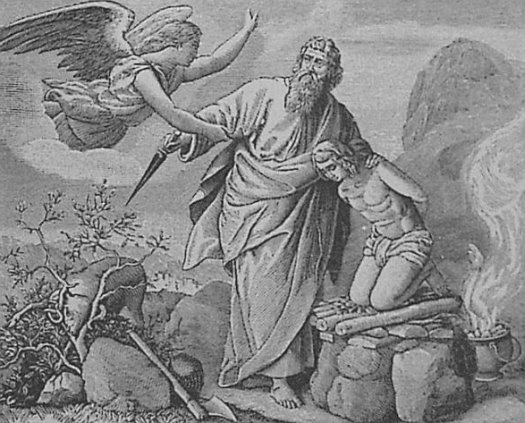
 When Isaac was a young man, Abraham took him to Mount Moriah. There, Abraham, obeying God's command, prepared to sacrifice his son as a burnt offering. But God intervened, sparing Isaac's life and providing a ram as a substitute offering (22:1-14).
In so doing, God also pointed to the substitutionary sacrifice of His own Son Jesus Christ for the sins of the world. When the author of Hebrews expounded on the faith of Abraham (11:8-19), he made special note of Abraham's belief that, in order to accomplish His purposes, "God was able even to raise [Isaac] from the dead, from which, figuratively speaking, he did receive him back. (v. 19)"
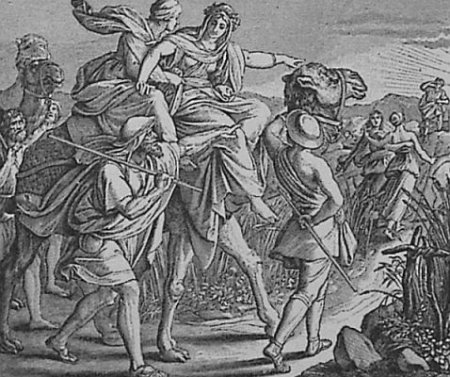
Abraham sent a faithful servant back among their kinfolk in order to find a bride for Isaac. There, the servant found Rebekah, who gladly traveled with this stranger to a new land, where she was given in marriage to Isaac (Genesis 24). They had twin sons, Esau and Jacob (25:19-26).
In his old age, Isaac became weak and blind. Before he died, he desired to give his blessing and the chief inheritance to Esau, his elder and favorite son, even though the Lord had promised Rebekah that their birth order would be reversed in the blessing and Jacob would be the favored son (25:23). However, Rebekah showed her favorite, Jacob, how to deceive his father and gain the blessing for himself (27:1-40). Of course, this resulted in years of bitter family strife, although Jacob and Esau later reconciled (Genesis 33).
Isaac lived to the age of 180 and was buried by his sons in the family burial cave of Machpelah (35:28-29).
Labels: abraham, biography, christianity, christology, commemoration, hagiography, isaac, israel, jacob, old testament, rebekah, sacrifice, sarah
¶ 00:00 | 1 comments |
 Ezekiel, the son of Buzi, was a priest, called by God to be a prophet to the exiles during the Babylonian captivity (Ezekiel 1:3). In 597 B.C. King Nebuchadnezzar and the Babylonian army brought the king of Judah and thousands of the best citizens of Jerusalem — including Ezekiel — to Babylon (2 Kings 24:8-16).
Ezekiel's priestly background profoundly stamped his prophecy, as the holiness of God and the Temple figure prominently in his messages (for example, Ezekiel 9-10 and 40-48). From 593 B.C. to the destruction of Jerusalem and the temple in 586 B.C., Ezekiel prophesied the inevitability of divine judgment on Jerusalem, on the exiles in Babylon, and on seven nations that surrounded Israel (Ezekiel 1–32). Jerusalem would certainly fall and the exiles would not quickly return — the just consequences of their sins.
Especially in the early part of the book, much of what the Lord "said" to His people was delivered in the form of action prophecies. In these, Ezekiel acted out representations of coming events pertaining to the fall of Judah, the destruction of the temple, and the seeming end of the Davidic line of kings. These action prophecies included the eating of the scroll (3:1-2), being struck with dumbness (3:22-27), sketching of the city of Jerusalem (4:1-3), lying on one side and then the other (4:4-8), eating restricted rations cooked on a fire of dried dung (4:9-17), and shaving his hair and beard with a sword before dividing the hair (5:1-4). Some seem a bit strange at first glance, once we understand their meaning and context, their messages are quite easily comprehended.
Once word reached Ezekiel that Jerusalem and the temple were destroyed, his message became one of comfort and hope. Through him God promised that his people would experience future restoration, renewal, and revival in the coming Messianic kingdom (Ezekiel 33-48).
Much of the strange symbolism of Ezekiel's prophecies was later employed in the Revelation to Saint John. Among these are the visions of the four living creatures as seen in Ezekiel 1 and Revelation 4.
See Happenings for a hymn stanza written for the Commemoration of Ezekiel.
Labels: babylonian captivity, bible, biography, christianity, christology, commemorations, ezekiel, hagiography, israel, old testament, prophet, revelation
¶ 00:00 | 0 comments |
 The prophet Elijah, whose name means, "My God is Yahweh [the Lord]," prophesied in the northern kingdom of Israel, mostly during the reign of Ahab (874 – 853 B.C.).
Ahab, under the influence of his pagan wife Jezebel, had encouraged the worship of Baal throughout his kingdom, even as Jezebel sought to get rid of the worship of Yahweh. Elijah was called by God to denounce this idolatry and to call the people of Israel back to the worship Yahweh as the only true God (as he did in 1 Kings 18:20-40).
Elijah was a rugged and imposing figure, living in the wilderness and dressing in a garment of camel's hair and a leather belt (2 Kings 1:8). He was a prophet mighty in word and deed. The Lord worked many miracles through Elijah, including the raising of the dead (1 Kings 17:17-24) and the effecting of a long drought in Israel (1 Kings 17:1).
At the end of his ministry, he was taken up into heaven as Elisha, his successor, looked on (2 Kings 2:11). Later on, the Lord proclaimed through the prophet Malachi that Elijah would return before the coming of the Messiah (Malachi 4:5-6), a prophecy that was fulfilled in the prophetic ministry of John the Baptist (see Jesus' words in Matthew 11:1-19).
See Happenings for a hymn stanza written for the Commemoration of Elijah.
Labels: 1 kings, 2 kings, ahab, biography, commemorations, elijah, elisha, hagiography, israel, jezebel, john the baptist, old testament, prophet, transfiguration
¶ 00:00 | 0 comments |
 Joseph was the son of the patriarch Jacob and Rachel — and was his father's favorite son. He incurred his older brothers' jealousy and anger (both through Jacob's favoritism and by his own attitude toward them, particularly regarding his dreams) so they sold him into slavery in Egypt and told their father he was dead (Genesis 37). In Egypt he became the chief servant in the home of Potiphar, a military official. Joseph refused to commit adultery when his master's wife tempted him. In retaliation, she unjustly accused him of attempted rape and he was imprisoned (Genesis 39).
Years later, he interpreted dreams for Pharaoh, who then freed him from prison and placed him in charge of the entire country. When his brothers came from Canaan to Egypt in search of food, they did not recognize him. He eventually revealed his identity, forgave them, and invited them and his father to live in Egypt. When Jacob blessed his sons before his death, he gave a blessing to both of Joseph's sons, Ephraim and Manasseh. Thus, each became an ancestor of one of the twelve tribes of Israel.
We remember and honor him for his moral uprightness (Genesis 39) and for his willingness to forgive his brothers (Genesis 45 and 50). But we especially celebrate his role in saving the family of Israel (Jacob), thus also playing an important part in God's plan to bring Messiah to His people and to all mankind.
Labels: biography, christology, commemoration, egypt, ephraim, hagiography, israel, jacob, joseph, manasseh, old testament
¶ 00:00 | 0 comments |
 Jacob was the third of the three great Hebrews given the title of patriarch, following his grandfather Abraham and his father Isaac. Jacob was the younger of the twin sons of Isaac and Rebekah.
He received his name because before birth he gripped his brother Esau's heel, seeming even then to be struggling for supremacy (Jacob can mean "He grasps the heel" or "he cheats"). After wrestling with the Angel of the Lord, Jacob, who certainly had lived up to the name of "Deceiver," was renamed Israel, which means "he strives with God" (Genesis 25:26; 32:28).
His family life was filled with trouble, much of it caused by his acts of deception toward his father and his brother Esau and his parental favoritism toward his son Joseph (commemorated on 31 March). He spent many of his later years grieving over the death of his beloved wife Rachel and the presumed death of Joseph, who had been appointed by the Egyptian Pharaoh to be in charge of food distribution during a time of famine in the land.
Late in life, as he was blessing his sons, Jacob uttered God's prophetic promise that the Messiah would come through the line of his fourth son, Judah (Genesis 49:8-12).
Labels: abraham, biography, christology, commemoration, esau, hagiography, isaac, israel, jacob, joseph, judah, leah, old testament, patriarch, rachel, rebekah
¶ 00:00 | 0 comments |
 David, son of Jesse, went from tending his father's flocks to being the greatest of Israel's kings. He ruled from about 1010 to 970 B.C. He was chosen by the Lord and anointed by Samuel to replace the apostate King Saul, for whom David had provided years of faithful service. The events of his life are found from 1 Samuel 16 through 1 Kings 2 and in 1 Chronicles 10 through chapter 29. David's son Solomon succeeded him as king.
David was also gifted musically. Skilled in playing the lyre, he wrote at least seventy-three of the Psalms, including the beloved Psalm 23 and several Messianic prophecies, including the foreshadowing of Christ's crucifixion in Psalm 22.
David's public and private character displayed a mixture of good, for example, his defeat of the giant Goliath, (1 Samuel 17) and evil, as in his adultery with Bathsheba, Uriah's wife, followed by his murder of Uriah, (2 Samuel 11). David's greatness lay in his fierce loyalty to God as Israel's military and political leader. For example, under his leadership, the people of Israel were united into a single nation with Jerusalem as the capital city.
This devotion to the Lord and to the people was coupled with his willingness to acknowledge his sins and ask for God's forgiveness, as recorded in 2 Samuel 12.* The great penitential outpouring of Psalm 51** came as a result of his sins against Uriah, as did the thoughts and emotions expressed in Psalm 32.
David's standing before the Lord and his place in the Messianic line are mentioned in many places. Of all of these, Paul's words in Acts 13:22-23 provide a fitting summary: "[The Lord] raised up David to be their king, of whom he testified and said, 'I have found in David the son of Jesse a man after my heart, who will do all my will.' Of this man's offspring God has brought to Israel a Savior, Jesus, as he promised."
*You Da Man! — a sermon on 2 Samuel 12
**Mercy Me! — a sermon on Psalm 51
Labels: biography, christology, commemoration, david, goliath, hagiography, israel, jesus, king, old testament, psalms
¶ 00:00 | 0 comments |
 Today we commemorate Moses, who was born in Egypt several generations after Joseph brought his father Jacob and his brothers there to escape a famine in the land of Canaan. Although Joseph certainly delivered Egypt from the effects of the famine, at some later time, a change in regimes brought a change in Egyptian attitude toward the Hebrews in their midst. As this happened, the sons of Israel began to know affliction.
By the time Jacob's descendants had lived in Egypt for 400 years, they were in slavery. Because they were worried about a rapidly expanding population of Hebrews, the Egyptians ordered the Israelites to kill their male children. When Moses was born, his mother had his elder sister put him in a basket and set it afloat among the reeds in the Nile River. Pharaoh's daughter found him and raised by her as her own son (Exodus 2:1-10). At age forty Moses killed an Egyptian taskmaster and fled to Midian, where he worked as a shepherd for most of his exile. There he married Zipporah, daughter of Jethro the priest of Midian (2:11-22).
After another 40 years had passed, the Lord called him through the burning bush to go back to Egypt and tell Pharaoh to release Israel from its bondage (Exodus 3). The Lord appointed his brother Aaron to assist him before Moses came to Pharaoh and told him that the Lord said, "Let My people go, that they may hold a feast to Me in the wilderness. (5:1)" After a series of plagues, the Israelites celebrated the first Passover, the Lord struck down the first-born males throughout Egypt, Pharaoh capitulated, and Moses led them out. Often, Moses and Aaron were aided by their sister Miriam.
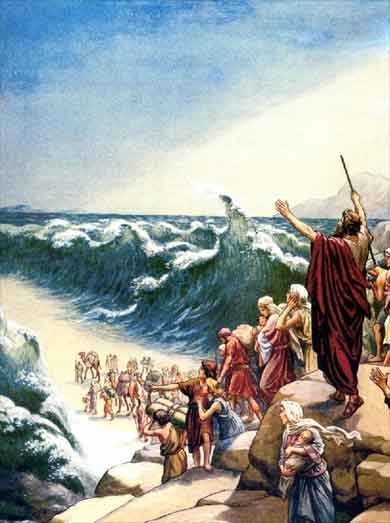
 At the Red Sea the Egyptian army was destroyed and the Israelites passed to safety on dry land (Exodus 12-15). At Mount Sinai they were given the Law and then erected the Tabernacle (19ff.). Because of disobedience, they had to wander in the wilderness for forty years. Moses himself was not allowed to enter the Promised Land because of his own sin of failing to uphold the Lord "as holy in the eyes of the people of Israel" (see Numbers 20:10-13), although God allowed him to view it (Deuteronomy 34).
Before Moses' death, the Lord appointed his faithful assistant Joshua to assume the mantle of leadership for Israel. It was he who led Israel into Canaan and directed the conquest of many of the hostile peoples who occupied Palestine.
In the New Testament Moses is referred to as lawgiver and prophet. Before his death, Moses promised Israel that the Lord would "raise up for you a prophet like me from among you. (Deuteronomy 18:15)" This prophecy found fulfillment in Jesus Christ. The first five books of the Bible, sometimes called the Pentateuch, are attributed to Mosaic authorship.
Q: Who is the world record-holding chiropractor?
A: Moses. He dealt with a million stiff-necked people.
Labels: biography, christology, commemoration, exodus, hagiography, israel, joshua, moses, old testament, pentateuch, pharaoh, ten commandments, torah
¶ 00:00 | 0 comments |
Joshua, the son of Nun, was first mentioned in Exodus 17:8-16. The Lord chose him through Moses to fight the Amalakites, whom he defeated in a brilliant military victory. According to Exodus 24, Joshua became close to Moses and accompanied him when he went up Sinai with "Aaron, Nadab, and Abihu, and seventy of the elders of Israel. (v. 9)" We know this since Scripture says that after he sent the others down the mountain, "Moses rose with his assistant Joshua, and Moses went up into the mountain of God. (v. 13)"
He was devoted to the Lord's Presence in the Tent of Meeting (Exodus 33:11) and was a member of the tribal representatives sent to survey the land of Canaan (Numbers 13:8). He and Caleb were the only two "spies" who provided honest reports which fully trusted in the Lord to deliver the Promised Land to His people (Numbers 14:6-9).
 God later appointed him to succeed Moses as Israel's leader. First, "Moses summoned Joshua and said to him in the sight of all Israel, 'Be strong and courageous, for you shall go with this people into the land that the Lord has sworn to their fathers to give them, and you shall put them in possession of it.' (Deuteronomy 31:7)" Shortly thereafter, "The Lord commissioned Joshua the son of Nun and said, 'Be strong and courageous, for you shall bring the people of Israel into the land that I swore to give them. I will be with you.' (v. 23)"
Joshua eventually led the Israelites across the Jordan River into the Promised Land, directing the capture of Jericho (Joshua 6), during which he commanded that the lives of the prostitute Rahab and her family be spared (v. 17). We also remember him for his final address to the Israelites, in which he challenged them to serve God faithfully (24:1-28), declaring, "As for me and my house, we will serve the Lord. (24:15)"
No Israelite should have been at all surprised with Joshua's successes. That's because Joshua is a shortened form of Jehoshua, which means "Yahweh (the Lord) saves." Through Joshua, the Lord defeated many armies and enemies, established His people in the promised land, and prepared them for their new life as a nation. This name becomes even dearer to Christians when we realize that the name of Jesus comes from the Greek transliteration of Joshua, "for there is no other name under heaven given among men by which we must be saved. (Acts 4:12)"
Labels: biography, christianity, christology, commemoration, exodus, hagiography, israel, jericho, jesus, jordan river, joshua, moses, old testament
¶ 00:00 | 0 comments |
Ezekiel, the son of Buzi, was a priest, called by God to be a prophet to the exiles during the Babylonian captivity (Ezekiel 1:3). In 597 B.C. King Nebuchadnezzar and the Babylonian army brought the king of Judah and thousands of the best citizens of Jerusalem — including Ezekiel — to Babylon (2 Kings 24:8-16).Ezekiel's priestly background profoundly stamped his prophecy, as the holiness of God and the Temple figure prominently in his messages (for example, Ezekiel 9-10 and 40-48). From 593 B.C. to the destruction of Jerusalem and the temple in 586 B.C., Ezekiel prophesied the inevitability of divine judgment on Jerusalem, on the exiles in Babylon, and on seven nations that surrounded Israel (Ezekiel 1–32). Jerusalem would certainly fall and the exiles would not quickly return — the just consequences of their sins.
Especially in the early part of the book, much of what the Lord "said" to His people was delivered in the form of action prophecies. In these, Ezekiel acted out representations of coming events pertaining to the fall of Judah, the destruction of the temple, and the seeming end of the Davidic line of kings. These action prophecies included the eating of the scroll (3:1-2), being struck with dumbness (3:22-27), sketching of the city of Jerusalem (4:1-3), lying on one side and then the other (4:4-8), eating restricted rations cooked on a fire of dried dung (4:9-17), and shaving his hair and beard with a sword before dividing the hair (5:1-4). Some seem a bit strange at first glance, once we understand their meaning and context, their messages are quite easily comprehended.
Once word reached Ezekiel that Jerusalem and the temple were destroyed, his message became one of comfort and hope. Through him God promised that his people would experience future restoration, renewal, and revival in the coming Messianic kingdom (Ezekiel 33-48).
Much of the strange symbolism of Ezekiel's prophecies was later employed in the Revelation to Saint John. Among these are the visions of the four living creatures as seen in Ezekiel 1 and Revelation 4.
See Happenings for a hymn stanza written for the Commemoration of Ezekiel.
Labels: babylonian captivity, biography, christianity, christology, commemorations, ezekiel, hagiography, israel, old testament, prophet, revelation
¶ 00:00 | 0 comments |
The prophet Elijah, whose name means, "My God is Yahweh [the Lord]," prophesied in the northern kingdom of Israel, mostly during the reign of Ahab (874 – 853 B.C.).Ahab, under the influence of his pagan wife Jezebel, had encouraged the worship of Baal throughout his kingdom, even as Jezebel sought to get rid of the worship of Yahweh. Elijah was called by God to denounce this idolatry and to call the people of Israel back to the worship Yahweh as the only true God (as he did in 1 Kings 18:20-40).
Elijah was a rugged and imposing figure, living in the wilderness and dressing in a garment of camel's hair and a leather belt (2 Kings 1:8). He was a prophet mighty in word and deed. The Lord worked many miracles through Elijah, including the raising of the dead (1 Kings 17:17-24) and the effecting of a long drought in Israel (1 Kings 17:1).
At the end of his ministry, he was taken up into heaven as Elisha, his successor, looked on (2 Kings 2:11). Later on, the Lord proclaimed through the prophet Malachi that Elijah would return before the coming of the Messiah (Malachi 4:5-6), a prophecy that was fulfilled in the prophetic ministry of John the Baptist (see Jesus' words in Matthew 11:1-19).
See Happenings for a hymn stanza written for the Commemoration of Elijah.
Labels: 1 kings, 2 kings, ahab, biography, commemorations, elijah, elisha, hagiography, israel, jezebel, john the baptist, old testament, prophet
¶ 00:00 | 0 comments |
Joseph was the son of the patriarch Jacob and Rachel — and was his father's favorite son. He incurred his older brothers' jealousy and anger (both through Jacob's favoritism and by his own attitude toward them, particularly regarding his dreams) so they sold him into slavery in Egypt and told their father he was dead (Genesis 37). In Egypt he became the chief servant in the home of Potiphar, a military official. Joseph refused to commit adultery when his master's wife tempted him. In retaliation, she unjustly accused him of attempted rape and he was imprisoned (Genesis 39).Years later, he interpreted dreams for Pharaoh, who then freed him from prison and placed him in charge of the entire country. When his brothers came from Canaan to Egypt in search of food, they did not recognize him. He eventually revealed his identity, forgave them, and invited them and his father to live in Egypt. We remember and honor him for his moral uprightness (Genesis 39) and for his willingness to forgive his brothers (Genesis 45 and 50). We also celebrate his role in saving the family of Israel (Jacob), thus also playing an important part in God's plan to bring Messiah to His people and to all mankind.
Labels: biography, christology, commemoration, egypt, hagiography, israel, jacob, joseph, old testament, patriarch, rachel
¶ 00:00 | 0 comments |
Jacob was the third of the three great Hebrews given the title of patriarch, following his grandfather Abraham and his father Isaac. Jacob was the younger of the twin sons of Isaac and Rebekah.He received his name because before birth he gripped his brother Esau's heel, seeming even then to be struggling for supremacy (Jacob can mean "He grasps the heel" or "he cheats"). After wrestling with the Angel of the Lord, Jacob, who certainly had lived up to the name of "Deceiver," was renamed Israel, which means "he strives with God" (Genesis 25:26; 32:28).
His family life was filled with trouble, much of it caused by his acts of deception toward his father and his brother Esau and his parental favoritism toward his son Joseph (commemorated on 31 March). He spent many of his later years grieving over the death of his beloved wife Rachel and the presumed death of Joseph, who had been appointed by the Egyptian Pharaoh to be in charge of food distribution during a time of famine in the land.
Late in life, as he was blessing his sons, Jacob uttered God's prophetic promise that the Messiah would come through the line of his fourth son, Judah (Genesis 49:8-12).
Labels: abraham, biography, christology, commemoration, esau, hagiography, isaac, israel, jacob, joseph, judah, leah, old testament, patriarch, rachel, rebekah
¶ 00:00 | 0 comments |
David, son of Jesse, went from tending his father's flocks to being the greatest of Israel's kings. He ruled from about 1010 to 970 B.C. He was chosen by the Lord and anointed by Samuel to replace the apostate King Saul, for whom David had provided years of faithful service. The events of his life are found from 1 Samuel 16 through 1 Kings 2 and in 1 Chronicles 10 through chapter 29. David's son Solomon succeeded him as king.David was also gifted musically. Skilled in playing the lyre, he wrote at least seventy-three of the Psalms, including the beloved Psalm 23 and several Messianic prophecies, including the foreshadowing of Christ's crucifixion in Psalm 22.
David's public and private character displayed a mixture of good, for example, his defeat of the giant Goliath, (1 Samuel 17) and evil, as in his adultery with Bathsheba, Uriah's wife, followed by his murder of Uriah, (2 Samuel 11). David's greatness lay in his fierce loyalty to God as Israel's military and political leader. For example, under his leadership, the people of Israel were united into a single nation with Jerusalem as the capital city.
This devotion to the Lord and to the people was coupled with his willingness to acknowledge his sins and ask for God's forgiveness, as recorded in 2 Samuel 12.* The great penitential outpouring of Psalm 51** came as a result of his sins against Uriah, as did the thoughts and emotions expressed in Psalm 32.
David's standing before the Lord and his place in the Messianic line are mentioned in many places. Of all of these, Paul's words in Acts 13:22-23 provide a fitting summary: "[The Lord] raised up David to be their king, of whom he testified and said, 'I have found in David the son of Jesse a man after my heart, who will do all my will.' Of this man's offspring God has brought to Israel a Savior, Jesus, as he promised."
*You Da Man! — a sermon on 2 Samuel 12
**Mercy Me! — a sermon on Psalm 51
Labels: biography, christology, commemoration, david, goliath, hagiography, israel, jesus, king, old testament, psalms
¶ 00:00 | 0 comments |
Today we commemorate Moses, who was born in Egypt several generations after Joseph brought his father Jacob and his brothers there to escape a famine in the land of Canaan. Although Joseph certainly delivered Egypt from the effects of the famine, at some later time, a change in regimes brought a change in Egyptian attitude toward the Hebrews in their midst. As this happened, the sons of Israel began to know affliction.By the time Jacob's descendants had lived in Egypt for 400 years, they were in slavery. Because they were worried about a rapidly expanding population of Hebrews, the Egyptians ordered the Israelites to kill their male children. When Moses was born, his mother had his elder sister put him in a basket and set it afloat among the reeds in the Nile River. Pharaoh's daughter found him and raised by her as her own son (Exodus 2:1-10). At age forty Moses killed an Egyptian taskmaster and fled to Midian, where he worked as a shepherd for most of his exile. There he married Zipporah, daughter of Jethro the priest of Midian (2:11-22).
After another 40 years had passed, the Lord called him through the burning bush to go back to Egypt and tell Pharaoh to release Israel from its bondage (Exodus 3). The Lord appointed his brother Aaron to assist him before Moses came to Pharaoh and told him that the Lord said, "Let My people go, that they may hold a feast to Me in the wilderness. (5:1)" After a series of plagues, the Israelites celebrated the first Passover, the Lord struck down the first-born males throughout Egypt, Pharaoh capitulated, and Moses led them out. Often, Moses and Aaron were aided by their sister Miriam.
At the Red Sea the Egyptian army was destroyed and the Israelites passed to safety on dry land (Exodus 12-15). At Mount Sinai they were given the Law and then erected the Tabernacle (19ff.). Because of disobedience, they had to wander in the wilderness for forty years. Moses himself was not allowed to enter the Promised Land because of his own sin of failing to uphold the Lord "as holy in the eyes of the people of Israel" (see Numbers 20:10-13), although God allowed him to view it (Deuteronomy 34).Before Moses' death, the Lord appointed his faithful assistant Joshua to assume the mantle of leadership for Israel. It was he who led Israel into Canaan and directed the conquest of many of the hostile peoples who occupied Palestine.
In the New Testament Moses is referred to as lawgiver and prophet. Before his death, Moses promised Israel that the Lord would "raise up for you a prophet like me from among you. (Deuteronomy 18:15)" This prophecy found fulfillment in Jesus Christ. The first five books of the Bible, sometimes called the Pentateuch, are attributed to Mosaic authorship.
Q: Who is the world record-holding chiropractor?
A: Moses. He dealt with a million stiff-necked people.
Labels: biography, commemoration, exodus, hagiography, israel, joshua, moses, old testament, ten commandments
¶ 00:00 | 0 comments |
Joshua, the son of Nun, was first mentioned in Exodus 17:8-16. The Lord chose him through Moses to fight the Amalakites, whom he defeated in a brilliant military victory. According to Exodus 24, Joshua became close to Moses and accompanied him when he went up Sinai with "Aaron, Nadab, and Abihu, and seventy of the elders of Israel. (v. 9)" We know this since Scripture says that after he sent the others down the mountain, "Moses rose with his assistant Joshua, and Moses went up into the mountain of God. (v. 13)"
He was devoted to the Lord's Presence in the Tent of Meeting (Exodus 33:11) and was a member of the tribal representatives sent to survey the land of Canaan (Numbers 13:8). He and Caleb were the only two "spies" who provided honest reports which fully trusted in the Lord to deliver the Promised Land to His people (Numbers 14:6-9).
God later appointed him to succeed Moses as Israel's leader. First, "Moses summoned Joshua and said to him in the sight of all Israel, 'Be strong and courageous, for you shall go with this people into the land that the Lord has sworn to their fathers to give them, and you shall put them in possession of it.' (Deuteronomy 31:7)" Shortly thereafter, "The Lord commissioned Joshua the son of Nun and said, 'Be strong and courageous, for you shall bring the people of Israel into the land that I swore to give them. I will be with you.' (v. 23)"Joshua eventually led the Israelites across the Jordan River into the Promised Land, directing the capture of Jericho (Joshua 6), during which he commanded that the lives of the prostitute Rahab and her family be spared (v. 17). We also remember him for his final address to the Israelites, in which he challenged them to serve God faithfully (24:1-28), declaring, "As for me and my house, we will serve the Lord. (24:15)"
No Israelite should have been at all surprised with Joshua's successes. That's because Joshua is a shortened form of Jehoshua, which means "Yahweh (the Lord) saves." Through Joshua, the Lord defeated many armies and enemies, established His people in the promised land, and prepared them for their new life as a nation. This name becomes even dearer to Christians when we realize that the name of Jesus comes from the Greek transliteration of Joshua, "for there is no other name under heaven given among men by which we must be saved. (Acts 4:12)"
Labels: biography, christianity, christology, commemoration, hagiography, israel, jesus, joshua, moses, old testament
¶ 00:00 | 0 comments |
Ezekiel, the son of Buzi, was a priest, called by God to be a prophet to the exiles during the Babylonian captivity (Ezekiel 1:3). In 597 B.C. King Nebuchadnezzar and the Babylonian army brought the king of Judah and thousands of the best citizens of Jerusalem — including Ezekiel — to Babylon (2 Kings 24:8-16).Ezekiel's priestly background profoundly stamped his prophecy, as the holiness of God and the Temple figure prominently in his messages (for example, Ezekiel 9-10 and 40-48). From 593 B.C. to the destruction of Jerusalem and the temple in 586 B.C., Ezekiel prophesied the inevitability of divine judgment on Jerusalem, on the exiles in Babylon, and on seven nations that surrounded Israel (Ezekiel 1–32). Jerusalem would certainly fall and the exiles would not quickly return — the just consequences of their sins.
Especially in the early part of the book, much of what the Lord "said" to His people was delivered in the form of action prophecies. In these, Ezekiel acted out representations of coming events pertaining to the fall of Judah, the destruction of the temple, and the seeming end of the Davidic line of kings. These action prophecies included the eating of the scroll (3:1-2), being struck with dumbness (3:22-27), sketching of the city of Jerusalem (4:1-3), lying on one side and then the other (4:4-8), eating restricted rations cooked on a fire of dried dung (4:9-17), and shaving his hair and beard with a sword before dividing the hair (5:1-4). Some seem a bit strange at first glance, once we understand their meaning and context, their messages are quite easily comprehended.
Once word reached Ezekiel that Jerusalem and the temple were destroyed, his message became one of comfort and hope. Through him God promised that his people would experience future restoration, renewal, and revival in the coming Messianic kingdom (Ezekiel 33-48).
Much of the strange symbolism of Ezekiel's prophecies was later employed in the Revelation to Saint John. Among these are the visions of the four living creatures as seen in Ezekiel 1 and Revelation 4.
See Happenings for a hymn stanza written for the Commemoration of Ezekiel.
Labels: babylonian captivity, biography, christianity, christology, commemorations, ezekiel, hagiography, israel, old testament, prophet, revelation
¶ 00:00 | 0 comments |
The prophet Elijah, whose name means, "My God is Yahweh [the Lord]," prophesied in the northern kingdom of Israel, mostly during the reign of Ahab (874 – 853 B.C.).Ahab, under the influence of his pagan wife Jezebel, had encouraged the worship of Baal throughout his kingdom, even as Jezebel sought to get rid of the worship of Yahweh. Elijah was called by God to denounce this idolatry and to call the people of Israel back to the worship Yahweh as the only true God (as he did in 1 Kings 18:20-40).
Elijah was a rugged and imposing figure, living in the wilderness and dressing in a garment of camel's hair and a leather belt (2 Kings 1:8). He was a prophet mighty in word and deed. The Lord worked many miracles through Elijah, including the raising of the dead (1 Kings 17:17-24) and the effecting of a long drought in Israel (1 Kings 17:1).
At the end of his ministry, he was taken up into heaven as Elisha, his successor, looked on (2 Kings 2:11). Later on, the Lord proclaimed through the prophet Malachi that Elijah would return before the coming of the Messiah (Malachi 4:5-6), a prophecy that was fulfilled in the prophetic ministry of John the Baptist (see Jesus' words in Matthew 11:1-19).
See Happenings for a hymn stanza written for the Commemoration of Elijah.
Labels: ahab, biography, commemorations, elijah, elisha, hagiography, israel, jezebel, john the baptist, old testament, prophet
¶ 00:00 | 0 comments |


