
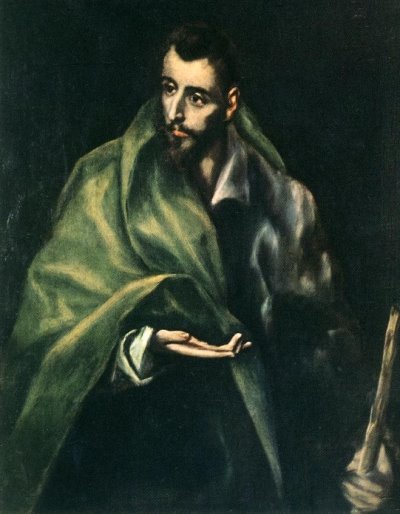
 James, son of Zebedee, and his brother John were among Our Lord's twelve disciples. Together with Peter, these two were privileged to behold the Transfiguration (Matthew 17:1; Mark 9:2; Luke 9:28). They witnessed the healing of Peter's mother-in-law (Mark 1:29-31) and the raising of the daughter of Jairus (Mark 5:37; Luke 8:51). Jesus called them aside to watch and pray with Him in the garden of Gethsemane on the night before His death (Matthew 26:37; Mark 14:33).
James and John may have been from a higher social level than the average fisherman. Their father could afford hired servants (Mark 1:20), and John (assuming him to be identical with the "beloved disciple") had connections with the high priest (John 18:15).
Jesus nicknamed the brothers Boanerges — Sons of Thunder — (Mark 3:17), probably commenting upon their headstrong, hot-tempered, and impulsive natures. So they seem to be in two incidents reported in the Gospels. Once, Jesus and the disciples were refused the hospitality of a Samaritan village, and James and John proposed to call down fire from heaven on the offenders (Luke 9:51-56). On another occasion, they asked Jesus for a special place of honor in the Kingdom, and were told that the place of honor is the place of suffering (Matthew 20:20-23; Mark 10:35-41).
 In about AD 42, shortly before Passover (Acts 12:1-2), James was beheaded by order of Herod Agrippa I, grandson of Herod the Great (who tried to kill the infant Jesus; see Matthew 2), nephew of Herod Antipas (who killed John the Baptist — Mark 6:14-29 — and examined Jesus on Good Friday — Luke 23:6-16), and father of Herod Agrippa II (who heard the defense of Paul before Festus — Acts 25:13-26:32). James was first among the Twelve to suffer martyrdom, and the only one whose death is recorded in the New Testament.
James is often called "James Major" (also "the Greater" or "the Elder") to distinguish him from other New Testament people named James. Tradition has it that he made a missionary journey to Spain, and that after his death his body was taken to Spain and buried there at Compostela. His supposed burial place there was a major site of pilgrimage in the Middle Ages, and the Spaniards fighting to drive their Moorish conquerors out of Spain took "Santiago de Compostela!" (Saint James of Compostela) as one of their chief war-cries. (The Spanish form of "James" is Diego or Iago. In most languages, "James" and "Jacob" are identical. Where an English Bible has "James," a Greek Bible has Iakobos.
The sword (the instrument of his death) and the scallop shell are both traditional representations of the apostle.
Lection
Psalm 56
Acts 11:27-12:5
Romans 8:28-39
Mark 10:35-45
Collect
Grant, O Lord, that as Saint James the apostle readily followed the calling of Your Son Jesus Christ, we may by Your grace be enabled to forsake all false and passing allurements and follow Him alone; through Jesus Christ, our Lord, who lives and reigns with You and the Holy Spirit, one God, now and forever.
Labels: apostle, bible, biography, disciple, feasts, festivals, gospels, hagiography, jacob, james, jesus, john, martyrdom, new testament, zebedee
¶ 00:00 | 0 comments |

 The Gospels mention Mary of Magdala as one of the women of Galilee who followed Jesus and His disciples. She witnessed His crucifixion and burial, and went to the tomb on Easter Sunday to anoint His body. She was the first recorded witness of the risen Christ and was sent by Him to tell the disciples. Thus, early Christian writings sometimes refer to her as "the apostle to the apostles" (apostle means "one who is sent").
Confusion sometimes abounds as to whether she is the same person as Mary of Bethany (sister of Martha and Lazarus) or the unnamed woman who anointed Jesus's feet (Luke 7:36-48). Add in the statement that Jesus cast seven demons out of her (Luke 8:2) and you get the origins of a tradition that she was a prostitute before she met Jesus.
Following the assumption (possibly quite misguided) that Mary Magdalene truly had been a spectacular sinner whose penitential sorrow was deep and complete — and possibly because John described her as crying at the tomb of Jesus — artists often portray her either as weeping or with red eyes from having wept. This appearance (and a slight corruption in translation) led to the English word "maudlin," meaning "effusively or tearfully sentimental." Magdalen College at Oxford and Magdalene College at Cambridge (note the different spellings) — both pronounced "Maudlin" — derive their names from this Saint Mary.
Since the printing of Dan Brown's book The Da Vinci Code and the subsequent motion picture, ancient, heretical ideas about marriage or a less permanent sexual relationship between Mary and Jesus have gained ground. Some even twist an offhand statement from Martin Luther to buttress this argument. Contrary to these false teachings, please read Was Jesus Married and Luther, Jesus, and Mary Magdalene.
Lection
Psalm 73:23-28
Proverbs 31:10-31
Acts 13:26-31
John 20:1-2, 11-18
Collect
Almighty God, Your Son, Jesus Christ, restored Mary Magdalene to health and called her to be the first witness of His resurrection. Heal us from all our infirmities, and call us to know You in the power of Your Son’s unending life; through the same Jesus Christ, our Lord, who lives and reigns with You and the Holy Spirit, one God, now and forever.
Labels: apostle, bible, biography, christianity, easter, feasts, festivals, gospels, hagiography, jesus, mary, mary magdalene, new testament, resurrection
¶ 00:00 | 0 comments |
 Ezekiel, the son of Buzi, was a priest, called by God to be a prophet to the exiles during the Babylonian captivity (Ezekiel 1:3). In 597 B.C. King Nebuchadnezzar and the Babylonian army brought the king of Judah and thousands of the best citizens of Jerusalem — including Ezekiel — to Babylon (2 Kings 24:8-16).
Ezekiel's priestly background profoundly stamped his prophecy, as the holiness of God and the Temple figure prominently in his messages (for example, Ezekiel 9-10 and 40-48). From 593 B.C. to the destruction of Jerusalem and the temple in 586 B.C., Ezekiel prophesied the inevitability of divine judgment on Jerusalem, on the exiles in Babylon, and on seven nations that surrounded Israel (Ezekiel 1–32). Jerusalem would certainly fall and the exiles would not quickly return — the just consequences of their sins.
Especially in the early part of the book, much of what the Lord "said" to His people was delivered in the form of action prophecies. In these, Ezekiel acted out representations of coming events pertaining to the fall of Judah, the destruction of the temple, and the seeming end of the Davidic line of kings. These action prophecies included the eating of the scroll (3:1-2), being struck with dumbness (3:22-27), sketching of the city of Jerusalem (4:1-3), lying on one side and then the other (4:4-8), eating restricted rations cooked on a fire of dried dung (4:9-17), and shaving his hair and beard with a sword before dividing the hair (5:1-4). Some seem a bit strange at first glance, once we understand their meaning and context, their messages are quite easily comprehended.
Once word reached Ezekiel that Jerusalem and the temple were destroyed, his message became one of comfort and hope. Through him God promised that his people would experience future restoration, renewal, and revival in the coming Messianic kingdom (Ezekiel 33-48).
Much of the strange symbolism of Ezekiel's prophecies was later employed in the Revelation to Saint John. Among these are the visions of the four living creatures as seen in Ezekiel 1 and Revelation 4.
See Happenings for a hymn stanza written for the Commemoration of Ezekiel.
Labels: babylonian captivity, bible, biography, christianity, christology, commemorations, ezekiel, hagiography, israel, old testament, prophet, revelation
¶ 00:00 | 0 comments |
 Esther is the heroine of the biblical book that bears her name. Her Jewish name was Hadassah, which means "myrtle." Her beauty, charm, and courage served her well as queen to King Ahasuerus. In that role she was able to save her people from the mass extermination that Haman, the king's chief adviser, had planned (2:19-4:17).
Esther's efforts to uncover the plot resulted in the hanging of Haman on the very same gallows that he had built for Mordecai, her uncle and guardian. Then the king named Mordecai minister of state in Haman's place. This story is an example of how God intervenes on behalf of his people to deliver them from evil, as here through Esther he preserved the Old Testament people through whom the Messiah would come.
Even though the book nowhere bears the name of the Lord (Yahweh), it is included in the canon of Scripture because it shows His providential protection of His covenant people and His preservation of the line of the Messiah.
Labels: ahasurus, bible, biography, commemoration, esther, hagiography, haman, mordecai, old testament, providence
¶ 00:00 | 0 comments |
 After the Ascension of Our Lord, Jesus' followers at Jerusalem chose Matthias to replace Judas: "And they cast lots for them, and the lot fell on Matthias, and he was numbered with the eleven apostles. (Acts 1:26)" Apart from the information given in the first chapter of Acts (vv. 12-26), we know nothing about him.
One extra-biblical account says that Saint Matthias was slain by cannibals in Ethiopia; another traditions claims that he was stoned and then beheaded by Jews in Jerusalem. This account lends itself to his customary representation in religious art: Sometimes the blade from his beheading is superimposed over a book or scroll representing Holy Scripture; at others, he is depicted holding ax or sword himself.
Lection
Psalm 134
Isaiah 66:1-2
Acts 1:15-26
Matthew 11:25-30
Collect
Almighty God, You chose Your servant Matthias to be numbered among the Twelve. Grant that Your Church, ever preserved from false teachers, may be taught and guided by faithful and true pastors; through Jesus Christ, our Lord, who lives and reigns with You and the Holy Spirit, one God, now and forever.
Labels: acts, apostle, bible, feasts, festivals, judas, martyrdom, new testament, saint matthias
¶ 00:00 | 0 comments |
 Saint Titus, Pastor and Confessor was sent by Paul as bishop and pastor to Crete.
Along with his other duties, he was also to "appoint elders in every town (Titus 1:5)" — in other words, he chose and consecrated the first generation of Cretan pastors and appears to have been the island's de facto bishop. While there, he was to himself be a faithful shepherd for Christ's flock as he trained and placed others into the Office of the Holy Ministry.
Titus is mentioned as Paul's companion in some of the epistles: 2 Corinthians 2:13; 7:6, 13-14; 8:6, 16, 23; 12:18; Galatians 2:1-3; 2 Timothy 4:10.
The letters Paul wrote to Titus and Timothy are collectively known as the Pastoral Epistles. Much of Christianity's understanding and practice of the pastorate comes from these three relatively brief letters.
Lection
Psalm 71:1-14
Acts 20:28-35
Titus 1:1-9
Luke 10:1-9
Collect
Almighty God, You called Titus to the work of pastor and teacher. Make all shepherds of Your flock diligent in preaching Your holy Word so that the whole world may know the immeasurable riches of our Savior, Jesus Christ, who lives and reigns with You and the Holy Spirit, one God, now and forever.
Labels: bible, biography, crete, epistles, feasts, festivals, new testament, pastor, pastoral epistles, saint paul, saint titus
¶ 00:00 | 0 comments |
 Today we commemorate Saint Timothy, Pastor and Confessor. The festival days for Pastors Timothy and Titus are set on either side of the day marking Saint Paul's conversion. This proximity reminds us of their connection with the apostle, including his establishing them in office and the letters he wrote to them.
Timothy grew up in the faith as taught by his mother and grandmother, Eunice and Lois. He was a companion of Paul for many of the apostle's travels and spent much of his own pastorate in Ephesus.
Timothy is mentioned in Acts 16-20, and appears in 9 epistles either as joining in Paul's greetings or as a messenger. Additionally, two of Paul's three "pastoral epistles" — 1 Timothy and 2 Timothy — were addressed to him and his congregation.
The letters Paul wrote to Timothy and Titus are collectively known as the Pastoral Epistles. Much of Christianity's understanding and practice of the pastorate comes from these three relatively brief letters.
Lection
Psalm 71:15-24
Acts 16:1-5
1 Timothy 6:11-16
Matthew 24:42-47
Collect
Lord Jesus Christ, You have always given to Your Church on earth faithful shepherds such as Timothy to guide and feed Your flock. Make all pastors diligent to preach Your holy Word and administer Your means of grace, and grant Your people wisdom to follow in the way that leads to life eternal; for You live and reign with the Father and the Holy Spirit, one God, now and forever.
Labels: bible, biography, ephesus, eunice, feasts, festivals, lois, new testament, pastor, pastoral epistles, saint paul, saint timothy
¶ 00:00 | 0 comments |
Lancelot Andrewes was born in London in 1555. Possessed of a keen intellect, he studied at Cambridge and Oxford, was a distinguished lecturer, and entered religious orders in 1580. A career that saw him enjoy working among the people while still challenging himself and others intellectually led to royal associations and eventual consecration as Bishop of Chichester in 1605 and a position as lord almoner. In 1618, he attended the Synod of Dort, was made dean of the Chapel Royal, and became Bishop of Winchester.
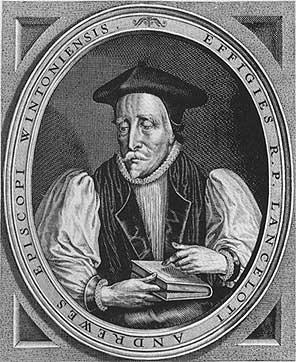 Active in church and secular politics, especially in their overlap, Andrewes advised James I of England and was on the committee of scholars responsible of the Authorized Version of the Bible. Indeed, his name is first on the list of translators, since he both provided translations of early parts of the Old Testament and served as an editor general of the entire work.
Versed in Latin, Greek, Hebrew and eighteen other languages, Andrewes enjoyed popularity during his life for writings. With Bishop Ussher, these two may have been the most learned and intellectually brilliant churchmen of the day. His apologetic writings included two essays against Robert Bellarmine. Large collections of his sermons remain and may still be read profitably both by lovers of Christ and by lovers of the English language.
Perhaps one of his finest works was the Preces Privatae (Private Prayers). The collection was, however, unavailable to contemporaries but were published after his death. Some sections are complete prayers and collects, other appear to be guides to devout meditation. A biography by James Kiefer includes quotes from the Preces. These selections from the Thursday prayers emphasize three important happenings on that day — the creation of birds and fish on the Fifth Day of Creation, the institution of the Lord's Supper, the Ascension of our Lord on Easter's 40th day.
Andrewes' impact on English arts and letters extended well beyond his life. T. S. Eliot considered him a major influence and wrote an essay in his honor.
Labels: andrewes, authorized version, bible, biography, christianity, church history, commemoration, english history, hagiography, king james i, kjv, theology, translation
¶ 00:00 | 0 comments |
Esther is the heroine of the biblical book that bears her name. Her Jewish name was Hadassah, which means "myrtle." Her beauty, charm, and courage served her well as queen to King Ahasuerus. In that role she was able to save her people from the mass extermination that Haman, the king's chief adviser, had planned (2:19-4:17).Esther's efforts to uncover the plot resulted in the hanging of Haman on the very same gallows that he had built for Mordecai, her uncle and guardian. Then the king named Mordecai minister of state in Haman's place. This story is an example of how God intervenes on behalf of his people to deliver them from evil, as here through Esther he preserved the Old Testament people through whom the Messiah would come.
Even though the book nowhere bears the name of the Lord (Yahweh), it is included in the canon of Scripture because it shows His providential protection of His covenant people and His preservation of the line of the Messiah.
Labels: ahasurus, bible, biography, commemoration, esther, hagiography, haman, mordecai, old testament, providence
¶ 00:00 | 1 comments |
After the Ascension of Our Lord, Jesus' followers at Jerusalem chose Matthias to replace Judas: "And they cast lots for them, and the lot fell on Matthias, and he was numbered with the eleven apostles. (Acts 1:26)" Apart from the information given in the first chapter of Acts (vv. 12-26), we know nothing about him.One extra-biblical account says that Saint Matthias was slain by cannibals in Ethiopia; another traditions claims that he was stoned and then beheaded by Jews in Jerusalem. This account lends itself to his customary representation in religious art: Sometimes the blade from his beheading is superimposed over a book or scroll representing Holy Scripture; at others, he is depicted holding ax or sword himself.
Lection
Psalm 134
Isaiah 66:1-2
Acts 1:15-26
Matthew 11:25-30
Collect
Almighty God, You chose Your servant Matthias to be numbered among the Twelve. Grant that Your Church, ever preserved from false teachers, may be taught and guided by faithful and true pastors; through Jesus Christ, our Lord, who lives and reigns with You and the Holy Spirit, one God, now and forever.
Labels: acts, apostle, bible, feasts, festivals, judas, martyrdom, new testament, saint matthias
¶ 00:00 | 0 comments |
Today we commemorate Saint Timothy, Pastor and Confessor. The festival days for Pastors Timothy and Titus are set on either side of the day marking Saint Paul's conversion. This proximity reminds us of their connection with the apostle, including his establishing them in office and the letters he wrote to them.Timothy grew up in the faith as taught by his mother and grandmother, Eunice and Lois. He was a companion of Paul for many of the apostle's travels and spent much of his own pastorate in Ephesus.
Timothy is mentioned in Acts 16-20, and appears in 9 epistles either as joining in Paul's greetings or as a messenger. Additionally, two of Paul's three "pastoral epistles" — 1 Timothy and 2 Timothy — were addressed to him and his congregation.
The letters Paul wrote to Timothy and Titus are collectively known as the Pastoral Epistles. Much of Christianity's understanding and practice of the pastorate comes from these three relatively brief letters.
Lection
Psalm 71:15-24
Acts 16:1-5
1 Timothy 6:11-16
Matthew 24:42-47
Collect
Lord Jesus Christ, You have always given to Your Church on earth faithful shepherds such as Timothy to guide and feed Your flock. Make all pastors diligent to preach Your holy Word and administer Your means of grace, and grant Your people wisdom to follow in the way that leads to life eternal; for You live and reign with the Father and the Holy Spirit, one God, now and forever.
Labels: bible, biography, ephesus, eunice, feasts, festivals, lois, new testament, pastor, pastoral epistles, saint paul, saint timothy
¶ 00:00 | 0 comments |
Lancelot Andrewes was born in London in 1555. Possessed of a keen intellect, he studied at Cambridge and Oxford, was a distinguished lecturer, and entered religious orders in 1580. A career that saw him enjoy working among the people while still challenging himself and others intellectually led to royal associations and eventual consecration as Bishop of Chichester in 1605 and a position as lord almoner. In 1618, he attended the Synod of Dort, was made dean of the Chapel Royal, and became Bishop of Winchester.
Active in church and secular politics, especially in their overlap, Andrewes advised James I of England and was on the committee of scholars responsible of the Authorized Version of the Bible. Indeed, his name is first on the list of translators, since he both provided translations of early parts of the Old Testament and served as an editor general of the entire work.Versed in Latin, Greek, Hebrew and eighteen other languages, Andrewes enjoyed popularity during his life for writings. With Bishop Ussher, these two may have been the most learned and intellectually brilliant churchmen of the day. His apologetic writings included two essays against Robert Bellarmine. Large collections of his sermons remain and may still be read profitably both by lovers of Christ and by lovers of the English language.
Perhaps one of his finest works was the Preces Privatae (Private Prayers). The collection was, however, unavailable to contemporaries but were published after his death. Some sections are complete prayers and collects, other appear to be guides to devout meditation. A biography by James Kiefer includes quotes from the Preces. These selections from the Thursday prayers emphasize three important happenings on that day — the creation of birds and fish on the Fifth Day of Creation, the institution of the Lord's Supper, the Ascension of our Lord on Easter's 40th day.
Andrewes' impact on English arts and letters extended well beyond his life. T. S. Eliot considered him a major influence and wrote an essay in his honor.
Labels: andrewes, bible, biography, christianity, church history, commemoration, english history, hagiography, king james i, kjv, theology, translation
¶ 00:00 | 0 comments |


