Aardvark Alley

Confessional Lutheran theology, hagiography, philosophy, music, culture, sports, education,
and whatever else is on the fevered mind of Orycteropus Afer
07 December 2016
+ Ambrose of Milan, Bishop, Doctor, & Hymnodist +
Consecrated 7 December AD 374
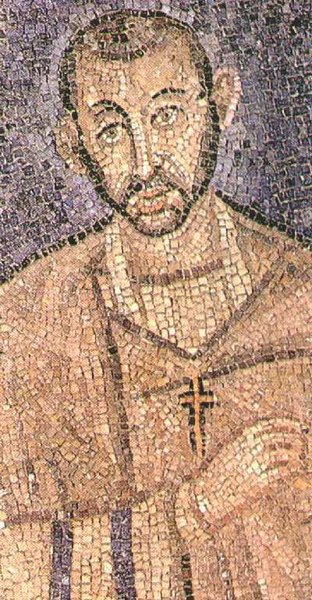
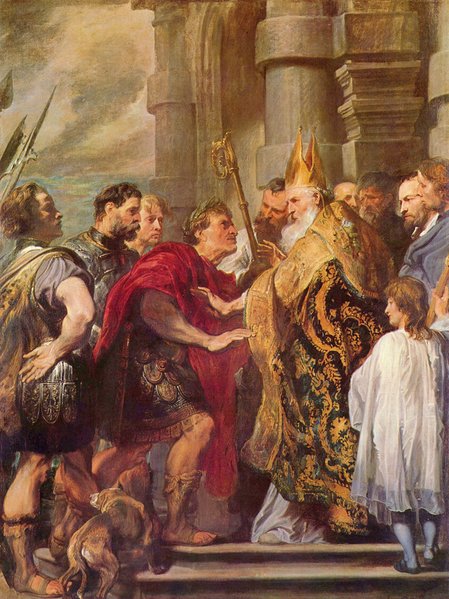 Saint Ambrose of Milan was born in Trier around AD 340. He became a Roman governor in northern Italy and the people of Milan later named him bishop by general acclaim. He stands as one of the four Latins among the eight Doctors of the undivided Church. Augustine, Jerome, and Gregory the Great are the West's other representatives; Athanasius, John Chrysostom, Basil the Great, and Gregory of Nazianzus represent the East.
Ambrose was also an author of hymns, the best known of which is probably Intende, qui regis Israel (usually known by its second stanza as Veni, Redemptor gentium). Martin Luther translated it into German (Nun komm, der Heiden Heiland); its English translations (from Luther or the original Latin) usually appear as Savior of the Nations, Come; Savior of the Heathen, Known; or Come, Thou Redeemer of the Earth).
His name is also associated with Ambrosian Chant. You can search the web for examples of the notation while YouTube has a number of recordings of sacred music performed according to Ambrosian sensibilities. This style of chanting the ancient liturgy took hold in the province of Milan. For more on his musical influence in the Church, see the NetHymnal for a detailed list with links to translations and adaptations of a number of the Hymns of Saint Ambrose.
While serving as a civil governor, Ambrose sought to bring peace among Christians in Milan who were divided into quarreling factions. When a new bishop was to be elected in 374, Ambrose addressed the crowd, and someone cried out, "Ambrose, bishop!" The entire gathering gave their support. At this time, Ambrose was still a catechumen, an unbaptized person still under instruction before joining the church. The general acclaim hastened the catechetical process and the 34-year-old was baptized on December 7, after which he was consecrated bishop of Milan.
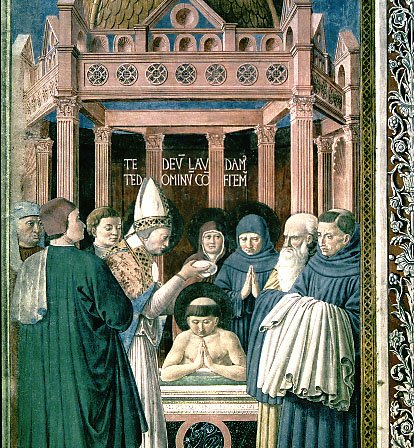 A strong defender of the faith, Ambrose convinced the Roman emperor Gratian in 379 to forbid the Arian heresy in the West. At Ambrose's urging, Gratian's successor Theodosius also publicly opposed Arianism.
Ambrose died on Good Friday, 4 April 397, but the Church was unwilling to honor such a known and popular person on the day commemorating the death of Christ. Thus, his feast day was transferred from his "heavenly birthday" (or death date) to the date of his baptism and subsequent consecration as bishop.
Ambrose was also instrumental in the conversion of Augustine of Hippo. Some early traditions hold that the hymn Te Deum Laudamus ("We Praise You, O God") was a spontaneous composition by Ambrose, perhaps with Augustine's help, upon the baptism of the latter. While later researchers hold this to be unlikely, some scholars are convinced that he was largely responsible for authorship of the Athanasian Creed (14k PDF).
As a courageous doctor and musician he upheld the truth of God's Word. Once again this Advent-tide, thousands upon thousands of believers will use Savior of the Nations, Come to pray for the Second Coming of our Lord. Here is my favorite, passed on to us from Ambrose via Martin Luther and William Morton Reynolds:
Lection
Psalm 27:5-11 or 33:1-5,20-21
Ecclesiasticus 2:7-11,16-18
1 Peter 1:3-9, 13-21
Luke 12:35-37, 42-44
Collect
O God, who graciously gave Your servant Ambrose eloquence to proclaim Your righteousness and fearlessness to bear reproach for the honor of Your Name, mercifully grant to all pastors and overseers such excellence in preaching and faithfulness in ministering Your Word that Your people may be partakers with them of the glory that shall be revealed; through Jesus Christ our Lord, who lives and reigns with You and the Holy Spirit, one God, now and forever.


 Saint Ambrose of Milan was born in Trier around AD 340. He became a Roman governor in northern Italy and the people of Milan later named him bishop by general acclaim. He stands as one of the four Latins among the eight Doctors of the undivided Church. Augustine, Jerome, and Gregory the Great are the West's other representatives; Athanasius, John Chrysostom, Basil the Great, and Gregory of Nazianzus represent the East.
Ambrose was also an author of hymns, the best known of which is probably Intende, qui regis Israel (usually known by its second stanza as Veni, Redemptor gentium). Martin Luther translated it into German (Nun komm, der Heiden Heiland); its English translations (from Luther or the original Latin) usually appear as Savior of the Nations, Come; Savior of the Heathen, Known; or Come, Thou Redeemer of the Earth).
His name is also associated with Ambrosian Chant. You can search the web for examples of the notation while YouTube has a number of recordings of sacred music performed according to Ambrosian sensibilities. This style of chanting the ancient liturgy took hold in the province of Milan. For more on his musical influence in the Church, see the NetHymnal for a detailed list with links to translations and adaptations of a number of the Hymns of Saint Ambrose.
While serving as a civil governor, Ambrose sought to bring peace among Christians in Milan who were divided into quarreling factions. When a new bishop was to be elected in 374, Ambrose addressed the crowd, and someone cried out, "Ambrose, bishop!" The entire gathering gave their support. At this time, Ambrose was still a catechumen, an unbaptized person still under instruction before joining the church. The general acclaim hastened the catechetical process and the 34-year-old was baptized on December 7, after which he was consecrated bishop of Milan.
 A strong defender of the faith, Ambrose convinced the Roman emperor Gratian in 379 to forbid the Arian heresy in the West. At Ambrose's urging, Gratian's successor Theodosius also publicly opposed Arianism.
Ambrose died on Good Friday, 4 April 397, but the Church was unwilling to honor such a known and popular person on the day commemorating the death of Christ. Thus, his feast day was transferred from his "heavenly birthday" (or death date) to the date of his baptism and subsequent consecration as bishop.
Ambrose was also instrumental in the conversion of Augustine of Hippo. Some early traditions hold that the hymn Te Deum Laudamus ("We Praise You, O God") was a spontaneous composition by Ambrose, perhaps with Augustine's help, upon the baptism of the latter. While later researchers hold this to be unlikely, some scholars are convinced that he was largely responsible for authorship of the Athanasian Creed (14k PDF).
As a courageous doctor and musician he upheld the truth of God's Word. Once again this Advent-tide, thousands upon thousands of believers will use Savior of the Nations, Come to pray for the Second Coming of our Lord. Here is my favorite, passed on to us from Ambrose via Martin Luther and William Morton Reynolds:
Savior of the nations, come;
Virgin's Son, here make Thy home!
Marvel now, O heaven and earth,
That the Lord chose such a birth.
Not by human flesh and blood;
By the Spirit of our God
Was the Word of God made flesh,
Woman's offspring, pure and fresh.
Wondrous birth! O wondrous Child
Of the virgin undefiled!
Though by all the world disowned,
Still to be in heaven enthroned.
From the Father forth He came
And returneth to the same,
Captive leading death and hell
High the song of triumph swell!
Thou, the Father's only Son,
Hast over sin the victory won.
Boundless shall Thy kingdom be;
When shall we its glories see?
Brightly doth Thy manger shine,
Glorious is its light divine.
Let not sin o'ercloud this light;
Ever be our faith thus bright.
Praise to God the Father sing,
Praise to God the Son, our King,
Praise to God the Spirit be
Ever and eternally.
Lection
Psalm 27:5-11 or 33:1-5,20-21
Ecclesiasticus 2:7-11,16-18
1 Peter 1:3-9, 13-21
Luke 12:35-37, 42-44
Collect
O God, who graciously gave Your servant Ambrose eloquence to proclaim Your righteousness and fearlessness to bear reproach for the honor of Your Name, mercifully grant to all pastors and overseers such excellence in preaching and faithfulness in ministering Your Word that Your people may be partakers with them of the glory that shall be revealed; through Jesus Christ our Lord, who lives and reigns with You and the Holy Spirit, one God, now and forever.
Labels: ambrose, arianism, augustine, biography, chant, commemoration, european history, hagiography, hymnody, liturgics, music, roman empire, te deum, theology
¶ 00:00 | 0 comments |
07 December 2015
+ Ambrose of Milan, Bishop, Doctor, & Hymnodist +
Consecrated 7 December AD 374
Saint Ambrose of Milan was born in Trier around AD 340. He became a Roman governor in northern Italy and the people of Milan later named him bishop by general acclaim. He stands as one of the four Latins among the eight Doctors of the undivided Church. Augustine, Jerome, and Gregory the Great are the West's other representatives; Athanasius, John Chrysostom, Basil the Great, and Gregory of Nazianzus represent the East.
Ambrose was also an author of hymns, the best known of which is probably Intende, qui regis Israel (usually known by its second stanza as Veni, Redemptor gentium). Martin Luther translated it into German (Nun komm, der Heiden Heiland); its English translations (from Luther or the original Latin) usually appear as Savior of the Nations, Come; Savior of the Heathen, Known; or Come, Thou Redeemer of the Earth).
His name is also associated with Ambrosian Chant, of which a number of samples in PDF may be found at Canto Ambrosiano — Spartiti. This style of chanting the ancient liturgy took hold in the province of Milan. For more on his musical influence in the Church, see the NetHymnal for a detailed list with links to translations and adaptations of a number of the Hymns of Saint Ambrose.
While serving as a civil governor, Ambrose sought to bring peace among Christians in Milan who were divided into quarreling factions. When a new bishop was to be elected in 374, Ambrose addressed the crowd, and someone cried out, "Ambrose, bishop!" The entire gathering gave their support. At this time, Ambrose was still a catechumen, an unbaptized person still under instruction before joining the church. This acclaim hastened the catechetical process and the 34-year-old was baptized on December 7, after which he was consecrated bishop of Milan.
A strong defender of the faith, Ambrose convinced the Roman emperor Gratian in 379 to forbid the Arian heresy in the West. At Ambrose's urging, Gratian's successor, Theodosius, also publicly opposed Arianism.
Ambrose died on Good Friday, 4 April 397, but the Church was unwilling to honor such a known and popular person on the day commemorating the death of Christ. Thus, his feast day was transferred from his "heavenly birthday" (or death date) to the date of his baptism and subsequent consecration as bishop.
Ambrose was also instrumental in the conversion of Augustine of Hippo. Some early traditions hold that the hymn Te Deum Laudamus ("We Praise You, O God") was a spontaneous composition by Ambrose, perhaps with Augustine's help, upon the baptism of the latter. While later researchers hold this to be unlikely, some scholars are convinced that he was largely responsible for authorship of the Athanasian Creed (14k PDF).
As a courageous doctor and musician he upheld the truth of God's Word. Once again this Advent-tide, thousands upon thousands of believers will use Savior of the Nations, Come to pray for the Second Coming of our Lord. Here is my favorite, passed on to us from Ambrose via Martin Luther and William Morton Reynolds:
Lection
Psalm 27:5-11 or 33:1-5,20-21
Ecclesiasticus 2:7-11,16-18
1 Peter 1:3-9, 13-21
Luke 12:35-37, 42-44
Collect
O God, who graciously gave Your servant Ambrose eloquence to proclaim Your righteousness and fearlessness to bear reproach for the honor of Your Name, mercifully grant to all pastors and overseers such excellence in preaching and faithfulness in ministering Your Word that Your people may be partakers with them of the glory that shall be revealed; through Jesus Christ our Lord, who lives and reigns with You and the Holy Spirit, one God, now and forever.
Saint Ambrose of Milan was born in Trier around AD 340. He became a Roman governor in northern Italy and the people of Milan later named him bishop by general acclaim. He stands as one of the four Latins among the eight Doctors of the undivided Church. Augustine, Jerome, and Gregory the Great are the West's other representatives; Athanasius, John Chrysostom, Basil the Great, and Gregory of Nazianzus represent the East.Ambrose was also an author of hymns, the best known of which is probably Intende, qui regis Israel (usually known by its second stanza as Veni, Redemptor gentium). Martin Luther translated it into German (Nun komm, der Heiden Heiland); its English translations (from Luther or the original Latin) usually appear as Savior of the Nations, Come; Savior of the Heathen, Known; or Come, Thou Redeemer of the Earth).
His name is also associated with Ambrosian Chant, of which a number of samples in PDF may be found at Canto Ambrosiano — Spartiti. This style of chanting the ancient liturgy took hold in the province of Milan. For more on his musical influence in the Church, see the NetHymnal for a detailed list with links to translations and adaptations of a number of the Hymns of Saint Ambrose.
While serving as a civil governor, Ambrose sought to bring peace among Christians in Milan who were divided into quarreling factions. When a new bishop was to be elected in 374, Ambrose addressed the crowd, and someone cried out, "Ambrose, bishop!" The entire gathering gave their support. At this time, Ambrose was still a catechumen, an unbaptized person still under instruction before joining the church. This acclaim hastened the catechetical process and the 34-year-old was baptized on December 7, after which he was consecrated bishop of Milan.
A strong defender of the faith, Ambrose convinced the Roman emperor Gratian in 379 to forbid the Arian heresy in the West. At Ambrose's urging, Gratian's successor, Theodosius, also publicly opposed Arianism.Ambrose died on Good Friday, 4 April 397, but the Church was unwilling to honor such a known and popular person on the day commemorating the death of Christ. Thus, his feast day was transferred from his "heavenly birthday" (or death date) to the date of his baptism and subsequent consecration as bishop.
Ambrose was also instrumental in the conversion of Augustine of Hippo. Some early traditions hold that the hymn Te Deum Laudamus ("We Praise You, O God") was a spontaneous composition by Ambrose, perhaps with Augustine's help, upon the baptism of the latter. While later researchers hold this to be unlikely, some scholars are convinced that he was largely responsible for authorship of the Athanasian Creed (14k PDF).
As a courageous doctor and musician he upheld the truth of God's Word. Once again this Advent-tide, thousands upon thousands of believers will use Savior of the Nations, Come to pray for the Second Coming of our Lord. Here is my favorite, passed on to us from Ambrose via Martin Luther and William Morton Reynolds:
Savior of the nations, come;
Virgin's Son, here make Thy home!
Marvel now, O heaven and earth,
That the Lord chose such a birth.
Not by human flesh and blood;
By the Spirit of our God
Was the Word of God made flesh,
Woman's offspring, pure and fresh.
Of the virgin undefiled!
Though by all the world disowned,
Still to be in heaven enthroned.
From the Father forth He came
And returneth to the same,
Captive leading death and hell
High the song of triumph swell!
Thou, the Father's only Son,
Hast over sin the victory won.
Boundless shall Thy kingdom be;
When shall we its glories see?
Brightly doth Thy manger shine,
Glorious is its light divine.
Let not sin o'ercloud this light;
Ever be our faith thus bright.
Praise to God the Father sing,
Praise to God the Son, our King,
Praise to God the Spirit be
Ever and eternally.
Lection
Psalm 27:5-11 or 33:1-5,20-21
Ecclesiasticus 2:7-11,16-18
1 Peter 1:3-9, 13-21
Luke 12:35-37, 42-44
Collect
O God, who graciously gave Your servant Ambrose eloquence to proclaim Your righteousness and fearlessness to bear reproach for the honor of Your Name, mercifully grant to all pastors and overseers such excellence in preaching and faithfulness in ministering Your Word that Your people may be partakers with them of the glory that shall be revealed; through Jesus Christ our Lord, who lives and reigns with You and the Holy Spirit, one God, now and forever.
Labels: ambrose, arianism, augustine, biography, commemoration, european history, hagiography, hymnody, music, roman empire, te deum, theology
¶ 00:00 | 0 comments |
28 August 2015
+ Augustine of Hippo, Doctor of the Church +
28 August AD 430
Saint Augustine was one of the greatest of the Latin church fathers and was among the most significant influences in the formation of Western Christianity, including Lutheranism. He was born to Monica and Patricius, a Christian mother and a pagan father, in AD 354 in Tagaste, Numidia (now Souk Ahras in Algeria).
Augustine's early life was distinguished by exceptional advancement as a teacher of rhetoric. He described his life before his conversion to Christianity in his book Confessions. He was drawn into the moral laxity of the day, plagued by lust, and fathered an illegitimate son. He also joined himself to the Manichaeian religion.
 Although he wandered (and sometimes wallowed) through a sinful, unchristian life for many years, Monica continued faithfully praying for Augustine's conversion. During his times of spiritual unrest, he moved first to Rome and later to Milan in order to find and hold teaching positions.
Monica's prayers were answered as her son responded to God's Word and the work of the Holy Spirit through the the preaching of Ambrose, Bishop of Milan. Certainly Monica must have rejoiced to see her son baptized by Ambrose during the Easter Vigil of 387. However, her earthly joy was short-lived; she died at Ostia Antica, just outside Rome, as she was beginning a journey back to Africa with her sons Augustine and Navigius.
During the Pelagian Controversies* of the Fifth Century, Augustine fought the notion of salvation by works and emphasized the unilateral grace of God in the salvation of mankind. The great theologian served as Bishop of Hippo in North Africa from AD 395 until his death in 430. Augustine was a man of immense intellect and deep love, a fierce defender of the orthodox faith, and a prolific writer. In addition to his Confessions, Augustine's book City of God (De Civitate Dei) had great impact upon the Church throughout the Middle Ages and Renaissance.
His monastic rule was used and emulated in much of the Western Church. The Order of Saint Augustine adhered closely to his teachings. Through the Order, Augustine's theology had a profound impact upon the thinking of the young German monk, Martin Luther. Luther espoused and refined Augustine's understanding of divine grace and of original sin, becoming part of the theology that forged the Reformation.
The barbarian invasions of the 5th Century form the backdrop for his death. Saint Augustine died during the Vandal siege of Hippo. He urged resistance, at least in part because the Vandals held to the Arian heresy.** He is listed with Saint Ambrose as two of the Western (or Latin) fathers among the eight great Doctors of the undivided Church. Jerome and Gregory the Great are the West's other representatives; Athanasius, John Chrysostom, Basil the Great, and Gregory of Nazianzus represent Eastern (Greek) Christendom.
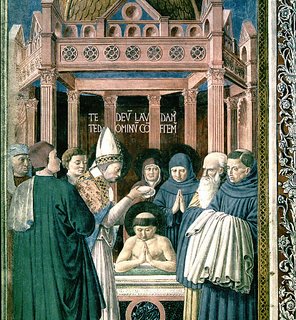
The picture above represents Augustine's baptism at the hands of Ambrose. The text behind his head is the opening of the medieval hymn, Te Deum Laudamus. Some legends tell of Augustine and Ambrose jointly improvising it at this moment.
Lection
Psalm 87 or 84:7-12
Hebrews 12:22-24,28-29
John 14:6-15
Collect
Lord God, the Light of minds who know You, the Life of souls who love You, and the Strength of hearts who serve You, help us to follow the example of Your servant Augustine of Hippo, knowing You that we may truly love You, and loving You that we may fully serve You, whom to serve is perfect freedom; through Jesus Christ our Lord, who lives and reigns with You and the Holy Spirit, one God, now and forever.
Hymn: Holy God, We Praise Your Name
Holy God, we praise your name;
Lord of all, we bow before you.
All on earth your scepter claim,
All in heaven above adore you.
Infinite your vast domain,
Everlasting is your reign.
Hark! The glad celestial hymn
Angel choirs above are raising;
Cherubim and seraphim,
In unceasing chorus praising,
Fill the heavens with sweet accord:
"Holy, holy, holy Lord!"
Lo, the apostolic train
Join your sacred name to hallow;
Prophets swell the glad refrain,
And the white robed martyrs follow;
And from morn to set of sun
Through the Church the song goes on.
You are King of Glory, Christ;
Son of God, yet born of Mary.
For us sinners sacrificed,
As to death a Tributary,
First to break the bars of death,
You have opened heaven to faith.
Holy Father, holy Son,
Holy Spirit, three we name you,
Though in essence only one;
Undivided God we claim you
And, adoring, bend the knee
While we own the mystery.
Canticle: Te Deum Laudamus
*See Alex Klages' blog A Beggar at the Table for details on this heresiarch, his false teachings, and the implications of his corrupt doctrine with Pelagius, Part 1 and Part 2.
**Pr. Klages also has more information on Arius.
Saint Augustine was one of the greatest of the Latin church fathers and was among the most significant influences in the formation of Western Christianity, including Lutheranism. He was born to Monica and Patricius, a Christian mother and a pagan father, in AD 354 in Tagaste, Numidia (now Souk Ahras in Algeria).
Augustine's early life was distinguished by exceptional advancement as a teacher of rhetoric. He described his life before his conversion to Christianity in his book Confessions. He was drawn into the moral laxity of the day, plagued by lust, and fathered an illegitimate son. He also joined himself to the Manichaeian religion.
Although he wandered (and sometimes wallowed) through a sinful, unchristian life for many years, Monica continued faithfully praying for Augustine's conversion. During his times of spiritual unrest, he moved first to Rome and later to Milan in order to find and hold teaching positions.Monica's prayers were answered as her son responded to God's Word and the work of the Holy Spirit through the the preaching of Ambrose, Bishop of Milan. Certainly Monica must have rejoiced to see her son baptized by Ambrose during the Easter Vigil of 387. However, her earthly joy was short-lived; she died at Ostia Antica, just outside Rome, as she was beginning a journey back to Africa with her sons Augustine and Navigius.
During the Pelagian Controversies* of the Fifth Century, Augustine fought the notion of salvation by works and emphasized the unilateral grace of God in the salvation of mankind. The great theologian served as Bishop of Hippo in North Africa from AD 395 until his death in 430. Augustine was a man of immense intellect and deep love, a fierce defender of the orthodox faith, and a prolific writer. In addition to his Confessions, Augustine's book City of God (De Civitate Dei) had great impact upon the Church throughout the Middle Ages and Renaissance.
His monastic rule was used and emulated in much of the Western Church. The Order of Saint Augustine adhered closely to his teachings. Through the Order, Augustine's theology had a profound impact upon the thinking of the young German monk, Martin Luther. Luther espoused and refined Augustine's understanding of divine grace and of original sin, becoming part of the theology that forged the Reformation.
The barbarian invasions of the 5th Century form the backdrop for his death. Saint Augustine died during the Vandal siege of Hippo. He urged resistance, at least in part because the Vandals held to the Arian heresy.** He is listed with Saint Ambrose as two of the Western (or Latin) fathers among the eight great Doctors of the undivided Church. Jerome and Gregory the Great are the West's other representatives; Athanasius, John Chrysostom, Basil the Great, and Gregory of Nazianzus represent Eastern (Greek) Christendom.
The picture above represents Augustine's baptism at the hands of Ambrose. The text behind his head is the opening of the medieval hymn, Te Deum Laudamus. Some legends tell of Augustine and Ambrose jointly improvising it at this moment.
Lection
Psalm 87 or 84:7-12
Hebrews 12:22-24,28-29
John 14:6-15
Collect
Lord God, the Light of minds who know You, the Life of souls who love You, and the Strength of hearts who serve You, help us to follow the example of Your servant Augustine of Hippo, knowing You that we may truly love You, and loving You that we may fully serve You, whom to serve is perfect freedom; through Jesus Christ our Lord, who lives and reigns with You and the Holy Spirit, one God, now and forever.
Hymn: Holy God, We Praise Your Name
Holy God, we praise your name;
Lord of all, we bow before you.
All on earth your scepter claim,
All in heaven above adore you.
Infinite your vast domain,
Everlasting is your reign.
Hark! The glad celestial hymn
Angel choirs above are raising;
Cherubim and seraphim,
In unceasing chorus praising,
Fill the heavens with sweet accord:
"Holy, holy, holy Lord!"
Lo, the apostolic train
Join your sacred name to hallow;
Prophets swell the glad refrain,
And the white robed martyrs follow;
And from morn to set of sun
Through the Church the song goes on.
You are King of Glory, Christ;
Son of God, yet born of Mary.
For us sinners sacrificed,
As to death a Tributary,
First to break the bars of death,
You have opened heaven to faith.
Holy Father, holy Son,
Holy Spirit, three we name you,
Though in essence only one;
Undivided God we claim you
And, adoring, bend the knee
While we own the mystery.
Canticle: Te Deum Laudamus
*See Alex Klages' blog A Beggar at the Table for details on this heresiarch, his false teachings, and the implications of his corrupt doctrine with Pelagius, Part 1 and Part 2.
**Pr. Klages also has more information on Arius.
Labels: african history, ambrose, arianism, augustine, biography, christianity, church history, commemoration, european history, hagiography, pelagianism
¶ 00:00 | 0 comments |


