
 This major Christological feast commemorates the joyous visit Mary paid to her relative (probably her cousin) Elizabeth, following The Annunciation. Inspired by the amazing news that she was to become the mother of the Christ and in response to the joyous word that her old and previously barren kinswoman was also pregnant, she joined Elizabeth during her sixth month of pregnancy (see Luke 1:39-56).
After Mary declared the wondrously good news, Elizabeth replied to the Virgin, "Blessed are you among women, and blessed is the fruit of your womb! ... Behold, when the sound of your greeting came to my ears, the baby in my womb leaped for joy. (vv. 42, 44)" She concluded by giving full credit and glory to God while also commending her young cousin's hearty faith: "Blessed is she who believed that there would be a fulfillment of what was spoken to her from the Lord. (v. 45)"
Mary responded with the Magnificat, the beautiful song of praise beginning, "My soul magnifies the Lord. (vv. 46-55)" It's not clear whether Mary stayed there until after the birth of John or if she left immediately beforehand; Luke merely said that the Virgin "remained with her about three months and returned to her home. (v. 56)"
And so, as we encounter God sending the Forerunner and the Messiah into the world, we see a study in contrasts. Two women stand before each other. One seemingly too old to bear children now carries the final prophet of the Old Covenant. The other, youthful and as yet unwed — completely unprepared in the eyes of the world — carries the One who brings both the Advent and the Fulfillment of the New Testament. And again we see, in the fullness of time, one age passing away while another age begins — an age that has no end but which lasts unto eternity.
The reaction of Jesus' unborn cousin and the words of his mother also serve as reminders to many Christians about the sanctity of life. Christian pro-lifers point to John's celebration as clear evidence of the humanity and the consciousness of children who are still in utero.
In Roman Catholicism, Vatican II changed the date of the observation from 2 July to 31 May in order to more accurately reflect the Bible's chronology regarding the life of Christ. Several other Western churches followed suit. In The Lutheran Church — Missouri Synod, today is celebrated in congregations following the Three Year Lectionary while the One Year Lectionary retains the July feast date.
Note: This illustration by Albrecht Dürer is from the Web Gallery of Art.
Lection
Psalm 138
Isaiah 11:1-5
Romans 12:9-16
Luke 1:39-56
Collect
Almighty God, You chose the virgin Mary to be the mother of Your Son and made known through her Your regard for the poor and lowly and despised. Grant that we may receive Your Word in humility and faith, and so be made one with Jesus Christ, Your Son, our Lord, who lives and reigns with You and the Holy Spirit, one God, now and forever.
The Magnificat
My soul magnifies the Lord,
and my spirit rejoices in God my Savior,
for He has looked on the humble estate of his servant.
For behold, from now on all generations will call me blessed;
for He who is mighty has done great things for me,
and holy is His name.
And His mercy is for those who fear Him
from generation to generation.
He has shown strength with His arm;
He has scattered the proud in the thoughts of their hearts;
He has brought down the mighty from their thrones
and exalted those of humble estate;
He has filled the hungry with good things,
and the rich He has sent empty away.
He has helped His servant Israel,
in remembrance of His mercy,
as He spoke to our fathers,
to Abraham and to his offspring forever.
Labels: christ, christology, elizabeth, feasts, festivals, gospels, incarnation, jesus, john the baptist, magnificat, mary, nativity, new testament, visitation
¶ 00:00 | 0 comments |

Transferred to 4 April AD 2016
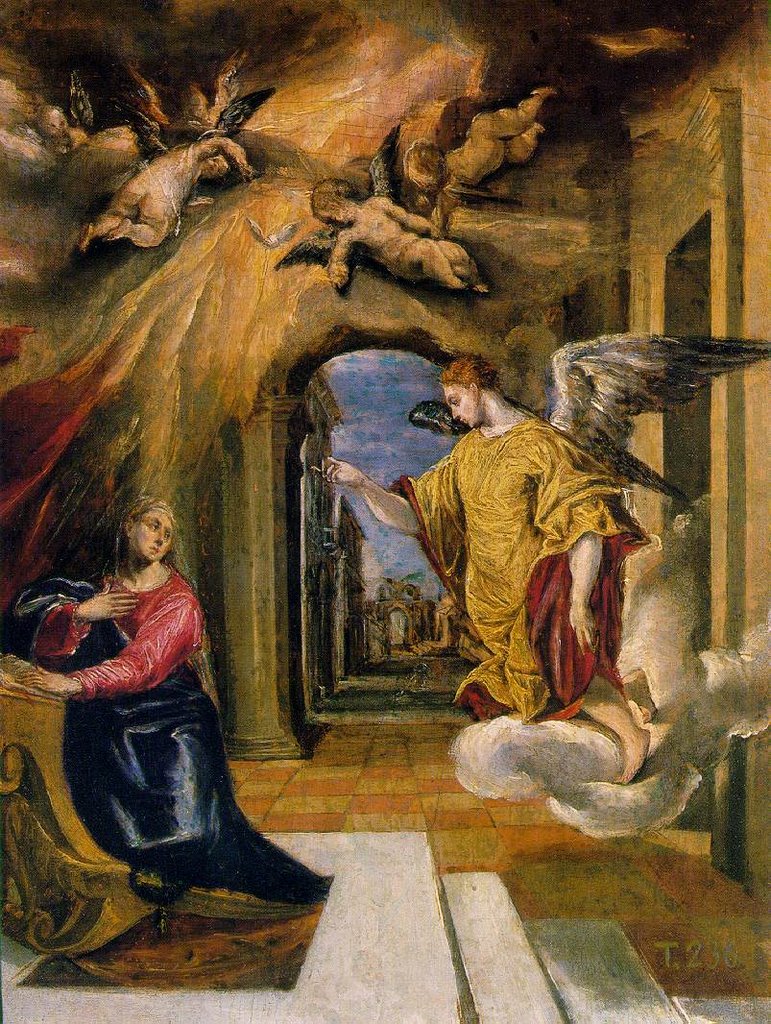 Luke 1:26-38 tells us how the angel Gabriel announced to Mary of Nazareth that she had been chosen to be the mother of the Christ and her response. Mary, a virgin pledged to marry Joseph, briefly wondered how this could be, since she had not had sex with any man.
Once Gabriel told her that the Child was conceived by the Holy Spirit, she humbly accepted this sacred obligation: "Behold, I am the servant of the Lord; let it be to me according to your word. (v. 38)"
Nothing prevents us from supposing that Our Lord was conceived immediately after this. Since the Church from early days observed 25 March as the date of the Annunciation, the celebration of the Christ's Nativity is observed on 25 December, nine months later.
For centuries in vast parts of Europe, 25 March also marked the change to the new year. While it seems somewhat odd and abrupt to change years in the middle of a month, we can imagine that those accustomed to that calendar easily made the adjustment. Furthermore, they could take to heart the reminder that God's chosen time, that most special time when He sent His Son into human flesh, merited such a "strange" circumstance.
Even though the Visitation of Mary to her cousin Elizabeth took place six months later (see Luke 1:39-56) — as Elizabeth neared the end of her own pregnancy with the child who would grow to become John the Baptizer — Mary's song of celebration at that time is also appropriate to remember on the Feast of the Annunciation. In the Magnificat (Luke 1:46-55) the virgin mother of God celebrated God's gift to her, to Israel, and to all people.
Martin Luther wrote a commentary on this canticle. About verse 49, he said, "The 'great things' are nothing less than that she became the Mother of God, in which work so many and such great good things are bestowed upon her as pass man's understanding. For on this there follows all honor, all blessedness, and her unique place in the whole of mankind, among whom she has no equal, namely, that she had a child by the Father in Heaven, and such a child.
"She herself is unable to find a name for this work, it is too exceedingly great; all she can do is break out in the fervent cry: 'They are great things,' impossible to describe or define. Hence men have crowded all her glory into a single word, calling her the Mother of God.
"No one can say anything greater of her or to her, though he had as many tongues as there are leaves on the trees, or grass in the fields, or stars in the sky, or sand by the sea. It needs to be pondered in the heart, what it means to be the Mother of God."
The Annunciation is such an important Christological feast that it takes precedence over even the Sundays in Lent in much of Christendom. See Looking Ahead at Weedon's Blog for details.
Lection
Psalm 45:7-17
Isaiah 7:10-14
Hebrews 10:4-10
Luke 1:26-38
Collect
O Lord, as we have known the incarnation of Your Son Jesus Christ by the message of the angel to the virgin Mary, so by His cross and Passion bring us to the glory of His resurrection; through the same Jesus Christ, our Lord, who lives and reigns with You and the Holy Spirit, one God, now and forever.
NOTE: Regarding the occasional transfer of this major feast, the Lutheran Service Book: Altar Book states on page 960, It is appropriate to observe this feast day in all its fullness during Lent. However, according to historical precedent, when the Annunciation falls during Holy Week or on Easter Day (or also on the Fifth Sunday in Lent in the one-year series), it should not be observed at those times but may be transferred to a weekday following the Second Sunday of Easter. In most of Eastern Christendom, rather than transferring the Annunciation, it is celebrated fully. In Orthodoxy, this normally means the celebratory Liturgy of John Chrysostom.
Luther quote from Luther's Works, Vol. 21, p. 326, ed. Jaroslav Pelikan, Concordia Publishing House © 1956.
Labels: annunciation, christ, christology, feasts, festivals, gabriel, gospels, incarnation, jesus, luke, mary, new testament, theotokos
¶ 00:00 | 0 comments |
 All that we know of Saint Joseph we learn from the first two chapters of Matthew and of Luke. Otherwise he is mentioned only in passing (see Luke 3:23; John 1:45; John 6:42) as the supposed father of Jesus of Nazareth.
Matthew shows Joseph's compassion for his betrothed wife: When the Virgin Mary revealed her pregnancy to him he sought to avoid a public rebuke, which may have resulted in her being stoned. Then after the Lord sent His angel and revealed Himself as the cause of this extraordinary circumstance, Joseph submitted to God's will, just as had his wife.
The Heavenly Father thus graciously allowed this unassuming man to bear the responsibility of protecting and providing for the Incarnate Word and the Theotokos. How could Joseph possibly have imagined the extraordinary events that awaited them, including the visits of shepherds and wise men, as well as Herod's wrath and their subsequent flight to Egypt?
 Joseph was a pious Jew, a descendant of David, and — as normally translated — a carpenter by trade. Actually, the the Greek word τέκτων (tekton) that is used in the Gospels can mean "builder" or "architect." Scholars suggest that Joseph may have been a repairman, a general craftsman, or a building contractor. And while other words are used in classical Greek, it's possible that tekton had a broader meaning in the Greek of the Scriptures and that Joseph may have been a metalworker, a stoneworker, or a mason.
Because of the silence of the Gospels — and because Jesus entrusted Mary to the care of John — it is generally believed that Joseph died a natural death after the visit to Jerusalem when Jesus was twelve (Luke 2:41-51) but likely before His baptism in the Jordan (Matthew 3:13-17), probably around His thirtieth year.
We can only wonder what influence Jesus' earthly father had on Him during His early years on earth.
Lection
Psalm 127
2 Samuel 7:4-16
Romans 4:13-18
Matthew 2:13-15, 19-23
Collect
Almighty God, from the house of Your servant David You raised up Joseph to be the guardian of Your incarnate Son and the husband of His mother, Mary. Grant us grace to follow the example of this faithful workman in heeding Your counsel and obeying Your commands; through Jesus Christ, our Lord, who lives and reigns with You and the Holy Spirit, one God, now and forever.
Labels: biography, father, feasts, festivals, gospels, guardian, hagiography, incarnation, joseph, mary, nativity, new testament, saint joseph
¶ 00:00 | 0 comments |
2 February, New Testament
 The Presentation of Our Lord at the Temple, one of the Christological feasts of the Christian Church, is Scripture's final infancy narrative concerning Jesus. After the Presentation, the Bible says nothing more about Him until His twelfth year.
Many liturgical calendars name this the Feast of the Purification (of the Blessed Virgin Mary), emphasizing its Marian connection. Still another term used is Candlemas, drawing the name from the tradition of blessing the coming year's church candles on this day.
Saint Luke is the only one of the Evangelists to describe the event (see 2:22-40), something likely unfamiliar to most of his Gentile readers. According to the Gospel, Mary and Joseph took the Baby to the Temple in Jerusalem forty days after his birth to consecrate Jesus to God and to complete the ritual purification of Mary, both of these because of the command of God's Law (Exodus 13:1-2, 11-16; Leviticus 12).
Upon entering the temple, the family encountered the devout and holy Simeon. Luke records that he was promised that "he would not see death before he had seen the Lord's Christ. (Luke 2:26)" Simeon took Jesus into his arms, prayed the prayer that would become known as the Nunc Dimittis, or Canticle of Simeon, blessed the parents, and prophesied regarding Jesus and Mary.
The prophetess Anna (2:36-38) was also in the temple. She, too, offered prayers and praise to God for sending the Savior.
In the Western liturgical calendar, the Presentation of Our Lord falls on 2 February because this is the fortieth day of Christmas. It is the last festival determined by the date of Christmas and thus shows that the Epiphany season is drawing to a close. Most churches in the East observe the occasion on 14 February since they celebrate Christ's Nativity on 6 January.
Lection
Psalm 84
1 Samuel 1:21-28
Hebrews 2:14-18
Luke 2:22-32 (33-40)
Collect
Almighty and ever-living God, as Your only-begotten Son was this day presented in the temple in the substance of our flesh, grant that we may be presented to You with pure and clean hearts; through Jesus Christ, our Lord, who lives and reigns with You and the Holy Spirit, one God, now and forever.
Labels: anna, christology, epiphany, feasts, festivals, gospels, incarnation, joseph, mary, nativity, new testament, presentation, purification, simeon, temple
¶ 00:00 | 0 comments |
This major Christological feast commemorates the joyous visit Mary paid to her relative (probably her cousin) Elizabeth, following The Annunciation. Inspired by the amazing news that she was to become the mother of the Christ and in response to the joyous word that her old and previously barren kinswoman was also pregnant, she joined Elizabeth during her sixth month of pregnancy (see Luke 1:39-56).After Mary declared the wondrously good news, Elizabeth replied to the Virgin, "Blessed are you among women, and blessed is the fruit of your womb! ... Behold, when the sound of your greeting came to my ears, the baby in my womb leaped for joy. (vv. 42, 44)" She concluded by giving full credit and glory to God while also commending her young cousin's hearty faith: "Blessed is she who believed that there would be a fulfillment of what was spoken to her from the Lord. (v. 45)"
Mary responded with the Magnificat, the beautiful song of praise beginning, "My soul magnifies the Lord. (vv. 46-55)" It's not clear whether Mary stayed there until after the birth of John or if she left immediately beforehand; Luke merely said that the Virgin "remained with her about three months and returned to her home. (v. 56)"
And so, as we encounter God sending the Forerunner and the Messiah into the world, we see a study in contrasts. Two women stand before each other. One seemingly too old to bear children now carries the final prophet of the Old Covenant. The other, youthful and as yet unwed — completely unprepared in the eyes of the world — carries the One who brings both the Advent and the Fulfillment of the New Testament. And again we see, in the fullness of time, one age passing away while another age begins — an age that has no end but which lasts unto eternity.
The reaction of Jesus' unborn cousin and the words of his mother also serve as reminders to many Christians about the sanctity of life. Christian pro-lifers point to John's celebration as clear evidence of the humanity and the consciousness of children who are still in utero.
In Roman Catholicism, Vatican II changed the date of the observation from 2 July to 31 May in order to more accurately reflect the Bible's chronology regarding the life of Christ. Several other Western churches followed suit. In The Lutheran Church — Missouri Synod, today is celebrated in congregations following the Three Year Lectionary while the One Year Lectionary retains the July feast date.
Note: This illustration by Albrecht Dürer is from the Web Gallery of Art.
Lection
Psalm 138
Isaiah 11:1-5
Romans 12:9-16
Luke 1:39-56
Collect
Almighty God, You chose the virgin Mary to be the mother of Your Son and made known through her Your regard for the poor and lowly and despised. Grant that we may receive Your Word in humility and faith, and so be made one with Jesus Christ, Your Son, our Lord, who lives and reigns with You and the Holy Spirit, one God, now and forever.
The Magnificat
My soul magnifies the Lord,
and my spirit rejoices in God my Savior,
for He has looked on the humble estate of his servant.
For behold, from now on all generations will call me blessed;
for He who is mighty has done great things for me,
and holy is His name.
And His mercy is for those who fear Him
from generation to generation.
He has shown strength with His arm;
He has scattered the proud in the thoughts of their hearts;
He has brought down the mighty from their thrones
and exalted those of humble estate;
He has filled the hungry with good things,
and the rich He has sent empty away.
He has helped His servant Israel,
in remembrance of His mercy,
as He spoke to our fathers,
to Abraham and to his offspring forever.
Labels: christ, christology, elizabeth, feasts, festivals, gospels, incarnation, jesus, john the baptist, magnificat, mary, nativity, new testament, visitation
¶ 00:00 | 0 comments |
Transferred to 4 April AD 2016
NOTE: Regarding the transfer of this major feast, the Lutheran Service Book: Altar Book states on page 960, It is appropriate to observe this feast day in all its fullness during Lent. However, according to historical precedent, when the Annunciation falls during Holy Week or on Easter Day (or also on the Fifth Sunday in Lent in the one-year series), it should not be observed at those times but may be transferred to a weekday following the Second Sunday of Easter. In most of Eastern Christendom, rather than transferring the Annunciation, it is celebrated fully. In Orthodoxy, this normally means the celebratory Liturgy of John Chrysostom.
Luke 1:26-38 tells us how the angel Gabriel announced to Mary of Nazareth that she had been chosen to be the mother of the Christ and her response. Mary, a virgin pledged to marry Joseph, briefly wondered how this could be, since she had not had sex with any man.Once Gabriel told her that the Child was conceived by the Holy Spirit, she humbly accepted this sacred obligation: "Behold, I am the servant of the Lord; let it be to me according to your word. (v. 38)"
Nothing prevents us from supposing that Our Lord was conceived immediately after this. Since the Church from early days observed 25 March as the date of the Annunciation, the celebration of the Christ's Nativity is observed on 25 December, nine months later.
For centuries in vast parts of Europe, 25 March also marked the change to the new year. While it seems somewhat odd and abrupt to change years in the middle of a month, we can imagine that those accustomed to that calendar easily made the adjustment. Furthermore, they could take to heart the reminder that God's chosen time, that most special time when He sent His Son into human flesh, merited such a "strange" circumstance.
Even though the Visitation of Mary to her cousin Elizabeth took place six months later (see Luke 1:39-56) — as Elizabeth neared the end of her own pregnancy with the child who would grow to become John the Baptizer — Mary's song of celebration at that time is also appropriate to remember on the Feast of the Annunciation. In the Magnificat (Luke 1:46-55) the virgin mother of God celebrated God's gift to her, to Israel, and to all people.
Martin Luther wrote a commentary on this canticle. About verse 49, he said, "The 'great things' are nothing less than that she became the Mother of God, in which work so many and such great good things are bestowed upon her as pass man's understanding. For on this there follows all honor, all blessedness, and her unique place in the whole of mankind, among whom she has no equal, namely, that she had a child by the Father in Heaven, and such a child.
"She herself is unable to find a name for this work, it is too exceedingly great; all she can do is break out in the fervent cry: 'They are great things,' impossible to describe or define. Hence men have crowded all her glory into a single word, calling her the Mother of God.
"No one can say anything greater of her or to her, though he had as many tongues as there are leaves on the trees, or grass in the fields, or stars in the sky, or sand by the sea. It needs to be pondered in the heart, what it means to be the Mother of God."
The Annunciation is such an important Christological feast that it takes precedence over even the Sundays in Lent in much of Christendom. See Looking Ahead at Weedon's Blog for details.
Lection
Psalm 45:7-17
Isaiah 7:10-14
Hebrews 10:4-10
Luke 1:26-38
Collect
O Lord, as we have known the incarnation of Your Son Jesus Christ by the message of the angel to the virgin Mary, so by His cross and Passion bring us to the glory of His resurrection; through the same Jesus Christ, our Lord, who lives and reigns with You and the Holy Spirit, one God, now and forever.
Luther quote from Luther's Works, Vol. 21, p. 326, ed. Jaroslav Pelikan, Concordia Publishing House © 1956.
Labels: annunciation, christ, christology, feasts, festivals, gabriel, gospels, incarnation, jesus, luke, mary, new testament, theotokos
¶ 00:01 | 0 comments |
All that we know of Saint Joseph we learn from the first two chapters of Matthew and of Luke. Otherwise he is mentioned only in passing (see Luke 3:23; John 1:45; John 6:42) as the supposed father of Jesus of Nazareth.Matthew shows Joseph's compassion for his betrothed wife: When the Virgin Mary revealed her pregnancy to him he sought to avoid a public rebuke, which may have resulted in her being stoned. Then after the Lord sent His angel and revealed Himself as the cause of this extraordinary circumstance, Joseph submitted to God's will, just as had his wife.
The Heavenly Father thus graciously allowed this unassuming man to bear the responsibility of protecting and providing for the Incarnate Word and the Theotokos. How could Joseph possibly have imagined the extraordinary events that awaited them, including the visits of shepherds and wise men, as well as Herod's wrath and their subsequent flight to Egypt?
Joseph was a pious Jew, a descendant of David, and — as normally translated — a carpenter by trade. Actually, the the Greek word τέκτων (tekton) that is used in the Gospels can mean "builder" or "architect." Scholars suggest that Joseph may have been a repairman, a general craftsman, or a building contractor. And while other words are used in classical Greek, it's possible that tekton had a broader meaning in the Greek of the Scriptures and that Joseph may have been a metalworker, a stoneworker, or a mason.Because of the silence of the Gospels — and because Jesus entrusted Mary to the care of John — it is generally believed that Joseph died a natural death after the visit to Jerusalem when Jesus was twelve (Luke 2:41-51) but likely before His baptism in the Jordan (Matthew 3:13-17), probably around His thirtieth year.
We can only wonder what influence Jesus' earthly father had on Him during His early years on earth.
Lection
Psalm 127
2 Samuel 7:4-16
Romans 4:13-18
Matthew 2:13-15, 19-23
Collect
Almighty God, from the house of Your servant David You raised up Joseph to be the guardian of Your incarnate Son and the husband of His mother, Mary. Grant us grace to follow the example of this faithful workman in heeding Your counsel and obeying Your commands; through Jesus Christ, our Lord, who lives and reigns with You and the Holy Spirit, one God, now and forever.
Labels: biography, father, feasts, festivals, gospels, guardian, hagiography, incarnation, joseph, mary, nativity, new testament, saint joseph
¶ 00:00 | 0 comments |
 Many Christians have problems with the world's celebration of Christmas. Baby dolls overwhelm the Baby Jesus in TV advertising. Violent video games replace "peace on earth" on too many wish lists. "Save Twenty Percent or More," drowns out mention of the Savior of the nations.
The characters in A Charlie Brown Christmas illustrate many of the wrong attitudes and actions: Crabby Lucy is in it for the presents. Snoopy glorifies himself by competing in (and winning) the home decorating contest. Schroeder looks at the pageant as an opportunity to show off his musical abilities. Linus sees the season through a lens of fear at standing on stage in the Christmas program. And Good Ol' Charlie Brown knows that something's wrong — something's missing — only he can't figure out just what.
Christians enjoy seeing Linus figure things out and recite the Christmas story from Luke 2. We smile as the arguing and misunderstanding disappear and the kids decorate the ratty little tree and sing "Hark! The Herald Angels." Finally someone "gets" Christmas!
We hear others (or ourselves) say, "Let's put the 'Christ' back in Christmas." Some even spell the word "CHRISTmas," with the capital letters pointing out the Savior. Nothing is wrong with increased emphasis on Jesus. Indeed, any proper focus on Him over worldly things deserves our attention. Yet when we get to the common name for the holiday ("holy" + "day" = "holiday"), we dare not forget also to keep the "Mass" in Christmas.
 What does this mean? Only that the Christian holy day celebrating the Nativity of Our Lord deserves more than a tree and some colored lights. "Mass" is the ancient word for the Christian worship service, specifically, the Communion service. We cannot go to Bethlehem to find Christ, nor to Calvary or the empty tomb. We find Him where He says He will be, "in the midst" of the gathering, in His Word and His Supper.
"The Word became flesh and dwelt among us. (John 1:14a)"
"He was incarnate [made flesh] by the Holy Spirit of the Virgin Mary (Apostles' Creed, Second Article)."
"She gave birth to her firstborn Son and wrapped Him in swaddling cloths and laid Him in a manger. (Luke 2:7a)"
That Word, the eternal Son of God, gives us His forgiveness through the preaching of His Word, the Gospel. He who became flesh and was lain in the bin where the animals ate has become our food as we come to His altar. While we might stay home thinking nice thoughts about Jesus — we may even take time for Bible reading, devotions, songs, and prayers — it's only in His house, in His divine service, where we begin to see "his glory, glory as of the only Son from the Father, full of grace and truth. (John 1:14b)"
 The carol urges, "Come to Bethlehem and see Him whose birth the angels sing. Come adore on bended knee Christ the Lord, our newborn King." If you would do this, then come to His house. Come not merely to give gifts and honor, for He already has all things under His divine control. You can give Him nothing that isn't already His — including yourself, your life, and your love. Come instead to receive. Receive the Christ. Receive forgiveness. Receive peace and reconciliation with God and carry this peace into a strife-torn world. Receive the fullness of His grace and truth and receive eternal life. Ask God to help you keep the "Mass" and the "Christ" in CHRIST-MASS.
God isn't calling you to a cold, dark stable. Most likely, He's inviting you, your family, and your friends to a nice, warm church. You probably won't have to spend time with dusty hay or smelly animals; you can sit in nice, clean clothes among well-bathed people. Yet He still calls you to see and receive the same Savior those shepherds met during a Bethlehem night over two thousand years ago. Will you make excuses to stay away, or will you go "with haste" to meet Him and then make known what you are told "concerning this Child (Luke 2:16-17)"?
This Christmas Day, come see the Gift God gives you — not one under a tree, but One who was nailed to a tree, shedding His blood to set you free. Not a Gift you'll bury in a closet, but One who was buried in a tomb only to rise on the third day. Not a Gift you'll hasten to exchange for something better, but One who worked a great exchange, taking your sins and giving you His righteousness. How could Christmas be merrier than in knowing that God loves you so much?
Merry CHRISTmas. Merry ChristMASS. Merry CHRISTMAS!
Scripture quoted from the ESV®
Labels: christ, christmas, communion, feasts, festivals, flesh, incarnation, jesus, mass, nativity, word
¶ 00:00 | 0 comments |


