Aardvark Alley

Confessional Lutheran theology, hagiography, philosophy, music, culture, sports, education,
and whatever else is on the fevered mind of Orycteropus Afer
01 March 2017
+ Saint Dewi of Mynyw +
1 March AD 601
 Dewi Sant (also Degui or David), Bishop and Confessor and patron of Wales, is usually represented standing on a little hill, with a dove on his shoulder. From ancient times, the Welsh have worn a leek on St. David's Day in memory of a battle against the Saxons. There, it is said they wore leeks in their hats at St. David's advice, to distinguish them from their enemies. The Welsh honor him not only as their patron saint but as special evangelist of their land, just as Pádraig holds that honor for Ireland.
The earliest mention of St. David is found in a tenth-century manuscript, the Annales Cambriae, which assigns his death to AD 601. Many other writers, from Geoffrey of Monmouth down to Father Richard Stanton, hold that he died about 544; their opinion is based solely on data given in various late "lives" of St. David, and there seems no good reason for setting aside the definite statement of the Annales Cambriae, which is now generally accepted.
Speculation that he was born at Henvynyw (Vetus-Menevia) in Cardiganshire is not improbable. He was prominent at the Synod of Brevi (Llandewi Brefi in Cardiganshire). Dewi was active in refuting heresy in Wales and in promoting Nicene Christology and the orthodox Christian faith.
 According to tradition, Saints Dubricius and Deiniol sought him out, calling him to the Synod of Brevi "against the Pelagians."* Only with great difficulty was Dewi persuaded to accompany them, since he preferred the quiet monastic life. However, once he arrived at the Synod, he preached so loudly and so eloquently that all the heretics were confounded. Shortly afterwards, in 569, he presided over another synod held at a place called Lucus Victoriae.
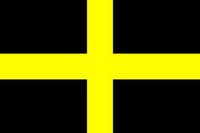
David is the only one of the four patron saints of the British Isles not to be represented on the British Union Jack flag. The Alley's biography for Saint Andrew touches upon each of these and their respective emblems.
*For more information on Pelagianism, please see Pelagius, Part 1 and Pelagius, Part 2 by Pastor Alex Klages.
Lection
Psalm 16:5-11 or 96:1-7
1 Thessalonians 2:2b-12
Mark 4:26-29
Collect
Almighty God, who called your servant Dewi to be a faithful and wise steward of your mysteries for the people of Wales, mercifully grant that, following his purity of life and zeal for the gospel of Christ, we may with him receive the crown of everlasting life; through Jesus Christ our Lord, who lives and reigns with you and the Holy Spirit, one God, now and forever.


 Dewi Sant (also Degui or David), Bishop and Confessor and patron of Wales, is usually represented standing on a little hill, with a dove on his shoulder. From ancient times, the Welsh have worn a leek on St. David's Day in memory of a battle against the Saxons. There, it is said they wore leeks in their hats at St. David's advice, to distinguish them from their enemies. The Welsh honor him not only as their patron saint but as special evangelist of their land, just as Pádraig holds that honor for Ireland.
The earliest mention of St. David is found in a tenth-century manuscript, the Annales Cambriae, which assigns his death to AD 601. Many other writers, from Geoffrey of Monmouth down to Father Richard Stanton, hold that he died about 544; their opinion is based solely on data given in various late "lives" of St. David, and there seems no good reason for setting aside the definite statement of the Annales Cambriae, which is now generally accepted.
Speculation that he was born at Henvynyw (Vetus-Menevia) in Cardiganshire is not improbable. He was prominent at the Synod of Brevi (Llandewi Brefi in Cardiganshire). Dewi was active in refuting heresy in Wales and in promoting Nicene Christology and the orthodox Christian faith.
 According to tradition, Saints Dubricius and Deiniol sought him out, calling him to the Synod of Brevi "against the Pelagians."* Only with great difficulty was Dewi persuaded to accompany them, since he preferred the quiet monastic life. However, once he arrived at the Synod, he preached so loudly and so eloquently that all the heretics were confounded. Shortly afterwards, in 569, he presided over another synod held at a place called Lucus Victoriae.
David is the only one of the four patron saints of the British Isles not to be represented on the British Union Jack flag. The Alley's biography for Saint Andrew touches upon each of these and their respective emblems.
*For more information on Pelagianism, please see Pelagius, Part 1 and Pelagius, Part 2 by Pastor Alex Klages.
Lection
Psalm 16:5-11 or 96:1-7
1 Thessalonians 2:2b-12
Mark 4:26-29
Collect
Almighty God, who called your servant Dewi to be a faithful and wise steward of your mysteries for the people of Wales, mercifully grant that, following his purity of life and zeal for the gospel of Christ, we may with him receive the crown of everlasting life; through Jesus Christ our Lord, who lives and reigns with you and the Holy Spirit, one God, now and forever.
Labels: biography, british history, church history, commemoration, david, dewi, hagiography, missionary, patron saint, pelagianism, wales
¶ 00:10 | 0 comments |
01 March 2016
+ Saint Dewi of Mynyw +
1 March AD 601
Dewi Sant (also Degui or David), Bishop and Confessor and patron of Wales, is usually represented standing on a little hill, with a dove on his shoulder. From ancient times, the Welsh have worn a leek on St. David's Day in memory of a battle against the Saxons. There, it is said they wore leeks in their hats at St. David's advice, to distinguish them from their enemies. The Welsh honor him not only as their patron saint but as special evangelist of their land, just as Pádraig holds that honor for Ireland.
The earliest mention of St. David is found in a tenth-century manuscript, the Annales Cambriae, which assigns his death to AD 601. Many other writers, from Geoffrey of Monmouth down to Father Richard Stanton, hold that he died about 544; their opinion is based solely on data given in various late "lives" of St. David, and there seems no good reason for setting aside the definite statement of the Annales Cambriae, which is now generally accepted.
Speculation that he was born at Henvynyw (Vetus-Menevia) in Cardiganshire is not improbable. He was prominent at the Synod of Brevi (Llandewi Brefi in Cardiganshire). Dewi was active in refuting heresy in Wales and in promoting Nicene Christology and the orthodox Christian faith.
According to tradition, Saints Dubricius and Deiniol sought him out, calling him to the Synod of Brevi "against the Pelagians."* Only with great difficulty was Dewi persuaded to accompany them, since he preferred the quiet monastic life. However, once he arrived at the Synod, he preached so loudly and so eloquently that all the heretics were confounded. Shortly afterwards, in 569, he presided over another synod held at a place called Lucus Victoriae.
David is the only one of the four patron saints of the British Isles not to be represented on the British Union Jack flag. The Alley's biography for Saint Andrew touches upon each of these and their respective emblems.
*For more information on Pelagianism, please see Pelagius, Part 1 and Pelagius, Part 2 by Pastor Alex Klages.
Lection
Psalm 16:5-11 or 96:1-7
1 Thessalonians 2:2b-12
Mark 4:26-29
Collect
Almighty God, who called your servant Dewi to be a faithful and wise steward of your mysteries for the people of Wales, mercifully grant that, following his purity of life and zeal for the gospel of Christ, we may with him receive the crown of everlasting life; through Jesus Christ our Lord, who lives and reigns with you and the Holy Spirit, one God, now and forever.
Dewi Sant (also Degui or David), Bishop and Confessor and patron of Wales, is usually represented standing on a little hill, with a dove on his shoulder. From ancient times, the Welsh have worn a leek on St. David's Day in memory of a battle against the Saxons. There, it is said they wore leeks in their hats at St. David's advice, to distinguish them from their enemies. The Welsh honor him not only as their patron saint but as special evangelist of their land, just as Pádraig holds that honor for Ireland.The earliest mention of St. David is found in a tenth-century manuscript, the Annales Cambriae, which assigns his death to AD 601. Many other writers, from Geoffrey of Monmouth down to Father Richard Stanton, hold that he died about 544; their opinion is based solely on data given in various late "lives" of St. David, and there seems no good reason for setting aside the definite statement of the Annales Cambriae, which is now generally accepted.
Speculation that he was born at Henvynyw (Vetus-Menevia) in Cardiganshire is not improbable. He was prominent at the Synod of Brevi (Llandewi Brefi in Cardiganshire). Dewi was active in refuting heresy in Wales and in promoting Nicene Christology and the orthodox Christian faith.
According to tradition, Saints Dubricius and Deiniol sought him out, calling him to the Synod of Brevi "against the Pelagians."* Only with great difficulty was Dewi persuaded to accompany them, since he preferred the quiet monastic life. However, once he arrived at the Synod, he preached so loudly and so eloquently that all the heretics were confounded. Shortly afterwards, in 569, he presided over another synod held at a place called Lucus Victoriae.David is the only one of the four patron saints of the British Isles not to be represented on the British Union Jack flag. The Alley's biography for Saint Andrew touches upon each of these and their respective emblems.
*For more information on Pelagianism, please see Pelagius, Part 1 and Pelagius, Part 2 by Pastor Alex Klages.
Lection
Psalm 16:5-11 or 96:1-7
1 Thessalonians 2:2b-12
Mark 4:26-29
Collect
Almighty God, who called your servant Dewi to be a faithful and wise steward of your mysteries for the people of Wales, mercifully grant that, following his purity of life and zeal for the gospel of Christ, we may with him receive the crown of everlasting life; through Jesus Christ our Lord, who lives and reigns with you and the Holy Spirit, one God, now and forever.
Labels: biography, british history, church history, commemoration, david, dewi, hagiography, missionary, patron saint, pelagianism, wales
¶ 00:00 | 0 comments |
28 August 2015
+ Augustine of Hippo, Doctor of the Church +
28 August AD 430
Saint Augustine was one of the greatest of the Latin church fathers and was among the most significant influences in the formation of Western Christianity, including Lutheranism. He was born to Monica and Patricius, a Christian mother and a pagan father, in AD 354 in Tagaste, Numidia (now Souk Ahras in Algeria).
Augustine's early life was distinguished by exceptional advancement as a teacher of rhetoric. He described his life before his conversion to Christianity in his book Confessions. He was drawn into the moral laxity of the day, plagued by lust, and fathered an illegitimate son. He also joined himself to the Manichaeian religion.
 Although he wandered (and sometimes wallowed) through a sinful, unchristian life for many years, Monica continued faithfully praying for Augustine's conversion. During his times of spiritual unrest, he moved first to Rome and later to Milan in order to find and hold teaching positions.
Monica's prayers were answered as her son responded to God's Word and the work of the Holy Spirit through the the preaching of Ambrose, Bishop of Milan. Certainly Monica must have rejoiced to see her son baptized by Ambrose during the Easter Vigil of 387. However, her earthly joy was short-lived; she died at Ostia Antica, just outside Rome, as she was beginning a journey back to Africa with her sons Augustine and Navigius.
During the Pelagian Controversies* of the Fifth Century, Augustine fought the notion of salvation by works and emphasized the unilateral grace of God in the salvation of mankind. The great theologian served as Bishop of Hippo in North Africa from AD 395 until his death in 430. Augustine was a man of immense intellect and deep love, a fierce defender of the orthodox faith, and a prolific writer. In addition to his Confessions, Augustine's book City of God (De Civitate Dei) had great impact upon the Church throughout the Middle Ages and Renaissance.
His monastic rule was used and emulated in much of the Western Church. The Order of Saint Augustine adhered closely to his teachings. Through the Order, Augustine's theology had a profound impact upon the thinking of the young German monk, Martin Luther. Luther espoused and refined Augustine's understanding of divine grace and of original sin, becoming part of the theology that forged the Reformation.
The barbarian invasions of the 5th Century form the backdrop for his death. Saint Augustine died during the Vandal siege of Hippo. He urged resistance, at least in part because the Vandals held to the Arian heresy.** He is listed with Saint Ambrose as two of the Western (or Latin) fathers among the eight great Doctors of the undivided Church. Jerome and Gregory the Great are the West's other representatives; Athanasius, John Chrysostom, Basil the Great, and Gregory of Nazianzus represent Eastern (Greek) Christendom.
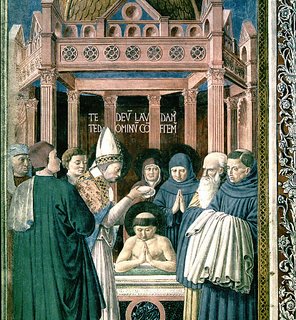
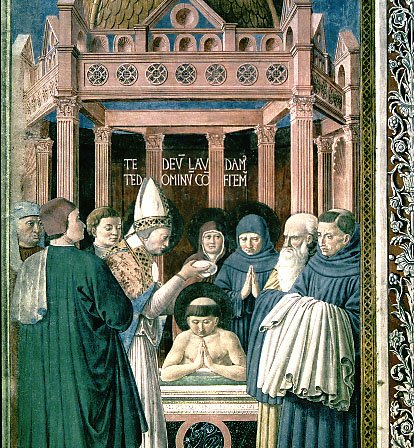
The picture above represents Augustine's baptism at the hands of Ambrose. The text behind his head is the opening of the medieval hymn, Te Deum Laudamus. Some legends tell of Augustine and Ambrose jointly improvising it at this moment.
Lection
Psalm 87 or 84:7-12
Hebrews 12:22-24,28-29
John 14:6-15
Collect
Lord God, the Light of minds who know You, the Life of souls who love You, and the Strength of hearts who serve You, help us to follow the example of Your servant Augustine of Hippo, knowing You that we may truly love You, and loving You that we may fully serve You, whom to serve is perfect freedom; through Jesus Christ our Lord, who lives and reigns with You and the Holy Spirit, one God, now and forever.
Hymn: Holy God, We Praise Your Name
Holy God, we praise your name;
Lord of all, we bow before you.
All on earth your scepter claim,
All in heaven above adore you.
Infinite your vast domain,
Everlasting is your reign.
Hark! The glad celestial hymn
Angel choirs above are raising;
Cherubim and seraphim,
In unceasing chorus praising,
Fill the heavens with sweet accord:
"Holy, holy, holy Lord!"
Lo, the apostolic train
Join your sacred name to hallow;
Prophets swell the glad refrain,
And the white robed martyrs follow;
And from morn to set of sun
Through the Church the song goes on.
You are King of Glory, Christ;
Son of God, yet born of Mary.
For us sinners sacrificed,
As to death a Tributary,
First to break the bars of death,
You have opened heaven to faith.
Holy Father, holy Son,
Holy Spirit, three we name you,
Though in essence only one;
Undivided God we claim you
And, adoring, bend the knee
While we own the mystery.
Canticle: Te Deum Laudamus
*See Alex Klages' blog A Beggar at the Table for details on this heresiarch, his false teachings, and the implications of his corrupt doctrine with Pelagius, Part 1 and Part 2.
**Pr. Klages also has more information on Arius.
Saint Augustine was one of the greatest of the Latin church fathers and was among the most significant influences in the formation of Western Christianity, including Lutheranism. He was born to Monica and Patricius, a Christian mother and a pagan father, in AD 354 in Tagaste, Numidia (now Souk Ahras in Algeria).
Augustine's early life was distinguished by exceptional advancement as a teacher of rhetoric. He described his life before his conversion to Christianity in his book Confessions. He was drawn into the moral laxity of the day, plagued by lust, and fathered an illegitimate son. He also joined himself to the Manichaeian religion.
 Although he wandered (and sometimes wallowed) through a sinful, unchristian life for many years, Monica continued faithfully praying for Augustine's conversion. During his times of spiritual unrest, he moved first to Rome and later to Milan in order to find and hold teaching positions.
Monica's prayers were answered as her son responded to God's Word and the work of the Holy Spirit through the the preaching of Ambrose, Bishop of Milan. Certainly Monica must have rejoiced to see her son baptized by Ambrose during the Easter Vigil of 387. However, her earthly joy was short-lived; she died at Ostia Antica, just outside Rome, as she was beginning a journey back to Africa with her sons Augustine and Navigius.
During the Pelagian Controversies* of the Fifth Century, Augustine fought the notion of salvation by works and emphasized the unilateral grace of God in the salvation of mankind. The great theologian served as Bishop of Hippo in North Africa from AD 395 until his death in 430. Augustine was a man of immense intellect and deep love, a fierce defender of the orthodox faith, and a prolific writer. In addition to his Confessions, Augustine's book City of God (De Civitate Dei) had great impact upon the Church throughout the Middle Ages and Renaissance.
His monastic rule was used and emulated in much of the Western Church. The Order of Saint Augustine adhered closely to his teachings. Through the Order, Augustine's theology had a profound impact upon the thinking of the young German monk, Martin Luther. Luther espoused and refined Augustine's understanding of divine grace and of original sin, becoming part of the theology that forged the Reformation.
The barbarian invasions of the 5th Century form the backdrop for his death. Saint Augustine died during the Vandal siege of Hippo. He urged resistance, at least in part because the Vandals held to the Arian heresy.** He is listed with Saint Ambrose as two of the Western (or Latin) fathers among the eight great Doctors of the undivided Church. Jerome and Gregory the Great are the West's other representatives; Athanasius, John Chrysostom, Basil the Great, and Gregory of Nazianzus represent Eastern (Greek) Christendom.
The picture above represents Augustine's baptism at the hands of Ambrose. The text behind his head is the opening of the medieval hymn, Te Deum Laudamus. Some legends tell of Augustine and Ambrose jointly improvising it at this moment.
Lection
Psalm 87 or 84:7-12
Hebrews 12:22-24,28-29
John 14:6-15
Collect
Lord God, the Light of minds who know You, the Life of souls who love You, and the Strength of hearts who serve You, help us to follow the example of Your servant Augustine of Hippo, knowing You that we may truly love You, and loving You that we may fully serve You, whom to serve is perfect freedom; through Jesus Christ our Lord, who lives and reigns with You and the Holy Spirit, one God, now and forever.
Hymn: Holy God, We Praise Your Name
Holy God, we praise your name;
Lord of all, we bow before you.
All on earth your scepter claim,
All in heaven above adore you.
Infinite your vast domain,
Everlasting is your reign.
Hark! The glad celestial hymn
Angel choirs above are raising;
Cherubim and seraphim,
In unceasing chorus praising,
Fill the heavens with sweet accord:
"Holy, holy, holy Lord!"
Lo, the apostolic train
Join your sacred name to hallow;
Prophets swell the glad refrain,
And the white robed martyrs follow;
And from morn to set of sun
Through the Church the song goes on.
You are King of Glory, Christ;
Son of God, yet born of Mary.
For us sinners sacrificed,
As to death a Tributary,
First to break the bars of death,
You have opened heaven to faith.
Holy Father, holy Son,
Holy Spirit, three we name you,
Though in essence only one;
Undivided God we claim you
And, adoring, bend the knee
While we own the mystery.
Canticle: Te Deum Laudamus
*See Alex Klages' blog A Beggar at the Table for details on this heresiarch, his false teachings, and the implications of his corrupt doctrine with Pelagius, Part 1 and Part 2.
**Pr. Klages also has more information on Arius.
Labels: african history, ambrose, arianism, augustine, biography, christianity, church history, commemoration, european history, hagiography, pelagianism
¶ 00:00 | 0 comments |


