
Born in Flavia Neapolis, Palestine around AD 100, near the close of the New Testament period, Justin was the son of pagan Greek parents. He was a philosophy student who studied in Alexandria, moving from Stoicism to Pythagoreanism and then Platonism as he sought to make sense of life. He converted to the Christian faith and became a teacher in Ephesus and Rome. Justin wrote that his conversion came as he observed the steadfast faith of Ephesian martyrs and through an elderly Christian whom he met along the shore of the sea.
 Justin probably wrote much more than we have preserved, but three extant works show his intellect, his never completely abandoned Platonic philosophical education, and his inclination toward apologetics — that is, an intellectual defense of the Faith.
In his First Apology, addressed to Emperor Antoninus Pius and his adopted sons, Justin defended Christianity as the only rational creed. He included accounts of contemporary baptismal and communion rites, quite possibly designed to rebut distorted accounts from anti-Christian sources. Some of these anti-Christian writings claimed that Christians were cannibals (probably because of a distorted second hand understanding of the Lord's Supper).
He addressed his Second Apology to the Roman Senate. It counters spurious charges of immorality and the like that were being made against Christians. He said that only those who misunderstood the Faith would accuse it of undermining Roman society and countered that Christians made good citizens.
His Dialogue with Trypho the Jewish rabbi shows him at his strength. He carefully defended Christian teaching while allowing that the Church would continue to welcome Jews and would let them remain faithful to the laws of the Torah. While he may have edited it to provide himself with a few good lines, the text reads as a faithful exposition of an actual conversation.
Justin was living in Rome when the cynic philosopher Crescens stirred up trouble for the Christians. After refusing to make pagan sacrifices, Justin was arrested, tried and executed, along with six other believers, including Charites, Paeon, and Liberianus. The official Roman court proceedings of his trial before Rusticius, a Roman prelate, document his confession of faith. The account of his martyrdom became a source of great encouragement to the early Christian community.
Much of what we know of early liturgical practice comes from Justin. For example, in the First Apology he gave this brief description of Holy Communion: "On finishing the prayers we greet each other with a kiss. Then bread and a cup of water mixed with wine are brought to the leader and he, taking them, sends up praise and glory to the Father of the Universe through the name of the Son and of the Holy Spirit, and offers thanksgiving at some length that we have been deemed worthy to receive these things. When the leader has finished the prayers and thanksgivings, the whole congregation assents, saying, 'Amen.' ('Amen' is Hebrew for 'So be it.') Then those whom we call deacons give to each of those present a portion of the consecrated bread and wine and water, and they take it to the absent."
Suggested Lection
Psalm 16:5-11 or 116:1-8
1 Corinthians 1:18-25
John 12:44-50
Collect
Almighty and everlasting God, who found Your martyr Justin wandering from teacher to teacher, seeking the true God, and revealed to him the sublime wisdom of Your eternal Word, grant that all who seek You, or a deeper knowledge of You, may find and be found by You; through Jesus Christ our Lord, who lives and reigns with you and the Holy Spirit, one God, now and forever.
Labels: apologetics, biography, church history, dialogue, hagiography, justin, liturgics, martyr, martyrdom, patristics, philosophy, platonism, trypho
¶ 00:00 | 0 comments |

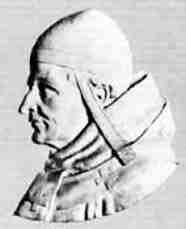 Known as the father of medieval Scholasticism, Anselm was born in Italy in 1033. Most closely associated with England, he first served as prior and abbot of the Benedictine Abbey in Bec, Normandy, later becoming Archbishop of Canterbury for many years.
A brilliant scholar and writer who loved the works and followed in the way of Augustine, Anselm used his political skills with the British kings on behalf of the established Christian Church, affirming that it is the leadership of the Church and not the state which has the responsibility of establishing structure and maintaining order among the clergy.
Anselm's book Cur Deus homo (Why God Became Man) expresses his thoughts on Christ's atonement and taught that the reason for the incarnation was that Jesus, the Son of God, would suffer and die in place of sinners. His Monologium shows the beginnings of his ontological argument for the existence of God. He further developed this philosophical argument in the Proslogion (also spelled Proslogium).
He was canonized in 1494 by Pope Alexander VI.
More at the Christian Cyclopedia, Wikipedia, and James Kiefer's Hagiographies.
Lection
Psalm 139:1-9 or 37:3-6,32-33
Romans 5:1-11
Matthew 11:25-30
Collect
Almighty God, who raised up Your servant Anselm to teach the Church of his day to understand its faith in Your eternal Being, perfect justice, and saving mercy, provide Your Church in every age with devout and learned scholars and teachers, that we may be able to give a reason for the hope that is in us; through Jesus Christ our Lord, who lives and reigns with You and the Holy Spirit, one God, now and forever.
Labels: anselm, apologetics, augustine, biography, british history, canterbury, christology, church history, commemoration, hagiography, scholasticism
¶ 00:00 | 0 comments |
 Croatian reformer Matthias Flacius Illyricus (Matija Vlačić Ilirik) was born on 3 March 1520 in Labin (Albona in Latin). At that time, the region was under control of the Venetian Republic. He left home at age 16 to study in Venice. Baldo Lupetina a relative and Franciscan superior on the nearby island of Cres (who was later executed as a heretic) encouraged Matthias to continue studying in Germany.
Flacius traveled to Augsburg, arriving in 1539. He stayed only a short time before moving to Basel, where he enrolled at the university and studied Hebrew and Greek. There he also acquainted himself with many of the day's noted Protestant intellectuals. He moved on to Tübingen to continue his studies.
Traveling on, Flacius headed for the birth place of the Lutheran Reformation. He received his Master's degree from the University of Wittenberg at the age of 24 and lived for most of the 1540s in that town. His degree led to an immediate promotion to professor of theology.
Following Wittenberg, Matthias moved to Magdeburg. Between 1549 and 1557 and under his leadership, this city became a center of opposition to first the Augsburg and then the Leipzig Interims. These were forced truces between the Catholics and the Lutherans and certain other Protestants. During this period, Flacius began openly opposing Philipp Melanchthon and the theological and political compromises he was making with Rome and certain non-Lutheran reformers. Flacius believed that he was a faithful follower of Martin Luther and his theology and saw Melanchthon as one who would destroy much of what Luther had struggled so mightily to obtain.
 His time in Magdeburg was productive otherwise, as well. While there, he commenced work on on the 13-volume Ecclesiastica Historia (poplularly known as the Magdeburg Centuries) with Johannes Wigand and other scholars. He also wrote numerous tracts and pamphlets on various theological topics.
In 1557, Flacius was invited to head the newly founded theological faculty at the University of Jena. He served in this capacity until the end of 1561, when he was released due to his position in a controversy over original sin. He then moved to Regensburg, living there from 1562-1566. He was unable to achieve two great desires. First, he wanted to open a school for Southern Slavs and also hoped to relocate the Protestant printing press from Urach. Neither happened because Regensburg cancelled his asylum on the orders of Emperor Maximilian II.
At the invitation of the City Senate of Antwerp, Flacius moved there for a brief time, staying long enough to write a confession of faith for the Lutherans of the Low Countries. He was then in Strasbourg from 1567 to 1573. There he completed his final large work, the Glossa compendiaria, a commentary on the New Testament. He died at Frankfurt-am-Main in 1575.
Many would call Matthias Flacius' hermeneutical works his most important achievements and he certainly was a pioneer in the field. His Clavis Scripturae Sacrae (Key to Sacred Scripture) established that any passage of the Bible should be interpreted considering the purpose and the structure of the whole chapter or a given book. It also declared the rule that the literal sense of the text should have a priority over allegories and metaphors. He also contributed much to Church history and dogmatics. As overall proof of his learning and scholarship, we note that Flacius likely owned the single largest private collection of books during the 16th Century.
 Silesian and Swabian pastors asked Matthias to refute Caspar Schwenckfeld, who taught that "the inner word of the spirit must be differentiated from the external word spoken by the preacher; that the living Word of God is not the Scriptures but Christ, and that the Scriptures must be interpreted spiritually." This appeal to a subjective understanding and acceptance of an inner word hidden in the hearts of believers rather than the divinely inspired and clearly stated external Word went against all he'd learned from the reformers on the literal sense of the text. Of Schwenckfeld's spiritualizing of the Bible, Flacius said, "Spiritual exegesis [explanation] fits Scripture like a fist fits into an eye."
In all of his theology, Flacius tried to stay loyal to Luther, particularly the Reformer's emphasis on the bondage of the will. Unfortunately, his often abrasive style and his extreme position on original sin alienated many other staunch Lutherans. Because of this, his name fell into neglect and an undeserved degree of disrepute among many confessional Lutherans, even to the present day.
Additionally, he was a Croatian with Italian manners and mannerisms whose German was never good enough for those among whom he worked. In other words, Matthias Flacius Illyricus failed to fit in among his contemporaries in almost every way imaginable. However, we cannot underestimate his influence in preserving, promoting, and expounding the theology of the Lutheran Reformation.
In 1878, biographer Johann Wilhelm Preger eulogized Flacius: "A man of resolute courage, insuperable strength, possessing a wide-ranging knowledge one rarely encounters, with a broad vision and an industrious spirit."
Notes: See the Matthias Flacius Illyricus Memorial Collection on the Internet Archive for an extensive resource of things Flacius. Magdeburg Press sells How to Understand the Sacred Scriptures, a translated portion of the Clavis Scripturae Sacrae. Illyricus comes from the name of the former Roman province of Illyricum, which included his homeland. I also recommend Oliver K. Olson's book Mattias Flacius and the Survival of Luther's Reform. Flacius is not on the LCMS calendar of commemorations but is part of my ongoing addition of noted Lutherans and other Christians to a list of those I consider worthy of the Church's remembrance.
Labels: apologetics, baldo lupetina, biography, commemoration, croatia, european history, flacius, hagiography, lutheranism, martin luther, philipp melanchthon, reformation
¶ 00:00 | 0 comments |
Born in Flavia Neapolis, Palestine around AD 100, near the close of the New Testament period, Justin was the son of pagan Greek parents. He was a philosophy student who studied in Alexandria, moving from Stoicism to Pythagoreanism and then Platonism as he sought to make sense of life. He converted to the Christian faith and became a teacher in Ephesus and Rome. Justin wrote that his conversion came as he observed the steadfast faith of Ephesian martyrs and through an elderly Christian whom he met along the shore of the sea.
Justin probably wrote much more than we have preserved, but three extant works show his intellect, his never completely abandoned Platonic philosophical education, and his inclination toward apologetics — that is, an intellectual defense of the Faith.In his First Apology, addressed to Emperor Antoninus Pius and his adopted sons, Justin defended Christianity as the only rational creed. He included accounts of contemporary baptismal and communion rites, quite possibly designed to rebut distorted accounts from anti-Christian sources. Some of these anti-Christian writings claimed that Christians were cannibals (probably because of a distorted second hand understanding of the Lord's Supper).
He addressed his Second Apology to the Roman Senate. It counters spurious charges of immorality and the like that were being made against Christians. He said that only those who misunderstood the Faith would accuse it of undermining Roman society and countered that Christians made good citizens.
His Dialogue with Trypho the Jewish rabbi shows him at his strength. He carefully defended Christian teaching while allowing that the Church would continue to welcome Jews and would let them remain faithful to the laws of the Torah. While he may have edited it to provide himself with a few good lines, the text reads as a faithful exposition of an actual conversation.
Justin was living in Rome when the cynic philosopher Crescens stirred up trouble for the Christians. After refusing to make pagan sacrifices, Justin was arrested, tried and executed, along with six other believers, including Charites, Paeon, and Liberianus. The official Roman court proceedings of his trial before Rusticius, a Roman prelate, document his confession of faith. The account of his martyrdom became a source of great encouragement to the early Christian community.
Much of what we know of early liturgical practice comes from Justin. For example, in the First Apology he gave this brief description of Holy Communion: "On finishing the prayers we greet each other with a kiss. Then bread and a cup of water mixed with wine are brought to the leader and he, taking them, sends up praise and glory to the Father of the Universe through the name of the Son and of the Holy Spirit, and offers thanksgiving at some length that we have been deemed worthy to receive these things. When the leader has finished the prayers and thanksgivings, the whole congregation assents, saying, 'Amen.' ('Amen' is Hebrew for 'So be it.') Then those whom we call deacons give to each of those present a portion of the consecrated bread and wine and water, and they take it to the absent."
Suggested Lection
Psalm 16:5-11 or 116:1-8
1 Corinthians 1:18-25
John 12:44-50
Collect
Almighty and everlasting God, who found Your martyr Justin wandering from teacher to teacher, seeking the true God, and revealed to him the sublime wisdom of Your eternal Word, grant that all who seek You, or a deeper knowledge of You, may find and be found by You; through Jesus Christ our Lord, who lives and reigns with you and the Holy Spirit, one God, now and forever.
Labels: apologetics, biography, church history, dialogue, hagiography, justin, liturgics, martyr, martyrdom, patristics, trypho
¶ 00:00 | 0 comments |
Known as the father of medieval Scholasticism, Anselm was born in Italy in 1033. Most closely associated with England, he first served as prior and abbot of the Benedictine Abbey in Bec, Normandy, later becoming Archbishop of Canterbury for many years.A brilliant scholar and writer who loved the works and followed in the way of Augustine, Anselm used his political skills with the British kings on behalf of the established Christian Church, affirming that it is the leadership of the Church and not the state which has the responsibility of establishing structure and maintaining order among the clergy.
Anselm's book Cur Deus homo (Why God Became Man) expresses his thoughts on Christ's atonement and taught that the reason for the incarnation was that Jesus, the Son of God, would suffer and die in place of sinners. His Monologium shows the beginnings of his ontological argument for the existence of God. He further developed this philosophical argument in the Proslogion (also spelled Proslogium).
He was canonized in 1494 by Pope Alexander VI.
More at the Christian Cyclopedia, Wikipedia, and James Kiefer's Hagiographies.
Lection
Psalm 139:1-9 or 37:3-6,32-33
Romans 5:1-11
Matthew 11:25-30
Collect
Almighty God, who raised up Your servant Anselm to teach the Church of his day to understand its faith in Your eternal Being, perfect justice, and saving mercy, provide Your Church in every age with devout and learned scholars and teachers, that we may be able to give a reason for the hope that is in us; through Jesus Christ our Lord, who lives and reigns with You and the Holy Spirit, one God, now and forever.
Labels: anselm, apologetics, augustine, biography, british history, canterbury, christology, church history, commemoration, hagiography, scholasticism
¶ 00:00 | 0 comments |
Croatian reformer Matthias Flacius Illyricus (Matija Vlačić Ilirik) was born on 3 March 1520 in Labin (Albona in Latin). At that time, the region was under control of the Venetian Republic. He left home at age 16 to study in Venice. Baldo Lupetina a relative and Franciscan superior on the nearby island of Cres (who was later executed as a heretic) encouraged Matthias to continue studying in Germany.Flacius traveled to Augsburg, arriving in 1539. He stayed only a short time before moving to Basel, where he enrolled at the university and studied Hebrew and Greek. There he also acquainted himself with many of the day's noted Protestant intellectuals. He moved on to Tübingen to continue his studies.
Traveling on, Flacius headed for the birth place of the Lutheran Reformation. He received his Master's degree from the University of Wittenberg at the age of 24 and lived for most of the 1540s in that town. His degree led to an immediate promotion to professor of theology.
Following Wittenberg, Matthias moved to Magdeburg. Between 1549 and 1557 and under his leadership, this city became a center of opposition to first the Augsburg and then the Leipzig Interims. These were forced truces between the Catholics and the Lutherans and certain other Protestants. During this period, Flacius began openly opposing Philipp Melanchthon and the theological and political compromises he was making with Rome and certain non-Lutheran reformers. Flacius believed that he was a faithful follower of Martin Luther and his theology and saw Melanchthon as one who would destroy much of what Luther had struggled so mightily to obtain.
His time in Magdeburg was productive otherwise, as well. While there, he commenced work on on the 13-volume Ecclesiastica Historia (poplularly known as the Magdeburg Centuries) with Johannes Wigand and other scholars. He also wrote numerous tracts and pamphlets on various theological topics.In 1557, Flacius was invited to head the newly founded theological faculty at the University of Jena. He served in this capacity until the end of 1561, when he was released due to his position in a controversy over original sin. He then moved to Regensburg, living there from 1562-1566. He was unable to achieve two great desires. First, he wanted to open a school for Southern Slavs and also hoped to relocate the Protestant printing press from Urach. Neither happened because Regensburg cancelled his asylum on the orders of Emperor Maximilian II.
At the invitation of the City Senate of Antwerp, Flacius moved there for a brief time, staying long enough to write a confession of faith for the Lutherans of the Low Countries. He was then in Strasbourg from 1567 to 1573. There he completed his final large work, the Glossa compendiaria, a commentary on the New Testament. He died at Frankfurt-am-Main in 1575.
Many would call Matthias Flacius' hermeneutical works his most important achievements and he certainly was a pioneer in the field. His Clavis Scripturae Sacrae (Key to Sacred Scripture) established that any passage of the Bible should be interpreted considering the purpose and the structure of the whole chapter or a given book. It also declared the rule that the literal sense of the text should have a priority over allegories and metaphors. He also contributed much to Church history and dogmatics. As overall proof of his learning and scholarship, we note that Flacius likely owned the single largest private collection of books during the 16th Century.
Silesian and Swabian pastors asked Matthias to refute Caspar Schwenckfeld, who taught that "the inner word of the spirit must be differentiated from the external word spoken by the preacher; that the living Word of God is not the Scriptures but Christ, and that the Scriptures must be interpreted spiritually." This appeal to a subjective understanding and acceptance of an inner word hidden in the hearts of believers rather than the divinely inspired and clearly stated external Word went against all he'd learned from the reformers on the literal sense of the text. Of Schwenckfeld's spiritualizing of the Bible, Flacius said, "Spiritual exegesis [explanation] fits Scripture like a fist fits into an eye."In all of his theology, Flacius tried to stay loyal to Luther, particularly the Reformer's emphasis on the bondage of the will. Unfortunately, his often abrasive style and his extreme position on original sin alienated many other staunch Lutherans. Because of this, his name fell into neglect and an undeserved degree of disrepute among many confessional Lutherans, even to the present day.
Additionally, he was a Croatian with Italian manners and mannerisms whose German was never good enough for those among whom he worked. In other words, Matthias Flacius Illyricus failed to fit in among his contemporaries in almost every way imaginable. However, we cannot underestimate his influence in preserving, promoting, and expounding the theology of the Lutheran Reformation.
In 1878, biographer Johann Wilhelm Preger eulogized Flacius: "A man of resolute courage, insuperable strength, possessing a wide-ranging knowledge one rarely encounters, with a broad vision and an industrious spirit."
Notes: See the Matthias Flacius Illyricus Memorial Collection on the Internet Archive for an extensive resource of things Flacius. Magdeburg Press sells How to Understand the Sacred Scriptures, a translated portion of the Clavis Scripturae Sacrae. Illyricus comes from the name of the former Roman province of Illyricum, which included his homeland. I also recommend Oliver K. Olson's book Mattias Flacius and the Survival of Luther's Reform. Flacius is not on the LCMS calendar of commemorations but is part of my ongoing addition of noted Lutherans and other Christians to a list of those I consider worthy of the Church's remembrance.
Labels: apologetics, baldo lupetina, biography, commemoration, croatia, european history, flacius, hagiography, lutheranism, martin luther, philipp melanchthon, reformation
¶ 00:00 | 0 comments |


