Aardvark Alley

Confessional Lutheran theology, hagiography, philosophy, music, culture, sports, education,
and whatever else is on the fevered mind of Orycteropus Afer
01 May 2017
+ Saints Philip and James, Apostles +
1 May, New Testament
 People frequently confuse Philip the Apostle with Philip the Deacon, whose story is included in the Acts of the Apostles. See Acts 6:1-6; 8:5-40; and Acts 21:7-9 for accounts from his life. This Philip's commemoration is on 6 June. Philip the Apostle appears in the Synoptic Gospels and in Acts only as a name on the list of the Twelve, but he figures in several incidents in the Gospel according to John.
Philip was one of the first men Jesus called to be a disciple (John 1:43-44), and promptly brought his friend Nathanael to Jesus as well (v. 45). When some Greeks (or Greek-speaking Jews) wished to speak with Jesus, they began by approaching Philip, who took Andrew and went to Jesus. This led Jesus to His declaration, "I, when I am lifted up from the earth, will draw all people to myself." (12:20-33). At the Last Supper, he said to Jesus, "Lord, show us the Father, and it is enough for us." Jesus responded, "Whoever has seen me has seen the Father." (See the account in 14:1-14.)
Before feeding the Five Thousand (John 6:1-15), Jesus turned to Philip and asked Him, "Where are we to buy bread, so that these people may eat?" Philip answered, "Two hundred denarii would not buy enough bread for each of them to get a little."
Some scholars think it might be significant that Jesus asked Philip rather than one of the others. Luke 9:10 says that the Feeding of the Five Thousand took place near Bethsaida, and John 1:44 shows Philip coming from Bethsaida. If they were in Philip's home area, it would seem natural to ask him for directions. (As an aside, we note that Peter and Andrew also came from Bethsaida, but appear to have moved to Capernaum.)
James the son of Alphaeus (sometimes spelled "Alpheus") appears on lists of the Twelve Apostles, usually in the ninth place, but is never mentioned otherwise. He is called James the Less, or James Minor, or James the Younger. (See Matthew 10:3; Mark 3:18; Luke 6:15; Acts 1:13) Thus, we know nothing of him from the New Testament except that he was one of Jesus' original disciples and one of the Apostles. However, because of other Jameses being mentioned in the New Testament, we get the impression that he is everywhere. This isn't because of James the Less, but because he shared his name with several others — after all, it was one of the most common names among the Jews.
Why was James such a popular name in Israel? It was the given name of the original Israel: The English James is a variant of the name Jacob. While we may think of them as unrelated, the distinction grew after Bible times. In Hebrew, the name is Ya'akov. In Greek, it is Iakobos. In Latin, two forms developed, Jacobus and Jacomus. The former gives us the English Jacob and the Spanish Diego and Iago. The latter grew into the English James, the Scottish Hamish, the Spanish Jaime, and so on.
That ends what we hear of Saints Philip and James in the New Testament and we don't get much additional help from extrabiblical tradition. One story says that Philip preached in Phrygia and died in Hierapolis, and that his remains were brought to Rome and buried in the Basilica of the Twelve Apostles, where an ancient inscription indicates that this church was formerly dedicated to Philip and James.
Lection
Psalm 36:5-12
Isaiah 30:18-21
Ephesians 2:19-22
John 14:1-14
Collect
Almighty God, Your Son revealed Himself to Philip and James and gave them the knowledge of everlasting life. Grant us perfectly to know Your Son, Jesus Christ, to be the Way, the Truth, and the Life, and steadfastly to walk in the way that leads to eternal life; through the same Jesus Christ, our Lord, who lives and reigns with You and the Holy Spirit, one God, now and forever.


 People frequently confuse Philip the Apostle with Philip the Deacon, whose story is included in the Acts of the Apostles. See Acts 6:1-6; 8:5-40; and Acts 21:7-9 for accounts from his life. This Philip's commemoration is on 6 June. Philip the Apostle appears in the Synoptic Gospels and in Acts only as a name on the list of the Twelve, but he figures in several incidents in the Gospel according to John.
Philip was one of the first men Jesus called to be a disciple (John 1:43-44), and promptly brought his friend Nathanael to Jesus as well (v. 45). When some Greeks (or Greek-speaking Jews) wished to speak with Jesus, they began by approaching Philip, who took Andrew and went to Jesus. This led Jesus to His declaration, "I, when I am lifted up from the earth, will draw all people to myself." (12:20-33). At the Last Supper, he said to Jesus, "Lord, show us the Father, and it is enough for us." Jesus responded, "Whoever has seen me has seen the Father." (See the account in 14:1-14.)
Before feeding the Five Thousand (John 6:1-15), Jesus turned to Philip and asked Him, "Where are we to buy bread, so that these people may eat?" Philip answered, "Two hundred denarii would not buy enough bread for each of them to get a little."
Some scholars think it might be significant that Jesus asked Philip rather than one of the others. Luke 9:10 says that the Feeding of the Five Thousand took place near Bethsaida, and John 1:44 shows Philip coming from Bethsaida. If they were in Philip's home area, it would seem natural to ask him for directions. (As an aside, we note that Peter and Andrew also came from Bethsaida, but appear to have moved to Capernaum.)
James the son of Alphaeus (sometimes spelled "Alpheus") appears on lists of the Twelve Apostles, usually in the ninth place, but is never mentioned otherwise. He is called James the Less, or James Minor, or James the Younger. (See Matthew 10:3; Mark 3:18; Luke 6:15; Acts 1:13) Thus, we know nothing of him from the New Testament except that he was one of Jesus' original disciples and one of the Apostles. However, because of other Jameses being mentioned in the New Testament, we get the impression that he is everywhere. This isn't because of James the Less, but because he shared his name with several others — after all, it was one of the most common names among the Jews.
Why was James such a popular name in Israel? It was the given name of the original Israel: The English James is a variant of the name Jacob. While we may think of them as unrelated, the distinction grew after Bible times. In Hebrew, the name is Ya'akov. In Greek, it is Iakobos. In Latin, two forms developed, Jacobus and Jacomus. The former gives us the English Jacob and the Spanish Diego and Iago. The latter grew into the English James, the Scottish Hamish, the Spanish Jaime, and so on.
That ends what we hear of Saints Philip and James in the New Testament and we don't get much additional help from extrabiblical tradition. One story says that Philip preached in Phrygia and died in Hierapolis, and that his remains were brought to Rome and buried in the Basilica of the Twelve Apostles, where an ancient inscription indicates that this church was formerly dedicated to Philip and James.
Lection
Psalm 36:5-12
Isaiah 30:18-21
Ephesians 2:19-22
John 14:1-14
Collect
Almighty God, Your Son revealed Himself to Philip and James and gave them the knowledge of everlasting life. Grant us perfectly to know Your Son, Jesus Christ, to be the Way, the Truth, and the Life, and steadfastly to walk in the way that leads to eternal life; through the same Jesus Christ, our Lord, who lives and reigns with You and the Holy Spirit, one God, now and forever.
Labels: acts, apostle, disciple, feasts, festivals, gospels, james, nathaniel, new testament, philip, saint james, saint philip
¶ 00:00 | 0 comments |
24 August 2016
+ Bartholomew, Apostle +
24 August, New Testament
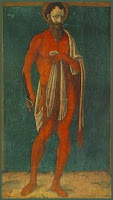 The name "Bartholomew" appears in the New Testament only on lists of the names of the twelve apostles. John gives no list of the Twelve, but refers to more of them individually than do any of the Synoptic writers. He doesn't name Bartholomew, but early in his account (John 1:43-50) he tells of the call to discipleship of one Nathaniel who is supposed to be the same person.
The reasoning is as follows: John's Nathanael is introduced as one of the earliest followers of Jesus, in terms suggesting that he became one of the Twelve. He is clearly not Peter, Andrew, James, John, Philip, Thomas, Judas Iscariot, or Judas (not Iscariot), all of whom John names separately.
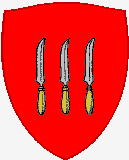 He isn't Matthew, whose call is described differently. This leaves Bartholomew, James the son of Alpheus, and Simon the Zealot. Of these, Bartholomew is the leading candidate for two reasons: (1) "Bar-tholomew" is a patronymic (a father-based name), meaning "son of Tolmai (or Talmai)." Thus, it's quite likely that he had another name. (2) Nathanael is introduced in John's narrative as a friend of Philip. Since Bartholomew is paired with Philip on three of our four lists of Apostles, it seems likely that they were associated.
We have no certain information about his later life. Some writers, including the historian Eusebius, say that he preached in India. The majority tradition, with varying details, is that Saint Bartholomew preached in Armenia, and was finally skinned alive and beheaded in Albanus or Albanopolis on the Caspian Sea, as shown above. His emblem in art is, therefore, a flaying knife or knives. Michelangelo also followed this tradition but imposed his own face on Bartholomew in his "Last Judgment" fresco, as shown in a previous commemoration.
Lection
Psalm 121
Proverbs 3:1-8
2 Corinthians 4:7-10
Luke 22:24-30 or John 1:43-51
Collect
Almighty God, Your Son, Jesus Christ, chose Bartholomew to be an apostle to preach the blessed Gospel. Grant that Your Church may love what he believed and preach what he taught; through Jesus Christ, our Lord, who lives and reigns with You and the Holy Spirit, one God, now and forever.
 The name "Bartholomew" appears in the New Testament only on lists of the names of the twelve apostles. John gives no list of the Twelve, but refers to more of them individually than do any of the Synoptic writers. He doesn't name Bartholomew, but early in his account (John 1:43-50) he tells of the call to discipleship of one Nathaniel who is supposed to be the same person.
The reasoning is as follows: John's Nathanael is introduced as one of the earliest followers of Jesus, in terms suggesting that he became one of the Twelve. He is clearly not Peter, Andrew, James, John, Philip, Thomas, Judas Iscariot, or Judas (not Iscariot), all of whom John names separately.
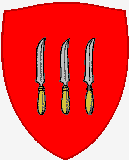 He isn't Matthew, whose call is described differently. This leaves Bartholomew, James the son of Alpheus, and Simon the Zealot. Of these, Bartholomew is the leading candidate for two reasons: (1) "Bar-tholomew" is a patronymic (a father-based name), meaning "son of Tolmai (or Talmai)." Thus, it's quite likely that he had another name. (2) Nathanael is introduced in John's narrative as a friend of Philip. Since Bartholomew is paired with Philip on three of our four lists of Apostles, it seems likely that they were associated.
We have no certain information about his later life. Some writers, including the historian Eusebius, say that he preached in India. The majority tradition, with varying details, is that Saint Bartholomew preached in Armenia, and was finally skinned alive and beheaded in Albanus or Albanopolis on the Caspian Sea, as shown above. His emblem in art is, therefore, a flaying knife or knives. Michelangelo also followed this tradition but imposed his own face on Bartholomew in his "Last Judgment" fresco, as shown in a previous commemoration.
Lection
Psalm 121
Proverbs 3:1-8
2 Corinthians 4:7-10
Luke 22:24-30 or John 1:43-51
Collect
Almighty God, Your Son, Jesus Christ, chose Bartholomew to be an apostle to preach the blessed Gospel. Grant that Your Church may love what he believed and preach what he taught; through Jesus Christ, our Lord, who lives and reigns with You and the Holy Spirit, one God, now and forever.
Labels: apostle, bartholomew, biography, disciple, feasts, festivals, gospels, hagiography, jesus, martyrdom, nathaniel, new testament
¶ 00:00 | 0 comments |
01 May 2016
+ Saints Philip and James, Apostles +
1 May, New Testament
People frequently confuse Philip the Apostle with Philip the Deacon, whose story is included in the Acts of the Apostles. See Acts 6:1-6; 8:5-40; and Acts 21:7-9 for accounts from his life. This Philip's commemoration is on 6 June. Philip the Apostle appears in the Synoptic Gospels and in Acts only as a name on the list of the Twelve, but he figures in several incidents in the Gospel according to John.
Philip was one of the first men Jesus called to be a disciple (John 1:43-44), and promptly brought his friend Nathanael to Jesus as well (v. 45). When some Greeks (or Greek-speaking Jews) wished to speak with Jesus, they began by approaching Philip, who took Andrew and went to Jesus. This led Jesus to His declaration, "I, when I am lifted up from the earth, will draw all people to myself." (12:20-33). At the Last Supper, he said to Jesus, "Lord, show us the Father, and it is enough for us." Jesus responded, "Whoever has seen me has seen the Father." (See the account in 14:1-14.)
Before feeding the Five Thousand (John 6:1-15), Jesus turned to Philip and asked Him, "Where are we to buy bread, so that these people may eat?" Philip answered, "Two hundred denarii would not buy enough bread for each of them to get a little."
Some scholars think it might be significant that Jesus asked Philip rather than one of the others. Luke 9:10 says that the Feeding of the Five Thousand took place near Bethsaida, and John 1:44 shows Philip coming from Bethsaida. If they were in Philip's home area, it would seem natural to ask him for directions. (As an aside, we note that Peter and Andrew also came from Bethsaida, but appear to have moved to Capernaum.)
James the son of Alphaeus (sometimes spelled "Alpheus") appears on lists of the Twelve Apostles, usually in the ninth place, but is never mentioned otherwise. He is called James the Less, or James Minor, or James the Younger. (See Matthew 10:3; Mark 3:18; Luke 6:15; Acts 1:13) Thus, we know nothing of him from the New Testament except that he was one of Jesus' original disciples and one of the Apostles. However, because of other Jameses being mentioned in the New Testament, we get the impression that he is everywhere. This isn't because of James the Less, but because he shared his name with several others — after all, it was one of the most common names among the Jews.
Why was James such a popular name in Israel? It was the given name of the original Israel: The English James is a variant of the name Jacob. While we may think of them as unrelated, the distinction grew after Bible times. In Hebrew, the name is Ya'akov. In Greek, it is Iakobos. In Latin, two forms developed, Jacobus and Jacomus. The former gives us the English Jacob and the Spanish Diego and Iago. The latter grew into the English James, the Scottish Hamish, the Spanish Jaime, and so on.
That ends what we hear of Saints Philip and James in the New Testament and we don't get much additional help from extrabiblical tradition. One story says that Philip preached in Phrygia and died in Hierapolis, and that his remains were brought to Rome and buried in the Basilica of the Twelve Apostles, where an ancient inscription indicates that this church was formerly dedicated to Philip and James.
Lection
Psalm 36:5-12
Isaiah 30:18-21
Ephesians 2:19-22
John 14:1-14
Collect
Almighty God, Your Son revealed Himself to Philip and James and gave them the knowledge of everlasting life. Grant us perfectly to know Your Son, Jesus Christ, to be the Way, the Truth, and the Life, and steadfastly to walk in the way that leads to eternal life; through the same Jesus Christ, our Lord, who lives and reigns with You and the Holy Spirit, one God, now and forever.
People frequently confuse Philip the Apostle with Philip the Deacon, whose story is included in the Acts of the Apostles. See Acts 6:1-6; 8:5-40; and Acts 21:7-9 for accounts from his life. This Philip's commemoration is on 6 June. Philip the Apostle appears in the Synoptic Gospels and in Acts only as a name on the list of the Twelve, but he figures in several incidents in the Gospel according to John.Philip was one of the first men Jesus called to be a disciple (John 1:43-44), and promptly brought his friend Nathanael to Jesus as well (v. 45). When some Greeks (or Greek-speaking Jews) wished to speak with Jesus, they began by approaching Philip, who took Andrew and went to Jesus. This led Jesus to His declaration, "I, when I am lifted up from the earth, will draw all people to myself." (12:20-33). At the Last Supper, he said to Jesus, "Lord, show us the Father, and it is enough for us." Jesus responded, "Whoever has seen me has seen the Father." (See the account in 14:1-14.)
Before feeding the Five Thousand (John 6:1-15), Jesus turned to Philip and asked Him, "Where are we to buy bread, so that these people may eat?" Philip answered, "Two hundred denarii would not buy enough bread for each of them to get a little."
Some scholars think it might be significant that Jesus asked Philip rather than one of the others. Luke 9:10 says that the Feeding of the Five Thousand took place near Bethsaida, and John 1:44 shows Philip coming from Bethsaida. If they were in Philip's home area, it would seem natural to ask him for directions. (As an aside, we note that Peter and Andrew also came from Bethsaida, but appear to have moved to Capernaum.)
James the son of Alphaeus (sometimes spelled "Alpheus") appears on lists of the Twelve Apostles, usually in the ninth place, but is never mentioned otherwise. He is called James the Less, or James Minor, or James the Younger. (See Matthew 10:3; Mark 3:18; Luke 6:15; Acts 1:13) Thus, we know nothing of him from the New Testament except that he was one of Jesus' original disciples and one of the Apostles. However, because of other Jameses being mentioned in the New Testament, we get the impression that he is everywhere. This isn't because of James the Less, but because he shared his name with several others — after all, it was one of the most common names among the Jews.
Why was James such a popular name in Israel? It was the given name of the original Israel: The English James is a variant of the name Jacob. While we may think of them as unrelated, the distinction grew after Bible times. In Hebrew, the name is Ya'akov. In Greek, it is Iakobos. In Latin, two forms developed, Jacobus and Jacomus. The former gives us the English Jacob and the Spanish Diego and Iago. The latter grew into the English James, the Scottish Hamish, the Spanish Jaime, and so on.
That ends what we hear of Saints Philip and James in the New Testament and we don't get much additional help from extrabiblical tradition. One story says that Philip preached in Phrygia and died in Hierapolis, and that his remains were brought to Rome and buried in the Basilica of the Twelve Apostles, where an ancient inscription indicates that this church was formerly dedicated to Philip and James.
Lection
Psalm 36:5-12
Isaiah 30:18-21
Ephesians 2:19-22
John 14:1-14
Collect
Almighty God, Your Son revealed Himself to Philip and James and gave them the knowledge of everlasting life. Grant us perfectly to know Your Son, Jesus Christ, to be the Way, the Truth, and the Life, and steadfastly to walk in the way that leads to eternal life; through the same Jesus Christ, our Lord, who lives and reigns with You and the Holy Spirit, one God, now and forever.
Labels: apostle, disciple, feasts, festivals, gospels, james, nathaniel, new testament, philip, saint james, saint philip
¶ 00:00 | 0 comments |
24 August 2015
+ Bartholomew, Apostle +
24 August, New Testament
The name "Bartholomew" appears in the New Testament only on lists of the names of the twelve apostles. John gives no list of the Twelve, but refers to more of them individually than do any of the Synoptic writers. He doesn't name Bartholomew, but early in his account (John 1:43-50) he tells of the call to discipleship of one Nathaniel who is supposed to be the same person.
The reasoning is as follows: John's Nathanael is introduced as one of the earliest followers of Jesus, in terms suggesting that he became one of the Twelve. He is clearly not Peter, Andrew, James, John, Philip, Thomas, Judas Iscariot, or Judas (not Iscariot), all of whom John names separately.
 He isn't Matthew, whose call is described differently. This leaves Bartholomew, James the son of Alpheus, and Simon the Zealot. Of these, Bartholomew is the leading candidate for two reasons: (1) "Bar-tholomew" is a patronymic (a father-based name), meaning "son of Tolmai (or Talmai)." Thus, it's quite likely that he had another name. (2) Nathanael is introduced in John's narrative as a friend of Philip. Since Bartholomew is paired with Philip on three of our four lists of Apostles, it seems likely that they were associated.
We have no certain information about his later life. Some writers, including the historian Eusebius, say that he preached in India. The majority tradition, with varying details, is that Saint Bartholomew preached in Armenia, and was finally skinned alive and beheaded in Albanus or Albanopolis on the Caspian Sea, as shown above. His emblem in art is, therefore, a flaying knife or knives. Michelangelo also followed this tradition but imposed his own face on Bartholomew in his "Last Judgment" fresco, as shown in a previous commemoration.
Lection
Psalm 121
Proverbs 3:1-8
2 Corinthians 4:7-10
Luke 22:24-30 or John 1:43-51
Collect
Almighty God, Your Son, Jesus Christ, chose Bartholomew to be an apostle to preach the blessed Gospel. Grant that Your Church may love what he believed and preach what he taught; through Jesus Christ, our Lord, who lives and reigns with You and the Holy Spirit, one God, now and forever.
The name "Bartholomew" appears in the New Testament only on lists of the names of the twelve apostles. John gives no list of the Twelve, but refers to more of them individually than do any of the Synoptic writers. He doesn't name Bartholomew, but early in his account (John 1:43-50) he tells of the call to discipleship of one Nathaniel who is supposed to be the same person.The reasoning is as follows: John's Nathanael is introduced as one of the earliest followers of Jesus, in terms suggesting that he became one of the Twelve. He is clearly not Peter, Andrew, James, John, Philip, Thomas, Judas Iscariot, or Judas (not Iscariot), all of whom John names separately.
He isn't Matthew, whose call is described differently. This leaves Bartholomew, James the son of Alpheus, and Simon the Zealot. Of these, Bartholomew is the leading candidate for two reasons: (1) "Bar-tholomew" is a patronymic (a father-based name), meaning "son of Tolmai (or Talmai)." Thus, it's quite likely that he had another name. (2) Nathanael is introduced in John's narrative as a friend of Philip. Since Bartholomew is paired with Philip on three of our four lists of Apostles, it seems likely that they were associated.We have no certain information about his later life. Some writers, including the historian Eusebius, say that he preached in India. The majority tradition, with varying details, is that Saint Bartholomew preached in Armenia, and was finally skinned alive and beheaded in Albanus or Albanopolis on the Caspian Sea, as shown above. His emblem in art is, therefore, a flaying knife or knives. Michelangelo also followed this tradition but imposed his own face on Bartholomew in his "Last Judgment" fresco, as shown in a previous commemoration.
Lection
Psalm 121
Proverbs 3:1-8
2 Corinthians 4:7-10
Luke 22:24-30 or John 1:43-51
Collect
Almighty God, Your Son, Jesus Christ, chose Bartholomew to be an apostle to preach the blessed Gospel. Grant that Your Church may love what he believed and preach what he taught; through Jesus Christ, our Lord, who lives and reigns with You and the Holy Spirit, one God, now and forever.
Labels: apostle, bartholomew, biography, disciple, feasts, festivals, gospels, hagiography, jesus, martyrdom, nathaniel, new testament
¶ 00:00 | 0 comments |


